Anna Barnacka
Leszek Bogacz
Mira Grudzińska
Mateusz Janiak
Nukri Komin
Giovanni Lamanna
Rafal Moderski
MONTE CARLO SIMULATIONS
FOR THE CHERENKOV TELESCOPE
ARRAY OBSERVATORY USING PL-GRID
E-INFRASTRUCTURE
Abstract The paper presents Monte Carlo simulations carried out during the preparatory phase of the Cherenkov Telescope Array project. The aim of the project is to build the next generation observatory of very high energy gamma rays. During the preparatory phase there is a need to optimize and verify design concepts for various elements of the array. In this paper we describe the main components of the software being used for that purpose, their functions and requirements. Preliminary results of the optimization of the small telescope – one of the several kinds intended for the array, are presented.
Keywords very high energy astrophysics, Monte Carlo simulations, extensive air showers, telescope design, the Cherenkov Telescope Array
1. Introduction
Measuring cosmic radiation at very high energies (VHE), above 100 GeV, requires more than a simple telescope with a CCD camera. The latest generation of gamma-ray instruments like H.E.S.S. [1], MAGIC [2] and VERITAS [3] consists of multiple telescopes with analogue cameras based on photomultipliers. This is the only way to observe Cherenkov light from extensive air showers that are produced when a high energy particle enters the Earth’s atmosphere. Those experiments have delivered spec-tacular astrophysical results. Now, based on the experience of current instruments the community of more than 100 institutes from 25 countries is going to build a new generation ground-based gamma-ray observatory – the Cherenkov Telescope Array (CTA)[4]. The array will consist of tens of telescopes and will have an order of ma-gnitude better sensitivity as compared to currently operated instruments.
Because of the complexity of the project a proper preparatory phase is required before the actual construction of the facility. The CTA will operate at least three kinds of telescopes, each one equipped with a high sensitivity analogue or digital cameras based on standard or semiconductor photomultipliers. Cameras will detect even single Cherenkov photon, then the trigger system will determine if the event observed is scientifically interesting or not.
The overall performance of the system depends on many parameters such as the configuration of the telescopes, size of a single telescope (aperture, focal length, field of view), the parameters of the cameras (the size of a single pixel, the amount of pixels, the sampling) and many more. To determine the best configuration at optimal cost billions of numerical simulations are required. This means hundreds of TB of storage and many years of single CPU time. During the operational phase CTA will produce at least 3 PB of data per year. All these data will need to be analyzed, archived and shared with the community. Additional massive Monte Carlo simulations will be required to provide calibration for the scientific data. The high data rate of CTA together with the large computing power requirements for the Monte Carlo simulations demand dedicated computer resources which can be well handled through the grid approach. The EGI grid (www.egi.eu) [5] infrastructure and middleware for distributed computing, data storage and access are considered the most efficient solution for the CTA e-infrastructure.
In our previous paper [6] we have described the details of the numerical simula-tions performed during the, so called, Prod-1 phase. Here, in Sec. 2 we briefly remain the procedure of generation and the analysis of the Monte Carlo data. In Sec. 3 we present new results of the performace studies of the array of small size telescopes. We devote Sec. 4 to our conclusions and prospects for future research.
2. Monte Carlo simulations and analysis
be estimated both for a single telescope: mechanical details, such as construction geometry, mirror layout, and also camera details, electronics, etc. and for the whole array – telescopes layout and spacing. To study the performance of the array massive Monte Carlo simulations are performed. These simulations consist of several steps. First, the development of the extensive air showers (EASs) caused by high energy particles is calculated and the resulting information about Cherenkov photons capable of reaching the detector is stored in output files. In the second step the detector response to the Cherenkov photons is simulated, while in the final step the analysis of the obtained data is performed.
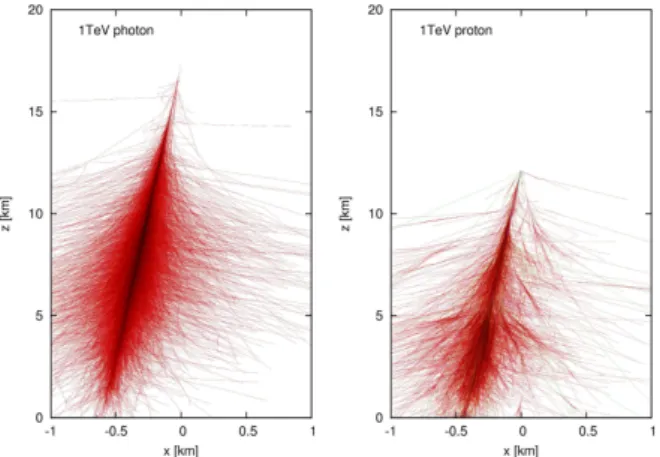
The extensive air showers are simulated with CORSIKA (COsmic Ray SImula-tions for Kascade) [7, 8] – a numerical code which uses Monte Carlo technique to calculate the interactions between the particles involved in the development of the shower. Two examples of simulated showers are presented in Fig. 1. An additional package takes care of the emission of the Cherenkov light – a faint, blueish light from relativistic particles traveling through the Earth’s atmosphere.
Figure 1. Two examples of simulated extended air showers developed in the Earth’s atmo-sphere. Each line represents the path of an elementary particle created during the shower evolution. The left panel presents the shower generated by a single photon of energy 1 TeV, while the right panel shows the shower originating from a single proton of the same energy
CORSIKA CPU and memory requirements depend, to a great extent, on the type of primary particle and, of course, on the desired number of showers to be simulated. While the low energy (∼100 GeV) gamma photon simulations with several hundred
The nature of Monte Carlo simulations requires at least a few thousands of events for each energy and each particle type in order to properly describe reality in a statistical sense.
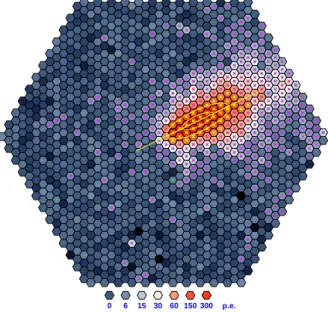
The second performance estimation step is based on sim telarray software which simulates all the telescope hardware response to Cherenkov photons [10]. The aim of this step is to get a final, raw output similar to the final output of a fully operational array. Sim telarrayprovides a list of events detected by the camera of the telescopes. A graphical example of such an output is shown in Fig. 2.
0 6 15 30 60 150 300 p.e.
Figure 2.Example output fromsim telarrayshowing telescope camera triggered by a single incident gamma ray. All pixels show some signal due to the night sky background and
electronic noise
After computing the telescope response to the air showers it is then necessary, in the final step, to translate the hardware response to measurable values. The analysis of thesim telarrayoutput is done using theread hesssoftware which attempts to reconstruct events seen by the telescope by applying various image analysis methods, image cleaning etc. The procedure must be repeated many times since usually we do not know in advance which parameters should be used for the analysis.
To sum up, the Monte Carlo simulations performed during optimization of the CTA array are a very complicated task and demand large resources, both CPU time and storage. The analysis usually requires more than 106
of MBs, but it must be produced for everysim telarrayjob and thus is comparably CPU consuming. Since none of the software uses parallel computing the whole analysis procedure is also input/output intensive. The InfiniBand network connection thus becomes highly desirable. Such resources are difficult to collect in a single computer cluster and the grid approach seems to be more appropriate in the case of CTA simulations. To provide the necessary infrastructure the virtual organization (VO) vo.cta.in2p3.frwas created within the EGI grid. PL-Grid with its ZEUS computer cluster located in ACK CYFRONET is one of the largest computer centres supporting the virtual organization of the CTA.
3. Results
The first part (Prod-1 phase) of the massive Monte Carlo simulations for the CTA project started in 2008 using the resources available for vo.cta.in2p3.fr. During these simulations PL-Grid was the second largest resource provider for the VO with more than 100 TB of storage and over 2000 CPU cores. The main goal of the Prod-1 production was to simulate showers initiated by cosmic rays. These are mainly charged particles (∼99.9%), like protons (∼89%),α-particles (∼10%), ionized nuclei
of heavy elements (∼1%), electron/positrons (∼1%) and a small fraction of γ-rays.
It was necessary to simulate a huge number of showers (e.g. ∼1010 protons) before
estimating the remaining background and drawing conclusions about the performance of a particular configuration.
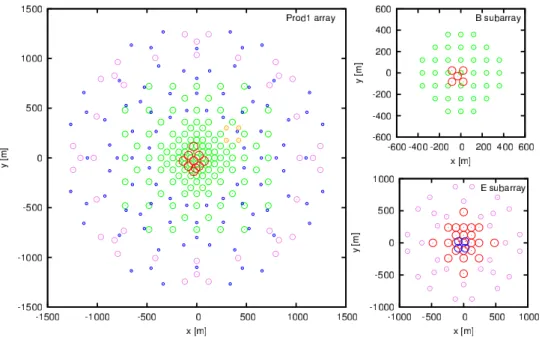
The CTA array will consist of at least three kinds of telescopes: large size (LST), medium size (MST), and small size telescopes (SST). During the Prod-1 phase the generic configuration of 275 telescopes of 5 different types has been considered (see Fig. 3). A candidate configuration being a subset of this (typically about 80 telescopes of total estimated cost of approximately 80 million EUR), marked by letters A-K were later chosen for detailed analysis.
The result of the CORSIKA simulation, which is the information on the showers which are theoretically detectable by at least one telescope was stored. Until now (June 2011) 7.9 ×10³ runs with 7.9×10⁸ showers were done. From this amount
2.3×10⁷ were triggered by at least one telescope. The amount of data currently
available for further analysis exceeds 100 TB.
In addition to the Prod-1 simulations we have performed dedicated massive si-mulations to study various trigger strategies and the performance of arrays consisting of just SSTs. We have used 40 different SSTs to form two kind of arrays: E3 which is similar to CTA-E from Prod-1 phase, but with no medium and large telescopes and four additional telescopes in the middle of the array to fill the gap, and regular arrays with telescopes distributed on a regular grid. The array layout can be seen in Fig. 4.
Figure 3. The generic configuration of 275 telescopes for Prod-1 phase and two example candidate configurations B and E. Taken from [9]
Figure 4. Two array layouts used to study the influence of a single telescope configuration on overall array performance. Each point represents a single small size telescope
30 energies were simulated (from 50 GeV to 100 TeV). All the data was analyzed using theread hess code to obtain the final results.
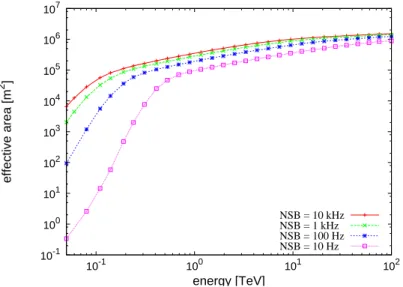
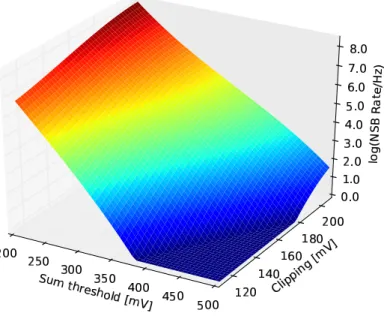
In order to analyze trigger strategies we calculated telescope effective areas and trigger efficiencies. Also, the night-sky background level was measured which is a cru-cial parameter for Cherenkov telescopes. The results are presented in Fig. 5 and Fig. 6.
10-1 100 101 102 103 104 105 106 107
10-1 100 101 102
effective area [m
2 ]
energy [TeV]
NSB = 10 kHz NSB = 1 kHz NSB = 100 Hz NSB = 10 Hz
Figure 5.Effective area of the single SST as a function of energy for different incidental NSB levels
For a given night-sky background rate, we have calculated also a total data rate that the camera electronics has to manage in real operation. This is important infor-mation for designing electronics and read-out systems as well as the data acquisition system.
Figure 6. Surface plot of the NSB rate for different trigger parameters: sum threshold and clipping
The computational resources needed to perform the above-mentioned simulations were supplied by the PL-Grid project – mainly the ZEUS cluster at ACK CYFRONET in Cracow and a site CAMK located at the Nicolaus Copernicus Astronomical Center in Warsaw. The jobs were submitted through PBS queue system. The total estimated CPU time we used to simulate two arrays is estimated to be about one million hours (for CORSIKA,sim telarrayandread hess) and about 5% of that value for single telescopes. The number of submitted jobs was about 4000, and the longest ones took more than 1000 hours of CPU time. The total amount of data is currently about 11 TB of which roughly 60 % is taken by larger regular array data.
4. Conclusion and future work
budget. This would require realistic estimations of the price of individual components and solutions. We will investigate that subject during further study. Last, we will search for the optimal layout of the array depending on the number of telescopes, their configuration, type, and overall performance.
References
[1] Vasileiadis, G.:The H.E.S.S experimental project. [in:] Proceedings of the Fifth International Workshop on Ring Imaging Detectors, Nucl. Instr. and Methods in Phys. Research A,553(2005) 268–273
[2] Ferenc, D. and MAGIC Collaboration: The MAGIC gamma-ray observatory. Nucl. Instr. and Methods in Phys. Research A,553(2005) 274–281
[3] LeBohec, S.et al. Deployment of the VERITAS observatory. J. Phys.: Conf. Ser.
47(2006) 232–237
[4] Glicenstein, J.-F. for the CTA Consortium: The Cherenkov telescope array, an advanced facility for ground based gamma-ray astronomy. [in:] Proceedings of the Seventh International Workshop on Ring Imaging Cherenkov Detectors, Nucl. Instr. and Methods in Phys. Research A,639(2011) 46–49
[5] Ghiselli, A., and Mazzucato, M.:Grid: From EGEE to EGI and from INFN-GRID to IGI. Il Nuovo Cimento C32(2009) 233–241
[6] Barnacka, A. et al.: PL-Grid e-Infrastructure for the Cherenkov Telescope Ar-ray Observatory. [in:] Bubak, M., Szepieniec, T., and Wiatr, K., eds,Building a National Distributed e-Infrastructure – PL-Grid, Lecture Notes [in:] Computer Science vol. 7136, Springer 2012
[7] Capdevielee, J. N. et al.: Extensive air shower simulations with the CORSIKA program. [in:] L. Jones, ed., Very High Energy Cosmic-Ray Interactions, AIP Conference Series,276(1993) 545–553
[8] Heck, D., & The KASCADE Collaboration:Hadronic Interaction Models and the Air Shower Simulation Program CORSIKA. [in:] Proceedings of the 27th Inter-national Cosmic Ray Conference, InterInter-national Cosmic Ray Conference,1(2001)
233
[9] Actis, M.et al.:Design Concepts for the Cherenkov Telescope Array: an advanced facility for ground-based high-energy gamma-ray astronomy. Experimantal Astro-nomy,32(2010) 193–316
Affiliations
Anna Barnacka
Nicolaus Copernicus Astronomical Center, Warsaw, Poland and DSM/IRFU/SPP, CEA/Saclay, Gif-sur-Yvette, France
Leszek Bogacz
Department of Information Technologies, Faculty of Physics,Astronomy and Applied Computer Science, Jagellonian University, Krakow, Poland
Mira Grudzińska
Astronomical Observatory, Warsaw University, Warsaw, Poland
Mateusz Janiak
Nicolaus Copernicus Astronomical Center, Warsaw, Poland
Nukri Komin
LAPP, Universitas de Savoie et IN2P3/CNRS, Annecy, France
Giovanni Lamanna
LAPP, Universitas de Savoie et IN2P3/CNRS, Annecy, France
Rafal Moderski
Nicolaus Copernicus Astronomical Center, Warsaw, Poland