The antecedents of post-initial adoption behavior
in a S-D logic context:
Leveraging the power of the viral metaphor to advance service innovation adoption
Assignment Master Thesis
Faculty Maastricht University, School of Business and Economics
Graduate Program Double Degree Nova SBE and Maastricht SBE
Degrees M.Sc. IB Strategy & Innovation and M.Sc. Management
Student Name Anna-Sophie Oertzen
Student ID I6034225
Supervisor Prof. Dr. Gaby Odekerken-Schröder
2nd Assessor Robert Ciuchita
2nd Co-advisor Prof. Dr. Luís Filipe Lages
Acknowledgements
First and foremost, I would like to express my sincere gratitude to Prof. Dr. Gaby Odekerken-Schröder for being a path-breaking influence not only in my contemporary life, but also in the direction my living is evolving to. Her guidance, the many enlightening meetings and her joyful way to inspire have decisively imprinted on my desire to broaden my current knowledge in the service domain and continue by doing a Ph.D.
Furthermore, I would like to thank the Ph.D. candidate Teerawut Techachaicherdchoo for his unwavering patience while introducing me to AMOS to conduct Structural Equation Modeling. He truly went above and beyond by providing me with the software as such and even permitting me to use his hardware.
Finally, I am grateful to Mr. Andreas Sommer, Mr. Andreas Hanowski and Mrs. Ellen-Denise Anwander of the Sparkasse Harburg-Buxtehude for granting me the opportunity to send out my online survey to their customers and for taking precious time to answer all my enquiries.
Abstract
Repercussions of innovation adoption and diffusion studies have long been imperative to the success of novel introductions. However, perceptions and deductions of current innovation understandings have been changing over time. The paradigm shift from the goods-dominant (G-D) logic to the service-dominant (S-D) logic potentially makes the distinction between product (goods) innovation and service innovation redundant as the S-D logic lens views all innovations as service innovations (Vargo and Lusch, 2004; 2008; Lusch and Nambisan, 2015). From this perspective, product innovations are in essence service innovations, as goods serve as mere distribution mechanisms to deliver service. Nonetheless, the transition to such a broadened and transcending view of service innovation necessitates concurrently a change in the underlying models used to investigate innovation and its subsequent adoption. The present research addresses this gap by engendering a novel model for the most crucial period of service diffusion within the S-D logic context – the post-initial adoption phase, which demarcates an individual’s behavior after the initial adoption decision of a service. As a well-founded understanding of service diffusion and the complementary innovation adoption still lingers in its infancy, the current study develops a model based on interdisciplinary domains mapping. Here fore, knowledge of the relatively established viral source domain is mapped to the comparatively undetermined target domain of service innovation adoption.
To assess the model and test the importance of the explanatory variables, survey data from 750 respondents of a bank in Northern Germany is scrutinized by means of Structural Equation Modeling (SEM). The findings reveal that the continuance intention of a customer, actual usage of the service and the customer influencer value all constitute important post-initial adoption behavior that have meaningful implications for a successful service adoption. Second, the four constructs customer influencer value, organizational commitment, perceived
customer’s post-initial adoption behavior. Third, this study indicates that post-initial adoption behavior further underlies the influence of a user’s age and besides that is also provoked by the internal and external environments of service adoption.
Finally, this research amalgamates the broad view of service innovation by Nambisan and Lusch (2015) with the findings ensuing this enquiry’s model to arrive at a framework that it both, generalizable and practically applicable. Implications for academia and practitioners are captured along with avenues for future research.
Keywords: S-D logic, service innovation adoption, service diffusion, WOM, commitment, customization, TAM model, continuance intention, viral metaphor, disciplined imagination, interdisciplinary domains mapping
Table of content
1. INTRODUCTION ... 1
1.1BUSINESS ECONOMIC MOTIVATION ... 2
1.2ACADEMIC MOTIVATION ... 3
1.3PROBLEM STATEMENT, RESEARCH QUESTION AND SUB-QUESTIONS ... 4
1.4CONTRIBUTION ... 5
1.5STRUCTURE ... 6
2. LITERATURE REVIEW ... 7
2.1THE EVOLUTION TO A SERVICE-DOMINANT (S-D) LOGIC ... 7
2.2SERVICE INNOVATION ... 9
2.3INNOVATION DIFFUSION THEORY ... 11
2.3.1 Traditional product innovation diffusion models ... 12
2.3.2 Shortcomings of traditional product innovation diffusion models ... 14
2.3.2.1 Reciprocal relationship of prolonged service exchange ... 14
2.3.2.2 Customer attrition ... 15
3. METAPHOR BUILDING AND HYPOTHESES DEVELOPMENT ... 18
3.1THE IMPORTANCE OF METAPHORS IN ORGANIZATIONS ... 18
3.2METAPHOR CHOICE –THE DEVELOPMENT OF A GENERIC STRUCTURE (STEP 1) ... 20
3.3MODEL BUILDING –THE DEVELOPMENT AND ELABORATION OF THE BLEND (STEP 2) ... 21
3.3.1 Immune response and attitude toward using ... 24
3.3.2 Susceptibility to infection and level of episodic influence ... 25
3.3.3 Incubation and organizational commitment ... 26
3.3.4 Replication and perceived usefulness ... 27
3.3.5 Mutation and service customization ... 28
3.3.6 Recovery and customer attrition ... 29
3.3.7 Chronic infection and actual usage ... 30
3.3.8 Transmissibility of infection and customer influencer value ... 31
3.3.9 Direct effects ... 33
3.3.10 Sub-questions in form of moderating variables ... 34
3.3.10.1 Sub-question 1 – The external environment ... 34
3.3.10.2 Sub-question 2 – The internal environment ... 36
3.4CONCEPTUAL MODEL –THE EMERGENT MEANING STRUCTURE (STEP 3) ... 38
4. METHOD ... 39
4.3PROCEDURE ... 42
4.4MEASURE DEVELOPMENT ... 42
4.5ANALYTICAL STRATEGY ... 45
5. EMPIRICAL ANALYSIS AND RESULTS ... 47
5.1PREPARATION OF THE DATA FILE ... 47
5.2DESCRIPTIVE STATISTICS ... 47
5.3MEASUREMENT MODEL EVALUATION ... 49
5.4OVERALL MODEL EVALUATION ... 51
5.5STRUCTURAL MODEL EVALUATION ... 53
5.5.1 Additional findings and control variables ... 56
5.5.2 Moderating influences ... 58
5.6A RIVAL MODEL ... 59
6. DISCUSSION AND IMPLICATIONS ... 61
6.1THE ANTECEDENTS OF POST-INITIAL ADOPTION BEHAVIOR IN A S-D LOGIC CONTEXT ... 61
6.1.1 Mediated effects on the post-initial adoption behavior ... 62
6.1.2 Direct effects on the post-initial adoption behavior ... 66
6.1.3 Moderating effects of the internal and external environments ... 68
6.2TOWARD AN APPLIED VIEW OF SERVICE INNOVATION ... 71
6.3THEORETICAL IMPLICATIONS ... 74
6.4PRACTICAL IMPLICATIONS ... 76
6.5LIMITATIONS AND DIRECTIONS FOR FUTURE RESEARCH ... 78
7. CONCLUSION ... 80
8. REFERENCES ... 81
9. APPENDIX ... 92
APPENDIX A–THE MULTIPLICATION CYCLE OF A VIRUS ... 92
APPENDIX B–COMPLETE SET OF HYPOTHESES ... 93
APPENDIX C–ORIGINAL SOURCES OF THE QUESTIONNAIRE CONSTRUCTS ... 94
APPENDIX D–QUESTIONNAIRE –ENGLISH VERSION ... 95
APPENDIX E–QUESTIONNAIRE REMINDER MAIL –ENGLISH VERSION ... 103
APPENDIX F–QUESTIONNAIRE –GERMAN VERSION ... 104
APPENDIX G–QUESTIONNAIRE REMINDER MAIL –GERMAN VERSION ... 114
APPENDIX H –SEM OUTPUT INCLUDING THE UNSTANDARDIZED ESTIMATES ... 115
List of figures
Figure 1: A broadened view of service innovation (Lusch and Nambisan, 2015, p. 162) ... 10
Figure 2a: Bass model: S-shaped cumulative adoption curve (Mahajan et al., 1990, p. 4) ... 12
Figure 2b: Non-cumulative adoptions due to external and internal influences (…) ... 12
Figure 3 : Rogers model: Adopter categorization on the basis of innovativeness (…) ... 13
Figure 4a: Bell-shaped infectivity curve of influenza within an infectious individual (…) .... 21
Figure 4b: The one-step growth curve showing the principal stages during virus replic. (…) 21 Figure 5 : Technology Acceptance Model (TAM), (Davis, 1986, p. 24) ... 25
List of models
Model 1: Dynamics of viral progression within host individuals (…) ... 22Model 2: First part of the model showing the indirect links through mediation ... 38
Model 3: Second part of the model showing the direct links without visible mediation ... 38
Model 4: First part of the modelshowing the resultsof theindirecteffects through mediation ... 55
Model 5: Second part of the model showing the results of the direct effects without (…) .... 56
List of tables
Table 1: Definitions and synergies of the variables ... 23Table 2: Demographics of respondents (n=750) ... 41
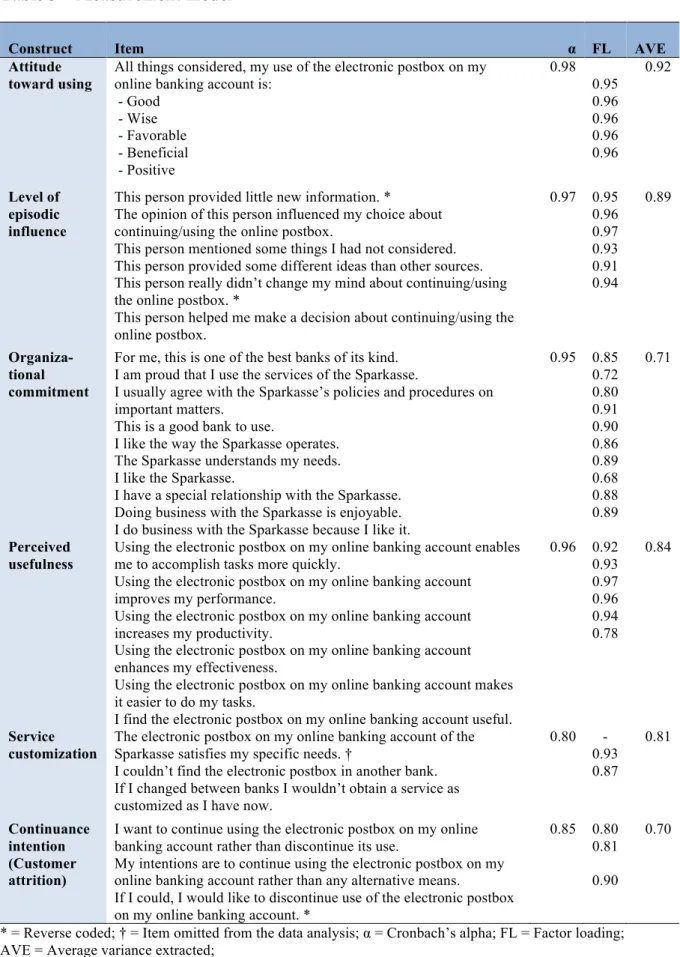
Table 3: Measurement model ... 43
Table 4: Means, standard deviations and correlations ... 48
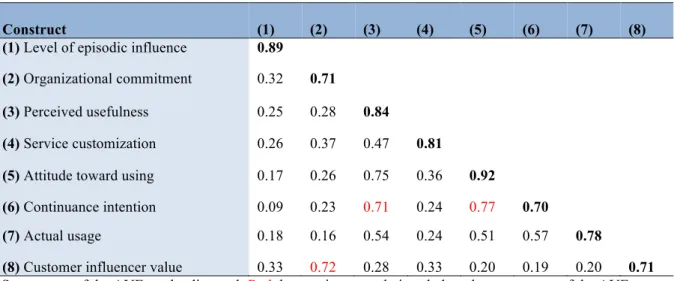
Table 5: Intercorrelations of the latent variables ... 50
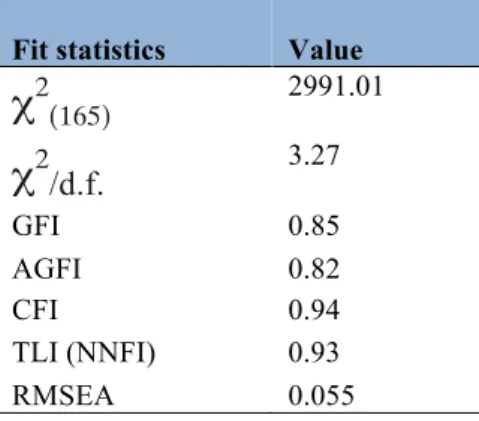
Table 6: Overall model fit ... 52
Table 7: Structural model ... 53
Table 8: Additional findings and control variables ... 56
Table 9: Age multi-group analysis ... 57
Table 10: Significant set of moderating influences ... 59
Table 11: Analysis of competing structural models ... 60
1. Introduction
For decades, service exchange has been the hub of economic activity within most societies. In developed countries, the service sector accounts for the majority of the Gross Domestic Product (GDP) per capita with an overwhelming share of 78% in the USA and 74% in the EU (The World Bank, 2015). Management literature almost universally agrees that offering service is not an optional verdict, but a necessity to stay competitive and profitable (Anderson et al., 1997; Kohtamäki et al., 2013; Oliva and Kallenberg, 2003; Wise and Baumgartner, 1999). As a consequence, the focus transfers from a goods-dominant (G-D) perspective of tangible resources, transactions and embedded value, to a service-dominant (S-D) logic that incorporates intangible resources, relationships and the cocreation of value (Vargo and Lusch, 2004). Herein, service is the common denominator to all exchanges and goods are considered as distribution mechanisms to provide service.
Concurrently with the shift to the transmittable nature of goods, the process of innovation has undergone radical alterations over the past decade. Lusch and Nambisan (2015) describe these changes along three lines. First, a network-centric focus denotes that innovations emerge from the joint action of a network, opposing the traditional confinement within the borders of organizations. Second, an information-centric focus results in many innovations not centered on goods but on intangible offerings with high information content. Finally, a value- and/or experience-centric focus deliberates rather the cocreated value or experience gained by using the innovation than its physiognomies. These three foci have transformed the innovation landscape and have led to the new definition of service innovation as
“the rebundling of diverse resources that create novel resources that are beneficial (i.e. value experiencing) to some actors in a given context; this almost always involves a network of actors, including the beneficiary” (Lusch and Nambisan, 2015, p. 161),
According to the S-D logic, resources are classified into two categories (Vargo and Lusch, 2004). Operand resources usually have a facilitating and enabling function and are thus mostly tangible and static. On the other hand, operant resources (embedded knowledge and skills), act on other resources and are often intangible and dynamic.
Despite these progressions, adequate service innovation diffusion models have been deficiently advanced. While the initial adoption decision is defined as the erstwhile exchange of a service innovation, the pre- and post-initial adoption behavior denote the comportment before and after a customer consumes a particular service for the first time. Considering the multiple exchanges implied by the relational aspect of the S-D logic, especially the post-initial adoption behavior has been regrettably neglected. Consequently, this research seeks to expand service innovation by developing a functional model that captures the broad conceptualization of service innovation adoption.
1.1 Business economic motivation
As Barczak (2012) explicates, especially in today’s times of prolonged economic volatility, service innovation is a key avenue to aid firms improve their innovation proficiencies and subsequent market success. There are three core economic drivers explaining the interest in innovatively enlarging firms’ service portfolios in the B2B and B2C context (Oliva and Kallenberg, 2003). First, service experiences higher margins than product offerings and is therefore more attractive from an economic perspective (Anderson et al., 1997; VDMA, 1998). Second, in the age of increasing customization, customers mandate service tailored to their individual needs of process support and lifecycle management (Gao et al., 2011). Finally, with increasing commoditization of goods, service-lead growth promises to enhance differentiation (Sawhney et al. 2004). Due to the invisible and inimitable nature of service, it is difficult to duplicate for competitors and can thus lead to a competitive advantage (Gebauer
et al., 2006). Nonetheless, in reality the service growth as a percentage of GDP has been stagnating over recent years for most advanced economies. In the Unites States, the share grew from 76% to only 78% from 2000 until 2014, while in the Euro area only a 4% increase could be accounted for from 70% to 74% (The World Bank, 2015). Oliva and Kallenberg (2003) offer a possible explanation by outlining that even though organizations recognize the potential of service offerings, they struggle in deploying a successful service strategy. This could potentially be the result of the insufficient apprehension of the post-initial adoption behavior that drive a user’s continuance intention, usage rate and word-of-mouth activities.
1.2 Academic motivation One of the key challenges of effective service strategy implementation is the diffusion and adoption of service innovation. Even though the managerial importance toward successful service innovation diffusion appears evident, the overwhelming stream of diffusion modeling literature has adhered to the G-D logic and its traditional diffusion models for durable goods such as the Bass model (Bass, 1969). This creates a clear gap in academia with most authors simply assuming that the S-shaped cumulative adoption curve of innovation diffusion is equivalent within the G-D and S-D logic (Jain et al., 1991; Krishnan et al., 2000; Lilien et al., 2000; Hogan et al., 2003). To the best knowledge of the author, there have only been two publications so far insinuating an essentially different approach for service (Libai et al., 2009; Shi et al., 2014), in which Libai et al. (2009) evidently prove the misfit of using product models for service innovation diffusion for several studies. Conclusively, this research is motivated by realizing that, when viewed through S-D logic lens, important aspects are missing within current service innovation diffusion models, particularly within the principal post-initial adoption phase of service innovation.
1.3 Problem statement, research question and sub-questions
This inquiry is encouraged manifold by a business economic motivation of developing a successful service strategy for the adoption of service innovation, and an academic motivation of narrowing the gap in the service diffusion and service innovation adoption literature. In response to the problem statement, this research seeks new insights into service innovation adoption by inductively leveraging the power of metaphors. The resulting model then deductively tests the innovation adoption behavior of a digital B2C service.
Metaphors have traditionally been a vital part of theory building in organizations by clarifying and advancing the understanding of theoretical conceptions (Cornelissen and Kafouros, 2008). This research introduces the viral metaphor to ameliorate the current perceptions about service innovation adoption. Here fore, a virus is chosen as the epidemiology of directly transmitted infectious diseases and networks, such as the diffusion network within which a service innovation manifests, are fundamentally connected (Keeling and Eames, 2005). Ultimately, the hitherto described problem statement leads to the following research question:
How do the lifecycle characteristics of a virus, translated as the determinants of perceived service value, affect the consumer attitude and thus post-initial adoption behavior of service
innovation?
Two sub-questions in form of moderating factors are supplementing the research question. 1.) How does the external environment of service innovation diffusion, signified by existing competition and tie strength, influence the service adoption?
2.) How does the internal environment of service innovation diffusion, denoted by the need for interaction with a service employee and the attitude toward using technology, influence the service adoption?
1.4 Contribution
First, this research contributes to academia by adding to the literature stream of service innovation diffusion with an approach including attrition and the relational exchange of service as proposed by the S-D logic (Vargo and Lusch, 2004). Herewith, it answers the call of Peres et al. (2010) to lessen the gap between product diffusion theories applied for service. Second, this study operationalizes the broad conceptualization of service innovation by Lusch and Nambisan (2015) and breathes life into their tripartite framework of service ecosystems, service platforms and value cocreation. Hereby, it corresponds to the service research priorities of Ostrom et al. (2015), who stimulate more research in the field of service innovation and value creation. Additionally, it follows the highlighted research horizon for service innovation of Barrett et al. (2015) by further applying the S-D logic framework to service innovation. Third, this enquiry expands current technology acceptance studies by merging social innovation diffusion with the technology acceptance model (TAM) of Davis (1993), to explicitly treat post-initial adoption behavior of service innovation. Once again, this complements the research priorities of Ostrom et al. (2015) by investigating adoption and usage of technology to advance service. Fourth, the importance of customer relationship management (CRM) in an increasingly networked society is considered by including consumers’ commitment and word-of-mouth (WOM) activities from a dual perspective as connoted by Harrison-Walker (2001). This also adheres to Ostrom et al. (2015) by furthering the research priorities on value creation as it highlights the customer as a resource integrator, who is influenced by multi-actor networks. Fifth, this study extends the efforts of Bhattacherjee (2001) by scrutinizing the key drivers of users’ continuance intention. Finally, this research is valuable through its interdisciplinary approach of mapping knowledge from the viral source domain to the target domain of innovation adoption, collaboratively effecting the broadening of current service innovation horizons and advancing the S-D logic paradigm.
Additionally, this study results in important managerial contributions. First, in line with the customer retention – acquisition dialogue, it underlines the prominence of post-initial adoption behavior for service innovation. Second, this research adds to a better understanding of post-initial adoption behavior by analyzing the respective antecedents, which proves vital for marketing tactics and future planning. Finally, the scrutiny into the continuance intention of current customers provides salient information for organizations, as it remains pivotal to comprehend which factors influence attrition before users discontinue a service.
1.5 Structure
This research commences by reviewing existing literature in the field of service theory, innovation and diffusion studies. The second chapter elucidates the importance of metaphors and inductively generates new knowledge through a three-steps-approach that merges the source domain of viral biology with the target domain of service innovation adoption. Successively, Dewey’s (1910) double movement of reflective thought is leveraged by deductively testing the novel theory with a detailed questionnaire send-out to customers of a German bank. The remainder of the study considers the methodological approach, evaluates the findings and deliberates the implications, limitations and avenues for future research.
2. Literature review
2.1 The evolution to a service-dominant (S-D) logic
Eichengreen and Gupta (2013) substantiate in a review that until the mid-1980s relatively little research was conducted in the service array. It follows a remarkable boom in the academic interests, over which the information advancement and technological progress of the last three decades can evidently be seen. However, even though nearly all developed economies are service based, or as the S-D logic argues, “all economies are service economies” (Vargo and Lusch, 2008, p. 7), research still devotes most efforts to product innovation and its adoption (Barczak, 2012). To place this study’s problem statement, a delineation of service necessitates amplified attention.
Traditionally, four well-documented characteristics of service that constitute fundamental disparities to goods were widely conceded (Parasuraman et al., 1985; Kotler and Armstrong, 2012). Intangibility, denoting that service cannot be perceived by the senses, heterogeneity, encompassing its variable nature, inseparability, implying the simultaneous production and consumption and finally perishability, as service cannot be stored. Over the last decade, several authors voiced their doubts about this core paradigm. Lovelock and Gummesson (2004) demonstrate in the “Search of a New Paradigm and Fresh Perspectives”, that all four supposedly unique service characteristics are in fact not generalizable across different service economies. The authors insinuate in form of an alternative paradigm that the true value does not lay in the perceived differences between service and goods but rather in the mode of possession. They argue that service, rather than allowing full-fledged ownership, offers temporary access or possession with imbursement in form of access or rental fees. Nonetheless, also through the lens of this perspective, service is manifold still seen as a unit
instance Lovelock and Gummesson’s (2004) “Physical Acts to Customers’ Bodies” such as health care or beauty salons, still retain heterogeneity, inseparability and perishability (p. 31). By continuing the use of the unique service characteristics classification though, service is still documented on the basis of how they differ from products. As Rust already stipulated in 1998, “It is time for a change. Service research is not a niche field characterized by arcane points of difference with the dominant goods management field” (p. 107).
Finally, the S-D logic, introduced by Vargo and Lusch (2004), changed the playing field of service and motivated a true paradigm shift. In this definition, which also serves as the theoretical foundation for this study, the singular concept “service” is
“the application of specialized competences (knowledge and skills), through deeds, processes, and performances for the benefit of another entity or the entity itself” (Vargo and Lusch, 2004, p. 2)
Thereby, service is not demarcated by units of output or unique characteristics diverging it from products, but rather as a dominant logic in itself. In contrast, goods are defined as “appliances (tools, distribution mechanisms)” which serve the service provision (p. 26). After Vargo and Lusch (2004), all exchanges are fundamentally service based and relational as implied through the cocreation of value between the firm and the customer. Therefore, “what precedes and what follows the transaction as the firm engages in a relationship (short- or long-term) with customers is more important than the transaction itself” (p. 12). For service diffusion, this means that pre- as well as post-initial adoption behavior is more significant than the initial adoption decision itself, which substantiates the scrutiny of the post-initial adoption behavior throughout this inquiry. While the initial adoption decision entitles the erstwhile consumption or exchange of a service, the pre- and post-initial adoption behavior define the periods before and after a customer consumes a particular service for the first time.
In line with the S-D logic, this study investigates service through the lenses of value cocreation and relationship orientation. Hence, it is important not to conceptualize “service” in form of repeat transaction as genuine in the G-D logic, but rather as a multidimensional construct. By definition, a customer-oriented and relational perspective denotes in itself the reciprocity of exchange and an extended duration (De Wulf et al., 2001), and thus the singular term service, as used throughout this study, denotes this multidimensional view.
Recently, Vargo and Lusch (2015) set to expand the S-D logic theory by supplementing the ten foundational premises with an actor-generated institutions and institutional arrangement angle. This implicates that value is not cocreated by merely two actors, the firm and the customer, but within a multi-agent network. Embracing the standpoint that value is always uniquely determined by the beneficiary (the customer), other agents such as the social network or competing forces influence this subjective evaluation.
Conclusively, this research incorporates the multidimensional service quintessence by incising “service” instead of “services”, by focusing on the relational exchange of post-initial adoption behavior and by attempting to include a fraction of the institutional arrangements.
2.2 Service innovation
According to Lusch and Nambisan (2015), the S-D logic permits service to be viewed as a transcending mental model, which demarcates all innovations as service innovations. Indeed, while moving away from the G-D logic, the distinction between product and service innovation may no longer be relevant. Resembling the way goods serve as operand resources to dispense service, product innovations oblige as mechanisms, mediums or vehicles for transmitting service as well. Nonetheless, as Lusch and Nambisan (2015) and Barrett et al. (2015) accentuate, opinions on whether differences between product and service innovation should be deemphasized or highlighted diverge. One school of thought assumes differences
and hence necessitates deviating models, for service innovation, from the traditional product innovation models (Miles, 2008; Damanpour et al., 2009). On the other hand, some authors diminish the importance placed on differences between product and service innovations and call for adapting existing models for service innovation (Nijssen et al., 2006). This research favors the approach of Lusch and Nambisan (2015), who pronounce both perspectives as valuable, but too narrow and one-sided. Rather a much broader conceptualization of service innovation is needed, that builds on existing studies and evolves through interdisciplinary research (Ostrom et al., 2015).
A milestone into the direction of a holistic service innovation conception is the overarching framework for service innovation of Lusch and Nambisan (2015, Figure 1).
Figure 1: A broadened view of service innovation (Lusch and Nambisan, 2015, p. 162)
The tripartite elements in the framework, service ecosystem, service platform and value cocreation, build up on the four meta-theoretical foundations of the S-D logic – actor-to-actor networks, resource liquefaction, resource density and resource integration (Lusch and Nambisan, 2015).
The actor-to-actor network parts from the traditional producer – consumer perspective, because all actors engage in resource-integration and thus cocreate value. Together, actors are involved within an emergent structure that is guided by institutional norms and collective meanings. This resource-integrative value creation, channeled by institutional rules, inaugurates a service ecosystem, which is formally defined as “a community of interacting entities […] that coevolve their capabilities and roles and depend on one another for their overall effectiveness and survival (Lusch and Nambisan, 2015, p. 161). In the successive layer, a service platform liquefies resources, indicating the decoupling of information from its physical form, and mobilizes them to be readily available, enhancing resource density in the process. Within the final layer, inferring from the S-D logic, all actors perform as resource integrators and innovation occurs through value cocreation.
Lusch and Nambisan (2015) implicate that organizations must adopt this holistic tripartite focus and its interconnections. Nonetheless, for firms to be able to operationalize the framework, the abstract concepts need to become more empirically applicable. Consequently, the ensuing sections first elucidate which rudiments are missing in traditional, well-applied product innovation diffusion models and subsequently attempts to generate new theory.
2.3 Innovation diffusion theory
After diving into a brief chronicle of service research and service innovation, the main takeaway for this study is that engaging in a one-to-one transferal of product innovation models for service innovation is not appropriate. Nonetheless, when viewed through the S-D logic lens, there should not be an apparent focus on disparities between goods and service per se. Keeping this broad conceptualization in mind, the subsequent investigation clarifies, in which manner the shift from a G-D logic to S-D logic has changed certain elements of the
2.3.1 Traditional product innovation diffusion models
Traditionally, the cumulative adoption from introduction to saturation of an innovation designates the diffusion of a durable good and is modeled by an S curve (Figure 2a). A genuine query is: Why is that? Meade and Islam (2006, p.522) offer in their review on innovation diffusion the following explanation: “The two extreme hypotheses that explain this shape are those based on the dynamics of a (broadly homogenous) population and those based on the heterogeneity of the population”. Considering the homogenous population first, the Bass model cogitates only the aggregate initial adoption growth of a durable good in a market with potential m at time t (Bass, 1969). It suggests that the motivation to buy is twofold. Individuals desire to innovate and they feel the need to imitate others in the population, which is represented in the model by the coefficients p and q respectively. As can be seen in Figure 2b, many authors have translated the coefficients of innovation and imitation as the mass media effect (adoptions due to internal influence) and the social effect through WOM processes (adoptions due to external influence), (Mahajan et al., 1990; Hogan et al., 2003). Nonetheless, current research demonstrates that social networks are neither homogeneous nor fully connected as the Bass model assumes (Kossinets and Watts, 2006).
Figure 2a: Bass model: S-shaped cumulative adoption curve (Mahajan et al., 1990, p. 4)
Figure 2b: Non-cumulative adoptions due to external and internal influences (Mahajan et al., 1990, p. 4)
x
x x
Hence, the second type of diffusion models is heterogeneous in nature and was first developed by Rogers (1962, as cited in Meade and Islam, 2006). He proposes that populations are heterogeneous in their affinity and readiness to innovate. Rogers (1995, p. 247) pictorially explains the curve by classifying product adopters into five distinct groups. As visualized in Figure 3, at the beginning a limited number of venturesome innovators (2.5%) adopt the innovation, further followed by the early adopters (13.5%). After that, the deliberate early (34%) and skeptical late majority (34%) follows as a result of social interaction with the early market (q coefficient of imitation) and firm-internal factors such as advertising (p coefficient of innovation). Hereby, the decreased risk and search costs ultimately enhance growth levels (Peres et al. 2010). Finally, the S-shaped curve levels off when the last group is reached, the traditional laggards (16%).
Figure 3: Rogers model: Adopter categorization on the basis of innovativeness (Rogers, 1995, p. 243)
Overall, both models illustrate the diffusion curve of products with meaningful inferences. Therefore, both are widely used and act as founding models for many adapted models (Geroski, 2000, Meade and Islam, 2006).
2.3.2 Shortcomings of traditional product innovation diffusion models
Innovation diffusion contains three high-level stages including pre-initial adoption behavior, the initial adoption decision and post-initial adoption behavior (Rogers 1995). The prevailing number of traditional studies has focused on the initial adoption decision itself and on the innovation’s characteristics that may drive pre-initial adoption behavior (Jasperson et al., 2005). As the ensuing section reveals, it is crucial to further include post-initial adoption behavior such as prolonged consumption as defined by relational exchange and customer attrition. Applying either of the two dominating models directly to the service context is essentially flawed and provides biased results as it denotes remaining with the archaic G-D logic, while the nature and process of innovation has undergone radical change and evolved in light of the S-D logic.
2.3.2.1 Reciprocal relationship of prolonged service exchange
During the initial adoption decision and whilst the consumer does not have any prior accumulation of experience that is informing him, adoption behavior is likely guided by other people such as friends or salespersons (Foxall, 1999). This guidance through WOM communication, advertising and imitation techniques is fundamental for innovation diffusion (Murray, 1991; v. Wangenheim and Bayón, 2004; Libai et al. 2013). With increasing learning history however, the consumer substitutes these other opinions through his own experience. Foxall (1998) argues that with progressing time, a consumer develops his own set of rules, which guide him for subsequent decision making. Consequently, a positive learning history makes behavior in a similar setting more likely to occur in the future because of two reasons (Foxall, 1999). With a positive consumption history, utility in form of “utilitarian reinforcement” and symbolism, the “informational reinforcement”, lead a consumer to procure the same experience again (p. 146). On the contrary, costs perceived as aversive consequences make a repeated use less likely in the future. This behavioral perspective model
is especially important in the S-D logic context of a relational service contrary to the initial adoption growth of products. According to the S-D logic, service is by definition relational and thus subject to multiple exchanges (Vargo and Lusch, 2015). Through the utilization of operant resources, service is the fundamental basis of exchange and value cocreation is not merely an independent, one-time event (Vargo and Lusch, 2004; 2008). As relational exchange rather than one-time transactions move into the spotlight, the reciprocal service relationship becomes of primary concern as it embodies the idea that long-term profit results from customer satisfaction rather than units of goods sold (Kohli and Jaworski, 1990; Vargo and Lusch, 2004). For instance, the espousal of a financial service should be seen as an evolution of growing consumer sophistication rather than an initial adoption decision, with relational interchange, consumption context and learning history paving the way (Foxall, 1999). Thus, while for goods relational exchange and consumption history might be rather trivial as evidenced by the traditional, exclusive focus on the initial adoption decision, for service, they are of prodigious worth as they entitle the long-term trust-based exchange with any provider (Berry, 1999).
2.3.2.2 Customer attrition
Besides occurring as a relationship of extended exchange, post-initial adoption behavior appears in form of clients discontinuing the service relationship. The sum of de-adoption, customers leaving the entire service provision category, and churn, customers switching from one firm to a competing firm within the same service provision category, compounds the term customer attrition. Libai et al. (2009) define customer attrition as “any case of a customer who terminates a relationship with a service provider” (p. 165). Customer attrition is a primary concern for service providers for three reasons. First, the effective customer base of a service provider is a function of both the number of new customers and the number of leaving ones.
(2004) substantiate in a study that a mere 1% improvement in customer retention improves firm value by a staggering 5%. Finally, negative WOM has shown to have a greater impact than positive WOM (Parthasarathy and Bhattacherjee, 1998). Especially the loss of an early adopter relative to a late adopter is very costly, as initial consumers have the largest social impact seen over the whole service life cycle (Hogan et al., 2003). Approximately 75% of switching customers told at least one other person about the switching incident (Keaveney, 1995), and evidence shows that especially negative WOM, in contrast to positive WOM, proves detrimental for beliefs and continuance behavior of other institutional agents (Mizerski, 1982; Mahajan et al., 1984).
Although the negative effects of attrition in a competitive marketplace are undeniable, little research has been done with only two authors merging it into their service innovation diffusion models (Libai et al., 2009; Shi et al., 2014). Libai et al. (2009) are the first to consider customer attrition in form of firm churn and category de-adoption by proposing an amended version including prolonged relationship behavior based on the Bass model. The authors demonstrate that the use of the traditional models initially conceptualized for durable goods, leads to considerable bias in the parameter estimation of m, p, and q, the market potential, innovation and imitation coefficients, respectively. After using the adapted model to re-estimate the studies of Krishnan et al. (2000), Lilien et al., (2000) and Hogan et al. (2003), Libai et al. (2009) validate the magnitude of this parameter bias. p is on average overestimated by a staggering 46%, while q and m are underestimated by 39% and 30%, respectively. The most important implication for managers is the misapprehension of the market potential, m. Due to category de-adoption, consumers are constantly leaving the service milieu. Even though de-adopters can by definition rejoin the category again, the service provider cannot exploit the whole market potential as re-adoption takes time.
Conclusively, two fundamental reasons have been reconnoitered in the product innovation diffusion literature making a one-to-one transference of product innovation diffusion models to service innovation essentially flawed. Research streams have commonly under-investigated the phenomenon of relational exchange and customer attrition when modeling service innovation growth, because the G-D logic has not necessitated the addition of these variables to innovation diffusion models (Bass, 1969; Rogers, 1995). The lack of research in the service innovation diffusion domain and the nonsufficient contributions to post-initial adoption behavior for service necessitate new theory generation. It is time to change the approach to service innovation diffusion by absorbing the missing dimensions of prolonged, relational service exchange and customer attrition.
3. Metaphor building and hypotheses development
As the previous literature review outlines, service innovation diffusion literature suggests multiple gaps that require closing in order to facilitate a successful elongated service innovation adoption. Regrettably, practically testable hypotheses are presented rarely and much of the theory generation is still in its infancy. Therefore, this study first seeks to inductively initiate novel knowledge by making use of metaphor building, before deductively testing it for its applicability. According to Ostrom et al. (2015), moving a field forward requires succeeding at interdisciplinary research. Considering the circumstance that broad service innovation conceptualizations are merely available in a rather abstract substance (Lusch and Nambisan, 2015), further discrete ingredients and concepts need to be defined to be practically testable. To establish these constituents, this research complies with the service research call to engage in more cross-disciplinary research by leveraging the power of metaphors (Ostrom et al., 2015)
3.1 The importance of metaphors in organizations
Often unknowingly, metaphors are a frequently used and versatile tool of cognitive linguistics for organizations. Lakoff and Johnson (1980) even go as far as proposing that most of the “ordinary conceptual system is metaphorical in nature” (p. 454). Some comparisons are so widely expended that the speaker does not recognize them as transcribed meanings. Many conceptualizations used in common business life fall in this mundane category. For instance, the concepts of the ‘organization’ itself or firm ‘culture’ are such pervasive metaphorical representations. Hereby, metaphors are seen as an amalgamation of language and thought to construct and comprehend reality. This is confirmed by one of the originators of organizational metaphor theory, Gareth Morgan, who argues that due to an organization’s complex and ambiguous nature, it is difficult to capture by the senses (Morgan, 1980). Thus,
metaphoric use has a clarifying effect when the senses fall ill to non-physical matters. Perceiving a known situation placed in another informative context inspires new perspectives and broadens one’s mind. Hereby, the ease of understanding the metaphor and the degree to which it captures salient features are decisive for its explicatory and insights generative impact (Cornelissen and Kafouros, 2008). Indeed, the role of metaphors within organizations has become widely acknowledged (Tsoukas, 1991; Cornelissen 2004, 2005).
In practice, using metaphors as a theory-building or theory-facilitating tool can be explained as the mapping of dispositions of one source domain to another target domain (Cornelissen and Kafouros 2008). Within the context of this research, a metaphor in shape of a virus is deliberately transposed to the service adoption field. This demands an interdisciplinary domain mapping from the relatively known source domain of virology to the comparatively unknown target domain of service innovation adoption and service innovation diffusion. Ultimately, the viral metaphor has a dual purpose for this study. First, it is used to explicate theoretical findings of service innovation adoption and its subsequent diffusion and second, to generate novel insights about successful service innovation diffusion. Here fore, knowledge is engendered through comparison, substitution and interaction between the source and target domain, which vindicates the interdisciplinary domains’ approach (Morgan, 1980). For clarification purposes, this research uses the “Domains-Interaction Model” by Cornelissen (2005, p. 758) to facilitate the metaphor building process. Hereby, step one, the development of a generic structure, includes the decoding of the features and structures of the chosen metaphor and its applicability to the target domain. During step two, the development and elaboration of the blend, the transfer between the source and target domain occurs. Finally, the third step, the emergent meaning, denotes the newly synthesized and collectively generated theoretical model, which is subsequently tested within this study.
3.2 Metaphor choice – The development of a generic structure (Step 1)
The viral metaphor has been chosen based on the following three reasons. First, intuitively seen there are many analogies between the adoption of a service innovation and the diffusion of a virus. Other authors have evidently noticed the seeming alikeness as well. For instance, Geroski (2000) terms the so-called epidemic model as the most widely used model displaying an S-curve for new technology diffusion. Naturally, the concept “epidemic model” in itself is already a metaphor as the term is borrowed from the viral spread. However, not only academia has leveraged the virus parallel for its purposes. Managers have likewise risen to employ the metaphor. For instance, IBM and Symantec are jointly creating “a full biology-inspired immune system for computer protection, so systems can deal with invaders as automatically as your body deals with microorganisms” (Dlunginski, 2001, p. 30). Academia and management have used the viral metaphor through disciplined imagination after Weick (1989), by intuitively recognizing and consistently applying commonalities (Røvik, 2011). Second, besides intuition, there are hard facts showing that the S-shaped innovation diffusion curve can also be found in the field of viruses, such as for instance in the real life cases of the H1N1 flu wave in Mexico in 2009 or the Ebola epidemic since 2013 (Bourne, 2009; Chowell et al., 2014). Similar networks, transmissions and infection rates empower Keeling and Eames (2005) to say that networks and viral diseases are fundamentally linked. Figure 4 indicates the alikeness by displaying a bell-shaped and cumulative S-shaped curve of the viral life cycle. Finally, the viral source domain and the service diffusion target domain comply with the two rather paradoxical governing rules for metaphors (Cornelissen et al., 2005). As revealed before, there is a within-domains similarity as service diffusion and viral expansion share important characteristics. Additionally, there is still a relatively high between-domains distance as viral biology and service diffusion literature have an inherently different semantic affiliation.
Figure 4a: Bell-shaped infectivity curve of influenza within an infectious individual (Halder et al., 2010) Figure 4b: The one-step growth curve showing the principal stages during virus replication (Lycke and Norrby, 1983). (For a visualization of the replication stages please see Appendix A)
3.3 Model building– The development and elaboration of the blend (Step 2)
To extract metaphoric value, understanding the nature of a virus is of principal importance. Being the second-largest entity in terms of biomass and most plentiful entity on the planet (Douglas and Young, 2006), viruses are indeed a mysterious species as even the basic question whether viruses are alive is hotly debated (Pandey and Trivedi, 1994; Villarreal, 2004). Although the conceptual nature of viruses has remained blurry over the last century, researchers commonly agree on their behavior and composition. As depicted in Appendix A, “the essential nature of all viruses is to infect a host cell, replicate, package its nucleic acid, and exit the cell” (Douglas and Young, 2006, p. 873). Along the lines of this commonly agreed on viral progression, Model 1 includes the viral life cycle characteristics, the resulting immune response of the host and the possible infection outcomes, all moderated by the external and internal environments.
b.) a.)
Model 1: Dynamics of viral progression within host individuals (constructed by the author on the basis of Lycke and Norrby, 1983; Ananthanarayan and Paniker, 2005; Dimmock et al., 2007)
There are four viral physiognomies that are widely discussed as part of the virus life cycle and four outcomes of a viral infection (Lycke and Norrby, 1983; Ananthanarayan and Paniker, 2005; Dimmock et al., 2007). Successively, the viral life cycle characteristics susceptibility to infection, incubation, replication and mutation, the mediator immune response and the infection outcomes recovery, chronic infection and transmissibility of infection are introduced and transcribed into the context of service innovation adoption as the determinants of perceived service value, attitude and post-initial adoption behavior (Model 2, p. 38). Merely the variable death is omitted, as it does not apply to the target domain. For an overview of the hypotheses please refer to Appendix B. Table 1 constitutes a synopsis of all definitions and analogies between the viral and service innovation terminologies, with exception of the moderating variables.
23 D efi n iti on s an d s yn er gi es of th e var iab le s in ol og y Se rv ic e in n ov at io n te rm in ol og y An al og y on se im m un it y [… ] co ver s th e m ech an ism s by w hi ch a ho st m ay r eco gn ize an d react t o vi ru ses. [ … ] Th e ho st i m m un e re sp on se en ef ic ia l, de tr ime nt al , or b ot h” ( Kl imp el , 19 96 , C ha pt er 5 0, Vi ra l o f Immu ni ty , P ar ag ra ph 1 ). At ti tu d e to w ard u si n g “T he d eg re e of e va lu at iv e af fe ct th at a n in di vi du al asso ci at es w it h usi ng th e tar get sy st em in h is or h er jo b” (D av is , 1 99 3, p . 4 76 ). Bo th v ar ia bl es d en ot e an a ff ec ti ve r es po ns e as t he hos t/ indi vi dua l ana logous ly re cogni ze s, eva lua te s an d re act s to th e vi ru s/ ser vi ce in no va tio n a do ptio n. li ty t o Inf ec ti on il it y de fi ne s th e ca pa ci ty of a ce ll or (i nd iv id ua l) to be co m e R oiz m an , 1 99 6, C ha pte r 4 2, G en er al C on ce pts , P ar ag ra ph 2 ). Le ve l o f ep is od ic in fl u en ce “D ef in ed as th e ch an ge in at ti tu de an d/ or b eh av io ral in te ntio n r es ultin g f ro m a n in te rp er so na l in fo rm atio n ex ch an ge” (G il ly et al ., 19 98 , p . 8 4) . Th e pa ra ll el i s th at b ot h va ri ab le s ne ce ss it at e co nt ac t wi th a no th er p er so n an d th at t hi s pe rs on s er ve s to in fe ct o r i nf lue nc e the s us ce pt ibl e indi vi dua l. n atio n pe ri od ( is ) th e ti m e be tw ee n th e in it ia ti on o f in fe ct io n an d th e of th e fi rst sy m pt om s” (L yck e an d N or rb y, 1 98 3, p . 1 14 ). Or ga n iz at io n al c om m it m en t “O rg an iz at io na l co m m it m en t is th e str en gth of an in div id ua l’ s id en tif ic atio n w ith , an d in vo lv em en t in , a pa rt ic ul ar or ga ni za ti on” ( P or te r et a l., 1974, p. 604) . Bo th v ar ia bl es s ta te t he d eg re e of i nv ol ve m en t of t he vi rus /i ndi vi dua l i n the hos t/ ser vi ce pr ov id er . n de not es the “s ynt he si s of vi ra l com pone nt s us ing pr ot ei n m ach in er y of [th e ho st ]” (P an dey an d T ri ved i, 19 94 , p. 7 2) . an o nl y re pl ic at e in l iv in g [pe rm is si bl e] cel ls” (L yck e an d N or rb y, . Pe rc ei ve d us ef ul ne ss “T he d eg re e to w hi ch an indi vi dua l be li eve s tha t us ing a pa rt ic ul ar sys te m w oul d enha nc e hi s or he r job pe rf or m anc e” ( D avi s, 1989, p. 477) . Th e sy ne rg y of th e va ria ble s is th at th e vir us a nd th e in div id ua l ar e on ly u si ng a sys te m i f it e nha nc es th em ; ei th er f or r ep li ca tio n pu rp os es o r be ca us e of its ad ded v al ue (p er cei ved u sef ul ness) . he r or ga ni sm s, v ir us es s po rt m ut an ts i n th e co ur se o f th ei r gr ow th , m ut at io ns can af fect al l pr op er ti es in cl ud in g th e ty pe of p laq ue r an ge o f ho st s w hi ch t he vi ru s can i nfect , an d th e ph ysi co ch em ical of the vi rus ( D im m oc k et a l., 2007, p. 14) . Se rv ic e cus to m iz at io n “C us to m iz at io n – th e de gr ee t o w hi ch the f ir m 's of fe ri ng is cu st om ized to m eet het er og en eo us cu st om er s' need s” (A nd ers on e t al ., 19 97 , p .1 29 ). Th e an al og y is t ha t su pe ri or m ut at io n or s up er io r cu st om izat io n lead to a sel ect iv e ad van tag e ov er co m pet it or s th at m ak es it har der fo r th e hos t/ indi vi dua l to te rm ina te the li ai son w it h the vi rus /ser vi ce pr ov id er . ve ry, i nf ec ti ons a re de al t w it h by the hos t’ s im m une s ys te m s o tha t co ve rs a nd c an r ep ro du ce a nd p ro vid e ne w n on im m un e ho sts f or th e m oc k et a l., 2007, p. 242) . Cu st om er a tt ri ti on (C on ti n u an ce in te n ti on ) Cu st om er a tt ri ti on d en ot es “ an y ca se of a c us tom er w ho te rm in ate s a r ela tio ns hip w ith a s er vic e p ro vid er ” ( L ib ai e t al ., 20 09 , p . 1 65 ). Th e sy ne rg y is t ha t on ce a v ir us i s cl ea re d fr om t he hos t, or t he i ndi vi dua l le ave s the s er vi ce pr ovi de r, bot h ca n be i nf ec te d/ joi ne d aga in af te r a m in im um tim e p er io d. fe ct io n d su bc li ni ca l i nf ec ti on s, th e ba la nc e fa vo rs th e ho st ( i.e . t he v ir us is m t he bo dy ), w her eas in p er si st en t an d ch ro ni c in fect io ns it i s ti lt ed e vir us ( w hic h is n ot cle ar ed a nd d oe s not ha ve to fa ce the ha za rds of ne w su sc ep ti bl e ho st fo r a lo ng t im e) ” (D im m oc k et a l., 2 00 7, p . Ac tu al u sa ge Th e be ha vi or al re sp on se th at de no te s th e “s el f-re po rt ed sy st em u se” (D av is, 1 99 3, p . 4 80 ). Th e an al og ou s ph ys io gn om y be tw ee n th e tw o va ri abl es i s tha t bot h ar e be ha vi or al r es pons es , w hi ch si gn ify th e pr eser vi ng of th e vi ru s or ser vi ce in no va tio n w ith in th e h os t/in div id ua l. b il it y of in fe ct io n e m ai n va ri ab le s th at d et er m in e th e tr an sm is si bi li ty o f vi ru se s ar e (m an ner , du rat io n, qu an ti ty of vi ru s, an d in fect iv it y) [an d] t (st ab il it y of t he vi ru s an d th e ch an ce of co nt act w it h a new h ost ) ner , 19 96 , C hap ter 4 8, E pi dem io lo gi c F eat ur es of V ir al I nf ect io ns, 4) . Cu st om er in fl u en ce r va lu e “C IV , c ap tu re s th e va lu e of th e in fl ue nc e th at a n in di vi du al (u su al ly a c us to m er) ex ert s on o th er cu st om ers o r pr os pe ct s” ( K um ar e t a l., 2010, p. 302) . Bo th v ar ia bl es s ig ni fy t he g ra di en t of i nf ec ti ou sn es s be tw ee n tw o indi vi dua ls , one ta ki ng the se nde r’ s pe rs pe ct ive ( cus tom er i nf lue nc er va lue ) and the one th e re ce iv er ’s pe rs pe ctiv e (le ve l of ep is od ic in flu en ce ).
3.3.1 Immune response and attitude toward using
“The term immunity […] covers the mechanisms by which a host may specifically recognize and react to viruses. […] The activation of different immune functions and the duration and magnitude of the immune response depend on how the virus interacts with host cells […] and on how the virus spreads” (Klimpel, 1996, Chapter 50, Viral Activation of Immunity, Paragraph 1). Basically, the strength and magnitude of the immune response depends on viral life cycle characteristics such as infectiousness, incubation, replication and mutation (Model 1). In the service innovation adoption domain, this translates to TAM variable attitude toward using, which is a major determinant of whether an individual actually uses a system (Davis, 1993; Figure 5). It is defined as “the degree of evaluative affect that an individual associates with using the target system in his or her job” (p. 476). Similarly to the immune response, attitude toward using is theoretically influenced by multiple variables (Model 2, p. 37). Hereby, both variables denote an affective response as the host/individual analogously recognizes, evaluates and reacts to the virus/innovation adoption.
Furthermore, both constructs influence the subsequent infection outcomes and post-initial adoption behavior. The host’s immune response can be beneficial or detrimental for the host (Klimpel, 1996). Beneficial in the sense that it destroys the virus (recovery) and detrimental when the immune response turns against the host’s own body (chronic infection). Compatibly, attitude toward using can evoke a post-initial adoption behavior that is beneficial (high actual usage) or detrimental (customer attrition) for the organization. As some determinants of perceived service value are further theorized to have a direct effect on the post-initial adoption behavior, attitude toward using is hypothesized to have a partial mediating effect.
Figure 5: Technology Acceptance Model (TAM), (Davis, 1986, p. 24)
3.3.2 Susceptibility to infection and level of episodic influence
Susceptibility to infection is defined as “the capacity of a cell or [individual] to become infected” by another individual (Roizman, 1996, Chapter 42, General Concepts, Paragraph 2). This process either spreads through direct contact between an infected and uninfected individual or through an indirect route via a carrier (Røvik, 2011). The corresponding feature in the target domain of service innovation diffusion is the level of episodic influence, which is expressed as “the change in attitude and/or behavioral intention resulting from an interpersonal information exchange” (Gilly et al., 1998; p. 84). The parallel between the two variables is that they both necessitate contact with another person and that this person infects or influences the susceptible individual. Many studies have widely accepted the impetus of WOM on the subsequent attitude and behavior of an individual (Brown and Reingen, 1987). Some even argue that rational agents may favor interpersonal information over their own private information (Godes and Mayzlin, 2004). One possible reason is that personal sources are deemed more trustworthy and thus have a larger impact on the consumer’s attitude compared to firm advertising. This is especially important for the S-D logic as service mandates an increased need for personal sources compared to goods, which links to the actor-generated institutions (Murray, 1991; Vargo and Lusch, 2015). The analogy between
H1: The susceptibility to infection, translated as the level of episodic influence, has a positive effect on the subsequent immune response, the attitude toward using.
3.3.3 Incubation and organizational commitment
“The incubation period [is] the time between the initiation of infection and the appearance of the first symptoms” (Lycke and Norrby, 1983, p. 114). It can vary between years or a mere few days such as the 2.5 – 3.5 days period of a common cold (Lidwell and Williams, 1961). Intuitively speaking, this means that the virus spreads and multiplies throughout the whole body without evoking any symptoms, yet. Naturally, the longer the incubation period, the more the virus can multiply and spread without inducing an immune response and the fiercer is its involvement within the host’s body. In the business world, incubation is translated to organizational commitment. The term denotes the attitudinal perspective of Porter et al. (1974) and is expressed as “the strength of an individual’s identification with and involvement in a particular organization” (p. 604). Hence, both variables state the degree of involvement of the virus/individual in the host/organization. A suitable real-life example is Apple. If a customer is already fond of Apple, for instance because of owning the iPhone, he might be more inclined to demonstrate a positive attitude toward a new service innovation such as the Apple Watch. Porter et al. (1974) evidenced this in an organization-employee context, however organizational commitment seems also plausible in a customer-organization setting. There are two main factors that lead to this commitment. First, acceptance of the firm’s goals and standards fosters the identification with an organization and second, the willingness to be a member of the organization nurtures an individual’s involvement. Indeed, Steers (1977) found a strong relation between commitment and intent and desire to stay with an organization. Harrison-Walker (2001) stresses the importance of organizational commitment by evidencing its positive relationship with WOM communications, which again
is said to have an essential impact on the attitude and consumption behavior of others. Therefore,
H2: The incubation period, translated as organizational commitment, has a positive effect on the subsequent immune response, the attitude toward using.
3.3.4 Replication and perceived usefulness
The third virus life cycle characteristic, replication, is the “synthesis of viral components using protein synthesizing machinery of [the] host” (Pandey and Trivedi, 1994, p. 72, Appendix A). “Viruses can only replicate in living cells” as they are assembled so simple that they cannot reproduce on their own (Lycke and Norrby, 1983, p. 1). Thus, they need to find a permissive cell because only those ones are usually productive and have the systematics that the virus can use to multiply itself (Albrecht et al., 1996). Replication translates into the TAM variable perceived usefulness, “the degree to which an individual believes that using a particular system would enhance his or her job performance” (Davis, 1989; p. 477, Figure 5). The synergy for the variables is that both the virus and the individual are only using a system if it enhances them, either for replication purposes or because of its added value. Hereby, it does not matter that Davis (1989) original definition encompasses the job as such, since perceived usefulness for any sort of activity is only going to be replicated by the individual as long as it adds value. There is much research about TAM proving the link between perceived usefulness and attitude toward using. Davis (1993) describes the line of thought as follows: An external stimulus in form of system design features provokes the response of perceived usefulness and perceived ease of use. This cognitive response further triggers the attitude toward using as an affective response, which finally leads to the behavioral response of actual usage. By including TAM, this research moves away from traditional diffusion literature. However, to understand the service innovation adoption process and the post-initial adoption
behavior deemed as essential by the S-D logic, an individual’s acceptance of technology and factors that comprise it need to be included. Nevertheless, perceived ease of use is excluded from the model as it is nearly fully mediated by the perceived usefulness of a system and studies have revealed mixed results of its effects (Davis, 1993; Chau, 1996; Parthasarathy and Bhattacherjee, 1998; Nor and Pearson, 2007). Parthasarathy and Bhattacherjee (1998) even argue that ease of use might be an artifact of old times due to the service evolution and the continued simplification and user friendliness of online service systems. Hence,
H3: The replication period, translated as perceived usefulness, has a positive effect on the subsequent immune response, the attitude toward using.
3.3.5 Mutation and service customization
Mutation is neatly explained by Dimmock et al. (2007): “Like all other organisms, viruses sport mutants in the course of their growth, and these mutations can affect all properties including the type of plaque formed, the range of hosts which the virus can infect, and the physicochemical properties of the virus (p. 14). (…) Where conditions enable a mutant to multiply at a rate faster than its fellows, that mutant virus will have an advantage and will succeed the parental type” (p. 271).These mutations can be positive or negative and lead to completely new viruses, making it often impossible for the immune system to detect and neutralize them. Translated into the service innovation context, mutation denominates service customization, “the degree to which the firm's offering is customized to meet heterogeneous customers' needs” (Anderson et al., 1997; p.129). The analogy is that superior mutation or superior service customization leads to a selective advantage over competitors that makes it less desirable for the host/individual to terminate the liaison. Service customization results in customer centricity as obliged by the S-D logic, which gives the service provider a competitive advantage by making clients less likely to change to another provider due to
customer loyalty and lock-in (Reichheld and Teal, 2001; Ansari and Mela, 2003). Besides, service customization potentially leads to higher customer satisfaction and lengthier relationships, which in turn positively influence the attitude toward using and the actual usage rate (Anderson and Sullivan, 1993; Fornell et al., 1996; Arora et al., 2008). Thus, H4: Mutation, translated as service customization, has a positive effect on the subsequent immune response, the attitude toward using.
3.3.6 Recovery and customer attrition
The first possible infection outcome in viral terms is recovery. “In a recovery, infections are dealt with by the host’s immune system so that the host recovers and can reproduce and provide new nonimmune hosts for the virus” (Dimmock et al., 2007, p. 242). Thus, recovered individuals are able to remove the virus from their bodies, as their immune response is severe enough to clear the invader. This research employs the susceptible-infectious-susceptible (SIS) viral model as it allows for repeat infections such as the common cold. Opposing, the susceptible-infectious-recovered (SIR) model defines infectious diseases that once battled confer lifelong immunity such as measles (Keeling and Eames, 2005). Libai et al. (2009) demarcate customer attrition as customers, who de-adopt/discontinue the relationship with their respective service provider, however who can re-join the provider after a minimum time period. Correspondingly, recovery ensuing the SIS viral model resembles customer attrition. The synergy between recovery and customer attrition is that once a virus is cleared from the host, or the individual leaves the service provider, both can be infected/joined again after a minimum time period. For instance, after having a common cold, there is a clear degree of reduced susceptibility for reinfection for at least eight weeks after which an individual returns to the prior infection exposure (Lidwell and Williams, 1961). Taking the heterogeneous angle of Rogers (1995), it is only realistic to let de-adopting customers rejoin a service because