A Work Project, presented as part of the requirements for the Award of a Masters Degree in Economics from the NOVA – School of Business and Economics
The Economic Valuation of Noise Reduction Projects:
A Cost-Benefit Analysis Approach
Nuno Gonçalo Simões Salva – No. 403
A Project carried out under the supervision of Prof. Clara Costa Duarte to be delivered in January 2013
Abstract
The main purpose of this Work Project consists in performing a practical Cost-Benefit Analysis from a social perspective of two noise reduction projects in industrial sites that aim at complying with the existing regulation. By doing so, one may expect a more comprehensive view of the benefits and costs of both projects, as well as relevant insight to the way noise exposure regulation must be optimally defined in Portugal and within the EU area.
Keywords: Noise valuation; Willingness-to-pay; Cost Benefit Analysis 1. Introduction
The impacts of excessive environmental noise represent nowadays a significant concern for policy-makers and the general public in the EU area; In fact, according to Night Noise Guidelines for Europe (2009), it is the leading environmental factor causing common public complaints among Member States. Reflecting this concern, the EU has defined and published two main guidelines for noise exposure, which contain extensive recommendations based on the most recent scientific, mostly health-based criteria and evidence: Guidelines for Community Noise (1999), Night Noise Guidelines for Europe (2009). These guidelines along with other publications by the World Health Organization: WHO LARES Final Report, Noise effects and morbidity (2004), Quantifying burden of disease from environmental noise: Second technical meeting report (2005), Burden of disease from environmental noise: Quantification of healthy life years lost in Europe (2011), clearly identify noise as a disturbance factor with consequences on the population exposed. Since estimates suggest that a substantial part of the population in Europe could be exposed to excessive noise levels that put at risk
their health and well-being (Night Noise Guidelines for Europe, 2009), the study of noise exposure and its social and economic implications on modern societies has been gaining relevance as authorities try to mitigate the problem. Moreover, as detailed in The European Environment: State and Outlook, Urban Environment (2010), of the overall population in Europe exposed to excessive noise levels, road traffic noise is the most frequent problematic noise source, followed by railway noise and airport noise, while industrial noise exposure affects the least number of individuals. Because of this relationship between exposure and the different types of noise, industrial noise has been subject to a scarce number of studies and empirical work so far (Navrud, 2002).
This study aims at performing a Cost-Benefit Analysis of two industrial noise reduction projects in Portugal; It finds that both projects do not generally pass the CBA criteria, with important implications regarding optimal policy definition in the EU area.
The Work Project is organized as follows: Section 2 describes the noise regulation in Portugal and noise valuation techniques useful for this study; Section 3 consists in the Cost-Benefit Analysis methodology and results; Section 4 presents the conclusions and further discussion on the cases considered.
2. Valuing noise reductions
2.1 – The EU guidelines and the Portuguese Law concerning noise pollution
The Portuguese law concerning noise exposure is defined according to the Directive 2002/49/EC of the European Parliament and of the Council of 25 June 2002. Portugal’s relevant regulation concerning the particular case of the two factories defines different
maximum noise exposure thresholds according to day and night time periods, as follows “Sensitive areas should not be exposed to environmental noise exceeding 55 dB(A), measured by the indicator Lden, and exceeding 45 dB(A), measured by the indicator
Lnight”.
The indicator Lden is defined as a weighted average of the overall noise level, measured in decibels, during a 24-hour period (day, evening and night), while the indicator Lnight, is the average long-term noise level at night. These maximum limits were first defined in Guidelines for Community Noise (1999), motivated by the evidence at the time linking excessive noise exposure to adverse health effects (with the minor difference that Lden was initially expressed as Lday, a simple day-time average noise level that was later reviewed). However, a number of updated recommendations were recently published in Night Noise Guidelines for Europe (2009), even though no revision of the Portuguese law was made to reflect the new policy guide. The many research studies published by the WHO and other institutions suggest a path of tightening and stricter regulation to be complied by any given polluter in the European Union.
It is thus clear that the policy definition inside the EU area is based on a strict rule in the form of a uniform emission standard, that is, a single physical quantity is defined as the optimal target to be achieved by all polluters regardless of the existence of a different economic and social context for each individual firm. According to economic theory, a definition of such target will necessarily lead to an inefficient outcome and excessive costs.
2.2 - Noise reduction valuation
To perform a Cost-Benefit Analysis, it is essential to have a clear perception and definition of what are the costs and benefits of both noise reduction projects. Costs are essentially comprised of the financial investment made by the firm in order to reduce noise levels in their surroundings to the levels mandatory by law. The benefits consist on the total increase in utility for all individuals whose noise exposure is affected by the project.
In order to make both costs and benefits comparable, a common, comprehensible unit of measurement is needed, which is usually assumed to be a currency unit, in this case an euro-value. While this is fairly simple to compute on the cost side of the project, since all the investment is already measured in euro-values, the estimation of a euro-value associated with the benefits of an individual’s reduced noise exposure is less direct, and requires the use of estimation methods in order to obtain a “willingness-to-pay” associated with a marginal decrease in the noise exposure levels (subjective and/or objective levels).
The difficulty in translating the individual benefit of reduced noise exposure into a euro-value arises from the fact that noise is a non-market public good/bad, in the sense that it doesn’t have any formal market from which one can extract an actual price associated with a given quantity. Thus, in order to associate a given utility increase/decrease to a decreased/increased exposure to noise, one needs to use a value estimation method, either a Revealed Preferences Method, a Stated Preferences Method or a Benefit Transfer Method.
2.2.1 – Literature Survey
A main reference for the study of noise valuation is Navrud (2002), which consists on a report for the European Commission DG Environment providing an overview of the techniques of valuation, empirical noise valuation studies available at the time and potential for the use of benefit transfer techniques of noise values. Navrud explores the rationale behind the techniques for noise valuation and the validity of using the main estimation methods for non-market goods (revealed preferences, stated preferences and benefit transfer techniques). An extensive review of the available empirical studies at the time for different noise sources (air, road and railway noise as well as industrial noise) is presented; the studies consist in both stated preferences and revealed preferences methods applied empirically in Europe and North America. The benefit transfer technique is also addressed separately, exploring the possibility of using other studies for transferring values, as well as the different types of benefit transfer methods and their characteristics. Other considerations of this work include the validity of the indicators used to measure noise levels and its cut-off points, as well as the differences between noise values in different transportation modes. Another relevant point addressed is the possibility of differences between Member States in the EU or socio-economic groups affecting the value of noise considered at each study site.
Although Navrud (2002) is one of the most relevant works concerning noise valuation, recent studies present updated values, methods of estimation and assumptions that weren’t considered previously. Hence, in this Work Project other recent empirical studies were also taken into account: Wilhelmsson (2000) uses an Hedonic Pricing model to compute the willingness-to-pay of an individual for noise reduction in a residential context in Sweden; Galilea (2005) conducts a Stated Preferences experiment
to estimate the willingness-to-pay of households for reducing noise levels in a residential context in Santiago, Chile; Fosgerau (2005) uses an alternative Contingent Valuation (stated preferences) model to estimate the value for road noise reduction in a dataset from Copenhagen; Andersson (2009) uses an hedonic regression technique to examine the effect of both road and railway noise on property prices in Lerum, Sweden; Arsenio (2006) uses an application of the stated preferences method to value road traffic noise in Lisbon.
2.2.2 - Possible Estimation Methods
In the specific context of economic noise valuation, Navrud (2002) explains in detail the strengths and weaknesses of each estimation method. The revealed preferences method mainly consists in Hedonic Pricing models, which estimate the devaluation of property prices due to changes in noise exposure levels, ceteris paribus. The stated preferences method (Contingent Valuation) is based on the idea of constructing surveys that, when well structured, allow the author to extract a value for the individual’s willingness-to-pay that arises from what he “states” throughout the questionnaire. Finally, the Benefit Transfer method aims at collecting data from previous studies and adapting one or more values to a new case, while controlling for relevant factors that could affect the final outcome in the new study site.
A relevant point to be addressed is then which method to use in the specific case being presently studied. While both stated and revealed preferences seem promising as noise valuation techniques, they both require a large amount of resources in order to obtain valid results. As an example, both methods require a large sample size to be collected in
order to obtain statistically significant results regarding the final estimation. Thus, the benefit transfer method appears to be the most appropriate to apply when valuing noise reduction in this context. However, one must take into account general weaknesses and strengths of the other methods concerning the transfer of values to a different study site.
Specifically, the Hedonic Pricing method has the advantage of being based on the actual behavior of individuals/households in the housing market, that is, their willingness-to-pay is at least partially observed through the price mechanism. However, the depreciation of the value of houses is usually dependent on the model specifications of each case study, and moreover on the conditions of the local housing market. As for the modeling decisions, their functional form specification, the estimation procedures, the level of information on noise levels and how they were obtained and the difficulty in people actually perceiving correctly the physical measures of noise levels used can all affect significantly the noise valuation estimates, and these are factors that can easily differ from one study to the other.
On the other hand, the stated preferences method is better insulated against this variability, and if designed properly it can obtain the full magnitude of the willingness-to-pay while avoiding the bias arising from observing markets, even though it is still subject to some weaknesses: Contingent Valuation surveys are typically difficult to construct in the context of valuing noise level reductions. A classic challenge when designing a CV survey for noise valuation purposes is the difficulty people have in understanding the measures used, for example, a 50% reduction in noise level is not understandable by the average individual and probably won’t correspond to an actual objective reduction in noise levels. To solve this problem, measures used should be stated in a scale of “annoyance levels”, a subjective unit that can then be translated into
the objective (dB) noise level scale. Another common problem specific to noise valuation is that people will typically exhibit a higher marginal willingness-to-pay to avoid a percentage increase in noise level than the same percentage decrease due to the uncertainty about the increase in annoyance they don’t actually experience when faced with the question of increasing noise level.
On the benefit transfer technique itself; one needs to have some caution when applying it to a new study site. The benefit transfer method can be divided into three distinct paths for transferring values: The unit value transfer, the function transfer and the meta-analysis. The unit value transfer is the simplest method, and assumes that the disutility experienced by the average individual at the original study site is the same as other individuals experience at the actual policy site. The problem with this approach is obvious: differences in valuations of noise levels between different individuals won’t be reflected in the final result, particularly if the units used are of the kind “euro per dB per person per year”. Navrud (2002) states that changes in noise levels might not be valued the same across individuals according to social, economic, ethnic, religious and educational characteristics. Another drawback is that even if individuals value noise levels all the same, the opportunities to avoid noise might not be the same across different study sites. Also, the simple unit transfer does not take into account different income level and standards of living in different countries. Therefore, unit transfer must be income adjusted, e.g.: Using purchasing power parity indices. Nevertheless this adjustment won’t take into account other differences between countries like institutional development, preferences, etc. The function transfer consists in using a specified function to adjust the value of a study for all the differences above mentioned. However, in the case of noise valuation many times these differences are not significant. The
meta-analysis is based on the same idea as the function transfer but applied simultaneously for a number of studies.
The three approaches have been used in the context of economic valuation of noise in several projects by European environmental authorities, but the most extensively used method is the simple unit value transfer, due to its simplicity and the lesser degree of variability of the factors referred above when compared to the economic valuation of other goods and services.
2.2.3 – Considered values and range
Of the overall empirical literature written on the economic valuation of noise, there are no valuation studies performed on industrial noise sites according to Navrud (2002). As previously stated, this lack of empirical studies is justified by the relatively low exposure of the overall population affected by noise to this specific source. This poses a challenge when transferring values from previous studies to be applied in the two industrial sites considered in this Work Project, since no direct industrial noise valuation transfers can be performed for this purpose. If the other noise sources possibly differ in terms of the disutility caused to the affected population, then caution should be taken when transferring values from previous studies, which should be chosen considering the most similar source to the type of noise produced in an industrial site.
Night Noise Guidelines for Europe (2009) explores the relationship between different noise sources and the health effects consequent of the noise produced by each source. Specifically, it shows how using a single indicator for measurement can establish a relationship between health effects and the measured noise level, however the
magnitude of the relationship can be dependent on the noise source. That is, when studying different noise sources, the same level of health effects and discomfort can happen at different noise levels. According to Navrud (2002), the majority of studies on noise valuation consider a single indicator LAeq as the standard noise indicator, which is the equivalent continuous noise level of a given source. In the particular case of this Work Project, the indicator used to measure noise levels, as previously stated, is Lnight.
However, since the type of noise output in both factories is constant and continuous, with no significant pikes, the indicator Lnight is equivalent to LAeq. It is thus plausible to assume inherent differences in the relationship between this indicator, the considered noise source and the marginal valuation of noise attributed by each individual/household. Navrud (2002) also supports this claim when addressing the possibility of using different values for different noise sources, particularly at night1.
Empirical work specifically analyzing the different valuations for noise reduction according to different noise sources has also been performed supporting the hypothesis that different noise sources affect individuals with different impacts: Bateman et al. (2000) concludes that reductions in aircraft noise are valued higher than road traffic noise; Andersson et al. (2009) show that road noise reductions are valued higher than railway noise reductions, which is in line with evidence from acoustic literature but contradicts the findings in Day et al. (2007).
Clearly the evidence available so far finds that the type of noise that an individual is exposed to influences his valuation. This suggests that for the scope of this Work
1 “In situations with restrictions on rail noise during the night, road traffic noise is ranked higher in terms of noise annoyance than rail, but lower than air. Road traffic is characterized by more frequent and constant levels of noise than air and rail noise. The annoyance from industrial noise will vary dependent on the type of industry and noise.
Project, one should chose studies considering the noise source that most closely resembles the noise produced in the industrial sites being evaluated. In the case of the two factories, the noise produced is of low level and continuous throughout a 24-hour period; the closest noise source to this type of noise is then road traffic noise, with a high number of events at low levels, and thus it will constitute the main basis of studies included for the range of values of benefits associated with a marginal reduction of the objective noise level.
Another issue of a possible bias in the estimation is the hypothesis of self-selection: if individuals that are highly disturbed by noise exposure chose to live in quiet areas then a study performed in these areas will inevitably overestimate the benefits for noise reduction when the values are transferred to a site subject to higher noise exposure. To control for these differences several recent studies were considered, as referred in the literature survey, in order to avoid the possibility of randomly choosing only one value that coincides with a population significantly different from the one being studied in terms of the relevant characteristics that affect noise valuations.
Navrud (2002) conducts a review of the relevant road traffic noise studies available at the time, summarizing the overall results from the stated preferences studies in terms of “Willingness-to-pay per dB per household per year”. The results reveal a large disparity of values estimated between different studies (€2-32 per dB per household per year, excluding outliers). This disparity in values is due to several reasons: the simplified assumptions made by the author in order to convert all the stated preferences studies into the same unit of measurement, as well as differences in methodological and modeling decisions (and the implicit assumptions) of each study, differences in preferences, sites, institutions, culture and contexts. Navrud (2004) states that although
there is a large degree of variability associated with these estimates, which makes it difficult to recommend only one specific marginal value, the median value of the stated preferences studies reviewed is of €23.5 per dB per household per year, and this is the estimate currently being used by the DG Environment of the European Commission as an interim value for the Cost-Benefit Analysis of various noise-related projects and policies. However, it is important to note that this value does not distinguish between different marginal willingness-to-pay, which is typically increasing for increasing noise levels, which means that by simply using this estimate to value reductions at low noise levels (being that “low” levels is a subjective concept in the noise valuation literature) one might be overestimating the total benefits.
The disparity and variability of values found in Navrud (2002) is also reflected in the most recent studies considered for this work as summarized in table 1. One of the most relevant examples that explain these differences is the cut-off value for which the authors assume there is no willingness-to-pay.
Table 1: Individual total WTP per year, in euros, for reducing noise levels to 45 dB
The table depicts a comparable individual total willingness-to-pay per year for reducing noise levels from any given interval to the 45 dB limit. The values for each threshold were calculated using marginal valuations for different noise levels stated in each study and then aggregating all valuations to find a total willingness-to-pay to comply with the Portuguese maximum noise output limit.
All the marginal valuations for noise reduction of the different studies analyzed were corrected for each country’s inflation and exchange rate. Since household sizes can differ significantly from country to country, the values were converted to an individual level, using average household sizes for each country.
As referred in the literature survey, the studies are carried in different locations where it is plausible that significant socio-economic differences arise in relation to Portugal, but more importantly, the methods of estimation and assumptions of each author were critical for the differences in the final outcomes. As previously referred, the cut-off value assumed for noise annoyance has a significant impact on the benefit estimation: Wilhelmsson (2000) considers that a noise level below 54 dB causes no disutility to individuals exposed, so their willingness-to-pay for the noise levels between 45 and 55 dB is null. Galilea (2005) provides only a mean value of €7 per individual for the marginal willingness-to-pay between the noise interval 31-61 dB. In order to find a marginal value for each interval considered, a linearization of this value was made along the interval, such that at 31 dB the marginal willingness-to-pay would be zero and at 43 dB (the mean value between 31 and 61 dB) it would be €7. This is thus a simplification that assumes a constant slope for the marginal willingness-to-pay function that might not be a true representation of reality. Fosgerau (2005) obtains results from the regression estimations that indicate the marginal willingness-to-pay for reducing noise as becoming positive only at 52 dB.
A relevant work taken into account for the specific context of this Work Project was performed by Arsenio et al. (2006), a road traffic noise stated choice valuation study performed in Lisbon, Portugal. Because the location of the study is fairly approximate from the industrial sites considered in this Work Project (same country but on different
cities), significant socio-economic differences that can affect individual noise valuation can be somewhat ruled out. The study finds however values for noise reduction that are considerably above the mean value calculated by Navrud (2002), even at low noise levels, and also radically above the other recent studies considered in this Work Project. There are no reasonable socio-economic differences between most studies considered that would justify such an increase in noise valuation in the case of Lisbon residents. Additionally, the estimation methods used throughout the study are not economically sound. Taking these two factors into account, it is fair to consider this study an outlier, even though it was still included in this work to test an extreme case.
3 – The Cost-Benefit Analysis
3.1 – Project definition
The projects to be analyzed are being currently undertaken at two cement and lime production factories in Maceira-Liz and Cibra-Pataias, which are part of the SECIL group, a large company focused on the production and distribution of these goods. Both factories are located at the heart of distinct residential areas, and both presently exceed the permitted noise levels defined by the Portuguese Law, particularly at night, which poses a problem and a concern for the population surrounding the factory and the environmental authorities. Specifically, according to the noise maps performed by SECIL, both industrial sites produce noise that affect the surrounding houses with levels above 45 dB but in none of the sites are there houses affected by more than 60 dB. Furthermore, the large majority of the residential area is affected by noise levels between 45 and 50 dB, with very few households affected by noise levels above those
levels in both locations. During the daytime period there is no concern regarding noise level exposure since levels don’t generally go beyond the 55 dB threshold defined by the EU directive (in the case of Pataias few houses are affected by levels between 55 and 60 dB), however at night both factories continue to output the same levels.
Image 1: Maceira-Liz factory aerial view
3.2 – Data collection and analysis
In order to perform the Cost-Benefit Analysis, besides the computation of benefits arising from the reduction of noise to the levels complying with the Portuguese Law, a series of statistical data had to be collected regarding the population surrounding the factories. Since benefits were calculated at the individual level, average household size data in both sites was collected through Instituto Nacional de Estatística (INE). The number of households affected by the different noise levels was obtained through the noise maps provided by SECIL.
Benefit Side
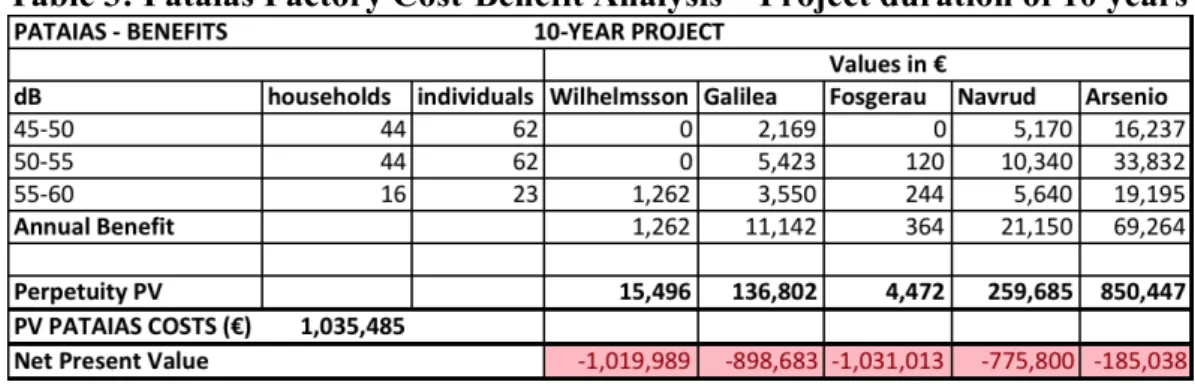
The total annual willingness-to-pay of all individuals arising from reducing noise levels to 45 dB on each policy site was calculated by applying the individual willingness-to-pay per year discriminated by noise levels exposure depicted in table 1, section 2.2.3, to the population affected in each site. The benefits were considered perpetuities, and assumed to start only after the project completion.
Cost side
The financial cost of all the materials necessary for the achievement of a maximum 45 dB noise output were given by SECIL employees at current market prices. The distribution of costs across time was also given by SECIL employees: if the funds were readily available for investment and the project was approved to start immediately, its construction would take at most three years, assuming a fair implementation of the factory soundproofing regarding the time required for each step of the project. However, a more realistic scenario is to assume the firm wants to smooth investment throughout time, avoiding a large investment in such a short time span. To reflect this, costs were
distributed evenly along a 10-year timeframe. There is a large degree of uncertainty related to the maintenance costs and depreciation of the materials to be implemented in this project, primarily because the firm has not yet performed any maintenance or cleaning of the materials implemented so far. Therefore, the cost-benefit analysis was performed ignoring maintenance costs at first, and then assuming annual maintenance costs equivalent to 5% of the project cost.
Results
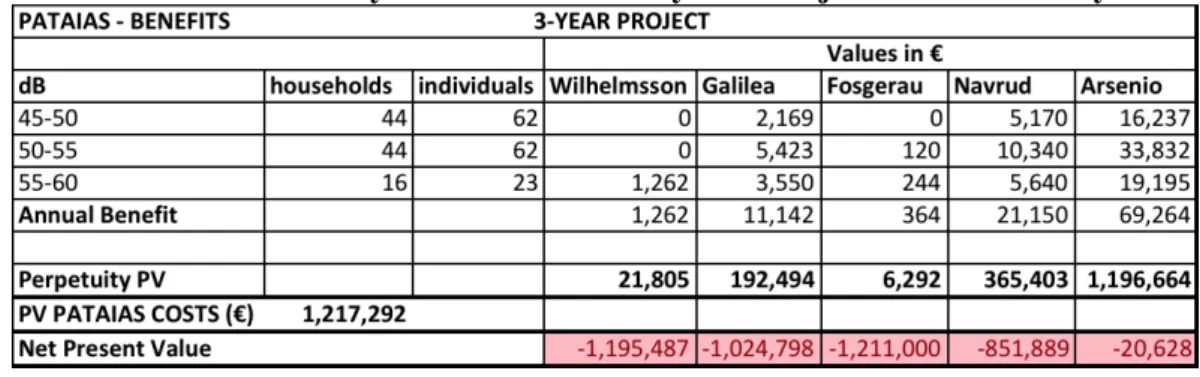
The results of the Cost-Benefit Analysis for the two sites, Maceira and Pataias, are summarized in tables 2 and 3 of the annex section respectively, assuming a project implementation of 10 years. If funds are readily available, tables 4 and 5 represent the 3-year Cost-Benefit Analysis. As expected, there is a large variation in the total benefits obtained from the different studies considered. However, in all scenarios the costs for strictly complying with the Portuguese law considerably exceed the benefits associated with the reduction in noise exposure. When considering the constant average marginal willingness-to-pay derived from Navrud (2002), which presumably overestimates the households’ willingness-to-pay for low noise levels, the cost side of the project exceeds by a large amount the estimated benefits; Specifically, considering a 10-year implementation, in the case of Maceira costs are more than ten times the value of benefits, and in the case of Pataias costs are four times the value of benefits. Even when valuing using the benefits estimated in Arsenio (2006) the projects yield a negative net present value in both time lengths considered, and thus do not pass the Cost-Benefit Analysis criteria. Since the net present value is already negative in any of the cases, even though maintenance costs are very uncertain, it is obvious that adding them to the cost structure will result in even lower net present values.
Besides yielding a negative result for both industrial projects, the cost-benefit analysis is also capable of capturing the inherent differences in costs, population exposed and benefits in each project: the net present value in any of the studies considered differs considerably from one project to the other; in fact, due to the lower financial costs and higher number of people exposed to noise, Pataias consistently obtains a higher net present value when compared to Maceira.
Sensitivity analysis
A sensitivity analysis is required to test different assumptions associated to the discounting of benefits and costs of the projects, and the population affected by excessive noise levels. Regarding the discount rate, it was assumed so far to be 5%, and is now subject to changes between 3% and 10%. As for the population affected, the noise maps do not provide an exact information on how many houses are affected by different noise levels since the aerial view creates difficulties in the perception and counting of households (e.g.: some buildings might not have a residential purpose like storage buildings and factories), for which a sensitivity analysis is performed as well.
The Cost-Benefit Analysis was recalculated for a discount rate of 3% as a lower limit and 10% as an upper limit. At a 10% discount rate, the present value of both costs and benefits is reduced since future values are discounted at a higher rate; therefore for some studies (depending on the magnitude of benefits compared to costs) the gap between costs and benefits widens even more. For a discount rate of 3%, as expected, results are the inverse: the present value of both benefits and costs increases. The net present value for both projects remains negative across almost all studies considered;
The only exception is the Arsenio (2006) values for Pataias with a 3% discount rate, where the net present value becomes €574,075.
As for the number of households, a sensitivity analysis was performed by adding and subtracting 20% of the households exposed to all noise levels. Again the main result that costs exceed benefits still hold across all studies, even when adding 20% more households to the estimation, which should overestimate the benefits while keeping financial costs fixed. With less 20% of households exposed obviously the same conclusion is reached.
A relevant hypothesis to be tested is the “worst case scenario”, that is, setting all the previous assumptions so as to expose the maximum number of people, discounting future benefits at the lowest rate threshold, with the least time possible for project completion. In this case that means performing a cost benefit analysis assuming a project duration of 3 years, adding 20% to the households originally counted and discounting at a rate of 3%. The results of the two projects’ cost benefit analysis are summarized in tables 6 and 7 of the annex section. Even assuming this unrealistic scenario, due to the magnitude of costs when compared to benefits results generally still hold across most studies, with the exception of the Arsenio (2006) case that now yields a positive net present value for both projects.
3.3 - Conclusion
From the Cost-Benefit Analysis performed it is clear that the required noise reduction projects are not viable from an economic (social) point of view across all values considered. This suggests that a full soundproofing of the SECIL factories in
Maceira-Liz and Cibra-Pataias to comply with the Portuguese law is not potentially pareto improving, since the costs associated with the reduction of excessive noise exposure are far greater than the social benefits estimated for this change. In a broader sense, this is a clear sign of a non-optimal policy definition in the EU area. By looking at the uniform standard type of regulation on noise exposure, economic theory predicts the outcome will not be efficient neither cost-effective, since this strict quantity restriction doesn’t take into account different economic conditions on different policy sites. The results obtained in this Work Project confirm this hypothesis empirically: the cost-benefit analysis yields a negative social outcome for both industrial sites. Moreover, the final outcome is also significantly different from one site to the other due to different financial cost structures and different aggregate noise exposure.
Thus, the results supporting economic theory on optimal policy definition suggest a redefinition of the EU law in order to achieve economic efficiency. Even though there is a large uncertainty related to the benefits of noise reduction, it is possible to find that some projects clearly do not pass the cost-benefit analysis criteria, for which certainly there is no rationale for being subject to this regulation. Noise reduction projects should be evaluated at an individual level, estimating each policy site aggregate benefits and costs and finding an optimal quantity to be achieved. Otherwise the EU area risks incurring in excessive and unnecessary costs such as the two projects evaluated in this work: the fact that they are industrial sites that were not projected originally with concerns related to noise exposure makes them bear high financial costs to reduce even small amounts of noise output, and the fact that the overall population affected is low and affected only at low noise levels makes this project a particular case that is subject to a strict regulation without flexibility to adapt to its individual characteristics.
Additionally, it is now clear that there is no specific need to invest a large amount of resources to get the general social outcome of a project on noise valuation, at least in some particular cases; In this case it is obvious that the project does not pass the cost-benefit analysis criteria for the range of values considered. This suggests that despite the uncertainty regarding the true economic value of noise reduction in the two policy sites, the projects are clearly not efficient from an economic perspective.
One note of caution must me made on the limitations of the Cost-Benefit Analysis instrument itself. Even though it provides economic efficiency criteria, it gives no concern regarding the moral dimension of the final result. In the case of SECIL’s factories, both were constructed at a time when the present regulation wasn’t applicable. Thus, shareholders made a decision without having perfect information about the government’s behavior regarding noise regulation that ultimately is affecting its current profits.
As for practical schemes to solve the noise pollution problem of both sites, an important hypothesis to be considered is the possibility of the polluter compensating the victims using the euro-value estimated for damages. This would avoid the excessive financial costs needed in order to completely eliminate the damages caused. If damages are correctly estimated, this would be a fair measure to be applied both for the polluter and the population affected, and it would be a flexible measure to replace the strict regulation currently in place. However, this type of arrangement between the polluter and the victims has a downside: According to the Baumol-Oates general equilibrium model, victims should not be compensated for the damages caused by the polluter, since this distorts their decisions in the first place. Even though this implies per se an inefficient regulation, it would create room for a policy that does relieve the polluter
from supporting the considerable high burden of soundproofing the factory, and thus it can be considered a more just policy for both parts, so it is possible that even though the measure would imply a trade-off between efficiency and justice, it would be a more feasible and realistic approach to this specific problem.
Bibliography
Andersson, H., Jonsson, L., Ögren, M. 2009. “Property Prices and Exposure to Multiple Noise Sources: Hedonic Regression with Road and Railway Noise”, Environ Resource Econ 45,73-89
Arsenio, E., Bristow, A., Wardman, M. 2006. “Stated choice valuations of traffic related noise”, Transportation Research Part D 11, 15-31
Baranzini, A., Schaerer, C., Thalmann, P. 2010. “Using measured instead of perceived noise in hedonic models”, Transportation Research Part D 15, 473-482
Baumol, William J., Oates, Wallace E. 1988. The Theory of Environmental Policy. Cambridge University Press.
Day B., Bateman I., Lake I. 2007. “Beyond implicit prices: recovering theoretically consistent and transferable values for noise avoidance from a hedonic property price model”, Environ Resour Econ 37(1),211–232
Directive 2002/49/EC of the European Parliament and of the Council of 25 June 2002. Official Journal of the European Communities, L 189, 12-25.
European Environment Agency, 2010. Good practice guide on noise exposure and potential health effects European Environment Agency, 2010. The European Environment: State and Outlook 2010 Urban Environment
Fosgerau, M., Bjørner, T. 2006. “Joint models for noise annoyance and willingness to pay for road noise reduction”, Transportation Research Part B 40, 164-178
Galilea, P., Ortúzar, J. de D. 2005. “Valuing noise level reductions in a residential location context”, Transportation Research Part D 10, 305-322
Navrud, Ståle. 2002. “The State-Of-The-Art on Economic Valuation of Noise”. Final Report to European Commission DG Environment.
Wilhelmsson, M. 2000. “The Impact of Traffic Noise on the Values of Single-Family Houses”, Journal of Environmental Planning and Management, 43(6), 799-815
Wilhelmsson, M. 2005. “Valuation of traffic-noise abatement”, Journal of Housing and the Built Environment 20, 129-151
World Health Organization, 1999. Guidelines for community noise
World Health Organization, 2004. WHO LARES Final Report, Noise effects and morbidity
World Health Organization, 2005. Quantifying burden of disease from environmental noise: Second technical meeting report
World Bank, 2007. Environmental, Health, and Safety (EHS) Guidelines World Health Organization, 2009. Night Noise Guidelines for Europe
World Health Organization, 2011. Burden of disease from environmental noise: Quantification of healthy life years lost in Europe
Annex
Table 2: Maceira Factory Cost-Benefit Analysis – Project duration of 10 years
Table 4: Maceira Factory Cost-Benefit Analysis – Project duration of 3 years
Table 5: Pataias Factory Cost-Benefit Analysis – Project duration of 3 years
Table 6: Maceira Factory Cost-Benefit Analysis – Worst Case Scenario