Accepted Manuscript
Evaluation of cardiovascular protective effect of different apple varieties- cor‐ relation of response with composition
Ana Teresa Serra, J. Rocha, B. Sepodes, Ana A. Matias, Rodrigo P. Feliciano, Agostinho de Carvalho, Maria R. Bronze, Catarina M.M. Duarte, M.E. Figueira
PII: S0308-8146(12)01181-8
DOI: http://dx.doi.org/10.1016/j.foodchem.2012.07.067
Reference: FOCH 12893
To appear in: Food Chemistry Received Date: 14 March 2012 Revised Date: 7 July 2012 Accepted Date: 10 July 2012
Please cite this article as: Serra, A.T., Rocha, J., Sepodes, B., Matias, A.A., Feliciano, R.P., Carvalho, A.d., Bronze, M.R., Duarte, C.M.M., Figueira, M.E., Evaluation of cardiovascular protective effect of different apple varieties-correlation of response with composition, Food Chemistry (2012), doi: http://dx.doi.org/10.1016/j.foodchem. 2012.07.067
This is a PDF file of an unedited manuscript that has been accepted for publication. As a service to our customers we are providing this early version of the manuscript. The manuscript will undergo copyediting, typesetting, and review of the resulting proof before it is published in its final form. Please note that during the production process errors may be discovered which could affect the content, and all legal disclaimers that apply to the journal pertain.
Evaluation of cardiovascular protective effect of different
apple varieties- correlation of response with composition
Ana Teresa Serra1,2, J. Rocha3, B. Sepodes3 , Ana A. Matias1,2, Rodrigo P. Feliciano1 ,
Agostinho de Carvalho4, Maria R. Bronze1,2,3, Catarina M.M. Duarte1,2*, M.E.
Figueira3*
1 Instituto de Tecnologia Química e Biológica, Universidade Nova de Lisboa, Avenida
da República, Estação Agronómica Nacional, 2780-157 Oeiras, Portugal
2 Instituto de Biologia Experimental e Tecnológica, Avenida da República,
Quinta-do-Marquês, Estação Agronómica Nacional, Apartado 12, 2781-901 Oeiras, Portugal
3 iMED.UL, Faculdade de Farmácia da Universidade de Lisboa, Av. Prof. Gama Pinto,
1649-003- Lisboa, Portugal
4Instituto Superior de Ciências da Saúde Egas Moniz, 2829-511 Monte de Caparica,
Portugal
* Corresponding authors : Catarina M.M. Duarte, PhD
Instituto de Tecnologia Química e Biológica, Universidade Nova de Lisboa, Avenida da República, Estação Agronómica Nacional, 2780-157 Oeiras, Portugal
Tel: +351 21 446 97 27; Fax: +351 21 442 11 61; E-mail address : [email protected]
M. E. Figueira, PhD
iMED.UL, Faculdade de Farmácia da Universidade de Lisboa, Av. Prof. Gama Pinto, 1649-003- Lisboa, Portugal
Keywords: anti-hypercholesterolemic effect, apples ,Bravo de Esmolfe, cardiovascular
Abstract
Epidemiological evidence supports the concept that diets rich in fruits and vegetables promote health and attenuate or delay the onset of cardiovascular disease (CVD). In particular, a reduced risk of CVD has been associated with apple consumption, probably due to the cholesterol-lowering effect of the main bioactive compounds, namely fiber and polyphenols.
In this work, the effect of diet supplementation with 20% of three Portuguese apple cultivars (Bravo de Esmolfe, Malápio Serra and Golden), containing distinct phenolic and fiber concentrations, on serum lipid profile and oxLDL of male Wistar rats fed a cholesterol-enriched diet (2%) was evaluated. After 30 days, only Bravo de Esmolfe apple was able to decrease significantly serum levels of triglycerides, total and LDL cholesterol concentrations (reductions of 27.2%, 21.0% and 20.4%, respectively, in relation to the cholesterol-enriched diet group, p<0.05) . The levels of oxLDL were also significantly improved with the consumption of this apple variety (reductions of 20.0% and 11.9%, in relation to the cholesterol-enriched diet group and control group, respectively, p>0.05) as well as with Malapio da Serra apple (reductions of 9.8% in relation to the cholesterol-enriched diet group, p<0.05). Correlation of the bioactive response with chemical composition showed that catechin, epicatechin, procyanidin B1 and -carotene are the major phytocompounds responsible for the cholesterol lowering ability of apples. The antioxidant potential may have also contributed to this beneficial effect.
1. Introduction
The relationship between dietary factors and cardiovascular disease (CVD) was often regarded as primarily and almost exclusively dependent on lipid (especially saturated fat and cholesterol) consumption and metabolism leading to increased serum cholesterol; in particular, low density lipoprotein (LDL) levels resulting in atherosclerotic vascular changes. CVD is the number one cause of death globally (WHO, 2011), and
epidemiological, clinical and biochemical studies have indicated convincingly that increased serum lipid concentrations, including triglycerides (TG), total cholesterol (TC), low density lipoprotein cholesterol (LDL), low-density and high-density lipoprotein cholesterol (LDL/HDL), TC/HDL ratios and low-density lipoprotein oxidation (oxLDL) are risk factors contributing to the development of CVD and
atherosclerosis (Egger et al., 1999; Manuel et al., 2006; Rywik et al., 1999; Smith et al., 1992; Sugamura & Keaney, 2011; Meisinger et al., 2005).
There are some studies that suggest that the consumption of fruit and vegetables is associated with a reduced risk of cardiovascular diseases (Bazzano et al., 2003;
Dauchet et al., 2005; Ness et al., 1997; van´t Veer et al., 2000) . The inverse association between fruit and vegetable intake and the risk of CVD-related morbility and mortality is often attributed to antioxidants present in fruits and vegetables, such as vitamins C and E, fibers, carotenoids and polyphenols (Gaziano et al., 1995; Tribble, 1999; Chang & Liu, 2009).
Apples are widely consumed and are among the major sources of phytochemicals and antioxidants in the human diet. In particular, a reduced risk of CVD has been shown for apple consumption, probably due to the potential cholesterol-lowering ability of this fruit (revised by Boyer & Liu, 2006). In fact, several animal and human studies have
demonstrated that apple consumption significantly reduces plasma cholesterol, LDL cholesterol (LDL-C) and triglycerides concentrations (Aprikian et al., 2001; Leontowicz et al., 2001; Sablé-Amplis et al., 1983;Salgado et al., 2008). The main compounds responsible for this effect are proposed to be fiber and polyphenols (Aprikian et al., 2003; Leontowicz et al., 2001, 2003; Nagasako-Akazome et al., 2007), which content and composition varies greatly within different cultivars (Feliciano et al., 2010; Vrhovsek et al., 2004).
Within this context, the purpose of this study was to evaluate the in vivo cholesterol-lowering effect of three different apple varieties containing different phenolic
compounds and different fiber content, aiming at correlating the bioactive response with the composition of the fruits. The selection of the apple varieties was based on previous studies concerning the nutritional characteristics, phytochemical content, antioxidant capacity and sensorial properties of nine traditional and exotic Portuguese varieties (Feliciano et al., 2010; Serra et al., 2010). Moreover, comparison between two
consecutive crop years of phenolic content and in vitro bioactivity of these apples was performed prior to the in vivo study in order to evaluate if the harvest year significantly affects the phenolic composition and in vitro bioactivity of the fruits.
2. Materials and methods
2.1 Reagents
Acetone, 2’,2’-Azobis (2-amidinopropane) dihydrochloride (AAPH),
2’,7’-dichlorofluorescin diacetate (DCFH-DA), 6-hydroxy-2,5,7,8-tetramethylchroman-2-carboxilic acid (Trolox), caffeic acid, 5,5-dimethyl-1-pyrroline-N-oxide (DMPO), hydrogen peroxide (H2O2), phosphate buffer solution (PBS) and t-butyl hydroperoxide
(t-BHP) were purchased from Sigma-Aldrich (Portugal). Disodium fluorescein (FL) was obtained from TCI Europe (Belgium) and FeSO4 was from Merck (Germany). All
cell culture media and supplements, namely foetal bovine serum (FBS), glutamine and RPMI 1640, were obtained from Invitrogen, Gibco (Portugal).
2.2 Apples
Nine apple varieties, namely Bravo de Esmolfe, Malápio Fino, Malápio da Serra, Pêro Pipi, Fuji, Gala Galaxy, Golden, Reineta Parda and Starking, were collected in
Mangualde, Portugal, between September and December 2007.
2.3 Extraction
Apple extracts were prepared following the method described by several authors (Dewanto et al., 2002; Eberhardt et al., 2000) with some modifications as reported previously (Serra et al., 2010). Briefly, the edible part of the fruits (flesh and peel) was extracted with 80% acetone (1:2 w/v) during 8 minutes in a blender. The homogenates were filtered and the solvent was evaporated in a rotary evaporator at 40ºC. The remaining extracts were diluted in distilled water to make a concentration of 2 g of apple/mL. Finally, natural extracts were filtered through 0.22 m filter before storage at -20ºC.
2.4 Phenolic characterization 2.4.1 Total polyphenolic content
Total phenolic concentration was determined, according to the Folin-Ciocalteu colorimetric method (Singleton & Rossi, 1965) with some modifications, as described previously (Serra et al., 2008). Diluted samples were mixed with Folin-Ciocalteu reagent (Panreac, Barcelona, Spain) and the reaction was neutralized with sodium
carbonate. Absorbance of the samples was measured at 765nm on Genesys10uv spectrometer (Thermo Spectronic, New York, USA), after a period of 30 min at 40ºC. Gallic acid was used as external standard and the results were expressed as means of triplicates (mg of gallic acid equivalents - mg GAE/per 100g edible fruit) ±SD.
2.4.2 HPLC analysis of phenolic compounds
HPLC analysis of phenolic compounds was carried out using a Surveyor equipment from Thermo Finnigan with a diode array detector (DAD) (Thermo Finnigan— Surveyor, San Jose, CA, USA) and an electrochemical detector (ED) (Dionex, ED40) (Bravo et al., 2006; Feliciano et al., 2010). The data acquisition systems were the Chromquest version 4.0 (Thermo Finnigan—Surveyor, San Jose, CA, USA) and the software 4880 (Unicam) for the diode array and electrochemical detector, respectively. Identification of compounds was done by comparing retention time, spectra and spiking samples with known amounts of pure standards, whenever available. For quantification purposes standard solutions were prepared in methanol:water (50:50) solution and extracts were diluted 1:5 or 1:10 and analysed as triplicates. Since DAD is less selective than ED, the latter was used to quantify compounds that co-elute on the former detector, namely catechin, epicatechin, chlorogenic acid and procyanidins. Quercetin-3-glucoside was detected with both detection systems but quantified using data from DAD due to the lower electrochemical signal. Moreover, using these chromatographic conditions, kaempferol-3-glucoside and quercetin-3-rhamnoside could not be separated and were quantified together as quercetin-3-glucoside equivalents. Phloridzin was not detected within the ED conditions and was only quantified from HPLC-DAD data.
2.5.1 Oxygen radical absorbance capacity (ORAC)
ORAC assay was used to evaluate the antioxidant capacity of the samples towards peroxyl radicals. The assay was carried out by following the method of Huang et al. (2002) modified for the FL800 microplate fluorescent reader (Bio- Tek Instruments, Winooski, VT, USA) (Feliciano et al., 2009). This assay measured the ability of the antioxidant species in the sample to inhibit the oxidation of disodium fluorescein (FL) catalysed by peroxyl radicals generated from AAPH. All data were expressed as micromoles of trolox equivalent antioxidant capacity per 100 g of apple fresh weight ( mol TEAC/g dw) and the experiments were performed in triplicate.
2.5.2 Hydroxyl radical adverting capacity (HORAC)
The HORAC assay was based on a previously reported method (Ou et al., 2002), modified for the FL800 microplate fluorescence reader (Bio- Tek Instruments,
Winooski, VT, USA) (Serra et al., 2010). The reader was used with fluorescence filters for an excitation wavelength of 485 ± 20 nm and an emission wavelength of 530 ± 25 nm, and the plate reader was controlled by software Gen5. Caffeic acid was used as the standard as it provides a wider linear range as compared to gallic acid (Dubost et al., 2007). Data were expressed as micromoles of caffeic acid equivalents (CAE) equivalents per 100 grams of fresh apples. All samples were analysed in triplicate.
2.5.3 Hydroxyl Radical (HOy) Scavenging Capacity – EPR assay
Hydroxyl radical scavenging capacity of the apple extracts was evaluated by an electron paramagnetic resonance (EPR) technique, as described previously (Serra et al., 2010). This method involves the addition-type reaction of a short-lived radical with the paramagnetic compound DMPO to form a relatively long-lived free radical product
which can be detected by EPR. The intensity of the spectrum is related to the amount of free radicals trapped.
The Fenton reaction was used as a source of HOy radicals. Briefly, hydroxyl radicals
were generated by adding 100 L of 10 mM H2O2 to a solution containing 100 L of
DMPO (48mM) and 100 L of FeSO4 (2 mM in phosphate buffer solution, pH 7.4).
Immediately, 100 L of apple extracts (2 g apple/mL) were added to the system and the spectrum of DMPO/HOy was recorded 3 min later. Control experiments were performed
by adding 100 L of distilled water. The scavenging capacities of apple extracts were determined by measuring the intensity of their spectrum and final results were
expressed in percentage relative to the control. EPR measurements were conducted using an EPR spectrometer (Bruker EMX6/1, 1998) and a flat cell assembly. Experiments were performed in duplicate, at room temperature and at atmospheric pressure.
2.5.4 Intracellular antioxidant activity
Human colon carcinoma Caco2 cells were purchased from DSMZ (Germany), and were routinely grown in RPMI 1640 supplemented with 10% of FBS and 2 mM of glutamine. Stock cells were maintained as monolayers in 175 cm2 culture flasks and incubated at
37ºC in a 5% CO2 humidified atmosphere.
To evaluate the intracellular antioxidant capacity of apple extracts, Caco2 cells were seeded at a density of 2x10⁴cells/well in 96 well plates and the medium was changed every 48 hours. The experiments were performed using completely differentiated cells (after reaching confluence- ±72 hours). Intracellular antioxidant activity of the apple extracts was evaluated following the formation of reactive oxygen species (ROS) in Caco2 cells after treatment with two chemical stressors: t-BHP and H2O2. The
formation of intracellular ROS was monitored using the fluorescent probe, DCFH-DA, as described elsewhere (Serra et al., 2010; Wang & Joseph, 1997). Briefly,
differentiated Caco2 cells were incubated for 24 hours with extracts equivalent to 100mg/mL of apple. The cells were washed with PBS and incubated with 100 M of DCFH-DA for 30 min. After removal of the DCFH-DA and further washing, the cells were incubated with 2 mM of t-BHP or 10 mM of H2O2 for 60min. Fluorescence (F)
was measured for each sample at 0 and 60 min in a microplate reader (FL600, Bio- Tek Instruments, Winooski, VT, USA). Intracellular antioxidant activity of apple extracts was expressed as the percentage of inhibition of intracellular ROS caused by exposure to the oxidative stressors and was calculated as (1-(F60min-F0min)/F0min) x 100 against a control (cells without apple extracts). Results presented are a mean of four replicates.
2.6 In vivo study 2.6.1 Animals
Forty Wistar male rats (4-5 weeks old, 125-132 g) were purchased from Harvard Ibérica. The animals were maintained under standard conditions of temperature (25ºC) and humidity with alternating 12 hours light/dark cycles. All the studies were
performed in conformity with the guidance for care and standard experimental animals study ethical protocols and with the relevant EEC regulation (JOCE L358/1 12/18/86). Moreover, researchers are certificated by the National Authority (Direção Geral de Veterinária, DGV) for animal experimentation (references: 004908 and 013432)
2.6.2 Experimental design
the control group (C) was fed ad libitum on a standard diet (Harlan, 2018, E= 3.1 kcal/g); the cholesterol control group (C. Chol) was fed ad libitum on a diet with 2% (w/w) cholesterol (Harlan, 2018+2% cholesterol, E= 3.1 kcal/g); the third group (G) was fed ad libitum on a diet with 2% (w/w) cholesterol (Harlan, 2018+2% cholesterol, E= 3.1 kcal/g) supplemented with 20% (w/w of cholesterol-enriched diet) of Golden apples (E= 0.46 kcal/g; Serra et al., 2009); the fourth group (MS) was fed ad libitum on a diet with 2%(w/w) cholesterol supplemented with 20%(w/w of cholesterol-enriched diet) of Malapio da Serra apples (E= 0.53 kcal/g; Serra et al., 2009); and the fifth group (BE) was fed ad libitum on a diet with 2% (w/w) of cholesterol (Harlan, 2018+2% cholesterol, E= 3.1 kcal/g) supplemented with 20% (w/w of cholesterol-enriched diet) of Bravo Esmolfe apples (E= 0.53 kcal/g; de Carvalho & Duarte, 2009).
The selection of 2% of cholesterol for the hypercholesterolemic diet was based on the results obtained in a preliminary experiment where different percentages of cholesterol were administered to animals. Our data indicated that at least 2% of cholesterol is required to induce hypercholesterolemia in rats by significantly increasing the levels of total cholesterol when compared with a control group (data not shown). Additionally, this dosage was already used by other authors to induce hypercholesterolemia in animals (Negis et al., 2006; Kwok et al., 2012). Concerning the apples, the selected amount given to rats (20% w/w in relation to cholesterol diet) was equivalent to 5g/rat/day. When translated to humans, this value corresponds to eating 2 or 3 apples per day - 324-432g/person/day (Reagen –Shaw et al., 2007).
All groups were fed as described throughout 30 days and the intake of each diet was monitored daily and was similar among groups.
At the end of the experiment, rats were fasted overnight and were anesthetized with sodium pentobarbital (60 mg/kg i.p.) and blood was drawn by cardiac puncture into a serum SST gel and clot activator tube (Becton, Dickinson and Company) and was centrifuged (2300 g for 10 min at room temperature) to separate the serum.
2.6.3 Biochemical assays
The concentrations of glycemia, triglycerides, total cholesterol, low-density lipoprotein (LDL-C) and high-density lipoprotein ( HDL-C) were assayed enzymatically using commercially specific kits (Roche Diagnostics, GmbH, Mannheim, Germany) and were measured spectrophotometrically using an autoanalyser Hitachi mod 717 (Hitachi-Roche, Tokyo, Japan). oxLDL was determined using Mercodia Oxidized LDL ELISA assay kit (Mercodia, Sweden).
2.7 Statistical Analysis
Comparison between the polyphenolic content and antioxidant effect of nine apple varieties harvested in 2007 with those obtained in 2006 was performed by Wilcoxon test. Statistical significance was established at P<0.05 or P<0.01.
In the in vivo study all data are expressed as mean ± SD and were compared using a one-factorial ANOVA test, followed by a Bonferroni’s post hoc test. A P value less than 0.05 was considered to be statistically significant.
3. Results and Discussion
The selection of fruits was based on our previous studies that examined the nutritional, phytochemical and bioactivity characterization of nine Portuguese apple varieties
harvested in 2006 (Feliciano et al., 2010; Serra et al., 2010). In this work, the fruits collected in the consecutive crop year (2007) were characterized and compared with the results generated from the previous year.
3.1 Two-year comparison of apples
Table 1 contains details of the phenolic and antioxidant characterization of four traditional Portuguese apple varieties, namely Bravo de Esmolfe, Malápio Fino, Malápio da Serra and Pêro Pipo, and five exotic apple cultivars (Fuji, Gala Galaxy, Golden, Reineta Parda and Starking) harvested in 2007. When compared with the values obtained in 2006, no significant differences were observed for total phenolic content of apples (P > 0.05) (Fig. 1A). However, within varieties, Pêro Pipo, Malápio da Serra and Starking showed increases of 38%, 47% and 33%, respectively, in 2007. These results are in accordance to those reported previously by Strake et al. (2009), where similar variations were observed for the Golden Delicious variety harvested in 2005 and 2006 (33% and 44% of variation, for organic and conventional apples respectively).
With respect to the polyphenolic composition, the results generated showed that the main significant changes were observed for chlorogenic acid, phloridzin and kampferol-3-glucoside + quercetin-3-rhamnoside content of apples, thus suggesting that the antioxidant value and antiproliferative effect of fruits may also diverge between the two crop years (Serra et al., 2010). To confirm this, the antioxidant activity of apples
harvested in 2007 was assessed using three different and complementary chemical assays; ORAC, EPR and HORAC assays. For ORAC assay, a significant increase was observed for 2007 apples (P<0.01). The highest variations (fold > 1.3) were found for Bravo de Esmolfe, Pêro Pipo, Gala Galaxy, Golden, Reineta Parda and Starking apples
(Fig. 2A), in which concentrations of epicatechin and/or chlorogenic acid increased in 2007 (Fig. 1C and Fig. 1D). Accordingly, these two phenolic compounds were already reported to yield good correlations with ORAC values (Stracke et al., 2009). For the HORAC assay, Pêro Pipo, Gala Galaxy and Starking apples harvested in 2007 also showed a higher increase on antioxidant value, whereas Reineta Parda demonstrated a decrease in relation to the 2006 crop (Fig. 2A). These variations were mainly due to changes in the epicatechin and procyanidin B1 contents (Fig. 1C and 1F), the main responsible compounds of HORAC values of apples (Serra et al., 2010). For the EPR assay, the most relevant increments (fold>1.4) were obtained for Malápio da Serra, Fuji, Gala Galaxy, Reineta Parda and Starking (Fig. 2A). However, in this case, it is still unknown which phenolic compounds are responsible for the scavenging capacity of hydroxyl radicals.
Overall, the highest increase in antioxidant activities was obtained for exotic varieties (Fig. 2). However, it is important to note that the average antioxidant value obtained for 2007 exotic apples (ORAC- 1568 µmol TEAC/100g; HORAC- 719 µmol
CAEAC/100g; EPR- 84%) was still lower than the average value of traditional varieties harvested in 2007 (ORAC- 2017 µmol TEAC/100g; HORAC- 951 µmol CAEAC/100g; EPR- 96%) or even in 2006 (ORAC- 1601 µmol TEAC/100g; HORAC- 843 µmol CAEAC/100g; EPR- 88%), reinforcing the conclusion that traditional Portuguese varieties are richer sources of antioxidant compounds. Among all varieties, Malápio Fino is the only cultivar that did not show differences in antioxidant value in the two crop years (Fig. 2A). This traditional variety was still the best antioxidant-containing apple, reaching the highest values in all three chemical assays (Table 1).
Apples from 2007 were also analysed for their antioxidant capacity in Caco2 cells. Results demonstrated that there were no significant differences between the cellular antioxidant protection of apples harvested in two different years (P>0.05) (Fig. 2B, C).
This fact could be related to the low variation in the content of catechin (Fig. 1B), which was previously identified as being primarily responsible for this effect (Serra et al., 2010).
Among all varieties of 2007 apples, Malápio Fino and Bravo de Esmolfe were still the best antioxidant apples, whereas Golden and Gala Galaxy were the apples with the lowest bioactivity in that year. The differences in both phenolic composition and antioxidant properties of apples verified between the two crop years could be related to climate variations. In fact, less rainfall was observed in 2007 (525.1 L/m2) than in 2006 (936.3 L/m2) (http://www.meteo.pt), which may explain the higher content in specific polyphenols and antioxidant capacity of apple varieties from 2007. This effect was also verified by other authors, when comparing the phenolic content of Golden Delicious apples produced in three different years (Stracke et al., 2009).
3.2. Cardiovascular protective effect of apples - in vivo study
The apple varieties selected for this study included two traditional Portuguese cultivars (Bravo de Esmolfe and Malápio da Serra) and one exotic variety (Golden). Bravo de Esmolfe was chosen as it is one of the Portuguese apples that present the highest phenolic content and antioxidant capacity measured by several chemical and cellular assays. Additionally, this traditional variety is very appreciated by consumers due to its odour, taste, hardness and juiciness (Feliciano et al., 2010). Golden and Malápio da Serra were selected due to significant differences in their phenolic contents and antioxidant capacities, relative to Bravo de Esmolfe. In addition, Malápio da Serra is reported to have the highest total fibre concentration (Feliciano et al., 2010). All results obtained for weight gain, glucose levels , blood lipid profile (triglycerides, total
cholesterol control group (rats fed a diet with 2% of cholesterol) and control group (rats fed a normal diet).
Results show that there were no significant differences in the weight gain of animals fed all types of diets (data not shown), indicating that neither the cholesterol-enriched diet nor the inclusion of apples contributes to increases in the body weights of animals. With respect to glucose levels, significant increases in all cholesterol-enriched diet groups (C Chol, G, MS and BE) were observed when compared with the control group (C) (Fig. 3A). These increases could be related to metabolic changes consequent to consuming the high cholesterol diet since there were no significant differences in the blood glucose levels of C Chol, G, MS and BE groups. Despite that, within all apple groups, a slight increase in blood glucose levels was observed in the two traditional Portuguese apple varieties groups (MS and BE) probably due to these fruit varieties containing the highest sugar content (Feliciano et al., 2010).
Figures 3B, C, D and E show the effect of experimental diets on the serum lipid profile of animals. As expected, a hypercholesteremic diet significantly increased animals’ serum levels of total cholesterol (C-58.1±3.9 mg/dL; C Chol- 77.8±4.2mg/dL, P<0.05) (Fig. 4C). However no significant changes were observed on LDL-C, HDL-C and total triglycerides between both control groups (LDL-C: C-14.4±2.38 mg/dL; C Chol-15.2±3.1 mg/dL; HDL-C: C-48.0±4.6 mg/dL; C Chol-52.1 ±12.7 mg/dL; total triglycerides: C-61.6±8.8 mg/dL; C Chol-62.6±9.0 mg/dL) (Fig. 4D-F). The effect of apple consumption on the lipid profiles of rats varied according to the cultivar. For all groups, no significant changes were observed in serum HDL levels. With respect to the other parameters, only Bravo de Esmolfe apple was able significantly to reduce serum levels of total cholesterol, LDL-C and total triglycerides of animals (decreases of 21.0%, 20.4 % and 27.2% respectively, in relation to cholesterol diet group, P<0.05).
The other two cultivars did not show an improvement in the lipid profile of rats, probably due to their lower phenolic content and antioxidant effect (Table 1).
In Figure 3F, the levels of oxLDL are presented. It can be seen that the consumption of a hypercholesteremic diet for 30 days did not significantly affect the levels of this biomarker in rats (C-5.9±0.5 mU/L; C Chol- 6.5±0.5 mU/L, p>0.05).
However , when Bravo de Esmolfe or Malapio da Serra apples were added to the diet, blood oxLDL values reduced significantly (p<0.05) in comparison to the high
cholesterol diet group (BE- 5.2±0.4 mU/L; MS- 5.9±0.3 mU/L). This effect was more pronounced in the Bravo de Esmolfe group where a reduction of 20% was observed. Moreover, this variety also showed the capacity to decrease significantly the levels of oxLDL in relation to the levels in the normal diet group (reduction of 9.2%, p<0.05). In contrast, the Golden variety did not affect the levels of this biomarker in animals. It is important to highlight that the results obtained for oxLDL are in accordance with our previous work relating to the capacity of several Portuguese apple extracts to inhibit LDL oxidation in vitro induced by AAPH. As described by Serra et al. (2010), among the three apple varieties, Bravo de Esmolfe was the most effective in inhibiting LDL oxidation (37.2±3.0%), followed by Malápio da Serra (28.0±2.2%) and Golden (14.2±1.1%). In fact, a high correlation coefficient between the two assays (R=0.982) was obtained.
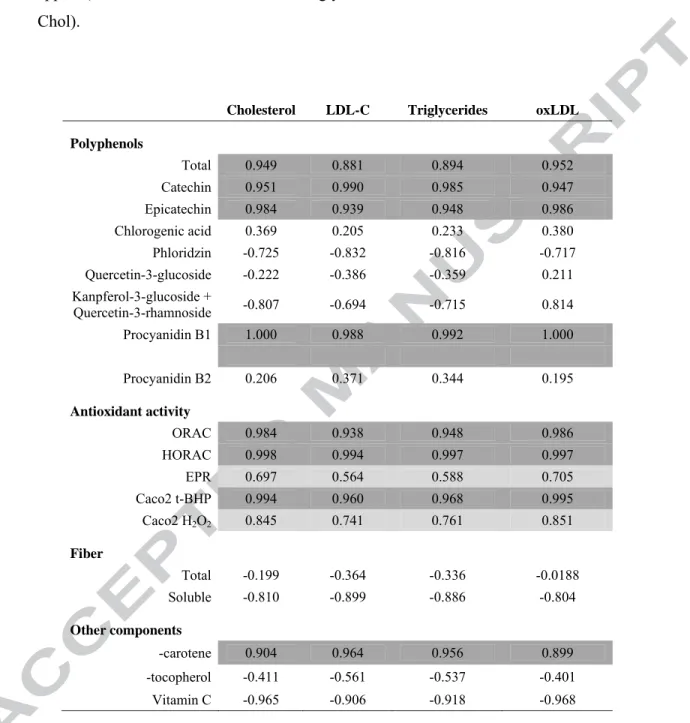
In seeking to identify the components responsible for the oxLDL- and cholesterol-lowering effects, these results were correlated with data on apple composition. Good correlations were obtained when comparing the total phenolic contents and antioxidant properties of apples (ORAC, HORAC and Caco2 t-BHP values) with total cholesterol, LDL-C, triglycerides and oxLDL reduction capacity (R>0.9) (Table 2, Fig. 4A, B). Among all polyphenols, the highest correlation coefficients were found for catechin, epicatechin and procyanidin B1, indicating that these compounds could be the major
contributors to the oxLDL- and cholesterol-lowering ability of apples (Table 2 and Fig. 4A). In fact, catechin, epicatechin and procyanidin B1 are present in green tea
(Murakami et al., 2006), whose consumption is reported to improve the lipid profiles of animals and humans (Chan et al., 1999; Coimbra et al., 2006; Yang et al., 2001), probably due to their capacity to delay lipid absorption (Koo & Noh, 2007; Nagkmonte et al., 2011).
In contrast to other studies (Aprikian et al., 2003; Leontowicz et al., 2001), the fiber content of apples seems to have no effect on their cholesterol-lowering ability (Table 2, Fig. 4C). However, this result could be related to the low levels of fiber presented in all fruit diets (<0.6%). Comparisons were also made between bioactive responses and the contents of ingredients such as vitamins (C and E) and carotenoids ( -carotene) that have been recognized to be inversely associated with CVD-risk mortality (Chang et al., 2009; Gaziano et al., 1995; Tribble et al., 1999). Among these ingredients, only -carotene concentration seemed to contribute to the cholesterol-lowering ability of apples (R>0.9) (Table 2, Fig. 4D).
Overall, the data presented here demonstrate that diets supplemented with 20% of Bravo de Esmolfe apples significantly improve plasma lipid profiles due to the powerful antioxidant capacity of this fruit and also due to its high content of bioactive compounds, namely, catechin, epicatechin, procyanidin B1 and -carotene. It is important to note that the cholesterol-lowering ability of Bravo de Esmolfe apple was similar to or higher than those described by other authors using higher apple
supplementation and lower cholesterol-enriched diet (Aprikian et al., 2001, 2002; Leontowicz et al., 2002). Moreover, the beneficial effect of Bravo de Esmolfe
no significant changes were observed in the plasma lipid profiles of animals fed a normal diet supplemented with this apple variety (data not shown).
4. Conclusions
This study describes for the first time the effect of three different apple varieties, namely Bravo de Esmolfe, Malápio da Serra and Golden, containing different amounts of bioactive compounds, on two relevant biomarkers of cardiovascular diseases in an animal model. The results show that both cholesterol- and oxLDL- lowering effects may be directly correlated with the phenolic contents, namely catechin, epicatechin and procyanidin B1, antioxidant activity and -carotene concentration of apples. Further investigation is required in order to elucidate the pharmacological mechanisms by which these effects occur.
Acknowledgements
The authors would like to thank project AGRO 930/2006.09.0040012, “Phytochemicals and fibers in Beiras’ native varieties and exotic apples and their health benefits”. Ana T. Serra acknowledges the financial support received from FCT (Fundação para a Ciência e Tecnologia), through the grant SFRH/BD/19238/2004.
References
Aprikian, O, Levrat-Verny, M., Besson, C., Busserolles, J., Remesy, C. & Demigne, C. (2001). Apple favourably affects parameters of cholesterol metabolism and of anti-oxidative protection in cholesterol fed rats. Food Chemistry, 75, 445–452.
Aprikian, O., Busserolles, J., Manach, C., Mazur, A., Morand, C., Davicco, M., Besson, C., Rayssiguier, Y., Remesy, C. & Demigne, C. (2002). Lyophilized apple counteracts the development of hypercholesterolemia, oxidative stress, and renal dysfunction in obese Zucker rats, Journal of Nutrition,132, 1969–1976.
Aprikian, O., Duclos, V., Guyot, S., Besson, C., Manach, C., Bernalier, A., Morand, C., Remesy, C. & Demigne, C. (2003). Apple pectin and a polyphenol rich apple concentrate are more effective together than separately on faecal fermentations and plasma lipids in rats. Journal of Nutrition, 133, 1860–1865.
Bazzano, L. A., Serdula, M. K. &Liu, S. (2003). Dietary intake of fruits and vegetables and risk of cardiovascular diseases. Current Atherosclerosis Reports, 5, 429-439.
Boyer, J. & Liu, R.H. (2006). Apple phytochemicals and their health benefits. Nutrition
Journal, 3, 1-15.
Bravo M. N., Silva, S., Coelho A. V., Vilas Boas L., & Bronze, M. R. (2006). Analysis of phenolic compounds in Muscatel wines produced in Portugal. Analytica Chemica
Acta, 563,84–92.
Chan, P. T., Fong, W. P., Cheung, Y. L., Huang, Y., Ho, W. K. K., & Chen, Z. Y. (1999). Jasmine green tea epicatechins are hypolipidemic in hamsters (Mesocricetus auratus) fed a high fat diet. Journal of Nutrition, 129, 1094–1101.
Chang, W. H., & Liu, J. F. (2009) Effects of kiwifruit consumption on serum lipid profiles and antioxidative status in hyperlipidemic subjects. International Journal of Food Sciences and Nutrition, 19, 11-18.
Coimbra, S., Santos -Silva, A., Rocha-Pereira, Rocha, P. S., & Castro, E. (2006). Green tea consumption improves plasma lipid profiles in adults. Nutrition Research, 26, 604-607.
Dauchet, I., Amouyet, P. & Dallongeville, J. (2005). Fruit and vegetable consumption and risk of stroke. A meta analysis of cohort studies. Neurology, 65, 1193-1197.
de Carvalho, A., & Duarte, C. (2009). Maçãs Tradicionais de Eleição- Fonte de Saúde
e de Sabores (1st Edition). Agro Manual Publicações Lda (Annex).
Dewanto, V., Wu, X., Adom, K. K. & Liu, R. H. (2002). Thermal Processing Enhances the Nutritional Value of Tomatoes by Increasing Total Antioxidant Activity. Journal of
Agricultural and Food Chemistry, 50, 3010-3014.
Dubost, N. J., Ou, B., & Beelman, R. B. (2007). Quantification of polyphenols and ergothioneine in cultivated mushrooms and correlation to total antioxidant capacity.
Food Chemistry, 105, 727–735.
Eberhardt, M. V., Lee, C. Y. & Liu, R. H. (2000). Antioxidant activity of fresh apples,
Nature, 405, 903-904.
Egger, M., Smith , G. D., Pfluger, D., Altpeter, E., Elwood, P.C. (1999). Triglyceride as a risk factor for ischaemic heart disease in British men: Effect of adjusting for measurement error. Atherosclerosis, 143, 275-284.
Feliciano, R. P., Antunes, C., Ramos, A., Serra, A. T., Figueira, M. E., Duarte, C. M. M., de Carvalho, A. & Bronze, M. R. (2010). Characterization of traditional and exotic
apple varieties from Portugal. Part 1- Nutritional, phytochemical and sensory analysis,
Journal of Functional Foods, 2, 35-45.
Feliciano, R. P., Bravo, M. N., Pires, M. M., Serra, A. T., Duarte, C., Boas, L. V., & Bronze, M. R. (2009). Phenolic content and antioxidant activity of Moscatel dessert wines from the Setúbal region of Portugal, Food Analytical Methods, 2, 149-161. Gaziano, J. M., Manson, J. E., Branch, L. G., Colditz, G. A., Willett, W.C., & Buring J.E. (1995). A prospective study of consumption of carotenoids in fruits and vegetables and decreased cardiovascular mortality in the elderly. Annals of Epidemiology, 5, 255-260.
Huang D., Ou, B., Hampsch-Woodill, M., Flanagan, J. A., & Prior, R.L. (2002). High-Throughput Assay of Oxygen Radical Absorbance Capacity (ORAC) Using a
Multichannel Liquid Handling System Coupled with a Microplate Fluorescence Reader in 96-Well Format. Journal of Agricultural and Food Chemistry, 50, 4437-4444. Kwok, C.Y., Wong, C.N., Yau, M.Y.C., Yu, P.H.F., Au, A.L.S., Poon, C.C.W., Seto, S.W., Lam, T.Y., Kwan,Y.W., & Chan, S.W. (2010). Consumption of dried fruit of Crataegus pinnatifida (hawthorn) suppresses high-cholesterol diet-induced
hypercholesterolemia in rats. Journal of Functional Foods 2, 179-186.
Koo, S. I., & Noh, S. K. (2007). Green tea as inhibitor of the intestinal absorption of lipids: potential mechanism for its lipid-lowering effect. Journal of Nutritional
Biochemistry, 18, 179-183.
Leontowicz, M., Gorinstein, S., Bartnikowska, E., Leontowicz, H., Kulasek, G., & Trakhtenberg, S. (2001). Sugar beet pulp and apple pomace dietary fibers improve lipid metabolism in rats fed cholesterol. Food Chemistry, 72, 73–78.
Leontowicz, H., Gorinstein, S., Lojek, A., Leontowicz, M., Ciz, M., Soliva-Fortuny, R., Park, Y., Jung, S., Trakhtenberg, S., & Martin-Belloso, O. (2002). Comparative content
of some bioactive compounds in apples, peaches, and pears and their influence on lipids and antioxidant capacity in rats, Journal of Nutritional Biochemistry, 1, 603–610. Manuel, D. G., Lim, J., Tanuseputro, P., Anderson, G. M., Alter, D.A., Laupacis, A., & Mustard, C.A. (2006). Revisiting Rose: strategies for reducing coronary heart disease.
British Medical Journal, 332, 659-662.
Meisinger, C., Baumert, J., Khuseyinova, N., Loewel, H., & Koening, W. (2005). Plasma oxidized low density lipoprotein, a strong predictor for acute coronary heart diseaseevents in apparently healthy, middle-aged men from the general population.
Circulation 112, 651-657.
Murakami, I., Nakamura, T., Ishibashi, Y., Shibuya, R, Ayano, E., Morita-Murase, Y., Nagata, Y., Kanazawa, H. (2006). Simultaneous determination of catechins and procyanidins in bottled tea drinks by LC/MS. Chromatography, 1, 27-33.
Nagasako-Akazome, Y., Kanda, T., Ohtake, Y., Shimasaki, H., & Kobayashi, T. (2007). Apple polyphenols influence cholesterol metabolism in healthy subjects with relatively high body mass index, Journal of Oleo Science, 56, 417-428.
Nagkmonte, S., Makynen, K., Thilawech, T., & Adisakwattana, S. (2011). Cholesterol-lowering activity of the major polyphenols in grape seed. Molecules, 16, 5054-5061. Negis, Y., Aytan, N., Özer, N., Ogru, E., Libinaki, R., Gianello, R., Azzi, A., Zingg, J.M. (2006). The effect of cholesterol phosphates on atherosclerosis progression in rabbits fed with a high cholesterol diet. Archives of Biochemistry and Biophysics 450, 63-66.
Ness, A. R. & Powels, J. W. (1997). Fruit and vegetables, and cardiovascular disease: A review. International Journal of Epidemiology, 26, 1-13.
Ou, B., Hampsch-Woodill, M., Flanagan, J., Deemer, E. K., Prior, R. L., & Huang, D. (2002). Novel fluorometric assay for hydroxyl radical prevention capacity using fluorescein as the probe. Journal of Agricultural and Food Chemistry, 50, 2772-2777. Reagan-Shaw, S., Nihal, M., & Ahmad, N. (2008). Dose translation from animal to human studies revisited. Faseb Journal 22, 659-661.
Rywik, S. L., Manolio, T. A., Pajak, A., Piotrowski ,W., Davis, C.E., Broda, G.B., & Kawalec, E. (1999). Association of lipids and lipoprotein level with total mortality and mortality caused by cardiovascular and cancer diseases (Poland and United States collaborative study on cardiovascular epidemiology). The American Journal of
Cardiology, 84, 540-548.
Sablé-Amplis, R., Sicart, R. & Agid, R. (1983). Further studies on the cholesterol-lowering effect of apple in human. Biochemical mechanisms involved. Nutrition
Research, 3, 325-328.
Salgado, J. M., Curte, F. & Mansi, D. N. (2008). Effect of gala apples (Malus domestica Borkh) on lipidemia of hyperlipidemic rats. Ciência e Tecnologia de Alimentos, 28, 477-484.
Serra, A. T., Matias, A. A, Frade, R. F. M., Duarte, R. O., Feliciano, R. P., Bronze, M. R., Figueira, M. E., de Carvalho A. & Duarte, C. M. M. (2010). Characterization of traditional and exotic apple varieties from Portugal. Part 2- Antioxidant and antiproliferative activities. Journal of Functional Food, 2, 46-53.
Serra, A. T., Matias, A. A., Nunes, A. V. M., Leitão, M. C., Brito, D., Bronze, R., Silva, S., Pires, A., Crespo, M. T., Romão, M. V. S., & Duarte, C. M. (2008). In vitro evaluation of olive- and grape-based natural extracts as potential preservatives for food.
Singleton, V. L., & Rossi, J. A. (1965). Colorimetry of total phenolics with phosphomolybdic-phosphotungstic acid reagents. American Journal of Enology and
Viticulture, 16, 144−158.
Smith, G. D., Shipley, M. J., Marmot, M. G., & Rose, G. (1992). Plasma cholesterol concentration and mortality. The Whitehall Study. JAMA, 267, 70-76.
Stracke, B. A., Rufer, C. E., Weibel, F. P., Bub, A. & Watzl, B. (2009). Three-year comparison of polyphenol contents and antioxidant capacities in organically and conventionally produced apples (Malus domestica Bork. cultivar “Golden Delicious”).
Journal of Agricultural and Food chemistry, 57, 4598-4605.
Sugamura, K., & Keaney, J.F. (2011). Reactive oxygen species in cardiovascular disease. Free Radical Biology and Medicine 51, 978-992.
Tribble, D. L. (1999). Antioxidant consumption and risk of coronary heart disease: Emphasis on vitamin C, vitamin E, and beta-carotene: A statement for healthcare professionals from the American Heart Association. Circulation, 99, 591-595.
van´t Veer, P., Jansen, M. C., Klerk, M. & Kok, F.J. (2000). Fruits and vegetables in the prevention of cancer and cardiovascular disease, Public Health Nutrition, 3, 103-107.
Vrhovsek, U., Rigo, A., Tonon, D., & Mattivi, F. (2004). Quantification of polyphenols in different apple varieties. The Journal of Agricultural and Food Chemistry, 52, 6532– 6538.
Wang, H., & Joseph, J. A. (1999). Quantifying cellular oxidative stress by dichlorofluorescein assay using microplate reader. Free Radical Biology and Medicine,
27, 612–616.
Yang, M., Wang, C., & Chen, H. (2001). Green, oolong and black tea extracts modulate lipid metabolism in hyperlipidemia rats fed high-sucrose diet. The Journal of
Figure Captions
Fig. 1. Comparison between phenolic content of traditional and exotic apple varieties
harvested in 2006 and 2007. A- Total phenolic content; B- Catechin; C- Epicatechin; D- Chlorogenic acid; E- Phloridzin; F- Quercetin-3-glucoside; G- Kaempferol-3-glucoside + quercetin-3-rhamnoside; H- Procyanidin B1; I- Procyanidin B2. For total phenolic content, catechin, epicatechin, quercetin-3- glucoside, procyanidin B1 and procyanidin B2 there was no significant difference between apples of two crop years (P > 0.05).
Fig. 2. Comparison between antioxidant capacity of traditional and exotic apple
varieties harvested in 2006 and 2007. A- Variation of antioxidant capacity of apples between 2006 and 2007 crop years (values were obtained by the ratio between average values of 2007 divided by average value of 2006). B- Intracellular antioxidant activity of apples against H2O2 induced oxidative stress in Caco2 cells; C- Intracellular
antioxidant activity of apples against t-BHP induced oxidative stress in Caco 2 cells. For all cell-free assays, there were significant differences between the antioxidant values of apples harvested in two crop years (P < 0.05) whereas for cell-based antioxidant assays no significant changes were observed (P > 0.05).
Fig. 3. Effect of apple variety consumption on weight gain, glycaemia and plasma lipid
concentrations – in vivo study. A- Weight increase; B- Glycemia levels; C- Serum total cholesterol concentration; D- Serum LDL-C concentration; (E)- Serum HDL-C
concentration; (F)- Serum triglycerides Concentration. (a is statistically different from C, P<0.05; b is statistically different from CChol, P<0.05)
Legend: C- Control group; C. Chol- cholesterol control group; G- Golden apple group; MS- Malápio da Serra apple group; BE- Bravo de Esmolfe apple group
Fig. 4. Comparison between the content of bioactive ingredients, namely polyphenols
(A), antioxidants (B), fiber (C) and vitamins and carotenoids (D), and the percentage reduction of blood total cholesterol, LDL-C, total triglycerides and oxLDL.
The in vivo cardiovalscular protective effect of three different apple varieties was studied
The three apple varieties contained different amount of polyphenols and fiber The cholesterol‐ and oxLDL‐lowering effect correlated with phenolic content
and composition of apples
Catechin, epicatechin and procyanidin B1 are the major contributors of the bioactive effect
Antioxidants and ‐carotene could also contribute to apple’s cardiovascular protective effect
Tables
Table 1. Phenolic content, antioxidant activity and antiproliferative effect of nine Portuguese apple
varieties harvested in 2007.
Traditional apples Exotic apples
Composition/ activity
BE MF MS PP F GG G RP S
Polyphenols (mg /100g)
Total Phenolic Content 136.5±2.0 151.8±7.9 118.3±7.8 130.1±1.3 74.8±1.6 82.5±4.0 74.5±3.0 168.0±5.3 139.3±3.3 Catechin 7.70±0.08 10.25±0.68 1.18±0.04 0.57±0.01 0.32±0.01 1.05±0.04 <0.2 0.99±0.06 2.30±0.04 Epicatechin 12.80±0.21 15.44±0.10 9.39±0.20 10.77±0.17 5.38±0.04 7.62±0.17 4.68±0.21 8.98±0.03 10.40±0.10 Chlorogenic acid 17.3±0.44 49.64±0.74 26.92±0.54 28.02±0.35 15.37±0.13 15.01±0.24 9.43±0.20 50.53±1.71 11.86±0.33 Phloridzin 0.68±0.01 0.91±0.07 1.82±0.01 0.75±0.01 0.97±0.01 0.53±0.01 1.45±0.01 11.42±1.29 3.71±0.01 Quercetin-3-glucoside 0.096±0.002 0.068±0.004 0.171±0.003 0.164±0.005 0.044±0.005 0.067±0.005 0.107±0.002 0.126±0.006 0.069±0.003 Kampferol-3-glucoside + Quercetin-3-rhamnoside 0.296±0.011 0.144±0.012 0.294±0.021 0.416±0.006 0.233±0.002 0.138±0.001 0.381±0.004 0.172±0.008 0.105±0.003 Procyanidin B1 1.42±0.08 1.53±0.10 0.80±0.04 0.91±0.04 0.60±0.05 0.82±0.01 0.37±0.01 0.85±0.02 1.15±0.01 Procyanidin B2 2.17±0.12 1.60±0.08 1.94±0.08 5.49±0.23 1.73±0.06 2.07±0.06 2.14±0.19 3.17±0.20 2.39±0.19 Antioxidant activity
ORAC (µmol TEAC/100g) 2089±60 2381±44 1703±22 1959±56 1210±33 1311±60 1167±67 2274±36 1877±225 HORAC (µmol CAEAC/100g) 988±82 1147±15 640±62 1029±78 621±34 917±36 437±21 567±24 1053±85
EPR (% of inhibition) 94.2±1.9 98.1±0.2 97.8±0.2 94.7±0.8 95.8±0.4 51.7±7.1 79.6±2.5 97.5±0.3 95.3±0.8
Caco2 t-BHP (% of inhibition) 48.0±4.0 41.5±1.8 33.8±2.7 19.5±1.3 30.1±3.6 35.2±2.3 18.4±2.1 24.6±2.9 17.6±1.4 Caco2 H2O2 (% of inhibition) 21.2±3.2 17.3±1.2 20.4±1.1 11.2±1.9 13.2±1.9 5.0±0.7 6.3±0.7 1.0±0.2 17.2±1.3 BE, Bravo de Esmolfe; MF, Malápio Fino; MS, Malápio da Serra; PP, Pêro Pipo; F, Fuji; GG, Gala Galaxy; G, Golden; RP, Reineta Parda; S, Starking; ORAC,
Oxygen radical absorbing capacity assay (results are expressed as µmol of trolox equivalents/100g); HORAC, Hydroxyl radical adverting capacity assay (results are expressed as µmol of caffeic acid equivalents/ 100g); EPR, Scavenging capacity of cherry extracts against hydroxyl radicals, measured by electron paramagnetic spin resonance technique - apple extracts were added to a solution containing 2.5 mM H2O2, 12 mM DMPO and 0.5 mM Fe2SO4 and results are expressed in terms of
% signal reduction relative to the control (without apple extract); Caco2 t-BHP, Intracellular antioxidant capacity towards t-BHP induced oxidative stress on Caco2 cells- effect of apple extracts (100 mg/mL)on t-BHP (2 mM) induced reactive oxygen species in Caco2 cells, measured by dichlorofluorescin oxidation assay (results are expressed as % of inhibition capacity relative to the control); Caco2 H2O2, Intracellular antioxidant capacity towards t-BHP induced oxidative stress on Caco2
cells- effect of apple extracts (100 mg/mL)on H2O2 (10 mM) induced reactive oxygen species in Caco2 cells, measured by dichlorofluorescin oxidation assay (results
are expressed as % of inhibition capacity relative to the control); HT29, Effective dose values (ED50) of apples on human colon cancer cells proliferation; MKN45, Effective dose values (ED50) of apples on human gastric cancer cells proliferation.
Table 2. Correlation values between phenolic content, antioxidant activity and fiber,
-carotene, -tocoferol concentration with ox-LDL and cholesterol lowering ability of apples (% of total cholesterol, LDL-C, triglycerides and ox-LDL reduction relative to C. Chol).
Cholesterol LDL-C Triglycerides oxLDL Polyphenols Total 0.949 0.881 0.894 0.952 Catechin 0.951 0.990 0.985 0.947 Epicatechin 0.984 0.939 0.948 0.986 Chlorogenic acid 0.369 0.205 0.233 0.380 Phloridzin -0.725 -0.832 -0.816 -0.717 Quercetin-3-glucoside -0.222 -0.386 -0.359 0.211 Kanpferol-3-glucoside + Quercetin-3-rhamnoside -0.807 -0.694 -0.715 0.814 Procyanidin B1 1.000 0.988 0.992 1.000 Procyanidin B2 0.206 0.371 0.344 0.195 Antioxidant activity ORAC 0.984 0.938 0.948 0.986 HORAC 0.998 0.994 0.997 0.997 EPR 0.697 0.564 0.588 0.705 Caco2 t-BHP 0.994 0.960 0.968 0.995 Caco2 H2O2 0.845 0.741 0.761 0.851 Fiber Total -0.199 -0.364 -0.336 -0.0188 Soluble -0.810 -0.899 -0.886 -0.804 Other components -carotene 0.904 0.964 0.956 0.899 -tocopherol -0.411 -0.561 -0.537 -0.401 Vitamin C -0.965 -0.906 -0.918 -0.968