42
Rev. Odontol. Univ. Cid. São Paulo 2016; 29(1): 42-7, jan-abr
ANTIMICROBIAL ACTIVITY OF DIFFERENT DENTAL CEMENTS ON
AGGREGATIBACTER ACTINOMYCETEMCOMITANS
ATIVIDADE ANTIMICROBIANA DE DIFERENTES CIMENTOS
ODONTOLÓGICOS SOBRE AGGREGATIBACTER
ACTINOMYCETEMCOMITANS
Thalyta Brito Santos Lima* Isabela Nunes Souza** Raquel Santos de Oliveira*** João Milton Rocha Gusmão**** Isabel Celeste Caires Pereira Gusmão*****
Alberto N. G. Antunes****** ABSTRACT
Objectives: The objective of this study was to evaluate, in vitro, the possible antimicrobial activity against the
A actinomycetemcomytans of three dental cements: glass-ionomer cement, zinc phosphate cement and resin cement. Material and Methods: Strains of A actinomycetemcomitans ATCC 29522 were used. The microor-ganism was grown in BHI Agar and transferred to tubes containing sterile saline solution. The suspension was calibrated to a similar turbidity to the 0.5 tube from McFarland scale. A base layer consisting of 20 ml of BHI agar was placed in sterile Petri 90 x 15 mm plates. After solidification, was added 0,1 uL of microbial suspen-sion, and three wells with 6 mm in diameter and 1mm deep were made, the wells were filled with cements with zinc phosphate cement, glass-ionomer cement and resin cement indicated for permanent cementation for fixed prostheses immediately after handling and positive (chlorhexidine) and negative (saline) controls.
Results: After 48 hours the presence or absence of inhibition halo of microbial growth was analyzed around the specimens. Conclusion: Zinc phosphate cement and glass ionomer cement tested showed antibacterial activity against A actinomycetemcomitans unlike resin cement.
Descriptors: Periodontium • Dental Cements • Periodontal Diseases
RESUMO
O objetivo deste estudo foi avaliar in vitro a ação antibacteriana de três cimentos odontológicos utilizados para fixação de próteses fixas: ionômero de vidro (Vitro CemR), fosfato de zinco (Cimento LSR) e cimento res-inoso (Dual CementR) ao microrganismo Aggregatibacter actinomycetemcomitans ATCC 29522. A espécie foi ajustada a 0,5 de MacFarland. Foi realizado o teste de difusão em ágar em triplicata, em meio BHI onde 0,1 µL foi semeado por placa. Um corpo de prova em formato de disco de cada material foi colocado em poços de 6mm de profundidade. Como controles positivo e negativo foram utilizados clorexidina e soro fisiológico respectivamente. Após a distribuição dos corpos de prova, as placas foram incubadas a 37ºC por 48 horas. O halo de inibição formado foi mensurado. O cimento resinoso não apresentou atividade antibacteriana, difer-entemente do fosfato de zinco e ionômero de vidro, que apresentaram positividade em todas as amostras, ha-vendo diferença entre eles com o fosfato de zinco apresentando maior atividade. Cimentos de fosfato de zinco e ionômero de vidro possuem atividade antimicrobiana, diferentemente dos cimentos resinosos.
Descritores: Periodonto • Cimentos Dentários • Doenças Periodontais
* Acadêmica de Odontologia. [email protected] ** Acadêmica de Odontologia. [email protected] *** Acadêmica de Odontologia. [email protected] **** Mestre em Prótese Dentária. [email protected] ***** Mestre em Microbiologia. [email protected] ****** Doutor em Odontologia. [email protected]
Lima, TBS Souza, IN Oliveira RS Gusmão, JMR Gusmão, ICCP Antunes, ANG Antimicrobial activity of different dental cements on aggregatibacter actinomycetemcomitans
••
43
••
Rev. Odontol. Univ. Cid. São Paulo2016; 29(1): 42-7, jan-abr
INTRODUCTION
The teeth loss in adults is strongly asso-ciated with the periodontal disease which is the leading cause of teeth loss1. It
con-sists of a chronic inflammatory process re-sulting in the loss of the tooth support.
Aggressive periodontitis consists of a rare type of periodontal disease; it affects approximately 1% of the adult population. The patient presents rapid loss of perio-dontal attachment and severe destruction of the alveolar bone. On clinical examina-tion it is observed that the amount of bio-film is not proportional to the destruction degree of periodontal tissues, but there is a direct relation with the founded amount of Aggregatibacter actinomycetemcomitans
2-10.
Microbiological and host factors are determinants of pathogenicity of the mi-croorganism. The colonization by A ac-tinomycetemcomytans is facilitated by several factors of virulence, facilitators of colonization, invasion and destruction of periodontal tissues3,5,6.
Patients who are conventional fixed prostheses users present an additional risk to the colonization by periodontopatho-genic microorganisms, which is the union interface between the prosthesis and the teeth. Different cements are used for the union of the prostheses to the teeth11.
The objective of this study was to eva-luate, in vitro, the possible antimicro-bial activity against the A actinomyce-temcomytans of three dental cements: glass-ionomer cement, zinc phosphate cement and resin cement.
METHODS
Microorganisms Reactivation
Strains of A actinomycetemcomitans ATCC 29522 were used. The microor-ganisms were obtained on the Reference Materials Laboratory of the National Insti-tute for Quality Control in Health (Oswal-do Cruz Foundation - Fiocruz, Rio de Janeiro, RJ, Brazil). The reactivation was performed in heart and brain infusion bro-th - BHI (DIFCO, Detroit, Michigan, USA) at 37°C. Microorganism suspensions were prepared in saline solution, under 1.5 106 ml microorganism-1 concentration,
consis-tent with the MacFarland scale.
The microorganism was grown in BHI Agar (Difco®, Detroit, Michigan, USA) at 37°C for 48h. After growing, the microor-ganism was removed from the surface of the plaques with the sterile swabs help, and transferred to tubes containing sterile saline solution. The suspension was cali-brated to a similar turbidity to the 0.5 tube from McFarland scale, which
correspon-ds to 106 cells/ml; proven by the reading
through spectrophotometer (Micronal S/A
- São Paulo, SP, Brazil).
Antimicrobial Activity Analysis
A base layer consisting of 20 ml of BHI agar (Difco, Detroit, USA) was placed in sterile Petri 90 x 15 mm plates. After soli-dification, was added 0,1 uL of microbial suspension, and three wells with 6 mm in diameter and 1mm deep (one for each material) were made by removing agar in equidistant points, using sterile instru-ments.
The wells were filled with cements with zinc phosphate cement, glass-ionomer ce-ment and resin cece-ment indicated for per-manent cementation for fixed prostheses immediately after handling and positive (chlorhexidine) and negative (saline) con-trols.
The Petri plaques were taken to a bac-teriological incubator at 37°C under mi-croaerophilic conditions. After 48 hours the presence or absence of inhibition halo of microbial growth was analyzed around the specimens. When present, its diameter was measured with good lighting condi-tions, with the aid of an electronic digital caliper Stainless Steel - Digimess®, Hong Kong, China). In positive and negative controls the presence or absence of mi-crobial growth was analyzed.
Statistical analysis
Kolmogorov-Smirnov test demonstra-ted that the data of the variable “inhibiting halo” showed normal distribution.
ANOVA test one criterion, followed by the post hoc Tukey test, was used to eluate the existence of differences in the va-riable “inhibition halo” between each one of the evaluated cements: zinc phosphate cement(C1), glass ionomer cement (C2) and resin cement(C3).
••
44
••
Lima, TBS Souza, IN Oliveira RS Gusmão, JMR Gusmão, ICCP Antunes, ANG Antimicrobial activity of different dental cements on aggregatibacter actinomycetemcomitans Rev. Odontol. Univ. Cid. São Paulo 2016; 29(1): 42-7, jan-abrThe analyses were performed using Gra-phPad Prism 1.5 software (San Diego, CA, USA).
RESULTS
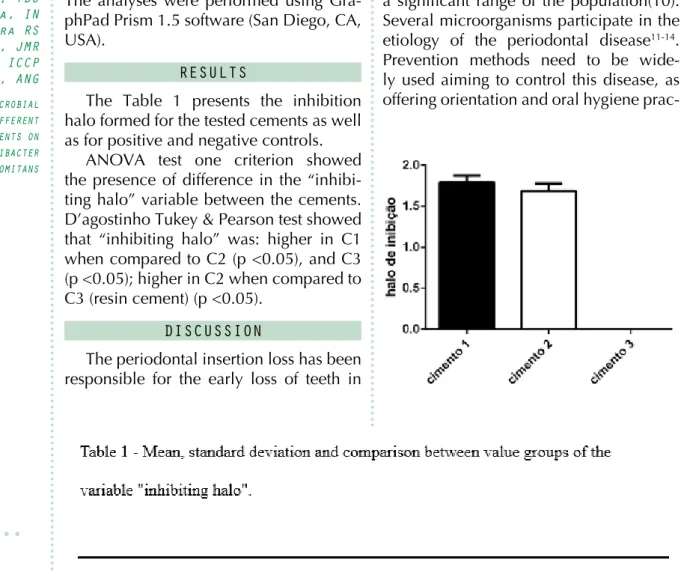
The Table 1 presents the inhibition halo formed for the tested cements as well as for positive and negative controls.
ANOVA test one criterion showed the presence of difference in the “inhibi-ting halo” variable between the cements. D’agostinho Tukey & Pearson test showed that “inhibiting halo” was: higher in C1 when compared to C2 (p <0.05), and C3 (p <0.05); higher in C2 when compared to C3 (resin cement) (p <0.05).
DISCUSSION
The periodontal insertion loss has been responsible for the early loss of teeth in
Figure 1 - Mean and standard deviation of the variable values “inhibiting halo”
a significant range of the population(10). Several microorganisms participate in the etiology of the periodontal disease11-14.
Prevention methods need to be wide-ly used aiming to control this disease, as offering orientation and oral hygiene
prac-Lima, TBS Souza, IN Oliveira RS Gusmão, JMR Gusmão, ICCP Antunes, ANG Antimicrobial activity of different dental cements on aggregatibacter actinomycetemcomitans
••
45
••
Rev. Odontol. Univ. Cid. São Paulo2016; 29(1): 42-7, jan-abr
tices12, and the use of specific
antimicro-bials.
In the classification of the periodontal diseases, the aggressive periodontitis is characterized by a rapid insertion loss in patients that do not present a biofilm com-patible with the evolution of the disease, and that present themselves without syste-mic changes15.
A actinomicetemcomitans participates in the etiology of the periodontitis agressi-va 5, so the control of this microorganism
becomes fundamental in the prevention and treatment of this disease.
The restoration and the maintenance of the periodontal health are fundamen-tal to obtain success in fixed prosthe-ses11. The use of fixed prostheses on
na-tural teeth presents a space between the tooth and the prosthesis that is filled with cement and is called cementation line. This space is externalized in the cervical margins of the crowns, usually extending subgingivally to a 0.5 mm limit. The sear-ching for the best possible adaptation has always been the goal for prosthodontists, as through that space bacterial infiltration can occur, causing decay and the perio-dontal disease.
Dental cements can actively participa-te in the prevention of periodontal disease by presenting antimicrobial activity. The results of this study were very useful from a scientific point of view, given that they show statistically significant values for the tested cements, with positivity zinc phos-phate cement and glass ionomer cement and with negativity for the resin cement for antibacterial activity. The founded values corroborate to those from Kla1 et al16 (2014) regarding the zinc phosphate
cement and the resin cement, but not in relation to the glass ionomer cement.
In the present study, zinc phosphate cement presented the highest antibacterial activity among the tested cements. That activity is certainly due to the presence of oxides in the composition of this material. This characteristic can be an indication for the use of such material at with risk pa-tients to the periodontal disease.
Although it is the most studied material among the tested sealers, the resin cement
did not present antibacterial activity, whi-ch is in line with the other studies descri-bed in the literature17, 18
.
The glass ionomer cement tested sho-wed antibacterial activity against A acti-nomycetemcomitans. This result is in ac-cordance with the results from19.
This studie show positive antibacterial activity for glass ionomer cements, and at-tribute this activity to fluoride release. This release occurs both in fresh state and after the polimerization, being more significant in the fresh state.
The glass ionomer pH also favors the antibacterial activity of this material20.
Authors present the results of studies that establish a correlation between low pH and fluoride release, that is, the lower the pH, the lower the fluoride concentration needed to develop antibacterial activi-ty20. In the current study the antibacterial
action of the glass ionomer cement was satisfactory with respect to A actinomyce-temcomitans, what suggests that the use of cement, besides of the zinc phosphate cement, is also suitable for the cementa-tion of fixed prostheses in patients with a history of periodontal disease.
The cements were evaluated in this study for a 48 hours period. Other studies with alternative methods, and for longer periods of time are needed to confirm the findings, however, the authors consider important the obtained results, because there were statistical differences between the tested cements with two materials pre-senting positive antimicrobial activity and one of them presenting negative activity, what makes this study important to be added to others in this important area of study of great clinical relevance in dental practice.
CONCLUSION
Considering the limitations of this stu-dy, we concluded that zinc phosphate cement and glass ionomer cement tested showed antibacterial activity against A actinomycetemcomitans unlike resin ce-ment and zinc phosphate cece-ment showed the highest antibacterial activity among the evaluated materials, being statistically superior to the others.
••
46
••
Lima, TBS Souza, IN Oliveira RS Gusmão, JMR Gusmão, ICCP Antunes, ANG Antimicrobial activity of different dental cements on aggregatibacter actinomycetemcomitans Rev. Odontol. Univ. Cid. São Paulo 2016; 29(1): 42-7, jan-abr1. Gasparetto A, Aarna-Chavez VE, Avila-Campos MJ. Aderência de Ac-tinobacillus actinomycetemcomitans às células epiteliais bucais: estabi-lidade e aspectos ultra-estruturais. Pesquisa Odontológica Brasileira. 2000;14(4):311-8.
2. Nakagawa RI, Guazeli-Amin VH, Hi-dalgo MM, Trevisan Jr. W, Itano EN. Anticorpos antileucotoxina contra Ac-tinobacillus actinomycetemcomitans em amostras de soro e saliva de pa-cientes com periodontite juvenil loca-lizada. Pesquisa Odontológica Brasi-leira. 2001;15(1):05-11.
3. Tan KS, Song KP, Ong G. Cytolethal distending toxin of Actinobacillus ac-tinomycetemcomitans. Occurrence and association with periodontal di-sease. Journal of periodontal research. 2002;37(4):268-72.
4. Van Hoogmoed CG, Geertsema-Door-nbusch GI, Teughels W, Quirynen M, Busscher HJ, Van der Mei HC. Reduc-tion of periodontal pathogens adhesion by antagonistic strains. Oral microbio-logy and immunomicrobio-logy. 2008;23(1):43-8.
5. Fine DH, Markowitz K, Fairlie K, Tis-chio-Bereski D, Ferrendiz J, Furgang D, et al. A consortium of Aggregatibacter actinomycetemcomitans, Streptococ-cus parasanguinis, and Filifactor alocis is present in sites prior to bone loss in a longitudinal study of localized aggres-sive periodontitis. Journal of clinical microbiology. 2013;51(9):2850-61. 6. Avila-Campos MJ, Simionato MRL, Cai
S, Mayer MPA, De Lorenzo JL, Zelante F. Virulence factors of Actinobacillus actinomycetemcomitans: other putati-ve factors. Pesquisa Odontológica Bra-sileira. 2000;14(1):05-11.
REFERÊNCIAS
7. Lima FLd, Farias FFd, Campos PC, To-tola AH, Tavares CAP, Costa JEd, et al. Leukotoxic activity of Actinobacillus actinomycetemcomitans isolated from human and non-human prima-tes. Brazilian Journal of Microbiology. 2001;32(3):250-6.
8. Yang HW, Huang YF, Chan Y, Chou MY. Relationship of Actinobacillus actinomycetemcomitans serotypes to periodontal condition: prevalence and proportions in subgingival plaque. European journal of oral sciences. 2005;113(1):28-33.
9. Faveri M, Figueiredo LC, Duarte PM, Mestnik MJ, Mayer MP, Feres M. Mi-crobiological profile of untreated subjects with localized aggressive pe-riodontitis. Journal of clinical perio-dontology. 2009;36(9):739-49.
10. Sanz M, Quirynen M. Advances in the aetiology of periodontitis. Group A consensus report of the 5th European Workshop in Periodontology. Journal of clinical periodontology. 2005;32 Suppl 6:54-6.
11. Flemmig TF, Sorensen JA, Newman MG, Nachnani S. Gingival enhance-ment in fixed prosthodontics. Part II: Microbiologic findings. The Journal of prosthetic dentistry. 1991;65(3):365-72.
12. Loe H, Theilade E, Jensen SB. Experi-mental gingivitis in man. The Journal of periodontology. 1965;36:177-87. 13. Newman MG, Socransky SS, Savitt
ED, Propas DA, Crawford A. Studies of the microbiology of periodonto-sis. The Journal of periodontology. 1976;47(7):373-9.
14. Lang NP. Commentary: bacteria play a critical role in the etiology of dontal disease. The Journal of perio-dontology. 2014;85(2):211-3.
15. Albandar JM. Aggressive periodontitis: case definition and diagnostic criteria. Periodontology 2000. 2014;65(1):13-26.
Lima, TBS Souza, IN Oliveira RS Gusmão, JMR Gusmão, ICCP Antunes, ANG Antimicrobial activity of different dental cements on aggregatibacter actinomycetemcomitans
••
47
••
Rev. Odontol. Univ. Cid. São Paulo2016; 29(1): 42-7, jan-abr
16. Klai S, Altenburger M, Spitzmuller B, Anderson A, Hellwig E, Al-Ahmad A. Antimicrobial effects of dental luting glass ionomer cements on Streptococ-cus mutans. TheScientificWorldJour-nal. 2014;2014:807086.
17. Orstavik D, Hensten-Pettersen A. An-tibacterial activity of tooth-colored dental restorative materials. Journal of dental research. 1978;57(2):171-4. 18. Qvist J, Qvist V, Lambjerg-Hansen
H. Bacteria in cavities beneath in-termediary base materials. Scandi-navian journal of dental research. 1977;85(5):313-9.
19. Scherer W, Lippman N, Kaim J. Antimi-crobial properties of glass-ionomer ce-ments and other restorative materials. Operative dentistry. 1989;14(2):77-81. 20. DeSchepper EJ, White RR, von der
Lehr W. Antibacterial effects of glass ionomers. American journal of dentis-try. 1989;2(2):51-6.
Recebido em 08/12/2016 Aceito em 18/04/2017