Aggregatibacter
actinomycetemcomitans
Outer Membrane
Vesicles
Thomas Kieselbach1, Vincent Zijnge2, Elisabeth Granström3, Jan Oscarsson3*
1Department of Chemistry, UmeåUniversity, Umeå, Sweden,2Center for Dentistry and Oral Hygiene, University Medical Center Groningen, Groningen, The Netherlands,3Oral Microbiology, Department of Odontology, UmeåUniversity, Umeå, Sweden
Abstract
Aggregatibacter actinomycetemcomitansis an oral and systemic pathogen associated with aggressive forms of periodontitis and with endocarditis. Outer membrane vesicles (OMVs) released by this species have been demonstrated to deliver effector proteins such as cyto-lethal distending toxin (CDT) and leukotoxin (LtxA) into human host cells and to act as trig-gers of innate immunity upon carriage of NOD1- and NOD2-active pathogen-associated molecular patterns (PAMPs). To improve our understanding of the pathogenicity-associated functions thatA.actinomycetemcomitansexports via OMVs, we studied the proteome of density gradient-purified OMVs from a rough-colony type clinical isolate, strain 173 (sero-type e) using liquid chromatography-tandem mass spectrometry (LC-MS/MS). This analysis yielded the identification of 151 proteins, which were found in at least three out of four inde-pendent experiments. Data are available via ProteomeXchange with identifier PXD002509. Through this study, we not only confirmed the vesicle-associated release of LtxA, and the presence of proteins, which are known to act as immunoreactive antigens in the human host, but we also identified numerous additional putative virulence-related proteins in theA.
actinomycetemcomitansOMV proteome. The known and putative functions of these pro-teins include immune evasion, drug targeting, and iron/nutrient acquisition. In summary, our findings are consistent with an OMV-associated proteome that exhibits several offensive and defensive functions, and they provide a comprehensive basis to further disclose roles ofA.actinomycetemcomitansOMVs in periodontal and systemic disease.
Introduction
Periodontal diseases are characterized by chronic inflammation of the gingiva, and progressive destruction of alveolar bone and supporting tissues around the teeth resulting in tooth loss [1]. Colonization by the Gram-negative human pathogenAggregatibacter actinomycetemcomitans
is strongly associated with aggressive forms of periodontitis in adolescents and young adults [2,3], and the organism also is a systemic pathogen, associated with non-oral infections such as endocarditis [4].
OPEN ACCESS
Citation:Kieselbach T, Zijnge V, Granström E, Oscarsson J (2015) Proteomics ofAggregatibacter actinomycetemcomitansOuter Membrane Vesicles. PLoS ONE 10(9): e0138591. doi:10.1371/journal. pone.0138591
Editor:Jens Kreth, University of Oklahoma Health Sciences Center, UNITED STATES
Received:June 27, 2015
Accepted:September 1, 2015
Published:September 18, 2015
Copyright:© 2015 Kieselbach et al. This is an open access article distributed under the terms of the Creative Commons Attribution License, which permits unrestricted use, distribution, and reproduction in any medium, provided the original author and source are credited.
Data Availability Statement:All relevant data are within the paper and its Supporting Information files.
The prevalence ofA.actinomycetemcomitansvaries widely with geographic origin, age and life style of a population [3,5]. Seven serotypes (a-g) exist, which form genetically divergent lin-eages [3,6]. Whole genome sequencing of 14A.actinomycetemcomitansstrains has disclosed a pangenome of 3301 genes (2034 core and 1267 flexible genes), and it showed that the difference between any two strains is 0.4–19.5% of the genomic content [7]. The mechanisms by whichA.
actinomycetemcomitanscauses periodontal attachment loss and systemic disease are not entirely known. As a highly leukotoxic clone (JP2; serotype b) is strongly linked to disease progression in North African adolescents [2,8], leukotoxin (LtxA) may have a major role in aggressive forms of periodontitis. Like HlyA ofEscherichia coli, LtxA is an RTX toxin, which selectively affects human cells of hematopoetic origin. It binds to the lymphocyte function associated receptor 1 (LFA-1) and causes disruption of the membrane integrity [9–12]. Moreover, similar to several other Gram-negative bacteria (e.g.Campylobacter jejuni,Escherichia coli,Salmonella enterica, and Shi-gella dysenteriae),A.actinomycetemcomitansproduces a cytolethal distending toxin (CDT), which kills host cells including gingival fibroblasts by blocking their proliferation [13–16]. In addi-tion to LtxA and CDT, accumulating evidence strongly suggests the importance of addiaddi-tional, yet undisclosedA.actinomycetemcomitansvirulence mechanisms in periodontitis [3,17,18].
It has been evident for decades that bacteria, archaea, and eukaryotes produce membrane vesicles (MVs). Membrane vesicles (“Type Zero secretion”) represent a very basic but relevant mode of protein export by bacteria, and are released by both commensals and pathogensin vivoand during infection of host cellsin vitro[19–23]. Vesicles from both Gram-negative and Gram-positive bacteria can carry out a number of offensive functions, including targeting con-centrated virulence factors, and inflammatory stimulants such as LPS and peptidoglycan frag-ments to host cells and tissues to manipulate the host immune response [24–30]. For
consistency, in this report vesicles liberated by Gram-negative organisms are referred to as outer membrane vesicles (OMVs). Biogenesis of OMVs is not known in great detail. They are generated as a result of the budding out of small portions of the outer membrane and the encapsulation of periplasmic components [31–33]. In chronic localized infections, such as peri-odontitis OMVs may represent an important source of inflammatory stimulants both locally and systemically, upon entry into the circulation [34,35]. For instance,A. actinomycetemcomi-tansOMVs can deliver biologically active virulence factors (CDT, OmpA) into HeLa cells and human gingival fibroblasts (HGF) [36]. In addition, the export of LtxA, peptidoglycan-associ-ated lipoprotein (Pal), and the chaperonin GroEL also involves OMVs [37–40]. We recently demonstrated thatA.actinomycetemcomitansOMVs carrying NOD1- and NOD2-active pepti-doglycan are internalized into non-phagocytic human cells including gingival fibroblasts [41], revealing a role of the vesicles as a trigger of innate immunity. Membrane vesicles also exhibit several defensive functions. For example, it was recently demonstrated thatVibrio cholerae
OMVs contribute to antimicrobial peptide resistance [42], and that biologically activeβ -lacta-mase is released via vesicles inStaphylococcus aureus[43]. There is also evidence that Morax-ella catarrhalisOMVs mediate immune evasion by inactivating complement factor C3 [44,45].
Accumulating knowledge from genomic, proteomic and transcriptomic analyses ofA. acti-nomycetemcomitansstrains provides novel, comprehensive information on virulence-related properties of this organism, and represents a good molecular basis for further disclosing its pathogenicity mechanisms and role in periodontal and systemic disease [7,18,46–48]. In recent years, several high-throughput proteomics studies have revealed the identity of vesicle proteins in an array of bacterial species [28,49]. However, the detailed composition of theA.
actinomycetemcomitansOMV proteome was not known. To improve our understanding of the virulence potential ofA.actinomycetemcomitansOMVs, we have used liquid chromatography-tandem mass spectrometry (LC-MS/MS) to identify the OMV-associated proteome of strain 173 (serotype e). This strain was selected because it was earlier assessed with respect to both design, data collection and analysis, decision to
publish, or preparation of the manuscript.
production of LtxA and CDT [17,50], which provides a basis for the analysis of unknown viru-lence-related proteins. In this study we identified 151 proteins in theA. actinomycetemcomi-tansOMV-associated proteome. In addition to confirming their immunoreactive potential, and leukotoxic activity, we provide a comprehensive overview of additional putative offensive and defensive mechanisms of the vesicles, which can serve as the groundwork for further dis-closing their role in periodontal and systemic disease.
Materials and Methods
Bacterial strains and growth conditions
TheA.actinomycetemcomitansserotype e strain, 173 (rough colony type) belongs to a strain collection sampled from an adolescent West African population, and was isolated from an indi-vidual with tooth attachment loss at baseline [50]. Strain D7SS is a smooth-colony derivative of D7S (serotype a), which was originally isolated from a patient with aggressive periodontal dis-ease [51]. Mutant derivatives of D7SS, D7SSΔltxAΔcdtABC[52], and D7SS-p (pal-deficient) [53] were constructed earlier. JP2 (serotype b) is a highly leukotoxic strain (serotype b) [54]. TheA.actinomycetemcomitansstrains were routinely cultivated in air supplemented with 5% CO2, at 37°C as previously described [39], on blood agar plates (5% defibrinated horse blood, 5
mg hemin/l, 10 mg Vitamin K/l, Columbia agar base).
SDS-PAGE and Western immunoblotting
The procedures used for SDS-PAGE and immunoblot analysis have been described previously [53,55]. Gels were stained using non-ammonical Silver-staining (BioRad). For Western blot experiments, we used a patient serum from a periodontitis subject, which exhibits strong reac-tivity toA.actinomycetemcomitansantigens [56] (final dilution 1:2,000). As a control, a serum sampled from a periodontally healthy,A.actinomycetemcomitans-negative individual was used (1:2,000). Polyclonal antisera made in rabbit againstE.coliGroEL protein (Sigma-Aldrich), and against wholeA.actinomycetemcomitansserotype e bacterial cells [57] were used at 1:8,000 and 1:10,000 final dilutions, respectively. As secondary antibody, human or anti-rabbit horseradish peroxidase (HRP)-conjugate (Jackson ImmunoResearch, Newmarket, UK) was used (1:10,000). Immunoreactive bands were visualized using Clarity™Western ECL Sub-strate (Bio-Rad) and the ChemiDoc™XRS+ System (Bio-Rad).
Isolation and purification of outer membrane vesicles
OMVs were isolated fromA.actinomycetemcomitanscells harvested from an average of ten blood agar plates, using ultracentrifugation as described earlier [36,41]. OMV pellets were washed twice with PBS (85,000 ×g; 2 h, 4°C) using a 70 Ti rotor (Beckman Instruments Inc.), and then used as the OMV preparation. The yield of OMVs was estimated by quantifying vesi-cle preparations for protein content using a Picodrop™(Picodrop Ltd.) [41]. To assess the uni-formity of OMV preparations, samples were validated by atomic force microscopy (AFM), and SDS-PAGE. OMVs were also checked for absence of bacterial contamination by cultivating small aliquots on blood agar plates in air supplemented with 5% CO2, at 37°C for 3 days. To
tube, and then different OptiPrep-HEPES layers were sequentially added as follows: 900μl of
35%, 900μl of 30%, 660μl of 25%, 660μl of 20%, 400μl of 15%, and 500μl of 10%. Gradients
were centrifuged at 180,000 ×g(3 h, 4°C) in an SW 60 Ti rotor (Beckman Instruments Inc.), and fractions of equal volumes (200μl) were removed sequentially from the top.
Preparation of OMV Samples for Liquid Chromatography Mass
Spectrometry (LC-MS/MS)
After SDS-PAGE analysis, selected fractions from the Optiprep density gradient were pooled into a total volume of 780μl. Subsequently, 400μl HEPES buffer (50 mM, pH 7.8) was added
to increase the pH to>7. For reduction of disulfide bonds, dithiotreitol (DTT) was added at 50
mM final concentration, and the sample was heated for 20 min at 60°C. For the alkylation reac-tion, iodacetamide (IAM) was added to the sample at a final concentration of 20 mM. After 60 min treatment in the dark, the OMV proteins were precipitated using trichloroacetic acid (TCA), and stored in -20°C overnight. The next day, the sample was centrifuged in a Beckman Coulter Avanti J-20 XP centrifuge (JA 18–1 Beckman Instruments Inc., California, USA) at 16,000 ×gfor 30 min at 4°C, followed by a subsequent washing step where the sample was cen-trifuged at 16,000 ×gfor 15 min with 80% ethanol. Finally, the OMV pellet was dried in air, and used for the preparation of an in-solution digest for LC-MS/MS analysis.
Preparation of in-solution digests of OMV proteins
A dried pellet of TCA-precipitated OMVs was resuspended in 15μl fresh 8 M urea and 20μl of
50 mM ammonium bicarbonate containing 0.2% ProteaseMaxTMsurfactant (Promega Biotech, Nacka, Sweden). The vesicle proteins were dissolved by shaking at 150 rpm for 20 min at 37°C. After the solubilization, 50μl of 50 mM ammonium bicarbonate, 10.4μl of Milli Q water, 1μl
of 50 mM ammonium bicarbonate containing 1% ProteaseMax surfactant, and 3.6μl of 0.5μg/ μl trypsin stock solution (sequencing grade trypsin, Promega Biotech, Nacka, Sweden) were
added. The final concentrations were 40 mM ammonium bicarbonate, 0.05% ProteaseMax sur-factant, 1.2 M urea and 18 ng/ml of trypsin in a volume of 0.1 ml. To generate peptides for mass spectrometry the in-solution digestion was performed for either 1 to 1.5 hours at 50°C or for 2 to 3 hours at 37°C [59]. Finally, the digestion was stopped by addition of 10% trifluoroace-tic acid to a final concentration of 0.5–1.0%, and the peptides were desalted using homemade reversed phase micro columns [60,61]. The bound peptides were eluted using 0.1% formic acid containing 50% acetonitrile. The solvent was removed using a speedvac and the peptides were dissolved in 0.1% formic acid for further analysis by mass spectrometry.
LC-MS/MS analysis and data processing
The peptides generated by in-solution digestion were analyzed by LC-MS/MS (DDA, 5 MS/MS channels) using a Synapt G2 mass spectrometer (Waters, Sollentuna, Sweden) linked to a nano UPLC (Waters, Sollentuna, Sweden). Separation of the peptides was performed by C18nano
actinomycetemcomitansserotype e strain SC1083, which is available at Ensembl Bacteria at: http://bacteria.ensembl.org/aggregatibacter_actinomycetemcomitans_serotype_e_str_sc1083/ Info/Index. This database was selected because the genome of strain 173 was not available, and it contained the gene models from a strain of the same serotype. The search parameters permit-ted mass errors of 20 ppm (MS mode) and 0.1 Da (MS/MS mode), respectively. Modifications included variable oxidation of methionine, N-terminal acetylation, deamidation (N,Q) and fixed cysteine derivation by carbamidomethylation. The false discovery rate was<1%.
Compi-lation of non-redundant protein lists was performed using the Protein Extractor of the Protein-Scape server (version 3, Bruker Daltonik GmbH, Bremen, Germany). Ion scores of individual MS/MS spectra lower than 30 and Mascot protein scores lower than 100 were not considered for the compilation of the results. The LC-MS/MS analysis was performed with four indepen-dent OMV preparations. The mass spectrometry proteomics data have been deposited to the ProteomeXchange Consortium [62] via the PRIDE partner repository with the dataset identi-fier PXD002509 and 10.6019/PXD002509.
Bioinformatics analysis of the LC-MS/MS results
The final result list was assembled using the proteins that were detected in at least three of the four OMV preparations that were analyzed. It included 151 proteins that were sorted according to their Clusters of Orthologous groups (COG) categories. COG groups were created manually by using the gene identifiers for searches in the COG database athttp://www.ncbi.nlm.nih.gov/ Structure/cdd/wrpsb.cgi. The COG classifiers were grouped according to the definitions in the conserved domains database at National Center for Biotechnology Information (NCBI) [63]. The subcellular locations of the identified proteins were predicted using the program PSORT3b 3.0 [64], and members of KEGG pathways were identified using the KOBAS 2.0 server [65] and the annotations of theA.actinomycetemcomitansstrain D7S genome as a template. The proteins were also subject toin silicoanalysis using VirulentPred (http://203.92.44.117/ virulent/submit.html), which predicts bacterial virulence proteins based on their sequences information [66].
Atomic Force Microscopy
For AFM, samples of OMVs were diluted with ultrapure water (Millipore) and placed onto a freshly cleaved mica surface. Samples were incubated for 5 min at room temperature, washed with ultrapure water, and then placed in a desiccator for ~2 h in order to dry. The samples were finally magnified through a Nanoscope V Atomic Force Microscope (Bruker AXS GmbH, Karlsruhe, Germany), using tapping mode. Final images were plane fitted in both thexandy
axes and are presented in amplitude mode.
Cell cultures and determination of leukotoxic activity of OMVs
Human myeloid monocytic THP-1 (ATCC 16) cells were cultivated in RPMI 1640 (Sigma-Aldrich, St Louis, MI, USA) with 10% fetal bovine serum (FBS) (Sigma-Aldrich) at 37°C in 5% CO2. Leukotoxic activity ofA.actinomycetemcomitansOMVs was determined by quantitating
the release of lactate dehydrogenase (LDH) from treated THP-1 cells as described earlier [17, 67]. In brief, aliquots of 100μl (1×10⁶cells per ml) of phorbol 12-myristate 13 acetate
(PMA)-differentiated THP-1 cells were incubated with OMVs for 120 min such that the final OMV protein concentration was 100μg/ml. As control treatment, PBS buffer was used. The release
Results and Discussion
Purification of OMVs from the
A.
actinomycetemcomitans
serotype e
strain 173
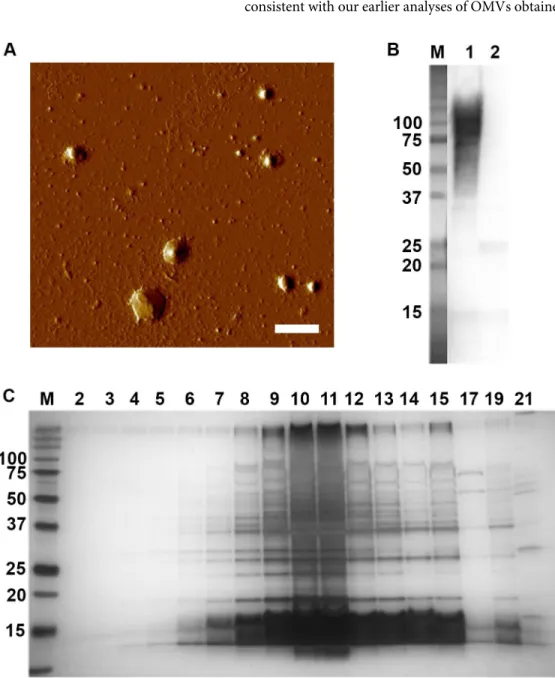
To study outer membrane vesicle release byA.actinomycetemcomitans, vesicles were purified from strain 173 cells grown on agar (Fig 1A). The seroreactivity of the isolated OMVs was con-firmed using a rabbit antiserum made against wholeA.actinomycetemcomitansserotype e bac-terial cells (Fig 1B). SDS-PAGE analysis of density gradient fractions of OMVs revealed a major population of OMVs, peaking approximately in the fractions 8 to 12 (Fig 1C), which is consistent with our earlier analyses of OMVs obtained from variousA.actinomycetemcomitans
Fig 1. Purification of OMVs fromA.actinomycetemcomitansstrain 173.(A) Atomic force micrograph of OMVs obtained from strain 173 after density gradient centrifugation. Bar = 300 nm. (B) Reactivity of the isolated strain 173 OMVs (lane 1) to a rabbit antiserum made against wholeA.
actinomycetemcomitansserotype e bacterial cells. OMVs from strain D7SS (serotype a) are loaded in lane 2. Samples equal to 10μg protein were applied on the gel. (C) SDS-PAGE analysis of density gradient fractions of strain 173 OMVs. Fractions (15μl loaded on the gel) are numbered according to increasing density. The central fractions (8–12) were pooled and subject to LC-MS/MS analysis. The sizes (kDa) of the proteins in the pre-stained molecular weight marker (M) are indicated along the left side of the gels in panel B, and C. The images show one representative experiment.
strains [36]. To identify the proteins of the purified OMVs of strain 173, the central fractions (8–12) were pooled and used for further analysis by LC-MS/MS. The analysis of the OMV pro-teome included four independent preparations.
Identification of
A.
actinomycetemcomitans
strain 173 OMV proteins by
LC-MS/MS, and their predicted subcellular distribution
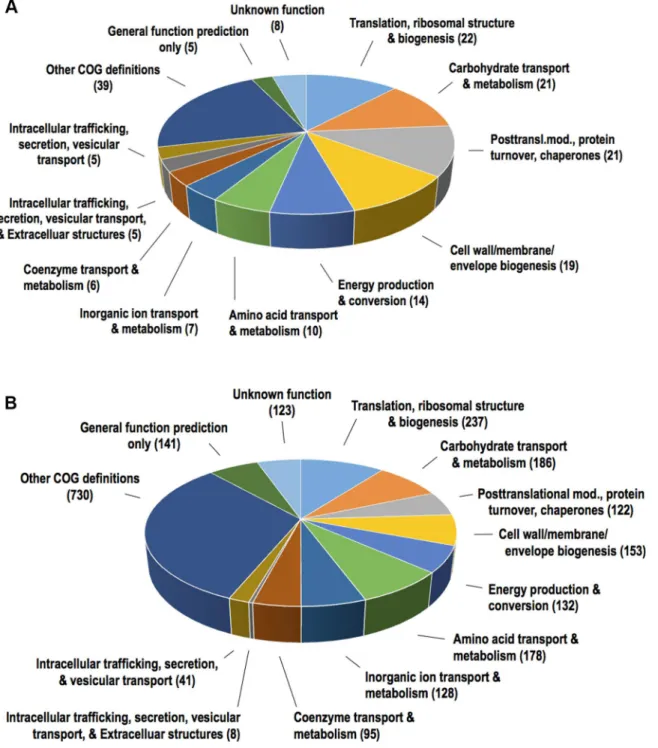
In total, 504 proteins were identified by LC-MS/MS in at least one of the four analyzed inde-pendent preparations ofA.actinomycetemcomitansstrain 173 OMVs. Out of these proteins, 151 were present in three of the four preparations analyzed, and defined as the OMV proteome in the present study (S1 Fig,S1andS2Tables). The number of 151 identified proteins is within the range of proteins detected in several high-throughput analyses of bacterial vesicle prote-omes [28,49]. To predict the subcellular localizations of the OMV proteins, PSORT3b 3.0 was used. According to our findings (Fig 2A), of the 151 proteins of the OMV proteome, two were predicted to be extracellular, 19 to be located in the outer membrane, 7 to be periplasmic, 23 to
Fig 2. Proportions of predicted subcellular locations of theA.actinomycetemcomitansstrain 173 OMV proteins identified by LC-MS/MS using PSORT3b.(A) Predicted subcellular locations of the 151 OMV proteins that were identified in at least three out of four independent vesicle preparations that were analyzed. (B) Predicted subcellular locations of all 2161 proteins encoded in the genome database ofA. actinomycetemcomitansserotype e strain SC1083 that was used for the database searches of the LC-MS/ MS analyses.
be located in the inner membrane, and 78 to be cytoplasmic. The relative proportions of proteins with predicted locations in the outer membrane and in the periplasm were found to be substan-tially higher among the 151 proteins than among the entire set of 2161 proteins encoded in the
A.actinomycetemcomitansserotype e genome that was used for the database searches of the LC-MS/MS analyses (Fig 2B). This is in accordance with an enrichment of proteins derived from these subcellular fractions in OMVs. Identification of relatively large numbers of cytoplasmic proteins in OMVs was also observed in several other recent studies, even though the vesicles were purified using a density gradient [68–71]. Based on such observations it has been suggested that some cytoplasmic proteins may in fact be sorted into bacterial membrane vesicles [49,72]. It is an area for future research to disclose mechanisms how and why these proteins might be selected for export via vesicles, and how vesicles incorporate other cytosolic material such as nucleic acid fragments [73–75]. One plausible mechanism might be the formation of double bilayered outer-inner membrane vesicles, as was demonstrated forShewanella vesiculosa[76]. The observation that cytoplasmic proteins are present in OMV proteomes may also be due to that some of these proteins exhibit moonlighting capacities [77]. Moonlighting proteins comprise a subclass of multifunctional proteins in which more than one biochemical or biophysical func-tion is contained within one polypeptide chain [78]. Moreover, presence of cytoplasmic proteins in OMV proteomes may be a result of cell lysis. However, among the proteins identified by LC-MS/MS (S1andS2Tables) we did not detect the cyclic nucleotide-binding domain protein (also known as cyclic AMP receptor protein [CRP]; GI:347994078), which is frequently used as a lysis marker in our studies for assessing the release of proteins byA.actinomycetemcomitans
strains [18,39,79]. Notably, CRP was not detected in the extracellular medium ofA. actinomyce-temcomitansstrain D7S cultivated as biofilm for up to 3 days, but could be released upon deliber-ate lysis of the bacterial cells [39,79]. Therefore, absence of CRP in our present OMV
preparations would argue against protein release due to bacterial lysis.
Functional classification of proteins identified in
A.
actinomycetemcomitans
strain 173 OMVs
To determine putative functions of the 151 proteins in the strain 173 OMV proteome, they were sorted according to their Cluster of Orthologous Groups (COG) definitions (Fig 3A). The group of 151 vesicle proteins had 182 of the 2274 COG definitions present in the database of the gene mod-els ofA.actinomycetemcomitansserotype e strain SC1083 (Fig 3B,S4 Table). The four largest COG groups recognized in the OMV proteome were found to be translation, ribosomal structure and biogenesis (22 of 237 COG definitions), carbohydrate transport and metabolism (21 of 186), post-translational modification, protein turnover, and chaperone activity (21 of 153), and cell wall, membrane, and envelope biogenesis (19 of 153). The relative abundance ratios of these COG groups were clearly higher in the OMV proteome than in the entire genome ofA. actinomycetem-comitansserotype e strain SC1083. In particular, the group of post-translational modification, protein turnover, and chaperones stood out, accounting for 11.5% of the COG definitions in the experimental OMV proteome as compared to 5.5% of the entire genome. Taken together, these findings indicate that the OMV proteome may exhibit specific functions. This result is similar to COG categorization of the OMV proteomic content in a number of other species, e.g.C.jejuni, and
Edwardsiella tarda[80,81], and of cell envelope fractions ofA.actinomycetemcomitanscells [82].
by LC-MS/MS were manually searched for their earlier reported involvement inA. actinomyce-temcomitansoffense and defense, and in other bacteria. As summarized below, this screening revealed 49 proteins of particular interest (Table 1). As a complement to the literature search, the 151 vesicle proteins were also subject toin silicoanalysis using VirulentPred, an algorithm
Fig 3. Functional classification ofA.actinomycetemcomitansstrain 173 OMV proteins.The 151 OMV proteins that were identified by LC-MS/MS in three out of four of the vesicle preparations were sorted according their COG groups as indicated. (A) This figure shows the proportions of the major groups of COG domains that were found in the OMV proteins, which were identified in this study. In total 182 COG domains were found in the 151 proteins. (B) This figure shows the corresponding COG domains that are present in the entire set of gene models of the genome ofA.actinomycetemcomitansserotype e strain SC1083. The 2161 gene models of this strain contained 2274 COG domains.
developed to predict putative novel virulence factors (S3 Table). Using this approach 60 of the OMV proteins (40%) were predicted to be associated with virulence, including most of the
proteins revealed in the initial literature search. Our findings suggest thatA. actinomycetemco-mitansOMVs may exhibit several offensive and defensive functions analogous to those described in recent reviews, including immune evasion, drug targeting, and iron/nutrient acquisition [28–30].
Immunoreactivity and proinflammatory activity
According to our data, the strain 173 OMV proteome contains several proteins earlier demon-strated to act as immunoreactive antigens in the human host. LtxA, Omp39, RcpA (referred to as GspD in the database used; GI:347992426), RcpC (FlpC; GI:347992425), TadA, TadD, TadZ (FlpD; GI:347992428), and YaeT (also known as BamA) were recognized exclusively by anti-bodies in sera from subjects with a provenA.actinomycetemcomitansinfection [47]. Moreover, the OmpA-like protein (GI:347991272; also referred to as Omp29 or Omp34), which is a major protein component ofA.actinomycetemcomitansOMVs [40], is immunoreactive in patients with periodontitis, and so are Omp18/16, Omp100 (GI:347992912; also referred to ApiA) [53, 83–85]. The ability of Pal to elicit proinflammatory responses in human cells has been demon-strated [39,79]. There is also evidence that Omp100 induces the expression of proinflamma-tory cytokinesin vitro[86]. Finally, GroEL is implicated as an immunodominantA.
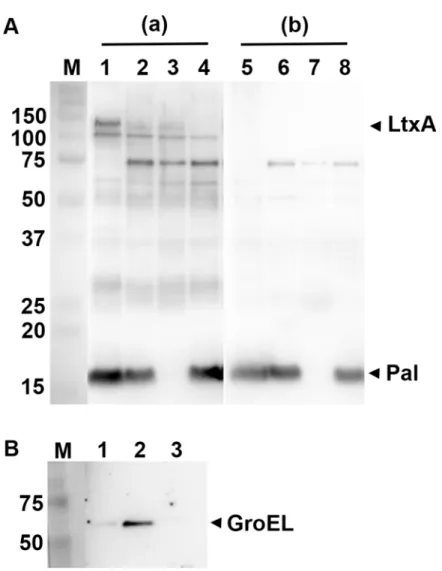
actinomycetemcomitansantigen, which promotes epithelial cell proliferation [38,87–89]. Car-riage of GroEL by OMVs also suggests the possibility that vesicles may contribute to alveolar bone resorption [87,90]. Western blot analysis was used to corroborate our LC-MS/MS find-ings. In contrast to a control serum from anA.actinomycetemcomitans-negative subject, which mainly produced faint signals, anA.actinomycetemcomitans-responsive patient serum strongly reacted to a number of proteins in strain 173 OMV preparations, including LtxA and Pal (Fig 4A). The observation that Pal is a major immunoreactive antigen of the vesicles is in line with patterns of patient serum reactivity toA.actinomycetemcomitansouter membrane protein preparations [53]. Likewise, the relatively strong reactivity of the control serum to Pal (Fig 4A) is consistent with presence of cross-reacting antibodies to Pal produced by other oral and/or non-oral Gram-negative species [53]. We deduced that the60 kDa immunoreactive band
Table 1. Virulence-related mechanisms ofA.actinomycetemcomitansvesicles as suggested by proteins identified in the strain 173 OMV prote-ome.The 151 proteins of the strain 173 OMV proteome identified by LC-MS/MS were manually searched for their earlier reported involvement inA. actino-mycetemcomitansoffense and defense, and in other bacteria. The listed proteins are discussed in the main text.
Type of OMV function Shown forA.actinomycetemcomitansproteina) Shown for paralogue in other bacteria, or predicted based
on protein amino acid sequence
Immunoreactivity and/or proinflammatory activity
GroEL, LtxA, OmpA-like protein, Omp18/16, Omp39, Omp100, Pal, RcpA, RcpC, TadA, TadD, TadZ, YaeT
OmpA
Cytotoxicity LtxA, GroEL OmpA-like protein, OmpA
Adhesion/invasion Omp100, RcpA, RcpB, RcpC, TadA, TadD, TadE, TadF, TadG, TadZ
Immune evasion BilR1, Omp100 Factor H-binding protein, OmpA-like protein, OmpA
Drug targeting TdeA AcrA, DNA gyrase, elongation factor G, organic solvent
tolerance protein, penicillin-binding protein 1A, ribosomal proteins (n = 16), RNA polymerase, TolB
Scavenging of iron and nutrients
Ferric transporter ATP-binding subunit, Ferritin-like protein, Omp64, putrescine/spermidine ABC transporter ATPase protein, TonB-dependent siderophore receptor
a)
Full protein descriptions as appearing in the genome database used, and their accession numbers are listed inS1,S2, andS3Tables.
(Fig 4A) might correspond to GroEL, as this protein was detected in the OMVs using a GroEL-specific rabbit antiserum (Fig 4B). A membrane vesicle preparation fromStaphylococcus aureus
strain 8325–4 [91] was here loaded as a negative control for GroEL, as this protein, which appears to be essential for bacterial growth [92], was not identified inS.aureusmembrane vesi-cle proteomes [93,94]. In summary, our observations support the notion that theA. actinomy-cetemcomitansOMV proteome represents a potent source of multiple proinflammatory stimulants. Our data also suggest a potential role ofA.actinomycetemcomitansOMVs as immunogens for vaccines against periodontal disease, in a similar manner as vesicles from Por-phyromonas gingivalis, which carry several proteins exhibiting strong immunogenicity in a mouse vaccine model [95,96].
Fig 4. Immunoreactivity ofA.actinomycetemcomitansOMVs.(A) Western blot analysis of reactivity of human sera with OMVs obtained from theA.actinomycetemcomitansstrains 173 (lanes 1 and 5), D7SS (lanes 2 and 6), D7SS-p (Δpal; lanes 3 and 7), and D7SSΔltxAΔcdtABC(lanes 4 and 8). AnA.
actinomycetemcomitans-responsive serum from a periodontitis subject (a) and from a periodontally healthy, A.actinomycetemcomitans-negative individual (b) was used for the immunodetection, respectively. (B) Western blot detection using a polyclonal antiserum specific forE.coliGroEL. Vesicles obtained fromA. actinomycetemcomitansstrains 173 (lane 1), and D7SS (lane 2), and fromS.aureusstrain 8325–4 [91] (lane 3) were analyzed. Samples equal to 10μg protein were applied on the gels. Reactive bands corresponding to LtxA, Pal, and GroEL are indicated with arrowheads. The sizes (kDa) of the proteins in the pre-stained molecular weight marker (M) are indicated along the left side.
Cytotoxicity: Leukotoxic activity
LtxA was identified in OMVs from the serotype e strain 173, which is consistent with earlier reports assessing vesicles derived from serotype a, and b strains [36,40]. To confirm the pres-ence of biologically active LtxA in the strain 173 OMVs, lysis of THP-1 cells incubated with vesicles was quantitated using an LDH release assay (Materials and Methods). This revealed that OMVs from strain 173 exhibited leukotoxic activity, albeit at a level approximately four times lower than vesicles from the highly leukotoxic strain JP2 (Fig 5). This relative difference in leukotoxicity is consistent with observations assessing extracts from these twoA. actinomy-cetemcomitansstrains [17]. The leukotoxicity of strain 173 OMVs was similar to that of vesicles from D7SS, which is considered a minimally leukotoxic strain [97]. Among the identified vesi-cle proteins, also GroEL may contribute to OMV cytotoxicity as judged by the deleterious effect of this protein on human epithelial cells [38]. It is not known if the OmpA-like protein
Omp29/Omp34, or its paralogue OmpA (GI:347992918) may play a role in OMV cytotoxicity towards human cells as has been demonstrated with the nosocomial pathogenAcinetobacter baumanii[98]. We note that CDT was not identified in the strain 173 OMV proteome, whereas this toxin is evidently released in association with vesicles by a number of otherA. actinomyce-temcomitansstrains of serotypes a, b, and c [36]. This is consistent with observations that strain 173 lacks cytolethal distending activity, which appears to be due to an incomplete subset of the
cdt-encoding genes [50].
Adhesion and invasion
A number of proteins that may contribute to adherence of vesicles to host cells were identified in the strain 173 OMV proteome. Omp100 promotes adhesion ofA.actinomycetemcomitans
cells, and their invasion of human gingival keratinocytes [86,99]. Moreover, RcpA, RcpB, RcpC, RadZ, TadA, TadD, TadE, TadF, and TadG are components of theA. actinomycetemco-mitans tad(tight adherence) gene locus, which mediates adhesion, and is required for virulence in a rat model for periodontal disease [100]. Recent evidence has supported the internalization ofA.actinomycetemcomitansOMVs into non-phagocytic human cells such as gingival fibro-blasts [41]. However, it is not known whether specific OMV-associated adhesins would be
Fig 5. Leukotoxic activity of OMVs obtained from the indicatedA.actinomycetemcomitansstrains.
THP-1 cells were incubated with OMVs (final concentration: 100μg/ml) for 120 min. Release of LDH was determined as described in Materials and Methods, and is expressed as % of the maximal release (100%) caused by incubation with 0.1% Triton X-100. The results shown are means + standard error of the means (SEM) from three independent experiments.
involved in adherence of the vesicles to host cells, comparable to the roles ofHelicobacter pylori
BabA, SabA, and VacA,M.catarrhalisUspA1, andPseudomonas aeruginosaaminopeptidase [28,29].
Immune evasion
A subset of proteins that may play a role in immune suppression and evasion were identified in the strain 173 OMV proteome. A hypothetical protein (GI: 347993884) exhibits86% amino
acid identity to BilR1, which is a recently recognizedA.actinomycetemcomitansIL-1β-binding lipoprotein [101]. Carriage of such receptor by OMVs suggests that they might enhance bacte-rial immune evasion by sequestering IL-1βto reduce inflammation.A.actinomycetemcomitans
strains are typically resistant to killing by human serum [86], and our present results suggest the possibility that OMVs may play a role in serum survival. For example, Omp100 was dem-onstrated to be important for serum resistance ofA.actinomycetemcomitansstrain IDH781 (serotype d), which appeared to be a result of Omp100-mediated binding of Factor H to the bacterial surface [86]. Moreover, we identified factor H-binding protein, a paralogue to the protein ofNeisseriaspp. that is critical for survival of meningococci in the human host [102]. Whether theA.actinomycetemcomitansfactor-H binding protein might play a similar func-tional role is not known. Also OmpA might interact with human serum factors to contribute to serum resistance, analogously to findings obtained usingA.baumannii, andE.colibacterial cells [103,104].
Drug targeting
The strain 173 OMV proteome was found to contain proteins that could bind to/serve as tar-gets for drugs. There are antibiotics that directly target DNA gyrase [105], elongation factor G [106], organic solvent resistance protein (also known as LptD or Imp/OstA) [107], penicillin-binding protein 1A [108], and RNA polymerase [109]. Also, TolB is a potential drug target [110]. Identification of ribosomal proteins in the OMV proteome is in accordance with detec-tion of rRNA fragments in OMVs from other organisms [74]. Our findings are also consistent with other proteomics studies on vesicles from various bacterial species, e.g.S.aureusandP.
aeruginosa[93,94,111]. For example ribosomal protein S12 was identified in such studies, which is bound by several antibiotics including aminoglycosides [111,112]. Whether presence of such drug target proteins in vesicles would play a functional role during infection is not known. However, intriguingly, it was shown that the aminoglycoside gentamicin bound to the surface of tentative OMVs ofP.aeruginosa[113]. Hence, vesicles may have the ability to bind directly with some antibiotics, thereby lowering their local free concentrations, contributing to protection of the bacterial cell. Efflux systems, analogously might function as binding proteins for their substrates in OMVs. Among such proteins in the OMV proteome, TdeA is a TolC-like protein that is required for secretion of LtxA, and resistance to antimicrobial compounds. As judged by homology, this protein may represent a component of a drug efflux porin system inA.actinomycetemcomitans[114]. Similarly, AcrA is a component of the tripartite AcrAB--TolC multidrug efflux pump, which is well characterized inE.coli[115,116].
Scavenging of iron and nutrients
consistent with a number of previous proteomics studies of OMVs, identifying vesicle-associ-ated TonB-dependent receptors, metal ion binding proteins, ABC transporters, and machiner-ies for ATP synthesis, supporting the idea that OMVs may collect and concentrate scarce ions and nutrients for the consumption of bacterial cells [28,49,71,117,118]. Interestingly, such a role of OMVs, also allowing intraspecies nutrient transfer was recently demonstrated regarding carbon flux between several species of bacteria and cyanobacteria [119].
Conclusions
In conclusion, we have characterized the OMV-associated proteome of the roughA. actinomy-cetemcomitansserotype e strain, 173 by LC-MS/MS, and used manual literature search and the VirulentPred algorithm to assess the virulence potential of this subproteome. To the best of our knowledge, this work represents the first proteomic study of purifiedA. actinomycetemco-mitansOMVs. Apparently, the virulence potential may be subject to variation amongA. acti-nomycetemcomitansstrains, including their released OMVs. As an example, CDT was not identified in the strain 173 OMV proteome, whereas this toxin is evidently released in associa-tion with vesicles by a number of otherA.actinomycetemcomitansstrains. Nevertheless, our results suggest that a reasonably large part of the OMV proteins may contribute to the viru-lence potential of the vesicles. Such proteins include established viruviru-lence factors like LtxA, and major antigens such as Pal, which is also suggesting a potential role ofA. actinomycetemco-mitansOMVs as immunogens for future vaccines against periodontal disease. Moreover, by identifying numerous additional putative virulence-related proteins in the vesicle proteome, our work lays the molecular groundwork for novel mechanistical studies that for instance could elucidate the roles ofA.actinomycetemcomitansOMVs in immune evasion, drug target-ing, and iron/nutrient acquisition. Finally, as compared to several recent high-throughput pro-teomics studies on OMVs, we identified relatively large numbers of cytoplasmic proteins in the vesicles, and we conclude that it is an area of interest for future research to disclose mecha-nisms how such proteins might be targeted for vesicle export.
Supporting Information
S1 Fig. Venn diagram obtained from the comparison of the LC-MS/MS-identified proteins of the four independentA.actinomycetemcomitansstrain 173 OMV preparations.In total 504 proteins were identified, out of which 151 were present in at least three out of the four preparations that were analyzed.
(TIF)
S1 Table. Proteins identified by LC-MS/MS in at least one of the four independent OMV preparations ofA.actinomycetemcomitansstrain 173.In total, 504 proteins were identified. (XLSX)
S2 Table. Proteins identified by LC-MS/MS in at least three out of four independent OMV preparations ofA.actinomycetemcomitansstrain 173.A total of 151 proteins were identified. (XLSX)
S3 Table. VirulentPred screening of the 151 proteins in theA.actinomycetemcomitans
strain 173 OMV proteome.Where available, references are included that support virulence-related activities of theA.actinomycetemcomitansproteins and/or their paralogues in other bacterial species.
S4 Table. COG definitions for all gene models ofA.actinomycetemcomitansserotype e strain SC1083 according to NCBI.
(XLSX)
Acknowledgments
We are grateful to Dr. Anders Johansson, Department of Odontology, Umeå University for kindly providing theA.actinomycetemcomitansstrain 173, THP-1 cells, and patient sera.
Author Contributions
Conceived and designed the experiments: TK JO. Performed the experiments: TK EG. Ana-lyzed the data: TK VZ EG JO. Contributed reagents/materials/analysis tools: TK JO. Wrote the paper: TK VZ JO.
References
1. Darveau RP. Periodontitis: a polymicrobial disruption of host homeostasis. Nat Rev Microbiol. 2010; 8: 481–490. PMID:20514045. doi:10.1038/nrmicro2337
2. Haubek D, Ennibi OK, Poulsen K, Vaeth M, Poulsen S, Kilian M. Risk of aggressive periodontitis in adolescent carriers of the JP2 clone ofAggregatibacter(Actinobacillus)actinomycetemcomitansin Morocco: a prospective longitudinal cohort study. Lancet. 2008; 371: 237–242. PMID:18207019. doi: 10.1016/S0140-6736(08)60135-X
3. Henderson B, Ward JM, Ready D.Aggregatibacter(Actinobacillus)actinomycetemcomitans: a triple A*periodontopathogen? Periodontol 2000. 2010; 54: 78–105. PMID:20712635. doi: 10.1111/j.1600-0757.2009.00331.x
4. van Winkelhoff AJ, Slots J.Actinobacillus actinomycetemcomitansandPorphyromonas gingivalisin nonoral infections. Periodontol 2000. 1999; 20:122–135. PMID:10522225.
5. Haubek D. The highly leukotoxic JP2 clone ofAggregatibacter actinomycetemcomitans: evolutionary aspects, epidemiology and etiological role in aggressive periodontitis. APMIS Supplementum. 2010; Sep( 130): 1–53. PMID:21214629. doi:10.1111/j.1600-0463.2010.02665.x
6. Tsuzukibashi O, Saito M, Kobayashi T, Umezawa K, Nagahama F, Hiroi T, et al. A gene cluster for the synthesis of serotype g-specific polysaccharide antigen inAggregatibacter actinomycetemcomitans. Arch Microbiol. 2014; 196: 261–265. PMID:24562973. doi:10.1007/s00203-014-0965-3
7. Kittichotirat W, Bumgarner RE, Asikainen S, Chen C. Identification of the pangenome and its compo-nents in 14 distinctAggregatibacter actinomycetemcomitansstrains by comparative genomic analy-sis. PLoS One. 2011; 6: e22420. PMID:21811606. doi:10.1371/journal.pone.0022420
8. HöglundÅberg C, Kwamin F, Claesson R, Dahlen G, Johansson A, Haubek D. Progression of attach-ment loss is strongly associated with presence of the JP2 genotype ofAggregatibacter actinomyce-temcomitans: a prospective cohort study of a young adolescent population. J Clin Periodontol. 2014; 41: 232–241. PMID:24304011. doi:10.1111/jcpe.12209
9. Johansson A.Aggregatibacter actinomycetemcomitansleukotoxin: a powerful tool with capacity to cause imbalance in the host inflammatory response. Toxins (Basel). 2011; 3: 242–259. PMID: 22069708.
10. Lally ET, Golub EE, Kieba IR, Taichman NS, Rosenbloom J, Rosenbloom JC, et al. Analysis of the Actinobacillus actinomycetemcomitansleukotoxin gene. Delineation of unique features and compari-son to homologous toxins. J Biol Chem. 1989; 264: 15451–15456. PMID:2670940.
11. Munksgaard PS, Vorup-Jensen T, Reinholdt J, Söderström CM, Poulsen K, Leipziger J, et al. Leuko-toxin fromAggregatibacter actinomycetemcomitanscauses shrinkage and P2X receptor-dependent lysis of human erythrocytes. Cell Microbiol. 2012; 14: 1904–1920. PMID:22906303. doi:10.1111/ cmi.12021
12. Simpson DL, Berthold P, Taichman NS. Killing of human myelomonocytic leukemia and lymphocytic cell lines byActinobacillus actinomycetemcomitansleukotoxin. Infect Immun. 1988; 56: 1162–1166. PMID:3258584.
14. DiRienzo JM. Breaking the Gingival Epithelial Barrier: Role of theAggregatibacter actinomycetemco-mitansCytolethal Distending Toxin in Oral Infectious Disease. Cells. 2014; 3: 476–499. PMID: 24861975. doi:10.3390/cells3020476
15. Guerra L, Cortes-Bratti X, Guidi R, Frisan T. The biology of the cytolethal distending toxins. Toxins (Basel). 2011; 3: 172–190. PMID:22069704.
16. Tan KS, Song KP, Ong G. Cytolethal distending toxin ofActinobacillus actinomycetemcomitans. Occurrence and association with periodontal disease. J Periodontal Res. 2002; 37: 268–272. PMID: 12200970.
17. HöglundÅberg C, Haubek D, Kwamin F, Johansson A, Claesson R. Leukotoxic Activity of Aggregati-bacter actinomycetemcomitansand Periodontal Attachment Loss. PLoS One. 2014; 9: e104095. PMID:25093857. doi:10.1371/journal.pone.0104095
18. Zijnge V, Kieselbach T, Oscarsson J. Proteomics of protein secretion byAggregatibacter actinomyce-temcomitans. PLoS One. 2012; 7: e41662. PMID:22848560. doi:10.1371/journal.pone.0041662
19. Birdsell DC, Cota-Robles EH. Production and ultrastructure of lysozyme and ethylenediaminetetraac-etate-lysozyme spheroplasts ofEscherichia coli. J Bacteriol. 1967; 93: 427–437. PMID:4960155.
20. Deatherage BL, Cookson BT. Membrane vesicle release in bacteria, eukaryotes, and archaea: a con-served yet underappreciated aspect of microbial life. Infect Immun. 2012; 80: 1948–1957. PMID: 22409932. doi:10.1128/IAI.06014-11
21. Dorward DW, Garon CF. DNA Is Packaged within Membrane-Derived Vesicles of Gram-Negative but Not Gram-Positive Bacteria. Appl Environ Microbiol. 1990; 56: 1960–1962. PMID:16348232.
22. Knox KW, Vesk M, Work E. Relation between excreted lipopolysaccharide complexes and surface structures of a lysine-limited culture ofEscherichia coli. J Bacteriol. 1966; 92: 1206–1217. PMID: 4959044.
23. Uhlin BE, Oscarsson J, Wai SN. Haemolysins. In: Morabito S, editor. PathogenicEscherichia coli: Molecular and cellular microbiology. UK: Horizon Press; 2014. p. 161–180.
24. Bielig H, Rompikuntal PK, Mitesh D, Zurek B, Lindmark B, Ramstedt M, et al. NOD-like receptor acti-vation by outer-membrane vesicles (OMVs) from non-O1 non-O139Vibrio choleraeis modulated by the quorum sensing regulator HapR. Infect Immun. 2011; 79: 1418–1427. PMID:21263023. doi:10. 1128/IAI.00754-10
25. Bonnington KE, Kuehn MJ. Protein selection and export via outer membrane vesicles. Biochim Bio-phys Acta. 2014; 1843: 1612–1619. PMID:24370777. doi:10.1016/j.bbamcr.2013.12.011
26. Kaparakis M, Turnbull L, Carneiro L, Firth S, Coleman HA, Parkington HC, et al. Bacterial membrane vesicles deliver peptidoglycan to NOD1 in epithelial cells. Cell Microbiol. 2010; 12: 372–385. PMID: 19888989. doi:10.1111/j.1462-5822.2009.01404.x
27. Kaparakis-Liaskos M, Ferrero RL. Immune modulation by bacterial outer membrane vesicles. Nat Rev Immunol. 2015; 15: 375–387. PMID:25976515. doi:10.1038/nri3837
28. Kim JH, Lee J, Park J, Gho YS. Gram-negative and Gram-positive bacterial extracellular vesicles. Semin Cell Dev Biol. 2015; 40: 97–104. PMID:25704309. doi:10.1016/j.semcdb.2015.02.006
29. MacDonald IA, Kuehn MJ. Offense and defense: microbial membrane vesicles play both ways. Res Microbiol. 2012; 163: 607–618. PMID:23123555. doi:10.1016/j.resmic.2012.10.020
30. Olsen I, Amano A. Outer membrane vesicles—offensive weapons or good Samaritans? J Oral Micro-biol. 2015; 7: 27468. PMID:25840612. doi:10.3402/jom.v7.27468
31. Haurat MF, Elhenawy W, Feldman MF. Prokaryotic membrane vesicles: new insights on biogenesis and biological roles. Biol Chem. 2015; 396: 95–109. PMID:25178905. doi:10.1515/hsz-2014-0183
32. Mayrand D, Grenier D. Biological activities of outer membrane vesicles. Can J Microbiol. 1989; 35: 607–613. PMID:2670152.
33. Kadurugamuwa JL, Beveridge TJ. Virulence factors are released fromPseudomonas aeruginosain association with membrane vesicles during normal growth and exposure to gentamicin: a novel mech-anism of enzyme secretion. J Bacteriol. 1995; 177: 3998–4008. PMID:7608073.
34. Asikainen SE. Periodontal bacteria and cardiovascular problems. Future Microbiol. 2009; 4: 495– 498. PMID:19492958. doi:10.2217/fmb.09.21
35. Kebschull M, Demmer RT, Papapanou PN. "Gum bug, leave my heart alone!"—epidemiologic and mechanistic evidence linking periodontal infections and atherosclerosis. J Dent Res. 2010; 89: 879– 902. PMID:20639510. doi:10.1177/0022034510375281
37. Demuth DR, James D, Kowashi Y, Kato S. Interaction ofActinobacillus actinomycetemcomitans outer membrane vesicles with HL60 cells does not require leukotoxin. Cell Microbiol. 2003; 5: 111– 121. PMID:12580947.
38. Goulhen F, Hafezi A, Uitto VJ, Hinode D, Nakamura R, Grenier D, et al. Subcellular localization and cytotoxic activity of the GroEL-like protein isolated fromActinobacillus actinomycetemcomitans. Infect Immun. 1998; 66: 5307–5313. PMID:9784537.
39. Karched M, Ihalin R, Eneslätt K, Zhong D, Oscarsson J, Wai SN, et al. Vesicle-independent extracel-lular release of a proinflammatory outer membrane lipoprotein in free-soluble form. BMC Microbiol. 2008; 8: 18. PMID:18226201. doi:10.1186/1471-2180-8-18
40. Kato S, Kowashi Y, Demuth DR. Outer membrane-like vesicles secreted byActinobacillus actinomy-cetemcomitansare enriched in leukotoxin. Microb Pathog. 2002; 32: 1–13. PMID:11782116.
41. Thay B, Damm A, Kufer TA, Wai SN, Oscarsson J.Aggregatibacter actinomycetemcomitansouter membrane vesicles are internalized in human host cells and trigger NOD1- and NOD2-Dependent NF-κB activation. Infect Immun. 2014; 82: 4034–4046. PMID:25024364. doi:10.1128/IAI.01980-14
42. Duperthuy M, Sjöström A, Sabharwal D, Damghani F, Uhlin BE, Wai SN. Role of theVibrio cholerae matrix protein Bap1 in cross-resistance to antimicrobial peptides. PLoS Pathog. 2013; 9: e1003620. doi:10.1371/journal.ppat.1003620PMID:24098113
43. Lee J, Lee EY, Kim SH, Kim DK, Park KS, Kim KP, et al.Staphylococcus aureusextracellular vesicles carry biologically active beta-lactamase. Antimicrob Agents Chemother. 2013; 57: 2589–2595. PMID:23529736. doi:10.1128/AAC.00522-12
44. Nordström T, Blom AM, Tan TT, Forsgren A, Riesbeck K. Ionic binding of C3 to the human pathogen Moraxella catarrhalisis a unique mechanism for combating innate immunity. J Immunol. 2005; 175: 3628–3636. PMID:16148107.
45. Tan TT, Mörgelin M, Forsgren A, Riesbeck K.Haemophilus influenzaesurvival during complement-mediated attacks is promoted byMoraxella catarrhalisouter membrane vesicles. J Infect Dis. 2007; 195: 1661–1670. PMID:17471436.
46. Huang Y, Kittichotirat W, Mayer MP, Hall R, Bumgarner R, Chen C. Comparative genomic hybridiza-tion and transcriptome analysis with a pan-genome microarray reveal distinchybridiza-tions between JP2 and non-JP2 genotypes ofAggregatibacter actinomycetemcomitans. Mol Oral Microbiol. 2013; 28: 1–17. PMID:23194436. doi:10.1111/omi.12005
47. Rylev M, Abduljabar AB, Reinholdt J, Ennibi OK, Haubek D, Birkelund S, et al. Proteomic and immu-noproteomic analysis ofAggregatibacter actinomycetemcomitansJP2 clone strain HK1651. J Prote-omics. 2011; 74: 2972–2985. PMID:21867783. doi:10.1016/j.jprot.2011.07.022
48. Sun R, Kittichotirat W, Wang J, Jan M, Chen W, Asikainen S, et al. Genomic Stability of during Persis-tent Oral Infection in Human. PLoS One. 2013; 8: e66472. PMID:23824402.
49. Kulkarni HM, Jagannadham MV. Biogenesis and multifaceted roles of outer membrane vesicles from Gram-negative bacteria. Microbiology. 2014; 160: 2109–2121. PMID:25069453. doi:10.1099/mic.0. 079400-0
50. HöglundÅberg C, Antonoglou G, Haubek D, Kwamin F, Claesson R, Johansson A. Cytolethal dis-tending toxin in isolates ofAggregatibacter actinomycetemcomitansfrom Ghanaian adolescents and association with serotype and disease progression PLoS One. 2013; 8: e65781. doi:10.1371/journal. pone.0065781PMID:23922633
51. Wang Y, Goodman SD, Redfield RJ, Chen C. Natural transformation and DNA uptake signal sequences inActinobacillus actinomycetemcomitans. J Bacteriol. 2002; 184: 3442–3449. PMID: 12057937.
52. Nalbant A, Chen C, Wang Y, Zadeh HH. Induction of T-cell apoptosis byActinobacillus actinomyce-temcomitansmutants with deletion ofltxAandcdtABCgenes: possible activity of GroEL-like mole-cule. Oral Microbiol Immunol. 2003; 18: 339–349. PMID:14622339.
53. Paul-Satyaseela M, Karched M, Bian Z, Ihalin R, Boren T, Arnqvist A, et al. Immunoproteomics of Actinobacillus actinomycetemcomitansouter-membrane proteins reveal a highly immunoreactive peptidoglycan-associated lipoprotein. J Med Microbiol. 2006; 55: 931–942. PMID:16772422.
54. Brogan JM, Lally ET, Poulsen K, Kilian M, Demuth DR. Regulation ofActinobacillus actinomycetem-comitansleukotoxin expression: analysis of the promoter regions of leukotoxic and minimally leuko-toxic strains. Infect Immun. 1994; 62: 501–508. PMID:8300209.
55. Laemmli UK. Cleavage of structural proteins during the assembly of the head of bacteriophage T4. Nature. 1970; 227: 680–685. PMID:5432063.
57. Saarela M, Asikainen S, Alaluusua S, Pyhälä L, Lai CH, Jousimies-Somer H. Frequency and stability of mono- or poly-infection byActinobacillus actinomycetemcomitansserotypes a, b, c, d or e. Oral Microbiol Immunol. 1992; 7: 277–279. PMID:1494451.
58. Horstman AL, Kuehn MJ. EnterotoxigenicEscherichia colisecretes active heat-labile enterotoxin via outer membrane vesicles. J Biol Chem. 2000; 275: 12489–12496. PMID:10777535.
59. Promega. ProteaseMAX surfactant, trypsin enhancer, Technical Bulletin 373, February 2015http:// www.promega.com/~/media/files/resources/protocols/technicalbulletins/101/proteasemax surfactant trypsin enhancer.pdf2015.
60. Gobom J, Nordhoff E, Mirgorodskaya E, Ekman R, Roepstorff P. Sample purification and preparation technique based on nano-scale reversed-phase columns for the sensitive analysis of complex peptide mixtures by matrix-assisted laser desorption/ionization mass spectrometry. J Mass Spectrom. 1999; 34: 105–116. PMID:10093212.
61. Rappsilber J, Ishihama Y, Mann M. Stop and go extraction tips for matrix-assisted laser desorption/ ionization, nanoelectrospray, and LC/MS sample pretreatment in proteomics. Anal Chem. 2003; 75: 663–670. PMID:12585499.
62. Vizcaino JA, Deutsch EW, Wang R, Csordas A, Reisinger F, Rios D, et al. ProteomeXchange pro-vides globally coordinated proteomics data submission and dissemination. Nat Biotechnol. 2014; 32: 223–226. PMID:24727771. doi:10.1038/nbt.2839
63. Tatusov RL, Galperin MY, Natale DA, Koonin EV. The COG database: a tool for genome-scale analy-sis of protein functions and evolution. Nucleic Acids Res. 2000; 28: 33–36. PMID:10592175.
64. Yu NY, Wagner JR, Laird MR, Melli G, Rey S, Lo R, et al. PSORTb 3.0: improved protein subcellular localization prediction with refined localization subcategories and predictive capabilities for all pro-karyotes. Bioinformatics. 2010; 26: 1608–1615. PMID:20472543. doi:10.1093/bioinformatics/btq249
65. Xie C, Mao X, Huang J, Ding Y, Wu J, Dong S, et al. KOBAS 2.0: a web server for annotation and iden-tification of enriched pathways and diseases. Nucleic Acids Res. 2011; 39: W316–322. PMID: 21715386. doi:10.1093/nar/gkr483
66. Garg A, Gupta D. VirulentPred: a SVM based prediction method for virulent proteins in bacterial patho-gens. BMC Bioinformatics. 2008; 9:62. PMID:18226234. doi:10.1186/1471-2105-9-62
67. Johansson A, Claesson R, Hänström L, Sandström G, Kalfas S. Polymorphonuclear leukocyte degranulation induced by leukotoxin fromActinobacillus actinomycetemcomitans. J Periodontal Res. 2000; 35: 85–92. PMID:10863962.
68. Bai J, Kim SI, Ryu S, Yoon H. Identification and characterization of outer membrane vesicle-associ-ated proteins inSalmonella entericaserovar Typhimurium. Infect Immun. 2014; 82: 4001–4010. PMID:24935973. doi:10.1128/IAI.01416-13
69. Choi DS, Kim DK, Choi SJ, Lee J, Choi JP, Rho S, et al. Proteomic analysis of outer membrane vesi-cles derived fromPseudomonas aeruginosa. Proteomics. 2011; 11: 3424–3429. PMID:21751344. doi:10.1002/pmic.201000212
70. Jang KS, Sweredoski MJ, Graham RL, Hess S, Clemons WM Jr. Comprehensive proteomic profiling of outer membrane vesicles fromCampylobacter jejuni. J Proteomics. 2014; 98: 90–98. PMID: 24382552. doi:10.1016/j.jprot.2013.12.014
71. Lee EY, Bang JY, Park GW, Choi DS, Kang JS, Kim HJ, et al. Global proteomic profiling of native outer membrane vesicles derived fromEscherichia coli. Proteomics. 2007; 7: 3143–3153. PMID: 17787032.
72. Siljamäki P, Varmanen P, Kankainen M, Sukura A, Savijoki K, Nyman TA. Comparative exoprotein profiling of differentStaphylococcus epidermidisstrains reveals potential link between nonclassical protein export and virulence. J Proteome Res. 2014; 13: 3249–3261. PMID:24840314. doi:10.1021/ pr500075j
73. Dorward DW, Garon CF, Judd RC. Export and intercellular transfer of DNA via membrane blebs of Neisseria gonorrhoeae. J Bacteriol. 1989; 171: 2499–2505. PMID:2496108.
74. Ghosal A, Upadhyaya BB, Fritz JV, Heintz-Buschart A, Desai MS, Yusuf D, et al. The extracellular RNA complement ofEscherichia coli. MicrobiologyOpen. 2015; 4: 252–266. PMID:25611733.
75. Kolling GL, Matthews KR. Export of virulence genes and Shiga toxin by membrane vesicles of Escher-ichia coliO157:H7. Appl Environmen Microbiol. 1999; 65: 1843–1848. PMID:10223967.
76. Pérez-Cruz C, Carrión O, Delgado L, Martinez G, López-Iglesias C, Mercade E. New type of outer membrane vesicle produced by the Gram-negative bacteriumShewanella vesiculosaM7T: implica-tions for DNA content. Appl Environmen Microbiol. 2013; 79: 1874–1881. PMID:23315742.
78. Jeffery CJ. Moonlighting proteins. Trends Biochem Sci. 1999; 24: 8–11. PMID:10087914.
79. Oscarsson J, Karched M, Thay B, Chen C, Asikainen S. Proinflammatory effect in whole blood by free-soluble bacterial components released from planktonic and biofilm cells. BMC Microbiol. 2008; 8: 206. PMID:19038023. doi:10.1186/1471-2180-8-206
80. Elmi A, Watson E, Sandu P, Gundogdu O, Mills DC, Inglis NF, et al.Campylobacter jejuniouter mem-brane vesicles play an important role in bacterial interactions with human intestinal epithelial cells. Infect Immun. 2012; 80: 4089–4098. PMID:22966047. doi:10.1128/IAI.00161-12
81. Park SB, Jang HB, Nho SW, Cha IS, Hikima J, Ohtani M, et al. Outer membrane vesicles as a candi-date vaccine against edwardsiellosis. PLoS One. 2011; 6: e17629. PMID:21408115. doi:10.1371/ journal.pone.0017629
82. Smith KP, Fields JG, Voogt RD, Deng B, Lam YW, Mintz KP. The cell envelope proteome of Aggrega-tibacter actinomycetemcomitans. Mol Oral Microbiol. 2015; 30: 97–110. PMID:25055881. doi:10. 1111/omi.12074
83. Komatsuzawa H, Asakawa R, Kawai T, Ochiai K, Fujiwara T, Taubman MA, et al. Identification of six major outer membrane proteins fromActinobacillus actinomycetemcomitans. Gene. 2002; 288: 195–201. PMID:12034509.
84. Wilson ME. IgG antibody response of localized juvenile periodontitis patients to the 29 kilodalton outer membrane protein ofActinobacillus actinomycetemcomitans. J Periodontol. 1991; 62: 211–218. PMID:2027074.
85. Wilson ME, Hamilton RG. Immunoglobulin G subclass response of juvenile periodontitis subjects to principal outer membrane proteins ofActinobacillus actinomycetemcomitans. Infect Immun. 1995; 63: 1062–1069. PMID:7868228.
86. Asakawa R, Komatsuzawa H, Kawai T, Yamada S, Goncalves RB, Izumi S, et al. Outer membrane protein 100, a versatile virulence factor ofActinobacillus actinomycetemcomitans. Mol Microbiol. 2003; 50: 1125–1139. PMID:14622404.
87. Kirby AC, Meghji S, Nair SP, White P, Reddi K, Nishihara T, et al. The potent bone-resorbing mediator ofActinobacillus actinomycetemcomitansis homologous to the molecular chaperone GroEL. J Clin Invest. 1995; 96: 1185–1194. PMID:7657790.
88. Koga T, Kusuzaki T, Asakawa H, Senpuku H, Nishihara T, Noguchi T. The 64-kilodalton GroEL-like protein ofActinobacillus actinomycetemcomitans. J Periodontal Res. 1993; 28: 475–477. PMID: 7903360.
89. Paju S, Goulhen F, Asikainen S, Grenier D, Mayrand D, Uitto V. Localization of heat shock proteins in clinicalActinobacillus actinomycetemcomitansstrains and their effects on epithelial cell proliferation. FEMS Microbiol Lett. 2000; 182: 231–235. PMID:10620671.
90. Lin FY, Hsiao FP, Huang CY, Shih CM, Tsao NW, Tsai CS, et al.Porphyromonas gingivalisGroEL induces osteoclastogenesis of periodontal ligament cells and enhances alveolar bone resorption in rats. PLoS One. 2014; 9: e102450. PMID:25058444. doi:10.1371/journal.pone.0102450
91. Thay B, Wai SN, Oscarsson J.Staphylococcus aureusα-toxin-dependent induction of host cell death by membrane-derived vesicles. PLoS One. 2013; 8: e54661. PMID:23382935. doi:10.1371/journal. pone.0054661
92. Fayet O, Ziegelhoffer T, Georgopoulos C. ThegroESandgroELheat shock gene products of Escheri-chia coliare essential for bacterial growth at all temperatures. J Bacteriol. 1989; 171: 1379–1385. PMID:2563997.
93. Gurung M, Moon DC, Choi CW, Lee JH, Bae YC, Kim J, et al.Staphylococcus aureusproduces mem-brane-derived vesicles that induce host cell death. PLoS One. 2011; 6: e27958. PMID:22114730. doi:10.1371/journal.pone.0027958
94. Lee EY, Choi DY, Kim DK, Kim JW, Park JO, Kim S, et al. Gram-positive bacteria produce membrane vesicles: proteomics-based characterization ofStaphylococcus aureus-derived membrane vesicles. Proteomics. 2009; 9: 5425–5436. PMID:19834908. doi:10.1002/pmic.200900338
95. Bai D, Nakao R, Ito A, Uematsu H, Senpuku H. Immunoreactive antigens recognized in serum sam-ples from mice intranasally immunized withPorphyromonas gingivalisouter membrane vesicles. Pathog Dis. 2015; 73(3). PMID:25743469.
96. Nakao R, Hasegawa H, Ochiai K, Takashiba S, Ainai A, Ohnishi M, et al. Outer membrane vesicles of Porphyromonas gingivaliselicit a mucosal immune response. PLoS One. 2011; 6: e26163. PMID: 22022548. doi:10.1371/journal.pone.0026163
98. Jin JS, Kwon S-O, Moon DC, Gurung M, Lee JH, Kim SI, et al.Acinetobacter baumanniiSecretes Cytotoxic Outer Membrane Protein A via Outer Membrane Vesicles. PLoS One. 2011; 6: e17027. PMID:21386968. doi:10.1371/journal.pone.0017027
99. Yue G, Kaplan JB, Furgang D, Mansfield KG, Fine DH. A secondAggregatibacter actinomycetemco-mitansautotransporter adhesin exhibits specificity for buccal epithelial cells in humans and Old World primates. Infect Immun. 2007; 75: 4440–4448. PMID:17620359.
100. Schreiner HC, Sinatra K, Kaplan JB, Furgang D, Kachlany SC, Planet PJ, et al. Tight-adherence genes ofActinobacillus actinomycetemcomitansare required for virulence in a rat model. Proc Natl Acad Sci U S A. 2003; 100: 7295–7300. PMID:12756291.
101. Paino A, Ahlstrand T, Nuutila J, Navickaite I, Lahti M, Tuominen H, et al. Identification of a novel bacte-rial outer membrane interleukin-1B-binding protein fromAggregatibacter actinomycetemcomitans. PLoS One. 2013; 8: e70509. PMID:23936223. doi:10.1371/journal.pone.0070509
102. McNeil LK, Zagursky RJ, Lin SL, Murphy E, Zlotnick GW, Hoiseth SK, et al. Role of factor H binding protein inNeisseria meningitidisvirulence and its potential as a vaccine candidate to broadly protect against meningococcal disease. Microbiol Mol Biol Rev. 2013; 77: 234–252. PMID:23699256. doi: 10.1128/MMBR.00056-12
103. Kim SW, Choi CH, Moon DC, Jin JS, Lee JH, Shin JH, et al. Serum resistance ofAcinetobacter bau-manniithrough the binding of factor H to outer membrane proteins. FEMS Microbiol Lett. 2009; 301: 224–231. PMID:19878322. doi:10.1111/j.1574-6968.2009.01820.x
104. Wooster DG, Maruvada R, Blom AM, Prasadarao NV. Logarithmic phaseEscherichia coliK1 effi-ciently avoids serum killing by promoting C4bp-mediated C3b and C4b degradation. Immunology. 2006; 117: 482–493. PMID:16556262.
105. Collin F, Karkare S, Maxwell A. Exploiting bacterial DNA gyrase as a drug target: current state and perspectives. Appl Microbiol Biotechnol. 2011; 92: 479–497. PMID:21904817. doi: 10.1007/s00253-011-3557-z
106. Farrell DJ, Castanheira M, Chopra I. Characterization of global patterns and the genetics of fusidic acid resistance. Clin Infect Dis. 2011; 52 Suppl 7: S487–S492. PMID:21546625. doi:10.1093/cid/ cir164
107. Srinivas N, Jetter P, Ueberbacher BJ, Werneburg M, Zerbe K, Steinmann J, et al. Peptidomimetic anti-biotics target outer-membrane biogenesis inPseudomonas aeruginosa. Science. 2010; 327: 1010– 1013. PMID:20167788. doi:10.1126/science.1182749
108. den Blaauwen T, Andreu JM, Monasterio O. Bacterial cell division proteins as antibiotic targets. Bioorg Chem. 2014; 55: 27–38. PMID:24755375.
109. Chopra I. Bacterial RNA polymerase: a promising target for the discovery of new antimicrobial agents. Curr Opin Investig Drugs. 2007; 8: 600–607. PMID:17668362.
110. Lo Sciuto A, Fernandez-Pinar R, Bertuccini L, Iosi F, Superti F, Imperi F. The periplasmic protein TolB as a potential drug target inPseudomonas aeruginosa. PLoS One. 2014; 9: e103784. PMID: 25093328. doi:10.1371/journal.pone.0103784
111. Park AJ, Surette MD, Khursigara CM. Antimicrobial targets localize to the extracellular vesicle-associ-ated proteome ofPseudomonas aeruginosagrown in a biofilm. Front Microbiol. 2014; 5: 464. PMID: 25232353. doi:10.3389/fmicb.2014.00464
112. Bulkley D, Brandi L, Polikanov YS, Fabbretti A, O'Connor M, Gualerzi CO, et al. The antibiotics dityro-mycin and GE82832 bind protein S12 and block EF-G-catalyzed translocation. Cell Rep. 2014; 6: 357–365. PMID:24412368. doi:10.1016/j.celrep.2013.12.024
113. Kadurugamuwa JL, Clarke AJ, Beveridge TJ. Surface action of gentamicin onPseudomonas aerugi-nosa. J Bacteriol. 1993; 175: 5798–5805. PMID:8376327.
114. Crosby JA, Kachlany SC. TdeA, a TolC-like protein required for toxin and drug export in Aggregati-bacter (Actinobacillus) actinomycetemcomitans. Gene. 2007; 388: 83–92. PMID:17116373.
115. Du D, Wang Z, James NR, Voss JE, Klimont E, Ohene-Agyei T, et al. Structure of the AcrAB-TolC multidrug efflux pump. Nature. 2014; 509: 512–515. PMID:24747401. doi:10.1038/nature13205
116. Nikaido H. Multidrug resistance in bacteria. Annu Rev Biochem. 2009; 78: 119–146. PMID: 19231985. doi:10.1146/annurev.biochem.78.082907.145923
117. Kulp A, Kuehn MJ. Biological functions and biogenesis of secreted bacterial outer membrane vesi-cles. Annu Rev Microbiol. 2010; 64: 163–184. PMID:20825345. doi:10.1146/annurev.micro.091208. 073413