EMPLOYMENT RELATIONS
RESEARCH SERIES 115
International Review of Leave Policies
and Related Research 2010
EMPLOYMENT RELATIONS RESEARCH SERIES NO. 115
International Review of Leave Policies
and Related Research 2010
EDITED BY PETER MOSS, INSTITUTE OF EDUCATION UNIVERSITY
OF LONDON
About EMAR
Employment Market Analysis and Research (EMAR) is a multi-disciplinary team of economists, social researchers and statisticians based in the Employment Relations Directorate of the Department for Business, Innovation and Skills. Our role is to provide the evidence base for good policy-making in employment relations, labour market and equality and discrimination at work. We do this through:
• conducting periodic socio-economic benchmark surveys • commissioning external research reports
• conducting in-house research and analysis
• assessing the regulatory impact of new employment laws • monitoring and evaluating the impact of government policies
We publicly disseminate the results of this research through the BIS Employment Relations Research Series and other publications. For further details of EMAR's work and to download electronic copies please see our web pages at:
http://www.bis.gov.uk/policies/employment-matters/research
About this publication
The project manager for this report was Shilpa Patel, Senior Research Officer in the EMAR branch.
Published in September 2010 by the Department for Business, Innovation and Skills.
URN 10/1157 ISBN 978-0-85605-757-1
Enquiries should be addressed to [email protected] or to: Employment Market Analysis and Research
Department for Business, Innovation and Skills Level 3, Abbey 2
1 Victoria Street London SW1H 0ET United Kingdom
The views expressed in this report are the authors’ and do not necessarily reflect those of the Department or the Government.
Contents
Executive summary... 4
Section 1: Introduction ... 9
1.1 The international network on leave policies and research ... 10
1.2 Defining leave policies ... 12
1.3 The current review ... 14
Section Two: ... 19
Country notes on leave policies and research... 19
2.1 Country notes 2010: overview... 20
2.2 Australia ... 42 2.3 Austria ... 52 2.4 Belgium ... 59 2.5 Canada... 65 2.6 Croatia... 74 2.7 Czech Republic ... 82 2.8 Denmark... 88 2.9 Estonia ... 96 2.10 Finland ... 101 2.11 France ... 112 2.12 Germany ... 118 2.13 Greece ... 125 2.14 Hungary... 134 2.15 Iceland... 142 2.16 Ireland ... 147 2.17 Italy... 152 2.18 Luxembourg ... 157 2.19 The Netherlands... 161 2.20 New Zealand ... 169 2.21 Norway ... 174 2.22 Poland ... 181 2.23 Portugal... 188 2.24 Russian Federation ... 196 2.25 Slovenia ... 200 2.26 South Africa... 206 2.27 Spain ... 212 2.28 Sweden ... 223 2.29 United Kingdom... 230 2.30 United States... 240
Annex 1: A formal network of experts on leave policies and research... 244
Annex 2: Network members at April 2010... 246
Executive summary
Section One: Introduction
This is the sixth annual review of the international network on leave policy
and research, which has members and associates from 29 countries,
mostly in Europe. The network covers policies for parents and others with
care responsibilities, including for adult relatives, as well as policies
available to the whole population such as life course career breaks and
time credits. Among the purposes of this network are: the exchange of
information about policies, both in individual countries and by international
organisations, and research on leave policies; the provision of a forum for
the cross-national discussion of issues and trends in policy and research;
and providing a source of regularly updated information on policies and
research.
Amongst other activities, the network organises an annual seminar, the
last one being held in Prague in September 2009, and produces an annual
review of leave policies and research. The review is based on country
notes, from 29 countries in the current review, 20 of which are EU member
states and one, Croatia, which is in the process of negotiating accession;
other countries include Australia, Canada, Iceland, Norway, South Africa,
the Russian Federation and the USA. These notes provide information on
current leave policies in the countries represented in the network, recent
developments in policy, information on take-up, and a listing of recent
publications and ongoing research.
The main types of leave covered by the review, including Maternity,
Paternity and Parental leaves, are defined. However, the distinction
between these types of leave is beginning to blur in some countries, for
example by part of Maternity leave being transferable to the father and by
the emergence of a single, generic Parental leave entitlement available
equally to women and men.
Section Two: Country notes on leave policy and research
The main part of this section, and the review, consists of country notes on
29 countries: Australia, Austria, Belgium, Canada, Croatia, Czech
Republic, Denmark, Estonia, Finland, France, Germany, Greece, Hungary,
Iceland, Ireland, Italy, Luxembourg, the Netherlands, New Zealand,
Norway, Poland, Portugal, Russian Federation, Slovenia, South Africa,
Spain, Sweden, United Kingdom, and the United States. The individual
country notes are preceded by an overview of leave policies in these
countries, including three comparative tables. This overview concludes
with a number of policy questions, proposed as a contribution to ongoing
debate and development of leave and related policies.
What types of leave are available?
Maternity leave
Twenty-three of the 29 countries have a statutory and designated
Maternity leave entitlement, paid for all or most of the leave period and
most covered by earnings-related payments (between 60 and 100 per
cent). Of the six countries that do not have a statutory, designated and
paid Maternity leave entitlement, two – Australia and the USA – make no
provision for paid leave for women at the time of pregnancy and childbirth,
though both have the possibility of unpaid leave and Australia is
introducing a paid leave in 2011. The other four countries without
designated Maternity Leave – Iceland, New Zealand, Norway and Sweden
– provide paid leave that women may take, but which is designated
‘Parental leave’ rather than Maternity leave.
Two approaches to leave policy are increasingly apparent. The more
widespread is the traditional concept of a ‘Maternity leave’ intended only
for women, linked to pregnancy, childbirth and the first months of
motherhood and treated as a health and welfare measure. The second,
more recently emerging approach is to move away from a ‘Maternity leave’
only for women: either towards a birth-related leave part of which can be
taken by women or men; or towards dropping a birth-related leave
altogether in favour of a generic ‘Parental leave’, usually with periods
designated for ‘mothers only’ and ‘fathers only’.
Paternity leave
As Parental leave in some countries includes a period of time that only
fathers can take (sometimes referred to as a ‘father’s quota’), the
distinction between Paternity leave and father-only Parental leave can be
unclear and confusing. If Paternity leave is narrowly defined as a short
period immediately after the birth that is only available to fathers and is in
addition to Parental leave, 16 countries under review have this leave. With
five exceptions, this leave varies from two to ten days and is usually paid
on the same basis as Maternity leave.
Parental leave
All EU member states must provide Parental leave. Outside the EU, all but
one country included in the notes provides Parental leave; the exception is
the United States (which has a generic and unpaid ‘family and medical’
leave, which does not apply to all employees). In six countries, parents
can take additional ‘childcare’ leave after Parental leave finishes.
Parental leave varies on four main dimensions: length; whether it is an
individual or family entitlement; payment; and flexibility. Parental leave is a
family entitlement in 12 countries, to be divided between parents as they
choose; an individual entitlement in another ten countries; and mixed (part
family, part individual entitlement) in three countries. A majority of
countries (19) provide some element of payment. However, in ten cases
payment is rather low, being flat rate or means tested or paid for only part
of the leave period, or a combination of these; the remaining nine
countries pay an earnings-related benefit pitched at more than half of
normal earnings. Flexibility includes the possibility: to use all or part of
leave when parents choose until their child reaches a certain age; to take
leave in one continuous or several shorter blocks; to take leave on a
full-time or part-full-time basis; of additional leave in the case of multiple births or,
in a few cases, other circumstances.
Other employment-related measures
Generally, adoptive parents have similar leave entitlements to other
parents. The EU Parental leave directive gives all workers an entitlement
to ‘time off from work on grounds of force majeure for urgent family
reasons in cases of sickness or accident making their immediate presence
indispensable’, without specifying minimum requirements for length of time
or payment. Among the 20 EU member states reviewed, 12 specify an
entitlement to leave of ten days or more per year to care for sick children,
though the age range of children covered varies; with two exceptions,
leave is paid at a high level of income replacement. Leave is shorter or
unspecified and unpaid in the other member states. Of the non-EU
countries, Croatia, Norway and the Russian Federation have an
entitlement to paid leave specifically to care for a sick child. New Zealand
employees have five days sick leave for themselves or their dependants;
South African workers are entitled to three days ‘family responsibility
leave’ per year, but this covers a range of circumstances, not only caring
for a sick child; while in Australia, all employees have an industrial right to
use up to five days of personal or sick leave per year to care for a sick
family member.
Fourteen of the 29 countries in this review offer additional leave
entitlements, covering a wider range of family members than young
children and/or situations of serious illness. Ten countries permit women
to reduce their working hours to enable breastfeeding. Four provide
parents with a legal right to request flexible working hours from their
employers.
How much leave is available?
Broadly, countries divide into those where the total available post-natal
leave entitlement, including Maternity leave, Paternity leave, Parental
leave and childcare leave, comes to around nine to 15 months; and those
where leave can run for up to three years or even longer. The total amount
of statutory post-natal leave entitlement available in the 29 countries
reviewed ranges from none to 72 months, with a median length of 24
months, while total paid leave ranges from none to 38 months, with a
median length of around 13 months. Applying the two-thirds earnings
standard for leave payment, adopted by the European Commission,
reduces the median length of total leave entitlement to just over four
months, with five countries offering nothing and only five countries, plus
the province of Québec in Canada, offering more than 12 months. On the
basis of this indicator, countries can be divided into three groups:
a. Countries providing post-natal earnings-related leave (at
two-thirds or more replacement rate) of nine months or over: the five
Nordic countries, four countries from Central and Eastern Europe
(Croatia, Estonia, Hungary and Slovenia), Germany, Greece and the
Canadian province of Québec. In all of these cases, except Greece,
the earnings-related leave includes some period of Parental leave.
b. Countries providing four to six months of post-natal
earnings-related leave: includes a number of Continental Western European
countries. Ireland comes here, although the effect of a ceiling on the
earnings-related benefit is a maximum payment of only €270 a week,
showing the need to take account of levels of ceilings in assessing the
generosity of national schemes. In all of these cases, the high
earnings-related leave is confined to Maternity leave.
c. Countries providing less than four months of post-natal
earnings-related leave: includes five of the six mainly English-speaking
countries (Australia, Canada, New Zealand, United Kingdom, United
States), plus Austria, Czech Republic, Luxembourg, Netherlands, the
Russian Federation and South Africa. Québec, which now has
responsibility for its own leave policy, is on a par with group (a)
countries; the rest of Canada offers up to 50 weeks of earnings-related
leave, but at 55 per cent of earnings it falls just below the EC criterion;
it also has a rather low ceiling.
Previous analysis has indicated a relationship between fathers’ use of
leave entitlements and the availability of well-paid ‘father-only’ leave – the
more such leave there is, the more leave fathers take. Seven countries
provide no father-only leave, four less than one month, nine one to five
months, and nine six months or more, with a median length of three
months. Length of leave paid at
two-thirds of earnings is much lower; only the three Scandinavian countries plus Iceland offer more than two months.Changes in policy since the 2009 review
Of the countries included in the 2009 review, 15 have introduced policy
changes since the last review or have announced changes to be
implemented in 2010 or 2011; this does not include any up-ratings in
benefit levels. Policy changes have included some reduction in entitlement
in five countries. Mostly, though, changes have involved some
improvement in policies, with the most common being improved leave for
fathers and greater flexibility in use of entitlements.
Take-up of leave
Information on take-up of leave entitlements has many gaps, making
systematic cross-national comparisons impossible. As a general rule,
there is no statistical information on take-up of unpaid leave and limited
information on paid leave.
Paid Maternity leave appears to be extensively and fully used by mothers
who are eligible (in a few cases, it is even obligatory to take this leave).
Paid Parental leave is also widely used. Where Parental leave is unpaid,
there are usually no regular statistics on use but take-up by both mothers
and fathers is thought to be low: irrespective of gender, few parents take
leave schemes that are completely unpaid. Where leave is a family
entitlement, fathers’ use is low, leaving mothers taking most or all.
However, where Parental leave has an individual entitlement element that
is relatively well paid, fathers’ use is higher. There is also evidence that
fathers’ use of leave does respond to targeted policy changes.
Information on take-up among different socio-economic or ethnic groups
within countries is even patchier. Where it exists, it points towards women
being less likely to take Parental leave, or to take it for shorter periods, if
they are: self-employed; work in the private sector; higher educated;
and/or higher earning. Fathers are more likely to take leave or to take it for
longer periods if: their partners have higher education and/or earnings; or
if fathers work in female-dominated occupations or the public sector.
Research and publications on leave and other
employment-related policies since 2009 review
Country notes finish with an overview of publications on leave since the
2009 review; and brief outlines of ongoing research on leave. One
hundred and fourteen publications are listed (many available in English
and increasingly downloadable), with a brief description of each. It is
noticeable that the number of publications varies considerably between
countries, implying different levels of policy interest and/or the presence of
researchers with an interest in work/life issues. Thirty-four research
projects are reported, plus the EC-funded European Family Platform (see
Hungary and Portugal). For ten countries, no ongoing research is
reported, while in two more the reported research is confined to a doctoral
study.
Section 1: Introduction
1.1 The international
network on leave
policies and research
This is the sixth annual review of the international network on leave policy
and research
1. The network was established at a seminar held in Brussels
in October 2004, organised by the Flemish government’s Centrum voor
Bevolkings- en Gezinsstudie (CBGS – Population and Family Study
Centre) and the Thomas Coram Research Unit (TCRU) at the Institute of
Education University of London. This seminar was attended by
researchers from a dozen countries, and built on earlier collaborative
cross-national work in which the network coordinators – Fred Deven (then
at CBGS) and Peter Moss (from TCRU) – had both been involved. This
collaboration began with the European Commission Childcare Network, an
expert group that between 1986 and 1996 undertook studies on a range of
issues related to the reconciliation of employment and family
responsibilities, including leave policies. When the EC Network ended in
1996, collaboration continued, first with an international seminar convened
in Brussels in 1999 that led to an edited book Parental Leave: Progress or
Pitfall?; and then with a special issue of the journal Community, Work and
Family (2002, Vol.5, No.3) on the theme of leave arrangements for
parents.
Among the purposes of the network on leave policies and research are:
• exchanging information about policies, both in individual countries and
by international organisations, and research on leave policies;
• providing a forum for the cross-national discussion of issues and trends
in policy and research; and
• providing a source of regularly updated information on policies and
research.
A fuller description of the remit of the network can be found in Annex 1.
1
Previous reviews are downloadable at:
http://www.berr.gov.uk/files/file31948.pdf (2006); http://www.berr.gov.uk/files/file40677.pdf (2007);http://www.berr.gov.uk/files/file47247.pdf (2008); http://www.berr.gov.uk/files/file52778.pdf (2009).
The network covers policies for parents and others with care
responsibilities, including for adult relatives, as well as policies available to
the whole population such as life course career breaks and time credits.
But the network has so far given priority to leave policies focused on the
care of children. These include Maternity, Paternity and Parental leave,
leave to care for sick children and parental entitlements to work reduced
hours.
Today, the network has members and associates from 29 countries (see
Annex 2), and undertakes a range of activities, including:
• A
major
annual seminar, the latest being held at Charles University,
Prague, in the Czech Republic, in October 2009;
• An
annual international review on leave policies and related
research, based on contributions from its members;
• Other publications by network members and associates including: a
special issue of Community, Work and Family (2007, Vol.10, No.4)
edited by three network members; a review of leave policies by the
network coordinators in Marriage and Family Review (2006, Vol.39,
No.3); and an edited book The Politics of Parental Leave: Children,
Parenting, Gender and the Labour Market, edited and authored by
network members, published in Summer 2009 by Policy Press (Bristol);
•A website (http://www.leavenetwork.org/), where the programmes and
presentations from all seminars can be found.
1.2 Defining leave
policies
This report is about leave entitlements, mainly for workers with dependent
children. As the review shows, working parents today in more affluent
countries are often entitled to a range of different types of leave, the most
common being:
a. Maternity leave
Leave generally available to mothers only (except in a few cases where
part of the leave can be transferred to other carers under certain
circumstances). It is usually understood to be a health and welfare
measure, intended to protect the health of the mother and newborn child,
to be taken just before, during and immediately after childbirth.
b. Paternity leave
Leave generally available to fathers only, usually to be taken soon after
the birth of a child, and intended to enable the father to spend time with his
partner, new child and older children.
c. Parental leave
Leave available equally to mothers and fathers, either as: (i) a
non-transferable individual right (i.e. both parents have an entitlement to an
equal amount of leave); or (ii) an individual right that can be transferred to
the other parent; or (iii) a family right that parents can divide between
themselves as they choose. In some countries, Parental leave consists
only of non-transferable individual entitlements; in other countries, it is an
entirely family right; while in other countries, part of Parental leave is an
individual right, the remainder a family right. It is generally understood to
be a care measure, intended to give parents the opportunity to spend time
caring for a young child; it usually can only be taken after the end of
Maternity leave. In some cases, parents can choose to take all or part of
their Parental leave on a part-time basis.
In some countries, Parental leave is supplemented by a further period of
leave intended also as a care measure, and given various names, such as
‘childcare leave’ or ‘home care leave’. This leave is for parents following
the end of Parental leave, and may not in practice be very different to
Parental leave (although the conditions attached to the two types of leave
may vary, see for example Finland or Norway).
d. Leave to care for children who are ill
This entitlement varies considerably between countries in terms of length,
age of children included and payment. In some cases it may be extended
to include certain adult relatives.
Although the rest of this introduction and the individual country notes
differentiate between Maternity, Paternity and Parental leave, the
distinction between these types of leave is beginning to blur in some
countries, leading to the emergence of a single, generic Parental leave
entitlement. For example, Iceland, Norway and Sweden already have a
single period of post-natal leave that does not distinguish between the
three different kinds of leave; however, one part of this generic post-natal
leave can only be taken by mothers and another part only by fathers.
In other countries (e.g. New Zealand, Portugal), although different types of
leave with distinct conditions are discernable, all leave comes under a
common umbrella term of ‘Parental leave’. A further variant that is blurring
distinctions is the possibility that part of Maternity leave can be transferred
to the father, making it, in effect, a variant of Parental leave (for example,
currently in Croatia, Czech Republic, Poland, Portugal and Spain, and
proposed for the UK).
1.3 The current review
Unlike in previous years, this year’s review does not include papers from
the network’s annual seminar, in this case the 2009 seminar held in
Prague. However, Powerpoint presentations from that and earlier
seminars are accessible at the network’s website
(http://www.leavenetwork.org/ ).The focus of this review is, therefore,
leave policies in 29 countries, with detailed country notes on each country
preceded by an introduction, which offers an overview of the main features
and developments in the participating countries. Both are situated in
Section Two.
The country notes are prepared by network members and associates (for
details see Annex 2), each following a common format with four parts. The
first part contains details of leave and related policies as at the end of
April 2010; proposed changes to be introduced after this date are
discussed in the next part. Details are provided of policy for four main
types of leave – Maternity, Paternity, Parental and care for sick
dependants (covering biological and adoptive parents) – as well as for
flexible working (i.e. are parents entitled to work reduced hours or
otherwise adapt their work to meet their needs?). This coverage includes
what is termed ‘childcare leave’ or ‘career breaks’; the latter, not common,
is leave available for a wider range of reasons than the provision of care.
For each type of leave, information is provided on length, payment and
funding, flexibility in use, any regional or local variations, eligibility and
variations in leave due to child or family reasons (for example, due to
multiple births). Payments made to parents taking leave are expressed in
national currencies; where the currency is not the Euro, it is also
expressed in Euros using the exchange rate on 7 July 2010.
The focus is on statutory entitlements, although collective agreements or
individual employer policies may supplement these basic entitlements for
certain groups and the extent of this supplementation varies from country
to country. In a few countries (e.g. Canada, Spain), provincial or regional
authorities may provide supplements or other variations to national policy.
The government department responsible for leave is given in this first part
of each country note. Where a government locates leave policy is
significant since different departments have different perspectives,
rationalities and objectives. It may also have implications for the degree of
coherence between leave and other policy areas. In most countries, leave
policy is located either within departments concerned with employment
matters and/or the regulation of business; or within
departments concernedwith social and/or family affairs. One exception is Ireland where
responsibility is with the Department of Justice, Equality and Law Reform.
Two departments may be involved, one responsible for leave policy, the
other for benefit payments. For example, in the United Kingdom, the
Department for Business, Innovation and Skills has the brief for Maternity,
Paternity and Parental leave and the right to request flexible working;
while the Department for Work and Pensions is responsible for maternity
and paternity pay (Parental leave is unpaid). In these cases, the country
note refers only to the department responsible for leave policy.
The next two parts of each country note cover: changes in policy since
the 2009 review and proposals for future change currently under
discussion; and information on take-up of various forms of leave. The
concluding part provides information on selected publications about
leave policy since the 2009 review and ongoing research projects.
Readers interested in changes in earlier leave policy developments and
publications are referred to earlier reviews.
Country notes are prepared by national experts, mainly members of the
network on leave policy and research, and edited by the coordinators of
the network in collaboration with the original authors. The selection of
countries included in this section, therefore, reflects the availability of
experts prepared to contribute the required information. For information on
other countries, see the Council of Europe (Drew, 2005; Wall et al., 2009)
and OECD (2008, Table PF7.1)
2.
This year the number of countries covered has increased to 29, with the
addition since the 2009 review of Croatia and Luxembourg.
• Australia • Austria • Belgium • Canada • Croatia • Czech Republic • Denmark • Estonia • Finland • France • Germany • Greece • Hungary • Iceland • Ireland • Italy • Luxembourg • The Netherlands • New Zealand • Norway • Poland • Portugal • Russian Federation • Slovenia • South Africa • Spain • Sweden • United Kingdom • United States
Most of these countries (20) are member states of the European Union
(EU), while Croatia is in the process of negotiating accession. This
2 Drew, E. (2005) Parental leave in Council of Europe member states. Strasbourg: Council of Europe (Equality Division, Directorate-General of Human Rights). Available at:
http://www.coe.int/t/dghl/standardsetting/equality/03themes/women-decisionmaking/CDEG(2004)14final_en.pdf
OECD (2008) OECD Family Database. Available at: www.oecd.org/els/social/family/database
Wall, K., Pappámikail, L., Leditāo, M. and Marinho, S. (2009) Questionnaire on family policy; comparative analysis report. Strasbourg: Council of Europe.
affiliation is significant in considering leave policy since the EU sets
minimum standards for Maternity and Parental leave and leave for urgent
family reasons (through Council Directive 92/85/EEC of 19 October 1992
on measures to encourage improvements in the safety and health of
pregnant workers and workers who have recently given birth or are
breastfeeding; and Directive 2010/18/EU on Parental leave adopted on 8
March 2010, to be implemented by member states by March 2012). For
the remaining eight countries, policy is purely a national competence.
These include two Nordic countries that are not EU member states
(Iceland and Norway); Australia; Canada; New Zealand; the Russian
Federation; South Africa; and the United States.
Table 1.1 shows which countries included in the country notes are federal
states, which may be significant if regional or state governments can vary
national policy. The table also summarises key demographic, economic
and social information for each country. Population varies from under two
million (Estonia, Iceland, Luxembourg, Slovenia) to over 100 million
(Russian Federation and the USA). The fertility rate in South Africa is 2.6;
and Iceland, Ireland, New Zealand and the USA are around replacement
level of 2.1. Fertility rates are particularly low (below 1.5) in the Russian
Federation, most Central and Eastern European countries (including
Austria), Germany, Greece, Italy, Portugal and Spain.
National income (expressed as per capita GDP) is highest, at over
US$40,000 (€31,610), in four English-speaking countries (Australia,
Canada, Ireland and the USA), two Nordic countries (Iceland and Norway)
and Luxembourg - though as these figures are for 2007, before the
financial crash, national income for Iceland and Ireland may have dropped
substantially subsequently. The Gini coefficient is an indicator of income
inequality. South Africa has by far the highest level, followed by four
English-speaking countries (Australia, New Zealand, the United Kingdom
and the USA), Italy, Portugal and the Russian Federation; lowest levels
are in Poland, Denmark, Norway and Sweden.
The final areas covered in Table 1.1 concern gender equality, showing
each country’s global ranking on two indexes, one for development, the
other for empowerment. Six countries are ranked in the top ten for both
indices: Australia, Netherlands and four of the five Nordic countries (the
exception is Denmark). Five countries fail to make the top 30 on both
indices: Czech Republic, Croatia, Hungary, Poland and the Russian
Federation.
Two more specific indicators of gender equality are also included. First,
women’s earned income as a percentage of men’s, where five countries
have a ratio of over 70 per cent: Australia, Denmark, Finland, Hungary and
Norway. While seven countries have a ratio under 60 per cent: Austria,
Czech Republic, Greece, Italy, Luxembourg, Poland and Spain. Second,
women’s representation in Parliament, where a wide range of countries
have over a third of seats taken by women: Belgium, Denmark, Finland,
Iceland, Netherlands, New Zealand, Norway, South Africa, Spain and
Sweden. Eight countries have low representation by women,
occupying less than a fifth of seats: Czech Republic, Greece, Hungary, Ireland, Poland, Russian Federation, Slovenia and the USA.Table 1.1: basic information on countries included in review
Population, Millions (2007) Total fertility rate (2005-10) GDP per capita (PPP US$) / Gini Index (2007)Gender Equality Rank (2007) Development Empowerment Index (GDI) Index (GEM) Australia(FED) 20.9 1.8 34,923 / 35.2 1 (70%) 7 (30%) Austria(FED) 8.3 1.4 37,370 / 29.1 23 (40%) 20 (27%) Belgium(FED) 10.5 1.8 34,935 / 33.0 11 (64%) 6 (36%) Canada(FED) 32.9 1.6 35,812 / 32.6 4 (65%) 12 (25%) Croatia 4.4 1.4 16,027 / 29.0 43 (67%) 44 (21%) Czech Republic 10.3 1.4 24,144 / 25.8 31 (57%) 31 (16%) Denmark 5.6 1.8 36,130 / 24.7 12 (74%) 4 (38%) Estonia 1.6 1.6 20,361 / 34.9 36 (65%) 30 (21%) Finland 5.3 1.8 34,526 / 26.9 8 (73%) 3 (42%) France 61.7 1.9 33,674 / 32.7 6 (61%) 17 (20%) Germany(FED) 82.3 1.3 34,401 / 28.3 20 (59%) 9 (31%) Greece 11.1 1.4 28,517 / 34.3 21 (51%) 28 (15%) Hungary 10.0 1.4 18,755 / 30.0 37 (75%) 52 (11%) Iceland 0.3 2.1 35,742 / NI 3 (63%) 8 (33%) Ireland 4.4 2.0 44,613 / 34.3 10 (56%) 22 (15%) Italy 59.3 1.4 30,353 / 36.0 15 (49%) 21 (20%) Luxembourg 0.4 1.7 79,485 / 30.8 16 (57%) NI (23%) Netherlands 16.5 1.7 38,694 / 30.9 7 (67%) 5 (39%) New Zealand 4.2 2.0 27,336 / 36.2 18 (69%) 10 (34%) Norway 4.7 1.9 53,433 / 25.8 2 (77%) 2 (36%) Poland 37.5 1.3 15,987 / 25.8 39 (59%) 38 (18%) Portugal 10.6 1.4 22,765 / 38.5 28 (60%) 19 (28%) Russian Fed.(FED) 141.9 1.4 14,690 / 37.5 59 (64%) 60 (11%) Slovenia 2.0 1.4 26,753 / 31.2 24 (61%) 34 (10%) South Africa 49.2 2.6 11,391 / 57.8 109 (60%) 26 (34%) Spain 44.1 1.4 31,560 / 34.7 9 (52%) 11 (34%) Sweden 9.2 1.9 36,712 / 25.0 5 (67%) 1 (47%) United Kingdom 60.9 1.8 35,130 / 36.0 17 (67%) 15 (20%) USA(FED) 308.7 2.1 45,592 / 40.8 19 (62%) 18 (17%)
Source: United Nations Development Programme (2009) Human Development Report
2009. Basingstoke: Palgrave Macmillan. Available at: http://hdr.undp.org/en/media/HDR_2009_EN_Complete.pdf.
Key:
GDI=Gender Development Index. A composite index measuring average achievement in
the three basic dimensions captured in the human development index – a long and healthy life, knowledge and a decent standard of living – adjusted to account for inequalities between men and women. Figure in brackets=earned income, ratio of estimated female to male; derived on the basis of the ratio of the female non-agricultural wage to the male non-agricultural wage, the female and male shares of the economically active population, total female and male population and total GDP.
GEM=Gender Empowerment Measure. A composite index measuring gender inequality
in three basic dimensions of empowerment – economic participation and decision-making, political participation, and decision-making and power over economic resources. Figure in brackets=seats in Parliament held by women.
Section Two:
Country notes on leave
policies and research
2.1 Country notes 2010:
overview
Peter Moss and Fred Deven
1. What types of leave are available
Table 2.1 summarises what statutory entitlements exist for leave in each
of the 29 countries included in the country notes in Section Two, as well as
the degree to which statutory leave is accompanied by payment.
a. Maternity leave
Twenty-three countries have a statutory and designated Maternity leave
entitlement, all paid and most covered by earnings-related payments
(between 60 and 100 per cent) – though it should be noted that with this
and other forms of leave, a ceiling may be set on earnings-related
payments, so that higher paid workers receive proportionately less of their
earnings. The period of leave, before and after birth, is mostly between 14
and 20 weeks. However, a number of countries have substantially longer
periods of leave, notably the Czech Republic (28 weeks), Ireland (42
weeks), Greece (43 weeks, private sector) and the UK (52 weeks).
However, in the last three of these countries, a substantial period of this
extended leave is either unpaid or paid at a low flat rate.
There is not much flexibility in Maternity leave, and taking leave is
obligatory in some countries (e.g. Germany and Italy). Flexibility in use
mainly takes the form of some choice about when women can start to take
leave and how much of the leave period they can take before and after
birth. Belgian mothers may take two weeks of Maternity leave as ‘free
days’, spread over a period of time. Portuguese mothers may also choose
between two periods of leave, one shorter but paid at 100 per cent of
earnings, the other longer but paid at 80 per cent.
The Czech Republic, Croatia, Poland, Portugal and Spain, however, have
introduced another dimension of flexibility: mothers may transfer part of
the leave period to fathers as a matter of course, i.e. without exceptional
circumstances such as serious illness applying. The UK has plans to
introduce a similar scheme. Maternity leave can be transferred to fathers
in some other countries, but only in certain extreme circumstances (such
as death or severe illness).
Of the six countries that do not have a statutory, designated and paid
Maternity leave entitlement, two – Australia and the USA – make no
provision for paid leave for women at the time of pregnancy and childbirth,
though both have the possibility of unpaid leave and Australia is
introducing a paid leave in 2011. The new Australian leave will, like the
existing paid New Zealand scheme, be designated ‘Parental leave’, and
therefore available for fathers to take in part or all. Similarly, the other
three countries without designated Maternity Leave – Iceland, Norway and
Sweden – provide paid leave that women may take, but which is
designated ‘Parental leave’ rather than Maternity leave.
We can, therefore, see two approaches to leave policy emerging. The first,
and more widespread, is the traditional concept of a ‘Maternity leave’
intended only for women, linked to pregnancy, childbirth and the first
months of motherhood and treated as a health and welfare measure.
Other leave available to women, mainly Parental leave, is additional and
available equally to women and men. So under this approach, women are
entitled to more leave overall than men.
The second, more recently emerging approach is to move away from the
idea of a ‘Maternity leave’, either towards a birth-related leave for women,
but which can be transferred, at least in part, to fathers; or towards
dropping Maternity leave altogether in favour of a generic ‘Parental leave’,
usually with periods designated for ‘mothers only’ and ‘fathers only’. Thus
Iceland offers nine months Parental leave, three months each for the
mother and father and a further three months for the parents to divide as
they choose; the only recognition of childbirth is the obligation for women
to take two weeks leave after birth, with the possibility of an extended
leave if a woman has suffered complications at or after giving birth.
b. Paternity leave
Just as ‘Maternity leave’ is gender-specific, so too is the usual definition of
Paternity leave, being an entitlement for fathers only that enables them to
take a short period of leave immediately following the birth of a child, often
associated with providing help and support to the mother. However, as
Parental leave in a number of countries includes a period of time that only
fathers can take (sometimes referred to as a ‘father’s quota’), here again
the distinction between Paternity leave and father-only Parental leave can
be unclear and confusing. A comparison of Iceland, Norway and Sweden
provides an example of this complexity. Iceland, as noted above, offers
nine months leave after birth, three months for mothers, three months for
fathers and three months as a family entitlement to be divided between
parents as they choose; there is, therefore, no Paternity leave per se, but
three months of leave are available for the use of fathers only, to take as
and when they choose (to add to the confusion, although the law covers
all nine months with the same name – ‘birth leave’ – the three months for
fathers is commonly referred to as ‘Paternity leave’). Norway, by contrast,
has two weeks Paternity leave (i.e. to be used at the time of birth) plus a
further ten weeks father’s quota, a part of the Parental leave that only the
father can use; most of the Parental leave is a family entitlement. Sweden
also has
Paternity leave (ten days) and a fathers’ quota (60 days) as part of Parental leave.In this review, Paternity leave is narrowly defined as a short period
immediately after the birth that is only available to fathers and is in addition
to Parental leave, e.g. it is the ten days leave for men in Sweden, not the
60 days. On this basis, 16 countries under review have Paternity leave.
With five exceptions, leave varies from two to ten days and is usually paid
on the same basis as Maternity leave. The exceptions are: Québec (but
not the rest of Canada), which offers three to five weeks of leave,
depending on the level of benefit taken; Finland, which provides 18 days
of Paternity leave with a further 12 ‘bonus’ days for fathers who take the
last two weeks of Parental leave; Portugal with 20 days, ten days of which
are obligatory (the first country to introduce such a measure); Slovenia,
with 90 days of Paternity leave; and Spain, with a recently introduced 15
days.
Italy allows fathers 12 weeks post-natal ‘optional leave’, mainly in
circumstances where the father is the sole or main carer (e.g. if the mother
is dead or severely incapacitated). It is unclear whether this should be
considered Paternity leave or a variant of schemes where Maternity leave
can be transferred to fathers in certain conditions.
c. Parental and childcare leave
These two types of leave are considered together here, though treated
separately in the country notes. All EU member states must provide at
least three months Parental leave per parent, to increase to four months
by 2012 under the terms of Directive 2010/18/EU. The directive defines
this leave as enabling men and women “to take care of (a) child until a
given age”, so distinguishing this leave from Maternity leave, where the
directive setting minimum standards was adopted as a health and welfare
measure. No payment or flexibility requirements are specified in Directive
2010/18/EU, but Parental leave is defined as “an individual right and in
principle non-transferable”, though the directive goes on to add that
“Member States are allowed to make it transferable.”
Seven of the non-EU countries in this overview also provide Parental
leave. The exception is the United States, which as already noted only has
a generic and unpaid leave – ‘family and medical leave’ – that is not
applicable to private employers with less than 50 employees.
Childcare leave can usually be taken immediately after Parental leave,
creating a continuous period of leave, even if the conditions (such as
benefit paid) may not be the same. It is, however, much less common than
Parental leave, being available in only six countries. In four cases
childcare leave is unpaid, in contrast to a paid Parental leave: two weeks
per year per parent until a child is 14 in Estonia; three months per year per
parent in Iceland until a child is eight years; a year in Norway; and two to
three years in Portugal. Parents with three or more children in Hungary
can take leave until their youngest child is eight years old, with a flat-rate
benefit. Finland is exceptional in that its ‘home care’ leave is both
available to all parents and paid, albeit with a relatively low flat-rate allowance (so blurring the distinction with Parental leave).Parental leave varies on four main dimensions:
• length;
• whether it is an individual or family entitlement;
• payment;
• flexibility.
Broadly, countries divide into those where the total length of post-natal
leave available – including Maternity, Parental and Childcare – comes to
around nine to 15 months; and those where continuous leave can run for
up to three years or more. The former includes Australia, Belgium,
Canada, Croatia, Denmark, Greece, Iceland, Ireland, Italy, Luxembourg,
New Zealand, Slovenia and the UK; the latter includes the Czech
Republic, Estonia, Finland, France, Germany, Hungary, Norway, Poland,
Portugal, Russia and Spain. Sweden falls in between: paid leave is
expressed in days (to emphasise that it can be taken very flexibly), roughly
equivalent to 18 months if taken continuously, while each parent is also
entitled to take unpaid leave until a child is 18 months. So, too, does
Austria, with leave lasting until a child’s second birthday (Table 2.2).
Parental leave is a family entitlement in 13 countries, to be divided
between parents as they choose (Australia, Austria, Canada, Denmark,
Estonia, Finland, France, Germany, Hungary, New Zealand, Poland,
Russia and Spain); an individual entitlement in eleven countries (Belgium,
Croatia, Czech Republic, Greece, Ireland, Italy, Luxembourg, Portugal,
Slovenia, the Netherlands and the United Kingdom); and mixed (part
family, part individual entitlement) in three countries (Iceland, Norway and
Sweden). It should be noted, however, that countries where leave is an
individual entitlements vary in whether unused entitlements can be
transferred to a partner (e.g. in Croatia and Slovenia) or whether
entitlements, if not used, are forgone.
A majority of countries (22) provide some element of payment. Payment
policy varies considerably. In 13 cases (Austria, Belgium, Canada,
Croatia, Czech Republic, Estonia, France, Italy, Luxembourg,
Netherlands, Poland, Portugal and Russia) payment is flat-rate or set at a
low earnings-related rate, means-tested or paid for only part of the leave
period, or a combination of these. Nine countries pay an earnings-related
benefit of more than two-thirds of normal earnings; however, all impose a
ceiling on benefit payments. In six cases – notably Austria, the Czech
Republic, Estonia, France, Germany and Poland – parents on leave
receive a general ‘childrearing’ benefit that is paid to all parents with young
children, not just those taking leave.
Denmark, Norway and Slovenia pay full earnings, but only up to a
maximum ceiling, while most or all of the leave period is paid at 80 per
cent of earnings or higher in Iceland and Sweden (again up to a maximum
‘ceiling’ amount). Hungary, too, is relatively generous, paying a benefit of
70 per cent of earnings to parents on leave until a child’s second birthday,
then a lower flat-rate payment until the child is three years old.
Flexibility takes a number of forms, including:
• the possibility to use all or part of leave when parents choose until their
child reaches a certain age;
• the possibility of taking leave in one continuous block or several shorter
blocks;
• the possibility to take leave on a full-time or part-time basis (i.e. so
parents can combine part-time employment with part-time leave);
• the option to take longer periods of leave with lower benefits or shorter
periods with higher benefits;
• additional leave in the case of multiple births or, in a few cases, other
circumstances;
• the possibility to transfer leave entitlements to carers who are not
parents.
Table 2.3 summarises the types of flexibility available in each country.
Part-time usage and being able to choose when to take leave until a child
reaches a certain age are the most common options.
Just as the UK has by far the longest period of Maternity leave, so it also
has a unique approach to Parental leave. Eligible employees are entitled
to three months unpaid leave: but this entitlement can only be taken in
portions of four weeks per year (rather than in one continuous block, as in
all other countries, many of which also allow leave to be taken in shorter
blocks of time). However, employers are encouraged to go beyond the
minimum provisions of the regulations, where it is possible to do so.
Various measures have been introduced to encourage fathers to use
Parental leave. Mostly these are wholly or partly individualised
entitlements, so that fathers not using their ‘quota’ lose it, as unused leave
cannot be transferred to a partner. Another approach is to offer extra leave
– a ‘bonus’ – to fathers who take some Parental leave. Fathers in Finland
can take 24 ‘bonus’ days, in addition to their 18 days of Paternity leave, if
they take the last two weeks of Parental leave; the 24 bonus days plus the
two Parental leave weeks are called ‘father's month’ in the legislation
(even though the total period is more than a month). Sweden has recently
introduced a ‘gender equality bonus’ that provides an economic incentive
for families to divide Parental leave more equally. While as part of a
radical overhaul of German policy, if the father takes at least two months
of leave the overall length of benefit payment is extended to 14 months.
Portugal offers a bonus to families where the father shares part of the
Maternity leave.
d. Career breaks
These provide a break from employment not necessarily tied to
childbearing and childcare. A statutory entitlement is found in only one
country, Belgium, with one year’s leave that can be extended up to five
years by collective agreement negotiated at sectoral or company level; this
is in addition to Parental leave. For further information, see the articles
about Belgium in the 2009 review.
e. Other employment-related measures
Generally, adoptive parents have similar leave entitlements to other
parents. The EU Parental leave directive gives all workers an entitlement
to ‘time off from work on grounds of force majeure for urgent family
reasons in cases of sickness or accident making their immediate presence
indispensable’, without specifying minimum requirements for length of time
or payment. Among EU member states reviewed here, 12 (Austria,
Belgium, Czech Republic, Estonia, Germany, Hungary, Italy, the
Netherlands, Poland, Portugal, Slovenia and Sweden) specify an
entitlement to leave of ten days or more per year to care for sick children,
though the age range of children covered varies; for all of these countries,
except Belgium and Italy, leave is paid at a high level of income
replacement. In some cases, the length of leave decreases as children get
older: for example, from being unlimited for a child under 12 months to 14
days a year for children from six to 12 years old in Hungary; or being
without limit for a child under three years in Italy but five days a year per
parent for a child aged three to eight years. Leave is shorter or unspecified
and unpaid in the other member states.
Of the non-EU countries, Croatia, Norway and the Russian Federation
have an entitlement to paid leave specifically to care for a sick child. New
Zealand employees have five days sick leave for themselves or their
dependants; South African workers are entitled to three days ‘family
responsibility leave’ per year, but this covers a range of circumstances, not
only caring for a sick child; while in Australia, all employees have an
industrial right to use up to five days of personal or sick leave per year to
care for a sick family member.
Fourteen of the 29 countries in this review offer additional leave
entitlements, covering a wider range of family members than children
and/or situations of serious illness. For example, most provinces and
territories in Canada have compassionate care leave provisions that allow
employees to take time off to care for or arrange care for a family member
who ‘is at significant risk of death’ within a 26-week period. The length of
leave is eight weeks unpaid within a 26-week period, but benefits of up to
six weeks can be claimed through Employment Insurance for this leave.
While in Portugal, in addition to up to 30 days per year of leave that can be
taken to care for sick children under the age of ten years, paid at 65 per
cent of the minimum wage, 15 days unpaid leave per year can be taken to
care for a spouse, older child or co-resident elderly relative, increased by
one day for every second and subsequent child (see Table 2.1).
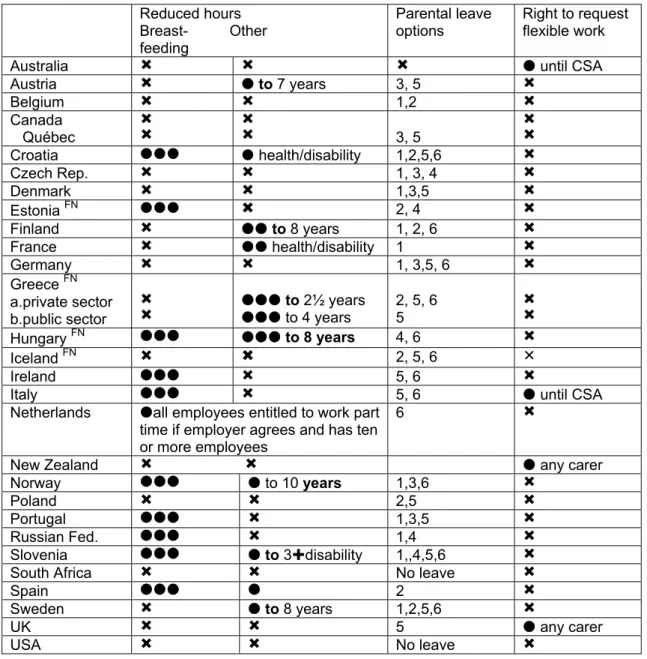
Ten countries (Croatia, Estonia, Hungary, Ireland, Italy, Norway, Portugal,
Russia, Slovenia and Spain) permit women to reduce their working hours
to enable breastfeeding. Women reducing their hours for this reason are
entitled to earnings compensation. This is not usually the case in the ten
countries (Austria, Estonia, Finland, Greece, Hungary, Iceland, Norway,
Slovenia, Spain, Sweden and the Netherlands) that give parents the right
to work part-time hours when they have a younger child, though
sometimes subject to employer agreement; for example, all Dutch
employees have the right to work part time, but employers may turn down
an employee’s request under specified conditions (see Table 2.3).
Greece provides an example of a country that provides both payment and
a substantial degree of flexibility in how reduced hours may be taken.
Parents are entitled to work fewer hours per day, with full earnings
replacement. But these reduced hours may also be taken as a period of
full-time leave, up to three and three-quarter months in the private sector
and nine months in the public sector.
Finally, in Australia, Italy, New Zealand and the UK, parents have a legal
right to request flexible working hours from their employers, who must
consider their request and may only refuse them if there is a clear
business case for doing so.
2. How much leave is available?
Table 2.2 summarises (i) the total amount of post-natal statutory leave
(Maternity, Paternity, Parental, Childcare) available in each country per
family, as well as (ii) the total amount paid in any way, and (iii) the number
of months of leave paid at two-thirds or more of earnings – an indicator
used by the European Commission in monitoring member states’ progress
in meeting Employment Guidelines (European Commission, 2009: Table
18.M3). However, as Tables 2.1. and 2.2 show clearly, most countries
apply a ceiling to the amount of earnings-related payments made to
leave-taking parents, which reduces the proportion of parents who actually
receive a full earnings-related proportion of their earnings.
Total leave ranges from none to 72 months, with a median length of 24
months, while total paid leave ranges from none to 38 months, with a
median length of around 13 months. Applying the two-thirds earnings
standard the median length reduces to just over four months, with five
countries offering nothing and only five countries, plus the province of
Québec in Canada, offering more than 12 months.
On the basis of this indicator, countries can be divided into three groups:
a. Countries providing earnings-related post-natel leave (at
two-thirds or more replacement rate) of nine months or over: the five
Nordic countries, four countries from Central and Eastern Europe
(Croatia, Estonia, Hungary and Slovenia), Germany plus Greece
(private sector) and the Canadian province of Québec. In all of these
cases, the earnings-related leave includes a period of Parental leave.
b. Countries providing four to six months of earnings-related
post-natal leave, in all cases confined to Maternity leave: includes a
number of Continental Western European countries. Ireland comes
here, although the effect of a ceiling on the earnings-related benefit is
that the maximum payment is only €270 a week, showing the need to
take account of levels of ceilings in assessing the generosity of
national schemes.
c. Countries providing less than four months of earnings-related
post-natal leave: includes five of the six mainly English-speaking
countries (Australia, Canada, New Zealand, United Kingdom, United
States), plus Austria, Czech Republic, Luxembourg, Netherlands, the
Russian Federation and South Africa. It should be noted that Québec,
which now has responsibility for its own leave policy, is on a par with
the top group of countries; the rest of Canada offers up to 50 weeks of
earnings-related leave, but at 55 per cent of earnings it falls just below
the EC indicator criterion; it also has a rather low ceiling.
Previous analysis has indicated a relationship between fathers’ use of
leave entitlements and the availability of well-paid ‘father-only’ leave – the
more such leave there is, the more leave fathers take. Table 2.2 shows
the total period of ‘fathers-only’ leave provided by each country, as well as
the period of ‘fathers- only’ leave paid at two-thirds or more of earnings
(though the qualification about ceilings on payments needs again to be
borne in mind). Eleven countries provide less than one month of
father-only leave, while nine offer six months or more, with a median length of
three months. Length of leave paid at two-thirds of earnings is much lower,
only the three Scandinavian countries plus Iceland offering more than two
months.
Emphasis is placed here on payment for leave-takers, justified by the clear
relationship between take-up and payment. How are these payments
funded? Generally statutory leave payments come from some form of
contributory insurance fund, financed by contributions from employers
and, often, employees; the costs are pooled or collectivised, rather than
individual employers paying their own workers. In some cases employers
may make ‘top up’ payments, adding to the statutory benefits received by
their employees, as a result either of collective agreements or individual
company policies. The main exception to this picture is when parents on
leave receive a general ‘childrearing’ benefit that is paid to all parents with
young children, not just confined to those taking leave; in such cases,
payments usually come from general taxation. An exception is France,
where such payments are funded by the family allowance fund, financed
by contributions from employers and employees.
3. Changes in leave policy since the 2009 review
Of the countries included in the 2009 review, half (15), have introduced
policy changes since the last review or have announced changes to be
implemented in 2010 or 2011; this does not include any up-ratings in
benefit levels. Policy changes have included some reduction in entitlement
(implemented or announced) in six countries: Belgium, Czech Republic,
Estonia, Germany, Hungary and Iceland. Mostly, though, changes have
involved some improvement in policies, with the most common being
improved leave for fathers and greater flexibility in use of entitlements.
Australia: unpaid Parental leave has been doubled and a right to request
flexible working introduced if parents have a child under school age. From
January 2011, paid Parental leave of 18 weeks will be introduced for the
main carer.
Austria: two childcare benefit options have been added to the existing
options to increase flexibility available to parents.
.
Belgium: Parental leave can be taken until a child’s twelfth birthday
(previously until the sixth birthday). More stringent eligibility conditions
have been introduced for the time credit scheme. Following the new EU
Directive, Parental leave will be extended from three to four months per
parent by the end of 2011.
Canada: from January 2011, benefit payments will be extended to
self-employed workers taking Maternity and Parental leave.
Czech Republic: fathers may take Maternity Leave from the seventh
week and parents can alternate leave to care for a sick child. Maternity
leave benefit has been cut through a reduction in the proportion of
earnings paid and a proposal to introduce Paternity leave has been
suspended.
Estonia: payment for leave to care for a sick child has been reduced.
Finland: the number of ‘bonus days’ given to fathers who take at least two
weeks Parental leave has been doubled from 12 to 24.
Germany: two cuts were announced in June 2010, to be introduced later
in the year. The proportion of earnings to be paid on net incomes above
€1240 a month will be cut from 67 to 65 per cent; and the €300 a month
minimum benefit for the long-term unemployed will be cut completely.
Hungary: eligibility for insurance-based leaves (Maternity leave and
GYED) has been made more stringent, and payment for parents taking
GYES has been reduced from three to two years.
Iceland: payment to parents taking leave has been reduced by lowering
the maximum earnings ceiling above which benefits are not paid, and
reducing the payments from 80 to 75 per cent of earnings over
ISK200,000 per month. Parents can now take leave until a child is 36
months old, instead of 18 months.
Netherlands: a Bill to make Parental leave more flexible will be presented
to Parliament by May 2010.
Norway: the father’s quota in Parental leave has been increased from six
to ten weeks, and fathers’ eligibility for leave has been made less
dependent on the mother’s employment.
Poland: Maternity leave has been extended (with further extensions
scheduled for 2012 and 2014). Paternity leave has been introduced, and
will be further extended in 2012.
Spain: Paternity leave to be extended from two to four weeks from
January 2011.
United Kingdom: the right to request flexible working has been extended
to parents of children up to 16 years of age. Legislation has been passed
enabling fathers to take up to six months of Maternity leave, to be
introduced in 2011.
Croatia, a new entry to the review, introduced major changes in January
2009, in part to harmonise policy with EU legislation as part of the
accession process.
4. Take-up of leave
Rostgaard (2005
3) notes that “only in the Nordic countries are there
regular, consistent statistical accounts of the use of leave, according to
gender, and occasionally also according to occupation and education of
the parent … [while in] most other countries, however, data on take-up of
Parental leave is irregular and inconsistent.” This continues to be
confirmed by the information provided in country notes on take-up of
leave, which is full of gaps, making systematic cross-national comparisons
impossible. Mostly, there is no information on take-up of unpaid leave and
limited information on paid leave, except for occasional survey data. The
situation has remained unchanged since the network was established.
There is the further question of what proportion of parents are eligible for
leave, where again there is no consistent and comparable information.
Eligibility conditions vary between countries and types of leave, making
cross-national comparisons even more difficult. Ineligibility may be related
to self-employment, temporary contracts, other conditions related to prior
3