1 INTRODUCTION
Tragic events such as the partial collapse of Ro-nan Point building (London, UK - 1968) or most re-cently the collapse of the World Trade Center (New York, USA - 2001) and the I-35W Mississippi River bridge (Minneapolis, USA - 2007), among others, increased the attention of engineers, but also the so-ciety, to the safety, reliability and robustness of structures.
Ronan Point was a 23-storey tower block in Newham, East London, which suffered a fatal partial collapse due to a natural gas explosion on a kitchen located on a corner flat on the 18th floor of the building.
The collapse of World Trade Center Towers on September 11 was triggered by an impact of two commercial aircrafts that damaged partially the pe-rimeter steel tube design and leading to overall col-lapse.
The initiating event in the collapse of the I-35W bridge was the lateral shifting instability of the upper end of a diagonal member and the subsequent failure of a gusset plate on the center portion of the deck truss. Since the deck truss portion of the I-35W bridge was non-load-path redundant, the total
col-lapse of the deck truss was likely once the gusset plates failed (NTSB 2008).
What seems to be common to these cases is the occurrence of disproportionate consequences to the initial cause or damage. If on the first two cases the collapse was triggered by extreme and low probabil-ity events, on the last case, failure occurred when structure was submitted to regular load conditions. As a result, it is understandable that robustness is al-so a useful concept even when applied on the con-text of more probable events such as design loads, deterioration scenarios, as considered on this paper, among others.
Although robustness seems definitely a desirable property, the fact is that consensus about a precise definition does not exist and a framework to assess it is still under development.
Most modern structural design codes provide de-tailed direction for verifying if a design is acceptable with regard to individual failure modes, which, in most cases, relates to damage of individual structural components. Unfortunately the codes are far less specific regarding requirements for reliability against system failure (Baker et al. 2008).
This limitation is more important as most struc-tural failures are due to unexpected loads, design er-rors, errors during execution, unforeseen deteriora-tion and poor maintenance which can not be
A framework for robustness assessment in the context of corroded RC
structures
Eduardo S. Cavaco
Universidade Nova de Lisboa, Civil Engineering Department, Monte de Caparica, Portugal
Joan R. Casas
Technical University of Catalunya, Civil Engineering Department, Barcelona Spain
Luis A. C. Neves
Universidade Nova de Lisboa, Civil Engineering Department, Monte de Caparica, Portugal
Alfredo H. Huespe
International Center for Computational Methods in Engineering (CIMEC), Santa Fe, Argentina
prevented using conventional component based code checking formats (Canisius et al. 2007).
Regarding this scenario, the question arises of what can be done to improve this situation, since ac-tual design codes contain no prescriptions to check against system failures and, consequently, the main causes of structural collapse can not be predicted and avoided.
There are no simple answers for this question, but certainly the risk could be minimized if structures would be designed to be less vulnerable to local damage no matter what causes it, or in other words if structures would be more robust. To achieve this it is important to have firstly a precise definition of ro-bustness and that to propose measures to assess it.
2 BACKGROUND ON ROBUSTNESS 2.1 Definition
As previously stated, a precise definition for ro-bustness still does not exist. Several works (Calla-way et al. 2000; Agarwal et al. 2006; Wisniewski et al. 2006; Starossek 2008; Baker et al. 2008) made interesting attempts to define it.
From the proposed definitions there are some common key concepts that must be highlighted. These fundamental concepts can be summarized as event, damage, structural performance and conse-quences. A straight relationship exists between them, i.e., a certain structure exposed to an event may suffer from damage that leads to some degree of loss of structural performance. From this, direct and indirect consequences may arise depending on the type and degree of structural performance loss.
From the referred works, and having in mind the presented fundamental concepts several times used to define robustness it is understandable that some authors (Wisniewski et al. 2006; Starossek 2008) consider that a structure is robust if the relationship between the initial damage and the degree of struc-tural performance is acceptable. On the other hand, remaining referred authors define an unrobust struc-ture when there is a disproportionate relationship be-tween the trigger event and the consequences result-ing from it.
On the first case, robustness is seen as a structural property because only depends on the structure it-self, i.e., irrespective of the events responsible for damaging the structure or the consequences resulting from it. On the second case, a wide concept is consi-dered, because it is important to have in mind the structural context. Robustness is defined as property of both structure and environment because exposure and consequences depend on it.
At this stage, it is important to note that robust-ness, defined as a property of both structure and en-vironment, is a much wider concept involving
com-plex socio and economical variables, among others, escaping from the civil engineering domain. Robust-ness becomes more difficult to assess because it de-pends on the developments on structural environ-ment. Imagine for instance a viaduct over a highway. Viaduct robustness will decrease with highway traffic increase because exposure to acci-dents and failure consequences will be higher. On the other hand, if robustness is defined as property of the structure it only depends on the degree of structural performance after damage occurs no mat-ters the extent of consequences and what causes damages. In this case, robustness is a more confined concept, more easily accessible to civil engineers that can be defined by the follow sentence: robust-ness is a property of the structure itself and measures the degree of structural performance loss after dam-age occurrence.
This relation can have many forms, from service limit states to ultimate limit states. Damage can vary from a simple degradation state to a more serious damage, as a column or a beam failure, among oth-ers. The concept behind this definition is not limit neither the functions spectrum nor the damage sce-narios.
2.2 Assessment
The ambiguity on robustness subject is due, not only to the two distinct approaches about the defini-tion, but also because there is a tendency to compare the proposed frameworks to measure it, or other re-lated concepts, when, in fact, they measure different things as will be demonstrated.
On the next paragraphs the proposed measures for robustness and related concepts will be presented on a historical perspective.
Frangopol and Curley (1987) proposed a proba-bilistic redundancy factor, R, to account for the
ran-dom nature in safety evaluation of damaged struc-tures:
Intact R
Intact damaged
(1)
where Intact is the reliability index of the intact
sys-tem and damaged is the reliability index of the
dam-aged system. R is equal to 1 when the damaged
structure has no reserve strength and is infinite when the damage has no influence on the reserve strength of the bridge.
Lind (1995) proposes quantitative measures for the vulnerability and damage tolerance of a system. Vulnerability and damage tolerance are considered complementary concepts. The vulnerability, V, of a system is defined as:
0
( , ) ( , )d
P r S V
P r S
where rd is the resistance of the damaged system, r0
is the resistance of the intact system, and S is the loading. P(r,S) is the probability of system failure as a function of both effect of loading and resistance. The vulnerability V of a system can vary from zero to infinite, if the damage has null or huge impact on system resistance, respectively. The system damage tolerance Td can be obtained inverting equation (2).
Ghosn and Moses (1998) proposed an entire me-thodology to assess system safety of highway bridges sub and superstructures. The incorporation of system behavior to the safety assessment is done by the relative reliability index , which is defined as the difference between the safety index for the system and the safety index for the member. In order to guarantee the bridge safety, the obtained relative reliability index must be greater than the corres-ponding target values and, at the same time, the member safety has to be ensured. Considering for instance a damaged superstructure, the safety as-sessment of the bridge is satisfied when the follow-ing condition is verified:
2.70
damaged damaged member
(3)
where damaged is the relative reliability index of the
damaged bridge and damaged and member are the
re-liability index of the damaged bridge and member respectively. The target value of damagedwas
pro-posed by Ghosn and Moses (1998) based on the val-ues found on bridges considered to having a robust behavior.
Baker et al. (2008) proposed a risk-based frame-work for robustness. Robustness is assessed by computing the ratio between direct and total risk. Direct (RDir) and indirect risk (RInd), which sum
gives the total risk, are associated respectively with the direct and indirect consequences of the damaged system. Indirect consequences can be interpreted as the penalties disproportionate to the cause of dam-age, and so robustness of a system is indicated by the contribution of the indirect risks to total risk. The robustness index IRob is then defined by equation
(4):
Dir Rob
Dir Ind R I
R R
(4)
The index may assume values between zero and one. If the system is completely robust, IRob is equal to
one, if all risk is due to indirect consequences, then
IRob is equal to zero.
As previously stated, robustness concept can also be useful on the context of ordinary events such as deterioration scenarios. Biondini and Restelli (2008) consider a trussed system subjected to corrosion of each of its members considered equivalent to the re-duction on the effective cross section area. In order to assess robustness, they measure the ratio between several structural performance indicators in the
in-tact state and in the deteriorated state. For corrosion levels from 0% to 100%, robustness index is then given by:
0
d f f
(5)
where f0 and fd are the structural performance
indica-tors on the intact and deteriorated state respectively. Considering damage as a continuous variable, can be essential, since a structure may be robust for a cer-tain damage level and suddenly became unrobust for a damage level slightly superior. The negative aspect of this approach is that robustness has different val-ues for the same type of damage, which might con-tribute to bring more ambiguity to the subject.
Starossek (2009) proposed several robustness measures depending on the type of progressive col-lapse occurred. Among the proposed measures, the
Damaged Based Robustness Measure II, obtained through equation (6), mainly measures the propor-tion between the direct consequences, d, and the ini-tial damage i.
1
, 1 2 [ ( )0 ]
d int
R
d i i di (6)Rd,int is the integral damage based measure of
ro-bustness, varying from 0 to 1 when a structure has null or full robustness respectively.
This approach has the same advantage of the pre-vious one because consider damage as a continuous variable. On the other hand, in this case, there is a single value for each damage type.
2.3 Robustness assessment framework
The lack of consensus about robustness is, in part, due to the direct comparison that has been done be-tween the measures presented in the previous sec-tion. In fact, they can not be directly compared be-cause they measure different things. On the other hand, some proposed measures are coherent with the structural property definition for robustness, and others are consistent with the notion of robustness being a property of both structure and its context. Equation (7), several times used to describe col-lapse, can be useful to understand how the proposed measures are related.
( ) ( ) ( | ) ( | )
P F P E P D E P F D (7)
In equation (7), P(E) is the probability of a cer-tain exposure, P(D|E) is the probability of the struc-ture being damaged given an exposure and finally
ap-proach that defines robustness as structural property. According with this judgment equation (7) could be rewritten in the following qualitative form:
FailureExposure Vulnerability Robustness (8) In the next paragraphs, the presented probabilistic measures for robustness will be rewritten, consider-ing a certain exposure E and a specific damage sce-nario D:
Frangopol and Curley (1987) redundancy index:
1
1 1
(1 ( ))
(1 ( )) (1 ( | ))
R
P F
P F P F D
(9)
Lind (1995) damage tolerance index: 1 ( | )
1 ( )
d
P F D T
P F
(10)
Ghosn and Moses (1998) target value for the damaged system:
1 1
(1 ( | )) (1 ( | ) ( ))
damaged P F D P D E P E
(11) Baker et al. (2008) risk based robustness
meas-ure:
( | )
( | ) ( | )
dir Rob
dir ind
P F D C I
P F D C P F D C
(12)
At this stage it is possible to extract the following conclusions: i) Indices proposed by Frangopol and Curley (1987) and Lind (1995) are very similar and mainly measure the importance of the term P(F|D) to failure; ii) Ghosn and Moses (1998) proposal meas-ure the difference between damaged system and member reliabilities; iii) Baker et al. (2008) proposal is conceptually different because it is a risk measure and for a damaged system it relates the conse-quences resulting from having a failure or not.
Although the robustness measure proposed by Biodini and Restelli (2008) is not probabilistic, it is closely related with the term P(F|D) because it is a measure of the structural performance of the dam-aged system. The same can be said about Damaged Based Robustness Measure II proposed by Starossek (2009) with the difference that consequences of damaged system are evaluated instead of structural performance.
From the exposed it is understandable that the proposed robustness measures are closely related but, in rigor, they measure different things and for that it is abusive to compare directly themselves. There is no doubt that risk assessment is the target when discussing the viability of a project. So it might be acceptable that robustness index proposed by Baker et al. (2008) is the most correct measure.
However in order to assess this risk, it is necessary to evaluate all the terms in equation (7) and the as-sociated consequences. Actual design codes give acceptable prescriptions to evaluate the terms P(E)
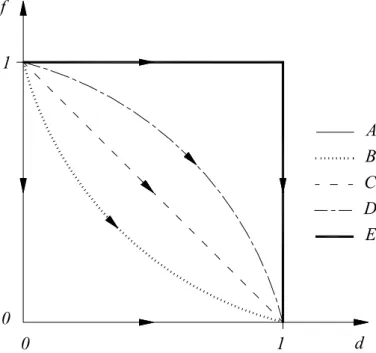
and P(D|E), at least for regular exposures. On the other hand, a lack of knowledge still exists when it is necessary to compute the term P(F|D) in order to assess system safety. For the term P(F|D) evalua-tion, it is firstly necessary to compute system struc-tural performance for the damage D spectrum. A de-terministic measure for robustness could be that obtained through equation (13), which gives the area above the curve defined by the normalized structural performance f subjected to a normalized damage d
(See Figure 1).
1 0 ( )
d
d d
R f x dx
(13)where f is given by the ratio between the structural performances on the intact and damage states, and d
is given by the ratio between actual and maximum possible damage.
f
1
1 d
A
B C D E
0 0
Figure 1. Robustness assessment. Normalized structural per-formance f as a function of the normalized damage d.
Robustness index Rd may vary from 0 to 1
re-spectively if a minimum damage level produces the entire loss of structural performance, curve A, or if the damage does not produces influence on structur-al performance, curve E. In Figure 1, curve B, C and
D represent, respectively, intermediate increasing robustness.
3 ROBUSTNESS OF A CORRODED RC BEAM 3.1 Introduction
In order to illustrate the application of the pre-vious proposed measure of robustness (see equation (13)), a simply supported footbridge (see Figure 2) subjected to corrosion of the longitudinal reinforce-ment was analyzed (Cavaco, 2009).
F
14.0m
Figure 2. Simply supported footbridge under corrosion.
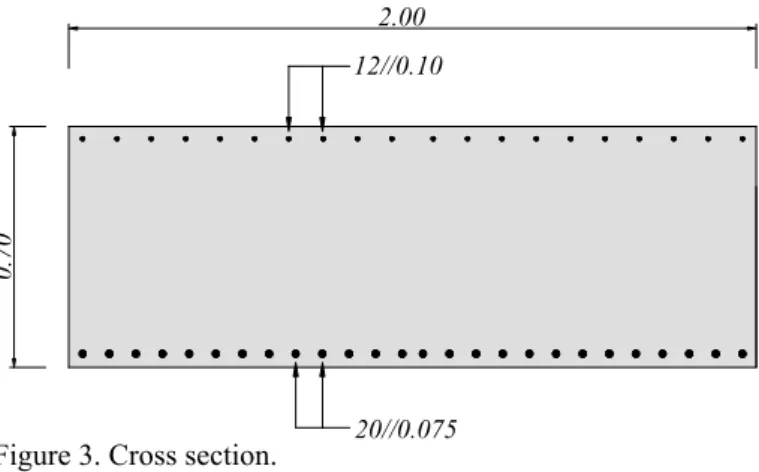
A simple cross section (see Figure 3) was de-signed in accordance with Eurocode prescriptions. Transversal reinforcement was overdesigned and considered protected against corrosion in order to simplify the analysis.
2.00
20//0.075 12//0.10
0
.7
0
Figure 3. Cross section.
For concrete, material properties are presented in Table 1.
Table 1. Concrete Material Properties
_______________________________________________
Material fctm fcm E Gf MPa MPa GPa kN/m _______________________________________________
Concrete 3.0 30.0 30 0.20 0.10
_______________________________________________
In Table 1, fctm and fcm are the maximum tension and compressive stresses. E, and Gf are, respec-tively, the Young modulus, the Poisson coefficient and the fracture energy.
For steel reinforcement an elastoplastic constitu-tive behavior was considered with a yielding stress of 400MPa and a Young modulus of 200GPa.
In order to analyze de effects of corrosion on RC structures a methodology proposed by Sánchez et al. (2008) was adopted. This methodology consists on two step analysis and its competence was demon-strated comparing numerical with experimental re-sults. On the first step a cross section analysis is
car-ried out with the objective of studying the effects of corrosion products expansion on section integrity. The results obtained are then used to build a 2D lon-gitudinal model of the corroded structure in order to study its load carrying capacity and robustness.
Having in mind the robustness proposed defini-tion and measure, damage considered is the corro-sion level Xp (in terms of weight) of the longitudinal
reinforcement and the structural performance studied is the load carrying capacity F.
3.2 Cross section analysis
The first step of the referred methodology is to perform a cross section analysis with the objective of capturing the corrosion effects: expansion of cor-rosion products; concrete deterioration and concrete cracking and spalling. To achieve this, corrosion was modeled as a steel bar expansion and concrete was modeled using an isotropic continuum damage model, ICDM, (Oliver et al. 1990) coupled with the kinematics provided by the strong discontinuities approach, CSDA (Oliver et al. 2002). One of the main features of the ICDM is the consideration that, physically, the degradation of concrete strength is the result of the initiation, growth and coalescence of micro cracks and that this process may be mod-eled by introducing an internal damage variable, d, which can be a scalar quantity. When this constitu-tive model is coupled with the CSDA kinematics, it is possible to model concrete cracks, which are, from a macroscopical point of view, discontinuities that can be characterized as jumps on the displace-ment field across material.
A full detailed description of ICDM and CSDA can be found, respectively, in Oliver et al. (1990) and Oliver et al. (2002).
Corrosion products expansion was simulated by a volumetric deformation 0 of the steel bars. Assum-ing a plain strain state, the total strains can be ob-tained by the sum of the strain due to stresses e and due to the referred volumetric expansion 0:
e 0
(14)
The volumetric expansion 0 can be obtained through the dilatational parameter D applied incre-mentally during the time steps required to perform the non-linear analysis:
2 2 2
2
f i
i
R R
D
R
(15)
where Ri and Rf are respectively the initial and final
bar radius.
Cross section analysis was performed for corro-sion levels from 0% to 100%. With corrocorro-sion in-crease, concrete around steel bars become damaged. In Figure 4, it is possible to observe damage in con-crete due to steel bar expansion. Where damage va-riable d is higher, displacements tend to concentrate. When damage reach the value of 1, material loses all its strength and a jump on the displacement field ap-pears, i.e. a crack, may occur.
1.0
0.8
0.6
0.4
0.2
0.0 d
Figure 4. Damage d in concrete due to steel bar expansion.
In Figure 5, isodisplacement lines are presented. It is possible to understand that there is a straight re-lation between both Figures 4 and 5. Cracks ap-peared where isodisplacement lines tend to concen-trate. At the beam’s top, small cracks appear connecting reinforcement to concrete top surface. At the bottom, as reinforcement spacing is smaller, a single crack appears connecting all the bars and leading to the delamination of the concrete cover.
Figure 5. Isodisplacement lines showing cracks on concrete.
3.3 2D longitudinal analysis
For each corrosion level Xp, results obtained from
the cross section analysis were used to build a 2D longitudinal model to check the load carrying capac-ity of the corroded structure.
In order to reach the compatibility between the cross section model and the 2D longitudinal model, it was necessary to project the damage variable from the first to the second model. Firstly, it was neces-sary to divide the cross section into horizontal slices. After this, the average damage on concrete for each slice was computed considering the parts of de-tached concrete with damage d equal to 1. Finally a horizontal projection of concrete average damage of each slice between both models was conducted and the 2D longitudinal model of the corroded structure built.
In the 2D longitudinal model, reinforced concrete was modeled as a composite material as proposed by Oliver et al. (2008) constituted by a matrix, representing concrete, with embedded fibers representing reinforcement. According to the mix-ture theory, a composite material is a continuum in which infinitesimal volume is occupied simulta-neously by all constituents behaving as a parallel mechanical system. Consequently, all constituents are subjected to the same strain and stresses are giv-en by the weighted sum, in terms of volume fraction, of the stresses of each constituent.
The ICDM, together with the CSDA and up-graded with the initial damage obtained from the cross section analysis, was used in order to model de deteriorated matrix behavior. For the fibers, and in order to account the bond-slip effect, the slipping-fiber model proposed by Oliver et al. (2008) was adopted. This model mainly consists on the associa-tion of two components, representing reinforcement and its interface with concrete, in a serial system. The slipping fiber-strain f is given by the sum of the strains on both components:
f d i
(16)
where d is the reinforcement mechanical deforma-tion and i is the deformation due to sliding. For the serial system the stresses are identical in both com-ponents:
f d i
(17)
Considering for each component an one-dimensional elastoplastic model, the constitutive be-havior of the serial system results also in an elastop-lastic model with the following characteristics:
( , )
1 1 1
f d i
y y i
f
d i
min
E
E E
(18)
where Ed and yd are the steel Young’s modulus and
yield stress, respectively, Ei is the interface elastic modulus and yi is the interface bond limit stress.
When Ei→∞ and yd <yi, the system reproduces
only the mechanical behavior of reinforcement con-sidering perfect adhesion between concrete and steel bars. In this work, the hypothesis of having Ei→∞
and, for uncorroded state,yd=yi was considered.
For the corroded states and in order to character-ize bond strength deterioration, the M-pull model proposed by Bhargava et al. (2004) was adopted. This model, summarized in equation (19), gives the normalized bond strength yi(Xp)/yi(Xp=0)as a
function of the corrosion level Xp and is based on the
0.117
1.0 1.5%
( )
( 0) 1.192· p 1.5%
i
p
y p
X i
y p p
if X X
X e if X
(19)
Summarizing, the present corrosion two step model is capable of taking into account the follow-ing effects: concrete deterioration and crackfollow-ing due to corrosion products expansion; effective rein-forcement area reduction and bond strength deteri-oration.
In Figure 6, the normalized force-displacement diagram is presented for several corrosion levels. The normalized force and displacement are given re-spectively by the ratio between the load carrying ca-pacity and displacement of the corroded and uncor-roded beam.
0.0 0.2 0.4 0.6 0.8 1.0
0.0 0.2 0.4 0.6 0.8 1.0
X = 0%p
X = 2.4%p
X = 3.9%p
X = 5.8%p
X = 7.7%p
X = 11.3%p
X = 23.0%p
X = 100%p
Normalized displacement at mid span
Nor
m
al
iz
ed Loa
d
Figure 6. Normalized load/displacement diagram for several corrosion levels Xp.
Figure 6 confirms the expected flexural failure behavior for the beam due to the overdesign of the transversal reinforcement. Three behavior stages can be identified for the uncorroded state. The first stage corresponding to elasticity, the second equivalent to crack spreading and the third corresponding to me-chanism development due to a plastic hinge forma-tion at mid span. Regard that, for higher levels of corrosion, the second stage tend to disappear be-cause when the first crack occurs the corroded rein-forcement immediately enters into the plastic do-main.
-0.01m Horizontal Displacement at bottom fiber (c)
(b) (a)
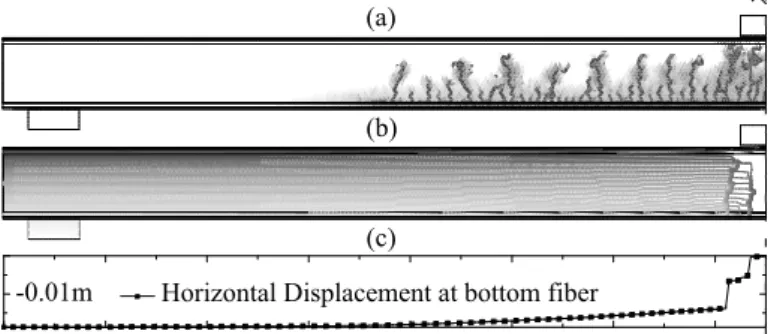
Figure 7. 2D longitudinal model results. (a) Damage variable
d; (b) Isodisplacement lines showing the two main cracks cor-responding to failure mechanism; (c) Horizontal displacement at bottom fiber showing the jump on the displacement field corresponding to the two main cracks.
In Figure 7(a), it is possible to observe the me-chanism development captured with the 2D longitu-dinal model corresponding to the development of two large width cracks at mid span (see Figure 7(b)), which according to the CSDA kinematics, corres-pond to jumps on the displacement field (see Figure 7(c)).
3.4 Robustness assessment
As previously defined, and in order to assess ro-bustness, the damage considered was the corrosion of the bottom longitudinal reinforcement and the structural performance was the load carrying capaci-ty. In Figure 8 the normalized peak load carrying capacity is plotted as function of the corrosion level
Xp. The normalized bond strength, given by the ratio
between the corroded and uncorroded stresses is also plotted in Figure 8.
0.0 0.2 0.4 0.6 0.8 1.0
0.0 0.2 0.4 0.6 0.8 1.0
Corrosion Level Xp
Beam Bond strength
N
o
rm
al
iz
ed
L
oa
d
F
/Fma
x
Figure 8. Normalized peak load carrying capacity as a function of the corrosion level Xp.
From the analysis of Figure 8, it is possible to conclude that for corrosion levels Xp below 10%,
bond strength reduction is the major factor causing decreasing on peak load. For corrosion levels from 10% to 30%, bond strength deterioration starts loos-ing influence and for higher corrosion levels struc-tural load carrying capacity is provided only by the concrete material. The irregularities observed on the normalized load presented in Figure 8 are due to concrete cover spalling on both beam’s bottom and top. The minimum residual load carrying capacity for the corroded structure is reached for corrosion levels higher than 30% and is about 36% of the load carrying capacity of the uncorroded beam.
Finally the robustness of the corroded beam can be assessed using equation (13) in order to calculate the area above the curve with respect to normalized load carrying capacity in Figure 8:
1
0 / max( p) p 0.42
R
F F X dX (20)con-crete may seem less robust than the reinforced ones, but in fact they are not affected by reinforcement corrosion.
4 CONCLUSIONS
Robustness is an emergent concept related with the increased fear resulting from extreme events such as terrorist attacks. Corrosion of reinforced concrete structures is also an issue due to the pected costs on maintenance and replacements ex-pected on the next decades.
In the present work, an effort to couple both re-ferred issues was made. Therefore, several defini-tions and frameworks proposed by different authors were analyzed and discussed. From the proposed de-finitions it was concluded that some authors define robustness as a property of the structure and others define it also as a property of the structure environ-ment.
Related to the proposed measures to assess ro-bustness, it was concluded that they cannot be com-pared directly, because they measure different things.
Having in mind a structural property concept for robustness, a new definition was proposed. The cor-responding deterministic measure was defined and illustrated with a practical example consisting on a simply supported beam subjected to corrosion of longitudinal reinforcement.
In order to assess robustness, an advanced me-thodology based on ICDM, CSDA, mixture theory and M-pull model for predicting bond strength dete-rioration was used.
Results show that the main cause of the drop on load carrying capacity of the studied beam is the bond strength deterioration. Concrete cracking due to corrosion products expansion and reinforcement area reduction has minor influence.
Robustness of the corroded beam resulted on 0.42 and the residual load carrying capacity of the full corroded specimen resulted on 36% of the uncor-roded one.
ACKNOWLEDGMENTS
The authors would like to acknowledge COST Action TU-0601 and Fundação para Ciência e Tec-nologia, scholarship SFRH/BD/45799/2008, for help supporting this research.
5 REFERENCES
Agarwal, J., England, J., and Blockley, D. (2006). Vulnerabili-ty analysis of structures. Structural Engineering Interna-tional, 16(2): 124–128.
Baker, J., Schubert, M., and Faber, M. (2008). On the assess-ment of robustness. Structural Safety, 30(3): 253–267. Bhargava, K., Ghosh, A., Mori,Y., and Ramanujam, S. (2007).
Corrosion-induced bond strength degradation in reinforced concrete analytical and empirical models. Nuclear Engi-neering and Design, 237(11): 1140–1157.
Biondini, F. and Restelli, S. (2008). Damage propagation and structural robustness. In Life-Cycle Civil Engineering: Pro-ceedings of the International Symposium on Life-Cycle Civ-il Engineering, IALCCE’08, Held in Varenna, Lake Como, Italy on June 11-14 2008, page 131. Taylor & Francis. Callaway, D., Newman, M., Strogatz, S., and Watts, D. (2000).
Network robustness and fragility: Percolation on random graphs. Physical Review Letters, 85(25): 5468–5471. Canisius, T., Sørensen, J., and Baker, J. (2007).Robustness of
structural systems – a new focus for thejoint committee on structural safety (JCSS). In Proc., 10th Int. Conf. on Appli-cation of Statistic and Probability in Civil Engineering (ICASP10).
Cavaco, E. S. (2009). Robustness of Corroded Reinforced Concrete Structures. Technical report, Short Term Scientific Mission, Cost Action TU-0601, Barcelona.
Frangopol, D. M. and Curley, J. P. (1987). Effects of damage and redundancy on structural reliability. Journal of Struc-tural Engineering, 113(7): 1533–1549.
Ghosn, M. and Moses, F. (1998). NCHRP Report 406: Redun-dancy in Highway Bridge Superstructures. Transportation Research Board, National Research Council, Washington, DC.
Lind, N. (1995). A measure of vulnerability and damage toler-ance. Reliability engineering & systems safety, 48(1):1–6. NTSB (2008). Collapse of I-35W Highway Bridge. Highway
Accident Report NTSB/HAR-08/03. Technical report, Na-tional Transportation Safety Board.
Oliver, J., Cervera, M., Oller, S., and Lubliner, J. (1990). Iso-tropic damage models and smeared crack analysis of con-crete. In Second International Conference on Computer Aided Analysis and Design of Concrete Structures, volume 2, pages 945–958.
Oliver, J., Huespe, A., and Cante, J. (2007). An impli-cit/explicit integration scheme to increase computability of non-linear material and contact/friction problems. Comput-er Methods in Applied Mechanics and EngineComput-ering. Oliver, J., Huespe, A., Pulido, M., and Chaves, E. (2002).
From continuum mechanics to fracture mechanics: the strong discontinuity approach. Engineering Fracture Me-chanics, 69(2): 113–136.
Oliver, J. ,Linero, D., Huespe, A., and Manzoli, O. (2008).Two-dimensional modeling of material failure in reinforced concrete by means of a continuum strong dis-continuity approach. Computer Methods in Applied Me-chanics and Engineering, 197(5): 332– 348.
Sánchez, P., Huespe, A., Oliver, J., and Toro, S. (2008). Nu-merical modelling of the load carrying capacity degradation in concrete beams due to reinforcement corrosion. In 8th World Congress on Computational Mechanics (WCCM8), 5th European Congress on Computational Methods in Ap-plied Sciences and Engineering (ECCO¬MAS 2008). Starossek, U., Haberland, M. (2008). Measures of structural
robustness - requirements and applications. In Proceedings, ASCE SEI 2008 Structures Congress, Crossing Borders. Starossek, U. (2009). Collapse types and robustness measures.
In COST Action TU-0601 Robustness of Structures. Wisniewski, D., Casas, J., and Ghosn, M. (2006). Load