______________________________________________________________________________________________________
Article
________________________________________________________________________________________________
Ciências Ambientais Environmental Sciences
Comparison Between Corn Evapotranspiration Rates by
the Modified Bowen Ratio and the Ceres-Maize Model
Vitor de Jesus Martins Bianchini1, Tamires Teles de Souza2, Rodolfo Armando de Almeida Pereira3& Fábio
Ricardo Marin4
* Corresponding Author: [email protected] Received: June 12, 2017 Todos autores contribuíram de forma igualitária Accepted: June 21, 2017
Published: July, 2017
ABSTRACT
Corn stands out among grains because of its high global importance due to its chemical composition, nutritional value and productive potential. Several factors influence corn crop performance, and climate poses the greatest challenges for crop planning and management. Although tolerant to water deficit, the corn plant presents high sensitivity to water scarcity in specific developmental stages. Therefore, knowing factors related to water loss, namely potential or reference evapotranspiration (ET0) and Evapotranspiration (ETc) is crucial. This work aimed to calculate the ET0 by the methods of Priestley and Taylor (1972) and Penman-Monteith and ETc of the corn crop, both using the CERES-MAIZE model, and compare them with the results observed by the Modified Bowen Ratio method.The field experiment was conducted in the experimental area of ESALQ / USP and sensors were installed for data collection. For the comparison of results, the CERES-MAIZE model, duly calibrated for the experimental conditions, was used. The results showed that ET0 was underestimated by the Penman-Monteith method and overestimated by the Priestley and Taylor method through the CERES-MAIZE model throughout the crop cycle. However, at the cycle end, the accumulated values were lower than those measured by the MBR method.
Keywords: Irrigation, climate, water
Introduction
Corn is considered one of the most important crops worldwide (KRESOVIC et al., 2014) due to its chemical composition, nutritional value and productive potential (FANCELLI and DOURADO-NETO, 2000); however, several factors influence its productivity, such as water use. Despite its tolerance water deficit during the vegetative phase, the corn plant shows high sensitivity water scarcity in the stage between pre-flowering and the beginning of grain filling (BERGAMASCHI et al., 2006).
Potential or reference evapotranspiration (ET0) refers to water losses of a field without water restrictions (PAES et al., 2000) and it can be estimated through different methods, and the method proposed by Penman-Monteith is considered a standard (ALLEN et al., 1998). Crop evapotranspiration (ETc) is a function of microclimatic conditions of the site of interest, along with the physiological and morphological features of the crop (DOORENBOS and KASSAM 1994;
CARVALHO, 2009), which is important in water consumption estimation. ETc can be calculated by the Modified Bowen Ratio (MBR) method in which direct measurements of dry and wet bulb temperatures, radiation balance, and soil heat flux are carried out.
Several models are developed to understand the interaction between plants and the environment where they are inserted (OLIVEIRA, 2011). Currently, several efficient models are available, which are tools of great potential in sites of cultivated systems, allowing understanding and estimating crop performance in different locations and conditions (TOJO SOLER, 2004).
Therefore, considering the availability of estimation models for ET0 and ETc, this work aimed to calculate the ET0 by the methods of Priestley and Taylor (1972) and Penman-Monteith and ETc of the corn crop, both using the CERES-MAIZE model, and compare them with the results observed by the Modified Bowen Ratio method.
Material and Methods
Experimental siteThe work was carried out at the Fazenda Areão experimental site, belonging to the Luiz de Queiroz College of Agriculture (ESALQ / USP), in the municipality of Piracicaba, São Paulo State, Brazil (lat 22°52'S and long 47°30'O and altitude 546 m). According to the Köppen classification, the climate of the region is type Cwa, that is, tropical humid, with rainy summers and dry winters. The total rainfall in the driest month (July) is 26 mm and in the wettest month (January), 217 mm. the annual rainfall is about 1270 mm and the driest months are June, July and August. The average temperature in the hottest month (January) is 24.6°C, in the coldest month (July), 17.3°C, with an annual average of 21.5°C.
The soil of the experimental site is classified as Eutrophic Red Argisol and the soil of the experimental site located near the meteorological station is classified as eutrophic Red Nitosol. The soil was prepared in a conventional manner, plowed at a depth of 30 cm, and then trenched for leveling and dewatering. The mineral planting and cover fertilization was carried out according to the soil analysis in order to prevent nutritional stresses. The cover fertilization was carried out in the V5 to V6 stage of the plants, that is, 5-6 fully expanded leaves, with the fertilizer incorporated at 3 cm depth.
The planting spacing was 0.45 m between rows with a population of 66,000 plants per ha. Sowing was performed using about 10% more of the number of seeds due to possible germination failure, pest attack and other germination reduction factors. Hybrid P4285YH was selected, among the most commercialized ones by producers of the region. This hybrid has high productive potential and is well adapted to the edaphoclimatic conditions of the site. Besides an excellent option for silage, grain quality and stalk, hybrid P4285YH has high productivity, leaf stability and sanity as well as high tolerance to storage and breaking.
Modified Bowen Ratio Method
To estimate crop evapotranspiration (ETc), an automatic modified Bowen ratio system was installed in the center of the experimental site, and was connected to an automatic data acquisition system (datalogger). The system obtained the following meteorological elements: surface radiation balance (Rn); soil heat flux (G) performed at two points (G1 and G2); and vertical gradients of air temperature (Tar) and relative humidity (RH). G1 and G2 sensors were installed 5 cm below the soil surface.
The data were stored daily into the datalogger at 15-min intervals. The energy balance for estimating the heat flux on a surface was defined, with the modified Bowen ratio (β) defined as the ratio
between sensible (H) and latent (LE) heat fluxes. Finally, evapotranspiration was assumed equal to the latent heat flux.
With the measurements of radiation balance (Rn), soil heat flux (G1 and G2), temperature differences (ΔT) and vapor pressure (Δe) between the two levels, energy balance is determined, according to equation 1 .
0
LE
H
G
n
R
(1)Where: Rn is the radiation balance (MJ m - 2 d - 1), G is the heat flux in the soil (MJ m - 2 d - 1), H is the sensible heat flux 2 d-1) and LE is the latent heat flux of evaporation (MJ m - 2 d-1).
The values of the modified Bowen ratio (β) were calculated through equation 2 for each 15-min interval, based on the temperature gradient values (ΔT). 1 1 s ΔT W) (1 u ΔT β (2)
Where: ΔTs is the temperature difference of the dry bulb, in °C; ΔTu is the temperature difference of the wet bulb, in °C. E w is the weighting factor calculated by equations 3 and 4:
u
T
0.0145
0.407
W
(0°C
<
T
<
16°C)
(3)u
T
0.01
0.483
W
(16.1°C
<
T
<
32°C)
(4) The latent heat flux was obtained by equation (5) and the ETc by equation (6).β 1 G n R LE (5) 2.45 LE c ET (6)
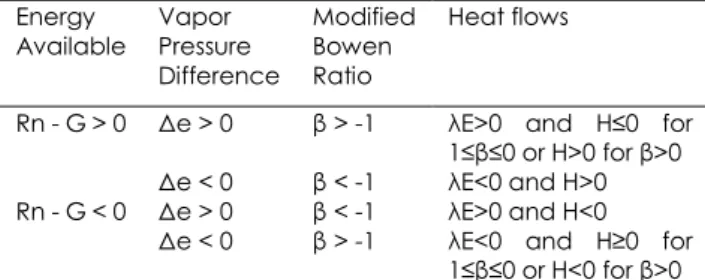
The data were analyzed according to methodology developed by Perez et al. (1999) (Table 1), which describes the conditions for the data collected to present physical consistency, avoiding possible estimation errors caused by advection or equipment problems.
Table 1. Conditionals for data evaluation for the modified Bowen ratio method (adapted from PEREZ et al., 1999).
Energy
Available Vapor Pressure Difference
Modified Bowen Ratio
Heat flows
Rn - G > 0 Δe > 0 β > -1 λE>0 and H≤0 for 1≤β≤0 or H>0 for β>0 Δe < 0 β < -1 λE<0 and H>0 Rn - G < 0 Δe > 0 β < -1 λE>0 and H<0
Δe < 0 β > -1 λE<0 and H≥0 for 1≤β≤0 or H<0 for β>0 In periods when inconsistency was observed, it was interpolated based on the previous and posterior values, provided that they did not occur in continuous periods of more than 2 h of incoherent
data. In cases where intervals greater than 2 h did not present consistent data, the entire dataset of the day was discarded.
DSSAT CEREZ-Maize
The model used was CERES-Maize, grouped in a Decision Support System for Technology Transfer (DSSAT), version 4.6 (HOOGENBOOM et al., 2012), where the experimental data were registered. The experiment was duly registered and the soil profile was constructed according to the chemical and physical analysis of the experimental site. The daily meteorological data of maximum, minimum temperature, radiation balance and precipitation referring to the experiment period for the simulation to be in accordance with actual conditions.
Subsequently, the sensitivity analysis of the model was performed to make the optimistic and pessimistic estimates of a group of variables that influence the model calibration. The simulations were processed considering a scenario of potential production. For this experiment, we evaluated the DKB 333 hybrid on which the DSSAT / CERES-MAIZE model was initially developed, because this hybrid presents similar characteristics to the hybrid used in the experiment.
The DSSAT / CERES-MAIZE model needs to have its coefficients calibrated to produce the corn growth and development (OLIVEIRA, 2015), adjusted to the experimental conditions, considering the average values of the genetic parameters representative of the experimental site. For that purpose, the calibration was performed manually by visual adjustment between the simulated curves and the observation points through the genetic coefficients P1, P2 and P5 that define the crop phenology, while G2 and G3 are related to grain yield, according to Hoogenboom Et al. (1994).
The CERES-Maize model can calculate the reference evapotranspiration (ETo) by two methods, Priestley-Taylor and Penman-Monteith. The Penman-Monteith method is expressed by the following equation (7):
)
2
U
0.34
(1
γ
s
275
T
)
a
e
s
(e
2
U
900
γ
G)
n
(R
s
0.408
0
ET
(7)Where: ET0 is the evapotranspiration rate of a hypothetical reference crop (mm d-1), Rn is the net surface flux density (MJ m-2 d-1), G is the soil heat flux density MJ m-2 d-1), y the psychrometric constant (kPa °C-1), T is the average air temperature (°C), U2 is the wind speed (ms-1) at 2 m above the soil, es is the current vapor pressure of the air (kPa), ea is the current vapor pressure curve (kPa) and s is the slope of the vapor pressure curve at temperature of the area (kPa °C-1).
Priestley-Taylor Method
The Priestley-Taylor method to calculate daily ETo (mm d-1) replaces the aerodynamic term of the Penman-Monteith equation with an empirical dimensionless multiplier (Priestley-Taylor coefficient) thus requiring a smaller data amount. This method is adopted as a standard in the DSSAT software (Equation 8).
.α
γ
s
G)
n
s.(R
.
λ
1
0
ET
(8)Where: (MJ m-2 d-1) is the heat flux of the soil, Rn (MJ m-2 d-1) is the net radiation, G (MJ m-2 d-1) is the latent heat of vaporization, s (KPa °C-1) is the slope of the vapor pressure curve at air temperature, y (kPa °C-1) is the psychrometric constant, and a is the Priestley-Taylor coefficient. The crop evapotranspiration (ETc) can be obtained by the relation (Equation 9):
0
ET
c
K
c
ET
(9)Where: Kc is the crop coefficient, which varies with the phenological phases as a function of the leaf area index (LAI), as presented in the following equation (Equation 10):
6.0
LAI
1.0)
max
c
(K
1.0
c
K
(10)Evaluation of the results obtained
The MBR was considered an observed evapotranspiration data, where the PM and PT method was the simulated data. The evaluation of its performance was based on the following statistics: correlation (r), root mean squared error (RMSE), BIAS index, concordance index (d) and coefficient of efficiency of the model (COE).
Correlation (r) quantifies the degree of relationship between two variables. The value r varies from -1 to 1, the closer to the upper or lower limits, the greater the relation between estimated and observed values (Equation 11).
)²
O
(Oi
²
E)
(Ei
)
O
(Oi
E)
(Ei
r
(11)The root mean squared error (RMSE) establishes the mean error of the model, i.e., the lower the value, the better the model performance (MARTINS et al., 2014) (Equation 12).
n
²
O
E
RM SE
n 1 i i i
(12)The mean deviation of estimated values based on observed values expresses the model trend, and is quantified by the BIAS index. Thus, the closer to zero, the lower the model trend (Leite, Valdir, Lima et al., 2002; Martins et al., 2014) (Equation 13).
n 1 i i n 1 i n 1 i i iO
O
E
BIAS
(13)The concordance index (d) represents much free estimated variables are error-free, and d can range from 0 to 1, that is, the closer to 1, the greater the concordance between observed and estimated data (WILLMOTT, 1981) (Equation 14).
([Ei
E
]
[Oi
O
])²]
[
Oi)²]
(Ei
[
1
d
(14)The coefficient of efficiency of the model (COE) represents how good the adjustment of the simulated values is. COE can vary from -∞ to 1, where the closer to 1, the better the fit in the model (BRAS; CI; SOLO, 2003) (Equation 15).
)
O
(Oi
Ei)²
(Oi
COE
n 1 i
(15)Where: Ei is the estimated evapotranspiration values; Oi is the evapotranspiration values observed by MBR; n is the number of observations;
O
is the mean of the observed values;E
is the average of estimated values.
Results and Discussion
The evaluation of the reference evapotranspiration (ET0) data estimated from the Pennam-Montheth (PM) and Priestley and Taylor (PT) methods and the data estimated by the Modified Bowen Ratio (MBR) method showed significant differences between the results. Similar observations were found for crop evapotranspiration (ETc).
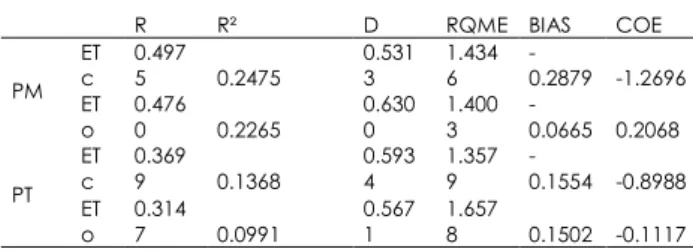
According to the results of the statistical analysis (Table 2), the estimated data did not present satisfactory adjustment compared to the measured data, which showed low accuracy. The coefficient of determination (R²), which occurs in the total variability explained by the model (MONOD et al., 2006), was far from coefficient 1, which indicates a perfect linear correlation. The "d" index of Willmott presented similar behavior to that of the correlation
coefficient; however, the indices for ETc were slightly higher those for ET0 in both methods used.
The COE values were low, as they should vary from -∞ to 1, and the closer to 1, the more accurate adjustment (ASCE, 1993). Therefore, the data obtained are not accurate and are considered questionable since they were lower than 0.36 (SILVA et al., 2008).
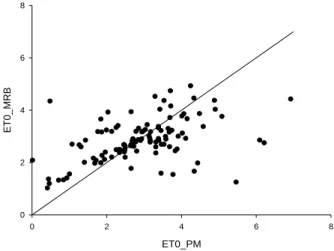
As observed, for ET0, estimates using the Penis-Montheth (PM) method were underestimated (Figure 1) and the results were overestimated (Priestley and Taylor) (Figure 2) . For ETc, the same data behavior was observed for the Pennam-Montheth (PM) method (Figure 3) and for the Priestley and Taylor (PT) method (Figure 4).
The ET0 estimated by the CERES-MAIZE model using the Pennam-Montheth (PM) and Priestley and Taylor (PT) methods was lower when compared to the ET0 obtained by the MBR at approximately 90 days after sowing until the end of the corn crop cycle (Figure 5), which may have been due to the small number of meteorological input variables in the model.
With the meteorological input data for the model, it was inserted radiation balance, maximum temperature, minimum temperature and precipitation; However, they were not enough to estimate ET0 by the Pennam-Montheth (PM) method, since this method still requires de information regarding air humidity and wind speed, which many times cause limitations to its use (PEREIRA et al., 1997). The method of Priestley and Taylor (1972) is more simplistic and approximates the Penman method, using as input variable only maximum and minimum temperature (Figure 6).
Figure 1. Reference Evapotranspiration (ET0) of the data measured by the Modified Bowen Ratio as a function of the data estimated by ET0 calculation using the Pennam-Montheth (PM) method.
ET0_PM 0 2 4 6 8 ET0_ MR B 0 2 4 6 8
Figure 2. Reference evapotranspiration (ET0) of the data measured by Modified Bowen Ratio according to the data estimated by ET0 calculation using the Priestley and Taylor (PT) method.
ET0_PT 0 2 4 6 8 ET0_ MR B 0 2 4 6 8
Figure 3. Evapotranspiration of the crop (ETc) of the data measured by the Modified Bowen Ratio according to the data estimated by ET0 calculation using the Pennam-Montheth (PM) method.
ETc_PM 0 2 4 6 ETc_ MR B 0 2 4 6
Figure 4. Evapotranspiration of the crop (ETc) of the data measured by the Modified Bowen Ratio according to the data estimated by ET0 calculation using the Priestley and Taylor (PT) method.
ETc_PT 0 2 4 6 ETc_ MR B 0 2 4 6
As observed in the figures below, there was difference between crop evapotranspiration (ETc) values between both methods used. The ETc estimated through ET0 calculated by the Pennam-Montheth model (PM) (Figure 5) was lower when
compared to ETc measured by the Modified Bowen Ratio (MBR) method (Figure 6). The ETc estimated through the ET0 calculated by the Priestley and Taylor (Figure 7) method was superior when compared to ETc measured by the Modified Bowen Ratio (MBR) method (Figure 8).
Figure 5. Reference Evapotranspiration (ET0) of the data measured by the Modified Bowen Ratio as a function of days after sowing, by calculating the ET0 using the Pennam-Montheth (PM) method.
Dias após semeadura
10 20 30 40 50 60 70 80 90 100 110 120 130 ET0_PM 0 2 4 6 8 MRB CRES-MAIZE
Figure 6. Evapotranspiration of the crop (ETc) of the data measured by the Modified Bowen Ratio according to the days after sowing, by calculation of ET0 by the Pennam-Montheth (PM) method.
Dias após semeadura
10 20 30 40 50 60 70 80 90 100 110 120 130 ETc_P M 0 2 4 6 8 MRB CRES-MAIZE
The cumulative evapotranspiration in the corn crop cycle for the Modified Bowen Ratio (MBR) method was 433.6943 mm d-1, using the Pennam-Montheth (PM) method 308,832 mm d-1 and by the Priestley and Taylor (PT) method, 366.16 mm d-1. However, in spite of ETc variation throughout the crop cycle, ET0 estimation using the CERES-MAIZE model were lower than in the accumulated ETc method (Figure 9).
Figure 9. Evapotranspiration of the crop (ETc) accumulated during the crop cycle.
Days after sowing
0 20 40 60 80 100 120 140 ET c ( m m d -1) 0 100 200 300 400 500 MRB_accumulated PM_accumulated PT_accumulated
Table 2. Statistical results of reference evapotranspiration (ET0) and daily evapotranspiration (ETc) estimated by the Pennam-Montheth (PM) and Priestley and Taylor (PT) methods, using the CERES-MAIZE model in comparison to reference evapotranspiration (ET0) and crop evapotranspiration (ETc) estimated by the Modified Bowen Ratio (MBR) method.
R R² D RQME BIAS COE
PM ET c 0.4975 0.2475 0.5313 1.4346 -0.2879 -1.2696 ET o 0.4760 0.2265 0.6300 1.4003 -0.0665 0.2068 PT ET c 0.3699 0.1368 0.5934 1.3579 -0.1554 -0.8988 ET o 0.3147 0.0991 0.5671 1.6578 0.1502 -0.1117
Conclusions
Potential evapotranspiration (ET0) was underestimated by the Pennam-Montheth method and overestimated by the Priestley and Taylor method, using the CERES-MAIZE model during the crop cycle.
Accumulated crop evapotranspiration (ETc) estimated by the Pennam-Montheth and Priestley and Taylor method using the CERES-MAIZE model was lower than that measured by MBR.
Acknowledgement
The author wish to thank Luiz de Queiroz College of Agriculture - University of São Paulo (ESALQ / USP) and the Foundation for Research Support of the State of São Paulo (FAPESP), process No. 2016 / 17008-2.
References
ALLEN, R. G.; PEREIRA, L. S.; RAES, D.; SMITH, M. Crop evapotranspirations: guidelines for computing crop water requirements. Roma: FAO, 1998. 297p. (FAO Irrigation and Drainage Paper, 56).
BERGAMASCHI, H.; DALMAGO, G. A.; COMIRAN, F.; BERGONCI, J. I.; MÜLLER, A. G.; FRANÇA, S.; SANTOS, A. O.; RADIN, B.; BIANCHI, C. A. M.; PEREIRA, P. G. Déficit hídrico e produtividade na cultura do milho. Pesquisa Agropecuária Brasileira, Brasília, v. 41, n. 2, p. 243-249, 2006.
BRAS, R.; CI; SOLO. SIMULAÇÃO DA PRODUÇÃO DE SEDIMENTOS PARA A MICROBACIA HIDROGRÁFICA DO RIBEIRÃO DOS MARINS (SP). v. 27, n. 1, p. 735– 741, 2003.
DOORENBOS, J.; KASSAM, A.H. Efeito da água no rendimento das culturas. Campina Grande: UFPB, 1994. 306p. (FAO. Irrigação e drenagem, 33). Tradução de H.R. Gheyi, A.A. de Souza, F.A.V. Damasco, J.F. de Medeiros.
DOURADO-NETO, D. Modelos fitotécnicos referentes à cultura de milho. Piracicaba: ESALQ/USP, 1999. 229p. (Livre Docência).
FANCELLI, A.L. & D. DOURADO-NETO. Produção de Milho. Editora Agropecuária, Guaíba. 360p. 2000. HOOGENBOOM, G.; JONES, J. W.; WILKENS, P. W.; PORTE, C. H.; BOOTE, K. J.; HUNT, L. A.; SINGH, U.; LIZASO, J. L.; WHITE, J. W.; URYASEV, O.; ROYCE, F. S.; OGOSHI, R.; GIJSMAN, A. J.; TSUJI, G. Y. Decision Support System for Agrotechnology Transfer: version 4.5. Honolulu: University of Hawaii, 2012.
KRESOVIC, et. al. Irrigation as a climate change impact mitigation measure: An agronomic and economic assessment of maize production in Serbia. Agricultural Water Management, v. 139, p.
7–16, 2014. Disponível em:
<http://dx.doi.org/10.1016/j.agwat.2014.03.006>
LEITE, H. G.; VALDIR, E.; LIMA DE ANDRADE, C. UM MÉTODO PARA CONDUÇÃO DE INVENTÁRIOS FLORESTAIS SEM O USO DE EQUAÇÕES VOLUMÉTRICAS A METHOD FOR CONDUCTING FOREST INVENTORIES WITHOUT USING VOLUMETRIC EQUATIONS. v. 26, n. 3, p. 321–328, 2002.
MARTINS, F. B. et al. Desenvolvimento foliar em duas cultivares de oliveira estimado por duas categorias de modelos. Revista Brasileira de Meteorologia, v. 29, n. 4, p. 505–514, dez. 2014.
OLIVEIRA, L. A. De. Universidade de São Paulo Escola Superior de Agricultura “ Luiz de Queiroz ” Manejo da irrigação no cultivo da cana-de-açúcar e milho sob cenários futuros : aplicação dos modelos DSSAT / CANEGRO e CERES-MAIZE Luciano Alves de Oliveira Piracicaba. 2015
PAES, Â. et al. UMA REVISÃO ANALÍTICA DA EVAPOTRANSPIRAÇÃO POTENCIAL (1). Bragantia, v. 59, p. 125–137, 2000.
PEREIRA, A.R.; VILLA NOVA, N.A.; SEDIYAMA, G.C. Evapo(transpi)ração. Piracicaba: FEALQ, 1997. 183p.
PEREZ, P. J.; CASTELLVI, F.; IBAÑEZ, M.; ROSELL, J. I. Assessment of reliability of Bowen ratio method for partitioning fluxes. Agricultural and Forest Meteorology, v.97, p.141-150, 1999.
TOJO SOLER, C. M. Uso do modelo Ceres-Maize para previsão de safra do milho “safrinha”. 2004. 146 f. Tese (Doutorado em Agronomia) – Escola Superior de Agricultura Luiz de Queiroz, Piracicaba, 2004.
WILLMOTT, C. J. ON THE VALIDATION OF MODELS. Physical Geography, v. 2, n. 2, p. 184–194, 1 jul. 1981.