of Chemical
Engineering
www.scielo.br/bjcePrinted in BrazilVol. 35, No. 01, pp. 91 – 100, January – March, 2018
*Corresponding author: Hanife Sari Erkan. E-mail: [email protected]; Phone: +90 212 383 5383; Fax: +90 212 383 5358 dx.doi.org/10.1590/0104-6632.20180351s20160599
APPLICATION OF SUBMERGED MEMBRANE
BIOREACTOR TECHNOLOGY FOR THE
TREATMENT OF HIGH STRENGTH DAIRY
WASTEWATER
Hanife Sari Erkan
1*, Gorkem Gunalp
1and Guleda Onkal Engin
11 Yildiz Technical University, Faculty of Civil Engineering, Department of Environmental Engineering, 34220 Davutpasa, Esenler, Istanbul, Turkey. E-mail: [email protected]; [email protected]; [email protected]
(Submitted: October 21, 2016; Revised: November 29, 2016; Accepted: December 8, 2016)
Abstract – In this study, an aerobic submerged membrane bioreactor (sMBR) was used for the treatment of dairy wastewater at 15 h of hydraulic retention time (HRT) and 40 d of sludge retention time (SRT) with constant permeate
flux (9.5 L.m-3.d-1(LMH)). The COD, ammonia-nitrogen (NH
3-N) and orthophosphate (PO4-P) removal efficiencies
were 98.2%, 95.4% and 88.9%, respectively. The results demonstrated that sMBR was a suitable and effective
treatment for removal of organic matter and nutrients for treating dairy wastewater. The properties of the activated sludge, such as extracellular polymeric substances (EPS) and soluble microbial products (SMP) concentration, protein
and carbohydrate, relative hydrophobicity, zeta potential and floc size distribution were also investigated. According to
the results obtained, the total EPS content was lower than that of domestic wastewater treatment by MBR technology.
Keywords: Activated sludge; dairy industry wastewater; extracellular polymeric substances; membrane bioreactors
INTRODUCTION
Among the food industries, the dairy industry is generally considered to be the largest source of pollution (Farizoglu and Uzuner, 2011; Andrade et al., 2013). Since water is used in almost all steps of dairy production industry, such as heating, sanitization, cooling, and cleaning, high amounts of wastewater are generated (Sarkar et al., 2006; Chen and Liu, 2012). It was reported that the dairy industry produces on an average 2.5 - 3.0 liters of wastewater per liter of milk processed (Singh
et al., 2014). The effluents of this industry are generally
characterized by high organic matter and nutrients, mainly proteins, carbohydrates, and fats originated from milk, and residual cleaning agents (Perle et al., 1995; Andrade
et al., 2013). Significant variations in COD (430–18,045
mg/L) and BOD (40–8,240 mg/L) have been reported by researchers for the dairy industry wastewater (Koyuncu et al., 2000; Schwarzenbeck et al., 2005; Passeggi et al.,
2009). The reason for COD variations is primarily affected
by the milk, whey, or cream (Kushwaha et al., 2011). It was reported that the pH varies between 4.7 to 11 (Passeggi et al., 2009), while the suspended solids (SS) concentration varies between 0.024 to 4.5 g/l (Kushwaha et al., 2011).
Significant amount of nutrients can also be found, for
(Grasshoff, 1997). Dairy wastewater always includes
micronutrients such as Na, Cl, K, Ca, Mg, Fe, Co, Ni, Mn. The presence of high Na and Cl concentration is due to the use of large quantities of alkaline cleaners in the plant (Demirel et al., 2005).
Commonly, conventional treatment processes, such as primary treatment and biological treatment, have been used for dairy wastewater treatment, though each of these systems has some disadvantages, such as high energy requirement, high scum production, low settleability of
sludge, low resistance to shock loadings, difficulties in
nutrients removal (Chen and Liu, 2012; Andrade et al., 2013). Also these systems may have some problems in
the degradation of fats, oils and other types of specific
pollutants (Andrade et al., 2013).
Recently, industries have been searching for new technologies for wastewater treatment, aiming not only at the achievement of standards, but also at acquiring high
removal efficiency of the treated effluent for reuse. For
these reasons, there is a growing interest in combining membrane systems and biological wastewater processes. The membrane bioreactors (MBR) have distinct advantages over conventional biological processes, such as, higher
biodegradation efficiency, smaller footprint, better removal efficiency and treated waste quality, and no settling
problems of sludge (Bouhabila and Ren, 2001; Xing et al., 2003; Farizoglu and Uzuner, 2011). Considering these advantages, the MBRs appear to be a promising process for the treatment of dairy industry wastewater.
In spite of the high potential of the MBR applications for dairy wastewater treatment, there are only a few studies conducted using MBR systems (Farizoglu and Uzuner, 2011; Andrade et al., 2013). Some researchers used a membrane sequencing batch reactor (MSBR) for dairy wastewater treatment and obtained high removal
efficiencies of COD, nitrogen and phosphorus (Bae et al.,
2003; Rezaee et al., 2015). Farizoglu and Uzuner (2011) investigated treatment of dairy industry wastewater in a biological high performance membrane system (aerobic
jet loop reactor with ceramic membrane filtration unit). In
their study, the organic loading rate was 53 kg COD/m3
day and the COD removal efficiency was 97-98% under
3 hours of hydraulic retention time. Chen and Liu (2012) studied dairy wastewater treatment with coagulation and a MBR hybrid system. The MBR capacity was 7 L/h and the HRT was controlled at 10 h. It was reported that the hybrid system reduced 98% COD and, as a result, the
effluent COD value decreased to 8 mg/L. The authors
remarked that the combination of coagulation with MBR
presents the possibility and applicability to reclaim effluent
in dairy industries. Praneeth et al. (2014) investigated the performance of sMBR in treating dairy wastewater using a laboratory-scale HRT of 10 hours. The removal
efficiencies were over 91% and 86% for COD and BOD,
respectively. Andrade et al. (2013) investigated real dairy
industry wastewater treatment with aerobic MBR. The 6 and 8 hours of HRT were studied and, for both HRT values,
the organic matter removal efficiencies were found to be
99%.
The aim of this study is to evaluate the performance of the sMBR in the treatment of pre-treated dairy industry wastewater. Another important point determined was that activated sludge treating industrial wastewater exhibited
different properties compared to activated sludge treating
domestic wastewater. Therefore, the study also focused on physico-chemical properties of the activated sludge, such as EPS, SMP, protein and carbohydrate, relative hydrophobicity.
MATERIALS AND METHODS
Characterization of wastewater and inoculum
The dairy wastewater was taken from the wastewater treatment plant of a dairy factory in Istanbul. During the experimental period, approximately 1000 L of dairy
wastewater was obtained from the factory at two different
times and was stored at 4 °C to prevent degradation. Milk, yogurt and butter are the main products of the factory. The dairy wastewater was treated using the combination of chemical coagulation with ferric chloride and aerobic activated sludge process on the premises of the plant. The chemical coagulation was performed in the plant in order to remove total suspended solids (TSS). The
characteristics of raw wastewater and the effluent of the
chemical coagulation process are shown in Table 1. The
effluent wastewater from chemical coagulation was used
to feed the sMBR. The C/N/P ratio of the pre-treated wastewater was found to be around 100/1.5/0.12. In order to provide the 100/5/1 ratio for aerobic biological treatment criteria, the required amounts of urea and orthophosphoric acid were added to pre-treated wastewater.
The activated sludge used in the sMBR was obtained from a municipal wastewater treatment plant in Istanbul. The concentrations of MLSS and MLVSS of the activated sludge were 7.9 g/L and 5.15 g/L, respectively.
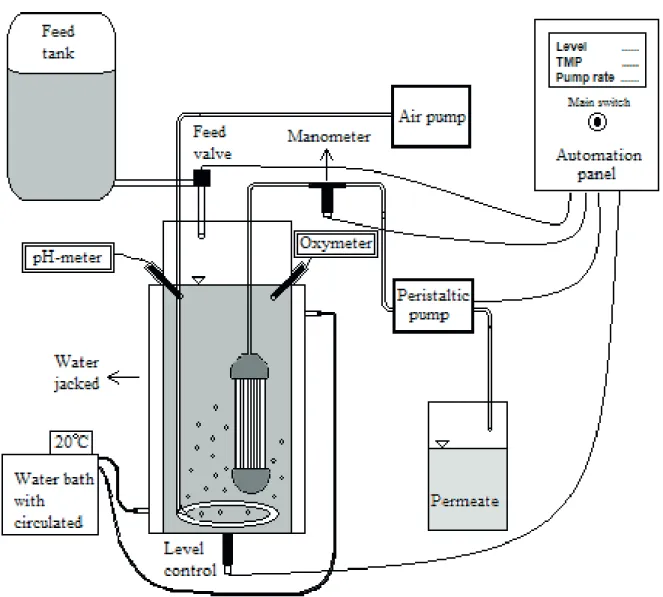
A schematic plan of the sMBR system can be seen
in Figure 1. The sMBR had 10 L effective volume. As
mentioned previously, the sMBR was fed with pre-treated
dairy industry wastewater obtained from the effluent of
chemical coagulation and operated for a period of 100
days. A hollow fibre membrane module (0.4 µm pore size) with a total effective area of 0.07 m2 was used in the sMBR. Filtration was operated continuously from the sMBR by
imposing a negative pressure on the fibres. The sMBR
System used and operating conditions
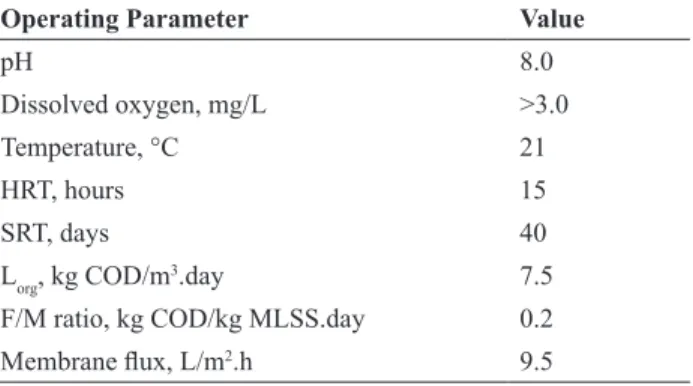
The operating conditions are presented in Table 2. As can be seen from Table 2, the F/M ratio was 0.2 kgCOD/ kgMLSS.day in the sMBR at steady-state conditions. According to Judd (2006), the majority of MBRs operate with lower F/M (<0.25 kgCOD/kgMLSS.day) for treating
industrial effluents.
The sMBR system was operated under 7.5 kg/m3.day of organic loading rate and at SRT of 40 days at steady-state conditions. The sMBR was continuously fed on pre-treated dairy industry wastewater which is located in the Istanbul region.
Sampling and analyses
The measurements of COD, TKN, ammonia nitrogen (NH3-N), and orthophosphate (PO4-P) in the feed wastewater and the permeate, MLSS and MLVSS in the sMBR were carried out according to the Standard Methods (2005). DO and pH measurements were conducted daily, while COD, NH3-N, and PO4-P analyses were performed every other day. For the determination of activated sludge properties in the sMBR, the analyses of EPS, SMP,
carbohydrate, protein, hydrophobicity and critical flux
were conducted once every 15 days. In order to see the repeatability of the experiments, all the measurements were carried out three times independently.
The analyses of EPS and SMP were carried out by the formaldehyde extraction method (Tinggang et al., 2008). The Lowry method (Lowry et al., 1951) and the phenol-sulphuric acid method (Dubois et al., 1956) were used for the analysis of protein and carbohydrate, respectively. The relative hydrophobicity (RH) analyses were conducted by the MATH test (Measuring the Attachment of Bacteria to Hydrocarbons) (Chang and Lee, 1998).
Critical flux and membrane fouling rate determination The critical flux analyses were performed by the flux-step method (Wu et al., 2008). The critical flux of the sMBR was measured using a flat sheet membrane module with an effective filtration area of 0.044 m2. Average pore
size of the flat sheet membrane was 0.4 µm. Fresh flat sheet membranes were used for each critical flux determination.
The time intervals were kept constant at 30 minutes for
each filtration step.
Membrane fouling rate was determined by short-term
filtration experiments which were conducted as by Huang
et al. (2000), Liu et al. (2005), and Wu et al. (2007). The
same flat sheet membrane module was used for the critical flux determination. The filtration performance of the flat
sheet membrane module was carried out with constant
flux, by which the critical flux was determined, while the
change of TMP was monitored. The degree of membrane
fouling was evaluated by the membrane filtration resistance
calculated using Eq. 1:
(1)
where J is the membrane flux (LMH), TMP is the
transmembrane pressure (Pa), µ is the water viscosity of the permeate (Pa.s) , R is the resistance of the membrane
filtration (1/m).
The membrane fouling rate (ΔR) of the mixed liquor
was finally calculated as ΔR30 (1/(m h)), the change rate of
R within 30 min of filtration, according to Eq. 2.
(2) Table 1. Characteristics of raw and pre-treated dairy wastewater
Parameter Unit Raw wastewater Pre-treated wastewater
COD mg/L 7136 ± 75 6404 ± 46
BOD5 mg/L 4900 ± 37 4418 ± 25
TS mg/L 12120 ± 280 11410 ± 150
TSS mg/L 1820 ± 130 214 ± 15
TKN mg/L 95 ± 7.30 94 ± 9
NH3-N mg/L 30 ± 2 28 ± 4
NO3-N mg/L 3.2 ± 0.8 3.2 ± 0.35
TP mg/L 8.0 ± 0.55 7.9 ± 1.5
PO4-P mg/L 3.29 ± 0.35 2.77 ± 0.25
pH - 5.59 ± 0.1 5.41 ± 0.2
Conductivity mS/cm (20 °C) 6.15 ± 0.64 6.08 ± 0.03
Alkalinity mg CaCO3/L 1225 ± 35 181.6 ± 25
Chloride mg/L 1728 ± 146 1682 ± 150
TMP
J
µR
=
30 0
30
R
R
R
t
−
∆
=
where Δt is the filtration time (h), R0 the R value of the module at starting time (1/m) and R30 the R value of the module after30 min filtration (1/m).
By combining equation 1 and 2, ΔR30 can berewritten as Eq. 3:
(3)
where TMP0 is the TMP value of the module at starting time (Pa) and TMP30 is the TMP value of the module after
30 min filtration (Pa).
The parameters μ and J in Eq. 3 were adjusted previously
to equivalent values at 20ºC to eliminate the influence of water viscosity variations on filtration resistance.
RESULTS AND DISCUSSION
Overall performance of the sMBR systems
During the sMBR operation, the removal efficiencies of
COD, NH3-N and PO4-P were found to be high. The total
removal efficiencies of COD, NH3-N and PO4-P were over 98.2%, 95.4% and 88.9%, respectively. The COD removal
efficiency indicated that the removal of organic matter was rather successful and nutrient removal efficiencies showed
NH3-N and PO4-P removal was also successful. The sMBR
showed high removal efficiencies for organic matter
and nutrients. Andrade et al. (2013) investigated dairy wastewater treatment in sMBR at a SRT of 60 days and HRT of 6 and 8 hours, respectively. The authors reported
that the organic matter removal efficiencies were over 99%
for both HRTs. Farizoglu et al. (2004) investigated the use Figure 1. Schematic representation of the submerged membrane bioreactor used.
30 0
30
TMP
TMP
R
µJ t
−
∆
=
of an aerobic jet loop bioreactor coupled to membranes for the treatment of whey from a cheese-making process.
The authors achieved COD removal efficiencies over
94%; however, the HRT and SRT were 0.82 to 2.8 days and 1.1 to 2.8 days, respectively. On the other hand, it is known that application of high SRTs in sMBRs contribute
to nitrification in these systems. Thus, nitrifying bacteria,
which are notoriously slow growing microorganisms, are responsible for the conversion of ammonia nitrogen into nitrate (Judd, 2006). Andrade et al. (2013) reported that NH3-N and TN removal efficiencies were 96% and 98%, when the dairy wastewater was treated in the sMBR at 8
h of HRT. It was stated in an earlier study that significant
removal of TN is not expected, once the reactor is operated under fully aerated conditions (Puznava et al., 2001). However, it is known that, due to lack of oxygen, anoxic zones can form in the inner regions of the activated
sludge flocs, thereby providing convenient conditions for denitrification (Puznava et al., 2001). Otherwise, some researchers had high phosphorus removal efficiencies
in MBR systems when they were treating dairy industry wastewater (between 53-85%) (Farizoglu et al., 2007; Andrade et al., 2013). According to the researchers, these
high removal efficiencies were due to a considerable
uptake of phosphorus for new microorganism synthesis, since the MLSS concentration was high in the reactor, and to phosphate precipitation with Ca2+ and Na+ ions. Both
reasons account for high phosphorus removal efficiencies
in this study.
Variations of biomass, SMP and EPS in sMBR
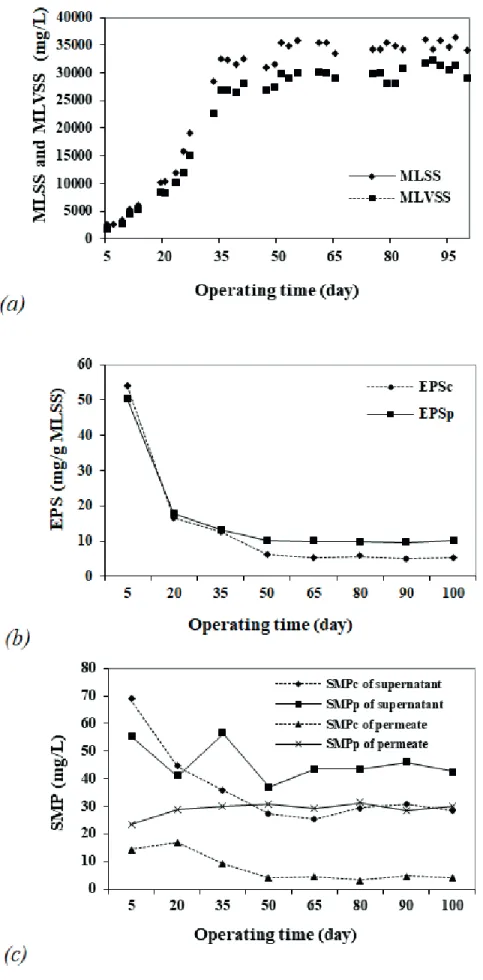
Concentrations of MLSS and MLVSS during the operation of the sMBR are shown in Figure 2-a. The initial concentrations of MLSS and MLVSS were around 2480 mg/L and 1740 mg/L, respectively, corresponding to a MLVSS/MLSS ratio of 70%. Throughout the operation of 100 days, the concentrations of MLSS and MLVSS increased slightly and they reached 34,070 mg/L and 29,130 mg/L at the end of the operation, respectively, corresponding to a MLVSS/MLSS ratio of around 85.5%, showing the activity of the inoculum. 400 mL of biomass
was drawn daily from the sMBR in order to keep the SRT value at 40 d, both MLSS and MLVSS concentrations remained almost constant after the sMBR reached steady-state condition (after 37 days). It was reported that the SRT in aerobic MBRs should be controlled between 20 and 50 days in order to control the concentration of EPS and the membrane fouling (Meng et al., 2009). Therefore, in this study, the SRT was kept at 40 days during the sMBR operation.
Bound or soluble forms of extracellular polymeric substances are considered as the predominant component causing membrane fouling in MBRs (Meng et al., 2009). Bound EPS is composed of carbohydrates, proteins, nucleic acids, lipids, and humic acids. Soluble EPS or SMP
can be defined as the pool of organic compounds which
are excreted into solution from the microorganism (Meng et al., 2009). As the carbohydrate and protein are regarded as the major components (Meng et al. 2006), these are considered to represent the total amount of EPS and SMP in this study. The experimental results of EPS and soluble EPS (SMP) are presented in Figure 2-b. In the sMBR, the EPS concentration decreased steadily throughout the reactor operation and the EPS reached constant values when the sMBR reached the steady-state condition. The EPSc (carbohydrate fractions of EPS) and EPSp (protein fractions of EPS) concentrations in the sMBR averaged 5.6 ± 0.4 mg/g MLSS and 10.0 ± 0.25 mg/g MLSS, respectively. Total EPS of activated sludge in MBRs generally fall in the range of 20-250 mg/g MLSS, in the case of domestic wastewater treatment (Lee et al. 2003; Meng et. al. 2007; Lin et al. 2014). Masse et al. (2006) reported that the total EPS content was 20-40 mg/g MLVSS at 53 days of SRT. In this study, the total EPS content was found to be 15.6 ± 0.65 mg/g MLSS, slightly lower than those reported in the literature.
The carbohydrate and protein concentrations of SMP (SMPc and SMPp) in the supernatant and permeate of the sMBR are shown in Figure 2-c. The total concentrations of SMP in the supernatant and the permeate of sMBR averaged 70.85± 4.73 mg/L and 34.08± 0.70 mg /L, respectively, corresponding to around 46.6% SMP rejection by the membrane. In thesMBR, the supernatant and permeate concentrations of SMPc were 28.27± 2.12 mg/L and 4.10 ± 0.61 mg/L, respectively, corresponding to around 85% rejection by the membrane. On the other hand, the supernatant and permeate concentrations of SMPp were 42.57± 3.36 mg/L and 30.0 ± 1.23 mg/L, respectively, corresponding to around 30% rejection by the membrane. As a conclusion, much higher SMPc rejection performance (85%) was achieved compared to SMPp (30%). The reason
for this could be due to different molecular weights of
the SMPc and SMPp produced. It was reported by Ng et
al. (2006) that carbohydrate and protein have different
transmembrane rates throughout the membrane, so
different rejection performances can be obtained for the
rejection of SMPc and SMPp. Table 2. Operating conditions in the sMBR
Operating Parameter Value
pH 8.0
Dissolved oxygen, mg/L >3.0
Temperature, °C 21
HRT, hours 15
SRT, days 40
Lorg, kg COD/m3.day 7.5
F/M ratio, kg COD/kg MLSS.day 0.2
Membrane filtration performance and critical flux analyses in the sMBR system
Figure 3 shows the flux and transmembrane pressure
(TMP) of the sMBR. Dotted lines mark the operation days when physical cleaning with tap water and a sponge cleaner
was carried out. During the operations, the permeate flux was around 9.5 LMH. Maximum fluxes acquired in sMBR
for domestic wastewater were usually between 25 and 30 LMH; however, for industrial wastewater these values were found to be between 5 and 15 LMH (Cornel and Krause, 2008). The TMP values increased sharply just after the system’s initiation and the TMP values reached
approximately 378 mbars. On day 13, the first physical
cleaning was applied using a sponge cleaner. After physical cleaning, the TMP value remained below 260 mbars for around 30 days and increased steadily. On day 45, 55, 67,
79 and 95, the recovery of flux was attained by physical
cleaning.
The critical flux measurements were conducted two
times: on days 40, and 80 when the sMBR reached the
steady-state condition. The average critical flux values did not change significantly on different operating days
and averaged between 12-14 LMH. Therefore, the sMBR
was operated under sub-critical flux conditions during
the study. Many industrial MBR systems were operated
at low membrane flux (Wang et al., 2005; Hoinkis and
Panten 2008). Membrane fouling rate determination was
conducted at constant membrane flux (9.5 LMH) when the
sMBR reached the steady-state condition. In this study,
∆R30 was found as 4.11x10¹³ 1/m.h.
Relative Hydrophobicity of activated sludge
Bacterial floc hydrophobicity (relative hydrophobicity:
RH) is the tendency of flocs to repel water. Van Loosdrecht et al. (1987) reported that the attachment of sludge flocs
would increase as RH increased. On the other hand, it was reported that the EPSp had a strong positive influence on the RH of activated sludge, however EPSc had no
significant influence (Jorrand et al. 1998; Lee et al. 2003).
Therefore, increased hydrophobicity of EPSp is more likely
to enhance attachment of flocs on the membrane surface
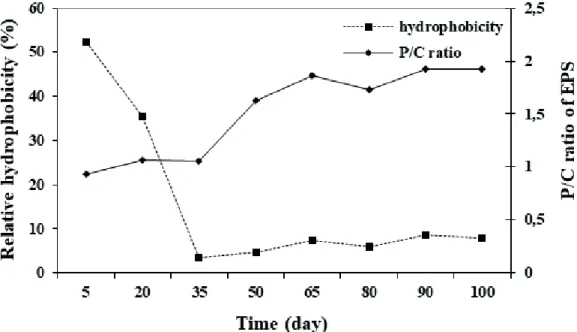
than hydrophobic EPSc. The relationship between relative hydrophobicity and protein/carbohydrate (P/C) ratio of EPS of the activated sludge was seen in Figure 4. It can be stated that there is a positive linear correlation between
them with a correlation coefficient (R2) of 0.834 after 35 days of operation (Figure 5). Joglekar and May (1987) suggested that R2 should be at least 0.80 for a good fit of a model. As known in the literature, mainly amino acids
with hydrophobic side groups contribute significantly to
the hydrophobicity of the microbial surface. Therefore, the relative hydrophobicity increased with increasing P/C ratio of EPS.
CONCLUSIONS
Taking into consideration the complexity and high strength of dairy wastewaters, it is very important that
dairy product manufacturers need to utilize effective treatment technologies before discharging effluents to the
environment. Most of the time, conventional treatment
systems are not cost effective and these systems may
produce high amounts of excess sludge.
To address these problems and to find out sound
solutions for the manufacturers, the treatment of dairy industry wastewater was studied using an aerobic submerged MBR operated at 40 d of SRT and 15 h of HRT.
Figure 4. Variation of activated sludge relative hydrophobicity and protein/carbohydrate ratio (P/C) of EPS.
Figure 5. Relationship between relative hydrophobicity and P/C ratio of EPS after 35 days of MBR operation.
The sMBR produced an effluent COD value of 115.3 ± 25
mg/L. It was found that operation of the sMBR at 9.5 LMH was sustainable with regular maintenance. The results indicated that low EPS was produced and especially SMPc rejection by the membrane was quite high. On the other hand, a linear correlation was found between the relative hydrophobicity and P/C ratio of EPS of the activated sludge. According to the results obtained, dairy industry wastewater discharge limits (direct discharge to a receiving water body) have been met based on the standards in Water Pollution Control Regulation of Turkey (COD <160 mg/L) (Ministry of Environment and Urbanization, MoEU).
ACKNOWLEDGEMENTS
The authors would like to thank the Scientific and
Technological Research Council of Turkey (TUBITAK) for
financially supporting this study under the project no. 112Y308.
REFERENCES
Andrade, L.H., Motta, G.E. and Amaral, C.S., Treatment of dairy wastewater with a membrane bioreactor, Brazilian Journal Of Chemical Engineering, 30, No. 04, 759 (2013).
Bae, T.H., Han, S.S. and Tak, T.M., Membrane sequencing batch reactor system for the treatment of dairy industry wastewater, Process Biochemistry, 39, 221 (2003).
Bouhabila, E. and Ben, R. Aim and Buisson Fouling characterization in membrane bioreactors, Separation and
Purification Technology, 22-23, 123 (2001).
Chang, I.S. and Lee, C.H., Membrane filtration characteristics in membrane-coupled activated sludge system - the effect of
physiological states of activated sludge on membrane fouling, Desalination, 120, 221 (1998).
Chen, W. and Liu, J., The possibility and applicability of coagulation-MBR hybrid system in reclamation of dairy wastewater, Desalination, 285, 226 (2012).
Cornel, P., Krause, S., Membrane Bioreactors for Wastewater Treatment. In: Li, N.N., Fane, A.G., Ho, W.S.W., Matsuura, T., Advanced Membrane Technology and Applications. John Wiley and Sons: Hoboken, N.J., pp. 217-239 (2008). Demirel, B., Yenigun, O. and Onay, T.T., Anaerobic treatment of
dairy wastewaters: A review, Process Biochemistry, 40, 2583 (2005).
Erkan, H.S., Engin, G.O., Ince, M. and Bayramoglu, M.R., Effect of carbon to nitrogen ratio of feed wastewater and sludge retention time on activated sludge in a submerged membrane bioreactor, Environmental Science and Pollution Research, 23, 10742 (2016).
Farizoglu, B. and Uzuner, S., The investigation of dairy industry wastewater treatment in a biological high performance membrane system, Biochemical Engineering Journal, 57, 46 (2011).
Farizoglu, B., Keskinler, B., Yildiz, E. and Nuhoglu A., Cheese whey treatment performance of an aerobic jet loop membrane bioreactor, Process Biochemistry, 39, 2283 (2004).
Farizoglu, B., Keskinler, B., Yildiz, E. and Nuhoglu, A., Simultaneous removal of C, N, P from cheese whey by jet loop membrane bioreactor (JLMBR), Journal of Hazardous Materials, 146, 399 (2007).
Gavala, H.N., Kopsinis, H., Skiadas, I.V., Stamatelatou, K. and Lyberatos, G., Treatment of Dairy Wastewater Using
an Upflow Anaerobic Sludge Blanket Reactor, Journal of
Agricultural Engineering Research, 73, 59 (1999).
Grasshoff, A., Fouling and cleaning of heat exchanges. In:
Bulletin of the IDF, No. 328, IDF, p. 32, Brussels (1997). Gutierrez, J.L.R., Encina, P.A.G. and Fdz-Polanco, F., Anaerobic
treatment of cheese production wastewater using a UASB reactor, Bioresource Technology, 37, 271 (1991).
Hoinkis, J. and Panten, V., Wastewater recycling in laundries— From pilot to large-scale plant, Chemical Engineering and
Processing: Process Intensification. 47, 1159 (2008).
Huang, X., Liu, R. and Qian, Y., Behaviour of soluble microbial products in a membrane bioreactor, Process Biochemistry, 36, 401 (2000).
Joglekar, A.M. and May, A.T., Product excellence through design of experiments, Foods World, 32, 857–868 (1987).
Jorrand, F., Bigne, F.B., Block, J.C. and Urbain, V., Hydrophobic/ hydrophilic properties of activated sludge exopolymeric substances, Water Science and Technology, 37,307 (1998). Judd, S., The MBR Book: Principles and Applications of
Membrane Bioreactors in Water and Wastewater Treatment. Elsevier Ltd: Oxford (2006).
Koyuncu, I., Turan, M., Topacik, D. and Ates, A., Application
of low pressure nanofiltration membranes for the recovery and reuse of dairy industry effluents, Water Science and
Technology, 41, 213 (2000).
Kushwaha, J.P., Srivastava, V.C. and Mall, I.D., An Overview of Various Technologies for the Treatment of Dairy Wastewaters, Critical Reviews in Food Science and Nutrition, 51, 442 (2011).
Lee, W., Kang, S. and Shin, H., Sludge characteristics and their
contribution to microfiltration in submerged membrane
bioreactors, Journal of Membrane Science, 216, 217 (2003). Lin, H., Zhang, M., Wang, F., Meng, F., Liao, B.-Q., Hong, H.,
Chen, J. and Gao, W., A critical review of extracellular polymeric substances (EPSs) in membrane bioreactors: Characteristics, roles in membrane fouling and control strategies, Journal of Membrane Science, 460, 110 (2014). Liu, R., Huang, X., Xi, J.Y. and Qian, Y., Microbial behaviour in a
membrane bioreactor with complete sludge retention, Process Biochemistry, 40, 3165 (2005).
Lowry, O.H., Rosebrough, N.J., Farr, A.L. and Randall, R.J., Protein measurement with the folin phenol reagent, Journal of Biological Chemistry, 193, 265 (1951).
Massé, A., Sperandio, M. and Cabassud, C., Comparison of sludge characteristics and performance of a submerged membrane bioreactor and an activated sludge process at high solids retention time, Water Research, 40, 2405 (2006). Meng, F., Chae, S-R., Drews, A., Kraume, M., Shin, H-S. and
Yang, F., Recent advances in membrane bioreactors (MBRs): Membrane fouling and membrane material, review, Water Research, 43, 1489 (2009).
Meng, F., Zhang, H.,Yang, F., Zhang, S., Li, Y. and Zhang,
X., Identification of activated sludge properties affecting
membrane fouling in submerged membrane bioreactors,
Seperation and Purification Technology, 51, 95 (2006). Meng, F., Shi, B., Yang, F. and Zhang, H., Effect of hydraulic
retention time on membrane fouling and biomass characteristics in submerged membrane bioreactors, Bioprocess and Biosystems Engineering, 30, 359 (2007). Ng, H.Y., Tan, T.W. and Ong, S.L., Membrane fouling of
submerged membrane bioreactors: impact of mean cell residence time and the contributing factors, Environmental Science and Technology, 40, 2706 (2006).
Passeggi, M., López, I. and Borzacconi, L., Integrated anaerobic treatment of dairy industrial wastewaterand sludge, Water Science and Technology, 59, 501 (2009).
Perle, M., Kimchie, S. and Shelef, G., Some biochemical aspects of the anaerobic degradation of dairy wastewater, Water Research, 29, 1549 (1995).
Praneeth, K., Moulik, S., Vadthya, P., Bhargavac, S.K., Tardioc, J. and Sridhar, S., Performance assessment and hydrodynamic analysis of a submergedmembrane bioreactor for treating
dairy industrial effluent, Journal of Hazardous Materials,
274, 300 (2014).
Puznava, N., Payraudeau, M. and Thornberg, D., Simultaneous
nitrification and denitrification in biofilters with real-time
aeration control, Water Science and Technology, 43, 269 (2001).
Rezaee, S., Zinatizadeh, A.A.L. and Asadi, A., High rate CNP removal from a milk processing wastewater in a single
ultrasound augmented up-flow anaerobic/aerobic/anoxic
bioreactor. Ultrasonics Sonochemistry, 23, 289 (2015). Sarkar, B., Chakrabarti, P.P., Vijaykumar, A. and Kale, V.,
Wastewater treatment in dairy industries — possibility of reuse, Desalination, 195, 141 (2006).
Schwarzenbeck, N., Borges, J.M. and Wilderer, P.A., Treatment
of dairy effluents in an aerobic granular sludge sequencing
batch reactor, Applied Microbiology and Biotechnology, 66, 711 (2005).
Singh, N.B., Singh, R. and Imam, M.M., Waste water management in dairy industry: pollution abatement and preventive attitudes, International Journal of Science, Environment and Technology, 3, 672 (2014).
Tinggang, L., Renbi, B. and Junxin, L., Distribution and composition of extracellular polymeric substances in
membrane-aerated biofilm, Journal of Biotechnololog, 135,
52 (2008).
Van Loosdrecht, M.C., Lyklema, J., Norde, W., Schraa, G. and Zehnder, A.J., The role of bacterial cell wall hydrophobicity in adhesion, Applied and Environmental Microbiology, 53, 81893 (1987).
Wang, Y., Huang, X. and Yuan, Q., Nitrogen and carbon removals from food processing wastewater by an anoxic/aerobic membrane bioreactor, Process Biochemistry, 2005, 40, 1733 (2005).
Water Pollution Control Regulations, Ministry of Environment and Planning, Turkey, 31.12.2004.http://www.mevzuat.gov.tr/
Metin.Aspx? MevzuatKod=7.5.7221&sourceXmlSearch=& MevzuatIliski=0 (accessed 05 September 2016).
Wu, Z., Wang, Z., Huang, S., Mai, S., Yang, C., Wang, X.
and Zhou, Z., Effects of various factors on critical flux in
submerged membrane bioreactors for municipal wastewater
treatment, Seperation and Purification Technology, 62, 56
(2008).
Wu, Z., Wang, Z., Zhou, Z., Yu, G. and Gu, G., Sludge rheological and physiological characteristics in a pilot-scale submerged membrane bioreactor, Desalination, 212, 152 (2007). Xing, X.H., Wen, X.H., Qian, Y., Sun, D., Klose, P.S. and Zhang,
X. Q., Fouling and cleaning of microfiltration membrane