Vol. 34, No. 03, pp. 739 – 746, July – September, 2017 dx.doi.org/10.1590/0104-6632.20170343s20150803
* To whom correspondence should be addressed
ISOLATION AND CHARACTERIZATION
OF A HIGH SALT-TOLERANT AND
GLYPHOSATE-DEGRADING STRAIN OF
Agrobacterium tumefaciens
BZ8
Shoubao Yan
1, 2, Wei Zhao
1, Cuie Shi
1*, Qianqian Tong
1, Zhijun Zhai
3and Yun Wang
1*1School of Life Science, Huainan Normal University, Huainan, Anhui Province, 232001, People’s Republic of China *E-mails: [email protected]; [email protected]; Phone: +86 5546641722; Fax: +86 5546863540.
2Liquor Making Biological Technology and Application of Key Laboratory of Sichuan Province, Zigong, Sichuan Province, 643000, People’s Republic of China
3School of Life Science, Jiangxi Agricultural University, Jiangxi Province, 230026, People’s Republic of China
(Submitted: December 15, 2015; Revised: April 16, 2016; Accepted: April 16, 2016)
Abstract – In this study, a high salt-tolerant and glyphosate-degrading strain named BZ8 was isolated from activated sludge. According to 16S rDNA sequencing methods, morphological, physiological and biochemical analysis, strain
BZ8 was identified as Agrobacterium tumefaciens. The growth and glyphosate-degrading capability of A. tumefaciens
BZ8 were investigated and the results showed that the optimum conditions for glyphosate degradation under 6% of
NaCl concentration were found as follows: inoculation size of 10% (v/v), incubation temperature 37℃ and initial pH of
5.0. Salt tolerance test showed that A. tumefaciens BZ8 grew well and could thoroughly degrade 2000 mg/L glyphosate in 36 h if the concentration of NaCl was lower than 6%, while the degradation rate decreased gradually with increasing NaCl concentration. But the glyphosate degradation rate could still reach 62% when the salt concentration was 8%. In addition, the kinetic parameters for A. tumefaciens BZ8 grown on 100-2800 mg/L glyphosate according to Haldane’s model could predict the cell growth tendency successfully. These results showed that A. tumefaciens BZ8 could be used to control glyphosate wastewater with high salt content. Therefore, it has potential application.
Keywords: salt-tolerant; glyphosate-degrading strain; identification; growth kinetics.
INTRODUCTION
Glyphosate is the most widely used herbicide in the
world because it is a cheap, high efficient, low residue,
broad-spectrum and foliar applied weed-killer. It can be used on non-cropland as well as on a great variety of crops. Nowadays, China is the largest exporter of glyphosate in the world. However, during the production of glyphosate, the discharge of wastewater can cause serious water pollution problems and environmental damage (Xu et al.,
2007). This is because the wastewater mainly contains glyphosate, NaCl and so on (Amoros et al., 2007). It was reported that producing one ton of glyphosate could cause production of 5-6 tons of glyphosate wastewater. Therefore,
it is necessary to find safe and effective treatment methods
for glyphosate wastewater.
Up to now, several technologies, which can be defined
as physical methods, chemical techniques and biological treatments, have been developed for the treatment of glyphosate wastewater. Among these, physical and
of Chemical
chemical methods have proven to be costly and always produce additional harmful pollution. Biological treatment is more economical than physical and chemical methods
because it can be cost-effective and achieve the complete
degradation of organic pollutants (Fan et al., 2012). Therefore, biological treatment of glyphosate wastewater has received increased attention for contamination
prevention, and a number of different microorganisms,
including yeast (Tang and Chen, 2010), Pseudomonas (Wu et al., 2010), Flavobacterium (Terry et al., 1986), Arthrobacter (Pipke and Amrhein, 1988) etc., have been isolated and tested for their ability to degrade glyphosate. However, there have been few studies on microorganisms that can function under the conditions of high NaCl concentration.
In this study, a salt-tolerant and glyphosate-biodegrading bacterium was screened from activated sludge
and identified. In addition, the effects of environmental
factors such as inoculation size, initial pH, temperature and salinity on the growth and glyphosate biodegradation were evaluated. The intrinsic kinetics of the growth on glyphosate using the Haldane model was also investigated. The aim of this study was to provide possible new resources for glyphosate wastewater treatment.
MATERIALS AND METHODS
Isolation of the salt-resistant and glyphosate-degrading strain
Activated sludge samples collected from a glyphosate wastewater treatment plant located in Anhui Hong Sifang Co., Ltd. currently manufacturing glyphosate in Hefei, Anhui province, People’s Republic of China were acclimated for one mouth in the selection medium (SM) supplemented with 500-2000 mg/L glyphosate and 60 g/L NaCl for selection of a salt-tolerant and glyphosate-degrading strain. The SM contained (g/L) KH2PO4 (0.5), K2HPO4 (0.5), MgSO4·7H2O (0.5), CaCl2 (0.04). Initially, 10 g of the samples were inoculated into 90 mL SM
with 500 mg/L glyphosate and incubated at 37℃, 200 rpm
for one week. Then, 10% of the culture was sub-cultured in SM with a glyphosate concentration of 1000 mg/L under the conditions as described above. The process was repeated until 2000 mg/L glyphosate was biodegraded by the samples. Then the resulting culture was serially diluted with sterilized water and spread onto selection medium agar plates supplemented with 2000 mg/L glyphosate as
the sole carbon source. The plates were incubated at 37℃.
Colonies that appeared on the plates were picked out and streaked several times to obtain pure isolates.
The obtained strains were stored on slants at 4℃ and
their glyphosate-degrading potential tested by inoculating
the pure cultures into replicated flasks. Each flask contained
100 mL SM supplemented with 2000 mg/L glyphosate. The
cultures were maintained at 37℃ with a shaker speed of 200
rpm. The strain that completely metabolized glyphosate at the fastest rate was chosen for further research.
Identification of the salt-resistant and
glyphosate-degrading strain
The screened strain was characterized and identified
based on its morphological, biochemical properties and 16S rRNA gene sequence analysis. The obtained cells of exponential growth phase in SM were harvested by
centrifugation at 12000 rpm, 4℃ for 20 min and washed
with sterile water. By using the method mentioned by Zhai et al. (Zhai et al., 2012), the genome of the strain was extracted.
Part of the 16S rRNA gene was amplified
by PCR using the forward primer: Eu27F (5’-AGAGTTTGATCATGGCTCAG-3’) and the reverse primer: 1492R (5’-TACGGCTACCTTGTTACGACTT-3’).
DNA amplifications were performed in 50 µL reactions containing approximately 100 ng of total DNA, 4 µL of 10×buffer, 4 µL of 25 mmol/L MgCl2, 4 µL of 2.5 mmol/L dNTPs, 2 µL of each 10 mmol/L primer and 0.4 µL of 5 U/ µL Taq polymerase. The PCR conditions were as follows: 94℃ for 3 min followed by 30 cycles of denaturation at 94℃ for 30 s, annealing at 55℃ for 30 s and primer extension at 72℃ for 2 min, followed by a final step at 72℃ for 10 min. PCR products were purified using a
commercial kit (Sangon, Shanghai, China), and then the
obtained purified PCR products were sequenced by Sangon
Biotech Company (Shanghai, China). The sequencing result was submitted to GenBank for BLAST analysis. A phylogenetic tree was constructed by the neighbor-joining method using the software MEGA 4.0 (Tamura et al., 2007).
Colony morphology was observed after cultivation
on SM at 37℃ for 24 h. Cell morphology was examined after 24 h of incubation at 37℃ by optical microscopy
(CX31, OLYMPUS, Japan). Gram staining was performed by a conventional method (Dong and Cai 2001). After
heat treatment at 80℃ for 10 min, the presence of spores
was investigated by optical microscopy following crystal violet staining for 2 min. Activities of catalase and nitrate reductase, hydrolysis of starch and glutin, utilization of citrate, nitrate reduction and production of indole were carried out according to the conventional methods (Smibert et al., 1994; Dong and Cai, 2001). The utilization of various substrates (sucrose, maltose, glycerol, D-galactose, xylose, D-glucitol, mannitol) as the sole carbon source was conducted according to the methods reported by Liu et al. (2014).
Biodegradation experiments
at the late exponential phase was used as inoculum. The biodegradation experiments were performed in 500 mL
flasks with a working volume of 100 mL at 200 rpm. In order to investigate the influence of initial
inoculation size, initial pH and temperature on glyphosate
degradation, replicate flasks with SM supplemented with
2000 mg/L glyphosate and 60 g/L NaCl were conducted at initial inoculum sizes varying from 2% to 15%, initial
pH ranges from 3 to 7 and temperatures from 20℃ to 42℃, respectively. A similar experimental procedure was
used for testing the capacity of the strain BZ8 to degrade glyphosate under the optimized conditions.
The effect of NaCl concentrations on glyphosate degradation was investigated by applying different NaCl
concentration (20, 40, 60, 80 and 100 g/L) at a constant glyphosate concentration of 2000 mg/L.
For the estimation of intrinsic kinetic parameters, a pure culture of strain BZ8 was inoculated into 100 mL SM
in 500 mL flasks with 60 g/L NaCl under the optimized
conditions. The SM was supplemented with glyphosate concentrations varying from 100 to 2800 mg/L. All the experiments were performed in triplicate. Culture samples were regularly taken for measurement of biomass and glyphosate concentration, and results were shown as means
± confidence intervals.
Glyphosate degradation kinetics
The most commonly used kinetic model to describe microbial growth is the Monod kinetic model. However, this model does not represent the growth kinetics of inhibitory substrates. Haldane’s model developed from the Monod kinetic model has been used widely to characterize the metabolic inhibition of substrate on the microbial growth (Li et al., 2010). Therefore, in this study, Haldane’s equation was used to describe strain BZ8 growth kinetics. For each
flask with a certain initial glyphosate concentration, the specific growth rate (µx, 1/h) was calculated as:
r
x x1
x
x x
d
dt
ρ
µ
ρ
ρ
=
=
where rx is the cell growth rate (mg/L/h) and ρx is the cell concentration (mg/L). Then µx was modeled using
Haldane’s model described as follows:
max S
2
S S
/
SIx s
K
K
µ ρ
µ
ρ
ρ
=
+
+
where µmax is the maximum specific cell growth rate (1/h), ρS is the glyphosate concentration (mg/L), KS is the
saturation constant (mg/L), and KSI is the self-inhibition constant (mg/L).
The yield coefficient (mg dry cell mass/mg glyphosate)
Ym was calculated using the following equation:
max
i r
i m
S S
M
M
Y
ρ
ρ
−
=
−
where Mmax is the maximum biomass concentration
(mg/L), Mi is the initial cell concentration (mg/L), ρSi is the initial substrate concentration (mg/L), and ρSr
is the residual glyphosate concentration when the cell concentration reached the maximum (mg/L).
Analytical procedures
The cell concentration was monitored spectrophotometrically at 600 nm. The uninoculated sterile medium was used as a control. The optical density (OD) value was then converted to dry cell mass (DCW) using a calibration curve (Vasiliadou et al., 2008). The relationship between DCW and OD was found to be DCW (mg/L)=287.3× OD600−3.27; R2= 0.9997. The concentration of glyphosate in the culture was determined by a high performance liquid chromatography (HPLC) method on a 1100 series HPLC (Agilent, American) as described by Kawai et al. (1991).
RESULTS AND DISCUSSION
Characterization and identification of
glyphosate-degrading strain BZ8
Several strains were isolated from activated sludge by the method mentioned above. The glyphosate degradation
ability was confirmed by the glyphosate degradation rate.
Among them, a bacterium, named BZ8, was found to exhibit the highest glyphosate degradation ability and thus was chosen for further study. Colonies of strain BZ8 were smooth, round, moderate humidity, neat edges and white opaque. This bacterium is non-spore-forming, aerobic and gram-negative rod-shaped. It was V.P experiment-negative, nitrate reductase-positive, catalase-negative, utilization of citrate, hydrolysis of starch, glutin-positive and indole production-negative. It also utilizes sucrose, maltose, glycerol, D-galactose, xylose, D-glucitol, mannitol as sole carbon sources for growth.
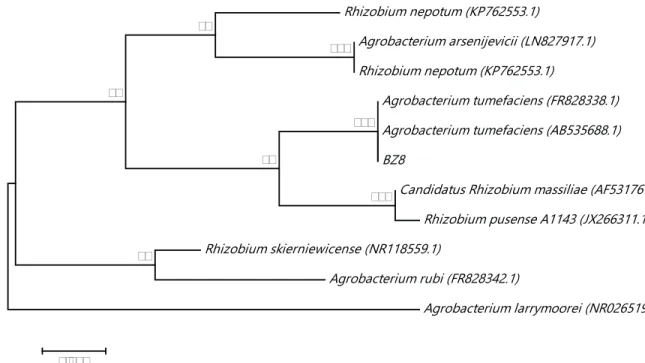
The 16S rRNA gene is a highly conserved gene and was used for the phylogenetic analysis of taxa at higher levels. The 16S rRNA gene sequences of strain BZ8 were obtained (comprising 1385 nucleotides) and submitted to GenBank (http://www.ncbi.nlm.nih.gov). The sequence displayed the highest similarity (99%) to that of A. tumefaciens
(GenBank accession AB535688.1 and FR828338.1). A phylogenetic tree was constructed based on the 16S (1)
(2)
rRNA coding gene sequences of the isolate and the nearest relatives (Fig. 1). Combined with the morphological, physiological and biochemical analysis, the strain can be
identified as A. tumefaciens. So, this strain was named A. tumefaciens BZ8.
Effects of inoculation size, initial pH, temperature and
salinity on glyphosate degradation
Fig. 2 illustrates the effect of inoculation size on
the glyphosate degradation of A. tumefaciens BZ8. Experiments were carried out with the same initial glyphosate concentration of 2000 mg/L. It was obvious that the glyphosate concentration decreased with time for
different inoculation sizes. Glyphosate was thoroughly
degraded after 54 h, 48 h, 34 h and 36 h at inoculation sizes
of 2%, 5%, 10% or 15%, respectively (Fig. 2). The effect
of inoculum size on cell growth of strain BZ8 is also shown in Fig. 2. As shown in Fig. 2, with the increase of inoculum size, the lag period of the cell growth shortened gradually, while the cell growth rate and the substrate utilization rate were accelerated. Table 1 presents the values of glyphosate degradation rate with respect to inoculation size. The glyphosate degradation rate was greatly increased with inoculation size up to 10% (v/v), but it kept almost constant as the inoculation size further increased up to 15%. Taking into account the growth of strain BZ8 and glyphosate degradation, 10% (v/v) was chosen as the optimum inoculum size and used for all following experiments.
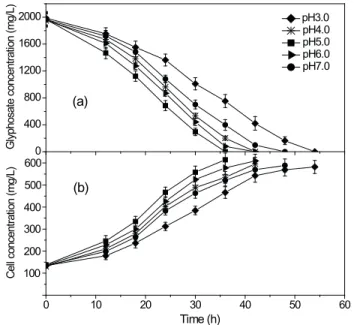
Glyphosate degradation and the cell growth were also tested at various initial pH values (Fig. 3). As expected, the
pH greatly influenced glyphosate degradation as well as cell
growth in the strain BZ8 culture system. Fig. 3 illustrates
that the growth of strain BZ8 was positively related with the glyphosate degradation. The optimal pH for A. tumefaciens BZ8 growth occurred at pH 5.0. The shortest time to degrade glyphosate thoroughly occurred at pH 5.0. Apparently, a pH value of 5.0 would be the optimum for degradation of glyphosate by this bacterial strain. However,
there was no distinct difference in glyphosate degradation
rate as pH increased from 4.0 to 6.0 (Table 1). Although
the glyphosate biodegradation efficiencies of the other two systems (pH 3.0 and pH 7.0) were significantly delayed,
the strain BZ8 was still capable of entirely consuming glyphosate. This special pH adaptability indicates that the strain BZ8 could be applied to acidic or neutral conditions without altering the pH.
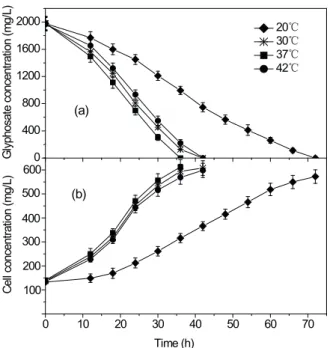
The influence of temperature on the glyphosate
degradation and growth of strain BZ8 is illustrated in Fig. 4.
The results show that strain BZ8 could effectively degrade glyphosate in the temperature range from 30℃ to 42℃. Especially under the temperature of 37℃, BZ8 showed higher efficiency of glyphosate degradation as compared to
the other three temperatures. The glyphosate degradation rate was seen to decrease with increasing or falling temperature (Table 1). However, at a low temperature of
20℃ and a high temperature of 42℃ the strain BZ8 could
still degrade glyphosate thoroughly within 70 h and 40 h, respectively. Therefore, strain BZ8 is a potentially useful microorganism that could function at both comparatively low and high temperatures. This broad temperature adaptability may be important for biodegradation in glyphosate-contaminated environments that undergo daily and seasonal temperature changes.
Rhizobium nepotum (KP762553.1)
Agrobacterium arsenijevicii (LN827917.1)
Rhizobium nepotum (KP762553.1)
Agrobacterium tumefaciens (FR828338.1)
Agrobacterium tumefaciens (AB535688.1)
BZ8
Candidatus Rhizobium massiliae (AF531767.1)
Rhizobium pusense A1143 (JX266311.1)
Rhizobium skierniewicense (NR118559.1)
Agrobacterium rubi (FR828342.1)
Agrobacterium larrymoorei (NR026519.1)
Table 1. Glyphosate degradation rates of A. tumefaciens BZ8 under different conditions
Initial inoculum size (%)
Glyphosate degradation rate
(mg/L/h)
Initial pH
Glyphosate degradation rate
(mg/L/h)
Culture temperature
(℃)
Glyphosate degradation rate
(mg/L/h)
2 36.67 3 36.76 20 26.5
5 40.63 4 46.43 30 47.12
10 54.16 5 54.78 37 55.18
15 53.33 6 46.79 42 46.15
– – 7 40.93 – –
0 10 20 30 40 50 60
600
500
400
300
200
100
C
el
l c
onc
ent
rat
ion (
m
g/
L)
Time (h) 0
400 800 1200 1600 2000
(b)
2% 5% 10% 15%
G
ly
phos
at
e
conc
ent
rat
ion
(m
g/
L)
(a)
Figure 2. Effect of inoculum size on biodegradation of glyphosate (a)
and cell growth (b) by strain BZ8
Figure 3. Effect of pH on biodegradation of glyphosate (a) and cell
growth (b) by strain BZ8
0 10 20 30 40 50 60
600
500
400
300
200
100
Time (h)
C
el
l c
onc
ent
rat
ion (
m
g/
L)
0 400 800 1200 1600
2000 pH3.0
pH4.0 pH5.0 pH6.0 pH7.0
(b)
G
ly
phos
at
e c
onc
ent
rat
ion (
m
g/
L)
(a)
A. tumefaciens BZ8 grew well over the temperature
ranges from 30℃ to 42℃, which was significantly different at 20℃ (Fig. 4). It reached the stable phase after 36 h at 30-42℃. At 20℃, the stable phase was recorded after 66 h. The fastest cell growth speed of BZ8 occurred at 37℃. According to these results, the temperature of 37℃ was
applied in the following set of experiments.
The actual glyphosate wastewater normally contains
various concentrations of NaCl, which directly influences
the activity of glyphosate-degrading microorganisms. In this study, strain BZ8 was inoculated into SM medium with
2000 mg/L glyphosate at different NaCl concentrations and incubated at 37℃ for 36 h. As shown in Fig. 5, the strain
grew well and glyphosate could be completely degraded in 36 h when the concentration of NaCl was lower than 60 g/L. With increasing salt concentration, the cell growth was inhibited gradually and the glyphosate degradation rate decreased greatly. The possible reason is that high salinity could cause osmotic stress or inhibit the reaction
pathways in the organic degradation process. This results
in a significant decrease in biological treatment efficiency
or biodegradation kinetics. In addition, high salt content
induces cell lysis, which causes increased effluent solids.
However, the glyphosate degrading rate of strain BZ8 could still achieve 62% when the salt concentration reached 80 g/L. Compared with the other salinities, strain
BZ8 grew difficultly at the salinity of 100 g/L, and the total
glyphosate removed was only 35%. Therefore, strain BZ8 could be applied for comparatively high salinity glyphosate wastewater treatment.
Growth kinetics of A. tumefaciens BZ8
The consumption of glyphosate and growth of
0 10 20 30 40 50 60 70 600 500 400 300 200 100 (b) C el l c onc ent rat ion ( m g/ L) Time (h) 0 400 800 1200 1600
2000 20℃
30℃ 37℃ 42℃ G ly phos at e c onc ent rat ion ( m g/ L) (a)
Control 2% 4% 6% 8% 10%
0 20 40 60 80 100 C el l c onc ent rat ion ( m g/ L) Glyphosate removal G ly phos at e r em ov al ( % )
Conentration of NaCl (w/v)
0 700 600 500 400 300 200 Cell concentration 100
0 10 20 30 40 50 60
700 600 500 400 300 200 Time (h) 100 0 400 800 1200 1600 2000 2400
2800 1400mg/L
1200mg/L 1000mg/L 600mg/L 400mg/L 200mg/L 100mg/L 2800mg/L 2600mg/L 2400mg/L 2200mg/L 2000mg/L 1800mg/L 1600mg/L C el l c onc ent rat ion ( m g/ L) G ly phos at e c onc ent rat ion ( m g/ L)
Figure 4. Effect of temperature on biodegradation of glyphosate (a)
and cell growth (b) by strain BZ8
Figure 5. Effect of NaCl on biodegradation of glyphosate (a) and cell
growth (b) by strain BZ8
Figure 6. Biodegradation of glyphosate (a) and growth of strain BZ8
(b) at different glyphosate concentration
Figure 7. Experimental and predicted specific growth rates of the
culture due to Haldane’s model
with the increase of glyphosate concentration, the time to degrade glyphosate thoroughly gradually shortened. It was obvious that the strain BZ8 could completely degrade 2800 mg/L glyphosate within 56 h (Fig. 6a). This maximum biodegradable glyphosate concentration of BZ8 was higher than Bacillus cereus CB4 (Fan et al. 2012) and Arthrobacter sp. N4 (Bazot and Lebeau, 2008), and it is inferred that strain BZ8 could tolerate a relatively
higher concentration of glyphosate than most glyphosate-degrading microorganisms in previous reports.
The biomass and glyphosate concentrations were linearly related for most of the active growth phase, so
the yield coefficient (Ym, mg/mg) was calculated by
linearizing the decline of glyphosate with the increment of cell mass using Equation (3).
All coefficients of correlation (R2) were found to be
above 0.99. The growth yields observed in this study varied between 0.201 mg/mg and 0.353 mg/mg as the initial glyphosate concentration was varied from 100 to 2800 mg/L (Fig. 6b). The highest value (0.353 mg/mg) was found at a glyphosate concentration of 200 mg/L, where
the maximum specific growth rate was also obtained (Fig.
7).
When the concentrations were between 0 and 200
mg/L, the values of specific growth rate increased gradually
with increase of glyphosate. There was a slight decrease
in specific growth rate as the glyphosate concentrations
increased from 200 mg/L to 400 mg/L; however, beyond 400 mg/L, with an increase of glyphosate concentration, a
The phenomenon could be explained by the fact that the sole carbon source of glyphosate was consumed mainly for assimilation into biomass and energy for cell growth
and maintenance. When the inhibition effect of glyphosate
becomes predominant above the glyphosate concentration of 400 mg/L, the proportion of the total glyphosate converted to energy for cell growth and maintenance
increased as the specific growth rate decreased. More energy is required to overcome the effect of substrate
inhibition at high glyphosate concentrations, while the proportion of the total substrate assimilated into biomass
decreases as specific growth rates decrease. Therefore, substrate inhibition is known to reduce both specific growth rate and the yield coefficient.
The specific growth rate (µx) was estimated using
Equation (1) by performing a linear least squares regression on the semi-logarithmic plot of the biomass concentration over cultivation time in the exponential growth phase.
Then, the µx data were employed to determine Haldane’s
parameters by nonlinear least-squares regression analysis using Matlab 7.0. The Haldane parameters for strain BZ8
grown on glyphosate were obtained as µmax = 1.28 1/h,
KS =84.82 mg/L, and Ki = 227.59 mg/L (R2=0.992). It is clear that Haldane’s equation was strongly correlated with the experimental data (Fig. 7). This indicates that Haldane equation was suitable to describe the process of strain BZ8 glyphosate degradation in terms of cell growth behavior.
CONCLUSIONS
In present study, a high salt-tolerant and
glyphosate-degrading strain BZ8 was isolated and identified as A. tumefaciens. The growth and glyphosate-degrading capability of the stain BZ8 were investigated and the optimum degradation conditions were obtained. Salt tolerance tests showed that the strain grew well and could thoroughly degrade 2000 mg/L glyphosate in 36 h when the concentration of NaCl was lower than 6%, and the glyphosate degradation rate could still reach 62% when the salt concentration was 8%. The kinetic parameters for strain BZ8 grown on glyphosate according to Haldane’s
model were µmax = 1.28 1/h, KS =84.82 mg/L, and Ki
= 227.59 mg/L. The results demonstrate that strain BZ8 has a remarkable potential for application in the disposal of industrial glyphosate wastewater.
ACKNOWLEDGEMENT
The present research was financially supported by
Anhui Provincial Natural Science Foundation (Grant No. 1508085QC56), the Key research and development project of Anhui Province (Public welfare research linkage1704f0704067), the National Natural Science Funds Fund (grant no. 31501461), the foundation of Huainan
science and technology planning project (grant no. 1095), the Liquor Making Biological Technology and Application of key laboratory of Sichuan Province (grant no. NJ2014-18), the Key project of Natural Science Foundation of Anhui Provincial Department of Education (Grant No. KJ2015A279), the Key projects of domestic and foreign research and training of outstanding young and middle aged backbone talents in Universities (gxfxZD2016203).
REFERENCES
Amoros, I., Alonso, J.L., Romaguera, S., Carrasco, J.M., Assessment of toxicity of a glyphosate-based formulation using bacterial systems in lake water. Chemosphere, 67, 2221-2228 (2007).
Bazot, S., Lebeau, T., Simultaneous mineralization of glyphosate and diuron by a consortium of three bacteria as free-and/or immobilized-cells formulations. Applied Microbiology and Biotechnology, 77, 1351-1358 (2008).
Dong, X.Z., Caim, M.Y., Determinative manual for routine
bacteriology. Scientific Press, Beijing (English translation)
(2001).
Fan, J.Y., Yang, G.X., Zhao, H.Y., Shi, G.Y., Geng, Y.C., Hou,
T.P., Tao, K., Isolation, identification and characterization of
a glyphosate-degrading bacterium from soil. Bacillus cereus CB4. Journal of General and Applied Microbiology, 58, 263-271 (2012).
Kawai, S., Uno, B., Tomita, M., Determination of glyphosate and its metabolite aminomethylphophonic acid by high-performance liquid chromatograhy after derivatization with para-toluenesulfonyl chloride. Journal of Chromatography, 540, 411–415 (1991).
Liu, B., Liu, G. H., Hu, G. P., Sengonca, C., Lin, N. Q., Tang, J. Y., Tang, W. Q., Lin, Y. Z., Bacillus bingmayongensissp. nov., isolated from the pit soil of Emperor Qin’s Terra-cotta warriors in China. Antonie van Leeuwenhoek, 105: 501-510 (2014).
Li, Y., Li, J., Wang, C., Wang, P., Growth kinetics and phenol biodegradation of psychrotrophic Pseudomonas putida LY1. Bioresource Technology, 101, 6740-6744 (2010).
Pipke, R., Amrhein, N., Isolation and characterization of a mutant of Arthrobacter sp. strain GLP-1 which utilizes the herbicide glyphosate as its sole source of phosphorus and nitrogen.
Applied and Environmental Microbiology, 54, 2868−2870
(1988).
Simbert, R.M., Krieg, N.R., Phenotypic characterization. In: Gerhare P, Murray RGE, Wood WA, Krieg NR (eds), Methods for general and molecular bacteriology. American Society for Microbiology, Washington, DC, p. 647–654 (1994). Tamura, K., Dudley, J., Nei, M., MEGA 4: Molecular evolutionary
genetics analysis (MEGA) software version 4.0. Molecular Biology and Evolution, 24, 1596-1599 (2007).
Tang, M.Q., Chen, J.X., Isolation, Identification and Biological
Terry M., Balthazor E., Hallas E., Glyphosate-degrading microorganisms from industrial activated sludge. Applied
and Environmental Microbiology, 51(2), 432−434 (1986).
Vasiliadou, I., Tziotzios, G., Vayenas, D., A kinetic study of combined aerobic biological phenol and nitrate removal in batch suspended growth cultures. International Biodeterioration & Biodegredation, 61, 261-271(2008). Wu, X.H., Fu, G.M., Wan, Y., Guo, D.B., Cheng, Y.H., Luo,
Y.F., Wu, X.F., Isolation and Identification of
Glyphosate-degrading strain Aspergillus oryzae sp. A-F02 and Its
degradation characteristics (In Chinese). Journal of Anhui Agricultural Science, (15), 7731-7733 (2010).
Xu, M.L., Cui, S.H., Wang, Y.P., Peng, P.Y., Pretreatment and recovery utilization of glyphosate wastewater (in Chinese). Journal of Nanjing Normal University Engineering Technology Edition, 7, 51-53 (2007).