Tissue-based molecular markers in upper tract urothelial
carcinoma and their prognostic implications
_______________________________________________
Ricardo L. Favaretto
1, Stênio C. Zequi
1, Renato A. R. Oliveira
1, Thiago Santana
1, Walter H. Costa
1, Isabela
W. Cunha
2, Gustavo C. Guimarães
11 Departamento de Cirurgia Pélvica, Serviço de Urologia AC Camargo Cancer Center, São Paulo, Brasil, São
Paulo, Brasil; 2 Departamento de Patologia, AC Camargo Cancer Center, São Paulo, Brasil
ABSTRACT
ARTICLE
INFO
______________________________________________________________ ______________________
Upper tract urothelial carcinoma (UTUC) is a rare and aggressive disease that is as-sociated with high rates of recurrence and death. Radical nephroureterectomy (RNU) with excision of the bladder cuff is considered the standard of care for high-risk UTUC, whereas kidney-sparing techniques can be indicated for select patients with low-risk disease. There is a significant lack of clinical and pathological prognostic factors for stratifying patients with regard to making treatment decisions. Incorporation of tissue-based molecular markers into prognostic tools could help accurately stratify patients for clinical decision-making in this heterogeneous disease. Although the number of studies on tissue-based markers in UTUC has risen dramatically in the past several years—many of which are based on single centers and small cohorts, with a low level of evidence—many discrepancies remain between their results. Nevertheless, certain biomarkers are promising tools, necessitating prospective multi-institution studies to validate their function.
INTRODUCTION
Upper tract urothelial carcinoma (UTUC) is a rare disease, accounting for approximately 5% to 10% of all urothelial malignancies, and has an estimated annual incidence of 2 per 100.000 inha-bitants in Western countries (1). Although impro-vements in imaging and endoscopic techniques have led to stage migration in UTUC, it remains an aggressive malignancy with high recurrence and progression rates.
Radical nephron-ureterectomy with exci-sion of the bladder cuff (RNU) is the standard tre-atment for UTUC (1, 2). However, kidney-sparing techniques can be indicated for select patients with low-risk UTUC, whereas multimodal
thera-pies, such as perioperative chemotherapy and ex-tended lymph node dissection, in addition to RNU, are considered for high-risk disease (1, 2).
The correct preoperative identification of patients who could benefit from these procedu-res is complicated. In the past two decades, many studies have examined the clinical, operative, and pathological prognostic factors in UTUC (2). Con-sequently, several predictive and prognostic tools, based on various statistical techniques, have been developed to provide accurate estimates of outco-mes (3-5).
Yet, the predictive accuracy of these prog-nostic models remains low. Thus, guiding pa-tients and physicians in selecting the best treat-ment options and follow-up strategies in UTUC
Keywords:
Carcinoma; Biomarkers; Prognosis
Int Braz J Urol. 2018; 44: 22-37 _____________________
Submitted for publication: April 01, 2017
_____________________
Accepted after revision: July 29, 2017
_____________________
is challenging, necessitating better approaches to counseling individual patients. Recent studies on prognostic biomarkers in urothelial carcinoma are promising and might benefit outcomes by impro-ving risk stratification and decision-making (6-8).
Molecular markers are molecules that are produced by a tumor and are detectable and quantifiable in specimens, such as tissue, blood, and urine. Ideal biomarkers improve the accuracy when integrated into prognostic models, allowing one to counsel patients regarding treatment deci-sions (9). Biomarkers have been studied extensi-vely in urothelial carcinoma of the bladder (UCB), several of which are established independent prognostic factors that are associated with featu-res of biologically and clinically aggfeatu-ressive UCB (10-12). However, the carcinogenetic mechanisms in UTUC differ from those of urothelial carcino-ma of the lower urinary tract; thus, the molecular alterations that occur in one setting might not be able to be extrapolated to the other (8).
In the past several years, many collabora-tive groups have published studies on molecular markers as prognostic factors in UTUC, especially tissue-based markers (6-8). However, due to the low incidence of the disease, no randomized con-trolled trial has been reported. Further, few reviews have discussed this issue, and none has focused on tissue-based markers.
The objective of this review is to detail re-cent data on tissue-based markers in UTUC, how each of these markers functions in oncogenesis, their prognostic impact, and how they influence clinical decision-making in this disease.
Review Criteria
A nonsystematic literature search was conducted using the PubMed/Medline database to identify English articles (original, review, and edi-torial articles) on tissue-based molecular markers in UTUC using the following key words and phra-ses: “upper urinary tract carcinoma” or “upper tract transitional cell carcinoma” or “upper tract urothelial carcinoma” AND “molecular markers” or “biomarkers.” To select relevant articles for the different sections of the manuscript, additional re-ferences were collected by cross-referencing the bibliography of the selected articles. We chose
ar-ticles that were published between 1995 and 2016, because the data on molecular markers in UTUC have become available only recently. Older arti-cles were considered only if they were pertinent. The most relevant articles were examined and se-lected, based on the consensus of all authors.
Tissue-based markers in UTUC
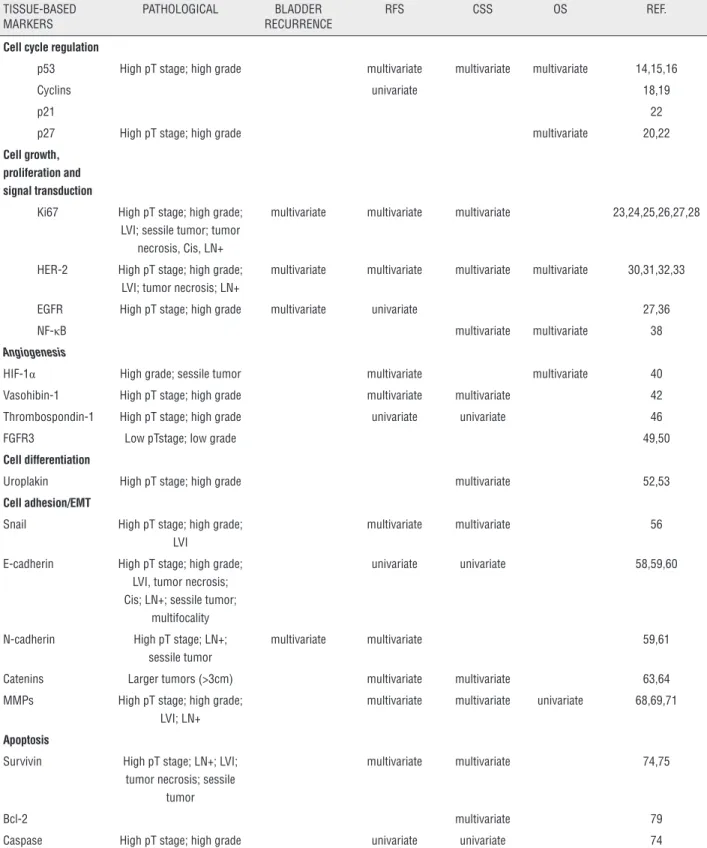
Recent data by the Cancer Genome Atlas (TCGA) project have changed the landscape of urothelial carcinoma research (13), performing a comprehensive genetic and molecular analysis that has provided novel insights into the mole-cular pathways that underlie carcinogenesis, dise-ase progression, and possible therapeutic targets. Some of the molecular markers that mediate tu-morigenesis can be measured and correlated with oncological outcomes. In UTUC, most studies on molecular markers are related to tissue-based ma-rkers (Table-1 and Table-2). Many of the tory proteins that are involved in cell cycle regula-tion, cell growth, proliferation and differentiaregula-tion, signal transduction, angiogenesis, apoptosis, and cell adhesion have been recently studied in UTUC. The major limitations of these studies are their re-trospective nature and their small sample size, due primarily to the low incidence of the disease.
Cell cycle regulation p53
p53 is a tumor suppressor gene in chromo-some 17p13 that preserves genomic stability by preventing genomic mutation. When p53 becomes damaged, tumor suppression is severely compro-mised, potentiating the formation of tumors.
HIF-1α Transcription factor that plays an important role in oxygen homeostasis. Levels of HIF-1α subunit can increase rapidly in response to hypoxia and upregulate a number of factors important for tumor expansion.
Vasohibin-1 Angiogenic molecule expressed in endothelial cells and upregulated by VEGF and fibroblast growth factor-2. VASH1 expression is restricted to endothelial cells of blood vessels in the tumor stroma and has a positive correlation with MVD.
Thrombospondin-1 Potent inhibitor of angiogenesis in physiological and pathological conditions and inhibits proliferation of tube-like structures in endothelial cells.TSP-1 expression is inversely related to MVD.
FGFR3 Part of a tyrosine kinase receptor family that regulates several cellular processes, such as growth, differentiation, and angiogenesis.
Cell differentiation
Uroplakin Specific differentiation product of urothelial cells and is undetectable in nonurothelial tissues. Present at the apical surface and cytoplasm of umbrella cells and can be used as marker for urothelial differentiation.
Cell adhesion/EMT
Snail Considered an EMT transcription factor that can repress E-cadherin and therefore regulate tumor progression and metastasis. E-cadherin Calcium-dependent glycoprotein essential to epithelial tissue integrity. Expressed in epithelial cells, where cytoplasmic domain binds
with β or γ subtype of catenin proteins and secures attachment to the actin microfilament, thus ensuring cytoskeletal integrity and stable cellular adhesion. Decreased E-cadherin can lead to loss of cellular adhesion, resulting in invasive tumors.
N-cadherin Expressed by mesenchymal cells. Decreased expression of E-cadherin and increase of N-cadherin have been established as features of EMT in epithelial malignancies and have been shown to be associated with the acquisition of aggressive phenotypes.
Catenins Family of proteins found in complexes with cadherins. They connect cadherins to actin filaments, ensuring cytoskeletal integrity and stable cellular adhesion.
MMPs Part of a family of proteases capable of degrading all kinds of extracellular matrix proteins. Tumor cell invasion and metastasis are biologically dependent on the proteolytic destruction of surrounding matrix components.
Apoptosis
Survivin Member of a family of proteins that inhibit apoptosis by blocking downstream caspase activity.
Bcl-2 Bcl-2 is an antiapoptotic protein that blocks caspase activation by inhibiting the mitochondrial release of cytochrome-c.
Caspase Proteases that can be activated by intrinsic or extrinsic pathways that induce cell death by apoptosis.
Abbreviations: CDK = cyclin-dependent kinase; EGFR = endothelial growth factor receptor; NF-κB = nuclear factor-κB; HIF-1α = hypoxia-inducible factor 1α; VEGF = vascular endothelial growth
Table 1 – Tissue-based markers in upper tract urothelial carcinoma and their molecular functions.
TISSUE-BASED MARKERS FUNCTION
Cell cycle regulation
p53 Tumor suppressor gene that maintains genomic stability by preventing genomic mutation. When mutated, tumor suppression is compromised, and tumors can develop.
Cyclins Proteins that regulate progression through the cell cycle (G1/S transition) by activation of cyclin-dependent kinase. Dysregulation of CDK-cyclin complexes can promote tumor cell growth.
p21 and p27 Members of the cyclin-dependent kinase family. Function as tumor suppressors, and loss of their expression is associated with tumor development and progression.
Cell growth, proliferation, and signal transduction
Ki67 Nuclear protein associated with cellular proliferation. Marker of growth factor for a specific cell population.
HER-2 Member of the ErbB family of receptors (plasma membrane-bound receptor tyrosine kinases). Plays an important role in tumor cell growth and development. Amplification or overexpression of HER-2 stimulates PI3K/AKT pathway and is associated with the development and progression of cancer.
EGFR Transmembrane glycoprotein with tyrosine kinase activity and also a member of the ErbB family of receptors. EGFR activation stimulates intrinsic intracellular protein-tyrosine kinase activity, leading to DNA synthesis and cell proliferation. EGFR overexpression or upregulation is associated with malignant tumors.
NF-κB Complex protein that regulates genes which controls cell proliferation and survival. NF-κB is inactive and sequestered in the cytoplasm. Several stimuli can activate and release NF-κB, which translocates to the nucleus. In the active form, it can regulate the expression of several genes associated with anti-apoptosis, inflammation, proliferation, invasion, and angiogenesis.
Table 2 – Tissue-based markers in upper tract urothelial carcinoma and their prognostic implications.
TISSUE-BASED MARKERS
PATHOLOGICAL BLADDER RECURRENCE
RFS CSS OS REF.
Cell cycle regulation
p53 High pT stage; high grade multivariate multivariate multivariate 14,15,16
Cyclins univariate 18,19
p21 22
p27 High pT stage; high grade multivariate 20,22
Cell growth, proliferation and signal transduction
Ki67 High pT stage; high grade; LVI; sessile tumor; tumor
necrosis, Cis, LN+
multivariate multivariate multivariate 23,24,25,26,27,28
HER-2 High pT stage; high grade; LVI; tumor necrosis; LN+
multivariate multivariate multivariate multivariate 30,31,32,33
EGFR High pT stage; high grade multivariate univariate 27,36
NF-κB multivariate multivariate 38
Angiogenesis
HIF-1α High grade; sessile tumor multivariate multivariate 40
Vasohibin-1 High pT stage; high grade multivariate multivariate 42
Thrombospondin-1 High pT stage; high grade univariate univariate 46
FGFR3 Low pTstage; low grade 49,50
Cell differentiation
Uroplakin High pT stage; high grade multivariate 52,53
Cell adhesion/EMT
Snail High pT stage; high grade; LVI
multivariate multivariate 56
E-cadherin High pT stage; high grade; LVI, tumor necrosis; Cis; LN+; sessile tumor;
multifocality
univariate univariate 58,59,60
N-cadherin High pT stage; LN+; sessile tumor
multivariate multivariate 59,61
Catenins Larger tumors (>3cm) multivariate multivariate 63,64
MMPs High pT stage; high grade; LVI; LN+
multivariate multivariate univariate 68,69,71
Apoptosis
Survivin High pT stage; LN+; LVI; tumor necrosis; sessile
tumor
multivariate multivariate 74,75
Bcl-2 multivariate 79
Caspase High pT stage; high grade univariate univariate 74
review, which included 514 patients, finding that overexpression of p53 correlated with statistically significant differences in disease-free (DFS), can-cer-specific (CSS), and overall survival (OS), sug-gesting that p53 is an independent prognostic fac-tor in UTUC. Rey et al. were one of the first groups to examine the prognostic value of p53 and re-ported that its overexpression was significantly associated with tumor aggressiveness and patient survival in a small cohort of 83 patients (15).
In contrast, a recent review by Mitchell et al. analyzed 24 papers, in 5 of which multivariate analysis demonstrated that p53 expression had inde-pendent prognostic significance in UTUC, all of whi-ch contained potential statistical bias. The authors concluded that existing data do not support p53 as an independent prognostic marker in UTUC, requi-ring more prospective collaborative studies (16).
Cyclins
Cyclins are a family of proteins that regula-te progression through the cell cycle by activation of cyclin-dependent kinase (CDK). G1/S cyclins, which include cyclin A, cyclin D, and cyclin E, are essential for controlling the cell cycle during the G1/S transition. Cyclin levels usually modula-te during the cell cycle and are strictly regulamodula-ted. Overexpression of cyclin A and E and dysregula-tion of CDK-cyclin complexes can promote tumor cell growth and mediate the pathogenesis of can-cer. In addition, high expression of cyclins A and E is associated with a poor prognosis in several types of cancer (17).
In UTUC, Liang et al. studied 340 patients with localized disease and found that expression of cyclin A was associated with worse metastasis--free survival (MFS) in the univariate but not mul-tivariate analysis (18). Bogdanovic et al. retros-pectively analyzed cyclin E levels in 24 patients and found no statistically significant association with tumor stage or grade (19).
p21 and p27
p21 and p27 are members of the cyclin--dependent kinase family, functioning as tumors suppressors. The loss of their expression is linked to tumor development and progression in many malignancies.
In UTUC, Nakanishi et al. found that p27 expression declines significantly with increasing stage and grade, but no correlation was observed with the prognosis (20). In 2005, Fromont et al. analyzed a panel of molecular markers and failed to note any prognostic value of p27 expression (21). Recently, Sarsik and colleagues studied the immune-expression of p21 and p27 and correlated them with various clinical and pathological va-riables and OS (22). They reported that p21 and p27 are expressed in 52.9% and 88.2% of cases, respectively. Although no correlation was seen be-tween loss of or lower p21 expression and clinico-pathological variables, they were associated with a shorter OS in the univariate and multivariate analysis. No noninvasive tumors showed a loss of p27, whereas one-third of invasive tumors did. This group concluded that additional research is needed to determine the function of p27 in UTUC, due to their small cohort (n=34) and the prelimi-nary nature of their results.
Cell growth and proliferation and signal trans-duction
Ki-67
Ki-67 is a nuclear protein that is associated with cell proliferation and is an excellent marker for determining growth factor for a specific cell population, with prognostic value for carcinomas of the prostate, breast, and brain.
The prognostic value of Ki67 in UTUC has been studied in the past several years. A Japa-nese group retrospectively analyzed 69 patients who were diagnosed with UTUC and determined that overexpression of Ki67 by immunohistoche-mistry correlated significantly with stage, grade, and lymphatic and vascular invasion (23). In sur-vival analyses, Ki67 expression was a significant prognostic factor by univariate analysis but did not impact survival in the multivariate analysis. In 2005, a multicenter study examined the prognos-tic value of Ki67 in UTUC and found an associa-tion with poor prognosis and disease recurrence only in the univariate analysis (21).
ove-rexpression of Ki67 was an independent predic-tor of DFS and CSS. These results were posteriorly confirmed in a prospective study of 101 patients (25). Notably, Joung et al. attempted to identify immune-histochemical predictors that were as-sociated with bladder recurrence in patients with UTUC who were subjected to RNU and found that Ki67 overexpression significantly predicts bladder cancer recurrence (26). These results were confir-med by Long et al. in a cohort of 320 patients (27). Thus, Ki67 can be used as a marker of blad-der recurrence after RNU, anticipating intravesical therapies.
In 2015, the International Upper Tract Urothelial Carcinoma Collaboration published a multi-institution validation study of the predictive value of Ki67 in patients with UTUC (28). Immu-no-histochemical staining for Ki67 was performed on a tissue microarray that was constructed from 475 patients who underwent radical surgery. Ove-rexpression of Ki67 was significantly associated with higher pT stage, lympho-vascular invasion, sessile tumor architecture, tumor necrosis, con-comitant carcinoma in situ, and regional lymph node metastasis. By multivariate analysis, Ki67 was an independent predictor of DFS and CSS. This group also observed a statistically significant improvement in Harrell’s C-index when Ki67 was included in their preoperative and postoperative prediction models for DFS and CSS, concluding that they validated Ki67 as an independent predic-tor of outcomes in UTUC patients.
HER-2
HER-2 (human epidermal growth factor receptor 2), also known as ErbB2, is a member of the ErbB family of receptors, which comprises four plasma membrane-bound receptor tyrosine kina-ses. HER-2 has important functions in tumor cell growth and development. Amplification or overex-pression of HER-2 stimulates the phophoinositi-de-3 kinase (PI3K)/AKT pathway and is associated with the development and progression of certain aggressive types of cancer. In breast cancer, HER-2 amplification is found in nearly HER-25% to 30% of tumors and correlates with disease recurrence and poor survival (29). Targeting HER-2 with mono-clonal antibodies in HER-2-overexpressing breast
carcinomas improves survival and has become a standard treatment option (29).
Studies in urological tumors have shown that HER-2 overexpression in patients with UTUC who undergo radical therapy is rare. Vershasselt--Crinquette et al. measured HER-2 expression in a cohort of 83 patients (30) by immune-histochemi-cal staining and in situ hybridization, observing overexpression and amplification was in 16% and 7% of subjects, respectively. However, patients with overexpression and amplification of HER-2 were more likely to have higher-grade and -sta-ge disease. Langner et al. also noted infrequent HER-2 overexpression and amplification in UTUC patients, which were more likely to occur in high--stage and high-grade tumors (31).
The prognostic value of HER-2 with regard to recurrence and survival in UTUC was debated until larger studies were recently published. In the largest single-center HER-2 study in UTUC pa-tients (32), Sasaki et al. investigated HER-2 status in 171 UTUC patients who underwent RNU and found that overexpression and amplification of HER-2 was associated with early bladder cancer recurrence. These findings were validated by a large multicenter retrospective study of 732 pa-tients (33), in which Soria and colleagues found that HER-2 was overexpressed in 35.6% of pa-tients and linked to pathological characteristics, such as more advanced T stage, presence of lymph node metastasis, high-grade tumor, tumor necro-sis, and lympho-vascular invasion. By multivaria-ble analysis, HER-2 overexpression remained as-sociated with disease recurrence and overall and cancer-specific mortality. The authors concluded that HER-2 is a good marker for therapeutic risk stratification and a therapeutic target in certain UTUC tumors.
Epidermal growth factor receptor
that affect EGFR overexpression or upregulation correlate with several cancers, including UCB (34).
Few studies have determined the influence of EGFR on the prognosis of patients who have been diagnosed with UTUC. In a small single--center study, Tsai et al. detected ErbB1 in 9.5% of UTUC tumors (35). Leibl et al. analyzed the immune-histochemical expression of EGFR in 268 consecutive patients with UTUC who underwent RNU and correlated it with histopathological pa-rameters and patient outcomes (36), finding that EGFR immunoreactivity was present in 55% of ca-ses higher than in previous studies. EGFR staining was associated with higher tumor stage and grade, and its intensity correlated with metastatic disea-se in the univariate but not multivariate analysis. However, Long et al. recently analyzed 320 UTUC patients and found that EGFR positivity was an independent risk factor for bladder cancer recur-rence after RNU (27). Thus, like Ki-67 and HER-2, EGFR expression could be used as a marker of bla-dder cancer recurrence after radical therapy.
Nuclear factor-κB (NF-κB)
Nuclear factor-κB (NF-κB) is a complex
protein that is expressed in many cells and regula-tes many genes that control cell proliferation and survival. Typically, NF-κB is inactive and seques-tered in the cytoplasm by specific inhibitors under resting conditions. Several stimuli can activate and release NF-κB, allowing it translocate to the nucleus. In its active form, NF-κB regulates the expression of genes that are associated with anti--apoptosis, inflammation, proliferation, invasion, and angiogenesis (37).
A Chinese group studied 90 patients with UTUC by immunohistochemistry (38) and
recor-ded cytoplasmic overexpression of NF-κB in 61%
of subjects and nuclear immunoreactivity in ne-arly 27%. Although no significant association be-tween NF-κB expression and pathological features of aggressive disease was seen, it was an indepen-dent predictor of CSS and OS.
Angiogenesis
Angiogenesis is the process by which new blood vessels form in tissue and is considered a critical event in the initiation and progression
of various solid malignancies-without angioge-nic activity, solid tumors cannot grow or expand. Several angiogenic factors have been identified in the past several years, including vascular en-dothelial growth factor (VEGF), platelet-derived growth factor (PDGF), hypoxia-inducible factor 1 (HIF-1), fibroblast growth factor receptor 3 (FGFR 3), vasohibin-1 (VASH1), and thrombospondin-1 (TSP-1). Despite being studied extensively in UCB, there are few reports on angiogenesis-related ma-rkers in UTUC.
Hypoxia-inducible factor 1α (HIF-1α)
Hypoxia-inducible factor 1 protein (HIF-1) is a transcription factor that governs oxygen ho-meostasis. The levels of the HIF-1α subunit can increase rapidly in response to hypoxia, in turn upregulating factors that are important for tumor expansion. Thus, overexpression of HIF-1α is as-sociated with tumor aggressiveness and prognosis in several malignancies, including UCB (39).
In UTUC, there are few studies on HIF-1α expression and outcomes. Nakanishi et al. per-formed a retrospective study of 127 patients and found that 55% of samples had immune-histoche-mical overexpression of HIF-1α (40). This overex-pression correlated with high-grade and sessile tumors but not with tumor stage. The authors also observed that HIF-1α overexpression was associa-ted with OS and DFS rates by univariate and mul-tivariate analysis (in all tumors and in invasive tumors), indicating that HIF-1α expression provi-des information on the prognosis in patients with UTUC.
Vasohibin-1 (VASH1)
Vasohibin-1 (VASH1) is a protein that is encoded by VASH1 and is an angiogenic molecule that is expressed specifically in endothelial cells and upregulated by VEGF and fibroblast growth factor-2. VASH1 expression is restricted to the en-dothelial cells of blood vessels in the tumor stro-ma (41).
correla-tion between MVD and VASH1. Elevated levels of VASH1 were significantly associated with higher pathological T stage and high-grade tumors. By multivariate analysis, high VASH1 density was an independent predictor of tumor recurrence and CSS. The authors concluded that although their results are preliminary, VASH1 density is a clinically relevant predictor of patient prognosis in UTUC and could be confirmed as a novel bio-marker in external validation studies.
Thrombospondin-1 (TSP-1)
Thrombospondin-1 (TSP-1) is a potent inhibitor of angiogenesis in various physiologi-cal and pathologiphysiologi-cal conditions and suppresses the proliferation of tube-like structures in endo-thelial cells (43).
Earlier studies reported that TSP-1 ex-pression is inversely related to MVD in bladder cancer patients (44, 45), suggesting that low TSP-1 expression correlates with increased malignant potential, aggressiveness, and poorer outcomes in urothelial carcinomas. There is one paper on TSP-1 expression in UTUC and its impact on the patient’s prognosis. In this retrospective single--center study of 97 UTUC patients who were subjected to RNU (46), the authors analyzed the expression of 4N1K, which is derived from the C--terminal domain of TSP-1 and inhibits angioge-nesis in in vivo and in vitro models (47). Miyata and colleagues found that low expression or lack of 4N1K was associated with higher pathologi-cal T stage and high-grade tumors. In survival analyses, negativity for 4N1K was a predictor of DFS and CSS in the univariate but not mul-tivariate analysis. Thus, based on these results, the prognostic value of TSP-1/4N1K is limited in UTUC (46).
Fibroblast growth factor receptor 3 (FGFR3)
Fibroblast growth factor receptor 3 (FGFR3) is part of a tyrosine kinase receptor family that regulates many cellular processes, such as growth, differentiation, and angiogene-sis. In general, FGFR3 mutations are associated with low-risk tumors that rarely progress and usually have a good prognosis in bladder can-cer patients (48).
In 2009, van Oers et al. reported that FGFR3 mutations occurred at the same frequen-cies in UTUC and bladder tumors in 280 pa-tients (117 bladder tumors and 163 upper tract tumors) with a median follow-up of 56 months (49). They also claimed that FGFR3 mutations correlated with low-stage tumors and better survival in patients with UTUC and UCB. Bur-ger and colleagues found that FGFR3 mutations were linked to a favorable stage and grade in 172 UTUC patients and benefited the survival rate-24.1% versus 54.2% cancer-related deaths occurred in the mutated group (50). Based on these results, FGFR3 has potential as a marker of low-risk patients and can be used to select candidates for conservative therapies other than RNU, if these findings can be recapitulated in biopsy specimens.
Cell differentiation Uroplakin
Uroplakins (UPs) comprise a group of four transmembrane proteins (UPs Ia, Ib, II, and III) that are specific differentiation products of urothelial cells and are undetectable in non--urothelial tissues (51). They usually reside at the apical surface and in the cytoplasm of um-brella cells and are absent from intermediate and basal cells. The specificity of UPs to urothe-lial carcinoma has led to their use as markers of urothelial differentiation.
Cell adhesion and epithelial-mesenchymal tran-sition (EMT)
The epithelial-to-mesenchymal transition (EMT) is a process in which cells lose their epithe-lial characteristics and gain the migratory and in-vasive properties of mesenchymal cells. The EMT is a key step in cancer development and progression. Epithelial cells express high levels of E-cadherin, whereas mesenchymal cells express N-cadherin, fibronectin, and vimentin. Loss of E-cadherin is a fundamental event in the EMT. Downregula-tion of E-cadherin and increased N-cadherin are hallmarks of EMT in epithelial malignancies and are associated with the acquisition of aggressive phenotypes (54). In normal cells, the cytoplasmic domain of E-cadherin binds to the β or γ subtype of catenin proteins, which in turn are secured to actin microfilaments, thus ensuring cytoskeletal integrity and stable cellular adhesion (55). Loss of cellular adhesion is a critical event in tumor progression, resulting in poorly differentiated and invasive tumors.
Snail
Snail is an EMT-inducing transcription factor (TF) that represses E-cadherin and thus re-gulates tumor progression and metastasis. As a result, Snail contributes to the EMT during cell differentiation (8, 56).
Kosaka et al. analyzed 150 patients and de-monstrated that nuclear Snail staining was weak in non-muscle-invasive UTUC (56). In contrast, Snail signals were robust in the nuclei of many muscle--invasive tumors. Snail expression was significan-tly upregulated in high-tumor-stage and high-grade tumors and in tumors with lympho-vascular inva-sion. By multivariate regression analysis, elevated Snail expression was a significant and independent prognostic predictor of DFS and CSS.
Cadherins
In many studies of various solid malig-nancies, patients with low E-cadherin levels were most likely to harbor tumors with features of bio-logically aggressive disease. This association is consistent with function of E-cadherin as a cal-cium-dependent glycoprotein that is essential for epithelial tissue integrity. Loss of cellular adhesion
results in the detachment of cancerous cells from the primary lesion, promoting invasiveness and metastasis (57). However, the relationship betwe-en E-cadherin and outcomes in UTUC is debated.
In 62 UTUC patients, Fromont et al. sho-wed that decreased E-cadherin expression is an independent prognostic factor for DFS and OS (201). In contrast, most subsequent studies of lar-ger cohorts have failed to demonstrate an inde-pendent association between E-cadherin expres-sion and disease recurrence (58, 59). Favaretto et al. assessed the clinical significance of lower E--cadherin levels in an international cohort of 678 UTUC patients who were treated with RNU (60), observing that downregulation of E-cadherin in tumor cells correlated with adverse clinicopatho-logical features. They also confirmed that lower E-cadherin expression was linked to a greater pro-bability of disease recurrence and cancer-specific mortality in UTUC. However, when adjusted for the effects of established prognostic factors by multivariable analysis, E-cadherin expression lost its independent prognostic value and thus might have limited use in clinical practice. Nevertheless, it can be used to identify more aggressive tumors in the preoperative setting to indicate periopera-tive chemotherapy and extended lymph node dis-section, in addition to RNU, if these results can be validated in biopsy specimens.
Muramaki et al. examined N-cadherin in UTUC in 59 patients, reporting that its expression was an independent prognostic factor of intra- and extravesical recurrence after RNUl (59) but, they did not analyze any predictors of CSS in this co-hort. More recently, Abufaraj et al. measured N--cadherin expression in a multi-institution study of over 600 patients (61). N-cadherin positivity was seen in 43% of patients and was associated with features of aggressive disease (advanced tumor sta-ge, lymph node metastases, and sessile architecture) and disease recurrence but not CSS or OS in the univariate analysis. Similarly, after adjustments for the effects of confounders, N-cadherin was not as-sociated with any survival outcome.
Catenins
function of catenins is to connect cadherins to ac-tin filaments, specifically in the adhesion junctions of epithelial cells, ensuring cytoskeletal integrity and stable cellular adhesion (56, 62). The catenins that were identified in human cancers became kno-wn as α-catenin, β-catenin, and γ-catenin.
Typically, studies determined the prog-nostic value of catenins in urothelial carcinoma with cadherins as part of a combined panel of EMT markers (55, 63). In UCB, Clairotte et al. analyzed 101 patients with bladder cancer (71 T1 and 30 T2/T3 tumors) and observed a highly sig-nificant correlation between decreased expres-sion of all catenins and higher TNM stage (55). By multivariate analysis, only γ-catenin was an independent predictor of DFS in patients with stage T1 bladder urothelial tumors.
In UTUC, few studies have examined the expression of catenins as prognostic markers. Izquierdo et al. measured α, β, and γ-catenin le-vels in 70 tumors samples from UTUC patients by immunohistochemistry and correlated them with outcomes- (64) in the multivariate analysis, ab-normal β-catenin expression was an independent prognostic factor of tumor progression and CSS. In a cohort of 20 patients, Reis et al. reported that moderate expression of γ-catenin was associa-ted with a lower DFS rate, albeit insignificantly (63); there was no relationship between α-catenin and β-catenin expression and tumor recurrence. Also, the authors found that downregulation of α-catenin was more frequent in larger tumors. In conclusion, the data on catenins as prognostic markers in UTUC remain weak; thus, none of them can be used for clinical decision-making.
Metalloproteinases
Matrix metalloproteinases (MMPs) are part of a large family of proteases that degrade many types of extracellular matrix proteins. Tumor cell invasion and metastasis depend on the proteolytic destruction of surrounding matrix components. Thus, many studies have determined the effects of MMPs on cancer invasion and progression (65-67).
In UTUC, Nakanishi et al. analyzed MMP-2 expression and correlated it with outcomes (68), noting a relationship between MMP-2 levels and tumor stage. Also, in the univariate analysis,
MMP-2 expression was associated with OS but did not reach statistical significance in the multiva-riate analysis. Subsequently, Miyata et al. measure MMP-2 and MMP-9 in 91 patients who underwent RNU (69), reporting that they correlated with hi-gher pT stage but that they were not independent predictors of CSS. In 2005, Kamijima et al. studied 69 UTUC patients and did not observe any link be-tween MMP-2 and MMP-9 expression and high--risk disease (70).
Conversely, Li et al. demonstrated that high MMP-11 expression in 340 UTUC patients and 295UCB subjects was significantly associated with advanced pT status, nodal metastasis, high histological grade, vascular and perineural inva-sion, and frequent mitoses (71). In the multivaria-te analysis, MMP-11 was independently associa-ted with CSS and the development of metastasis. Based on the most recent literature, MMP-2 and MMP-9 have limited value as predictive markers in UTUC. In contrast, MMP-11 has shown promi-sing results in a large multicenter retrospective study and is thus a potential novel prognostic and therapeutic target.
Apoptosis
Apoptosis is the highly regulated and controlled process of programmed cell death. It can be initiated by an intrinsic or extrinsic pa-thway, both of which induce cell death by ac-tivating proteases, called caspases. Inhibition of apoptosis and apoptotic pathways can result in tumorigenesis and cancer progression, because it allows tumor cells to survive longer and resist harmful stressors (72). Several markers of apop-tosis have been identified and studied in several malignancies, including survivin, caspase-3, FAS (first apoptosis signal), bcl-2, and bax. Some of these molecules have been examined in UTUC and are summarized below.
Survivin
re-currence, and survival (74). They found that 20% of patients had altered expression of survivin. Al-though survivin expression did not correlated with any clinical or pathological characteristics, in the multivariate analysis, it was the only marker that was independently associated with disease recur-rence and survival. Yet, well-designed studies with larger cohorts have been unable to confirm these findings (75, 76, 21).
A recent large multicenter study by Ma-thieu et al. in 732 patients who were diagnosed with UTUC analyzed survivin expression (75), finding that nearly 40% of tumors had altered survivin levels, which were associated with more advanced pathological tumor stage, lymph node metastasis, lympho-vascular invasion, tumor ne-crosis, and tumor architecture. In the univariate analysis, altered survivin correlated significantly with DFS and CSS but did not achieve indepen-dent predictive status by multivariate analysis.
Bcl-2 and caspase-3
Bcl-2 is an antiapoptotic protein that blo-cks caspase activation by inhibiting the mito-chondrial release of cytochrome-c (77). In UCB, studies on bcl-2 and caspase-3 are conflicting. Recent studies have shown that overexpression of bcl-2 and loss of caspase-3 are associated with higher pathological stage, disease recurrence, and cancer-specific mortality rates (78). Jeong et al. analyzed several apoptosis-related markers in 112 consecutive UTUC patients (74), reporting that 27% and 24% of patients had altered expression of bcl-2 and caspase-3, respectively-the latter of which correlated with pathological tumor stage and grade; bcl-2 was not linked to any clinico-pathological parameter. In the survival analysis, altered caspase-3 expression was significantly as-sociated with an increased probability of disease recurrence and CSS. When adjusted for the effects of pathological features by multivariate analysis, caspase-3 did not reach statistical significance. bcl-2 overexpression was not associated with di-sease recurrence or survival in the univariate or multivariate analysis.
In 2013, Yoshimine et al. published data on the expression of bcl-xl, a bcl-2 family protein, from 175 patients with UTUC (79). They also
tes-ted a specific inhibitor of bcl-xl, bafilomycin A1 (BMA), in in vitro and xenograft mouse models. This group observed that patients with high bcl--xl levels had a significantly lower 5-year CSS rate (53%) than those with low expression (77%). By multivariate analysis, high bcl-xl expression was an independent prognostic factor for CSS. Further, BMA inhibited urothelial cell prolifera-tion in vitro by inducing apoptosis and suppres-sed tumor growth in mouse models. The authors suggested that in addition to being a good prog-nostic marker in UTUC patients, bcl-xl is a pro-mising therapeutic target.
CONCLUSIONS
UTUC is a highly heterogeneous disease for which there is a significant lack of clinical predic-tive factors for accurately stratifying patients with regard to treatment decisions. Pathological predic-tive factors might be effecpredic-tive in determining the risk of aggressive disease, but information on them becomes available only after definitive therapy, precluding patients from receiving more effica-cious preoperative chemotherapy or extended lym-ph node dissection. Recent molecular studies have examined the various pathways in tumor behavior and carcinogenesis, and the incorporation of tis-sue-based markers into prognostic tools might help identify patients who could benefit from intensified therapy and monitoring.
In this review, we have described the exis-ting data on tissue-based markers in UTUC (Box 1), their prognostic impact, and how they might affect clinical decision-making in this disease. Despite the growing body of evidence on tissue-based markers in UTUC in the past several decades, none of these biomarkers is used in daily practice. The number of studies on tissue-based markers has risen substan-tially, but many discrepancies in their results re-main. Most such reports have been based on single centers and small cohorts, with a low level of evi-dence. Few studies have had their findings valida-ted, and the incorporation of tissue-based markers into prognostic models have been unable to impro-ve their accuracy significantly (28).
cohorts that are usually recruited. In a review, Netto et al. described the two pathogenetic pa-thways in UCB (80). One pathway was associa-ted with non-muscle-invasive bladder cancer and comprised disruption to PI3K-AKT-mTOR signaling and alterations in FGFR3 and the on-cogene HRAS. Conversely, the primary genetic alterations that underlie muscle-invasive blad-der cancer involve tumor suppressor genes that encode proteins that regulate the cell cycle and apoptosis, including TP53 and RB1. UCB studies typically include patients with non-muscle-in-vasive disease who have undergone transure-thral resection or received intravesical therapies or patients with muscle-invasive disease who have been subjected to radical cystectomy. In contrast, studies on UTUC generally comprise patients with any stage or grade who have un-dergone RNU, thus including too many dispa-rate pathogenetic pathways in the same cohort.
However, certain biomarkers appear to be promising tools in UTUC. In large multi--institution retrospective studies, Ki-67, HER-2, EGFR, and N-cadherin were independent prog-nostic factors for bladder cancer recurrence af-ter RNU and could be used as markers for intra-vesical therapies and bladder surveillance. Most of the tissue-based markers that have been stu-died correlate with high-grade and high-stage disease-one exception is FGFR3, which is linked to low-risk tumors. Other biomarkers have had good results as independent prognostic factors for survival (p53, Ki-67, HER-2, and MMP 11).
These studies have been performed in RNU specimens, allowing us to stratify pa-tients for adjuvant chemotherapy and intrave-sical therapy or intensify surveillance. However, the preoperative identification of patients with aggressive versus low-risk disease with regard to indications for neoadjuvant chemotherapy and extended lymph node dissection compared with conservative therapy remains a critical is-sue. Thus, the validation of these biomarkers in biopsy specimens would be invaluable for treat-ment decision-making.
Recently, immunological check point markers, such as PD1/PDL-1, CD28, CTLA-4, and T-cell receptors and proteins (e.g., FOXP3) have been evaluated as prognostic factors and targets for new drugs in several solid tumors, including UCB (81). We hope that these molecules will also be investigated as prognostic factors in UTUC.
In conclusion, tissue-based markers have the potential to improve the clinical prediction of outcomes in UTUC, necessitating their fur-ther development. Prospective studies that va-lidate the function of these markers are being awaited, for which multi-institution collabo-rations are necessary. An innovative panel of biomarkers that encompass a role pathway or several pathways might valuable, due to the dynamic processes of tumorigenesis, invasion, and progression, and creating accurate models to predict patient outcomes and the response to therapy would be a significant advance toward improving survival.
• p53 overexpression (inactivation/accumulation)
• Cyclins A and E overexpression
• Loss or lower expression of p21 and p27
• Overexpression of Ki67 (proliferation index)
• HER-2 overexpression and amplification
• EGFR overexpression
• NF-κB overexpression
• HIF-1α overexpression
• High levels and high density of VASH1
• Loss or lower expression of TSP-1
• FGFR mutation/overexpression (protective)
• Negative UPII and UPIII expression
• Snail overexpression
• Loss of E-cadherin expression
• Positive N-cadherin expression
• Abnormal expression of α, β and γ-catenin
• Overexpression of MMP-2, MMP-9 and MMP-11
• Altered survivin expression
• Altered expression of Bcl-2 and caspase-3 (apoptosis related markers)
CONFLICT OF INTEREST
None declared.
REFERENCES
1. Rouprêt M, Babjuk M, Compérat E, Zigeuner R, Sylvester R, Burger M, et al. European guidelines on upper tract urothelial carcinomas: 2013 update. Eur Urol. 2013;63:1059-71. 2. Lughezzani G, Burger M, Margulis V, Matin SF, Novara G,
Roupret M, et al. Prognostic factors in upper urinary tract urothelial carcinomas: a comprehensive review of the current literature. Eur Urol. 2012;62:100-14.
3. Favaretto RL, Shariat SF, Savage C, Godoy G, Chade DC, Kaag M, et al. Combining imaging and ureteroscopy variables in a preoperative multivariable model for prediction of muscle-invasive and non-organ confined disease in patients with upper tract urothelial carcinoma. BJU Int. 2012;109:77-82. 4. Jeldres C, Sun M, Lughezzani G, Isbarn H, Shariat SF, Widmer
H, et al. Highly predictive survival nomogram after upper urinary tract urothelial carcinoma. Cancer. 2010;116:3774-84.
5. Margulis V, Youssef RF, Karakiewicz PI, Lotan Y, Wood CG, Zigeuner R, et al. Preoperative multivariable prognostic model for prediction of nonorgan confined urothelial carcinoma of the upper urinary tract. J Urol. 2010;184:453-8.
6. Patel N, Arya M, Muneer A, Powles T, Sullivan M, Hines J, et al. Molecular aspects of upper tract urothelial carcinoma. Urol Oncol. 2014;32:28.e11-20.
7. Grivas PD, Melas M, Papavassiliou AG. The biological complexity of urothelial carcinoma: Insights into carcinogenesis, targets and biomarkers of response to therapeutic approaches. Semin Cancer Biol. 2015;35:125-32.
8. Yates DR, Catto JW. Distinct patterns and behaviour of urothelial carcinoma with respect to anatomical location: how molecular biomarkers can augment clinico-pathological predictors in upper urinary tract tumours. World J Urol. 2013;31:21-9.
9. Svatek RS, Jeldres C, Karakiewicz PI, Suardi N, Walz J, Roehrborn CG, et al. Pre-treatment biomarker levels improve the accuracy of post-prostatectomy nomogram for prediction of biochemical recurrence. Prostate. 2009;69:886-94. 10. Knowles MA, Hurst CD. Molecular biology of bladder cancer:
new insights into pathogenesis and clinical diversity. Nat Rev Cancer. 2015;15:25-41.
11. Sapre N, Herle P, Anderson PD, Corcoran NM, Hovens CM. Molecular biomarkers for predicting outcomes in urothelial carcinoma of the bladder. Pathology. 2014;46:274-82.
12. Xylinas E, Kluth LA, Lotan Y, Daneshmand S, Rieken M, Karakiewicz PI, et al. Blood- and tissue-based biomarkers for prediction of outcomes in urothelial carcinoma of the bladder. Urol Oncol. 2014;32:230-42.
13. Cancer Genome Atlas Research Network. Comprehensive molecular characterization of urothelial bladder carcinoma. Nature. 2014;507:315-22.
14. Ku JH, Byun SS, Jeong H, Kwak C, Kim HH, Lee SE. The role of p53 on survival of upper urinary tract urothelial carcinoma: a systematic review and meta-analysis. Clin Genitourin Cancer. 2013;11:221-8.
15. Rey A, Lara PC, Redondo E, Valdés E, Apolinario R. Overexpression of p53 in transitional cell carcinoma of the renal pelvis and ureter. Relation to tumor proliferation and survival. Cancer. 1997;79:2178-85.
16. Mitchell S, Mayer E, Patel A. Expression of p53 in upper urinary tract urothelial carcinoma. Nat Rev Urol. 2011;8:516-22. 17. Yasmeen A, Berdel WE, Serve H, Müller-Tidow C. E-
and A-type cyclins as markers for cancer diagnosis and prognosis. Expert Rev Mol Diagn. 2003;3:617-33.
18. Liang PI, Li WM, Wang YH, Wu TF, Wu WR, Liao AC, et al. HuR cytoplasmic expression is associated with increased cyclin A expression and poor outcome with upper urinary tract urothelial carcinoma. BMC Cancer. 2012;12:611. 19. Bogdanovic Lj, Radojevic-Skodric S, Lazic M, Bogdanovic
J, Spasic D, Milenkovic S, et al. Immunohistochemical detection of cyclin E in transitional cell carcinoma. J BUON. 2011;16:727-32.
20. Nakanishi K, Kawai T, Aida S, Kasamatsu H, Aurues T, Ikeda T. Expression of p27(Kip1) protein in transitional cell carcinoma of the upper urinary tract. Mod Pathol. 2001;14:371-6. 21. Fromont G, Rouprêt M, Amira N, Sibony M, Vallancien G,
Validire P, et al. Tissue microarray analysis of the prognostic value of E-cadherin, Ki67, p53, p27, survivin and MSH2 expression in upper urinary tract transitional cell carcinoma. Eur Urol. 2005;48:764-70.
22. Sarsik B, Doganavsargil B, Simsir A, Yazici A, Pehlivanoglu B, Cal C, et al. P21 and p27 Immunoexpression in Upper Urinary Tract Urothelial Carcinomas. Pathol Oncol Res. 2016;22:839-45.
23. Kamijima S, Tobe T, Suyama T, Ueda T, Igarashi T, Ichikawa T, et al. The prognostic value of p53, Ki-67 and matrix metalloproteinases MMP-2 and MMP-9 in transitional cell carcinoma of the renal pelvis and ureter. Int J Urol. 2005;12:941-7.
24. Jeon HG, Jeong IG, Bae J, Lee JW, Won JK, Paik JH, et al. Expression of Ki-67 and COX-2 in patients with upper urinary tract urothelial carcinoma. Urology. 2010;76:513.e7-12. 25. Krabbe LM, Bagrodia A, Lotan Y, Gayed BA, Darwish OM,
26. Joung JY, Yang SO, Jeong IG, Han KS, Seo HK, Chung J, et al. Identification of immunohistochemical factors that predict the synchronous or metachronous development of bladder tumors in patients with upper urinary tract tumors. Urol Int. 2008;81:306-11.
27. Long X, Zu X, Li Y, He W, Hu X, Tong S, et al. Epidermal Growth Factor Receptor and Ki-67 as Predictive Biomarkers Identify Patients Who Will Be More Sensitive to Intravesical Instillations for the Prevention of Bladder Cancer Recurrence after Radical Nephroureterectomy. PLoS One. 2016;11:e0166884.
28. Krabbe LM, Bagrodia A, Haddad AQ, Kapur P, Khalil D, Hynan LS, et al. Multi-institutional validation of the predictive value of Ki-67 in patients with high grade urothelial carcinoma of the upper urinary tract. J Urol. 2015;193:1486-93.
29. Mitri Z, Constantine T, O’Regan R. The HER2 Receptor in Breast Cancer: Pathophysiology, Clinical Use, and New Advances in Therapy. Chemother Res Pract. 2012;2012:743193.
30. Vershasselt-Crinquette M, Colin P, Ouzzane A, Gnemmi V, Robin YM, Aubert S, et al. Assessment of human epidermal growth factor receptor 2 status in urothelial carcinoma of the upper urinary tract: a study using dual-color in situ hybridization and immunohistochemistry. Appl Immunohistochem Mol Morphol. 2012;20:363-6.
31. Langner C, Gross C, Rehak P, Ratschek M, Rüschoff J, Zigeuner R. HER2 protein overexpression and gene amplification in upper urinary tract transitional cell carcinoma: systematic analysis applying tissue microarray technique. Urology. 2005;65:176-80.
32. Sasaki Y, Sasaki T, Kawai T, Morikawa T, Matsusaka K, Kunita A, et al. HER2 protein overexpression and gene amplification in upper urinary tract urothelial carcinoma-an carcinoma-analysis of 171 patients. Int J Clin Exp Pathol. 2014;7:699-708.
33. Soria F, Moschini M, Haitel A, Wirth GJ, Karam JA, Wood CG, et al. HER2 overexpression is associated with worse outcomes in patients with upper tract urothelial carcinoma (UTUC). World J Urol. 2017;35:251-9.
34. Lipponen P, Eskelinen M. Expression of epidermal growth factor receptor in bladder cancer as related to established prognostic factors, oncoprotein (c-erbB-2, p53) expression and long-term prognosis. Br J Cancer. 1994;69:1120-5. 35. Tsai YS, Tzai TS, Chow NH, Wu CL. Frequency and
clinicopathologic correlates of ErbB1, ErbB2, and ErbB3 immunoreactivity in urothelial tumors of upper urinary tract. Urology. 2005;66:1197-202.
36. Leibl S, Zigeuner R, Hutterer G, Chromecki T, Rehak P, Langner C. EGFR expression in urothelial carcinoma of the upper urinary tract is associated with disease progression and metaplastic morphology. APMIS. 2008;116:27-32.
37. Aggarwal BB. Nuclear factor-kappaB: the enemy within. Cancer Cell. 2004;6:203-8.
38. Yeh HC, Huang CH, Yang SF, Li CC, Chang LL, Lin HH, et al. Nuclear factor-κB activation predicts an unfavourable outcome in human upper urinary tract urothelial carcinoma. BJU Int. 2010;106:1223-9.
39. Theodoropoulos VE, Lazaris ACh, Sofras F, Gerzelis I, Tsoukala V, Ghikonti I, et al. Hypoxia-inducible factor 1 alpha expression correlates with angiogenesis and unfavorable prognosis in bladder cancer. Eur Urol. 2004;46:200-8. 40. Nakanishi K, Hiroi S, Tominaga S, Aida S, Kasamatsu H,
Matsuyama S, et al. Expression of hypoxia-inducible factor-1alpha protein predicts survival in patients with transitional cell carcinoma of the upper urinary tract. Clin Cancer Res. 2005;11:2583-90.
41. Hosaka T, Kimura H, Heishi T, Suzuki Y, Miyashita H, Ohta H, et al. Vasohibin-1 expression in endothelium of tumor blood vessels regulates angiogenesis. Am J Pathol. 2009;175:430-9.
42. Miyazaki Y, Kosaka T, Mikami S, Kikuchi E, Tanaka N, Maeda T, et al. The prognostic significance of vasohibin-1 expression in patients with upper urinary tract urothelial carcinoma. Clin Cancer Res. 2012;18:4145-53.
43. Tolsma SS, Stack MS, Bouck N. Lumen formation and other angiogenic activities of cultured capillary endothelial cells are inhibited by thrombospondin-1. Microvasc Res. 1997;54:13-26.
44. Bochner BH, Cote RJ, Weidner N, Groshen S, Chen SC, Skinner DG, et al. Angiogenesis in bladder cancer: relationship between microvessel density and tumor prognosis. J Natl Cancer Inst. 1995;87:1603-12.
45. Goddard JC, Sutton CD, Jones JL, O’Byrne KJ, Kockelbergh RC. Reduced thrombospondin-1 at presentation predicts disease progression in superficial bladder cancer. Eur Urol. 2002;42:464-8.
46. Miyata Y, Watanabe S, Kanetake H, Sakai H. Thrombospondin-1-derived 4N1K peptide expression is negatively associated with malignant aggressiveness and prognosis in urothelial carcinoma of the upper urinary tract. BMC Cancer. 2012;12:372.
47. Kanda S, Shono T, Tomasini-Johansson B, Klint P, Saito Y. Role of thrombospondin-1-derived peptide, 4N1K, in FGF-2-induced angiogenesis. Exp Cell Res. 1999;252:262-72. 48. Hernández S, López-Knowles E, Lloreta J, Kogevinas
M, Amorós A, Tardón A, et al. Prospective study of FGFR3 mutations as a prognostic factor in nonmuscle invasive urothelial bladder carcinomas. J Clin Oncol. 2006;24:3664-71.
50. Burger M, Catto J, van Oers J, Zwarthoff E, Hamdy FC, Meuth M, et al. Mutation of the FGFR3 oncogene is an independent and favorable prognostic factor for tumor-specific survival in patients with urothelial carcinoma of the upper urinary tract. Verh Dtsch Ges Pathol. 2006;90:244-52.
51. Lobban ED, Smith BA, Hall GD, Harnden P, Roberts P, Selby PJ, et al. Uroplakin gene expression by normal and neoplastic human urothelium. Am J Pathol. 1998;153:1957-67. 52. Ohtsuka Y, Kawakami S, Fujii Y, Koga F, Saito K, Ando N, et
al. Loss of uroplakin III expression is associated with a poor prognosis in patients with urothelial carcinoma of the upper urinary tract. BJU Int. 2006;97:1322-6.
53. Smith SC, Mohanty SK, Kunju LP, Chang E, Chung F, Carvalho JC, et al. Uroplakin II outperforms uroplakin III in diagnostically challenging settings. Histopathology. 2014;65:132-8.
54. Jeanes A, Gottardi CJ, Yap AS. Cadherins and cancer: how does cadherin dysfunction promote tumor progression? Oncogene. 2008;27:6920-9.
55. Clairotte A, Lascombe I, Fauconnet S, Mauny F, Félix S, Algros MP, et al. Expression of E-cadherin and alpha-, beta-, gamma-catenins in patients with bladder cancer: identification of gamma-catenin as a new prognostic marker of neoplastic progression in T1 superficial urothelial tumors. Am J Clin Pathol. 2006;125:119-26.
56. Kosaka T, Kikuchi E, Mikami S, Miyajima A, Shirotake S, Ishida M, et al. Expression of snail in upper urinary tract urothelial carcinoma: prognostic significance and implications for tumor invasion. Clin Cancer Res. 2010;16:5814-23.
57. Frixen UH, Behrens J, Sachs M, Eberle G, Voss B, Warda A, et al. E-cadherin-mediated cell-cell adhesion prevents invasiveness of human carcinoma cells. J Cell Biol. 1991;113:173-85.
58. Nakanishi K, Kawai T, Torikata C, Aurues T, Ikeda T. E-cadherin expression in upper-urinary-tract carcinoma. Int J Cancer. 1997;74:446-9.
59. Muramaki M, Miyake H, Terakawa T, Kusuda Y, Fujisawa M. Expression profile of E-cadherin and N-cadherin in urothelial carcinoma of the upper urinary tract is associated with disease recurrence in patients undergoing nephroureterectomy. Urology. 2011;78:1443.e7-12.
60. Favaretto RL, Bahadori A, Mathieu R, Haitel A, Grubmüller B, Margulis V, et al. Prognostic role of decreased E-cadherin expression in patients with upper tract urothelial carcinoma: a multi-institutional study. World J Urol. 2017;35:113-120. 61. Abufaraj M, Moschini M, Soria F, Gust K, Özsoy M, Mathieu R,
et al. Prognostic role of expression of N-cadherin in patients with upper tract urothelial carcinoma: a multi-institutional study. World J Urol. 2017;35:1073-1080.
62. Hirohashi S, Kanai Y. Cell adhesion system and human cancer morphogenesis. Cancer Sci. 2003;94:575-81.
63. Reis ST, Leite KR, Mosconi Neto A, Pontes Júnior J, Viana NI, Antunes AA, et al. Immune expression of E-cadherin and α, βand γ-Catenin adhesion molecules and prognosis for upper urinary tract urothelial carcinomas. Int Braz J Urol. 2012;38:466-73.
64. Izquierdo L, Truan D, Petit A, Gutiérrez R, Mallofré C, Alcaraz A. Adhesion molecules alpha, beta and gamma-catenin as prognostic factors of tumour progression in upper urinary tract urothelial tumours: the role of AKT-P/GSK-3beta/beta-catenin pathway. BJU Int. 2009;104:100-6.
65. Herbst RS, Yano S, Kuniyasu H, Khuri FR, Bucana CD, Guo F, et al. Differential expression of E-cadherin and type IV collagenase genes predicts outcome in patients with stage I non-small cell lung carcinoma. Clin Cancer Res. 2000;6:790-7.
66. Talvensaari-Mattila A, Pääkkö P, Höyhtyä M, Blanco-Sequeiros G, Turpeenniemi-Hujanen T. Matrix metalloproteinase-2 immunoreactive protein: a marker of aggressiveness in breast carcinoma. Cancer. 1998;83:1153-62.
67. Lokeshwar BL, Selzer MG, Block NL, Gunja-Smith Z. Secretion of matrix metalloproteinases and their inhibitors (tissue inhibitor of metalloproteinases) by human prostate in explant cultures: reduced tissue inhibitor of metalloproteinase secretion by malignant tissues. Cancer Res. 1993;53:4493-8.
68. Nakanishi K, Kawai T, Sato H, Aida S, Kasamatsu H, Aurues T, et al. Expression of matrix metalloproteinase-2 (MMP-2) and of membrane-type-1-matrix metalloproteinase (MT1-MMP) in transitional cell carcinoma of the upper urinary tract. Hum Pathol. 2000;31:193-200.
69. Miyata Y, Kanda S, Nomata K, Hayashida Y, Kanetake H. Expression of metalloproteinase-2, metalloproteinase-9, and tissue inhibitor of metalloproteinase-1 in transitional cell carcinoma of upper urinary tract: correlation with tumor stage and survival. Urology. 2004;63:602-8.
70. Kamijima S, Tobe T, Suyama T, Ueda T, Igarashi T, Ichikawa T, et al. The prognostic value of p53, Ki-67 and matrix metalloproteinases MMP-2 and MMP-9 in transitional cell carcinoma of the renal pelvis and ureter. Int J Urol. 2005;12:941-7.
71. Li WM, Wei YC, Huang CN, Ke HL, Li CC, Yeh HC, et al. Matrix metalloproteinase-11 as a marker of metastasis and predictor of poor survival in urothelial carcinomas. J Surg Oncol. 2016;113:700-7.
72. Alberts, B. et al. “Chapter 18 Apoptosis: Programmed Cell Death Eliminates Unwanted Cells”. Molecular Biologyof the Cell (5th ed.). 1115. (Garland Science, 2008).
73. Ambrosini G, Adida C, Altieri DC. A novel anti-apoptosis gene, survivin, expressed in cancer and lymphoma. Nat Med. 1997;3:917-21.
75. Mathieu R, Klatte T, Margulis V, Karam JA, Rouprêt M, Seitz C, et al. Survivin is not an independent prognostic factor for patients with upper tract urothelial carcinoma: a multi-institutional study. Urol Oncol. 2015;33:495. e15-22.
76. Nakanishi K, Tominaga S, Hiroi S, Kawai T, Aida S, Kasamatsu H, et al. Expression of survivin does not predict survival in patients with transitional cell carcinoma of the upper urinary tract. Virchows Arch. 2002;441:559-63. 77. Kluck RM, Bossy-Wetzel E, Green DR, Newmeyer DD.
The release of cytochrome c from mitochondria: a primary site for Bcl-2 regulation of apoptosis. Science. 1997;275:1132-6.
78. Karam JA, Lotan Y, Karakiewicz PI, Ashfaq R, Sagalowsky AI, Roehrborn CG, et al. Use of combined apoptosis biomarkers for prediction of bladder câncer recurrence and mortality after radical cystectomy. Lancet Oncol. 2007;8:128-36.
79. Yoshimine S, Kikuchi E, Kosaka T, Mikami S, Miyajima A, Okada Y, et al. Prognostic significance of Bcl-xL expression and efficacy of Bcl-xL targeting therapy in urothelial carcinoma. Br J Cancer. 2013;108:2312-20.
80. Netto GJ. Molecular biomarkers in urothelial carcinoma of the bladder: are we there yet? Nat Rev Urol. 2011;9:41-51. 81. Gupta S, Gill D, Poole A, Agarwal N. Systemic Immunotherapy
for Urothelial Cancer: Current Trends and Future Directions. Cancers (Basel). 2017;9.
_______________________ Correspondence address:
Ricardo L. Favaretto, MD Departamento de Cirurgia Pélvica Serv. de Urologia AC Camargo Cancer Center,