Branch-and-Cut and GRASP with Hybrid Local Search for
the Multi-Level Capacitated Minimum Spanning Tree Problem
Eduardo Uchoa
∗T´
ulio A.M. Toffolo
⋆Mauricio C. de Souza
⋄Alexandre X. Martins
+∗
Departamento de Engenharia de Produ¸c˜ao, Universidade Federal Fluminense Niter´oi, Brasil. e-mail : [email protected]
⋆Departamento de Ciˆencia da Computa¸c˜ao, Universidade Federal de Minas Gerais
Belo Horizonte, Brasil. e-mail : [email protected]
⋄
Departamento de Engenharia de Produ¸c˜ao, Universidade Federal de Minas Gerais Belo Horizonte, Brasil. e-mail : [email protected]
+
Departamento de Ciˆencias Exatas e Aplicadas, Universidade Federal de Ouro Preto Jo˜ao Monlevade, Brasil. e-mail : [email protected]
Abstract
We propose efficient algorithms to compute tight lower bounds and high quality upper bounds for the Multi-Level Capacitated Minimum Spanning Tree problem. We first develop a branch-and-cut algorithm for the problem. This algorithm is able to solve instances of medium size and to provide tight lower bounds for larger ones. We then use the branch-and-cut within GRASP to evaluate subproblems during the search. The computational experiments conducted have improved best known lower and upper bounds on benchmark instances.
Keywords: Capacitated spanning tree, Branch-and-cut, GRASP, Subproblem optimization.
1
Introduction
The Multi-Level Capacitated Minimum Spanning Tree (MLCMST) problem is an extension of the well-known Capacitated Minimum Spanning Tree (CMST) problem (for a comprehensive survey on the CMST probem, see Voss [6]). In the MLCMST, a feasible set of capacities is available to be installed between each pair of nodes. Thus, decisions on installing an arc to provide connection between terminal nodes and a central node can be made among different values of capacities and respective costs. LetG= (V, E) be a connected undirected graph, whereV denotes the set of nodes andE denotes the set of edges. Let us considerL different capacities of valuezl, l= 1, . . . , L, such that 0< z1< z2<· · ·< zL=C, which are available to be installed on each edge{i, j} ∈E with a costcl
ij. Given a spanning tree T = (V,Eˆ) of G, zˆl
{i,j} denotes the capacity installed on edge {i, j} ∈ Eˆ. The cost of T is given by P
{i,j}∈Eˆc
ˆ
l ij. A non-negative integral weight bi is associated to each node i ∈V. Let us designate by r the node in V which is the central node. The predecessorp(i) of a nodei ∈ V − {r} is the first node in the path fromitor inT. We denote byTi the connected component containing nodeiin the forest obtained by removing edge{p(i), i}ofT. The MLCMST problem consists of finding a minimum cost spanning treeT ofGsuch that the sum of the node weights in each Ti,i∈V − {r}, is less than or equal to the capacity zˆl
The MLCMST problem has been treated by Gamvros et al. [1]. The authors proposed two flow-based mixed integer programming formulations and several heuristic procedures for the problem, including ex-ponential size neighborhoods and a hybrid genetic algorithm. Recently, Martins et al. [3] proposed a GRASP using an hybrid heuristic-subproblem optimization approach for the MLCMST problem. Heuris-tic rules were used to define subproblems which were in turn solved exactly by employing a commercial optimization package with an integer programming model. The proposed GRASP have improved best known upper bounds for a subset of benchmark instances.
The purpose of this work is to present efficient algorithms to compute tight lower bounds and high quality upper bounds for the MLCMST problem. We propose a branch-and-cut algorithm capable to solve instances with 50 nodes, considering different locations for the central node, in a reasonable amount of time. The algorithm provides tight lower bounds for larger instances by solving relaxations on the root node. We also use the branch-and-cut within GRASP to evaluate subproblems during the construction and local search phases. This leads to a competitive algorithm to find high quality feasible solutions for the MLCMST problem.
2
Branch-and-Cut
Gouveia [2] proposed a formulation for the CMST that can be directly adapted for the MLCMST. This formulation works over a directed graphGD= (V, A), whereAhas a pair of opposite arcs (i, j) and (j, i) for each edgee={i, j} ∈E, excepting edges{r, i}, which are transformed into a single arc (r, i). The solution must be an arborescence having directed paths from node r to all the remaining nodes. The formulation requires the following assumptions: (i)z1 = 1 and (ii) capacities increase from 1 to zL by unitary increments. The cases in which conditions (i) and (ii) do not hold can be handled by introducing artificial capacities. The cost associated to an artificial capacity is the same of the first available capacity greater than the artificial one. Let binary variablesxd
aindicate that arca= (i, j) belongs to the optimal arborescence and that the total weight of the nodes in the sub-arborescence rooted inj is exactlyd. Let l(d) denote the smallerlsuch thatzl≥d, and letδ−(i)⊆A(resp. δ+(i)⊆A) the set of incoming (resp.
outgoing) arcs of nodei∈V.
Minimize P
a∈A C
P
d=1
cla(d)xda (1a)
S.t.
P
a∈δ−(i) C
P
d=1 xd
a= 1 (∀i∈V \ {r}), (1b)
P
a∈δ−(i) C P d=1 dxd a− P
a∈δ+(i)
C
P
d=1 dxd
a =bi (∀i∈V \ {r}), (1c)
xd
a∈ {0,1} (∀a∈A; d= 1, . . . , C). (1d)
This formulation was already used in [3] in order to solve (using only standard CPLEX routines) small-sized MLCMST that were generated as subproblems in the GRASP heuristic. This paper proposes enhancing this formulation with powerful cuts, so the resulting branch-and-cut algorithm can solve larger instances or at least provide significantly better lower bounds in its root node.
2.1
Extended Capacity Cuts
For any setS⊆V \ {r}, define b(S) =Pi∈Sb(i). Summing equations (1c) overS, one gets:
P
ad∈
δ−(S)
dxd a−
P
ad∈
δ+(S)
dxd
a =b(S). (2)
In practice, such inequalities can be separated in a fast way by multiplying equations (2) by suitable multipliers and applying integer rounding. This separation procedure is described in Uchoa et al. [5], where the same inequalities were used in a branch-cut-and-price algorithm.
2.2
Fenchel Cuts over Sets of Size 2
LetS ={u, v} ⊂V \ {r} be a set of size 2. Define the arc-setA(S) asδ−(S)∪δ+(S)∪ {(u, v),(v, u)}. Letx(S) the subset of the variablesxd
awherea∈AS. LetP(S) be the set composed by the 0-1 incidence vectors that correspond to the possible integral values for the variables inx(S). Let ¯x be the current fractional solution in the branch-and-cut and ¯x(S) its restriction to A(S). In a similar way, letα be a vector of coefficients associated to thexvariables andα(S) its restriction toA(S). If the solution of the following linear program over variablesα(S) yieldsz∗>1, thenα.x≤1 (the positions ofαnot inα(S)
are completed with zero) is a valid cut.
Maximizez= x¯(S).α (3a)
S.t.
p.α≤1 (∀p∈P(S)), (3b)
α≥0. (3c)
The separation of such kind of Fenchel cuts is quite practical because one can further restrictA(S) to the arcs with positive value in the current fractional solution. In this way, the size of the setsP(S) is not too large. Moreover, only setsS wherePCd=1(¯xd
uv+ ¯xdvu)>0 need to be considered. As far as we know, those cuts were never used before for capacitated spanning tree problems.
3
GRASP
Our GRASP employs the heuristic rules proposed by Martins et al. [3] to generate smaller-sized MLCMST subproblems. These subproblems are independently solved during the search by the proposed branch-and-cut algorithm, c.f. Section 2.
3.1
Construction Phase
In the construction phase, we first use a greedy randomized heuristic to do a partition ofV− {r}inRk, k = 1, . . . , K, subsets. The cardinality of each subset Rk is limited by a parameter w≥ zL. Initially, Rk =∅ fork= 1, . . . , K, andk is set to 1. A Restricted Candidate List (RCL) comprises nodes whose incorporation toRk results in the smallest incremental cost according to Prim’s algorithm to compute a minimum spanning tree. The node to be inserted inRk is then randomly selected from RCL. Whenw nodes are inserted inRk, we incrementkand proceed until a partition ofV − {r} is done. Subproblems consist of K independent MLCMST instances defined each on a subgraph induced in G by Rk ∪ {r}, k = 1, . . . , K. Then, we apply the proposed branch-and-cut to solve each of the K subproblems to optimality.
3.2
Local Search Phase
rules in selecting components to form ¯G, avoiding the need of evaluating all possible moves. To evaluate a considered move, we apply the proposed branch-and-cut to solve to optimality the subproblem on ¯G.
4
Computational Results
We report numerical results on a subset of benchmark instances introduced in the literature by Gamvros et al. [1]. These are graphs with 50, 100, and 150 nodes plus the central node, divided into three groups: central node located in the center, at the edge, or randomly. Nodes with unitary demand are randomly distributed in a 40×40 square grid. Capacity values are z1 = 1, z2 = 3 and z3 = 10; the cost c1
ij,
{i, j} ∈E is equal to Euclidean distance (not rounded), and thenc2ij = 2c1ij and c3ij = 3c1ij. We consider the first 5 instances out of 50 generated for each group resulting in a total of 45 instances.
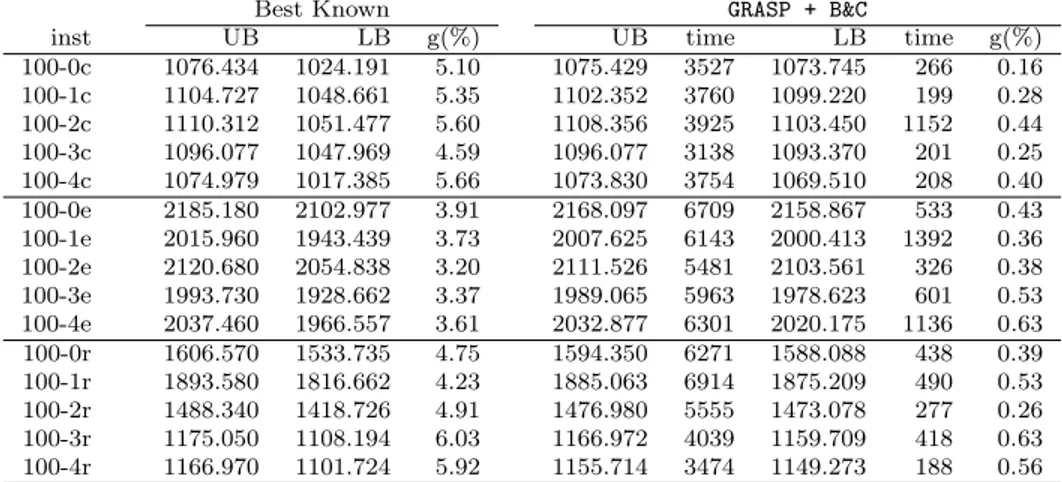
The procedures were coded inC++, compilergcc4.2.3, and CPLEX 10.2 was used. Experiments were perfomed on a machine Intel Core 2 Duo 2.5Ghz with 4GB de RAM running LINUX. Table 1 presents optimal values obtained with the branch-and-cut for instances with 50 nodes. Instances with central node in the center are identified by “c”, at the edge by “e”, and randomly by “r”. Computational times are in seconds. Tables 2 and 3 present upper (UB) and lower (LB) bounds for instances with 100 and 150 nodes respectively. First, the best known upper and lower bounds, with respective percentage gaps, are reported. Then, upper bounds obtained by running 10 iterations of GRASP with subproblems up to 50 nodes, and lower bounds obtained at the root node of the branch-and-cut are reported. The best known upper bounds for instances with central node in the center were obtained by Martins et al. [3]. For instances with central node at the edge or randomly located, the best known upper bounds were obtained by Gamvros et al. [1]. The best known lower bounds for all instances with 100 and 150 nodes were also obtained by Gamvros et al. [1]. The upper and lower bounds obtained by Gamvros et al. [1] were informed to us by Raghavan [4]. Computational results obtained with the approaches proposed in this work improved the best values for both upper and lower bounds, and percentage gaps are now significantly reduced.
inst. opt∗
time inst. opt∗
time inst. opt∗
time 50-0c 568.48 52.01 50-0e 1108.67 171.09 50-0r 591.99 74.07 50-1c 540.62 65.08 50-1e 1147.73 128.27 50-1r 737.05 109.47 50-2c 558.66 29.44 50-2e 1007.27 125.80 50-2r 701.63 67.94 50-3c 564.28 52.12 50-3e 1084.11 222.10 50-3r 676.35 32.95 50-4c 541.68 62.37 50-4e 1123.23 557.88 50-4r 859.79 67.03
Table 1: Optimal values for instances with 50 nodes.
References
[1] I. Gamvros, B.L. Golden, and S. Raghavan, The multi-level capacitated minimum spanning tree, INFORMS Journal on Computing18(2006) pp. 348–365.
[2] L. Gouveia, A 2n formulation for the capacitated minimal spanning tree problem, Operations Re-search 4(1995) pp. 130–141.
[3] A.X. Martins, M.C. de Souza, M.J.F. Souza, T.A.M. Toffolo, GRASP with Hybrid Heuristic-Subproblem Optimization for the Multi-Level Capacitated Minimum Spanning Tree Problem, Journal of Heuristics, to appear, DOI 10.1007/s10732-008-9079-x.
[4] S. Raghavan, personal communication, 2007.
Best Known GRASP + B&C
inst UB LB g(%) UB time LB time g(%)
100-0c 1076.434 1024.191 5.10 1075.429 3527 1073.745 266 0.16 100-1c 1104.727 1048.661 5.35 1102.352 3760 1099.220 199 0.28 100-2c 1110.312 1051.477 5.60 1108.356 3925 1103.450 1152 0.44 100-3c 1096.077 1047.969 4.59 1096.077 3138 1093.370 201 0.25 100-4c 1074.979 1017.385 5.66 1073.830 3754 1069.510 208 0.40 100-0e 2185.180 2102.977 3.91 2168.097 6709 2158.867 533 0.43 100-1e 2015.960 1943.439 3.73 2007.625 6143 2000.413 1392 0.36 100-2e 2120.680 2054.838 3.20 2111.526 5481 2103.561 326 0.38 100-3e 1993.730 1928.662 3.37 1989.065 5963 1978.623 601 0.53 100-4e 2037.460 1966.557 3.61 2032.877 6301 2020.175 1136 0.63 100-0r 1606.570 1533.735 4.75 1594.350 6271 1588.088 438 0.39 100-1r 1893.580 1816.662 4.23 1885.063 6914 1875.209 490 0.53 100-2r 1488.340 1418.726 4.91 1476.980 5555 1473.078 277 0.26 100-3r 1175.050 1108.194 6.03 1166.972 4039 1159.709 418 0.63 100-4r 1166.970 1101.724 5.92 1155.714 3474 1149.273 188 0.56
Table 2: Upper and lower bounds for instances with 100 nodes
Best Known GRASP + B&C
inst UB LB g(%) UB time LB time g(%)
150-0c 1555.086 1483.970 4.79 1550.382 7894 1541.393 728 0.58 150-1c 1639.308 1569.578 4.44 1634.420 5855 1627.047 1004 0.45 150-2c 1624.750 1550.347 4.80 1620.860 5924 1611.212 1086 0.60 150-3c 1586.540 1509.925 5.07 1578.877 6347 1569.488 1130 0.60 150-4c 1633.248 1555.021 5.03 1626.312 5826 1617.757 977 0.53 150-0e 3043.190 2932.044 3.79 3003.718 9120 2992.415 692 0.38 150-1e 3130.600 3017.356 3.75 3099.175 10151 3082.438 762 0.54 150-2e 3074.820 2969.406 3.55 3043.186 9807 3028.971 501 0.47 150-3e 3049.500 2944.365 3.57 3025.921 9360 3008.361 743 0.58 150-4e 3057.150 2930.994 4.30 3012.149 9329 2993.525 830 0.62 150-0r 2418.800 2303.125 5.02 2374.978 10067 2363.651 353 0.48 150-1r 2122.230 2020.047 5.06 2087.433 8119 2076.390 299 0.53 150-2r 2243.700 2135.843 5.05 2216.420 8431 2201.894 323 0.66 150-3r 2180.740 2076.635 5.01 2147.615 8081 2135.203 320 0.58 150-4r 2236.040 2128.817 5.04 2206.680 8877 2195.203 367 0.52
Table 3: Upper and lower bounds for instances with 150 nodes