M
ASTER IN
F
INANCE
M
ASTERS
F
INAL
W
ORK
D
ISSERTATION
D
ETERMINANTS OF
W
ORKERS
’
C
OMPENSATION PREMIUM
:
E
VIDENCE FROM
P
ORTUGAL
J
OANA
T
ERESA
S
ILVA
C
ORTEGANO
M
ASTER IN
F
INANCE
M
ASTERS
F
INAL
W
ORK
D
ISSERTATION
D
ETERMINANTS OF
W
ORKERS
’
C
OMPENSATION PREMIUM
:
E
VIDENCE FROM
P
ORTUGAL
J
OANA
T
ERESA
S
ILVA
C
ORTEGANO
S
UPERVISOR:
P
ROFESSORM
ARIAT
ERESAM
EDEIROSG
ARCIAA
CKNOWLEDGMENTSFirst of all I wish to thank my supervisor Professor Maria Teresa Medeiros Garcia for her constant availability and support. Also many thanks to Marsh Portugal, namely Carmen Crispim and Fernando Chaves, which enabled the realization of this work by kindly providing the data for this study.
Special thanks to my family, friends and colleagues for all the support and encouragement that gave me during this period. Special thanks to my uncles Fernanda Cortegano and Henrique Laranjeira for the constant support that gave me and for have never let me give up.
2
A
BSTRACTBetween 2007 and 2013, the production in workers´ compensation insurance, decreased 34% (Associação Portuguesa de Seguros - APS, 2014). The unemployment rate between 2010 and 2013 faced an increase of 5.4% (Instituto Nacional de Estatística - INE, 2014) and the GDP per capita decreased by 3.8 % (INE, 2014).
The motivation under this thesis is the understanding of the reasons behind the sharp decrease of workers’ compensation insurance production in Portugal, while it faces an economic crisis scenario. Many studies investigated the link between insurance demand and economic indicators. It is desired to achieve the same conclusion but trough a different way: premium risk determinants.
Based on premium risk theory, were chosen several variables that insurers have into account in risk evaluation. The variables under study are the payroll, the number of employees and incidence rate. Since this study has features of cross-firm dimension, which might also affect the premium determination, three categories of variables were chosen: the company size, the activity type and the region where is located.
This study was based on a sample imported from database SABI (Iberian Balance Sheet Analysis System). It was used a cross-firm panel data with 1435 companies over the time horizon from 2010 to 2012. The sample criterion was mediums and large companies based in Portugal (2003/361/EC) in order to access differences in premium determination due to the company size.
According to expectations, results suggest that the payroll and the number of employees are strongly correlated with workers’ compensation insurance premium. Since GDP and unemployment are economic indicators directly related with these risk
3
premium determinants, we support the literature that argues the link between insurance demand and these macroeconomic indicators.
This study also allows to conclude that the incidence rate, firm size, business activity type and region where is located, all have impact in premium determination.
4
C
ONTENTS ACKNOWLEDGMENTS ……….….……1 ABSTRACT ………..……….……2 CONTENTS ………..…….………4 ACRONYMS ………..6 INTRODUCTION ……….……...….…..….7 1. FRAMEWORK ………..………….111.1. PORTUGUESE INSURANCE MARKET ………...……...….11
1.2. WORKERS’ COMPENSATION LEGISLATION AND ITS HISTORICAL BACKGROUND ………....…...13
1.3. FUNDO DE ACIDENTES DE TRABALHO ………...……….16
2. LITERATURE REVIEW………...17
2.1. INSURANCE MARKET ………...….…17
2.2. DETERMINANTS OF INSURANCE DEMAND ………...……..18
2.3. WORKERS’ COMPENSATION MARKET ………...…....20
2.4. WORKERS’ COMPENSATION SYSTEM ………...…...20
2.5. MORAL HAZARDS IN WORKERS’ COMPENSATION SYSTEM ……...……….22
2.6. WORKERS’ COMPENSATION INSURANCE PREMIUM ………....…...23
3. SAMPLE AND METHODOLOGY ……….….24
3.1.DATABASE AND SAMPLE SELECTION CRITERIA ………..24
3.2.METHODOLOGY ………...………...26
3.2.1. DEPENDENT VARIABLE ……….…27
3.2.2. INDEPENDENT VARIABLES ………...….……....28
5
CONCLUSION AND LIMITATIONS ………...………36 BIBLIOGRAPHY ………...………..40 APPENDIX ………..………...44
6
A
CRONYMSAISAM: Association Internationale des Sociétés d'assurance Mutuelle
APS: Associação Portuguesa de Seguradores
ASF: Autoridade de Supervisão de Seguros e Fundos de pensões
GDP: Gross domestic product
GEP: Gabinete de Estratégia e Planeamento (Portugal)
INE: Instituto Nacional de Estatística
LoB: Line of Business
OECD: Organisation for Economic Co-operation and Development
OLS: Ordinary Least Square
PPR: Plano Poupança Reforma
SABI: System Analysis Balance sheet Iberian
SD: Standard Deviation
WC: Worker´s Compensation
7
I
NTRODUCTIONIn Portugal, the employers are responsible to repair the consequences of occupational accidents suffered by their employees. The first law was introduced in 1913 and had instituted a legal obligation of insurance for the risks of accident at work. The law is applied to all employers, as well as self-employees, and the coverage includes workers and their families.
Insurance companies assume employers responsibilities and in return receive a premium – insurance price. When the responsibility is assumed, there is no certainty about the occurrence of associated costs or on its severity. Therefore, when the insurers determine the premium, they must ensure an estimate based on the probability of an accident occurrence, besides to ensure their own profit margin.
Between 2007 and 2013, the production in workers´ compensation insurance, decreased 34% (Figure 2). The financial situation of a country is frequently associated to the insurance market. According to the APS (2014), the macroeconomic situation faced in Portugal affected the demand of insurance, fact that it is reflected in the increase of competition in the supply side.
Literature suggests several reasons that explain the premium behavior. The macroeconomic factors, such as GDP (Beenstock et al, 1988), unemployement rate (Outreville 1980), and competition effect (Schmidle, 1994) are the most argued by researchers to explain the demand of insurance.
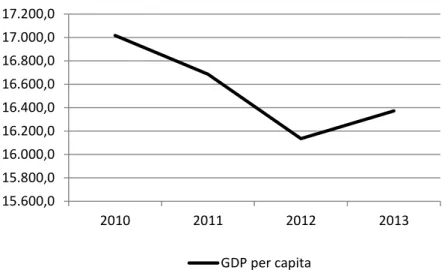
Since 2008, with the triggering of global financial crisis, Portuguese macroeconomic indicators had registered a negative trend. The unemployment rate between 2010 and 2013 faced an increase of 5.4% (INE, Figure A2) and the GDP per
8
capita, decreased 3.8 % (INE, Figure A1). The number of insurance companies in Portugal, between 2008 and 2012, had a decreasedof 14% (Figure A3).
This situation and the whole adjustment process of the economy associated with Portuguese bailout, had obvious impact on business activity and significant social repercussions, the insurance industry, of course, was not exception. The economic and financial crisis had directly and indirectly affected insurance market. For instance, according to Preda & Monea (2013), the direct factor that most contributed to the crisis in insurance market was the decrease of population income.
This dissertation intends to find and quantify the factors that influence the premium determination by insurance companies. Afterwards, searches to conclude about the reasons that leaded to the premium decrease by making a link of these determinants with macroeconomic factors.
The portion that the insurer must receive from the insurance holder, in order to cover the present value of the expected loss in a certain period, is the risk premium. The determination of this premium is based on two factors: exposure measure and premium rate (Silva, 2000). The insurers, through uniform policy, should follow the principle of graduation of insurance premiums depending on the degree of the accident risk, the nature of the activity and the safety conditions established in the work place (Law No. 98/2009 - Article 81).
This work aims to estimate premium determinants appealing to an econometric model and using a cross-firm panel data. Therefore, we need a source of exogenous variations between the explained and explanatory variables. The choice of explanatory variables was based on the risk premium calculation defined by Silva (2000). Thus, it
9
will be accessed, as premium determinants, the payroll, number of employees and incidence rate. Additionally, through control variables, it will be assessed whether the economic activity developed by the company, the region where is located and its size, have or not impact in the premium determination.
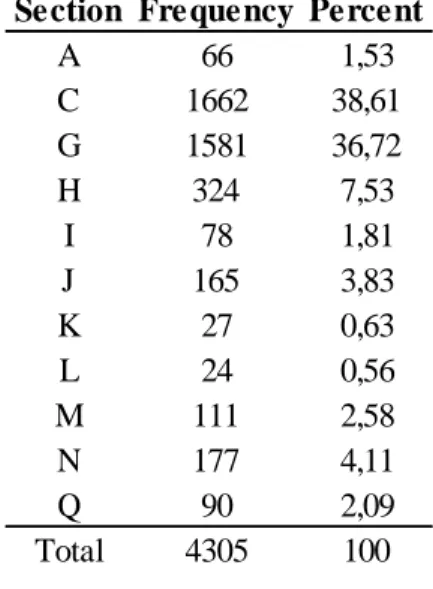
This empirical study is based on a sample that includes data of 1435 companies based in Portugal over 3 years, totalizing 4305 observations. The sample was imported from SABI (Iberian Balance sheet Analysis System) database. The sample criterion was mediums and large companies based in Portugal - classification according European commission recommendation of 6th May of 2003, article 2 - Staff and financial thresholds that define financial enterprise categories (2003/361/EC). It was chosen to focus the analysis only in the time horizon from 2010 to 2012 due to the lack of data. In this period the production in workers’ compensation had faced a decrease of 14% (ASP, 213).
We believe that this study should be of the best interest to the several parts involved in the system: first of all, is relevant for the employers as policy holder and entity who has the necessity to ensure the safety of its employees and therefore pays a premium in order to transfer that risk. This subject is also important for insurance companies as the entity that takes the risk and therefore is responsible for the payment of compensations. Finally, this study is also a major matter for the public entity that has the responsibility of ensure the payment of benefits whenever it cannot be paid by the insurance company.
The structure of this dissertation is organized as follows: the Section 1 aims to introduce the framework and historical background of workers´ compensation insurance
10
in Portugal. In Section 2 is dedicated to the literature review. The sample and methodology are presented in Section 3. This section has two subsections: the first one will discuss the dataset and the econometric model employed; in the second subsection the variables under study will be presented. The results achieved will be discussed in Section 4. The last section, Section 5, will provide the conclusions of this study, the main limitations and also some suggestions for further investigations.
11 P re m iu m s in '0 00 € -100 0 100 200 300 400 500 600 700 800 0 2000 4000 6000 8000 10000 12000 14000 16000 18000 2008 2009 2010 2011 2012 2013 Premiums Net result N e t re su lt in '0 00 €
1. F
RAMEWORKIn this section we present the framework of workers’ compensation insurance in Portugal. First, we will introduce an overview of the insurance market in Portugal from the general overview to the particular one, being the latter the line of business under study: WC insurance. The following subsection is dedicated to the Portuguese workers’ compensation insurance legislation and its historical development. Finally, in the third subsection it will be presented the important public fund that aims to promote the social purpose under in workers’ compensation scope.
1.1 PORTUGUESE INSURANCE MARKET
The economic situation of Portugal is still suffering the consequences of the global financial crisis that had started in 2008. The actual economic situation and the associated set of adjustment measures had impacted all business sectors. The insurance market was no exception and did not escape to economic tendency and, mainly due to its dependency in external capital, has reflected some instability in the results.
Figure 1 – Premiums and Net Result, Portuguese Insurance Market Source: Associação Portuguesa de Seguradores
12
It is possible to note the adaptation process of insurance market to the new reality, when we look to the evolution of the number of insurance companies that operate in Portugal. In 2010, the market was constituted by 83 insurance companies and in 2013 the number decrease to 77 companies (Table A1).
Analyzing Figure 1, it is possible to understand that the most difficult years faced by the sector were in 2011 and 2012. The net result in 2011 had a sharp decline, achieving amounts close to zero. Although, regarding the net income, the years 2012 and 2013 are of visible recovery, mainly due to the LoB life insurance, which was the big promoter of this result. Regarding production, the premium decrease by 28.6% in 2011/2010 (APS, 2013) almost due to life segment. This negative tendency remains in 2012/2011, but wasless marked.
The insurance production is divided by two main LoB´s: life and non-life insurance. The accident at work insurance is classified as non-life insurance. In 2013, the LoB of non-life insurance production represented 29.44 % (ASF, 2014) of total market.
The Worker´s Compensation insurance, in 2013, represented 3.9% of total insurance production and 13,26% of total non-life production (ASF, 2014). Even though this insurance do not have a relevant weight in Portuguese market, this insurance has a major role due to it mandatory characteristic.
The Portuguese market has its production very concentrated. In 2013 around 65% of WC production was distributed by the 5 most important insurance companies in the market (Table A2).
13 400000 500000 600000 700000 800000 2006 2007 2008 2009 2010 2011 2012 2013 Premiums P re m iu m s in '0 00 €
Figure 2 – Premiums Workers’ Compensation Insurance Source: Autoridade de Supervisão de Seguros e Fundos de Pensões
The production in WC, in line with remain insurance classes also faces a negative tendency (Figure 2). Between 2006 and 2013, the production decreased approximately by 34% (ASF).
1.2 WORKERS’ COMPENSATION LEGISLATION AND ITS HISTORICAL
BACKGROUND
The accident at work insurance aims to protect employees and their families as well as self-employed workers. In Portugal, as already mentioned, this insurance is mandatory and proposes to repair damage from accidents at work and occupational diseases. All employers and self-employers assume this obligation.
The Law no.98/2009, that regulates the workers’ compensation in Portugal, defines an accident at work as follows:
14
Section II Article 8
"1- An accident at work is one that is found at the place and time work, in the outward journey or return to the workplace, or elsewhere directly related to the employment contract and which results in bodily injury, functional disorder or disease that causes reduction in work capacity or gain or death …"
The historical legal background includes the following:
1913: Law no. 83
The first Portuguese law in workers’ compensation was the Law no.83, published in 24th of July 1913. At the time, only Germany, France, Spain, and Belgium had a similar law designed to protect workers. This law intends to protect the worker by establishing the responsibility of risk in the employers, which have the possibility of being transferred to an insurance company. Regarding compensation this law also establishes two types of benefits: specie and cash. Pecuniary compensation is based on actual wage loss. This law discourages moral hazard through a capping of wages and loss of income from temporary or permanent work disability.
1919: Decree-Law no. 5637
In 1919, the legal protection system has been expanded to all salaried workers, independently of the activity type, and also expands the law coverage to the professional diseases. This Decree-Law establishes the accident at work insurance as mandatory.
1936: Law no. 1942
The first Portuguese workers’ compensation law (Law no. 83), has been substituted by the Law no. 1942 in 27th of July, 1936. In order to compensate the partial permanent
15
disability, this law was improved by creating the concept of reducing overall capacity gain (article no. 22), and publishes the National Chart of Incapability which was approved only in 1960 (decree-law no. 43189). This law also instituted a regime of redemptions, which was conditioned and limited by an amount previously defined.
1965: Law no. 2127
This law expands the scope of the concept accident ate work to those incidences that occur while going to work place or coming from it, under some special conditions. In the regulation of decree of 1971, the limit of compensable wage was increased.
1981: Decree-law no. 227
The main change that this law introduced was the transference of responsibility of potential damages, from insurance companies to an institution called National Fund of Occupational Diseases.
2000: Law no. 100/97
This law improved the concept of the accident at work including the risk accidents to/from workplace. It also expands the scope of application to all self-employed workers. The concept of base-salary is extinct and, instead of it, the compensations started to be calculated based on the effective salary received by the injured. The capping compensation for wages above the minimum wage is extinct.
2009: Law no. 98/2009
Professional rehabilitation and reintegration is added to the compensations guaranteed. It also establishes that all the medical support should be the most appropriate independently of the costs involved. This law introduces one new responsibility to the insurance companies. When the employer have an accident which
16
arise from a wrongful act, the insurance company must respond, however in this case with the right of redress against him.
1.3 FUNDO DE ACIDENTES DE TRABALHO
FAT consists in a public fund that aims to promote the social purpose under workers’ compensation scope. Despites its administrative and financial autonomy, this fund works together with ASF, which has the responsibility of technical and financial management. This public fund arises with the Law no. 100/97 of September 13th and started operating in 1st January of 2000.
FAT has mainly responsibilities of ensure and refund. Ensures the payment of benefits to pensioners and on the other hand it also ensures the premium payment to insurance companies. FAT also has the responsibility of refund the insurance company in case of pensions and/or supplementary provision updates (ASF).
This public fund constitutes creditor of the entity responsible and therefore is entitled to be reimbursed in respect of compensation paid to the insurance beneficiaries (ASF).
The FAT is supported financially by a set of receipts from diverse source, although the most relevant revenue source with 85% weight of total revenue is charged by insurance companies to insurances holders. The amount to be charged is based on wages considered in the determination of accident at work insurance premium (ASF).
17
2. L
ITERATURE REVIEWIn this section, it will be introduced a literature review on the general insurance field, namely the market characteristics and its demand. Little further the main conclusions drawn by researchers specifically under the worker’s compensation system and some studies concerning premium calculation.
2.1 INSURANCE MARKET
Since the late 1980, the financial system has been reformed to liberalization, globalization and conglomeration. Following the trend of other financial services, the majority reason that explains the importance growth of insurance system, is the increase of risks and uncertainties.
Das et al. (2003) found that mainly through mergers and acquisitions, the total assets of insurance companies has grown more rapidly than the assets of banks. Indeed, also in Portugal, many insurance companies of today had resulted from mergers and acquisitions process.
One characteristic of insurance market is its high competition level. One consequence of deregulation and liberalization of systems was the rise of competition, within and across country, leading to the enhancement of insurance services as well as driving prices down (Mahlberg & Url, 2003). This competition increase, which arises from the deregulation, had also forced insurance companies to be more efficient and productive (Cummins & Rubio-Misas, 2006).
Regarding insurance companies efficiency, researchers suggest that larger firms are more efficient (Berger et al. 2000) and also that insurance companies with several type
18
of products are more efficient that the specialized ones (e.g. Fuentes et al. 2005, Cummins et al. 2007).
2.2 DETERMINANTS OF INSURANCE DEMAND
The importance of insurance industry in global market is well recognize by investigators, namely by the relevant role that plays in the economy. In the economic development field, the relationship between financial and economic growth has been deeply analyzed.
Patrick (1966) defined two possible forms regarding causal relationship between financial development and economic growth. In the first form, the author concludes that the lack of financial growth is an expression of the demand for financial services. Jung (1986) follows this argumentation concluding that the economic development is associated to the creation of new financial services. On the other hand, in the second form, Patrick (1966) affirms that financial development causes economic growth. Demetriades & Hussein (1996) and Greenwood & Smith (1997) uphold the bidirectional relationship between financial development and economic growth.
Several empirical researches found the positive relationship between insurance and GDP. In 1988, through a cross-country data model including 45 developed and non-developing countries in 1981, Beenstock et al. (1988) found the relationship between insurance premiums and GDP. Two years later, this relationship was also found by Outreville (1990) in a study for 55 developing countries in 1983-1984. Beck & Webb (2003), for 68 countries over the period 1961-2000, and Li et al. (2007), for a sample of 30 OECD countries from 1993 to 2000, also showed the correlation between insurance premium and GDP.
19
The case of Portugal was also under study. Garcia (2012) found that the level of gross domestic product explains the level of property-liability insurance demand in Portugal.
The nexus between insurance penetration and GDP has also been subject of study. Investigators concluded that insurance penetration rises with the GDP per capita, although after GDP reaches a certain level, this insurance indicator tends to plateau (Carter & Dickinson 1992, Enz 2000).
Unemployment rate is known as an indicator of the labor market performance. Regarding the relationship between this variable and insurance, the literature is not as extensive as with GDP. Although, the results significantly suggest that unemployment rate has negative impact in demand for insurance. This effect was found by Mantis & Farmer (1968), Outreville (1980), Beenstock et al. (1986), & and Rulli (2006).
The relationship between insurance and demographic factors was also under analysis. Researchers found positive effect of population size and density on insurance demand (Mantis & Farmer 1968, Nakata & Sawada 2007, Feyen et al 2011)
The market concentration has negative impact in insurance demand fact that leads to a lower equilibrium price (Outreville 1996, Park & Lemaire 2011, Feyen et al. 2011).
2.3 WORKER´S COMPENSATION MARKET
The market of WC insurance since early is recognized as competitive. The authors Appel & Gerofsky (1985) and Schmidle (1994) found evidence suggesting this statement.
20
As was already mentioned, one of the consequences of deregulation was the premiums level decrease. This fact is also verified in workers’ compensation insurance. Hunt et al. (1988), in a study between 1978 and 1984, discovered that the introduction of a free competition market in Michigan had an impact of 32% on rate decrease. Carrol & Kaestner (1995) also found that deregulation lead premiums level down, both per injury and per employee.
The deregulation on insurance pricing and its impact, give rise to many studies manly because of questions regarding reasonable prices for consumers and adequate for insurer solvency. Chelius & Moscovitch (1996) argue that rate deregulation allows individual rate negation based on the firm specific risk what promotes firms to invest in an improvement of safety conditions.
2.4 WORKER´S COMPENSATION SYSTEM
Workers’ compensation systems can be private or public. Both public and private characteristics of a system can have advantages and disadvantages and therefore there is also some literatures investigating this matter.
Within OECD countries, Austria, Belgium, Czech Republic, France, Germany, Greece, Hungary, Italy, Japan, Korea, Netherlands, Norway, Spain, Sweden and United Kingdom have public systems. On the other hand, in OECD, the countries under private systems are Australia, Canada, Denmark, Finland, Portugal, Switzerland and United States (Ilsoon et. al.,2011).
Private schemes are characterized by the active role that public authorities have in legislation, control of system, participation of the social security and funds. This type of system is financed by capitalization and can vary from system to another depending on
21
several aspects like rates, compensations, coverage and others. In public schemes there is no bankruptcy risk and continuity is guarantee. The limits of what and who is covered is not so restrict although with less benefits and less effective on dealing with claims (AISAM, 2004).
Ilsoon et al (2011), through a cross-country panel data analysis, investigated about how different workers’ compensation systems impacts occupational accidents. It was concluded that private system, when compared with public insurance, is associated to a lower level of occupational accident. In the same study the authors found that schemes with lower coverage of compensation and risk-based pricing system (versus fixed flat rate system) are correlated with higher level of occupational accidents. A similar conclusion was achieved by Krueger & Burton (1990) that found that workers´ compensation costs are higher in systems where the fund is controlled by the state than where is completely controlled by private insurance companies.
Desseile (1997) based on Belgian case, lists the advantages of a private system of, workers´ compensation for the several parts involved. For the firms because insurers already have a privileged relationship through other insurances that firm also has. Also, both have the same interest of low accident costs and better prevention. The worker takes also advantage of the private system when has possibility of having an additional compensate at a low cost. The characteristic of free competition that leads to a better cost control is gainful for both employers and employees. According with the author, through private system, victims are allowed to benefit of the best health care. Finally, the state only has the role of ensuring balance the system between premiums and expenses.
22
In the AISAM (2004) seminar, it was referred that competition associated to private schemes improves claims treatment and the overall private service and have a greater incentive for reducing risk and, therefore, to have a better developed risk management. Although the high competition may also drive premium levels down. Mahlberg & Url (2003), already have determinate this positive effect of competition in service quality and negative effect in premium levels.
2.5 MORAL HAZARDS IN WORKERS´ COMPENSATION SYSTEM
The accident at work insurance is paid by the employers, although economist argue that the costs are partial paid by the employees in the form of lower wages (Leigh et al. 2000). The conclusion of Gruber & Krueger (1990) supports the later when they found that an increase in accident at work costs are associated with reduced employment growth. The impact that this insurance mechanism have on workers requires an estimate on how wages respond to benefit changes.
Therefore, for economic reasons, higher level of workers’ compensation would lead to wage reduction and this fact lead to moral hazard issues. Literature highlights the importance of reporting injuries. Insurance for worker´s compensation is affected by a number of moral hazards involving both employers and employees (Moore & Viscusi, 1990). Therefore there is an extensive literature approaching the determinants of reporting an accident injury. Askenazy (2006) concluded that the incidence type and its severity have influence in the act of report or not. Also conclude that workers in large companies are more likely to report an accident and managers less.
There has been a growing body of evidence arguing that increases in benefits are generally associated with an increase in the incidence of claims and injuries. Butler &
23
Worral (1983) found that an increase in benefits have a positive correlation with the number of claims. The same conclusion was obtained in many investigations, for instance in the studies of Chelius (1983) & Ruser (1991). Ruser (1991) went deeply in these subjects and found that the positive impact of benefits in injury rates is less in the larger and more experienced-rated firms.
Although this insurance is being associated to moral hazard issues, workers´ compensation also plays a constructive role. Moore & Viscusi (1989) found that workplace fatalities would increase 20% without the existence of this program.
2.6 WORKERS ‘COMPENSATION INSURANCE PREMIUM
The price of insurance is the monetary value for which two parties agree to exchange risk and certainty. In the latest literature, the premium principles are usually based on risk measures (e.g Föllmer & Schied 2004). A different point of view, regarding premium principles, is the one defended by Bühlmann (1980). The author considers that is more realistic a premium determination that considers the market conditions. In Portugal, insurers have both perspectives in mind. When setting the premium, insurance companies have into account the nature of economic activity, as indicator of risk rate, and the current market competition (Silva, 2012).
On an empirical study about workers´compensation premium Barkume and Ruser (2001) consider two main factor that insurers have into consideration when setting the price: one is the actual past loss experience and the other is the possible discount that premium might have due to the advantage of economies of scale and fix costs associated to the larger firms.
24
3. S
AMPLE AND METHODOLOGY3.1 DATABASE AND SAMPLE SELECTION CRITERIA
The empirical study under this dissertation is supported by a sample imported from SABI (Iberian Balance sheet Analysis System) database. The sample criterion was mediums and large companies operating in Portugal (classification according European commission recommendation of 6th May of 2003, article 2 - Staff and financial thresholds that define financial enterprise categories). Therefore, from our sample we exclude all small and micro companies. It was chosen these two types of companies due to the huge differences in their characteristics and with that is intended to access if there are differences in the premium determinants regarding these two different realities.
In attempt to have robust results, the original sample suffered some adjustments. All observations with missing data, as well as observations with extreme values (outliers) and reasonably assumed as typing errors, have been eliminated. At end, it was obtained a balanced panel dataset, i.e., we have the same time periods, for each cross section observation.
We have a total of 1435 companies under analysis. The collected data covers a 3 years' time period, between 2010 and 2012. In order to have a more accurate analysis, it was chosen a cross-firm panel data of the 1435 companies over 3 years, therefore, there will be time series for each cross-company, totalizing in 4305 observations. One of the advantages of panel data model is that it allows controlling the unobserved variables that might also affect the dependent variable.
25
In order to understand whether the firm size influence, or not, the premium determinants, we will analyze the two types of companies both together and separated, and that will lead to us having three different dataset.
Since the main goal of the study is to find the premium determinants, we will study the impact of variables that are considerate by insurers in risk evaluation. The variables under study are the payroll, the number of employees and incidence rate. Since this study has features of cross-firm dimension, which might also affect the premium determination, was chosen three categories of variables: the company size, the activity type and the region where is located.
In this analysis it will be used three models. In the model 1 it was assessed the impact of the main explanatory variables under study: the payroll, the number of employees and incidence rate. The categorical variables were added in the model 2. Finally, in the third model we applied a “fixed effects transformation” (Wooldridge, 2002).
Model 1:
ln(Premium)= β1 + β2 ln(Payroll )+ β3 ln(No.Employees)+ β4 Incidence rate + u
Model 2:
ln(Premium)= β1 + β2 ln(Payroll )+ β3 ln(No.Employees)+ β4 Incidence rate +
+Sector Control + Region Control + Size Control + u Model 3:
ln(Premium)it= β1 + β2 ln(Payroll )it+ β3 ln(No.Employees)it+ β4 Incidence rate +
+ αi + uit
where the αi is the unknown intercept for each entity and uit is the error term and
26
The models applied in our estimations will be explained in more detailed in the next subsection as well as the variables under analysis.
The sample was imported from SABI through an Excel file and all the data preparation was also perform in Excel. The Software used in the estimations was the StataIC 12.
3.2 METHODOLOGY
In the model 1 and model 2 we used ordinary last square (OLS) estimator which under Gauss–Markov theorem is the most accurate unbiased estimator for β (Verbeek, 2004). It model has been chosen because it can be applied to multiple explanatory variables and also categorical explanatory variables.
As mentioned before, one of the characteristics of fixed effect model is that it does not have into account variables that are constant in time. Therefore, when we consider the categorical variables, we cannot use the fixed effect model.
In model 2, the categorical variable ‘size’ was only applied to the total sample which includes both medium and large-sized firms. As remain two datasets includes only one size firm, this control does not makes sense.
This paper investigates the premium determinants with a cross-country panel data analysis. The main issue in these types of empirical studies is the endogeneity of explanatory variables. Structural reverse causality and unobserved firm heterogeneity are the most common endogeneity problems that occur.
With heterogeneity among companies, the problem of not controlling other sources of variation in premium determination is unlikely to be solved by the inclusion of more
27
variables. Therefore we applied a fixed effect model with panel data to control for the time-invariant firm specific differences since they are assumed to be constant in time (Verbeek, 2004). As mentioned by Stock & Watson (2003), the assumption is that “if the unobserved variable does not change over time, then any changes in the dependent variable must be due to influences other than these fixed characteristics.”
The categorical variables “size”, “sector” and "region” were not included in model 3 because they are constant over time and therefore the fixed effect transformation would control for this type of explanatory variable. (Verbeek, Marno 2004).
3.2.1 DEPENDENT VARIABLE
The variable to be explained is the premium of workers’ compensation insurance. The insurance arise from probability theory, where the price of insurance, also called premium, is defined before knowing the exact cost of the product. Insurance companies collect customer’s responsibilities and in return receive a premium – insurance price. The premium is the price paid by the insurance holder and is calculated as follow: premium = commercial premium + taxes.
The commercial premium has four components: risk premium, management expenses, profit margin and insurance margin. The management expense is the amounts added to the pure premium to cover all expenses related to the management of mutuality. The profit margin is the prize component for the compensation of shareholder capital invested in the company. The security margin intends to cover abnormal deviations of accidents regarding their expectancy. Finally, and the most important component of premium, because is not possible to control and involves uncertainty, is the risk premium.
28
In our study we consider the components management expenses, profit margin and insurance margin as stable and we will focus on risk premium.
The risk premium arises from two factors: the exposure measure and premium rate. The exposure measure is the extension of the risk loss to which the insured property is exposed (Silva, 2000).Therefore, the higher is the extension, the higher is the expected loss. In the case of accident at work insurance the unit of exposure is the number of employees.
The premium rate is the product of two factors: the incidence frequency and the average cost (Silva, 2000).
3.2.2 INDEPENDENT VARIABLES
There are several factors that influence the frequency and severity of accident occurrence and which insurance companies, in premium determination, have it into consideration. The better the risk taken is measured the lower the involved costs will be. Insurance companies, when determinate the premium, search for the factors that closest predict the occurrence, both in terms of frequency and severity.
Payroll
The payroll, a premium determinate in Workers’ Compensation insurance scope, is known as a measure of risk exposure. The amount paid by the insured is the premium rate which is a percentage of “wages covered” (Finity, 2014). The study of the relationship of this variable regards the premium and is also relevant because as many Investigators argue, the insurance costs are partial paid by the employees in the form of lower wages (Leigh et al. 2000, Gruber and Krueger 1990).
29
The payroll, indeed should explain the premium once the higher is the extension of the insured business higher is the expected loss (Silva, C. 2000)
If the results show that this variable has indeed impact on the premium, we may conclude about the premium decrease in the last years based on the economic indicators as GDP.
Number of employees
The premium principles are usually based on risk measures (e.g Föllmer and Schied 2004). Silva (2000) suggests that the number of employees is a unit measure of exposure. The number of employees, as indeed should explain the premium once the higher number of employees higher the probability of an accident occurs.
Incident rate
The historical of incidence is one of the factors that had the most impact in the premium rate because is the one explains the majority of the costs assumed by insurances and therefore the one that closely predict about the future incidence probability. The premium rate is calculated based on the incidence frequency and the average cost (Silva, 2000). In our analysis it was only possible to have information about the incidence frequency.
The information of incidence rate, by firm, is not public. Therefore, in order to overcome this lack of information, an incidence rate of accidents was estimated based on CAE of each observed company. According the Relatório Unico of Gabinete de Estratégia e Planeamento (GEP), the incidence rate is calculated as follow:
30
(total no.accident at work) x 103 (total no.employees) x 103
Incidence rate of accidents =
This same entity, GEP, had published statistical information about the number of accidents at work by CAE (note: the most recent data regards 2012). On the other hand the INE provides information of the total numbers of employees, also by sector. Fortunately, with this information it was possible to estimate an incident rate of accident, by sector. Until the moment of this dissertation, there was no data regarding the number of accident at work in 2013, thus, it was only possible to estimate the incidence rate for 2010, 2011 and 2013 (Table A3).
Region
The region where the firm is located can have its own features, which might also affect the premium determination. According to the provision for accident deviation, insured companies located in geographical areas likely to natural disasters should have an additional increase in provisions (APS, 2013). Based on that, these companies situated in these areas should have a higher premium rate. Therefore it was considered that a control by region would accurate our empirical results.
The region is a categorical variable and therefore it was transformed in a dichotomous variable. The omitted region is Lisbon because is the region where more number of firms in the sample are located (Table A6.3)
Company size
The company size classification was done according to the European Commission recommendation of 6th May of 2003, article 2 - Staff and financial thresholds that
31
define financial enterprise categories. The firm-size classification was based on the thresholds of operational income data and number of employee data. The classification was done based data regarding 2012 year.
Some literature shows the existence of the size-firm effect on the incidence reporting. For instance, workers in large companies are more likely to report indicence (Askenazy, P. 2006) and the positive impact of the compensation benefits in injury rates are less in larger companies Ruser (1985,1991). This variable intends to access if the premium have or not into account the company size.
The firm size is also a categorical variable and therefore it was transformed into a dichotomous variable. The omitted category was the size medium because it is the firm size with more frequency in the sample (Table A6.1)
Sector
When setting the premium, insurance companies have to take into consideration the nature of economic activity, as indicator of risk rate (Silva, A. 2012). The type of activity developed by the company, due to the type of risk associated, is a factor that can well predict the occurrence and so has impact on premium risk determination. According to the Law no. 98/2009, 4th September, uniform policy of accidents at work insurance, should be settled according different professions, activities, incidence level and work security conditions. When setting premium rate, employers are classify by the business activity type. Thus, it is created rate groups based on the industry with similar economic activity and loss expectation (WCB Alberta, 2009). Indeed, there are types of activities that are associated to a higher frequency and severity of incidence than others.
32
That is easy to conclude, for instance, when comparing constructions sector, with the services sector.
The business activity classification of the entities under this study was parameterized according to Portuguese Classification of Economic Activities (CAE rev. 3, Table A4).
Once the Sector is also categorical variable, it was transformed in a dichotomous variable where the omitted category is the sector of manufacturing industry. This sector was chosen because was the one with more observations in the sample (Table A6.2).
4. E
MPIRCAL ANALYSISIn this part of the study we will analyze the performed statistical tests. At this point we are looking for statistical significant results in order to assess the determinants of the premium paid by 1435 companies, in worker’ compensation insurance, based on data collected over the years of 2010, 2011 and 2012.
As already mentioned, searching for an accurate study of the premium determinants, was built three different datasets looking to take into account the company size. Therefore, beside a dataset including total sample was built two additional ones: a dataset with the large-sized firms and another dataset with medium-sized firms. The model 1, model 2 and model 3 were applied to these three datasets totalizing in nine regressions.
33
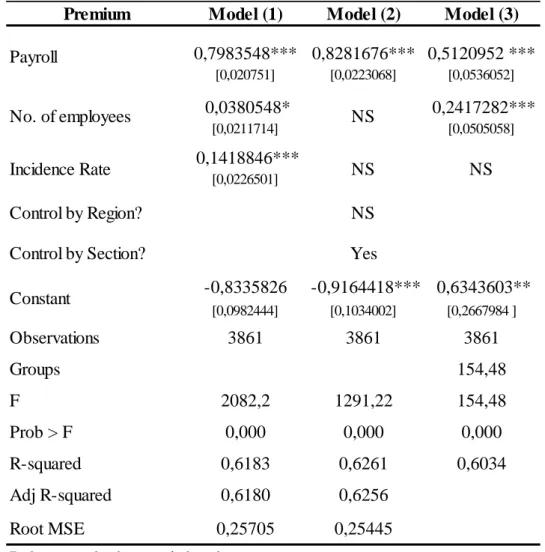
Analyzing the regressions outcomes, in a general way it is possible to verify that almost explanatory variables are statistically significant. Although, when the control variables are added to the model, some variables decrease their significance, namely the “number of employees” and “incidence frequency”.
Looking into the r-square of regressions, it shows that premium is explained, at least, 60% by the applied models. The r-square, as a quality measure of the statistical model, allows us to conclude that the observations fit well in the estimated regression line (Verbeek, 2004). Although, because r-square is less than one, it shows that there are other observable and non-observable variables that were not included in the model and which can also explain the premium. For instance, insurance companies can go deeply in their risk analysis and also take into account the safety regulations and procedures adopted by the firm.
Payroll
The results show that, the variable payroll, measured in logarithm, is the one that most impact has in the premium. The payroll has a strong positive effect in the premium in both medium and large-sized firms. This conclusion goes in line with the expectations once the wages are considered as a “measure of exposure of ultimate claim frequency” (Finity, 2014) which the insured property faces when taking the risk. Analyzing model 1 and model 2 and comparing medium and large-sized firms, we can assess that the impact of the payroll variable in the premium is slightly higher in the large companies. Therefore, the higher the risk extension is, the higher is the expected loss and that should be reflected in the premium. The higher weight of payroll variable in premium determination, in large companies, can also be explained by risk accrual
34
associated to the risk concentration (Silva, 2000), For instance, an accident that involves the total firm plant, will lead to higher costs in a larger than a small-sized company.
When we control for fixed effects (Model 3), it is interesting to note the different impact of the fixed effect transformation, between medium and large-sized firms. In the medium-sized firms, when we control for fixed effects, the impact of payroll in the premium fell a lot. This means that there is significant part of the premium that is explained by other observed and unobserved factors, that are not contemplated in our model and that are time-invariant firm specific differences and therefore constant in time (Verbeek, 2004) and thus with this model we have reduced the threat of omitted variable bias. On the other hand, when we look to the results of large-sized firms, the change was very small, suggesting that there are no relevant fixed effects to control. Although, these results can be criticized base on a limitation of the fixed effect model which is not access the effect of variables that have slightly within group variation.
Number of employees
According what was expected, the results suggests that the number of employees, also measured in logarithm, has a positive effect in the premium. The effect of this variable is less than the effect of the variable payroll. Analyzing the model 1, like it was verified regarding the payroll, also the number of employees has a higher impact in the premium in the larger companies, but in this case the difference is more notable. The logical behind these results are similar with the variable payroll since the number of employees is also considered a measure of risk exposure, but in terms of frequency.
In model 3, when we control fixed effects, the weight of this variable in the premium determination of medium-sized firms increases substantially. On the other
35
hand, after fixed effect transformation the variable number of employees in large firms decreases its significance.
Incidence rate
The statistical significant outcomes of variable incidence rate suggest the positive relation with the premium. This result is according our expectation as the incidence rate is directly associated to compensation costs, therefore, insurer should follow this cost increment by increased the premium and therefore looking to maintain the margins of the other components of the premium like profit margins and management expenses.
The significant outcomes were only verified in the datasets that had included medium-sized firms. The results suggest the positive effect of incidence rate in the premium. Analyzing model 1, it is interesting to note that, when we analyze medium-size firms separately (Table A7), the effect of the incidence rate in the premium is higher than when we have into account the total sample, which also includes the large-sized firms (Table A8). This might suggest that the weight of incidence rate in premium might be less in large firms.
The outcomes evidence that, in medium-sized firms, the incidence rate variable has more impact in premium than the number of employees. Although, when we analyze all the companies together (TableA7, Model 1), this relation is reversed. This take us to consider that, in large companies, the impact of number of employees in the premium is higher than the impact of incidence rate.
When we applied the fixed effect model (Model 1), this variable decreases its significance. When we assess the results of this variable it is important to have in mind that it consists in an incidence rate estimated by sector (total number of accidents by
36
sector / total number of employees of the sector) and therefore it is not exactly the incidence rate of the companies under analysis. Therefore, the number of large-sized firms under study, as well as the number of employees, might not be sufficiently representative regarding the sector and this might explain the non-significance of the outcomes.
Regarding categorical variables, when we consider the total sample, it is possible to access from the results that all have impact in the premium (Table A7), i.e., the firm size, the region where is located and the business activity type, all have impact in the premium determination. Although, when we analyzed both medium and large-sized firm separately, the results are different. The region has impact in the premium of large but not in medium-sized firms. The scenario is reversed regarding the variable sector. The results show that the sector has impact in medium-size firms.
5. C
ONCLUSIONBetween 2007 and 2013, the production in workers´ compensation insurance in Portugal, decreased by 34% (ASP). This premium behavior overlapped with a crisis scenario where Portuguese macroeconomic indicators had registered a negative trend.
Many studies had investigated and concluded about the link between insurance demand and economic indicators. The macroeconomic indicators GDP (e.g Beenstock et al. 1981) and unemployment (e.g Outreville 1980) are strongly argued by investigators to explain the demand of insurance.
37
Having into consideration the previous findings that relate economic factors with insurance demand, the goal of this thesis was the understanding of the reasons behind the decrease of workers’ compensation premium over the last years, through the study of the factors that insurers have into account when determine the risk premium.
In order to investigate the premium determinants, the study was based on a sample imported from database SABI. The sample includes data of 1435 companies over the time horizon from 2010 to 2012. The sample criterion was mediums and large companies based in Portugal (2003/361/EC).
The results show with a high level of significance that the payroll is a premium determinate that positive and strongly impact the premium of workers’ compensation insurance. The macroeconomic indicator GDP is "an aggregate measure of production equal to the sum of the gross values added of all resident, institutional units engaged in production …" (OECD), and therefore is related with the payroll. Thus, we can conclude that our results are in line with literature that argues the relationship between insurance demand and GDP (Beenstock et al.1988, Outreville, 1990, Beck & Webb 2003; Li et al. 2007). If the GDP indicator has a negative trend over the last years, so it has the total payroll paid by the companies. If the payroll has impact in the premium, in a scenario where the payroll faces decrease, consequently the premium will also decrease.
The regressions outcomes suggest that the numbers of employees have a positive impact the premium. Over the last years the unemployment rate in Portugal had faced an increase. Therefore, considering our results, with fewer employees on service the premium will also be lower. These conclusions are also according the literature that
38
suggests that unemployment rate has a negative impact in demand for insurance (Mantis & Farmer 1968, Outreville 1980, Beenstock et al. 1986, Lenten & Rulli 2006, Garcia 2012).
This empirical study also shows that the payroll and the number of employees have more impact in premium determination in large than in medium-sized companies. The opposite happens with incidence rate. The results suggest that the incidence rate has more importance in premium determination in medium than in large-sized firms.
We also found evidence that the firm size has impact in the premium determination. Indeed, according Silva (2000) the higher is the extension of the insured business higher is the expected loss and also according this author, there is a risk accrual associated to the risk concentration. The results showed that the business activity type has impact in premium, but the results were only significant in medium-sized firms. These findings are according the Law no. 98/2009, 4th September, uniform policy of accidents at work insurance, which advise that the premium should be settled according different professions, activities. Finally, the empirical outcomes suggest that the region where firm is located impact in premium. Although, these results, were only significant in the large-sized firms.
The main limitation of this dissertation is the lack of studies which estimate insurance premium determinants based on market premiums, like was done in this study. The sample analyzed has not contemplated the small Portuguese companies which represent an important section of Portuguese enterprise sector. Another great limitation of the current dissertation is the missing information about the incidence of occupational accidents by observed firm.
39
As a suggestion for future work, this analysis can be done including small Portuguese companies.
40
REFERENCES
AISAM, (2004). Workers’Compensation in Europe. Report on the seminar organized by the International Cooperation Networking group.
Appel, D. & Gerofsky J. (1985). Regulating Competition: The Case of Workers Compensation Insurance. Journal of insurance Regulation. 3( 4) 408-425.
Appel D. & Borba, P. S. (1988). Workers’ Compensation Insurance Pricing. Kluwer Academic Publishers 109–44.
APS. (2013, 2014). Panorama do Mercado Segurador.
Askenazy, P. (2006). Some determinants of reporting workplace accidents in France: The role of labour contract”, Centre Pour La Recherche Economique Et Ses Applications (CEPREMAP), Paper No 0606.
Barkume, A.J. & Ruser, J.W. (2001). Deregulating property-casualty insurance pricing: The case of workers’ compensation. Journal of Law & Economics. 44(1), 37-63.
Beck, T., Webb, I. (2003). Economic, demographic, and institutional determinants of life insurance consumption across countries. World Bank Economic Review, 17(1): 51-88.
Beenstock, M., Dickinson, G. & Khajuria, S. (1986). The determination of life premiums: An international cross-section analysis, 1970-1981. Insurance: Mathematics and Economics. 5: 261-270.
Beenstock, M., G. Dickinson, & S. Khajuria (1988). The Relationship Between Property- Liability Insurance Premiums and Income: An International Analysis. Journal of Risk and Insurance. 55(2): 259-272.
Berger, A.N., Young, R., Genay, H., Udell, G.F., (2000). The globalization of financial institutions: Evidence from cross-border banking performance. Brookings-Wharton Papers on Finacial Services. 3, 23–158.
Bülmann, M. (1980). An economic premium principle. Astin Bulletin. 52-60
Butler, R.J., & Worral J. D. (1983). Workers' Compensation: Benefit and Injury Claims Rates in the Seventies. Review of Economics and Statistics, 65(4), 580-99.
Carroll, A., & Kaestner, R. (1995). The Relationship between Regulation and Prices in the Workers’ Compensation Insurance Market. Journal of Regulatory Economics 8, 149–66.
Carter, R.L. & Dickinson, G.M. (1992). “Obstacles to the Liberalization of Trade in Insurance”. (2Ed) 175-188.
Chelius, J. R., & Moscovitch, E. (1996).Toward a Safer Workplace: Reform and Deregulation of Workers’ Compensation. Pioneer Institute for Public Policy Research
41
Chelius, J. R., & Smith. R. S. (1983). Experience-rating and injury prevention. In: Worrall, J. D. (Ed), Safety and the Work Force. 128–37.
Cummins, J. D. & Rubio-Misas M., (2006). Deregulation, Consolidation and Efficiency: Evidence from the Spanish Insurance Industry. Journal of Money Credit and Banking, 38 (2), 323-355.
Cummins, J. D., Dionne G., Gagne R., & Nouira A. (2007). Efficiency of Insurance Firms with Endogenous Risk Management and Financial Intermediation Activities. Journal of Productivity Analysis. 32( 2), 145-159.
Das, U.S., N. Davies and R. Podpiera (2003). Insurance and Issues in Financial Soundness. IMF Working Paper, WP/03/138.
Demetriades, P.O. & K. Hussein (1996). Does Financial Development Cause Economic Growth? Time Series Evidence from Sixteen Countries. Journal of Development Economics. 51(2), 387-411.
Desseille, C. (1997). Private versus state systems for insdrustial accidents : the belgiam case. The Geneva Papers on Risk and Insurance. 22 (84)314-326.
Enz, R. (2000). The S-curve relation between per-capita income and insurance penetration. Geneva Papers on Risk and Insurance. 25(3): 396-406.
Feyen, E., Lester, R. & Rocha, R. (2011). What Drives the Development of the Insurance Sector. Policy Research Working Paper no 5572, World Bank, Washington. Finity Consulting. (2014). ACT Worker´s Compensation Review of Scheme. Available in http://www.cmd.act.gov.au/__data/assets/pdf_file/0005/592493/R_2013_ACT-Scheme-Performance_PUBLIC-RELEASE_FINAL.pdf.
Föllmer, H., & A. Schied. (2004). Stochastic Finance. 2nd edition.
Fuentes H., Grifell E.T., & Perelman S. (2005). Product Specialization, Efficiency and Productivity Change in the Spanish Insurance Industry. CREPP, Université de Liège, Belgium.
Garcia, M.T. (2012). Determinants of the property-liability insurance market: evidence from Portugal. Journal of Economic Studies. 39 (4): 440 – 450.
Greenwood, J. & Smith, B. (1997). Financial Markets in Development and the Development of Financial Market. Journal of Economic Dynamic and Control. 21(1), 145-181.
Gruber, J. & Krueger A.B. (1990). The Incidence of Mandated Employer-Provided Insurance:Lessons from Workers' Compensation Insurance. Tax Policy and the Economy, Volume 5.
Hunt, A. H., Krueger, A. B., & Burton, J.F., (1988). The Impact of Open Competition in Michigan on Employers’ Costs of Workers’ Compensation. Huebner International Series on Risk, Insurance, and Economic Security. 7, 109-144.
42
Ilsoon, S., Byoung, J. & Hyung K. (2011). Occupational Safety and Health Agency, Incheon, Korea An Empirical Study with OECD Cross-Country Panel Data. Safe Health Work. 2, 148-57.
INE (2013). Empresas em Portugal. Ed. 2013.
Jung, W.S. (1986). Financial Development and Economic Growth: International Evidence. Economic Development and Cultural Change. 34(2): 333-346.
Krueger, A. B., & John F. B., Jr. (1990). The Employers' Cost of Workers' Compensation Insurance: Magnitudes, Determinants, and Public Policy. Review of Economics and Statistics. 72( 2)228-40.
Leigh, J., Markowitz S., Fahs M. & Landrigan P. (2000). Costs of occupational injuries and ilnesses. Ann Arbor: University of Michigan Press.
Lenten, L.J. and D.N. Rulli (2006), A Time-Series Analysis of the Demand for Life Insurance Companies in Australia: Unobserved Components Approach. Australian Journal of Management. 31(1): 41-66.
Li, D., F. Moshirian, P. Nguyen and T. Wee. (2007). The Demand for Life Insurance in OECD Countries. Journal of Risk and Insurance. 74(3): 637-652.
Mahlberg, B., & Url, T. (2003). Effects of the single market on the Austrian insurance industry. Empirical Economics 28(4), 813-838.
Mantis, G. and Farmer R. (1968), Demand for Life Insurance. Journal of Risk and Insurance, 35(2): 247-256.
Moore, M. J., & Viscusi W. Ki. (1989). Promoting safety through workers’ compensation: The efficacy and net wage costs of injury insurance. Journal of Economics. 20(4), 499–515.
Nakata, H. & Sawada, Y. (2007). Demand for Non-life Insurance: A Cross-Country Analysis. CIRJE Working Paper F-461.
Outreville, J.F. (1980). Dépenses d'Assurances, Primes Encaissées: Une Approche Macroéconomique, Geneva Papers on Risk and Insurance. 5(17) : 23-44
Outreville, J.F. (1990). The Economic Significance of Insurance Markets in Developing Countries. Journal of Risk and Insurance. 18(3): 487-498.
Outreville, J. F. (1996). Life Insurance Markets in Developing Countries. Journal of Risk and Insurance. 63(2): 263-278.
Park, S.C. & J. Lemaire (2011). The Impact of Culture on the Demand for Non-Life Insurance. University of Pennsylvania, Wharton School Working Paper IRM 2011-02 Patrick, H. (1966). Financial Development and Economic Growth in Underdeveloped Countries. Economic Development and Cultural Change, 174-189.
Preda, A., Monea M. (2013). How affected was the world insurance market by global crisis? Annals of the University of Petroşani, Economics, 13(2):191-202
43
Ruser, J. W. (1991). Workers’ Compensation and Occupational Injuries and Illnesses. Journal of Labor Economics 9, 325–50.
Schmidle, T.P. (1994).The impact of insurance pricing deregulation on the employers' costs of workers' compensation insurance. Cornell University.
Silva, A. (2012). Proposta de um modelo de desempenho preventivo para apoio à actividade seguradora. Universidade do Porto.
Silva. C. (2000). Da Economia e da Gestão nas Empresas de Seguros.
Stock, J.H. & Watson, M. W. (2003). Forecasting Output and Inflation: The Role of Asset Prices Beenstock. Journal of Economic Literature. Vol. 41: 788-829
Veerbeek, M. A Guide to Modern Econometrics. 2E (2004). Workers’ Compensation Board – Alberta (2009) available in:
http://www.wcb.ab.ca/pdfs/employers/pricing2.pdf&sa=U&ei=K70WVZfsO9LOaLOfgYgB&ved=0 CAMQFjAA&client=internal-uds cse&usg=AFQjCNHg2IhC1g2SNiKj6wEuTT59YyK6hA.
44 15.600,0 15.800,0 16.000,0 16.200,0 16.400,0 16.600,0 16.800,0 17.000,0 17.200,0 2010 2011 2012 2013 GDP per capita APPENDIX
Figure A1- GDP per Capita (in €) 2010-2013
Source: INE–BP - Annual National Accounts (Base 2011)
Figure A2- Unemployment Rate (in % ) 2010-2013
Source: INE - Labour Force Survey 10 11 12 13 14 15 16 17 2010 2011 2012 2013 Unemployment rate
45
Figure A3- Number of companies in Portugal (in % ) 2008-2012
Source: INE " Empresas em Portugal 2012"
Table A1 – Market Structure – Number of Insurance Companies by LoB
Source: ASF 1 050 000 1 070 000 1 090 000 1 110 000 1 130 000 1 150 000 1 170 000 1 190 000 1 210 000 1 230 000 1 250 000 2008 2009 2010 2011 2012 Number of Companies in Portugal
2010 2011 2012 2013 Insurance Companies 83 79 79 77 life 21 20 20 19 Non-life 49 46 46 45 Mixed Reinsurance Under ISP 47 45 43 42 Life 15 14 14 14 Non-life 23 22 21 21 Mixed 8 8 7 6 Reinsurance 1 1 1 1 UE subsidiaries 36 34 36 35 Life 6 6 6 5 Non-life 26 24 25 24 Mixed 4 4 5 6