Effects of B Chromosomes on the A Genome
Cytogenet Genome Res 106:320–324 (2004) DOI: 10.1159/000079306
Different numbers of rye B chromosomes
induce identical compaction changes in
distinct A chromosome domains
M. Delgado,
a,bA. Caperta,
a,bT. Ribeiro,
aW. Viegas,
aR.N. Jones
cand
L. Morais-Cecı´lio
aaSecça˜o de Genética, Centro de Botânica Aplicada à Agricultura, Instituto Superior de Agronomia, Tapada da Ajuda; bUniversidade Luso´fona de Humanidade e Tecnologias, Campo Grande, Lisboa (Portugal);
cThe University of Wales Aberystwyth, Institute of Biological Sciences, Aberystwyth, Wales (UK)
Supported by the Fundaça˜o para a Ciência e Tecnologia (project POCTI /1999/AGR/ 34000). M. Delgado was supported by a PhD grant from Fundaça˜o para a Ciência e Tecnologia (PRAXIS XXI/BD/4522/94).
Received 23 September 2003; manuscript accepted 3 December 2003. Request reprints from L. Morais-Cecı´lio, Secça˜o de Genética
Centro de Botânica Aplicada à Agricultura Instituto Superior de Agronomia, Tapada da Ajuda 1349-017 Lisboa (Portugal); telephone: +351 21 365 32 81 fax: + 351 21 363 50 31; e-mail: [email protected] M.D. and A.C. contributed equally to this work
Abstract. In rye each B chromosome (B) represents 5.5 % of the diploid A genome. Rye Bs have several nuclear to whole plant effects although they seem to bear no genes except for the ones that lead to their maintenance within a population. In this context, and considering that rye Bs are enriched in repetitive non-coding regions that build up heterochromatin (het), we investigated the influence of Bs on the organization of two chromatin fractions, namely the ribosomal DNA (facultative het) and satellite (non-het) domain of rye chromosome 1 by silver staining on root tip metaphase cells. The results show that rye Bs cause condensation both in the NOR and in the chromo-some 1 satellite domain. Since the silver staining technique
used is indicative of the transcriptional activity of the NORs, the condensation observed at those loci demonstrates that the rRNA gene arrays are down-regulated in the presence of Bs, regardless of their number per individual. Furthermore, the organizational changes of metaphase NORs find parallel with the interphase organization of ribosomal chromatin, since the frequency of cells with intranucleolar condensed rDNA regions increases drastically and nuclear matrix attachment pattern is altered in the presence of the Bs. Our results show an identical effect of the Bs on the organization of two distinct chromosome domains displaying a presence/absence dichotomy.
Copyright © 2004 S. Karger AG, Basel
A number of endo- or exophenotype characteristics have been correlated with the presence of B chromosomes (Bs) in rye. Rye is notable for the frequent occurrence of these chromo-somes, which are found in many populations throughout its geographical range. The property of B non-disjunction at first mitosis in the male and female gametophytes, together with irregularities at meiosis, means that they can be either absent or
present in distinct numbers between different individuals of the same population (for review see Jones and Puertas, 1993; Jones and Houben, 2003).
Rye Bs appear to have both heterochromatic and euchro-matic domains, and whilst their profile is unique, they have no C-banding properties which distinguish them markedly from the As. The information so far available for DNA sequence composition shows that Bs are mostly composed of repeated DNA common to the As (Wilkes et al., 1995; Houben et al., 1996) with exception of two families of specific repetitive sequences, namely D1100 and E3900 (Sandery et al., 1990; Blunden et al., 1993; Langdon et al., 2000). These sequences exist in high copy number in the terminal part of the B long arm that corresponds to a characteristic prominent C-band. Accord-ing to this description of the molecular organization of the rye Bs, these supernumerary chromosomes represent additional content of repetitive DNA sequences that usually organize into heterochromatin (het) domains (Houben et al., 1996), although some may escape the cytological analysis (Redi et al., 2001). Considering the referred effects of B chromosomes on
nucleo-type features, along with their het nature, we investigated the influence of the presence of the Bs on two distinct chromatin domains located adjacently on rye chromosome 1, namely the ribosomal DNA loci and the satellite region.
Previous analysis of different rye accession of B chromo-somes showed that rDNA topology is altered in their presence, since the frequency of cells with condensed rDNA within the nucleolus drastically increases (Delgado et al., 1995). In fact, in contrast to wheat (Leitch et al., 1992; Morais-Cecı´lio et al., 2000) and pea (Shaw and Jordan, 1995), condensed rDNA in rye without Bs is restricted to perinucleolar blocks (Leitch et al., 1992; Delgado et al., 1995). Here, we show that this B effect is independent of the B number and is also manifested by conden-sation of metaphase NOR and chromosome 1 satellite domains and in the periodicity of rDNA attachment to the nuclear matrix.
Materials and methods
Analysis of somatic cells was performed in meristems of seedling root tips from JNK rye plants with 0, 1, 2, 3 and 4Bs. Root tips were either fixed in 4 % (w/v) formaldehyde solution in PEM buffer and sectioned as described in Abranches et al. (1998), or colchicine treated in a 0.1 mg/ml solution for 4 h at 22° C to induce c-metaphases and then were fixed in 3:1 (v/v) absolute ethanol:glacial acetic acid. Unfixed root tips were also used to obtain nuclear halo preparations according to Allen et al. (1996). Tissue sections and nuclear halo preparations were hybridized with the rDNA probe pTa71 (a 9-kb fragment from 45S rDNA gene sequence isolated from wheat, Gerlach and Bedbrook, 1979) and analyzed by confocal laser scanning microscopy. C-metaphase spreads were silver stained and hybridized with pTa71 follow-ing the procedure described in Caperta et al. (2002), and analyzed under light and epifluorescence microscopes. Silver staining and in situ hybridization were either performed in distinct preparations or sequentially in the same preparation, producing identical results. Length measurements of c-meta-phase NORs and of satellites of chromosome 1 were performed using Axion-Vision measurement module 3.0.0.0 (Zeiss). For each level of analysis at least three plants from each genotype (0, 2 and 4 Bs) were used.
Results
Bs induce condensation of NOR and chromosome 1 satellite domains
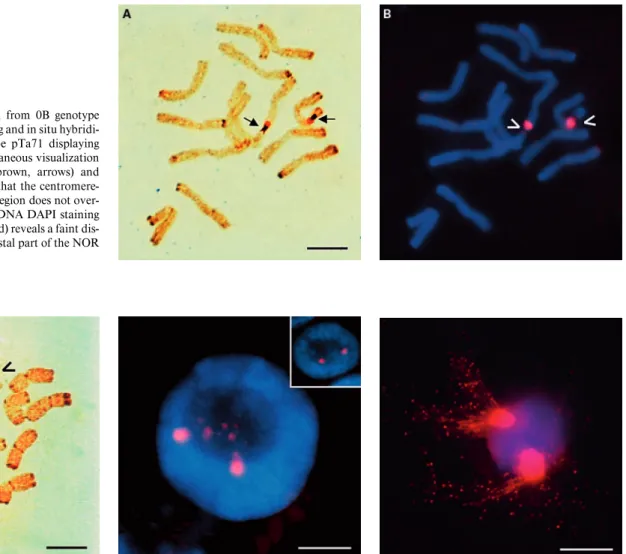
NOR activity in JNK rye was evaluated on c-metaphases through silver staining. In all c-metaphase cells analyzed from plants without Bs, and from plants with distinct numbers of Bs, homologues of chromosomes 1 show a positive silver staining of the NOR (Ag-NOR), revealing that genes from both NORs are transcribed during the previous interphase (Figs. 1 and 2). However differences in the Ag-NOR length were observed between cells, indicating distinct levels of condensation of the
rDNA chromatin in metaphase chromosomes. In order to eval-uate these differences the length of each NOR and its satellite was measured and compared. NORs were considered dis-tended when longer than the satellite (Fig. 1) and condensed when shorter or equal to the satellite (Fig. 2). The results of this analysis are summarized in Table 1. This shows a difference between plants with and without Bs, with both satellite and NOR mean lengths being reduced in the presence of Bs. The frequency of condensed NORs is considerably higher in plants with Bs in relation to plants without Bs, and similar values were obtained for plants with 2 or 4 Bs. These results show that the presence of B chromosomes induces NOR condensation but that this effect is not directly related to the number of Bs present. Similarly the presence of B chromosomes is also relat-ed to a rrelat-eduction in length of chromosome 1 satellite, revealing higher levels of chromatin condensation.
Distended NORs analysed using sequential silver staining and FISH with the pTa71 probe show a complex internal orga-nization. FISH labeling revealed a centromere-proximal con-densed rDNA region and a distended region with faint labeling (Fig. 1B). In all distended NORs, a portion of the centromere-proximal rDNA condensed region does not overlap with silver staining revealing a higher density of argeophilic proteins towards the telomeric end of the NOR (Fig. 1A). Since the pres-ence of argeophilic proteins in the NOR is related to gene tran-scription, the stronger silver staining of the distal region of the NOR should result from more intense transcriptional activity in that domain. In this respect the homogeneous silver staining observed in condensed NORs (Fig. 2) must result from the high level of rDNA condensation that renders impossible the dis-crimination of differentially stained regions.
The effect of the Bs on interphase rDNA organization is independent of B copy number
Hybridization of preserved nuclei with pTa71 and analysis by laser-scanning confocal microscopy gave detailed informa-tion on the organizainforma-tion of the NOR at interphase. No hybridi-zation signal was found apart from the nucleolus which is visualized due to reduced DAPI staining. The majority of the nuclei presented two blocks of ribosomal chromatin adjacent to the nucleolar periphery (Fig. 3 inset). Nuclei with only one per-inucleolar block were very rare and in these nuclei no other pTa71 signal was detected (Table 2). Perinucleolar blocks were usually large with intense fluorescence, indicating a high level of rDNA condensation. Besides these perinucleolar blocks con-densed rDNA was also detected inside the nucleolus (Fig. 3). The number of condensed sites of ribosomal chromatin located intranucleolarly, in contrast with the perinucleolar ones, is not constant and varies from one to more than ten.
Table 1. Mean length (Ìm) of satellite and dis-tinct types of Ag-NORs in plants with different numbers of B chromosomes
No. of Bs
Satellite NOR Condensed NOR % Distended NOR % No. of cells 0 2.63 (±0.4) 2.82 (±1.8) 1.92 (±0.87) 52 3.81 (±0.76) 48 22 2 1.55 (±0.2) 1.18 (±0.4) 1.06 (±0.26) 95 2.15 (±0.36) 5 39 4 1.50 (±0.6) 1.13 (±0.1) 1.08 (±0.68) 88 2.23 (±0.19) 12 21
Fig. 1. C-metaphase cell from 0B genotype after sequential silver staining and in situ hybridi-zation with the rDNA probe pTa71 displaying distended NORs. (A) Simultaneous visualization of the NOR Ag-staining (brown, arrows) and pTa71 signal (red) showing that the centromere-proximal rDNA condensed region does not over-lap with silver staining. (B) DNA DAPI staining (blue) and pTa71 labeling (red) reveals a faint dis-tended region towards the distal part of the NOR (arrowheads). Bar = 10 Ìm.
Fig. 2. C-metaphase cell with 2 Bs (arrow-heads) after sequential silver staining and in situ hybridization with the rDNA probe pTa71 dis-playing condensed NORs (arrows). NOR Ag-staining and pTa71 labeling (red) show colocaliza-tion. Bar = 10 Ìm.
Fig. 3. Interphase nucleus of a 4B plant after in situ hybridization with rDNA probe (red) and DAPI DNA staining (blue) showing two large rDNA condensed blocks in the periphery of the nucleolus together with several rDNA condensed regions inside the nucleolus. Inset – interphase nucleus of a 0B plant where the condensed rDNA is restricted to the two perinucleolar blocks. Bar = 5 Ìm.
Fig. 4. Meristematic root tip nucleus after his-tone extraction hybridized with rDNA probe pTa71 (red), showing rDNA labeling in the resid-ual nucleus as well as uncoiled fibers in the nuclear halo. The hybridization signal is superim-posed with DNA DAPI staining. Bar = 10 Ìm.
Table 2. Frequency (%) of nuclei with distinct number of rDNA con-densed regions in plants with different numbers of B chromosomes
No. of condensed rDNA regions per nucleusa No. of Bs 1 2 3 4 5 6 >6 No. of nuclei 0 2.5 85.0 8.8 2.5 1.3 0 0 80 1 0 35.0 22.5 30.0 5.0 5.0 2.5 40 2 1.0 34.5 22.5 25.5 10.5 4.5 1.5 200 3 0 37.5 23.8 20.0 8.8 7.5 2.5 80 4 0 43.8 30.0 16.3 7.5 1.3 1.3 80 a
More than two condensed rDNA regions correspond to nuclei with condensed rDNA inside the nucleolus.
Table 3. Average length (Ìm) of the uncoiled rDNA fibers from the rye NOR locus in the nuclear halo preparations from plants with different num-bers of B chromosomes
Significance of the difference between genotypesa Genotype No. of nuclei Medium length of rDNA fibers (SD) 2Bs 4Bs +Bsb 0Bs 12 14.8 (±3.7) P = 0.006 P = 0.034 P = 0.008 2Bs 26 10.9 (±4.1) P = 0.363 4Bs 17 11.8 (±3.2) +Bsb 43 11.2 (±3.9) a
The significance of the difference in length of the extended rDNA fibers between genotypes was assessed using a two-tailed distribution Student’s t test.
b
The frequency of nuclei with condensed rDNA in an intra-nucleolar position shows a drastic increase in the presence of B chromosomes (Table 2, 0B 12.5 %, 1B 65.0 %, 2B 64.5 %, 3B 62.5 % and 4B 56.2 %), corroborating the observations in spread nuclei (Delgado et al., 1995). The frequencies now obtained for nuclei with intranucleolar rDNA condensation both in plants without Bs and in plants with Bs are higher than that previously observed (5 % and 23–33 %, for 0 and +B geno-types respectively). This is probably due to the greater accuracy of confocal microscopy in the detection of spots of smaller size that can be scattered or overlapped in the perinucleolar con-densed blocks in nuclei spreads.
Nuclei from all genotypes were classified according to the total number of condensed rDNA sites per nucleus indepen-dently of their size, and these results are summarized in Table 2. A ¯2 analysis rejected the hypothesis of independence
between the number of discrete condensed rDNA spots and the variation of B chromosome number (¯2 = 71.3, P = 0.00).
How-ever, when only +B genotypes are considered (¯2 = 7.8, P =
0.25) this analysis clearly indicates that the B chromosome effect upon interphase rDNA organization is not related to their number, but only to the presence or absence of these chro-mosomes. In addition, in +B genotypes the higher density of condensed rDNA inside the nucleolus is found in the nucleolar subregion closer to the perinucleolar condensed rDNA blocks indicating a tendency to condensation towards the centromere proximal part of the locus.
Bs affect the periodicity of rDNA attachment to nuclear matrix
The pTa71 hybridization pattern, after histone displace-ment, shows that the rDNA sequences within the chromosome 1 locus are distributed between the residual nucleus and the nuclear halo (Fig. 4). Two bright blocks are detected in the residual nucleus, close to the nucleolar periphery from which emanate extended threads of rDNA.
The maximum length of the uncoiled threads of rDNA of each nuclear halo was measured. The average length was deter-mined for each genotype revealing another difference between plants with and without B chromosomes (Table 3). The average length of the uncoiled rDNA fibers due to histone extraction is significantly higher in the 0B genotype than in the +Bs geno-types. On the other hand, this parameter does not show any significant difference between 2B and 4B plants.
Discussion
The relation between positive metaphase NOR silver label-ing and transcription of rRNA genes in the precedlabel-ing inter-phase has long been established (Goodpasture and Bloom, 1975), and ever since silver staining has been extensively used to evaluate rDNA gene expression and to discriminate between actively transcribed and inactive rRNA gene loci (Jiménez et al., 1988; Zurita et al., 1998; Caperta et al., 2002). Silver label-ing analysis of metaphase plates of JNK rye reveals strong sil-ver bands in the NOR region of chromosomes 1, showing that both homologous NORs strongly contribute to nucleolus
for-mation, which is a general feature of diploid rye (Caperta et al. 2002). However, the presence of B chromosomes clearly in-duces a reduction in the absolute length of the secondary con-striction, and thus in the length of the silver label, and also a reduction in the frequency of distended NORs indicating a reduction in rRNA gene expression. The size of Ag-signals in metaphase chromosomes was directly related to the transcrip-tional level of the NOR (Hubbel, 1985), and used as a parame-ter to compare NOR activity between homologous and non-homologous loci (Hubbel, 1985; Zurita et al., 1998, 1999; Man-drioli et al., 1999; Morais-Cecı´lio et al., 2000; Caperta et al., 2002). In addition it is known that the presence in metaphase NORs of argeophilic proteins related to rRNA gene transcrip-tion is associated with reduced rDNA condensatranscrip-tion (Jiménez et al., 1988; Heliot et al., 1997). The reduction of NOR tran-scription here observed is in agreement with early reports of B chromosome effects upon nuclear phenotype showing that the presence of Bs is associated with a depletion in RNA content (Kirk and Jones, 1970), that in view of the magnitude of the changes, was later attributed to the ribosomal fraction (Jones and Rees, 1982). The effects of the presence of Bs on metaphase chromosome structure are not limited to the NOR loci, as the length of the chromosome 1 satellite is also reduced in the pres-ence of these chromosomes to a level that is not related to their number. A similar result was obtained by Jones and Rees (1968), where a shortening of metaphase A chromosomes was associated with the presence of Bs, and in this work also no significant differences were found between the effect of 4 or 8 Bs. Interestingly, the reduction in size of NOR silver labeling, and hence a reduction of rDNA gene transcription related with the presence of Bs, was also observed in the hexaploid wheat Lindström, a line with introgressed rye B chromosomes (Mo-rais-Cecı´lio et al., 2000). As in the present work, no evident relation between the severity of the effect and the number of Bs present was found in this wheat line.
Following this observation in metaphase chromosomes, the interphase results reveal that also the intranucleolar rDNA con-densation induced by the Bs is independent of the number of these chromosomes. In 0B nuclei the rDNA organization pattern is identical to that described for rye cultivars without Bs (Leitch et al., 1992; Delgado et al., 1995; Caperta et al., 2002) where the condensed rDNA is essentially restricted to the out-side of the nucleolus in peripheral position. Conversely in +B plants most of the nuclei show intranucleolar condensed rDNA with this organization being independent of number of Bs present. Although intranucleolar condensed regions could be found dispersed throughout the volume of the nucleolus, this situation was mainly restricted to nuclei with higher numbers of intranucleolar rDNA foci. In most nuclei, with few intranu-cleolar rDNA foci, this condensed rDNA tends to be localized towards the perinucleolar blocks, suggesting that rDNA con-densation inside the nucleolus occurs primarily close to the perinucleolar heterochromatic rDNA. Considering that at in-terphase intranucleolar rDNA condensation is observed promi-nently towards the centromere side it seems reasonable to assume that a preferential rDNA expression towards the telo-mere is a characteristic feature of rye NORs, although the extent of global rDNA transcription, and thus rDNA
decon-densation, can vary between distinct genotypes. The effects of Bs on the rDNA organization are also reflected in matrix attachment patterns. The alteration of the periodicity of attach-ment to the nuclear matrix observed in the rDNA sequences strongly suggests that different or additional attachment sites are recruited in the presence of Bs. Taken together the data obtained from metaphase silver staining and interphase in situ hybridization show a direct correlation between the decrease in nucleolar activity and the increase of intranucleolar condensed rDNA, associated with the presence of B chromosomes. The down regulation of rRNA gene expression by means of rDNA condensation is already related to lower levels of metabolic activity in differentiated cells (Shaw et al., 1993), and with NOR inactivation associated with nucleolar dominance (Neves et al., 1997; Lim et al., 2000).
Although rye Bs are mainly composed of repetitive DNA sequences that build up heterochromatin (Grewal and Moazed, 2003), our results do not show a dosage effect commonly associ-ated with alterations in the total amount of het (Henikoff, 2000). In addition, at this level of analysis it is not patently an odd/even B number effect, frequently associated with the pres-ence of rye Bs (Jones and Puertas, 1993). The effect of Bs upon rDNA and chromosome 1 satellite shows an absence/presence dichotomy, being independent of variation in their number. This suggests that the genome plasticity in terms of chromatin organization is limited in its scope, and that one or a few Bs are sufficient to reach a threshold.
Acknowledgements
We are most grateful to Augusta Bara˜o for excellent technical assistance.
References
Abranches R, Beven AF, Arago´n-Alcaide L, Shaw PJ: Transcription sites are not correlated with chromo-some territories in wheat nuclei. J Cell Biol 143:5– 12 (1998).
Allen GC, Hall G Jr, Michalowski S, Newman W, Spik-er S, WeissingSpik-er AK, Thompson WF: High-level transgene expression in plant cells: effects of a strong scaffold attachment region from tobacco. Plant cell 8:899–913 (1996).
Blunden R, Wilkes TJ, Forster JW, Jimenez MM, San-dery MJ, Karp A, Jones RN: Identification of the E3900 family, a second family of rye B chromo-some specific repeated sequences. Genome 36: 706–711 (1993).
Caperta A, Neves N, Morais-Cecı´lio L, Malho´ R, Vie-gas W: Genome restructuring in rye affects the expression, organization and disposition of homol-ogous rDNA loci. J Cell Sci 115:2839–2846 (2002).
Cuadrado A, Jouve N: Highly repetitive sequences in B chromosomes of Secale cereale revealed by in situ hybridisation. Genome37:709–712 (1994). Delgado M, Morais-Cecı´lio L, Neves N, Jones RN,
Vie-gas W: The influence of B chromosomes on rDNA organization in rye interphase nuclei. Chrom Res 3:487–491 (1995).
Gerlach WL, Bedbrook JR: Cloning and characteriza-tion of ribosomal RNA genes from wheat and bar-ley. Nucleic Acids Res 7:1869–1885 (1979). Goodpasture C, Bloom SE: Visualization of nucleolar
organiser regions in mammalian chromosomes us-ing silver stainus-ing. Chromosoma 53:37–50 (1975). Grewal SIS, Moazed D: Heterochromatin and
epigen-etic control of gene expression. Science 301:798– 802 (2003)
Heliot L, Kaplan H, Lucas L, Klein C, Beorchia A, Doco-Fenzy M, Menager M, Thiry M, O’Donohue MF, Ploton D: Electron tomography of metaphase nucleolar organizer regions: evidence for a twisted-loop organization. Mol Biol Cell 8:2199–2216 (1997).
Henikoff S: Heterochromatin function in complex ge-nomes. Biochim Biophys Acta 1470:1–8 (2000).
Houben A, Kynast RG, Heim U, Hermann H, Jones RN, Forster JW: Molecular cytogenetic character-ization of the terminal heterochromatic segment of the B-chromosomes of rye (Secale cereale). Chro-mosoma 105:97–103 (1996).
Hubbel HR: Silver staining as an indicator of active ribosomal genes. Stain Technol 60:285–294 (1985).
Jiménez R, Burgos M, Diaz de la Guardia R: A study of the Ag-staining significance in mitotic NORs. Her-edity 60:125–127 (1988).
Jones N, Houben A: B chromosomes in plants: escapes from the A chromosomes genome? Trends Plant Sci 8:417–423 (2003).
Jones RN, Puertas MJ: The B-chromosomes of rye
(Se-cale cereale L.), in Dhir KK, Sareen TS (eds):
Fron-tiers in Plant Science Research, pp 81–112 (Bhag-wati Enterprises, Dehli 1993).
Jones RN, Rees H: The influence of B-chromosomes upon the nuclear phenotype in rye. Chromosoma 24:158–176 (1968).
Jones RN, Rees H: B Chromosomes (Academic Press, London 1982).
Kirk D, Jones RN: Nuclear genetic activity in B chro-mosomes rye, in terms of the quantitative interre-lationships between nuclear protein, nuclear RNA and histone. Chromosoma 31:241–254 (1970). Langdon T, Seago C, Jones RN, Ougham H, Thomas
H, Forster JW, Jenkins G: De novo evolution of satellite DNA on the rye B chromosomes. Genetics 154:869–884 (2000).
Leitch AR, Mosgoller W, Shi M, Heslop-Harrison JS: Different patterns of r DNA organization at inter-phase nuclei of wheat and rye. J Cell Sci 101:751– 757 (1992).
Lim KY, Kovarik A Matyasek R, Bezdek M, Lichten-stein CP, Leitch AR: Gene conversion of ribosomal DNA in Nicotiana tabacum is associated with un-dermethylated, decondensed and probably active gene units. Chromosoma 109:161–171 (2000).
Mandrioli M, Manicardi GC, Bizzaro D, Bianchi U: NOR heteromorphism within a parthenogenic li-neage of the aphid Megoura viciae. Chrom Res 7:157–162 (1999).
Morais-Cecı´lio L, Delgado M, Jones RN, Viegas W: Modification of wheat rDNA loci by the rye B chromosomes: a chromatin organization model. Chrom Res 8:341–351 (2000).
Neves N, Castilho A, Silva M, Heslop-Harrison JS, Vie-gas W: Genomic interactions, gene expression, DNA methylation and nuclear architecture. Chrom Today 12:182–200 (1997).
Redi CA, Garagna S, Zacharias H, Zuccotti M, Capan-na E: The other chromatin. Chromosoma 110:136– 147 (2001).
Sandery MJ, Forster JW, Blunden R, Jones RN: Identi-fication of a family of repeated sequences on rye B chromosome. Genome 33:908–913 (1990). Shaw PJ, Jordan EG: The nucleolus. Annu Rev Cell
Biol 11:93–121 (1995).
Shaw PJ, Rawlins DJ, Highett MI: Nuclear and nucleo-lar structure in plants, in Heslop-Harrison JS, Flav-ell RB (eds): John Innes Review – The Chromo-some, pp 161–171 (Bios Scientific Publishers, Ox-ford 1993).
Wilkes TM, Francki MG, Langridge P, Karp A, Jones RN, Forster JW: Analysis of rye B-chromosome structure using fluorescence in situ hybridization (FISH). Chrom Res 3:466–472 (1995).
Zurita F, Jiménez R, Burgos M, Dı´az la Guardia R: Sequential silver staining and in situ hybridization reveal a direct association between rDNA levels and the expression of homologous nucleolar organ-izing regions: a hypothesis for NOR structure and function. J Cell Sci 111:1433–1439 (1998). Zurita F, Jiménez R, Dı´az la Guardia R, Burgos M: The
relative rDNA content of the NOR determines its level of expression and its probability of becoming active. A sequential silver staining and in-situ hy-bridization study. Chrom Res 7:563–570 (1999).