Copyright: This is an open-access article distributed under the terms of the Creative Commons Attribution License®, which permits unrestricted use, distribution, and reproduction in any medium, provided that the original author and source are credited.
Methodological evaluation of leisure-time
physical activity interventions in adults with
obesity: a systematic review
Avaliação metodológica de intervenções em atividade física no lazer em adultos com
obesidade: revisão sistemática
AUTHOR’S Marina Christofoletti¹ Anne Ribeiro Streb¹ Robert Passos da Silva¹
Tânia Rosane Bertoldo Benedetti¹ Fábio Araújo Almeida²
Giovani Firpo Del Duca¹
1 Federal University of Santa Catarina. Sports Center. Florianópolis, Santa Catarina, Brazil. 2 University of Nebraska Medical Center, College of Public Health. Omaha, Nebraska, Estados Unidos.
CORRESPONDING Marina Christofoletti [email protected]
Campus Reitor João David Ferreira Lima, s/n. Trindade, Florianópolis, Santa Catarina, Brasil. CEP 88040-900
DOI
10.12820/rbafs.23e0029
ABSTRACT
The aim of the present study was to systematize and analyze the methodological quality of physical activity interventions in leisure time in obese adults. A systematic review was conducted between June and August 2017 through four electronic databases (PubMed, Lilacs, ScienceDirect and Web of Science). A total of two researchers selected articles and, through consensus, analyzed these articles using the RE-AIM framework, which aims to identify the following dimensions: reach, effective-ness, adoption, implementation and maintenance of interventions. Of the 2,334 articles selected, nine met all eligibility criteria. The mean duration of the interventions was 14 weeks, with strategies including mainly aerobic exercises and nutritional monitoring. When the individual studies were taken into consideration, 67% reported at least one category of each dimension. The dimension with the highest reported proportion was “reach”, found in 65% of the interventions. The “effectiveness”, “adoption” (organizational and staff), “implementation” and “maintenance” dimensions (individual and organizational) were reported in less than 40% of the items investigated for this information. The conclusion is that most of intervention studies reported the “reach” dimension, while only a few described “maintenance”. Thus, it is suggested that future studies should previously look at the pres-entation of the total effect of the intervention and the methods applied, offering detailed information about each procedure. The scientific and practical scenario will provide relevant information about construction, application and subsequent follow-up of the interventions in leisure-time physical ac-tivity for obese adults.
Keywords: Program evaluation; Motor activity; Obesity; Adults; Review.
RESUMO
O objetivo do estudo foi avaliar sistematicamente a qualidade metodológica de intervenções de atividade física no lazer para adultos com obesidade. Trata-se de uma revisão sistemática conduzida de junho a agosto de 2017, com consulta eletrônica em quatro bases de dados (PubMed, Lilacs, ScienceDirect e Web of Science). Dois investigadores selecionaram os artigos e, mediante ao consenso, analisaram os artigos pelo emprego da ferramenta RE-AIM, que se propõe a identificar cinco dimensões específicas: alcance, efetividade, adoção, implementação e manutenção. Dos 2.334 artigos selecionados, nove atenderam aos critérios de elegibilidade. A duração média das intervenções foi de 14 semanas, com estratégias que continham exercícios aeróbios e acompanhamento nutricional em sua maioria. A dimensão com maior proporção de indicadores reportados foi o alcance, representada em 65% das intervenções. As dimensões de efetividade, adoção (organizacional e staff), implementação e manutenção (individual e organizacional) foram relatadas em menos de 40% dos indicadores. Um total de 67% dos estudos relatou, no mínimo, um indicador de cada dimensão. Conclui-se que as intervenções abordam com mais profundidade o alcance, ao passo que poucas descrevem informações sobre a manutenção. Dessa forma, sugere-se que estudos futuros atentem para a apresentação do efeito total da intervenção e os métodos utilizados, ofertando informações detalhadas sobre cada passo. Assim, o cenário científico e prático contará com importantes informações sobre a construção, a aplicação e o acompanhamento a posteriori das intervenções em atividade física no lazer para adultos com obesidade.
Palavras-chave: Avaliação de programas e projetos de saúde; Atividade motora; Obesidade; Adultos; Revisão.
Introduction
Obesity can be defined as an inflammatory state derived from the secretion of cytokines by the white adipose tis-sue1, resulting in chronic accumulation of excessive body
fat2. Since 1980, obesity prevalence values have doubled
worldwide, reaching 12% of adults in 20153. It is
esti-mated that 700 million individuals will be obese all over the world by 2025, a very pessimistic epidemiological
prediction, which is characterized as a pandemic4.
This information is even more alarming when an increase in the risk of morbidity and premature mor-tality is observed. This is because the body mass index (BMI) is closely associated with the occurrence of new chronic outcomes, such as type 2 diabetes mellitus, ar-terial hypertension and other cardiovascular diseases5.
Non-drug treatment for obesity is connected to behavioral changes, lifestyle and especially the adop-tion of healthy habits6,7 such as regular physical
activ-ity practice and a healthy hypocaloric diet. Regarding physical activity, increased practice in different do-mains (locomotion, home, leisure and work) is desir-able, thus guiding intervention measures in different contexts and specific strategies for this population8,9.
Behavioral change strategies including physical activity practice seems to contribute to the non-oc-currence of obesity14, especially if they are performed
during leisure time15,16. However, gaps associated with
aspects of joining, adherence and other processes in the management of obesity with physical activity practice still need to be filled. The proposed methodological synthesis aims to contribute to the flawed perspective of the details of the method adopted. This can hinder better decision-making due to the different strategies and not contribute to the reproducibility of actions for disease prevention and treatment. With the purpose of providing guidelines for the development of future interventions and/or publications, the present study aimed to systematically assess the methodological quality of interventions in leisure-time physical activi-ty for adults with obesiactivi-ty.
Methods
A systematic review was performed, based on the methodological procedures of the PRISMA® guide (Preferred Reporting Items for Systematic Reviews and Meta-Analyses)17. The research was conducted
in the following health databases: PubMed (U.S. Na-tional Library of Medicine), LILACS (Latina Ame-rican and Caribbean Literature in Health Sciences), ScienceDirect and Web of Science, between June and August 2017. The following descriptors were used in Portuguese and English: “atividade motora” (“motor activity”), “obesidade” (“obesity”), “atividades de
la-zer” (“leisure activities)”, “promoção de saúde” (“health
promotion”) or “estudos de intervenção” (“intervention studies”) or “avaliação de programas e projetos de saúde” (“program evaluation”) and “adulto” (“adult”).
Moreo-ver, selection also included the search for articles in citations and personal archives of authors.
During article selection, an independent review was performed by peers and, in case of divergences, a third reviewer was consulted. The reading and assessment of the articles found included the identification of el-igibility criteria for the order of titles, followed by the reading of abstracts and full texts. Only articles with the primary outcome of interventions aimed at behav-ioral changes in physical activity practice during leisure time were selected. For this domain, programs with strategies restricted to one’s free time with a greater flexibility and diversity of activities, published in Por-tuguese and English, were taken into consideration18.
In contrast, the following exclusion criteria were used: to be aged less than 18 years and more than 65 years; to have a certain non-metabolic disorder or disease; obe-sity not being the diagnosis of interest of the interven-tion program aimed at behavioral changes. As a result, those aimed at the improvement of indicators derived from the management of variables of prescription of exercises were not included. Articles that included ac-tivities in the domain of occupational physical activity or in others apart from leisure or without the explicit presentation of the domain of practice were not con-sidered in the analysis, as well as those aimed at obesity prevention in overweight individuals and non-treat-ment of obesity. Articles without access to digital plat-forms or Capes (Coordenação de Aperfeiçoamento de Pessoal de Nível Superior) periodicals19 were excluded.
This entire process was performed with the support of the Endnote® software, version X6.
After the search for databases and article selec-tion, a descriptive analysis of studies was performed, including information about authorship, year of pub-lication, country, sample size and characteristics of the intervention. The RE-AIM instrument (an acronym for Reach, Effectiveness, Adoption, Implementation and Maintenance) was used to assess the methodo-logical quality of each study. This assessment, which does not provide systematized data on classification to interpret the results of review studies, was restricted to information about the methods, with the description of reported indicator proportion from all dimensions in selected studies and the absolute number for each study separately. The RE-AIM instrument was used, previously validated in the 1990s for the planning, im-plementation and organization of behavioral change programs aimed at health indicators20, due to the
pos-sibility of an assessment directed towards methodolog-ical quality, which enables the analysis of information on individual, organizational or both levels to gather data on program methods21, in addition to enabling
greater understanding of health promotion interven-tions based on evidence or even the development of new adequate alternative programs22,23.
In the “reach” dimension, there were 11 indicators: “description of target population”, “demographic and behavioral data”, “identification method”, “number of eligible and invited (exposed) individuals for the re-cruitment of the target population”, “rere-cruitment strat-egies” “inclusion criteria”, “exclusion criteria”, “sample size”, “participation rate”, “cost of selection”, and “use of qualitative methods to assess the reach”. The “efficacy/ effectiveness” dimension included nine items: “prima-ry outcome results”, “report from mediators”, “report from moderators”, “intention of treatment or present in the follow-up”, “life quality measures”, “non-inten-tional consequences (negative) and their results were assessed”, “percentage of dropouts (at the conclusion of the program)”, “cost effectiveness” and “use of qualita-tive methods to assess efficacy/effecqualita-tiveness”. A total of 15 indicators were analyzed for the adoption, divided into: a) organizational level: “number of eligible and in-vited (exposed) individuals”, “number of participants”, “participation rate”, “description of the target location”, “criteria of inclusion/exclusion of studies”, “description of place of intervention”, “method of identification of study” and “mean number of individuals cared for in the study” and; b) staff level: “eligible and invited (ex-posed) individuals”, “member of the group of individ-uals who accepted to participate”, “participation rate”, “method to identify target delivery agent”, “agent’s level of knowledge”, “inclusion/exclusion criteria for agents”, and “measures of cost for adoption ”. The “implemen-tation” dimension included the following nine items: “theories”, “number of intervention contacts”, “period of contacts”, “duration of contacts” and “measure when the protocol was performed according to expectations”; “consistency in the implementation between studies and execution agents”, “presence/conclusion rates of partici-pants”, “cost measures” and “use of qualitative methods to assess implementation”. Finally, with nine indicators, “maintenance” was considered on two levels as follows: a) individual level: “was the individual behavior assessed at some point after the conclusion of the intervention?”, “dropouts” and “use of qualitative methods to assess in-dividual maintenance”; and b) organizational level:
“re-port the alignment with the organization’s mission”, “Is the program still functioning?”; “If not, what are the reasons for discontinuing it?”, “If yes, has the program been changed? Give details”; “Has the program been institutionalized?” and “program’s structural wear”.
All this information was obtained from the statisti-cal analysis of absolute and relative frequency. For data tabulation and analysis, Microsoft Office Excel 2010, the spreadsheet editor included in the Microsoft Of-fice 2010® package was used.
Results
Initially, a total of 2,334 articles were found in the da-tabases. Duplicates were excluded, resulting in 1,127 articles. Aiming to search for specific articles, exclusion was performed according to titles (n = 1,001), abstract reading (n = 167), lack of release of online content (n = 42), and full article reading (n = 39). Reasons for ex-cluding full articles were as follows: 11 did not only deal with obese adults, but also overweight adults; six included elderly individuals in the sample; seven per-formed physical activities at work and/or in transport; and six had a reduction in anthropometric measures as primary outcome. In this sense, the content search and analysis process resulted in nine articles (Figure 1).
The information described in the articles selected for the systematic review are shown in Table 1, with methodological data on interventions and study objec-tives and interventions.
Table 2 shows data on the percentage of indicators reported per dimension in the studies assessed.
After the articles selected were analyzed (Table 2), 65% of the existing categories in the “reach” dimension were found to be met, including three indicators show-ing totality (100%) and only “use of qualitative meth-ods to assess reach” showed no reports (0%). For the “efficacy/effectiveness” dimension, the selected studies revealed, on average, 37% of reported information and the result of “primary outcomes” was the only category informed in all articles. Regarding the “adoption” di-mension, 10% of the categories on the organizational level and 14% on the staff level were met. The most frequently reported information on the organization-al level referred to the “number of participants” (44%). On the other hand, five of the eight indicators were not mentioned in any of the studies. On the individual level, only three categories were reported and “agent’s level of knowledge” was the most frequent one, present in 78% of the articles analyzed. The information about
the “implementation” dimension met 27% of the items found in articles, with “period of contacts” obtaining 100% of frequency. Finally, the “maintenance” dimen-sion was assessed separately on the individual and or-ganizational levels, achieving 30% and 4% of reported information on average, respectively, while the mean total of the dimension was 12%. The three categories on the individual level were present in the study, with “assessment of individual behavior after the conclu-sion of the intervention” showing the highest frequen-cy (56%). The only reported category on the organi-zational level was “continuity of the program”, where such information appeared in 22% of studies.
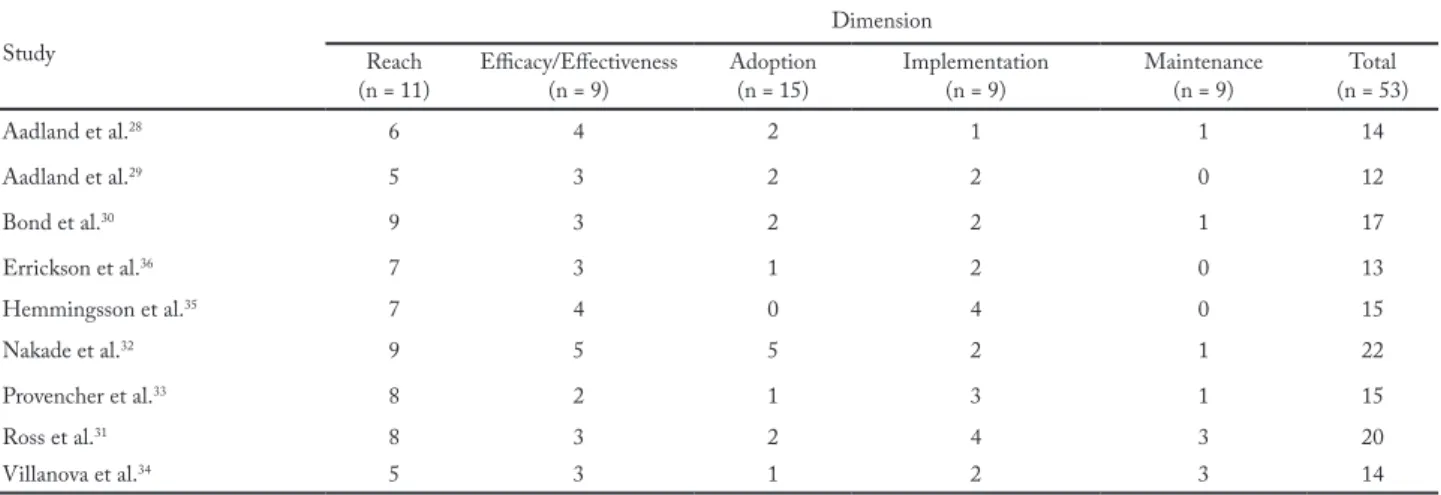
When studies were considered separately, Table 3 showed the number of indicators met in each of the five dimensions of the RE-AIM instrument. The majority of studies had a low performance in terms of RE-AIM dimensions, with four dimensions showing an overall mean lower than half of reports. “Reach” was the only dimension with a frequency of categories higher than 50%, a characteristic that can be attributed to studies dealing with the results of interventions for a special group, in this case, adults with obesity.
Discussion
This systematic review aimed to systematically assess
the methodological quality of interventions and phy-sical activity during leisure time among obese adults. “Reach” was the most frequently analyzed dimension in the selected studies (65%), whereas “maintenance” was the least mentioned one (12%), including three studies that did not report such information in this di-mension. Among the 53 categories found in the five dimensions, only five were described in all studies, whi-le 24 were not reported. Other studies performed the assessment of the methodological quality of physical activity programs for health improvement23, physical
activity programs in public health24 and physical
acti-vity promotion programs in Latin America25 and
revea-led that “adoption” indicators were the most frequently reported ones. Such difference can be primarily attri-buted to the characteristics of the population, usually showing significant numbers of dropouts26, which ends
up being omitted due to other more interesting results. Another possible reason is the use of strategies to select individuals with obesity for studies, a population that is highly exposed to other health problems.
Health promotion programs using physical activity are seen as relevant strategies to improve biopsycho-social indicators on the population level, thus justi-fying their implementation as a public health meas-ure24. Aiming to implement these measures, the results
obtained from successful strategies, which managed to lead to effective behavioral changes, must first be shown and discussed. In this sense, the use of the RE-AIM model enables a detailed and careful description of program findings, such as the “reach” dimension, with information about the proportion of the target population that was covered and their representative-ness, and the “efficacy/effectiveness” dimension, the second most frequently reported one in this study, which shows program results with their positive and negative effects, apart from economic and quality of life results being verified21,22.
The behavioral variable selected for this review was physical activity practice during leisure time, i.e. activ-ities performed during free time, which enable greater flexibility and diversity and may also be followed by sedentary behavior throughout this domain18. Due to
the characteristic of operational variability, some of the studies of this review aimed to assess the effective-ness/efficacy of programs, with information directed towards the “effectiveness” dimension. In this sense, authors strived to meet the goals by identifying the variables used for prescription, such as the assessment
of the intensity level28–31 and durations of the proposed
activities28–36, which led to behavioral changes or not.
The lack of further information about adoption, im-plementation and maintenance reveals the gaps of
exist-ing data on intervention programs durexist-ing leisure time for adults with obesity. The dimensions previously men-tioned could provide greater reproducibility, based on the descriptions of procedures and the adequate number
Table 1 – Methodological characteristics of intervention studies with physical activities during leisure time in adults with obesity (n = 9), 2017.
Author Year Country Sample size intervention Objective of the intervention Duration of Characteristics of the intervention
Aadland et al28 2013 Norway 21 12 months
To determine the relationship between the change in PA level and the change in maximal aerobic fitness in individuals with severe obesity who participated in an intervention of lifestyle for one year.
Diet, physical activity and behavioral cognitive therapy. Walks performed five days/week, with a duration of 20-30 minutes and two sessions of varied exercises with a duration of 45-60 minutes.
Aadland et al.29 2014 Norway 86 12 months
To determine the relationship between the change in PA determined by an accelerometer and the change in body fat in severely obese women and men.
Diet, physical activity and cognitive therapy. 20-30 minutes of walking and two sessions of other exercises with a duration of 45-60 minutes, individually or in a group. Physical exercises were performed five days/week. Once a week participants performed between one and two hours of walking.
Bond et al.30 2015 USA 75 6 weeks
To test the efficacy of a pre-operative PA intervention (PAI) versus standard pre-surgical care to increase daily moderate-to-vigorous PA (MVPA) in bariatric surgery patients.
One weekly session (30-45 minutes) of PA orientation (walks with a duration ≥ 10 minutes, with a moderate intensity, totaling 30 daily minutes).
Errickson et al.36 2015 USA 72 4 weeks
To assess the effects of intensive behavioral therapy for a month, diet and PA on functional exercise in adults with overweight and obesity.
Physical activity five days/week, ≥ one hour/ week, with recommended exercises according to participants’ individuality, in addition to encouragement of PA practice with aerobic, resisted and/or water exercises.
Hemmingsson
et al.35 2008 Sweden 42 18 weeks
To provide proof of concept that social support intensity influences PA adoption in a population of severely obese outpatients.
Use of pedometers and distribution of folders of behavioral change in PA. Group 1 had five sessions (one per month) of two hours each, including strategies for weight loss, and group 2 had ten additional sessions of two hours each, every two weeks, aimed at the promotion of walking.
Nakade et al.32 2012 Japan 265 12 months
To assess the effects of a behavioral approach with an emphasis on
personalized behavior, diet, weight loss and maintenance.
Intervention with individual counseling for 30 minutes, when one’s diet, eating habits and PA are discussed, and group meetings lasting 20 minutes each, totaling four meetings every three months.
Provencher et al.33 2009 Canada (only 144
women) 4 months
To assess the effects of Health-At-Every-Size (HAES) intervention on eating behavior, appetite sensations, metabolic and anthropometric variables and physical activity levels in women at six-month to one-year intervention.
Four months of intervention with weekly sessions. Group 1 had structured sessions lasting three hours each, guided by a nutritionist and psychologist, including structured discussions about nutritional, PA and body awareness aspects, among others. Group 2 had sessions lasting two hours each with a nutritionist and psychologist, including the same themes of Group 1, although without the structural aspect. Group 3 was the control group.
Ross et al.31 2009 Canada 491 24 months
To assess the efficacy of 24 months of PA based on behavior and a diet program to prevent and reduce obesity and associated diagnoses in men and women with abdominal obesity.
Intervention based on behavioral theory for the development of self-regulatory abilities for PA and diet, performed full-time by health professionals in each family practice clinic. Villanova et al.34 2006 Italy 36 (only
men) 24 months
To investigate the effects of a specific program to implement PA in weight loss and maintenance, level of activity and energy expenditure during rest.
Intervention with 12 cognitive sessions, once a week, guided by physicians and nutritionists.
Table 3 – Number of indicators cared for per dimension of the model. RE-AIM, 2017 (n = 9).
Study Reach Dimension
(n = 11) Efficacy/Effectiveness(n = 9) Adoption (n = 15) Implementation(n = 9) Maintenance(n = 9) (n = 53)Total
Aadland et al.28 6 4 2 1 1 14 Aadland et al.29 5 3 2 2 0 12 Bond et al.30 9 3 2 2 1 17 Errickson et al.36 7 3 1 2 0 13 Hemmingsson et al.35 7 4 0 4 0 15 Nakade et al.32 9 5 5 2 1 22 Provencher et al.33 8 2 1 3 1 15 Ross et al.31 8 3 2 4 3 20 Villanova et al.34 5 3 1 2 3 14
Table 2 – Indicators of the RE-AIM model dimensions (n = 9), 2017. Dimension Studies with the criterion used by
the publication (%) Dimension
Studies with the criterion used by the publication (%)
Reach 65 Staff level 14
Description of the target population 100 Eligible and invited (exposed) individuals 0 Demographic and behavioral data 100 Member of the group of participants who accepted to
participate 11
Method of identification of the target population 89
Strategies for sample recruitment 67 Participation rate 0
Inclusion criteria 89 Method to identify target delivery agent 11 Exclusion criteria 78 Level of expertise of target delivery agent 78 Number of eligible and invited (exposed) individuals
for sample recruitment 67 Inclusion/exclusion criteria of target delivery agent 0
Sample size 100 Measures of cost for adoption 0
Participation rate 11 Implementation 27
Cost of recruitment 11 Theories 33
Use of qualitative methods to assess reach 0 Number of intervention contacts 56
Efficacy/Effectiveness 37 Period of contacts 100
Results of primary outcomes 100 Duration of contacts 56
Reports from mediators 89 Extent to which the protocol was performed according to what was expected 0 Reports from moderators 78 Consistency in the implementation between studies and agents of execution 0 Intention of treatment or present in the follow-up 56 Participant attendance/conclusion rates 0
Quality of life measures 0 Measures of cost 0
Assessed non-intentional consequences (negative)
and the results 0 Use of qualitative methods to measure implementation 0 Percentage of dropouts (upon program conclusion) 11 Maintenance 12
Cost effectiveness 0 Individual level 30
Use of qualitative methods to assess the efficacy/
effectiveness 0 Was the individual behavior assessed at some point after the conclusion of the intervention? 56
Adoption 12 Dropouts 22
Organizational level 30 Use of qualitative methods to assess individual maintenance 11 Number of eligible and invited (exposed) individuals 22 Organizational level 4 Number of participants 44 Reported the alignment with the organization’s mission 0
Participation rate 11 Is the program still functioning? 22
Description of target location 0 If not: reasons for discontinuity 0 Inclusion/exclusion criteria of studies 0 If yes: has the program been changed? Give details. 0 Description of the intervention location 0 Has the program been institutionalized? 0 Method of identification of studies 0
Program’s structural wear 0
and profile of program team members. Thus, it would be possible to identify the reliability of the intervention on individual and organizational levels throughout the pro-cess, which would enable the maintenance of the strate-gy or its readjustment to be taken into consideration for the respective programs to continue20,23.
The relevance of the present study should be em-phasized. Its purpose was to approach important as-pects that must be considered in intervention programs to direct concrete information towards the creation of physical activity programs during leisure time aimed at adults with obesity, a non-communicable chronic dis-ease with an increasing prevalence in the world current-ly3. However, some study limitations should be pointed
out: a) the systematic search probably did not include all articles that would be adequate for the analysis, due to the restriction of selected descriptors and databas-es and; b) the analysis using the RE-AIM model was based on scientific articles, whereas further information could be gathered through direct contact with digital platforms or technical reports from the programs.
In conclusion, the program interventions aimed at leisure-time physical activity practice in adults with obesity have their methods described in the presenta-tion of their own respective intervenpresenta-tion effects, while the details in the methodological description of the de-scription, implementation and maintenance were miss-ing. In this sense, researchers developing programs for this population during leisure time should seek to detail the operational and financial aspects in their studies or publish a technical article that includes from the pro-cedures for its creation to its follow-up. This is relevant for both the scientific community and health profes-sionals, as it expresses its external validity and reveals a possible methodological reproducibility. Future inter-ventions can be based on previous studies which have been successful and include a detailed methodology, described in a way that enables the understanding of all possible factors for success. Thus, the use of a checklist of the steps indicated by the RTE-AIM instrument is recommended, where there is valid information for the structuring of articles and documents suitable for the foundation and direction of public measures.
Conflicts of interest
The authors declared no conflicts of interest.
Author contributions
Christofoletti M, participated in the initial study conception,
double-blind assessment of the systematic review, writing and critical review of the text; Streb AR, participated in the doub-le-blind assessment of the systematic review, writing and critical review of the text; Silva RP, was the third consultant of the sys-tematic review and participated in the writing and critical review of the text; Benedetti TRB, participated in the initial study con-ception and critical review of the text; Almeida FA, participated in the initial study conception and critical review of the text; Del Del Duca GF, participated in the initial study conception, wri-ting and critical review of the text.
References
1. Francisqueti FV, Nascimento AF, Corrêa CR. Obesidade, inflamação e complicações metabólicas. Nutrire. 2015;40(1):81–9.
2. Goossens GH. The role of adipose tissue dysfunction in the pathogenesis of obesity-related insulin resistance. Physiol Behav. 2008;94(2):206-18.
3. GBD Global Burden of Disease Study 2015. Obesity and Overweight Prevalence 1980-2015 [online]. Institute for Health Metrics and Evaluation; 2017. [citado 2018 jan 17]. Disponível em: http://ghdx.healthdata.org/record/ global-burden-disease-study-2015-gbd-2015-obesity-and-overweight-prevalence-1980-2015.
4. ABESO. Associação Brasileira para o Estudo da Obesidade e da Síndrome Metabólica. Mapa da Obesidade [Online]. 2009 [citado 2017 out 24]. Disponível em: http://www.abeso. org.br/atitude- saudavel/mapa-obesidade.
5. Goyal A, Nimmakayala KR, Zonszein J. Is there a paradox in obesity? Cardiol Rev. 2014;22(4):163-70.
6. WHO. World Health Organization. Obesity [Online]. WHO. [citado 2018 fev 1]. Disponível em: http://www.who. int/topics/obesity/en/.
7. Webb VL, Wadden TA. Intensive lifestyle intervention for obesity: principles, practices, and results. Gastroenterology. 2017;152(7):1752-64.
8. Del Duca GF, Rombaldi AJ, Knuth AG, Azavedo MR, Nahas MV, Hallal PC. Associação entre nível econômico e inatividade física em diferentes domínios. Rev Bras Ati Fis Saúde. 2009;14(2):123-31.
9. Pucci GCMF, Rech CR, Fermino RC, Reis RS. Associação entre atividade física e qualidade de vida em adultos. Rev Saúde Pública. 2012;46(1):166-79.
10. Balboa-Castillo T, León-Muñoz LM, Graciani A, Rodríguez-Artalejo F, Guallar-Castillón P. Longitudinal association of physical activity and sedentary behavior during leisure time with health-related quality of life in community-dwelling older adults. Health Qual Life Outcomes. 2011;9:47. 11. Sarma S, Devlin RA, Gilliland J, Campbell MK, Zaric GS.
The Effect of Leisure‐Time Physical Activity on Obesity, Diabetes, High BP and Heart Disease Among Canadians: Evidence from 2000/2001 to 2005/2006. Health Econ. 2015;24(12):1531–47.
12. Nahas MV. Atividade física, saúde e qualidade de vida: conceitos e sugestões para um estilo de vida ativo. Londrina: Midiograf, 2010.
13. Edmunds J, Ntoumanis N, Duda JL. Adherence and well-being in overweight and obese patients referred to an exercise on prescription scheme: A self-determination theory perspective. Psychol Sport Exerc. 2007;8(5):722–40.
Quote this article as:
Christofoletti M, Streb AR, Silva RP, Benedetti TRB, Almeida FA, Del Duca GF. Methodological evaluation of leisure-time physical activity interventions in adults with obesity: a systematic review. Rev Bras Ati Fis Saúde. 2018;23:e0029. DOI:
10.12820/rba-fs.23e0029 14. WHO. World Health Organizatiom. Overweight and
obesity 2015 [Online]. [citado 2017 ago 26]. Disponível em: http://www.who.int/gho/ncd/risk_factors/overweight/en/#,. 15. Gram AS, Bladbjerg EM, Quist JS, Petersen MB, Rosenkilde
M, Stallknecht B. Anti-inflammatory effects of active commuting and leisure time exercise in overweight and obese women and men: A randomized controlled trial. Atherosclerosis. 2017;265:318–24.
16. Quist JS, Rosenkilde M, Petersen MB, Gram AS, Sjödin A, Stallknecht B. Effects of active commuting and leisure-time exercise on fat loss in women and men with overweight and obesity: a randomized controlled trial. Int J Obes (Lond). 2018;42(3):469-78.
17. Moher D, Liberati A, Tetzlaff J, Altman DG, PRISMA Group. Preferred reporting items for systematic reviews and meta-analyses: the PRISMA statement. Int J Surg. 2010;8(5):336-41.
18. WLRA. World Leisure and Recreation Association. Carta internacional de educação para o lazer, 1993. [online]. [citado 2018 jan 13]. Disponível em: http://www.cev.org/biblioteca/ carta-internacional-educaca-para-o-lazer.
19. Portal periódicos CAPES [Internet]. [citado 1o de junho de 2018]. Disponível em: http://www.periodicos.capes.gov.br/ 20. Almeida FA, Brito FA, Estabrooks PA. Modelo RE-AIM:
tradução e adaptação cultural para o Brasil. Rev Fam Ciclos Vida Saúde Contexto Soc. 2013;1(1):6-16.
21. Belza B, Toobert DJ, Glasgow RE. RE-AIM for program planning: overview and applications. Natl Counc Aging. [online]2007. [citado 2017 nov 15]. Disponível em: https:// fromhungertohealth.files.wordpress.com/2013/02/re-aim_ issue_brief.pdf.
22. Glasgow RE, Vogt TM, Boles SM. Evaluating the public health impact of health promotion interventions: the RE-AIM framework. Am J Public Health. 1999;89(9):1322–7. 23. Antikainen I, Ellis R. A RE-AIM evaluation of
theory-based physical activity interventions. J Sport Exerc Psychol. 2011;33(2):198–214.
24. Jauregui E, Pacheco AM, Soltero EG, O’Connor TM, Castro CM, Estabrooks PA, et al. Using the RE-AIM framework to evaluate physical activity public health programs in México. BMC Public Health. 2015;15:162.
25. Lee RE, Galavíz KI, Soltero EG, Chavez JR, Jauregui E, Lévesque L, et al. Aplicando o modelo RE-AIM para a promoção da atividade física em países de baixa e média renda. Rev Latino-Am Enfermagem. 2017;25:e2923. 26. Moroshko I, Brennan L, O’Brien P. Predictors of dropout in
weight loss interventions: a systematic review of the literature. Obes Rev. 2011;12 (11):912–34.
27. Hadgraft NT, Lynch BM, Clark BK, Healy GN, Owen N, Dunstan DW. Excessive sitting at work and at home: correlates of occupational sitting and TV viewing time in working adults. BMC Public Health. 2015;15:899.
28. Aadland E, Jepsen R, Andersen JR, Anderssen SA. Increased physical activity improves aerobic fitness, but not functional walking capacity, in severely obese subjects participating in a lifestyle intervention. J Rehabil Med. 2013;45(10):1071–7.
29. Aadland E, Jepsen R, Andersen JR, Anderssen SA. Differences in fat loss in response to physical activity among severely obese men and women. J Rehabil Med. 2014;46(4):363–9.
30. Bond DS, Vithiananthan S, Thomas JG, Trautvetter J, Unick JL, Jakicic JM, et al. Bari-Active: a randomized controlled trial of a preoperative intervention to increase physical activity in bariatric surgery patients. Surg Obes Relat Dis. 2015;11(1):169–77.
31. Ross R, Blair SN, Godwin M, Hotz S, Katzmarzyk PT, Lam M, et al. Prevention and Reduction of Obesity through Active Living (PROACTIVE): rationale, design and methods. Br J Sports Med. 2009;43(1):57–63.
32. Nakade M, Aiba N, Suda N, Morita A, Miyachi M, Sasaki S, et al. Behavioral change during weight loss program and one year follow-up: Saku Control Obesity Program (SCOP) in Japan. Asia Pac J Clin Nutr. 2012;21(1):22–34.
33. Provencher V, Bégin C, Tremblay A, Mongeau L, Corneau L, Dodin S, et al. Health-at-every-size and eating behaviors: 1-year follow-up results of a size acceptance intervention. J Am Diet Assoc. 2009;109(1):1854–61.
34. Villanova N, Pasqui F, Burzacchini S, Forlani G, Manini R, Suppini A, et al. A physical activity program to reinforce weight maintenance following a behavior program in overweight/obese subjects. Int J Obes. 2006;30(4):697-703. 35. Hemmingsson E, Hellénius ML, Ekelund U, Bergström J,
Rössner S. Impact of social support intensity on walking in the severely obese: a randomized clinical trial. Obesity (Silver Spring). 2008;16(6):1308–13.
36. Errickson SP, Kolotkin RL, Skidmore MS, Endress G, Ostbye T, Crosby R, et al. Improvements in Functional Exercise Capacity after a Residential Behavioural Change, Diet and Fitness Program for Obese Adults. Physiother Res Int. 2016;21(2):84–90.
Received: 09/03/2018 Approved: 06/09/2018