THE EFFECT OF LMX AND AGE DYADIC DIFFERENCES ON THE SATISFACTION WITH THE FEEDBACK AND THE LEADER
Joana Isabel Duarte Cardoso Matança da Costa
Dissertation submitted as partial requirement for the conferral of
Master in Human Resources Management & Organizational Consultancy
Supervisor:
Prof. Silvia Dello Russo, ISCTE Business School, Department of Human Resources and Organizational Behavior
Abstract
There are a lot of companies and employees dissatisfied with the existing performance appraisal systems. It is well known and studied in the literature that performance feedback has a huge impact on learning and achievement of the employees, so it turns out to be very important to understand this process and all the variables that may influence it. It is studied that the social context in which the feedback process is embedded may influence employees’ reactions to the feedback. Leader-Member Exchange and age dyadic differences are some of the variables that have been studied in the leadership literature. This study now addresses how the connection between Leader-Member Exchange and age dyadic differences is related with the satisfaction with the feedback and the leader, especially in a poor feedback scenario. To understand this connection, we studied the role of attributions as a mediator of this process. The data collected for this study was obtained from a sample of 103 employees from Portuguese companies with performance appraisal systems. In general, results revealed that Leader-Member Exchange has an impact in the satisfaction with the feedback and with the leader, External and Unstable Attributions mediate the relationship between Leader-Member Exchange and the satisfaction with the leader only when the employee is older than the leader and age differences moderate the mediation of the relationship between Leader-Member Exchange and external and unstable attributions. The implications of these findings for both theory and practice are discussed in this study.
Keywords: LMX, performance appraisal, attributions, age differences
Classifications according to the JEL Classification System:
M540: Personnel Economics: Labor Management
0150 Economic Development: Human Resources; Human Development; Income Distribution; Migration
Resumo
Existem, nos dias de hoje, muitas empresas e colaboradores insatisfeitos com os sistemas de avaliação de desempenho em prática. É bem conhecido e estudado na literatura que os sistemas de avaliação de desempenho e feedback têm um enorme impacto nos processo de aprendizagem e no desempenho dos colaboradores, pelo que se torna fundamental perceber estes processos e todas as variáveis que os podem influenciar. Estudos anteriores mencionaram que o contexto social em que o feedback é fornecido pode influenciar as reações ao feedback. As diferenças de idade entre líderes e colaboradores e a teoria Leader-Member Exchange também têm vindo a ser exploradas em estudos anteriores de forma a explicar as reações dos colaboradores ao
feedback recebido. Este estudo aborda a relação entre LMX e a diferença de idades com a
satisfação com o feedback e com os líderes, especialmente num cenário de feedback negativo. Para percebermos esta conexão, estudámos a Teoria da Atribuição e tentámos perceber o papel das atribuições como mediador desta relação. Os dados recolhidos para este estudo foram obtidos a partir de uma amostra de 103 colaboradores pertencentes a empresas portuguesas com sistemas de avaliação de desempenho. Em geral, os resultados revelaram que Leader-Member Exchange tem impacto na satisfação com o feedback e com os líderes, as atribuições com locus de controle externo e instáveis funcionam como mediador da relação entre Leader-Member Exchange e a satisfação com o líder (apenas quando o colaborador é mais velho que o líder) e as diferenças de idade funcionam com moderador da mediação entre Leader-Member Exchange e atribuições com locus de controle externo e instáveis. Neste estudo, são discutidas as implicações dos resultados na teoria e na prática.
Acknowledgments
First of all, I would like to thank my supervisor, Professor Silvia Dello Russo, for all the commitment, knowledge and support given during this time.
To my family, for the sacrifices you needed to do in order to make all my academic years possible.
To my sister and our beloved princess Leia for showing me, every single day, what love is about.
To professor Ricardo Silva, for being the person who challenged me the most during these last 5 years, for always believe and for making me believe that I always have something better and different to do.
To CORO ISCTE-IUL, for showing me what music is truly about: a connection between people capable of breaking all the barriers that may exist. Thank you for all the music and beautiful moments we have shared. You were one of the best parts of my academic life.
To my friends: Frederico Carvalho, Stefano Loi, Filipa Miguéis, Leonor Andrade, João Pedro Henriques, Rita Tamagnini, and to my MARKETING EPIC COMBO. No words can’t explain how grateful I am for having you in my life.
To my grandparents, “when I need to get home you’re my guiding light”.
I Index Introduction………... 2 I) Literature Review……….. 4 1. Performance Appraisal………. 4 2. Leader-Member Exchange (LMX)………. 5 2.1 The concept………..……….. 5 2.2 High vs Low LMX………... 6
2.3 The organization of the dyad………... 6
2.4 LMX and Performance Appraisal………... 7
3. Attributions………. 8
3.1 Dimensions of causality………. 8
3.2 Cognitive Dissonance Theory………... 9
3.3 Attributions and Performance Appraisal………... 10
4. Leadership’s age related stereotypes……….. 10
5. Reactions to Performance Appraisal……….. 12
5.1 Fairness………..………….. 12
5.2 Perceived Utility……… 12
5.3 Satisfaction……… 12
5.3.1 Satisfaction with the leader………. 13
5.3.2 Satisfaction with the feedback………. 13
6. Hypotheses & Theoretical Model……….. 14
II) Empirical Study………. 16
7. Methodology……….………. 16
7.1 Type of study………... 16
7.2 The vignettes………... 16
7.3 Sample and Procedure………... 17
7.4 Measures………... 18
8. Results……….. 20
8.1 Manipulation Check………... 20
8.2 Bivariate Correlations……….. 21
8.3 Moderation-mediation model……….. 23
8.3.1. Satisfaction with the feedback………. 23
8.3.2. Satisfaction with the leader………... 24
9. Discussion……….. 26
10. Limitations and Future Directions………... 29
11. Practical Implications………... 30
12. Conclusion………... 32
1
Index of Figures
Figure 1. Theoretical Model ………..……… 15
Figure 2. LMX Manipulation check mean plots……… 21
Index of Tables
Table I. ONE WAY A-NOVA test ………... 20Table II. Scenario’s Descriptive Statistics………. 20
Table III. Means, Standards Deviations and Correlations ………22
Table IV. Direct Effects and 95% confidence intervals of LMX on attributions…... 23
Table V. Direct Effects and 95% confidence intervals of attributions on the satisfaction with the feedback ………...……….. 24
Table VI. Direct Effects and 95% confidence intervals of attributions on the satisfaction with the leader ……….………. 24
Table VII. Indirect Effect of LMX on satisfaction with the leader through External and Unstable Attributions……….... 25
Table VIII. Indirect Effects and 95% confidence intervals of Age Differences on the relationship LMX – External and Unstable Attributions………... 25
2
Introduction
According to the Corporate Leadership Council 2004 (as cited in Pulakos et. al., 2015), 95% of the managers are dissatisfied with their performance management systems, 59% of the employees feel performance management reviews are not worth the time invested and 56% say do not receive feedback on what to improve. But it seems this is not a recent problem. According to Meyer (1991), academic and practitioner accounts suggest that many employees are substantially dissatisfied with the Performance Appraisal processes and reject it the way it has been implemented in their own organizations.
Feedback is one of the most powerful influences on learning and achievement (Hattie and Timperley, 2007) and it is not only important to individuals but also to organizations because of its influence on employee performance, attitudes and behaviors of interest to organizations (Jawahar, 2006). Feedback can either be positive or negative and the importance of each one of them is undeniable. Negative feedback is assumed to create awareness and motivate individuals to change behaviors. It can help employees to understand which areas of work they need to address and correct and, thus, how to respond by performing more effectively (Chen, Zhong and Wing, 2007). Positive feedback is also essential to boost the good performance and to capitalize the company’s resources. The impacts of feedback can be also positive or negative (Hattie and Timperley, 2007) and this is influenced either by the content and the context of feedback.
Many studies have studied the importance of context in Performance Appraisal. One of the factors that have been studied is the relationship between the Leader and the employee who’s receiving the feedback. This relationship-building process is of very importance to the organizations, since it has impacts on the effort team members expend on the job, their job performance, and their job satisfaction (Miles and Mangold, 2002). Also, a couple of studies have been done in order to analyze the impact of demographic variables such as age differences in the way this relationship is built and in the Performance Appraisal process. The industrialized work-force is experiencing unprecedented demographic changes: the average worker is becoming older, older and younger individuals are working together side-by-side and there are increasing incidents
3 of extreme age differences between workers and their supervisors (Truxillo and Burlacu, 2015). This working context may influence the relationship between leaders and employees and also how people react to feedback.
The purpose of this study is to investigate in which way the relationship between a leader and an employee combined with age differences can influence the employees’ satisfaction with the received feedback and with the leader, especially in a poor feedback scenario. This kind of study is important for a better understanding of how employees perceive and react to feedback and to improve the effectiveness of performance appraisal processes.
This study is part of the project R.E.A.L. P.A.L., Ref.: PTDC/PSI-GER/29124/2017 coordinated by Prof. Silvia Dello Russo. The project aims to contribute to the ongoing debate on how to improve Performance Management practices and feedback in organizations, with specific focus on informal feedback and interpersonal relationships.
4
I) Literature Review
1. Performance Appraisal
Performance Appraisal (PA) is one of the most important human resources systems in organizations because its outcomes influence a variety of a subsequent human resources decisions (Judge and Ferris, 1993). Researchers believe the performance appraisal commonly serves two purposes: administrative and developmental purposes. Performance appraisal serves administrative purposes because it provides information and a basis for rewards policies, promotions, dismissals and other administrative decisions. It serves developmental purposes because employees are provided with specific job feedback to improve future job performance. The supervisors are expected to stimulate employees’ growth and development throughout this process (Dorfman, Stephan and Loveland, 1986).
PA refers to the whole procedure, including establishment of performance standards, appraisal related behaviors of raters within the performance appraisal period, determination of performance rating, and communication of the rating to the ratee (Erdogan, 2002).
A key component of PA is the formal communication of individual performance feedback to the employees that is often delivered in a face-to-face session involving the employee and his or her supervisor. This social context may influence employees’ reactions to the PA, including their work-related motivation and attitudes (Elicker, Levy and Hall, 2006).
Developmental feedback is defined as the extent to which organizational insiders provide employees with helpful and useful information that enables employees to learn, develop, and make improvements on the job (Zhou, 2003). It provides recipients with resources and information to help them in how to reach their goals (Zhou, 2003). It emphasizes improvement, signals support, and boosts recipients’ behavioral control even though it may contain both favorable and unfavorable information. The influence of developmental feedback is generally independent of valence because it may convey both positive and negative information. This type of feedback is expected to lower defensiveness because it directs the recipient’s attention toward learning and
5 improvement. Although developmental feedback may signal positive and negative information, it is expected to evoke more positive than negative reactions due to its informational and motivational tone. In contrast, if supervisors never give developmental feedback, there is an absence of informational practices that would boost intrinsic motivation. The employees would be less interested in learning and improving (Zhou, 2003).
Although the tone is of high importance, the sign of feedback is still critical because of its potential influence on how people respond to ratings (Kluger and DeNisi, 1996). These findings are entirely consistent with the self-enhancement theory which suggests that individuals will react more positively to higher ratings than to lower ratings.
The performance appraisal process involves interaction between the supervisor and subordinate in an ongoing organization and that is a focal point in the way performance appraisal is conducted (Duarte, Goodson and Klich, 1994). Supervisor-subordinate exchange relationships create a social context that substantially influences the PA discussion and feedback reactions (Elicker, Levy and Hall, 2006). The model developed by Erdogan (2002), for example, included social or relationship-oriented constructs, such as leader-member exchange, as a “contextual factor” in performance appraisal, and the model developed by Levy and Williams (2004) includes leader-member relationship quality, supervisor trust, and impression management as “proximal process variables.”
2. Leader-Member Exchange (LMX)
2.1 The concept
The Leader - Member exchange (LMX) theory of leadership describes the relationships that a leader develops with different employees (Duarte, Goodson and Klich, 1994). The conceptualization of LMX has undergone many refinements over the years (Graen and Uhl-Bien, 1995). This concept has evolved from the Vertical Dyad Linkage (VDL) concept which stated that leaders do not use an average leadership style, but rather develop differentiated relationships with their direct reports (dyads within units). LMX research then investigated the nature of these differentiated relationships and their implications on organizations and, later, Leadership Making model (Uhl-Bien
6 and Graen, 1992) described a process for accomplishing this relationship (dyad-level effect). The current research on LMX theory is focusing on the investigation of assembling dyads into larger collectives (Graen and Uhl-Bien, 1995).
2.2 High vs Low LMX
LMX theory suggests that leaders differentially interact, respond to, and treat subordinates depending upon their membership in the “in” or “out” groups (Levy and Williams, 2004). Dansereau and Graen (1975) distinguish “cadre” (in-group members) and the “hired hands” (out-group members). In their study, the “cadre” reported receiving higher amounts of information, influence, confidence, and concern from the superior. These employees also reported higher involvement in administering and communicating activities and the superiors reported giving higher support for their actions than for the actions of the “hired hands” (Dansereau and Graen, 1975). In-group members have better relationships with the leaders and receive more work-related benefits compared to out-group members. It is argued that nearly all leaders differentiate between subordinates in this way and these "group memberships" tend to develop quickly and remain stable after they have formed (Dienesch and Liden, 1986).
2.3 The organization of the dyad
According to Graen and Scandura (1987), there are different stages in the organization of the dyad between the leaders and the employees. In the initial phase, the leader “sends” role information to the employee and then uses the employee’s reaction to evaluate the employee’s performance and to assess the need for future role information. This initial phase may take anywhere from a few hours to a few months and, after this, role development behavior is initiated. During this next phase, the employee’s contribution to the work situation is established and it is determined the social acceptance by the leader. Finally, at some point, roles in the dyad become stabilized. Cognitive theories suggest that once a leader categorizes an employee, only high discrepant information will change the supervisor’s perception (Duarte, Goodson and Klich, 1994).
7
2.4 LMX and Performance Appraisal
This social context in which the feedback process is embedded may influence employees’ reactions to the PA, including their work-related motivation and attitudes. The events of the feedback session and the resulting psychological state depend on preexisting patterns of exchange between supervisors and subordinates (Elicker, Levy and Hall, 2006).
These authors stated that the employees who are in high-quality exchange relationships have a different experience and perceptions about the Performance Appraisal sessions than those who are not. High-quality relationship members are likely to enter a PA session with an initially higher level of trust in the supervisor, greater confidence in their ability to achieve positive outcomes. They may, in fact, elicit better treatment from the supervisor and will likely interpret the resulting interaction more positively. Research has consistently shown that higher-quality rater-ratee exchanges are related to more positive ratees’ reactions to the performance appraisal process. In high-quality exchanges, members expect higher ratings, and will be more dissatisfied with lower ratings. Most of the studies in this area have shown a consistent positive relationship between LMX quality and supervisory ratings of performance (Dienesch & Liden. 1986). This may be also explained because leaders can be reluctant to give low or moderate ratings to subordinates close to them (Erdogan, 2002).
Fairhurst (1993) found that subordinates in low-quality relationships experienced more confrontational and negative interactions; those in high-quality relationships tended to experience pleasant, positive interactions.
Elicker, Levy and Hall (2006), studied the employee voice in the feedback session and the resulting justice judgments. The results of their study provide strong empirical support to the idea that the quality of LMX sets a context for the extent to which the employee exercise voice in the performance appraisal session. Employees in a high LMX relationship experience greater opportunity to present their opinions and this point has a strong positive relationship with the employees post session Justice Judgments. Furthermore, these justice judgments have important implications on Performance Appraisal reactions and outcomes.
8 Other studies showed that in high-quality relationships, leaders behave in a less authoritarian way and use their formal authority less frequently. As a result, if overall exchange quality is high, ratees may feel that they are being treated fairly and respectfully during the PA (Erdogan, 2002).
There is some evidence that role expectations in early phases differ from those in later phases (Fisher, 1986). So, it is expected that differences in performance appraisal processes will occur across dyads that are in different stages of development (Cleveland & Murphy, 1992).
As mentioned before, at some point, roles in the dyad become stabilized (Duarte, Goodson and Klich, 1994) and each part start having expectations about how the other part is going to act. In this stage, for instance, a poor feedback might be seen as a dissonant event in a high-quality exchange relationship. In the next sections, it will be explained how people cope and react to these events.
3. Attributions
Attribution theory is centered on causes (Weiner, 2010). Causes are invoked to explain outcomes or end results, such as success and failure. According to Weiner (1986), causes are “constructions imposed by the perceiver (either an actor or an observer), are the answer to a “why” question regarding an outcome.
According to Kelley and Michela (1980), the general notion is that people scan and interpret a sequence of information until they attain an attribution from it and then disregard later information or assimilate it to their earlier impression. According to the authors, attributions are affected by beliefs. An observed effect is directly explained on the basis of existing suppositions about the causes for various effects. In other cases, the effect is explained indirectly by comparing it with expected effects. Given a certain effect, there are suppositions about its causes; given a certain cause, there are expectations about its effects.
3.1 Dimensions of causality
Heider (1958) made the most fundamental distinction between causes. According to the author, causes or attributions can be defined as internal or external,
9 which means that success or failure at a task can be conceived either as due to personal factors (e.g.: ability) or factors residing in the environment (e.g: an easy task, a good instruction). The second dimension of causality appeared because among the internal causes of behavior some fluctuate while others remain relatively constant. So, attributions can also be defined as stable or unstable.
Whether an action is attributed to the actor or to some aspect of the environment affects such things as liking for the actor, trust in him, and his persuasiveness (Kelley and Michela, 1980).
3.2 Cognitive Dissonance Theory
Cognitive dissonance was first investigated by Festinger (1957) and refers to a situation involving conflicting attitudes, beliefs or behaviors. This theory arose out of a participant observation study of a cult which believed that the earth was going to be destroyed by a flood, and what happened to its members when the flood did not happened. The fringe members were more inclined to recognize that they had made fool of themselves, while committed members were more likely to re-interpret the evidence to show that they were right (the earth was not destroyed because of the faithfulness of the cult members).
According to Festinger (1957), two elements are dissonant if they do not fit together. This dissonance may be caused because these two elements are inconsistent or contradictory, culture or group standards may dictate that they do not fit, and so on. In the previous example, the fact that the flood did not happen was contradictory to what committed members believed it would happen. Festinger (1957: 3) states that “the existence of dissonance, being psychologically uncomfortable, will motivate the person to try to reduce the dissonance and achieve consonance”. For this process of reducing dissonance, a person might be expected to seek new information and, at the same time, to avoid new information that might increase the existing dissonance.
This theory is also important to explain the idea we were exploring before. In the situation of poor feedback in a high-quality exchange relationship, employees will adjust themselves and will try to reduce the dissonance of this event, by making less dissonant attributions about the causes behind this behavior based on the high LMX relationship they already have with their leaders.
10
3.3 Attributions and Performance Appraisal
The role of attributions in the performance appraisal processes has attracted some research attention. In some studies investigators have examined how the attributions that raters make for ratees’ behaviors affect their motivation to rate or their actual rating (Levy and Williams, 2004). The authors stated that the process of making attributions is an important element of the rating process and these attributions, in part, determine raters’ reactions and ratings.
However, research on team members’ perceptions of their leaders’ behaviors has been unexplored (Miles and Mangold, 2002). Team member’s perception of their leaders is important to understand, since it is this perception that creates reality for subordinates and consequently feelings, attitudes and behaviors. If the team members view the relationship with leaders as not good enough, the team members are likely to experience internal tensions, with very few alternatives for solving the situation. Having this in mind, understanding the team members’ perceptions of the leaders and how it relates to team members’ satisfaction is critical (Miles and Mangold, 2002).
Based on this, the proposition of our study is that the process of making attributions also works on the other way around, attributions made by ratees about the raters will influence the ratees’ reactions to the feedback.
4. Leadership’s age related stereotypes
Empirical and theoretical work that has been done in this field suggests that age may be a key demographic factor in understanding the leader-follower relationship, both as a direct and moderating influence (Truxillo and Burlacu, 2015). Instead of being considered just a “control variable”, age is increasingly regarded a core factor in interactions between individuals in groups or teams (Gellert and Schalk, 2012). Age interacts with other variables (either characteristics of the leader or of the follower) and affects the dyadic relationships. The leader’s age may also interact with subordinate characteristics, namely, subordinate beliefs and stereotypes, and affect follower perceptions of the leader–follower relationship (Truxillo and Burlacu, 2015).
According to Tsui and O’Reilly (1989), it is harder for leaders and followers to interact smoothly if leaders and followers belong to different age categories.
Age-11 related self-categorization leads to similarity attraction effects (Gellert and Schalk, 2012). On the other hand, it also might happen social competition by age-related dissimilarity (Pelled and Xin, 2000).
In addition to interpersonal attraction, similarity has also been found to have a positive effect on communication and integration in social groups (Tsui and O’Reilly, 1989). The authors also reported that it is not just the age difference but high tenure difference in the manager–employee dyad that may be associated with lower levels of psychological attachment among work group members.
Differences in the attitudes, values, and beliefs of each generation affect how each generation view leadership. Generational differences can also contribute to how workers perceive the leadership of their supervisors (Arsenault, 2004). Research has also shown that jobs often have an “age norm” associated with them, which means that certain types of jobs and professions are associated with certain age groups (Perry, Kulik and Zhou, 1999). Lawrence (1984) suggested that people form implicit timetables of normal career progression and tend to judge careers as being on or off schedule according to these perceptions.
The leader age and/or tenure may serve as acceptable reasons for why one person among otherwise similarly qualified team members has been afforded a special position. Age is highly career related in that career achievements and the position that a person has attained in a company most of the times are evaluated in relation to a person’s age (Kearney, 2008).
If people use age as a marker for determining their place on their implicit career timetable, the particular situation of having a younger supervisor would represent a violation and thus would result in poorer employee outcomes. The relationship between younger managers and older subordinates may be problematic because of age-based beliefs and stereotypes (Gellert and Schalk, 2012).
According to Collins, Hair and Rocco (2009) older workers tend to have lower expectations of their younger supervisors. A supervisor who is younger than his or her subordinate may violate age and status stereotypes that suggest that older and more experienced supervisors should supervise younger and less experienced subordinates
12 (Perry, Kulik and Zhou, 1999). This scenario may be considered as a dissonant event. What we expect is that age differences would reduce the cognitive dissonance.
5. Reactions to Performance Appraisal
Employee reactions can be defined as individual-level attitudinal evaluations of and responses to the performance appraisal process (Pichler, 2012). The reactions measured in the literature include perceptions of appraisal fairness, utility, satisfaction with the appraisal and satisfaction with the leader.
5.1 Fairness
Fairness of performance appraisals has been identified as an important criterion in judging PA effectiveness and usefulness for organizations (Erdogan, 2002). Traditionally, appraisal fairness was conceptualized as either the perceived fairness of the performance rating or the perceived fairness of the appraisal in general (Keeping and Levy, 2000). Recently, researchers in performance appraisal have adopted the constructs of procedural and distributive justice and have used these measures to assess the issue of fairness. Thus, appraisal fairness has been conceptualized in four different ways: (a) fairness with performance ratings, (b) fairness with the appraisal system, (c) procedural justice, and (d) distributive justice. LMX quality can influence procedural justice perceptions (Erdogan, 2002).
5.2 Perceived Utility
Compared to fairness, the measurement of utility has been relatively consistent and unconfounded. The most typical conceptualizations of utility have focused on the usefulness of the appraisal session. Greller (1978) conceptualized utility in terms of the appraisal session and operationalized this with items such as "The appraisal helped me learn how I can do my job better" and "I learned a lot from the appraisal”.
5.3 Satisfaction
Satisfaction has been the most frequently measured appraisal reaction (Giles & Mossholder, 1990). Some studies support a positive relationship between Performance Appraisal satisfaction and work performance and also overall job satisfaction (Kuvaas, 2006). Thus, it is important to understand performance appraisal satisfaction in order to
13 understand the overall job satisfaction and how companies can improve it. Boswell and Boudreau (2000) studied how the perception of performance appraisal use is related to employee satisfaction with the appraisal and the leader.
For this study, these are our variables of interest: satisfaction with the feedback and satisfaction with the leader.
5.3.1 Satisfaction with the leader
There are some factors studied in the literature that influence satisfaction with the leader. According to Jawahar (2006), satisfaction with the leader can be shaped by rater’s knowledge of subordinate’s job and the supportive manner in which feedback is provided. The author found that these factors explained almost three times the variance in satisfaction with appraisal feedback as did performance ratings. Bartram and Casimir (2007), stated that followers need to trust the leader in order to feel positively about the leader and to exert extra effort to perform effectively.
The appraisal process may create negative feelings toward the leader and can arguably be detrimental to the relationship between the team member and the leader. This may be particularly true if the employee receives a low PA rating or perceives it as injustice (Boswell and Boudreau, 2000).
What we propose in this study is that in High LMX dyads it is expected to exist higher levels of trust, so, in this sense, it is expected that high LMX will influence the satisfaction with the leader and the performance, even when the feedback is poor itself.
5.3.2 Satisfaction with the feedback
Satisfaction with feedback signifies recognition, status, and future prospects within the organization (Jawahar,2006). According to this author, there are some Predictors of Satisfaction with Performance Appraisal Feedback such as “level” of performance ratings, ratees’ participation in the feedback session, the appraisal system and satisfaction with the rater. Ilgen et al. (1979) proposed that employee's perceptions of and responses to feedback depend not only on characteristics of the message and the ratee but also on the rater.
These various implications of satisfaction with feedback make it a significant determinant of future behavior and job and organizational attitude. According to
14 Jawahar (2006), satisfaction with the feedback is positively related to job satisfaction and organizational commitment and negatively related to turnover intentions.
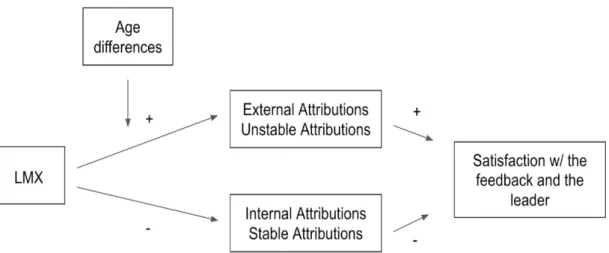
6. Hypotheses & Theoretical Model
When leaders and employees are in a high-quality exchange relationship, a poor feedback might be seen as a dissonant event. It is expected that employees make attributions to understand the causes of this event. To reduce the dissonance and, since they are embedded in this high-quality relationship, it is expected that they “ignore” or “minimize” contrasting information and create more external and unstable attributions, for example “the leader did not have time to do it better” or “the leader was under a lot of pressure”. Employees do not believe it will be like this all the time, it was exceptional, so it does not change their previous judgment of the leader. For this reason, employees will be more satisfied with the feedback and the leader itself.
When leaders and employees are in a low-quality exchange relationship, a poor feedback might be seen as something more expected. Since they are embed in this low-quality relationship, it is expected that the attributions made to understand the cause of this behavior will be more internal and stable, for example “the leader does not know how to do it”. It is expected that these attributions will lead to less satisfaction with the feedback and with the leader.
The relationship between the leader and the employee is also influenced by the age differences, and therefore this will also influence the way employees will make attributions about the leader’s behaviors. In High LMX relationships where the leader is younger, the cognitive dissonance is lower. According to the age norms and stereotypes, employees do not expect much from younger leaders, as mentioned before (Truxillo and Burlacu, 2015).Young leaders are perhaps seen as less good and not fitting with the age timeline in organizations. In these cases, when the age difference is anti-stereotypical, the relationship between LMX and external/unstable is weaker (which means, still positive, but less strong).
15
Hypothesis 1: In a situation of poor feedback, High LMX is positively related with
External and Unstable Attributions.
Hypothesis 2:
2a. External and Unstable attributions are positively related with satisfaction
with the feedback.
2b. External and Unstable attributions are positively related with satisfaction
with the leader.
Hypothesis 3:
3a. Attributions mediate the relationship between LMX and the satisfaction with
the feedback.
3b. Attributions mediate the relationship between LMX and the satisfaction with
the leader
Hypothesis 4: Age differences moderate the relationship between LMX and attributions
such as when the employee is older than the leader the relationship between LMX and external and unstable attributions is weaker.
16
II) Empirical Study
7. Methodology
7.1 Type of study
This was a quantitative study and it was applied the Experimental Vignette Methodology Studies (EVM). According to Aguinis and Bradley (2014), experimental vignette methodology studies consist in presenting participants with constructed scenarios to assess dependent variables, allowing researchers to manipulate and control independent variables. These types of studies are a good choice when the main goal is to study sensitive topics in an experimentally controlled way. Since Performance Appraisal is a sensitive topic and people probably would be afraid to talk about the relationship with their direct managers, this kind of study was thought as the most appropriate choice.
7.2 The vignettes
The current vignette study consisted of a 2 (LMX: high vs low) x 2 (Age of the leader: high vs low) design. This means that two variables were manipulated in the study, each one with two levels, ending in 4 different vignettes. Participants were asked to read a vignette, which consisted in a description of the interaction between a superior and a subordinate, and to respond to a set of questions following the description.
The vignettes started asking the participants to imagine themselves as employees of the Marketing and Sales department at synbus, an international company that sells HR software that allows companies to manage employee time and attendance, payroll and benefits administration.
The first variable manipulated was LMX. A brief description of the interaction between a leader and an employee was presented based on previous scenarios already studied in the literature (Radulovic, Thomas, Epitropaki and Legood, 2019). An example of the High LMX description: “You and your manager J.P. have a very good working relationship. J.P. sees that you are willing to put extra effort in and do things that are over and beyond your job description.”
A constant poor feedback was given across all the 4 vignettes. The feedback was poor in the content (negative feedback) but also in the way it was given. The poor
17 feedback was described with the following sentence: “Last week, the performance appraisal moment came and JP didn't sit long with you to talk, and actually stopped you in the corridor and told you that your work has not been up to standard lately and you have been making a lot of mistakes. J.P didn’t bring you precise examples but told you that you are now one of the worst performers in the department. J.P also tells you that he/she is disappointed about your performance.”
The second variable manipulated was Age of the leader. The negative feedback was delivered by a 30 years old leader or a 60 years old leader.
The effects of gender similarity on LMX have revealed contradictory results. While some researchers, such as Green, Anderson and Shivers (1996), found that gender differences have a significance effect on LMX (LMX was of lower quality when the leader and the employee were of different genders), other researchers found no significant effect of gender similarity on LMX. Thus, in this study, the leader’s gender was omitted; the initials J.P were used every time the name of the leader was mentioned.
7.3 Sample and Procedure
This study was conducted via Qualtrics and distributed using personal contacts and also connections on LinkedIn platform. The only requirements to participate in the study were that participants should speak in Portuguese and work in a company with a performance appraisal system. Snowball sampling was applied and each participant was asked to share the questionnaire with 3 colleagues in the same conditions.
This study was made with a between-person design, which means that each participant read only one vignette and comparisons were made across participants (Atzmüller and Steiner, 2010). Participants were randomly assigned to one of the four scenarios. The questionnaire took about 10 minutes to complete.
The final study sample size used for analysis was 103 of which 58% were male and 42% female. Participants had an average age of 30.48 (SD = 9.48) and an average of 5.78 working years (SD = 7.58).
18
7.4 Measures
Translated to Portuguese from its original English version, the questionnaire included a short introduction to explain the aim of the study and the different sections of the questionnaire. It had some initial questions to check demographic variables such as gender, age, tenure, tenure with the leader and questions to check some personality traits. After these initial questions, the vignette was presented to the participants followed by a set of questions about the scenario.
Leader Member Exchange (LMX)
The participants were asked to assess the quality of their LMX with the leader (from the scenario) for manipulation check purposes by using Graen and Uhl-Bien’s (1995) LMX-7 scale. The LMX-7 consists of seven items that characterize the overall effectiveness of the relationship between supervisor and subordinate. Sample item is “How would you characterize your working relationship with J.P?”
Attributions
To measure attributions, we developed a scale based on the literature about attributions. As mentioned in Heider (1958), attributions can be internal, external, stable and unstable. Having this is in mind, a scale that mixes these 4 types of attributions was developed. The participants were asked to rate the reasons behind the leader’s behavior in a scale from 1 to 5. Sample items are “Lack of ability. J.P did not know how to do it better” (1- Strongly Disagree; 5- Strongly Agree)
Satisfaction with the feedback and the leader
Satisfaction with the feedback and the leader were measured by using the items
used by Dorfman, Stephan and Loveland (1986). The participants were asked to indicate how satisfied they were with the received feedback and with their leaders. The response format used a 5-point scale (1- Extremely dissatisfied; 5- Extremely satisfied).
Age differences
The variable “age differences” was created by subtracting employee age from that of the scenario supervisor. The supervisor age was given in the vignette (30 or 60) and the employees’ age was asked in the questionnaire.
19
Age differences = Employees’ age - Leader’s Age
This variable can have either negative or positive values. When the “Age differences” is negative, it means that the leader is older than the employee. If “Age differences” is positive, it means that the leader is younger than the employee (anti-stereotypical relationship).
The questionnaire also had additional questions which are not going to be detailed for not being relevant for this analysis.
20
8. Results
8.1 Manipulation Check
For manipulation check purposes, the ONE-WAY ANOVA test was applied through IBM SPSS Statistics. Analyzing the F value (Table I), we can see that this is a high value. This means that the data is not sampled from populations with the same mean and, when random sampling process occurred, it happened to have large values in some groups and small values in others. We can see the statistics regarding each scenario on Table II, the scenario with more responses was “High LMX, High Age of the leader” (32 responses) comparing with 16 responses from the scenario “Low LMX, High Age of the leader”.
Table I. ONE WAY A-NOVA test
Table II. Scenarios’ descriptive statistics
Analyzing the means from each scenario, we can see that scenario 1 and 2 do not differ from oneanother (a) but they are clearly different from scenario 3 and 4 (b). The models’ p value < 0.01 and we can see through the mean plots (Figure 2) that people reported High LMX in High LMX Scenarios, which means that the manipulation worked and LMX can be used as the independent variable.
Sum of
Squares df Square Mean F Sig
Between Groups 103.973 3 34.658 25.806 0.000 Within Groups 132.959 99 1.343 Total 236.92 102 Scenario N M SD
1. High LMX, Low Age 28 3.75a 1.430
2. High LMX, High Age 32 3.47a 1.191
3. Low LMX, High Age 16 1.75b 1.065
4. Low LMX, Low Age 27 1.48b 0.802
21
Figure 2. LMX Manipulation check mean plots
8.2 Bivariate Correlations
Bivariate correlations for the studied variables are reported in Table III. Regarding the relationship between LMX and attributions, we cannot find a significant correlation (r = - .70, r = .159, r = .082, r = .157). However, we can look at some interesting relationships between the other variables.
Analyzing the correlations with the variable satisfaction with the feedback, we can notice that satisfaction with the feedback is positively correlated with the satisfaction with the leader. This was not hypothesized but it is something that we can take from the data. It is also interesting to notice that satisfaction with the feedback is positively correlated with External and Stable Attributions (r = .197), which was not hypothesized. We cannot find a correlation with the other types of attributions, namely External and Unstable attributions (r = .168), as we have hypothesized.
Analyzing the correlations with the satisfaction with the leader, we can only find significant correlation with External and Unstable Attributions (r = .336). We cannot find a correlation with the other types of attributions.
It is interesting to notice that LMX is positively correlated with the variable satisfaction with the feedback and satisfaction with the leader (r = 0.231, r = .686). This was also not hypothesized in this study, but emerged from the data.
22 Table III. Means, Standard Deviations and Correlations
Variable M SD 1 2 3 4 5 6 7 8 9 10
1. Gender 1.42 0.496
2. Age 30.68 9.93332 0.29
3. Tenure w/ the leader 2.08384 3.5611 0.158 0.398**
4. Age Differences - 13.30 17.4192 0.086 0.508** 0.152
5. LMX 2.76 1.524 -0.150 -0.128 0.053 -0.146
6. Internal and Stable Attributions 3.08 1.202 -0.154 0.216* 0.205* 0.148 -0.70
7. Internal and Unstable Attributions 2.47 1.119 -0.89 0.122 0.040 0.000 0.159 0.213*
8. External and Stable Attributions 1.75 0.997 -0.03 0.135 0.028 -0.26 0.082 0.115 0.071
9. External and Unstable Attributions 1.77 0.952 -0.104 0.78 -0.056 -0.065 0.157 -0.10 0.204* 0.29**
10. Satisfaction with the feedback 1.78 0.958 0.074 0.121 0.168 -0.067 0.231* 0.109 0.134 0.197* 0.168
11. Satisfaction with the leader 2.20 1.070 -0.199* -0.87 -0.107 -0.179 0.656** -0.081 0.133 0.150 0.336** 0.293*
23
8.3 Moderation-mediation model
For testing the moderated-mediation model proposed, it was used the PROCESS macro by Andrew F. Hayes in IBM SPSS Statistics. According to Hayes (2018: 551), “PROCESS is a computational tool for observed variable path analysis-based moderation and mediation analysis as well as their integration as conditional process analysis”. This type of analysis is the combination of mediation and moderation analysis and the main goal is to estimate and interpret the conditional nature of the indirect and/or direct effects of X on Y in a causal system (Hayes, 2018).
By analyzing the outputs from PROCESS macro in SPSS IBM Statistics (Table IV), we cannot support the direct relationship between LMX and External and Unstable Attributions as we have hypothesized (p value > 0.05), so Hypothesis 1 is not
supported.
Table IV. Direct Effects and 95% confidence intervals of LMX on attributions
Model Pathways β t p value 95% CI
Direct Effects
LMX –> Att_IS - 0.0394 -0.4961 0.6209 - 0.1968 - 0.1181
LMX –> Att_IU 0.1189 1.6120 0.1101 - 0.0275 - 0.2653
LMX –> Att_ES 0.0450 0.6863 0.4941 - 0.0851 - 0.1751
LMX –> Att_EU 0.0881 1.4171 0.1596 - 0.0353 - 0.2116
Note: Att_IS= Internal and Stable Attributions; Att_IU = Internal and Unstable Attributions; Att_ES = External and Stable Attributions; Att_EU = External and Unstable Attributions
With this study we wanted to understand the variables that may affect the satisfaction with the feedback and the satisfaction with the leader. Thus, the following analysis will start with the results regarding the variable satisfaction with the feedback and then move to the results regarding the variable satisfaction with the leader.
8.3.1. Satisfaction with the feedback
When analyzing the effect of External and Unstable attributions on the satisfaction with the feedback, p value = 0.2880 > 0.05, which means that there is no significant relationship between the two variables. Hypothesis 2a is not supported by the data (Table V).
24
Table V. Direct Effects and 95% confidence intervals of attributions on the satisfaction with the feedback
Model Pathways β t p value 95% CI
Att_IS –> Satisf. w/ feedback 0.0809 1.0307 0.3053 - 0.07 to 0.2367
Att_IU –> Satisf. w/ feedback 0.0423 0.4959 0.6211 - 0.13 to 0.21
Att_ES –> Satisf. w/ feedback 0.1646 1.7178 0.0891 - 0.026 to 0.35
Att_EU –> Satisf.w/ feedback 0.1091 1.0686 0.2880 - 0.094 to 0.31
Note: Att_IS= Internal and Stable Attributions; Att_IU = Internal and Unstable Attributions; Att_ES = External and Stable Attributions; Att_EU = External and Unstable Attributions
Regarding the mediation process of attributions (hypothesis 3a), analyzing the indirect effect of LMX on satisfaction with feedback through attributions, none of the attributions mediate this relationship (zero is included in all the confidence intervals).
Hypothesis 3a is not supported.
8.3.2. Satisfaction with the leader
Starting by analyzing the effect of External and Unstable attributions on the satisfaction with the leader, we can find a significant relationship between the variables (p value = 0.0027 < 0.05). Hypothesis 2b is supported by the data. We cannot find a relationship with the other type of attributions (Table VI).
Table VI. Direct Effects and 95% confidence intervals of attributions on the satisfaction with the leader
Model Pathways β t p value 95% CI
Att_IS –> Satisf. w/ the leader -0.235 -0.3607 0.7191 - 0.1528 – 0.1058
Att_IU –> Satisf. w/ the leader -0.124 -0.1753 0.8612 - 0.1527 – 0.1280
Att_ES –> Satisf. w/ the leader 0.0494 0.6209 0.5361 - 0.1085 – 0.2072
Att_EU –> Satisf.w/ the leader 0.2609 3.0810 0.0027 0.0928 – 0.4289
Note: Att_IS= Internal and Stable Attributions; Att_IU = Internal and Unstable Attributions; Att_ES = External and Stable Attributions; Att_EU = External and Unstable Attributions
Regarding the mediation process of attributions (hypothesis 3b), we only can support this hypothesis when talking about External and Unstable attributions. External
25 and Unstable Attributions mediate the relationship between LMX and the satisfaction with the leader. However, this happens only for values above the average of the variable Age Difference (which means that the employee is older than the leader. We can see these results on Table VII. This was not hypothesized in the study but it emerged from the data.
Table VII. Indirect Effect of LMX on satisfaction with the leader through External and Unstable Attributions
Regarding the moderation process (hypothesis 4), we cannot find a significant moderation from Age Differences in the direct relationship LMX-External and Unstable attributions as we have hypothesized, we can see it on Table VIII (p-value > 0.05 and β= 0.0050).
Table VIII. Indirect Effects and 95% confidence intervals of Age Differences on the relationship LMX-External and Unstable Attributions
β t p value 95% CI
Int_1: LMX x Age Differences 0.0050 1.3368 0.1844 - 0.0024 - 0.0125
The significant moderation occurs in the mediation process. Age differences moderate the mediation by external attributions in the relationship between LMX and satisfaction with the leader. So, older employees working with younger leaders when they have a good quality relationship tend even more to “excuse” their poor feedback so that their LMX engenders external attributions.
Moderator Level Conditional Indirect Effect 95% CI
Age Differences Low 0.0001 -0.0541 - 0.0601
26
9. Discussion
The fact that LMX has influence on the satisfaction with the feedback and on the satisfaction with the leader has been already studied and these results are consistent with what have been found in previous research. For example, Elicker, Levy and Hall (2006), stated that employees under a high LMX relationship will likely interpret the resulting of the feedback interaction more positively because of their previous relationship with the leaders.
Regarding the fact that satisfaction with the feedback is positively correlated with the variable satisfaction with the leader, this has also been studied in previous research. Russell and Goode (1988) found that satisfaction with the appraisal is positively associated with satisfaction with the supervisors. Employees’ feelings about the performance appraisal seem likely to extend to their feelings toward the person who is appraising them. Jawahar (2006) have also studied the satisfaction with the rater as a predictor of the Satisfaction with Performance Appraisal Feedback.
We cannot support with this study the direct relationship between LMX and External and Unstable Attributions, as hypothesized. This might be due to many other factors that are influencing the process of making attributions and not only LMX. It might be that these factors have bigger impact than LMX in the process of making attributions. Some of these factors were already mentioned in the literature by Festinger (1962) and can be either beliefs or previous stereotypes and cultural aspects. It may also be the knowledge of the person and the personality traits that they have or that employees perceive their leaders have.
We cannot support that there is a significant relationship between External and Unstable attributions and the satisfaction with the feedback. In the scenarios presented to the participants, the feedback was poor in content (negative feedback) but also in the way it was given, the leader stopped the employee in the corridor and told them that their performance has not been good enough. All this process will motivate attributions on the employees to try to explain the leaders’ behavior. It might be that the negative content of the feedback as well as it delivery mode overrides the attributions effects. In this way, it is understandable that people are not satisfied with the feedback received irrespective of the attributions they make to explain it.
27 The mediation process by external and unstable attributions on the relationship between LMX and the satisfaction with the feedback is not supported in this study. This is also explainable by what has just been explained before. The negative content of the feedback and the way feedback is given overrides the attributions effects and the relationship the leader and the employee already have before the negative feedback moment.
External and Unstable attributions are positively correlated with satisfaction with the leader. According to Kelley and Michela (1980), the employees will make attributions regarding the feedback they are receiving, so they try to explain the event that just happened. When these attributions are external and unstable it means that the employees attribute the causes for such feedback to external factors to the leader and they see it as something that is not usual to happen. So, even if the feedback is still poor, the satisfaction with the leader is higher because of the attributions that employees make. These attributions will alleviate the responsibility of the leader on the episode. Employees might think “my leader is not like this, he/she was in a bad day”, so this explains why they are satisfied with the leaders, even if the feedback is poor and not given in a proper way.
The mediation process is significant so that when employees have already a good relationship with the leaders (High LMX), they tend to explain externally the poor feedback given and, because of this, to be more satisfied with them. Because of the quality of their relationship, employees make these external and unstable attributions. However, in this study we can only prove that this is true for dyads of managers-employees of different age. This happens specifically when the managers-employees are older than the leaders. When the employee is older than the leader, the high quality of their relationship leads them to still be satisfied with the leader (to “protect” the relationship) via attributing the poor feedback to external and transitory conditions instead of personal characteristics, for example “my manager is still learning”, “my manager is a kid, will do better next time”, “it is not his/her fault”. It is a sort of paternalistic way that older employees may react: they are older and the relationship is good and they want to save it. This is countering the original expectation of our study, since we were thinking that when the employees are older than the leaders they would be less paternalistic and nice with the younger managers. However, this idea is consistent with Vecchio (1993)
28 that already had found that employees who were older than their managers reported better relations with them and evaluated them more favorably.
In this study we cannot prove the moderation of age differences in the direct relationship LMX - external and unstable attributions. This might occurred due to the sample, we did not have a representative sample of anti-stereotypical relationships so the results might be not statistically significant.
The significant moderation is not in the direct relationship LMX - external and unstable attributions as we hypothesized but in the mediation. Age differences moderate the mediation by external attributions in the relationship between LMX and satisfaction with the leader. So, older employees working with younger leaders when they have a good quality relationship tend even more to “excuse” their poor feedback so that their LMX engenders external attributions.
29
10. Limitations and Future Directions
Some limitations can be pointed to this study. The sample is very young and the variable age difference is not well shaped. The number of cases in which the leaders are younger than the employees may not be representative. The data was collected from personal contacts of the researcher and, once the researcher is young, most of the contacts were young as well and were working with older leaders. Although during the snowball sampling process we have asked to share the questionnaire with older people inside the companies, we could not reach a representative number at the end. It may be desirable in the future to do the same analysis but with a more age diverse sample, where anti-stereotypical relationships are more represented. For that, a recruitment agency can be used in order to recruit exactly the candidates with the characteristics we are looking for.
In this study all the types of attributions (internal/external and unstable/stable) were considered at the same time and probably this may cause some confusion. According to Hayes (2018), the inclusion of more than one mediator in a model comes with certain risks. “The results of multiple mediators model may appear to contradict the results obtained when estimating a simpler model with a single mediator” (p.183). In the future, it may be desirable to replicate the analysis focused just on one type of attributions (e.g just internal/external or stable/unstable) and not mixing all of them.
Although the scenarios used in this study have been already tested in previous researches, it is still a fictitious scenario, it may be possible that not all the aspects were considered or taken into account by the participants. This is always one of the risks when using vignette methodology.
30
11. Practical Implications
This kind of study is important for a better understanding of how employees perceive and react to feedback and to improve the effectiveness of performance appraisal processes. Even though further research is necessary to clarify the process of making attributions and the connection with LMX, we can point out from the results that LMX has an impact in the satisfaction with the feedback and with the leader, External and Unstable Attributions mediate the relationship between LMX and the satisfaction with the leader (in anti-stereotypical hierarchical relationships) and age differences moderate the mediation of the relationship between LMX and external and unstable attributions. Thus, it is important to apply this knowledge in companies. Companies must create a proper environment between leaders and employees so this relationship and, consequently, the feedback processes can be improved.
Leaders need to be confident in how to give positive and negative feedback. Leaders are often uncomfortable in giving performance feedback (Aguinis, 2009) and have a natural reluctance about negative feedback (Larson, 1984). Training sessions should be delivered to the leaders. These sessions should be related to the process of giving a proper feedback (in content and all the other variables that might influence employees’ perceptions). Aguinis, Gottfredson and Joo (2012) recommended nine principles for giving an effective performance feedback, such as “focus on a strengths-based approach”, “encourage employees to see how their strongest talents compensate for their talent weaknesses”, “make sure the supervisor is familiar with the employee and the employees’ job requirements”, “choose an appropriate setting when giving feedback”, “provide feedback that is specific and accurate”.
It would be interesting to have activities that mix leaders with employees of different age groups (younger leaders with older employees and vice versa). These activities would be important to connect people and to share different experiences coming from the different age groups. In these activities participants could change roles (leaders become employees and employees become leaders). This way, participants could feel what is to be “on the other side” and can share their perspectives and expectations with each other. These kind of activities would improve the relationship between leaders and employees, create connections between them and work in some stereotypes that might exist in the workplace.
31 Companies also need to take care of LMX especially in age-diverse dyads. It is important to develop LMX, as our findings show, especially when older employees work with younger leaders. When they have a high quality relationship, they make external and unstable attributions and this is important to safeguard the relationship, also in events such as negative feedback that could jeopardize it. A way of doing this is through the leaders. According to previous research, leader’s behavior have an huge impact in LMX. O’Donnell, Yukl and Taber (2012) found that supporting and leading by example were statistically significant predictors of LMX. Coaching and developmental opportunities to increase subordinate’s relevant skills and advance the subordinate’s career are also likely to increase the subordinate’s perception that the leader cares about them welfare and consequently LMX. These authors also found a statistically significant and positive relationship between the amount of delegation used by a manager and LMX. If companies train their leaders with these kind of mindset and attitudes, they are working on LMX and these will have an influence on the way employees will later respond to a negative feedback.
32
12. Conclusion
The purpose of this study was to search in which way the relationship between a leader and an employee combined with age differences can influence the employees’ satisfaction with the received feedback and with the leader, especially in a poor feedback scenario. This is an important study and it contributes to the literature in the sense that the influence of employee’s attributions about the leaders in the satisfaction with the leader and the feedback has been poorly studied and it is known that these variables can have a big impact on employees’ performance.
The main conclusions that can be pointed out from this study are: a) LMX has an impact on the satisfaction with the leader and with the feedback; b) External and Unstable attributions mediate the relationship of LMX and the feedback with the leader. However, this is only true for dyads of managers-employees when the employee is older than the leader. c) Age differences moderate the mediation by external and unstable attributions in the relationship between LMX and satisfaction with the leader.
In sum, we believe this study is important to point some aspects that have never been studied before and that we showed that have some correlation and open new perspectives for further research.