How Technological Frames influence Benefits achievement from
Information Systems in the Healthcare Sector
Irene Rebelo Cardoso
INUAF (Instituto Superior Dom Afonso Terceiro), Portugal [email protected]
Abstract
Technology adoption has been perceived as a way to improve organizational performance and quality of patient care. However, notwithstanding the high expectations for the value added by Healthcare Information Technology (HIT), the implementation of many projects has failed. A case study analysis of two public Portuguese hospitals was undertaken, focusing on understanding how stakeholders’ technological frames influence their commitment to the Information Systems and Information Technology (IS/IT) and the achievement of business benefits. An understanding is sought of the perceptions, assumptions, knowledge and commitment that health professionals hold regarding IT adoption. A qualitative and interpretative approach is used employing semi-structured interviews and document analysis. The Technological Frames of Reference (TFR) provided the theoretical basis for analysing the data. Findings revealed that some users’ frames alone or combined with some commitment antecedents can be particularly important to the commitment of users in achieving the expected IS benefits.
Keywords: HIT (Healthcare Information Technology), HIS (Healthcare Information Systems), Commitment, Technological Frames, Perceived Benefits.
1. Introduction
Technology adoption has been perceived as a way to improve organizational performance [Schäfferling, A. and Wagner, H. 2013] and, quality of patient care [Hillestad et al. 2005; Thakur et al. 2012]. Reflecting this, the Organization for Economic Co-operation and Development (OECD) published a report that shows the efforts that have been made by some countries in Healthcare Information Technology (HIT). This report focuses on two main dimensions: the development and relationship between health data and healthcare and the development and use of electronic medical record (EMR) [OECD 2013].
Systems in the Healthcare Sector
However, notwithstanding the high expectations for the value-added by HIT, the implementation of many projects has failed [Doolin 2004].
Applications such as Computerized Physician Order Entry (CPOE) systems or EMR are frequently strongly resisted by the same community that is expected to benefit from its use [Bhattacherjee et al. 2007].
As argued by Slack [2001], providers will use computer based IS and Healthcare Information Systems (HIS) if there is considerable benefit to their practice in the sense of time saving, increased ease in locating patient data, and speedy analysis of specific patient data. Therefore, overall reasonable expectations for the benefits of HIS must be defined and understood by all users [Wager et al. 2000].
Understanding how an organization’s members make sense of technology is critical in influencing their actions and achieving planned outcomes. In this way, a case study analysis of two public Portuguese hospitals was undertaken, focusing on understanding how stakeholders’ technological frames influence their commitment to the Information System and Information Technology (IS/IT) and the achievement of business benefits. The following research questions were developed:
i. How do technological frames of users influence the commitment towards a project? ii. Which is the role of Perceived Benefits on users’ commitment and usage of the
system?
The Technological Frames of Reference (TFR) of Orlikowski and Gash [1992, 1994] provided the theoretical basis for analysing the data.
A brief literature review about the subjects, Research Methodology, Findings and Conclusions, follows.
2. Theoretical Background
2.1. Commitment to IS
When an IS/IT is introduced in an organization, numerous issues within or outside the project can affect stakeholders perspectives (their perceptions, interests and priorities), which can in turn, change their commitment to the project [Jurison 1996].
The involvement of stakeholders in the identification of potential benefits either for individuals or organizations, as well as, understanding their viewpoints can increase their commitment, reduce their resistance, facilitate the IS Implementation and the accomplishment of expected business benefits [Dhillon 2005; Ward and Daniel 2006].
Systems in the Healthcare Sector
Jensen and Aanestad [2007 p.675] consider that “the introduction of new technology requires conscious work in securing acceptance, as well as, commitment among users” and, some studies have addressed the commitment to change from the stakeholder’s perspective as a key element in delivering benefits [Shum et al. 2008].
Meyer and Herscovitch [2001] define commitment as ‘a force that binds an individual to a course of action of relevance to one or more targets’ [p.301]. These targets can be an entity (e.g., an organization), an abstract concept or the desired outcome of a particular course of action.
When analyzing the concepts of resistance to change and commitment, Coetsee [1999] considers commitment as acceptance of change, and resistance as the opposite, or in other words, rejection of change. These concepts are related to each other in the sense that they represent polarity – two poles of a continuum.
In line with the definitions of commitment given by Meyer and Herscovitch [2001] and Coetzee [1999], here, commitment to an IS project implementation is considered as an acceptance of that project and a high affinity, identification and engagement in achieving the expected benefits from it [Cardoso 2012; Cardoso and Caldeira 2012], whereas resistance or lack of commitment is viewed as a set of behaviours adopted by users against the IS, which may impair the benefits achievement.
2.2. Benefits of information Systems
The benefits enabled by IS/IT can be seen as the advantages for a particular stakeholder or group of stakeholders who want to get value from the investment. They are often described as either tangible or intangible, depending on the objectivity and capability to be measured [Ward and Daniel 2006].Here, our analysis focus particularly on intangible benefits as they are perceived by users (perceived benefits).
Perceived benefits of an Information System refer to: the anticipated advantages that the application can provide to the organization [Chwelos et al. 2001], or the positive impact of implementation [Casedesus and Karapetrovic 2005].
The real benefits are not inherent to the IS/IT, but instead, they result from the changes in the organizational activities that the IS/IT has enabled [Dhillon 2005; Peppard et al. 2007].
Most of the benefits enabled by the use of the HIT/HIS fall under one of the following categories: quality of care; effect on efficiency [Leapfrog 2006] and cost reductions [Caldeira et al. 2012].
Systems in the Healthcare Sector
2.3. The Theory of Technological Frames
Orlikowski and Gash [1992, 1994], based on research in social cognition and organizational change, developed a theoretical approach centered on Technological Frames of Reference. Their framework stems from the principle that “people act on the basis of their interpretations of the world” [Orlikowski and Gash 1992, p.1], and has been cited in a varied range of published work [Cardoso and Caldeira 2012; Davidson 2006].
When people interact with technology, they make sense of it; and in this process of making sense, they develop particular technological frames. These are classified as “assumptions, expectations, and knowledge of the technology” that “shape subsequent actions toward it” [Orlikowski and Gash 1994, p. 175,178].
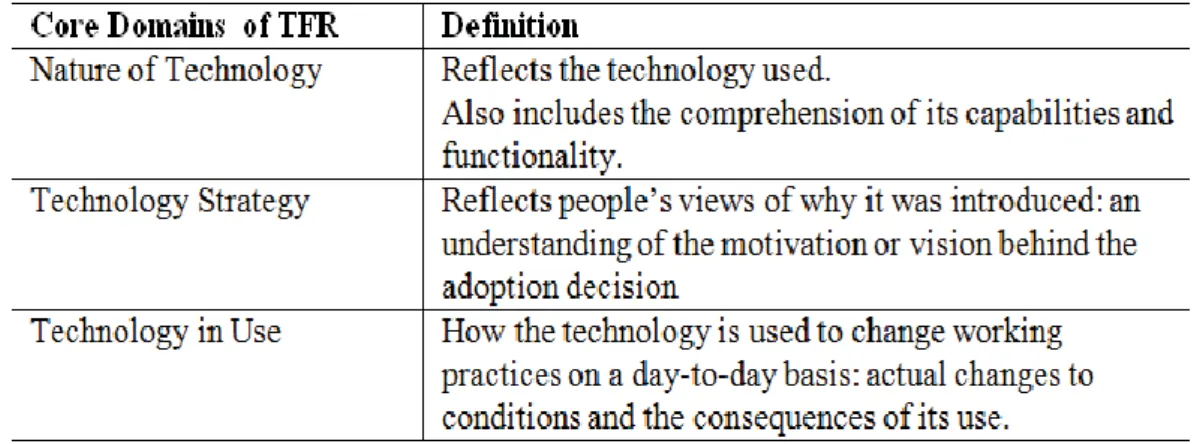
Orlikowski and Gash [1994] found a set of themes (presented in the Table 1), which were organized in core domains of the participants’ technological frames.
Table 1 - Core domains of the participants’ technological frames.
Technological Frames are interpretive, flexible, and context specific [Orlikowski and Gash 1994].
According to Orlikowski and Gash [1994], there are three distinct social groups involved in technological use or change within organizations (managers, technologists and users). In this research only the TF of users are analysed.
3. Research Methodology
Case study research is a strategy that allows a grasp of the different aspects of the complex social reality that surrounds the organizations [Yin 2003]. Following an interpretivist view of the world, a qualitative and interpretive case-study strategy was adopted, using multiple case studies.
Systems in the Healthcare Sector
3.1. Research Design
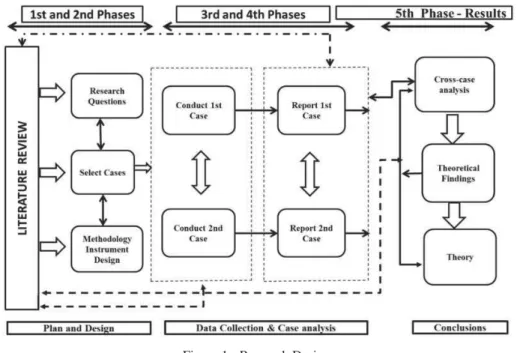
In the first part of the research a comprehensive literature review was conducted to help define the research topic and the research questions, as well as to set up the interview guidelines. In a second phase of the research, hospitals were selected, with the third phase comprising the fieldwork. The fourth phase consisted in the processing and analysis of data from the cases and the production of the written reports. Following from this, in the fifth phase a cross-case analysis of findings was conducted, with subsequent generation of theory and production of rich insights. Figure 1 provides an overview of how the research was conducted.
Figure 1 - Research Design
3.2. Data Collection and analysis
The field work took place between 2007 and 2011. The data gathered originated predominantly from semi-structured interviews, following Walsham [2006] and Yin [2003]. However, other sources of evidence were used with the aim of achieving an appropriate degree of internal validity [Yin 2003], rigor, richness and depth. Document analysis related to the implementation process and field notes resultant from direct observation and meetings1 were also subject to interpretation.
A total of 129 interviewees were undertaken (64 for organization Alfa and 65 for organization Beta), which included: managers, implementers – both of the supplier firm and from the organization – and users from each area where the system was implemented (emergency, out- patient and in-patient services). Table 2 shows the number of interviews within each group.
Systems in the Healthcare Sector
Hospital Alfa Nº Hospital Beta Nº
Implementation team
Project managers 1
Implementation team
Project managers 2
Monitoring Team (MT) 2 Monitoring Team (MT) 2
Managers
Board Members 3
Managers
Board Members 3
IS Manager 2 IS Manager 1
Service Directors 3 Service Directors 6
Nurse Managers 3 Nurse Managers 12
Users Nurses 27 Users Nurses 19 Assistants 8 Assistants 8 Physicians 15 Physicians 12 Total 64 Total 65
Table 2 - Interviews Realized
Qualitative data analysis was adopted [Denzin and Lincoln 2011]. Several techniques similar to those of Grounded theory were used, including: the coding of data segments into categories; subsequent coding to identify patterns in the data; and looking for emergent themes, as a step towards producing a conceptual coherent explanation of the phenomenon being studied [Huberman and Miles 1994]. Meaning was attributed to the data and efforts were made to ensure that the coding process conserved existing data relationships [Huberman and Miles 1994].
The coding process was carried out using NVivo software2. The data was organized into themes and categories suggested by the data, rather than being imposed a priori.
1 Meetings between organizational members and IS Provider to discuss the implementation process. 2 Is a specific software for qualitative research, allowing the collection, organization and analysis of
Systems in the Healthcare Sector
4. The Case Studies
The description of the cases resulted from an exploratory research conducted in two public Portuguese hospitals that have adopted the same HIS to computerize all care services, here designated as Paper Free Software Solution (PFSS)3. The PFSS facilitates the registration, consultation and analysis of information produced in the clinical care process of patients.
This HIS accumulates characteristics of Electronic Medical Record (EMR) and Decision Support Systems (DSS).
4.1. Case Alfa
Hospital Alfa is a large hospital with 332 beds and 1458 employees (on 31 December 2010). Its clinical activity is grouped in departments within the main health care areas: surgical, medical, maternal/paediatric, emergency and Complementary Methods of Diagnosis and Therapy (CMDT).
The PFSS was implemented at the end of February 2007 in the Emergency Room (ER), gradually being extended to the other clinical areas. In July 2011, when the fieldwork was finished, the implementation process was not fully completed.
The nursing and assistant’s groups exhibited a greater commitment to the IS. The doctors revealed most difficulty in complying with and using the system.
4.2. Case Beta
Hospital Beta is a medium-size hospital with a capacity of 182 beds and had 589 registered workers in June 2011. Its clinical activity operates through several departments: Surgery, Medicine, Infant Care, Emergency and CMDT.
The implementation process of the PFSS was gradual and in several stages. The adoption of the IS for the whole hospital was only carried out three or four years after the successful implementation of the ER, which took place in 2003. The implementation process was extended until 2010.
The integration of the Hospital in a Hospital Centre in 2007 had a strong influence in the implementation process of the PFSS, due to the lack of commitment of the new Board of Directors towards the IS.
3
Systems in the Healthcare Sector
The level of use was very variable between the medical specialties and professional groups. The nurses and assistants have shown to be completely committed with the PFSS in all areas, while the doctors have presented different levels of commitment, including active resistance (e.g. refusal to use the system).
5. Research Findings
Here, discussion is restricted to the set of findings resulting from cross-case analysis.
The analysis of the data allowed the identification of common patterns in the two cases. The information collected was attributable to several themes: Organizational Context, Technological Frames (TF), Commitment and Usage, which in turn comprise categories and sub-categories. The themes that are most directly relevant to this analysis are TF, Commitment and Usage. This paper will focus only on some relevant categories of TF and Commitment which have more impact on benefits achievement.
5.1. Technological Frames of Users
A set of themes was found in the two research sites, subsequently clustered in order to form the following core domains as presented in Table 3. These core domains are related to each other as well as with the other themes found in the data.
Core Domains of TFR Definition
Implementation Refers to all knowledge, expectations, experiences, interpretations,
and understanding that professionals have regarding the implementation of the IS project (e.g. objectives, process and evaluation).
Technology-in- use Refers to the understanding that people have of how technology is
used in their day-to-day activities. It also includes the perception of its attributes, capabilities (IS perceptions) and its meaning (system significance).
System Impact Refers to the positive and negative perceptions relating to the
consequences of the system. It includes the perceived benefits and ‘disbenefits’ accruing from system adoption (e.g., weakened patient relationship, increase in workload)
Table 3 - The main core domains of participants’ technological frames
This paper presents only the analysis of those TF which belong to the core domains of Technology-in-use and Impact of System, as well as their relationship with some of the antecedents of commitment which were also identified, and system Usage.
Systems in the Healthcare Sector 5.1.1. Technology-in-Use
System Significance. From a user's perspective, the information system has a subjective, inexplicit role with the real reasons for implementing the software system being hidden.
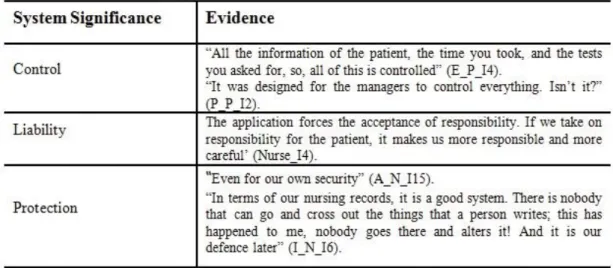
As regards the significance given to the system, two types of interpretation of technology have been identified which impact the user’s commitment, as well as in the manner they use the application: 1) the perception of the system as a factor that protects and promotes work activity (e.g. ‘Protection’) and, 2) the perception of technology as a threatening instrument (e.g. ‘Control’ and ‘Liability’).
While the perception of IS as protective mechanism for their job (‘Protection’) seems to be a great enabler of commitment and a strong incentive to the appropriate use of the system, therefore contributing to the rapid achievement of benefits, the other two frames (’Control’ and ’Liability’) act to reduce commitment. Some evidence of these TF is presented in Table 4.
Table 4 - Participants’ technological frames relating to System Significance
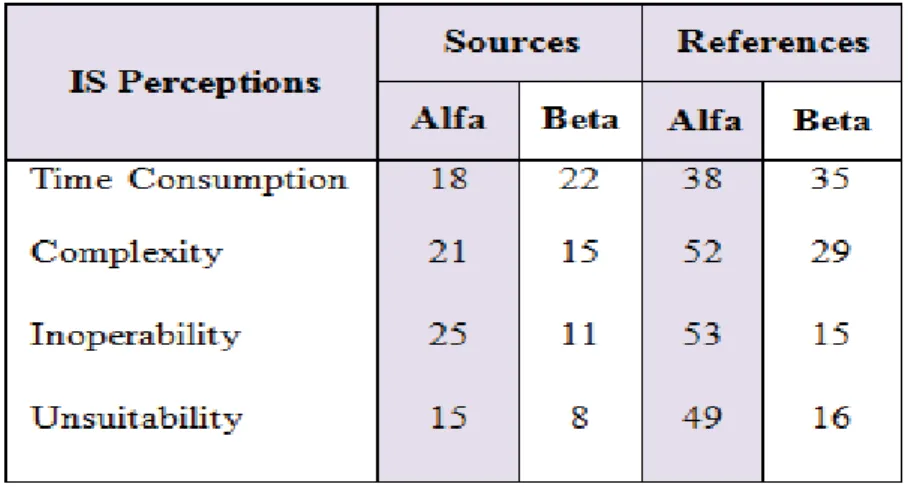
IS Perceptions. Although there were some positive perceptions about the system by some interviewees who considered the system intuitive and easy to use, the system was rated mostly as a complex system, difficult to handle, inappropriate for clinical practice and time-consuming. Four kinds of perceptions (frames) were found, which were grouped in the categories presented in Figure 2 as well as the number of sources and references in the two organizations.
Systems in the Healthcare Sector
Figure 2 - Users’ perceptions about IS
These perceptions are related to each other. In spite of the fact that all of them were mentioned by interviewees, those that revealed to have more influence in commitment and use of the system were: Time Consumption and Complexity. Hence, our focus goes to them.
Time Consumption: The data effectively shows that the time factor is highly valued by health professionals, influencing their commitment level towards the use of and compliance with technology. The vast majority of users who share this frame are from the medical profession, as shown in the excerpts presented below:
“This issue of time management in the use of the program gives me great difficulty in keeping to my timetable and seeing the same number of patients" (AS_P_I8).
“There is the risk of attending a tiny minority of patients, with the added time spent that the information system requires” (F_P_Letter2)
The frame ‘time consumption’ negatively influences the commitment in that it increases the conflict and role ambiguity, (an antecedent of commitment) and leads to the system as being interpreted as detrimental to the relationship with patients. As explained by a nurse of ER, "One can say that the system makes us waste some time. And if we have many patients, there is a tendency not to use it 100%” (JM_N_I4).
Complexity: Most of the perceptions recorded in this frame give an image of the system as being of great complexity. This perception of complexity of the system was found to be most often associated with system features and with the frames of, ‘Unsuitability’ and ‘Time Consumption’. The complexity of the system was referred to most frequently by doctors. We can see below some of their statements:
Systems in the Healthcare Sector
“It is very complex, not at all practical, it is very slow” (FL_P_I13).
“To help a patient, it is necessary to go through fields and fields of the application successively” (F_P_Letter2).
5.1.2. Impact of the System
This domain of TF in the two hospitals includes negative and positive perceptions about the consequences of the system. The negative frames (disbenefits) were: (1) the decrease in quality of the relationship between professionals and patients, and (2) the increase of workload. The positive perceptions of the consequences of the system were denoted as perceived benefits which act on commitment in an opposing way of the first two.
Decrease in Relationship with Patient. Sometimes, a reason given for lower acceptance (commitment) and usage of the application by the professionals is their own relationship with the patient, believed by some clinicians to be negatively affected, as can be seen from the following statements:
"The relationship with the patient is worse, because I'm facing the computer and hardly paying attention to the patient "(A_P_I3).
“The PFSS is a negative interference in carrying out clinical activities, dehumanizing the one- on-one relationship between patient and doctor” (F_P_Letter2).
This frame is also associated with the frames of ‘Complexity’ and ‘Time consumption’.
Increase of Workload. For people in general and doctors in particular, the PFSS system "is more of an annoyance, which adds to the workload", being seen as "an additional task and an overload”, according to the clinical director and a member of the monitoring team. This work overload makes it more difficult to explore and use the system properly:
"I think you could use the PFSS and all of the features it has, but that would conflict with the high number of patients, and sometimes, we place a more detailed record into the background in the application "(JM_N_I4).
Perceived benefits. The benefits most valued by users of the three professional groups that seem to have impact on their commitment to the project implementation were: attendance improvement, patient benefits, activity support, information security, reliability and accessibility to information. Note that all those benefits (Perceived Benefits) are shared between users, managers and implementers (congruence between frames). Another benefit that was also referred to by some users as well as by managers and members of monitoring team is ‘decision support’.
Systems in the Healthcare Sector
In Table 5 all the categories of benefits and their respective descriptions are presented, along with the verbatim text that illustrates the interpretations of the professional workers.
Perceived benefits Evidences
Attendance Improvement
This is associated with a general improvement in treatment and service provision resulting from the benefits that the professional workers receive.
“Professionals have a big advantage with this quality of records and the quality of service provided to patients”(Nurse_22_case_Beta)
“the gain is really in quality of service” (Nurse_8_case_Alfa)
“it allows us to save time in terms of having to go and talk to someone about the patient” (Physician_4_case_Beta)
Patient benefits
Includes the following perceptions associated to the IS: Better Clinical Decisions, Error Reduction, Patient Security (location, time savings).
“The user gained a big advantage and that translates into an increase in the
security with which the health care can be provided”
(Physician_8_case_Alfa)
“The patient wins more time, wins better monitoring, wins the quality of the service provided, because all the information relating to the patient is available” (Physician_12_case_Beta)
Activity Support
Images of the system related to the positive impact of the system on users’ activities.
“Without the PFSS we would not be able to look back. In a certain way it continues to be a great instrument, a work tool”
(Nurse_18_case_Alfa)
“I think that for the clinical activities it is very important” (Physician_4_case_Beta)
Information Security
This frame is associated with the interpretation that information is not lost or susceptible to alteration
“It is all recorded, anybody can access it, nobody can erase it, nobody can change it” (Nurse_11_case_Alfa)
“the advantage is that the data is inside, even in five years from now, you can still get it back” (Physician_12_case_Beta)
Information Accessibility
Represents the way that users perceive the accessibility of information and its impact on patients.
“The IS enables us to access information that otherwise we would not have,
or would be harder or more time consuming to obtain”.
(Physician_8_case_Alfa)
“we have access to all the files and we don’t have to do around looking to see where the patient is” (Assistant_4_case_Beta)
Decision Support
The capacity that the system has to influence decision making.
“It is a good system, much easier for us to realize what is happening in reality with the patient, and this increases the quality of work we provide” (Physician_12_case_Beta)
“I know where there the waiting times are longer, and I can mobilize resources” (Nurse_I8_case_Alfa)
Reliability of Data
This frame refers to the credibility and quality that the information should possess.
“The great benefit of the PFSS is to give us really accurate information” Physician_1_case_Alfa)
“It is reliable information because it stays recorded: who did what, the time that they did it, for always. I think that there is more truth in the information” (Nurse_17_case_Beta)
Cost reductions
Represents the images that the users have of the effect that the system generally has over costs.
“In terms of imaging I think we made a crushing gain” (Physician_1_case_Alfa).
"We have considerably reduced human resources in the area of imaging and laboratories"(Manager_case_Alfa)
Table 5 - List of Perceived Benefits
The largest part of these perceptions (frames) covering the benefits achieved show a strong link between them, influencing one another.
Systems in the Healthcare Sector
The perception of benefits by users functions as a great stimulus to commitment to the project that in turn increases the correct usage of the system.
5.2. Commitment
5.2.1. Commitment Antecedents
The antecedents of commitment found in the data collected were gathered into two groups according to the model of Meyer and Allen [1991, 1997]. The first consists of work-related experiences, and the second includes the personal characteristics. As far as this paper is concerned we highlight only two antecedents related to work experiences. They are: 1) autonomy and authority, and 2) conflict and role ambiguity.
Autonomy and Authority. The antecedent ‘autonomy and authority’ influenced the commitment to the project, and consequently the use of IS, since it highlighted the work done by professionals, making them liable for their clinical decisions, while showing their skills in working with IS/IT. Here, it is also associated with the image of the system as a control mechanism and unfit for purpose, reducing commitment, promoting a boycott, or partial use of the system and thus, decreasing the benefits.
The project manager of hospital Beta considers ‘power’ to be the most suitable word to explain the reasons for the resistance of some clinicians: “They are scared to lose autonomy and power, while becoming controlled”.
Issues related to the authority, professional autonomy, and role assigned to their social and professional status, influence how some doctors see the role of IS in their activity:
“The group of doctors is very difficult to deal with and has a lot of strength, a lot of power and the people are scared of challenging” (MC_P_I9).
“I have an independent spirit and I do not like to be manipulated” (F_P_I3).
Conflict and Role Ambiguity. According to Igbaria and Siegel [1992] role ambiguity is the difference between what is expected of an individual at work and what he/she feels he/she should do. Here it was considered as being related to the duality that professionals have between the “obligation" to use the system and the preservation of the relationship with patients and their care. This feeling leads to opposition to the use of the system by users, compromising the performance of healthcare professionals, as shown by the following comments.
Systems in the Healthcare Sector
“We spend a lot of time recording our activities. This time, sometimes, could be made available for talking to patients” (T_N_I17).
This antecedent was associated with negative images of system (complexity and time consumption) and the negative impacts (decrease in the relationship with the patient and increased of workload).
5.2.2. Project commitment
Out of the three professional groups, doctors showed most difficulty in complying with and using the system. The nurses and the assistants exhibited more compliance.
According to, the project manager of hospital Alfa “the doctors are always the group that show more resistance". A doctor reinforces this by saying:
"The idea that people in general have of PFSS is negative. Now, I think it undoubtedly is much more negative for the professional group of doctors".
5.2.3. Lack of Commitment or resistance
This category includes all verbatim accounts of the respondents that indicated less positive reactions, attitudes and adverse behaviours to the information system.
Resistance phenomena were mainly characterized by a refusal to use the application, or by using it only partially, and/ or by verbalizing opposition to the system and sending letters to the Board expressing their disagreement, as the following comments illustrate:
"I do not, until I am forced. We would be happy on the day the system went down and we have to return to paper" (AS_P_I6).
“The program is against everything that they taught us at the university in terms of obtaining the patient history and physical examination. It goes against medical tradition” (FL_P_I13).
Some of those interviewed favoured making the use of the system compulsory. The measures adopted by the management group to stimulate or even enforce resistant elements to comply through necessary measures are also relevant in this research, and is valued by many users.
“I think that these things, if they are going to be used, must be imposed; people must be forced to use the PFSS. There is no other way to make these changes “(JM_P_I12). “If there was more leadership and more commitment on the part of management, things, maybe, would have been done a long time ago” (MC_P_I9).
Systems in the Healthcare Sector
5.3. Usage
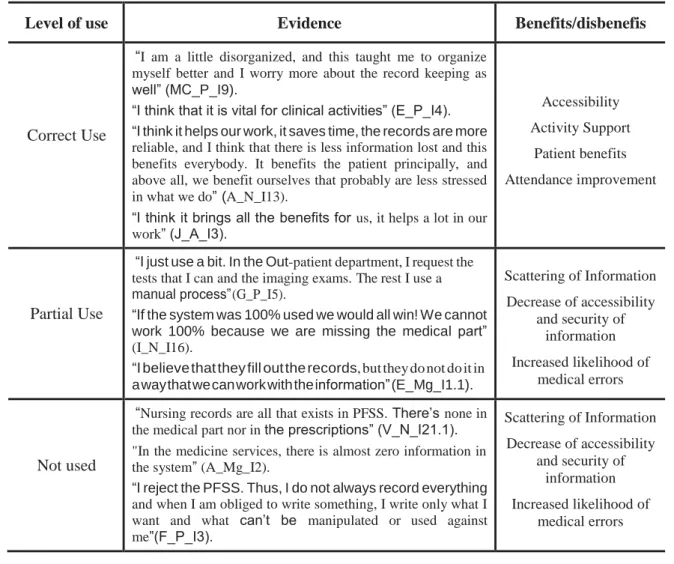
In this study, the usage level of IS/IT emerged as a relevant category and a critical point of consideration within the context of a HIS implementation, and is analysed as a direct or indirect consequence of commitment to the project and its resulting relevant role in benefits achievement. Three levels of usage were found, here classified as: (1) Correct usage of the system, (2) Partial usage, and (3) ‘Not used’. The last one is less common.
Correct Usage. The correct usage is associated with the full and adequate use of IS. At this level of use, users enter in the IS the required and necessary information in their respective fields.
Informants of the two most significant professional groups in terms of use of the IS (doctors and nurses), stressed the importance of its correct usage for achieving the desired benefits. From the perspective of these interviewees, the correct use of the application is associated to the acknowledgement that usage of the system provides benefits for the patients and the professionals.
Actually, in the case of a HIS, whose main role is to collect and manage all information related to a patient’s visit to the hospital, it is important that this information is reliable and can be shared with all stakeholders contributing for the continuity of care.
Partial Use. Partial use of the system consists of an incomplete use of the application's functions and respective record fields.
At this level of use, the information entered is sometimes woefully inadequate to monitor the patient efficiently, particularly due to the fact that in such cases the information is spread over two different media (paper and digital). Besides compromising the care process, the partial usage of the system interferes with the professionals' own activity, as explained by a Nurse: “there are some professional groups that did not comply. Plainly and simply they did not want to do it, they did not want to use it. This afterwards created some insatisfaction and disorganization in terms of the day-to-day activities”.
Systems in the Healthcare Sector
Level of use Evidence Benefits/disbenefis
Correct Use
“I am a little disorganized, and this taught me to organize myself better and I worry more about the record keeping as well” (MC_P_I9).
“I think that it is vital for clinical activities” (E_P_I4). “I think it helps our work, it saves time, the records are more reliable, and I think that there is less information lost and this benefits everybody. It benefits the patient principally, and above all, we benefit ourselves that probably are less stressed in what we do” (A_N_I13).
“I think it brings all the benefits for us, it helps a lot in our work” (J_A_I3). Accessibility Activity Support Patient benefits Attendance improvement Partial Use
“I just use a bit. In the Out-patient department, I request the tests that I can and the imaging exams. The rest I use a manual process” (G_P_I5).
“If the system was 100% used we would all win! We cannot work 100% because we are missing the medical part” (I_N_I16).
“I believe that they fill out the records, but they do not do it in a way that we can work with the information” (E_Mg_I1.1).
Scattering of Information Decrease of accessibility and security of information Increased likelihood of medical errors Not used
“Nursing records are all that exists in PFSS. There’s none in the medical part nor in the prescriptions” (V_N_I21.1). "In the medicine services, there is almost zero information in the system” (A_Mg_I2).
“I reject the PFSS. Thus, I do not always record everything and when I am obliged to write something, I write only what I want and what can’t be manipulated or used against me”(F_P_I3). Scattering of Information Decrease of accessibility and security of information Increased likelihood of medical errors
Table 6 - The relationships between use and benefits
6. Conclusions
Using as a starting point the research questions posed in the beginning, it was found that:
1. Some TF showed to have influence on commitment as well as on usage of IS and benefits realization.
2. The way the professionals use the system can increase the potential for benefits achievement. For example, a partial use of the system can seriously compromise the attainment of all possible benefits.
3. Some of the TF identified are closely related with some antecedents of commitment, with a great impact on the use of the system and consequently on its effect in the benefits achievement. Here, reference is made to the link between negative images of the system as ‘time consumption’, ‘complexity’, ‘increase of workload’ and ‘conflict and role ambiguity’ on one hand, and on the other hand, the link between ‘control’ and
Systems in the Healthcare Sector
‘autonomy and authority’. These relationships revealed a capability to enhance the lack of commitment and a partial use of system. On the contrary, the frame ‘protection’ acts as a driver to commitment to the project and therefore the correct usage of the system. 4. The negative perceptions of the system’s impact such as ‘increase of workload’, and
‘decrease in relationship with patients’ are associated to a lack of commitment, leading to its partial use that in turn reduces the perception of benefits.
5. Perceived benefits influence the appropriate use of IS, therefore assuring the likelihood of achieving the expected benefits from the investment in IS.
Previous personal experiences of the author should be acknowledged as a limitation of this work, therefore, it is essential to clarify that this research followed an interpretative approach. Thus, these research findings may be valuable to other settings and organizations as interpretations of phenomena but are not wholly predictive for future situations.
Further research that could compare the results found in this work in other contexts could provide significant insights in this area.
7. References
Bhattacherjee, A., Hikmet, N., Menachemi, N., Kayhan, V. and Brooks, R., “The differential performance effects of Healthcare Information Technology adoption”, Information Systems Management, 24, 1 (2007), 5-14.
Caldeira, M., Serrano, A., Quaresma, R., Pedron, C. and Romão, M., “Information and com- munication technology adoption for business benefits: A case analysis of an integrated paperless system”, International Journal of Information Management, 32, 2 (2012), 196- 202.
Cardoso, I. and Caldeira, M., “Users’ Commitment in Information System Implementation: The Role of Technological Frames”, In Rahman, H., Mesquita, A., Ramos, I., Pernici, B., (Eds.), Knowledge and Technologies in Innovative Information Systems. Proceedings of the 7th MCIS (Mediterranean Conference on Information Systems), Guimarães, Portugal, LNBIP, 129, 2012, 254-266.
Cardoso, I., “Understanding Organizational Stakeholder Commitment to Ensure Information Systems/ Information Technology Benefits in Portuguese Hospitals: An Analysis Based on the Theory of Technological Frames”, PhD Thesis, ISEG, Universidade Técnica de Lisboa. Lisboa, 2012.
Casedesus, M. and Karapetrovic, S., “The erosion of ISO 9000 benefits: a temporal study”, International Journal of Quality and Reliability Management, 22, 2 (2005), 120-136.
Systems in the Healthcare Sector
Coetsee, L., “From resistance to commitment”, Public Administration Quarterly, 23, 2 (1999), 204-222.
Davidson, E., “A Technological frames perspective on Information Technology and organizational change”, The Journal of Applied Behavioral Science, 42, 1(2006), 23-39. Denzin, Norman K. and Lincoln Yvonna, S., “The discipline and practice of Qualitative
Research”, In N. Denzin and Y. Lincoln, S. (Eds.), The Sage Handbook of Qualitative Research, 4th Edition, Sage Publications, Inc., Thousand Oaks, California, 2011, 1-32. Dhillon, G, “Gaining benefits from IS/IT implementation: interpretations from case studies”,
International Journal of Information Management, 25, 6(2005), 502-515.
Doolin, B., “Power and resistance in the implementation of a medical management information system”, Information Systems Journal, 14, 4(2004), 343-362.
Hillestad, R., Bigelow, J., Bower, A., Girosi, F., Meili, R., Scoville, R. and Taylor, R., “Can Electronic Medical Record systems transform health care? Potential health benefits, savings, and costs”, Health Affairs, 24, 5 (2005), 1103- 1117.
Huberman, A. M. and Miles, M.B., “Data management and analysis methods”, In N. Denzin and Y. Lincoln (Eds.), Handbook of qualitative research, Sage Publications Ltd., Thousand Oaks, 1994, 428-444.
Igbaria, M. and Siegel, S., “An Examination of the Antecedents of Turnover Propensity of Engineers: An Integrated Model”, Journal of Engineering and Technology Management, 9 (1992), 101-126.
Jensen, T. B. and Aanestad, M., “ Hospitality and hostility in hospitals: a case study of an EPR adoption among surgeons”, European Journal of Information Systems, 16, 6(2007), 672– 680.
Jurison, J., “Toward more effective management of information technology benefits”, Journal of Strategic Information Systems, 5, 4 (1996), 263-274.
Leapfrog Group, “The Leapfrog Group Hospital Quality and Safety Survey What's New in the 2006 Survey”, https://leapfrog.medstat.com/pdf/final.pdf, 2005.
Meyer, J. P. and Allen, N. J., “Commitment in the Workplace: Theory, Research, and Application”, Sage Publications, Thousand Oaks, CA, 1997.
Meyer, J.P. and Allen, N.J., “A three-component conceptualization of organizational commitment”, Human Resource Management Review, 1, 1(1991), 61-89.
Meyer, J.P. and Herscovitch, L., “Commitment in the workplace: toward a general model”, Human Resource Management Review, 11, 3 (2001), 299-326.
OECD, “Strengthening Health Information Infrastructure for Health Care Quality Governance: Good Practices, New Opportunities and Data Privacy Protection Challenges”, OECD Health Policy Studies, OECD Publishing, (2013).
Systems in the Healthcare Sector
Orlikowski, W.J and Gash, D.C., “Technological frames: making sense of information
technology in organizations”, ACM Transactions on Information Systems, 12, 2 (1994), 174–207.
Peppard, J., Ward, J. and Daniel, E., “Managing the Realization of Business Benefits from IT investments”, MIS Quarterly Executive, 6, 1(2007), 1-10.
Schäfferling, A. and Wagner, H. Do investors recognize Information Technology as a Strategic Asset? A longitudinal analysis of changes in Ownership Structure and IT Capability. Proceedings of Shum, P., Bove, L. and Auh, S., “Employees’ affective commitment to change. The key to successful CRM implementation”, European Journal of Marketing, 42, 11/12 (2008), 1346-1371.
Slack, W.V., “Cybermedicine: How Computing Empowers Doctors and Patients for Better Health Care”, John Wiley & Sons, Inc., New York, 2001.
Thakur, R, Hsu, S H Y and Fontenot, G., “Innovation in Healthcare: Issues and future trends”. Journal of Business Research, 65 (2012), 562-569.
Wager K., Lee F., White A., Ward D. and Ornstein, S., “Impact of an Electronic Medical Record System on Community-Based Primary Care Clinics”, The Journal of the American Board of Family Practice, 13,5(2000), 338-348.
Walsham, G., “Doing interpretive research”, European Journal of Information Systems, 15, 3 (2006), 320-330.
Ward, J. and Daniel, E., “Benefits Management: delivering value from IS and Investments”, John Wiley &Sons Ltd, Chichester, 2006.
Yin, R. K., “Case Study Research, Design and Methods”, (3rd ed.), Sage Publications, Inc., Thousand Oaks, 2003.the 21st European Conference on Information System, (2013), 1-12