Article
Printed in Brazil - ©2013 Sociedade Brasileira de Química0103 - 5053 $6.00+0.00
A
*e-mail: [email protected]
#Liangwei Du and Lianyang Bai contributed equally to this manuscript.
Photochemical Degradation of Pyrazosulfuron-Ethyl in Aqueous Solution
Yanhui Wang,a,b Liangwei Du#,a and Lianyang Bai*,#,b,c
aCollege of Chemistry and Chemical Engineering, Guangxi University, 530004 Nanning, Guangxi, People’s Republic of China
bDepartment of Pesticide Science, Hunan Agricultural University, 410128 Changsha, Hunan, People’s Republic of China
cHunan Institute of Humanities, Science and Technology, 417000 Loudi, Hunan, People’s Republic of China
Este trabalho descreve o comportamento fotoquímico do pirazosulfuronato de etila em soluções aquosas. A fotodegradação do pirazosulfuronato de etila foi investigada pela primeira vez em dois comprimentos de onda de irradiação diferentes e valores de pH variando de 2,00 a 10,00. Os resultados mostram que a taxa de fotodegradação foi mais rápida em meio ácido do que em meio básico, quando pyrazosulfuron-etil estava na forma neutra. Os tempos de meia-vida do pirazosulfuronato de etila sob luz ultravioleta e luz solar simulada foram 27,17 e 153,33 min, respectivamente. As reações seguiram cinética de primeira ordem. As rotas de degradação foram propostas de acordo com os resultados de identificação dos fotoprodutos: clivagens carbono-enxofre e nitrogênio-enxofre e fotohidrólise da ponte de sulfonilureia. Concluiu-se que comportamentos de fotodegradação podem ocorrer dentro da família de sulfonilureia, dependendo dos valores de pH da solução aquosa e dos comprimentos de onda de irradiação.
This report describes photochemical behaviors of pyrazosulfuron-ethyl in aqueous solution. The photodegradation of pyrazosulfuron-ethyl for the first time was investigated in aqueous solution at two different irradiation wavelengths and pH values ranging from 2.00 to 10.00. Results show that the rate of photodegradation was faster in acidic medium than that in basic medium, when pyrazosulfuron-ethyl was in neutral form. The half-lives of pyrazosulfuron-ethyl under ultra-violet light and simulated sunlight were found to be 27.17 and 153.33 min, respectively. The reactions followed first-order kinetics. The degradation pathways were proposed according to the identification results of photoproducts: carbon-sulfur and nitrogen-sulfur cleavages and photohydrolysis of the sulfonylurea bridge. It was concluded that photodegradation behaviors can occur within the sulfonylurea family, depending on the pH values of aqueous solution and the irradiation wavelengths.
Keywords: sulfonylureas, pyrazosulfuron-ethyl, photodegradation
Introduction
Sulfonylurea herbicides, discovered in the middle of the 1970’s, have been widely used with a dramatic increase due to their low application rates (2-100 g ha-1), good crop
selectivity and very low animal toxicity.1-3 Their mode of
action consists of the inhibition of acetolactate synthase (ALS), which is a key enzyme in the biosynthesis of the branched-chain amino acids such as valine, leucine and
isoleucine.1,4 The main abiotic degradation pathway of
sulfonylurea herbicides is hydrolysis, but several works suggest that photodegradation is an alternative pathway
to chemical hydrolysis.5-13 Indeed, these compounds
were hydrolyzed more quickly in acidic than neutral or weakly basic pH value. Therefore, it is suggested that photodegradation become an important pathway at neutral pH. In addition, it is known that photodegradation processes can accelerate chemical hydrolysis (photoassisted reaction) or form new products.
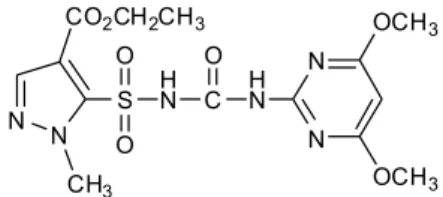
pyrimidin-2-ylcarbamoylsulfamoyl)-1-methylpyrazole-4-carboxylate) is a postemergence sulfonylurea herbicide for the control of annual and perennial grasses and broad-leaved weeds in rice production. The molecular structure of pyrazosulfuron-ethyl is presented in Figure 1. Several studies have indicated that pyrazosulfuron-ethyl has favorable toxicological and
environmental fate characteristics.14,15 Similar to other
sulfonylurea herbicides, degradation mechanisms for pyrazosulfuron-ethyl in rice paddies focus on microbial
metabolism and chemical hydrolysis.15-17 However, no
information was published on the photodegradation of pyrazosulfuron-ethyl in aqueous solution. The study on photodegradation in aqueous solution can be helpful to understand the pyrazosulfuron-ethyl behavior in the environment.
This work reports the influence of pH value and irradiation wavelength on the photochemical behavior of pyrazosulfuron-ethyl. The main photoproducts were identified and a photoreaction pathway is proposed.
Experimental
Material and apparatus
Pyrazosulfuron-ethyl (98% purity) was purchased from Dr. Ehrenstorfer GmbH (Augsburg, Germany). The standard chemical of photoproduct 1 (2-amino-4,6-dimethoxypyrimidine) was supplied by Jiansu Institute of Ecomones Co., Ltd. (P. R. China). Methanol and acetonitrile of high performance liquid chromatography (HPLC) grade (Fisher Scientific Company, USA) were used without further purification. The water used for chromatography mobile phase and buffer preparation was purified with Millipore water system.
UV-Vis absorption and fluorescence spectra were recorded using a Shimadzu 2450 UV-Vis spectrophotometer and Perkin Elmer LS-55 spectrofluorometer, respectively. Kinetics was measured by high performance liquid chromatography with UV detector (HPLC-UV). The photodegradation products were identified using HPLC-UV, liquid chromatography-mass spectrometry (LC-MS) and gas chromatography-mass spectrometry (GC-MS) analyses.
Photodegradation experiments
In photolysis experiment, photodegradation of pyrazosulfuron-ethyl was carried out in water at different pH values and wavelengths. The photodegradation of the
samples with the initial concentration of 20 mg L–1 was
carried out in quartz cylindrical tubes (50 mL) using a low pressure mercury lamp emitting at 254 nm (25 W) and a water-cooled filter with an optical window of 8 cm2 area. For
irradiation at ≥ 290 nm, a medium pressure mercury lamp
(125 W) and borosilicate tubes were used. Temperature was controlled at 28 ± 3 °C. At various time intervals, samples were withdrawn in triplicate and analyzed by HPLC.
HPLC analysis
HPLC analyses were performed with a Waters 600 equipped with UV detector and autosampler. The column
was Agilent Zorbax Eclipse XDB-C18 (250 × 4.6 mm i.d.;
5 µm particle size), the flow rate was 1 mL min–1, and the
injection volume was 20 µL. For kinetic studies, the mobile phase was a 75:25 mixture of methanol-0.2% aqueous acetic acid (pH 2.80). For the analyses of photoproducts, a mobile phase gradient was 0.2% acetic acid in water (i) and acetonitrile (ii), starting with 40% (i) for 5 min, changing to 20% over 5 min, and then remaining constant for the last 5 min.
Degradation kinetics was described using a first-order reaction model: Ct = C0 × e–kt, where C0(mg kg–1) is the
initial concentration in soil, Ct(mg kg–1) is the concentration
at time t (min) and k (min–1) is the rate constant. The half-life
was calculated as t1/2 = ln(2)/k.
LC-MS analysis
The identification of photoproducts was performed with Agilent Technologies 1100 Series LC-MSD Trap. The
column was XDB-C18 (150 × 4.6 mm i.d.; 1.7 µm). The
mass spectrometer was equipped with an ESI (electrospray ionization) source and operated in the positive and negative polarity mode. The ES-MS interface was operated under the conditions of a gas temperature of 350 ºC and a drying gas flow of 800 L h–1. The nebulizer nitrogen gas pressure
was 35 psi, while the capillary voltage was set to 3000 V.
Full scans were obtained by scanning from m/z 50 to 600.
GC-MS analysis
The analyses were performed on an Agilent 7890A/5957C equipped with a capillary HP-5MS (30 m × 0.25 mm i.d.; 0.25 µm film). The temperature
program was from 40 to 180 ºC at 4 ºC min–1, then from
180 to 250 ºC at 10 ºC min–1. Analyses were performed in
splitless mode and the injection temperature was 220 ºC. The transfer line was conditioned at 250 ºC, the ion source operated at 70 eV and 250 ºC, the acquisition was from
m/z 50 to 500.
Results and Discussion
Absorption spectrum of pyrazosulfuron-ethyl
Like other sulfonylureas herbicides, pyrazosulfuron-ethyl is a bichromophoric compound whose pyrazole ring and pyrimidine were linked through a sulfonylurea bridge. The UV spectrum of pyrazosulfuron-ethyl was measured in water at pH 6.50 (Figure 2). The molecule presented two absorption maxima below 290 nm (195 and 241 nm), but also a measurable absorption tail up to 300 nm. According to an EC (94/37/CE) directive, phototransformation must be taken into account if the molar extinction coefficient ε > 10 L mol−1 cm−1 at λ≥ 290 nm.
For pyrazosulfuron-ethyl, ε = 1200 L mol−1 cm−1 at
wavelength of 290 nm, meaning that the photolytic degradation pathway should not be neglected.
Kinetics of pyrazosulfuron-ethyl
The photodegradation of pyrazosulfuron-ethyl was investigated in aqueous solution. The influence of pH value and irradiation wavelength was evaluated in this section. The performed pH values ranged from 2.00 to 10.00. The irradiation wavelengths were 254 nm from UV light and above 290 nm from simulated sunlight, respectively.
Since the chemical stability of sulfonylureas in
aqueous solution is markedly influenced by pH,17-21 the
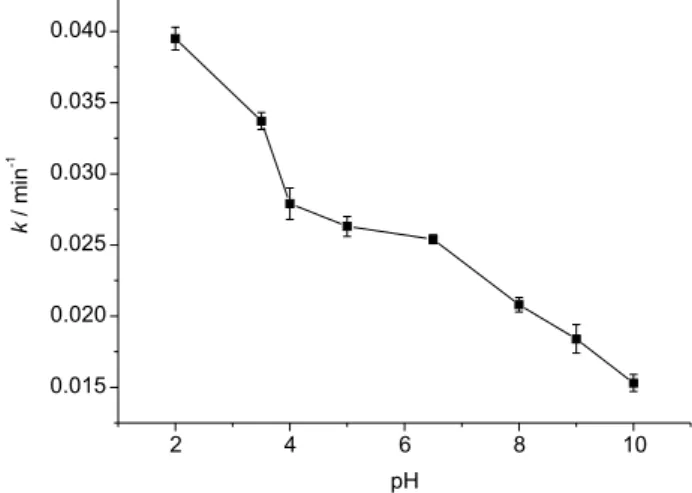
pH values of aqueous solution could have effect on the photodegradation of pyrazosulfuron-ethyl. This study was carried out at different pH (2.00-10.00) under the conditions of irradiation at wavelength of 254 nm. Meanwhile, the illumination time of photodegradation were less than 180 min in order to avoid the side effect of chemical hydrolysis. The photodegradation of pyrazosulfuron-ethyl at different pH followed first-order kinetic with high R2 values (correlation coefficient, ≥ 0.9217). The evolution
of pyrazosulfuron-ethyl kinetic constants as a function of pH is represented in Figure 3. The rate constants and half-lives for the photolysis of pyrazosulfuron-ethyl in different pH are presented in Table 1. From these results, the kinetic constants of pyrazosulfuron-ethyl obviously increase with the decrease of pH, ranging from 0.0153 min−1
at pH 10.00 to 0.0395 min−1 at pH 2.00. The corresponding
half-lives of pyrazosulfuron-ethyl decrease from 45.10 to 17.47 min. The pH value-kinetics measurements showed that photodegradation was faster in acidic medium than that in basic medium, when pyrazosulfuron-ethyl was in neutral form. These results suggested that acid-base behavior of pyrazosulfuron-ethyl could have been
involved in the photodegradation. Vulliet et al.12 also
reported the same phenomenon about cinosulfuron, while photodegradation rate of triasulfuron is at a maximum at pH 4. Considering the pH of actual samples, the photolysis of pyrazosulfuron-ethyl in the following experiments was performed at pH 6.50.
In order to evaluate the influence of the wavelength on the photochemical behavior of pyrazosulfuron-ethyl, the present study evaluates the rate of photodegradation of pyrazosulfuron-ethyl in distilled water with the pH of
6.50 under UV light (λ = 254 nm) and simulated sunlight
(λ≥ 290 nm). The kinetic results of the photodegradation
Figure 2. UV spectrum of pyrazosulfuron-ethyl in aqueous solution.
at different wavelengths were presented in Table 2, showing that wavelengths have a significant effect on the kinetics. The half-lives of pyrazosulfuron-ethyl under UV light and simulated sunlight were found to be 27.17 and 153.33 min, respectively. The transformation of pyrazosulfuron-ethyl in aqueous solutions irradiated at 254 nm was significantly faster than at λ≥ 290 nm. This is mainly due to the weaker
absorption of pyrazosulfuron-ethyl at the longer wavelength range. These results are in agreement with the data reported for other sulfonylureas.9,12,22,23
Photoproduct identification
The photoproducts were identified by HPLC-UV, GC-MS and LC-MS. From HPLC-UV chromatograms (Figure S1 in the Supplementary Information (SI) section), the main photoproducts under two irradiation wavelengths have characteristic peaks at the same retention time (tr). In
this experiment, it was only identified the photoproducts under the conditions of irradiation at UV light. Mass spectrometry data of the irradiated solutions are given in Table 3 and Figures S2 and S3 (in the SI section).
Product 1 in GC-MS has a retention time of 22.5 min and
m/z (%): 154 (M+, 100), 139 (9), 125 (20), 109 (18).
Meanwhile, the product 1 was confirmed by the same retention time with standard chemical in HPLC analysis (shown in Figure S1 in the SI section). It was tentatively identified as 2-amino-4,6-dimethoxypyrimidine, which results from the photohydrolysis of the sulfonylurea link, a typical degradation pathway of sulfonylurea herbicides under irradiation. The compound was also detected as
a hydrolysis product for pyrazosulfuron-ethyl17 and
other sulfonylureas with a pyrimidine ring, for example, azimsulfuron18 and rimsulfuron.11
The other photoproducts were identified by LC-MS and together with literature data.17,24 In positive mode, the mass
spectrum of photoproduct 2 showed a prominent protonated
molecular ion at m/z 308.1 [M + H]+ and characteristic
fragment ion peaks at m/z 289.0, 280.0, 262.0 and 232.9.
[M – H]– ion of this compound is 306.1 in negative mode.
This photoproduct results from the contraction of the sulfonylurea bridge in solutions and is also detected as
a hydrolysis product.17 This contraction mechanism is
suggested to proceed through an intramolecular SNAr
reaction.25
The mass spectrum of photoproduct 3 showed a
molecular ion peak at m/z 199.8 [M + H]+ with fragment
ion peaks at m/z 167.8, 155.9 and 135.8. [M – H]–
ion of this compound is 197.9 in negative mode. According to mass spectral data and fragment patterns, the photoproduct was tentatively identified as 2-ureido-4,6-dimetoxypyrimidine and photodegradation pathway was nitrogen-sulfur cleavage. This photoproduct was also found as a photodegradation product for azimsulfuron9 and
bensulphuron methyl.24 Mass spectrometry results do not
allow us a certain identification of other photoproducts originating after irradiation under UV light.
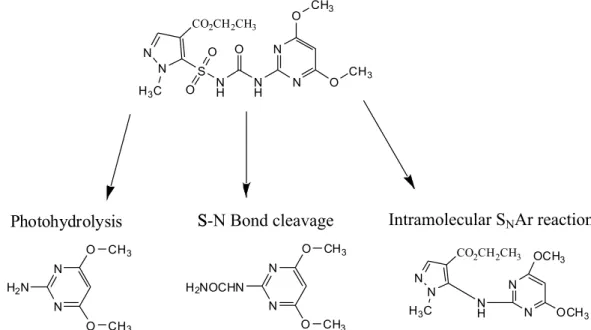
A c c o r d i n g t o p h o t o p r o d u c t s a n d l i t e r a t u r e data,12,13,22,24,26 a tentative pathway for the photolysis
of pyrazosulfuron-ethyl in aqueous solution is proposed in Figure 4. Three different pathways are proposed: cleavage of the sulfonylurea bridge to give
photoproduct 1, an intramolecular SNAr reaction leading
to photoproduct 2 and photodesulfonylation which proceeds by a homolitic nitrogen-sulfur cleavage, yielding photoproduct 3. However, the theoretical photoproduct from carbon-sulfur cleavage
(4,6-dimetoxypyrimidine-Table 1. Determination of rate constant (k) and half-life (t1/2) for the photolysis of pyrazosulfuron-ethyl
pH k / min−1 t
1/2 / min R2
2.00 0.0395 17.47 0.9328
3.50 0.0337 20.47 0.9437
4.00 0.0279 24.73 0.9619
5.00 0.0263 26.24 0.9527
6.50 0.0254 27.17 0.9611
8.00 0.0208 33.17 0.9217
9.00 0.0184 37.50 0.9785
10.00 0.0153 45.10 0.9544
Table 2. Photodegradation kinetics parameter of pyrazosulfuron-ethyl
Pyrazosulfuron-ethyl λ / nm k / min−1 t
1/2 / min R2 Distilled water 254 0.0254 27.17 0.9611
Distilled water ≥ 290 0.0045 153.33 0.9657
Table 3. LC-ESI-MS data of pyrazosulfuron-ethyl and its photodegradation products, in which tr stands for retention time
Product tr / min Mass, m/z MS2, m/z
Pyrazosulfuron-ethyl 9.3 413.0 (ESI–) 306.1, 231.9, 153.8
1 4.2 155.9 (ESI+) 135.8, 126.8, 109.8, 99.9
2 6.7 308.1 (ESI+) 289.0, 280.0, 262.0, 232.9
2-ylaminocarbonylsulphamic acid) was not found in this experiment. It is supposed that 4,6-dimetoxypyrimidine-2-yl aminocarbonylsulphamic acid rapidly transformed to product 3 after only a few minutes of irradiation. According to the content of photoproducts, the N–S bond cleavage was considered as the main photochemical pathway in this experiment. This photodegadation pathway was also reported for some sulfonylureas herbicides by Weiss et al.27 and Caselli et al.6 The results
are similar with data reported for other sulfonylureas
degradation by light.12,22,24 However, carbon-sulfur
cleavage is recognized as the main photochemical pathway for triasulfuron, primisulfuron, cinosulfuron and
sulfometuron-methyl.13,23,28 These experimental
evidences and theoretical predictions indicate an important effect of the substituent on the phenyl ring. The
o-chloro, p-methyl and p-amino groups favour N–S bond
photocleavage, while the o–OR (–OR strands for alkoxy
radical) substituent in cinosulfuron and triasulfuron leads
to C–S bond photocleavage.26
Conclusion
The photolysis studies on pyrazosulfuron-ethyl were carried out in aqueous solution at different irradiation wavelengths and pH values. It was find that photodegradation of pyrazosulfuron-ethyl was faster under UV light than simulated sunlight and was faster in acidic medium than basic medium. On the basis of the results obtained, it is possible to conclude that photodegradation behaviors can occur in pyrazosulfuron-ethyl, depending on the pH values of aqueous solution and the irradiation wavelengths.
Supplementary Information
Supplementary data are available free of charge at http://jbcs.sbq.org.br as PDF file.
Acknowledgements
This work was supported by National Natural Science Foundation of P. R. China (Grant No. 31171891) and Postgraduate Innovation Program of Hunan Province (Grant No. CX2011B288).
References
1. Blair, A. M.; Martin, T. D.; Pestic. Sci. 1988, 22, 195. 2. Brown, H. M.; Pestic. Sci. 1990, 29, 263.
3. Zhou, Q. Y.; Liu, W. P.; Zhang, Y. S.; Liu, K. K.; Pestic. Biochem. Physiol. 2008, 89, 89.
4. Beyer, E. M.; Duffy, M. J.; Hay, J. V.; Schlueter, D. D. In Herbicide Chemistry Degradation and Mode of Action;
Kearney, P. C.; Kaufman, D. D., eds.; Marcel Dekker: New York, USA, 1988, p. 118-183.
5. Bhattacherjee, A. K.; Dureja, P.; Pestic. Sci. 1999, 55, 183. 6. Caselli, M.; Chemosphere 2005, 59, 1137.
7. Choudhury, P. P.; Dureja, P.; J. Agric. Food Chem. 1996, 44, 3379.
8. Harvey, J.; Dulka, J.; Anderson, J.; J. Agric. Food Chem. 1985, 33, 590.
9. Pinna, M. V.; Zema, M.; Gessa, C.; Pusino, A.; J. Agric. Food Chem. 2007, 55, 6659.
10. Scrano, L.; Bufo, S. A.; Perucci, P.; Meallier, P.; Mansour, M.; Pestic. Sci. 1999, 55, 955.
11. Schneiders, G. E.; Koeppe, M. K.; Naidu, M. V.; Horme, P.; Brown, A. M.; Mucha, C. F.; J. Agric. Food Chem. 1993, 41, 2404.
12. Vulliet, E.; Emmelin, C.; Chovelon, J. M.; J. Photochem. Photobiol., A 2004, 163, 69.
13. Vulliet, E.; Emmelin, C.; Grenier-Loustalot, M. F.; Paisse, O.; Chovelon, J. M.; J. Agric. Food Chem. 2002, 50, 1081. 14. Ding, F.; Liu, W.; Zhang, X.; Wu, L. J.; Zhang, L.; Sun, Y.;
Spectrochim. Acta, Part A 2010, 75, 1088.
15. Xu, J.; Li, X. S.; Xu, Y. J.; Qiu, L. H.; Pan, C. P.; Chemosphere 2009, 74, 682.
16. Wang, Y. H.; Du, L. W.; Chen, Y. X.; Liu, X. L.; Zhou, X. M.; Tan, H. H.; Bai, L. Y.; Zeng, D. Q.; Folia. Microbiol. 2012, 57, 139.
17. Zheng, W.; Yates, S. R.; Papiernik, S. K.; J. Agric. Food Chem. 2008, 56, 7367.
18. Boschin, G.; D’Agostina, A.; Antonioni, C.; Locati, D.; Arnoldi, A.; Chemosphere 2007, 68, 1312.
19. Brigante, M.; Emmelin, C.; Previtera, L.; Baudot, R.; Chovelon, J. M.; J. Agric. Food Chem. 2005, 53, 5347.
20. Saha, S.; Shrestha, G.; J. Agric. Food Chem. 2002, 50, 4572. 21. Sarmah, A. K.; Sabadie, J.; J. Agric. Food Chem.2002, 50,
6253.
22. Morrica, P.; Fidente, P.; Seccia, S.; Biomed. Chromatogr. 2004, 18, 450.
23. Pusino, A.; Braschi, I.; Petretto, S.; Gessa, C.; Pestic. Sci. 1999, 55, 479.
24. Fidente, P.; Carpentiero, C.; Morrica, P.; Seccia, S.; Int. J. Environ. Anal. Chem. 2006, 86, 277.
25. Galeazzi, R.; Marucchini, C.; Orena, M.; Porzi, G.; Heterocycles 2000, 53, 2517.
26. Corminboeuf, C.; Carnal, F.; Weber, J.; Chovelon, J. M.; Chermette, H.; J. Phys. Chem. A 2003, 107, 10032.
27. Weiss, B.; Dürr, H.; Haas, H. J.; Angew. Chem., Int. Ed. Engl. 1980, 19, 648.
28. Braschi, I.; Pusino, A.; Gessa, C.; Bollag, J. M.; J. Agric. Food Chem. 2000, 48, 2565.
Submitted: May 10, 2012