A Tight-Binding Study of Acceptor
Levels in Semiconductors
J. G. Menchero
InstitutodeFsica,UniversidadeFederaldoRiodeJaneiro
Cx. Postal68.528,21945-970RiodeJaneiro,Brazil
Received February 8, 1999
Acceptor binding energies in zinc-blende semiconductors are determined within the tight-binding formalism. The importance of tting the valence-band masses in the (100) as well as (111) directions is discussed, and parametrizations that specically t the valence-band anisotropy are used to calculate Ge acceptor levels in AlxGa1,xAs alloys. The sensitivity of the calculated energies to the
parameters that determine bulk masses is investigated, as well as the eect of varying the on-site energy of the impurity. A comparison is made between rst-neighbor and second-neighbor hopping models. For shallow levels, both approaches give the same results. For deeper levels, however, important dierences arise. Experimental evidence suggests that rst-neighbor models are better suited for describing intermediate to deep levels.
I Introduction
The eective mass theory (EMT) has long been a prin-cipal tool for investigating shallow impurity states in semiconductors [1, 2]. In EMT, it is assumed that the impurity wave function is highly delocalized in real space, which in turn implies a strong localization in k
space. As a result, the electronic properties of the host material may be described by only a few parameters re-lated to the dispersion near thekpoint in consideration.
For instance, in the Luttinger-Kohn version ofkp
the-ory, the electronic structure of the host is completely dened in terms of the spin-orbit energy and the three Luttinger parameters (LP's), which also determine the impurity energy level. Because each host material has a dierent set of LP's, and acceptor binding energies are known to vary widely from host to host, it is clear that the impurity level within EMT must depend sensitively on these bulk parameters.
Another result of EMT is that, for a given mate-rial, any singly ionized acceptor should have the same binding energy, regardless of the species. However,
ex-perimentally it is known that such energies can vary widely from impurity to impurity. For example, an In acceptor in Si has a binding energy of 157 meV, com-pared to 45 meV for a B acceptor in the same host [3]. Such deviations from EMT are attributed to central-celleects, and demonstrate that the binding energies
can also be very sensitive to the details of the potential in the immediate neighborhood of the impurity.
Recently, an approach was presented [4] for calcu-lating impurity states in semiconductors based on the tight-binding (TB) formalism. The localized basis set of TB provides a natural description for deep levels, while the highly delocalized shallow levels are treated by means of very large unit cells together with a scal-ing law that allows extrapolation to the bulk limit [4]. In other words, the TB approach is not intrinsically restricted to either the shallow or deep limits. For the TB approach to be useful, however, a clear understand-ing of how the calculated energies depend on the TB parameters is required. In particular, the sensitivity of EMT on the LP's and the the role of central-cell eects must be understood in the context of the cur-rent model. Another important question particular to TB concerns dierences between rst-nearest neighbor (1nn) and second-nearest neighbor (2nn) descriptions of the impurity state.
eective masses and the on-site energy of the impurity is investigated. Comparisons are also made between 1nn and 2nn TB approaches, with important dierences found between the two. To illustrate these eects, Ge acceptors in GaAs, AlAs, and AlxGa1,xAs alloys are
considered. The summary and conclusions are given in
Sec. IV.
II Calculational Details
Our TB Hamiltoniancontains terms describing the bulk material as well as the impurity, and is given by [4]
c H= X ij X h ij c y i c j+ X i X i
hjlsjic y i c i+ X i X U(r
i) c y i c i ; (1) d
where the roman indices denote the site and the greek indices label the spin orbitals. The h
ij
dene all the
on-site energies and hopping for the bulk material. In this work, both 1nn and 2nn hopping are considered. The strength of the spin-orbit interaction for atomiis
dened by
i, and the on-site energy for atom i due
to the Coulomb potential of the impurity is given by
U(r
i). For our basis set the sp
3
s
orbitals proposed by
Vogl [5] is used, but spin is included here leading to a total of 10 basis states per site.
The perturbation potentialU(r
i) is described by an
isotropicq-dependent screening,
c
U(r i) =
e 2 0 r i +A e 2 r i e ,r
i+ (1 ,A)
e 2 r i e , r i , e 2 0 r i e ,r i ; (2) d
where the screening parameters A,,, andare taken
from Bernholc [6]. Near the origin, the potential looks like a bare Coulomb potential U
bare = e
2
=r
i, but far
away the potential looks like a bulk-screened potential
U bulk = e 2 = 0 r
i, with
0 being the static dielectric
con-stant for the host material. Precisely at the impurity site (r
i= 0), Eq. (2) is undened and the perturbation
potential is assigned a valueU
0, where U
0 is a
param-eter describing central-cell eects.
In order to determine the acceptor energy, rst the energy E
v at the top of the valence band is calculated
for the pure system, setting U(r
i) = 0 for all
i. This
energy is easily found with the aid of Bloch's theorem. Next, a single impurity is placed in a very large cubic supercell containing 8L
3 atoms arranged in the
zinc-blende structure and subject to periodic boundary con-ditions, withLbeing the length of the supercell side in
units of the conventional lattice parameter. The pres-ence of the impurity breaks translational symmetry and introduces states in the gap region with energy above
E
v. The energy ~ E
v(
L) of the highest of these states
determines the acceptor energy for supercell size Lvia
the relationE(L) = ~E v(
L),E
v. The main task
there-fore is to calculate ~E v(
L), which is accomplished here
using a variational algorithm that minimizes the ex-pectation value of
j(H,E r ef)
2
j
, withE
r ef being
a reference energy suitably chosen near ~E v(
L) [7]. The
computation time using this scheme scaleslinearlywith
the number of states, making solutions possible even for very large supercells. For instance, system sizes rang-ing up to L= 20 (64000 atoms) are handled routinely
[4]. However, using a recently proposed scaling law [4], the impurity binding energy can be extrapolated to the bulk limit using far smaller supercell sizes. In this scal-ing law, the energy E(L) as a function of supercell size Lis given by
E(L) =E a+
Pe ,L
; (3)
with E
a being the acceptor energy in the bulk limit
(L ! 1), and P being a constant independent of L.
The acceptor energy for the innite system can there-fore be found by calculating E(L) for three relatively
small supercells and then solving for E a,
Eq. (3). When using Eq. (3) to nd the binding energy in the bulk limit,caution must be exercised to verify not only that the supercell sizes are in the scaling regime, but also that the scaled energies have converged to the limiting value.
III Results
In EMT, the acceptor binding energy depends on the three Luttinger parameters 1, 2, and 3. These, in
turn, can be related to the heavy-hole (HH) and light-hole (LH) masses along (100) and (111) [8],
1 = 12
m,1
lh (100) + m ,1
hh(100)
; (4)
2 = 14
m,1 lh (100)
,m ,1
hh(100)
; (5)
3 = 14
m,1 lh (111)
,m ,1
hh(111)
; (6)
where the masses in these expressions and through-out this work are in units of the free-electron mass. The fact that the LP's depend on the valence-band masses in both the (100) and (111) directions suggests that both are very important to t properly in the TB parametrizations. On the other hand, due to the high density of states associated with the HH band, these masses are expected to be much more important than the LH masses for the purposes of determining the acceptor binding energies. Tight-binding parametriza-tions specically chosen to t the HH masses have been determined [9] both for 1nn and 2nn models, and will be used in this work. In Table 1 the valence-band masses resulting from these parametrizations are shown
for GaAs and AlAs, together with the experimental [10] and theoretical [11] values.
The Ge acceptor in AlxGa1,xAs alloys acts as a
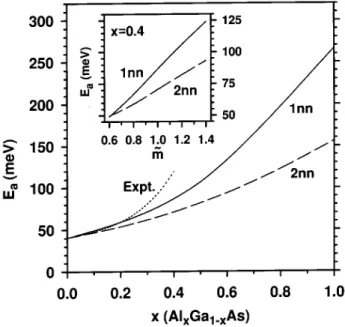
simple substitutional impurity at the As site. The bind-ing energy has been measured experimentally [12] usbind-ing photoluminescence in the direct-gap range 0 < x < 0:4, and the results are given by the dotted line in Fig.1. For pure GaAs, the binding energy is 40 meV, but
increases rapidly with an upward curvature to a rel-atively deep 120 meV by x = 0:40. The binding
energy curves Ea(x) calculated using the 1nn and 2nn
parametrizations are given in Fig.1 by the solid and broken lines, respectively. The VCA was used to obtain the Hamiltonian matrix elements for the alloy. Note, of course, that the VCA has no eect on the calculated binding energies at x = 0 or x = 1, which correspond to pure GaAs and pure AlAs respectively. The impu-rity perturbation potential U0was chosen in order that
the calculated acceptor energy match the experimental value for pure GaAs. This led to a value of 3.42 eV for 2nn and 2.80 eV for 1nn. These values of U0were then
used for all x, so that any variation in the acceptor en-ergy with respect to x is attributable to the electronic response of the host material, and not to central-cell eects. The result for 2nn is in qualitative agreement with experiment, showing an increasing binding energy with increasing Al content. However, it signicantly underestimates the binding energy at x = 0:4, with an energy of 71 meV compared to the experimental value of 120 meV. The result is improved considerably with 1nn, giving excellent agreement up to x = 0:2. How-ever, the results diverge beyond that, and the binding energy of 87 meV at x = 0:4 is still substantially below the experimental value.
Table 1 - Heavy- and light-hole eective masses along [100] and [111], given in units of the free-electron mass. Reference Compound MHH[100] MLH[100] MHH[111] MLH[111]
Experimenta GaAs 0.340 0.094 0.750 0.082
2nn (this work) GaAs 0.346 0.074 0.751 0.066
1nn (this work) GaAs 0.374 0.070 0.750 0.064
Theoryb AlAs 0.413 0.183 1.136 0.143
2nn (this work) AlAs 0.416 0.178 1.137 0.140
1nn (this work) AlAs 0.605 0.134 1.136 0.122
a Reference 10 b Reference 11
In order to investigate the possibility that small un-certainties in the eective masses for AlAs might pro-duce better agreement with experiment, the sensitivity of the binding energy to the HH masses is studied. The
adverse eect on some conduction-band features, these are of little importance in determining acceptor binding energies. In the inset of Fig.1, the acceptor energy at x = 0:4 is plotted as a function of ~m, for both 1nn and 2nn cases. A remarkably linear behavior is observed over a wide range of HH masses. Interestingly, the 1nn model is much more sensitive to variations in the HH mass, with even a modest increase greatly improving agreement with experiment. For the 2nn model, how-ever, even increasing the HH mass by 40% leads to bind-ing energy of only 93 meV, compared to 120 meV in experiment. It is worthwhile here to comment that in order to obtain good agreement with experiment (say 110 meV at x = 0:4) a binding energy of 400 meV
is required for x = 1:0 (i.e., pure AlAs). This energy serves as a useful reference for the analysis considered below.
Figure 1. Acceptor energies Ea for Ge impurities in
AlxGa1,xAs alloys, calculated with 1nn (solid line) and 2nn
parametrizations (dashed line). The experimental result is given by the dotted line. Inset: acceptor energy atx= 0:4 as a function of the mass scaling factor ~mfor 1nn and 2nn parametrizations.
Varying the TB parameters that determine the HH masses in eect changes thebulkproperties of the host. However, it is also possible to vary the TB parameters that pertain only to the impurity, without modifying the bulk properties. These parameters would therefore describe central-cell eects, and can be incorporated within the present theory through the on-site energy U0
of the impurity itself. Up to now, it has been assumed that U0was independent of the host. Nevertheless, it is
instructive to consider what eect variations in U0have
on the impurity energies. In Fig.2(a) the acceptor
en-ergy calculated for a range of U0 is presented for GaAs
and AlAs using the 2nn parametrizations. The curves are characterized by three distinct regimes: an ener-getically at regime for small U0, a linearly increasing
regime for large U0, and a transition region for
interme-diate U0. In the at region, dierent impurity species
(characterized by dierent U0) will have nearly identical
binding energies, meaning that central-cell corrections will be very small. Such behavior is typical of shallow levels, which implies that EMT is expected to work well in this regime.
It is interesting to note that in going from GaAs to AlAs (i.e., increasing HH mass), the energetically at regime gets pushed to ever smaller U0. In fact, for AlAs,
the at region is never quite reached, except perhaps for U0< 1 eV using 2nn, and so central-cell corrections are
expected to always be important for this host. It should also be kept in mind that the Coulomb potential due to the impurity as given by Eq. (2) is roughly 0.6 eV at the nearest-neighbor distance (2.45 A). Therefore, it is unphysical to consider acceptors with U0 smaller
than this value. The linear regime observed for large U0
marks the breakdown of the eective mass approach. In EMT, the impurity potential is assumed to be slowly varying on the atomic length scale. A potential of say 5.0 eV at the impurity site, falling to 0.6 eV at the nearest neighbor, clearly violates this approximation. In the linear regime, central-cell eects are expected to be very important, because even small variations in U0
(due to dierent impurities) will lead to large changes in binding energy.
In Fig.2(b) the impurity energy is plotted as a function of U0 for AlAs and GaAs using the 1nn
parametrization. Qualitatively, the results are similar to the 2nn case shown in Fig. (a). However, the 1nn case is once again found to be far more sensitive than the 2nn case. For instance, increasing U0 to just 3.3 eV
is sucient to give a binding energy of 400 meV in AlAs with 1nn, whereas a value of 5.5 eV is required with a 2nn model. Recalling that for GaAs the value of U0
was 3.42 eV for 2nn and 2.80 eV for 1nn, and consid-ering the chemical similarity between GaAs and AlAs, a value of 5.5 eV seems unrealistic. Therefore, the in-terpretation once more is that the 1nn results are more consisitent with experiment.
energy should depend only on the eective masses near the k point under consideration. From this point of
view, no dierence should exist between 1nn and 2nn parametrizations, as long as the eective masses were the same. In order to quantitatively study the validity of this assertion, however, the 1nn and 2nn TB parame-ters must be adjusted so as to give the same HH masses in the (100) as well as (111) directions [9]. Next, a value of U
0 suciently small (0.7 eV) is chosen so that the
EMT should be expected to hold, and the binding en-ergy calculated as a function of x, where as usualxis
the Al concentration of the AlxGa1,xAs alloy. The
re-sults are plotted in Fig.3, and show that the 1nn and 2nn results are in almost exact agreement over the en-tire range ofx. This is reassuring, because for shallow
levels the energy can only depend on the eective mass if the TB result is to be consisitent with EMT. The second case to be considered is for largerU
0, in which
the EMT can be expected to break down. A value of
U
0= 3
:5 eV is used and the energyE a(
x) recalculated.
From Fig.3, a radical dierence is now observed be-tween 1nn and 2nn parametrizations. For GaAs, the 1nn result gives 70 meV compared with only 42 meV using 2nn. In passing, it is instructive to note that the EMT result breaks down strongly for the U
0 = 3 :5 eV
case in GaAs but not for theU 0= 0
:7 eV case in AlAs,
even though the binding energies are comparable. This demonstrates that binding energy considerations alone are not enough to determine if a level can or cannot be described by EMT. In any case, the breakdown of EMT is even more dramatic for theU
0= 3
:5 eV case in
pure AlAs, with the 1nn approach yielding an energy of 454 meV compared with 182 meV using 2nn. The experimental data suggest, therefore, that1nn descrip-tions are more appropriate than 2nn for the case of deep levels. The likely reason is that the 2nn hopping terms permit the electron to escape more easily from the im-purity potential, thereby delocalizing the wave function and reducing the binding energy. To conrm this con-jecture, the radial charge distribution is calculated for an AlAs host using both 1nn and 2nn with an on-site energy U
0 of 3.5 eV. It is found indeed that the
elec-tron is far more delocalized using the 2nn approach. For instance, using 1nn, there is a 90% probability of local-izing the electron within 7 A of the impurity, whereas using the 2nn parametrization, the same probability is reached at roughly 14 A.
Figure 2. Acceptor binding energies for Ge impurities as a function of the on-site impurity potential U0 (a) Using
2nn parametrization for AlAs and GaAs. (b) Using 1nn parametrization for AlAs and GaAs. The at region for smallU0 indicates the regime in which EMT is expected to
work well.
Figure 3. Acceptor energies calculated for shallow levels (U0 = 0:7 eV) and deep levels (U0 = 3:5 eV) using 1nn
(solid line) and 2nn (dotted line) parametrizations, with the same HH eective masses. TheU
0= 0
:7 results are
consis-tent with EMT, whereas major deviations are observed for
IV Summary and Conclusions
Binding energies have been calculated for acceptors in GaAs, AlAs, and AlxGa1,xAs hosts. It was found that
the 1nn model is much more sensitive than the 2nn model to small changes in the parameters. Insight was gained into why and when central-cell corrections be-come important. For shallow levels in which central-cell corrections are unimportant, the 1nn and 2nn models give the same results. However, for intermediate to deep levels, the two results deviate, and experimental evidence suggests that the 1nn model is more appropri-ate. The reason is that the 2nn model is not as eective in binding the wave function to the impurity. The 2nn parametrizations are expected to be most useful there-fore for describing shallow levels, due to their superior ability to t the eective masses. A particularly inter-esting application of the 2nn approach may be for the case of donors in indirect gap materials, due to intrin-sic limitations in the 1nn ability to t conduction- band dispersion near the zone boundary.
Acknowledgements
Helpful discussions with Belita Koiller, Rodrigo Ca-paz, Helio Chacham, and Timothy Boykin are grate-fully acknowledged. The nancial support of CNPq, PRONEX, and FINEP is also greatly appreciated.
References
[1] C. Kittel and A. H. Mitchell, Phys. Rev. 96, 1488
(1954).
[2] J. M. Luttinger, and W. Kohn, Phys. Rev. 97, 869
(1955).
[3] C. Kittel,Introduction to Solid State Physics, 7th Ed., (Wiley, 1996) p. 225.
[4] J. G. Menchero, R. B. Capaz, Belita Koiller, and H. Chacham, Phys. Rev. B59, 2722 (1999).
[5] P. Vogl, H. P. Hjalmarson, and J. D. Dow, J. Phys. Chem. Solids 44, 365 (1983).
[6] J. Bernholc and S. T. Pantelides, Phys. Rev. B 15,
4935 (1977).
[7] J. K. L. MacDonald, Phys. Rev.46, 828 (1934); R. B.
Capaz, G. C. de Araujo, Belita Koiller, and J. P. von der Weid, J. Appl. Phys.745531 (1993); L. W. Wang
and A. Zunger, J. Chem. Phys.100, 2394 (1994).
[8] R. Enderlein, G. M. Sipahi, L. M. R. Scolfaro, and J. R. Leite, Phys. Stat. Sol. (b)206, 623 (1998).
[9] J. G. Menchero and T. B. Boykin, Impurity states in semiconductors calculated via tight-binding: a parame-ter sensitivity study, Phys. Rev. B59,to appear(1999).
[10] R. V. Shanabrook, O. J. Glembocki, D. A. Broido, and W. I. Wang, Phys. Rev. B39, 3411 (1989).
[11] L. Pavesi and M. Guzzi, J. Appl. Phys.75, 4779 (1994).
![Table 1 - Heavy- and light-hole eective masses along [100] and [111], given in units of the free-electron mass.](https://thumb-eu.123doks.com/thumbv2/123dok_br/18978770.456257/3.918.141.442.354.483/table-heavy-light-eective-masses-given-units-electron.webp)