Psychometric properties of Multidimensional Health
Locus of Control - A and General Self-Efficacy Scale in
civil servants: ELSA-Brasil Musculoskeletal Study
(ELSA-Brasil MSK)
Luciana A. C. Machado1, Rosa W. Telles2, Luciana Costa-Silva3, Sandhi M. Barreto1
Abstract | Background: Health-related control and self-eficacy beliefs can be assessed in the general population
using Multidimensional Health Locus of Control-A subscales (MHLC-A) and the General Self-Eficacy Scale (GSES), respectively. Objective: To test construct validity, internal consistency, reliability (test-retest) and ceiling and loor
effects of Portuguese-Brazil versions of MHLC-A and GSES. Method: Civil servants (N=2901) enrolled in a large
Brazilian cohort were included. A new version of the GSES was produced (GSES-Brazil). Procedures for cross-cultural adaptation and testing of psychometric properties followed well-accepted international guidelines. Results: Conirmatory
factor analyses yielded the following indices: MHLC-A (tridimensional model): χ2[df]=223.45[132], p-value <0.01;
CFI=0.87; TLI=0.85; RMSEA=0.07 (0.07-0.08); WRMR=3.00. GSES-Brazil (unidimensional model): χ2[df]=788.60[35], p-value <0.01; CFI=0.95; TLI=0.94; RMSEA=0.09 (0.08-0.09); WRMR=2.50. Cronbach’s alpha coeficients and
Intraclass Correlation Coeficients (ICC2,1) ranged from 0.57 (0.54-0.59) and 0.57 (0.47-0.65) for MHLC-A internality to 0.80 (0.79-0.81) and 0.71 (0.66-0.77) for GSES-Brazil, respectively. There was no evidence of ceiling and loor effects. Convergent validity analyses provided further support for construct validity of both scales. Conclusion: These
indings support the use of the newly developed version of GSES-Brazil for the assessment of general self-eficacy of adult Brazilians. Internal consistency was lower than ideal for MHLC-A, indicating these subscales may need further reinements to provide a more psychometrically sound measure of control beliefs.
Keywords: psychometric properties; measurement instruments; health-related control beliefs; self-eficacy, ELSA-Brasil.
BULLET POINTS
• Health-related control and self-eficacy beliefs can inluence engagement. • Psychometric properties of two scales designed to assess beliefs were tested. • Civil servants enrolled in a large cohort (N=2901) were included.
• The GSES-Brazil showed acceptable properties for use in adult Brazilians. • MHLC-A subscales need further reinements for the measure of control beliefs.
HOW TO CITE THIS ARTICLE
Machado LAC, Telles RW, Costa-Silva L, Barreto SM. Psychometric properties of Multidimensional Health Locus of Control - A and General Self-Eficacy Scale in civil servants: ELSA-Brasil Musculoskeletal Study (ELSA-Brasil MSK). Braz J Phys Ther. 2016 Sept-Oct; 20(5):451-460. http://dx.doi.org/10.1590/bjpt-rbf.2014.0177
1 Departamento de Medicina Preventiva e Social, Faculdade de Medicina, Universidade Federal de Minas Gerais (UFMG), Belo Horizonte, MG, Brazil 2 Departamento de Clinica Médica, Faculdade de Medicina, UFMG, Belo Horizonte, MG, Brazil
3 Departamento de Propedêutica Complementar, Faculdade de Medicina, UFMG, Belo Horizonte, MG, Brazil
Received: Oct. 02, 2015 Revised: Dec. 12, 2015 Accepted: Feb. 22, 2016
Introduction
Engagement is one of the core elements of the chronic care model, which is the framework for patient-centered disease management in modern healthcare1-3. When it comes to the patients’ perspective, engagement can be understood under a tripartite deinition, which includes their recognition of the importance to play an active role in their own health and health care, their
self-management capability, and health-promoting behaviors4. Increasing attention has been given to the development of strategies that empower individuals to engage in the prevention and management of long-term illnesses5,6. This has also been recently set
for Physical Therapy (WCPT), physical therapists are urged to discuss eficient ways “[...] to work with patients and clients to ensure that the health behavior changes that are important to sustainable healthy lives
are owned by them”7.
Health locus of control and self-eficacy are psychological constructs derived from social learning theories8 that can inluence engagement. Health locus
of control refers to cognitions regarding the location where one’s control over health resides: in the individual or in external factors over which the individual has little control9. Bandura has described self-eficacy as the “[...] belief in one’s capabilities to organize and execute the courses of action required to manage prospective situations [...]” (p. 2)10. Individuals with high self-eficacy are regarded as those who believe in their competency to deal with life stressors11. Thus, health locus of control and self-eficacy relate to different phenomena that can interact to produce and to maintain changes in health behavior12,13. For example,
a person with strong beliefs in his/her own actions to determine health outcomes (i.e. internal locus of control) and with a high sense of personal mastery over the environment and health (i.e. high self-eficacy) would be more likely to engage in the necessary behaviors to preserve or restore health. This has been supported by cumulative evidence from studies linking these two constructs to treatment adherence and long-lasting healthy behaviors14-21. However, the way health locus of control and self-eficacy interrelate and how they can affect both the initiation and persistence of certain behaviors (e.g. those that will ultimately inluence health and treatment outcomes) are still not clearly understood. Limited evidence has pointed towards a mediation role of self-eficacy in providing control of one’s performance in face of stressful situations22.
Multidimensional Health Locus of Control scales (MHLC) have been developed for the assessment of health-related control beliefs in the general population (MHLC-A and MHLC-B)23 or in individuals with a pre-existing medical condition (MLHC-C)24. MHLC-A and MHLC-B are considered equivalent forms of the same scale, although the former has been more frequently used in the literature. MHLC scales measure the level of agreement with belief statements indicating internal or external health-control beliefs23. Self-eficacy can be assessed by the General Self-Eficacy Scale (GSES)25, which measures the generalized sense of self-eficacy according to whether individuals agree with statements relecting a wide range of stressful situations, such as unexpected life events. Self-eficacy
can also been assessed by context-speciic scales, which measure the sense of personal competence to self-manage speciic chronic health conditions (e.g. arthritis26, asthma27, diabetes28,29, hypertension30), to cope with persistent symptoms (e.g. pain31) and/or to perform certain behaviors (e.g. to exercise32 or return to work33).
Given that MHLC-A and GSES have been widely used to assess health beliefs and do not have their application restricted to a target population, these scales were among the instruments selected for use in an ancillary study on musculoskeletal disorders from a large cohort investigating risk and prognostic factors for chronic non-communicable diseases in Brazil: the ELSA-Brasil Musculoskeletal Study (ELSA-Brasil MSK)34-36. Both scales have been previously adapted
for use in the Brazilian population and have had some of their psychometric properties tested (e.g. construct validity and internal consistency)37-41. However, the
investigation of key properties of the scales was still lacking, such as test-retest reliability and ceiling and loor effects. Additionally, the presence of important semantic and scoring differences between the two available versions of the GSES38,40 raised questions
on the adequacy of previous adaptation procedures. The present study aimed to expand prior psychometric research on Portuguese-Brazil versions of MHLC-A and GSES by evaluating measurement properties not previously investigated in the literature, and to test construct (structural and convergent) validity and internal consistency of both scales in participants of ELSA-Brasil MSK. A new process of cross-cultural adaptation of the GSES was also performed prior to psychometric testing of this particular scale.
Method
The study was approved by the ethics and research committee of Universidade Federal de Minas Gerais (UFMG), Belo Horizonte, MG, Brazil (protocol CAAE 0186.1.203.000-06). All participants signed a written informed consent after they had been informed of the nature and details of the study.
Cross-cultural adaptation of GSES
self-eficacy), except for the use of one bilingual translator in either translation process. The use of two translators was judged unnecessary given that previous Portuguese-Brazil versions of the scale38,40 could be
used for comparison with the newly developed version. This was done by an expert committee formed by the translators and the authors of this study, in order to evaluate the semantic, idiomatic, experiential and conceptual equivalence between the original and all translated versions of the scale, thus allowing the production of the inal version for psychometric testing.
The full versions of the scales previously adapted by Souza and Souza38 and Sbicigo et al.40 were retrieved through personal communication with the authors. Relevant differences between the two scales included the concept of effort of the original scale (e.g. “I can always manage to solve dificult problems if I try hard enough”), which was relected in the version of Souza and Souza38 but not in the version of Sbicigo et al.40, and the inclusion of an additional response option (“neither agree nor disagree”) to the scoring of the scale adapted by Souza and Souza38.
The new version of the Portuguese-Brazil GSES (GSES-Brazil) was pretested on a socioeconomically heterogeneous sample of 15 adults recruited by convenience at the institution where the study was conducted. No relevant issues were identiied in the comprehension of the newly developed version of the scale. The GSES-Brazil is described in Appendix 1.
Psychometric testing of MHLC-A and GSES-Brazil
Participants and data collection
Active or retired civil servants enrolled in ELSA-Brasil at the Investigation Center of Minas Gerais (IC-MG), who returned for the second wave of face-to-face interviews and examination of the cohort between September 2012 and October 2014 (corresponding to baseline assessments of ELSA-Brasil MSK), were eligible for inclusion34,35. Data on health-related
control and self-eficacy beliefs were collected by trained and certiied staff through the application of the MHLC-A and GSES-Brazil during an initial interview at the subject’s workplace (initial test). For reliability analyses, a subsample of consecutive subjects who visited IC-MG for further assessments was requested to complete both scales a second time (retest). The time between the initial test and the retest could not be deined a priori, as it was dependent on the date scheduled for participants’ return to IC-MG
to complete the battery of interviews and examination of the second wave of ELSA-Brasil36.
The targeted number of participants for test-retest reliability analyses was set at 300, representing three times the minimum sample size considered adequate by the COnsensus-based Standards for the selection of health Measurement INstruments (COSMIN) checklist43,44.
Instruments
The MHLC-A scale adapted to Portuguese-Brazil by Dela Coleta37 was used for the assessment of health-control
beliefs. The MHLC-A includes 18 belief statements subdivided into three 6-item subscales: (1) internality, or the level of control attributed to the individual, e.g. “If I get sick, it is my own behavior that determines how soon I get well again”; (2) externality-powerful others, or the level of control attributed to other persons (e.g. health providers, social leaders), e.g. “Having regular contact with my physician is the best way for me to avoid illness”; and (3) externality-chance, or the level of control attributed to luck, fate or chance, e.g. “No matter what I do, I ‘m likely to get sick”. Individuals should indicate whether they agree or disagree with each statement on a 6-point Likert scale (1 = strongly disagree; 2=moderately disagree; 3=slightly disagree; 4=slightly agree; 5=moderately agree; 6=strongly agree). The total MHLC-A score for each subscale ranges from 6 to 36 points, with higher scores indicating stronger beliefs in the control attributed to the particular dimension assessed by the subscale45.
The GSES-Brazil was used to assess general self-eficacy (Appendix 1). Similarly to the original
scale25, the GSES-Brazil contains 10 statements on the self-perceived competence of the individual to deal with new or dificult tasks, e.g. “I can remain calm when facing dificulties because I can rely on my coping abilities”. The scoring structure of the original scale was also retained, as follows: 1=not at all true; 2=hardly true; 3=moderately true; 4=exactly true. The sum of the responses provides a total score ranging from 10 to 40 points, with higher scores indicating a stronger sense of self-eficacy.
Statistical analysis
the same scale on two occasions (i.e.test and retest) were included in test-retest reliability analyses.
Structural validity was analyzed by conirmatory factor analyses (CFA). This approach has been recommended when the instrument to be tested has already had its factor structure determined by previous research46.
The original three-factor and one-factor structures of MHLC-A and GSES-Brazil, respectively, were considered for CFA analyses. The diagonal weighted least squares estimation (DWLS) method with polychoric correlations was used to estimate the factorial model parameters. To evaluate the adequacy of the model, the following goodness to it statistics were considered: χ2 (minimum it function); comparative it index (CFI); Tucker-Lewis index (TLI); root mean square error of approximation (RMSEA) with its associated 90% conidence interval (CI) and signiicance level due to a close it test; weighted root mean square residual (WRMR). The χ2 statistic is an absolute measure of the discrepancy between the observed covariance matrix and the matrix the model predicts, with smaller χ2 values and higher probability levels representing better it of the hypothesized model47,48. The CFI and TLI are
incremental relative it indices that estimate differences between the examined model and a hypothetical null model with unrelated components47. CFI and TLI
values ≥0.95 are indicative of close it49; however, less conservative cutoffs of 0.80 for TLI and 0.90 for CFI have also been used to indicate a desirable model it50,51. The RMSEA considers a hypothetical
null model where every component is related to other components in the model, and its estimate can be used both descriptively and inferentially52. RMSEA values ≤0.05 indicate a close it, whereas values up to 0.08 indicate an adequate it53. WRMR is a residual-based it index for ordinal data that measure the (weighted) average discrepancy between the studied sample and the estimated population variances and covariances48.
WRMR values close to 1.0 or lower denote adequate model it48,54.
The Pearson correlation coeficient (r) was used to investigate convergent validity. To do this, the following a priori hypotheses were formulated: (1) the MHLC-A internality score correlates positively with the GSES-Brazil score (given that beliefs in internal control and self-eficacy are related but not identical constructs, the correlation between them were expected to be moderate; i.e. 0.3≤r≤0.6); (2) the magnitude of the correlation between the GSES-Brazil score and the MHLC-A internality score is higher (≥10%) than that between the GSES-Brazil score and the
MHLC-A externality scores (for powerful others and chance subscales).
Internal consistency was analyzed by calculating Cronbach’s alpha coeficients and 95% CI, with coefficients between 0.70 and 0.95 considered satisfactory46. Ceiling and loor effects were analyzed
according to the percentage of participants who achieved the lowest or highest possible scores on each (sub)scale, and were considered present if more than 15% of the sample scored the maximum or minimum points. Test-retest reliability was analyzed by type 2,1 Intraclass Correlation Coeficient (ICC2,1). Reliability
was considered poor if ICC2,1<0.40, moderate if
0.40≤ICC2,1<0.75, substantial if 0.75≤ICC2,1≤0.90
and excellent if ICC2,1>0.9055. Alpha coeficients,
loor-ceiling effects and ICC were calculated separately for each of the three MHLC-A subscales (i.e. internality; externality-powerful others; externality-chance).
The Statistical Package for the Social Sciences (SPSS Inc., Chicago, USA, version 19.0) was used for all analyses except CFA. The latter was performed by using the latent variable analysis package for structural equation modeling (lavaan56) in the R software for
statistical computing (version 3.2.0)57.
Results
A total of 2901 civil servants, who were enrolled in ELSA-Brasil and completed MHLC-A and/or GSES-Brazil during baseline assessments of ELSA-Brasil MSK, were included in this study. Of these, 307 and 308 provided data for MHLC-A and GSES-Brazil, respectively, at two occasions (i.e. test and retest). Sociodemographic characteristics (i.e. sex, age, race/ ethnicity, social class, work status and nature of occupation) of the included participants are described in Table 1. Social class (i.e. low; middle; high) was coded as a summary measure based on the current occupation held by the participant, the expected income based on the education level (i.e. average market value), and the observed income58. The nature of occupation was categorized
into four groups (i.e.routine, manual; non-routine, manual; routine, non-manual; and, non-routine, non-manual) according to the deinitions proposed by Autor et al.59. Because of the small amount of missing data, imputation procedures were not required60
Table 1. Sociodemographic characteristics of study participants.
Characteristics
N (%)
Overall sample (N=2901) Subsamplea (N=308)
Sex
Female 1534 (52.9) 152 (49.4)
Male 1367 (47.1) 156 (50.6)
Age, years, mean ± SD 56.0±8.9 53.4±8.1 Race/ ethnicity
White 1417 (48.8) 170 (55.2)
Black 368 (12.7) 34 (11.0)
Brown (‘Pardo’) 998 (34.4) 97 (31.5)
Asian 64 (2.2) 5 (1.6)
Indigenous 15 (0.5) 0
Missing 39 (1.4) 2 (0.6)
Social class
Low 522 (18.0) 38 (12.3)
Middle 1184 (40.8) 124 (40.3)
High 1170 (40.3) 141 (45.8)
Missing 25 (0.9) 5 (1.6)
Work status
Active 2308 (79.6) 291 (94.5)
Retired 593 (20.4) 17 (5.5)
Nature of occupationb
Routine, manual 343 (11.8) 22 (7.1)
Non-routine, manual 23 (0.8) 0
Routine, non-manual 764 (26.3) 57 (18.5) Non-routine, non-manual 1746 (60.2) 224 (72.7)
Missing 25 (0.9) 5 (1.6)
aSubsample included in analyses of test-retest reliability; bData provided from participants with active work status.
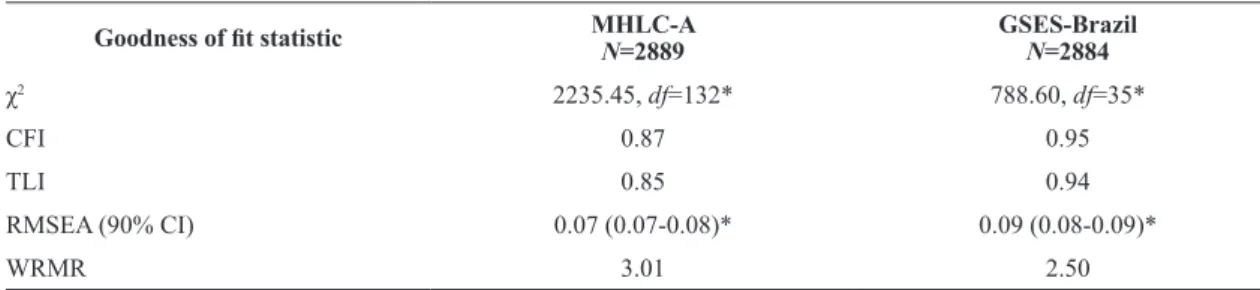
Table 2. Goodness of it indices from conirmatory factor analyses (CFA) of GSES-Brazil and MHLC-A.
Goodness of it statistic MHLC-A
N=2889
GSES-Brazil N=2884
χ2 2235.45, df=132* 788.60, df=35*
CFI 0.87 0.95
TLI 0.85 0.94
RMSEA (90% CI) 0.07 (0.07-0.08)* 0.09 (0.08-0.09)*
WRMR 3.01 2.50
GSES-Brazil: Portuguese-Brazil General Self-Eficacy Scale. MHLC-A: Multidimensional Health Locus of Control - Form A. χ2: minimum
it function. CFI: comparative it index. TLI: Tucker Lewis index. RMSEA: root mean square error of approximation. CI: conidence interval. WRMR: weighted root mean square residual. Data refers to the robust (scaled) test statistic for one-factor GSES-Brazil and three-factor MHLC-A. *p<0.001.
were {1,6,8,12,13,17}, on externality-powerful others were {3,5,7,10,14,18}, and, on externality-chance were {2,4,9,11,15,16}. For GSES-Brazil, the ability of the unidimensional model to reproduce the input
Results of convergent validity analyses showed signiicant correlations at a p=0.01 level (2-tailed) between MHLC-A internality and GSES-Brazil scores (r=0.27, p<0.01), MHLC-A powerful others and GSES-Brazil scores (r=0.14, p<0.01) and MHLC-A chance and GSES-Brazil scores (r=0.07, p<0.01). Results of internal consistency, ceiling and loor effects and test-retest reliability analyses for MHLOC-A subscales and GSES-Brazil are described in Table 3. The median sample time between the test and the retest of both scales was 26 days (interquartile range, IQR 15 to 42). Post-hoc sensitivity analyses for test-retest reliability was performed excluding participants whose time between the irst and second application of the scales was within the highest quartile (i.e. >42 days) to explore whether this could inluence the ICC2,1 values. These analyses included
237 participants and new ICC2,1 values (95% CI)
were only marginally different from those found in the main analyses, as follows: 0.57 (0.47-0.66) for MHLC-A internality; 0.72 (0.65-0.78) for MHLC-A powerful others; 0.63 (0.54-0.70) for MHLC-A chance; 0.71 (0.64-0.77) for GSES-Brazil.
Discussion
This study has investigated the construct validity and internal consistency of two belief scales (MHLC-A and GSES-Brazil) in a large, ethnically and socioeconomically diverse sample of Brazilian civil servants. It has also provided novel data on test-retest reliability and loor-ceiling effects of these instruments.
Prior evidence on structural validity of MHLC-A in Brazil came from the study by Paine et al.39, who performed exploratory factor analysis (EFA) on a sample of 280 civil servants, university students and wives of military personal. In accordance to the original structure of MHLC-A, the authors found three factors
with eigenvalues greater that 1.00 that accounted for 25% of the total variance39. Additionally, a series of principal component analyses (PCA) performed by Dela Coleta37 and reported in two unpublished
studies seem to support the three-factor structure of MHLC-A; however, the lack of detailed information on these analyses preclude any formal conclusions (these have been briely described in a book chapter37,
p. 226-227). When it comes to the GSES-Brazil, one previous study conducted by Leme et al.41 performed CFA to assess the scale’s structural validity in a sample of 447 Brazilian adolescents and found goodness to it indices that support its original one-factor structure (e.g. CFI=0.95; RMSEA=0.06).
CFA in our study has somewhat conirmed the tridimensional and unidimensional structures of MHLC-A and GSES-Brazil, respectively, given than three of the investigated indices (CFI, TLI and RMSEA) were close to the cutoffs recommended for acceptable model it. Although the signiicant p-values for χ2 (<0.001) would imply a model misit for both scales, this statistic is known to have important drawbacks when the sample size is large (e.g. N>1000). For example, in this situation it may relect statistically signiicant but negligible differences between the sample and the model implied matrices61. The same concern has
been raised by Yu for the WRMR statistic48 (p. 41, 42),
which has also presented values indicating a poor it in our sample.
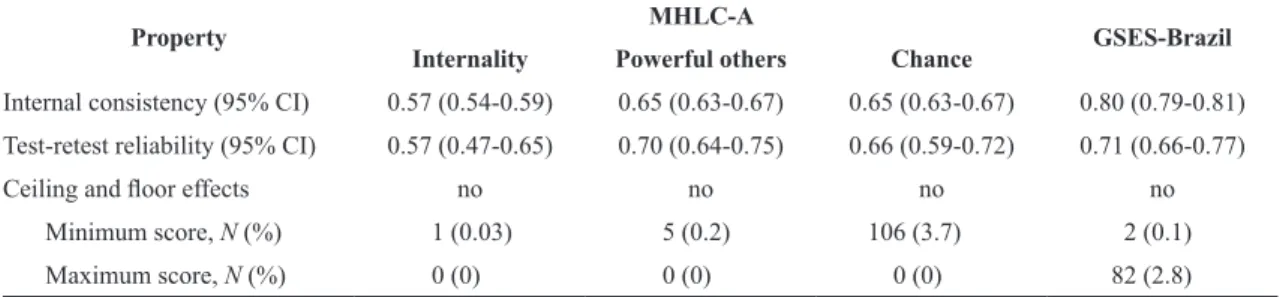
Although we found that internal consistency of MHLC-A subscales was not satisfactory (i.e. cronbach’s alpha coeficients <0.70), it was within the range reported in previous studies conducted in other Brazilian samples, as follows: 0.54 to 0.67 for MHLC-A internality, 0.62 to 0.71 for MHLC-A powerful others and 0.51 to 0.78 for MHLC-A
chance37,39. The GSES-Brazil presented adequate
internal consistency (alpha coeficient >0.80), a result that was also similar to that of previous studies38,40,41.
Table 3. Psychometric properties (i.e. internal consistency, test-retest reliability and loor-ceiling effects) of MHLC-A subscales and
GSES-Brazil.
Property MHLC-A GSES-Brazil
Internality Powerful others Chance
Internal consistency (95% CI) 0.57 (0.54-0.59) 0.65 (0.63-0.67) 0.65 (0.63-0.67) 0.80 (0.79-0.81) Test-retest reliability (95% CI) 0.57 (0.47-0.65) 0.70 (0.64-0.75) 0.66 (0.59-0.72) 0.71 (0.66-0.77)
Ceiling and loor effects no no no no
Minimum score, N (%) 1 (0.03) 5 (0.2) 106 (3.7) 2 (0.1)
Results of correlation analyses were in line with our pre-set hypotheses, providing further support for the validity of both scales. As expected, the strength of one’s beliefs in his or her ability to perform the behaviors required to produce desired outcomes (i.e. high self-eficacy) correlated moderately with higher levels of conidence in the ability to exercise control (i.e. high internality beliefs).
To our knowledge, our study was the irst to investigate the test-retest reliability and ceiling and loor effects of Portuguese-Brazil versions of MHLC-A subscales and GSES-Brazil. All (sub)scales presented moderate test-retest reliability, with the ICC2,1 value for
GSES-Brazil nearly reaching the cutoff for substantial reliability. Additionally, there was no evidence of ceiling and loor effects for any of the investigated (sub)scales. Given that the present study was designed as a secondary investigation nested within assessments of a large cohort36, the date of the retest for reliability
analyses could not be chosen a priori. The use of an arbitrary time between the test and retest was an important limitation in our study. For example, one could question whether personal beliefs assessed by MHLC-A and GSES-Brazil would remain stable over several weeks. However, similar results of sensitivity analyses excluding participants with longer periods between the two applications of the scales suggested no effect of time on our reliability results.
The assessment of health-related control and self-efficacy beliefs in epidemiologic research including non-clinical samples is extremely important for increasing the understanding of the mechanisms by which maladaptive beliefs inluence the onset and progression of chronic conditions commonly managed by physical therapists. Our indings support the use of the newly developed version of the GSES-Brazil for the assessment of general self-eficacy in adult Brazilians. On the other hand, the psychometric properties of MHLC-A subscales, particularly internal consistency, were found to be lower than ideal, not reaching the quality standards recommended by current guidelines on health measurement instruments. Therefore, MHLC-A subscales may need further reinements to provide a more psychometrically sound measure of health-related control beliefs in epidemiologic studies.
Acknowledgements
The authors thank the staff and participants of the ELSA-Brasil Study for their important contributions. We also thank Dr Rodrigo Citton Padilha Reis for
his valuable assistance with the statistical analyses. The ELSA-Brasil baseline study was supported by the Brazilian Ministry of Health (Science and Technology Department) and the Brazilian Ministry of Science and Technology (Financiadora de Estudos e Projetos) and CNPq (National Research Council). ELSA-Brasil MSK has been supported by the Coordination for the Improvement of Higher Education Personnel (CAPES) and Secretaria de Estado de Ciência, Tecnologia e Ensino Superior de Minas Gerais (SECTES), Serviço de Apoio às Micro e Pequenas Empresas (SEBRAE–MG), and Universidade Federal de Minas Gerais (UFMG). LACM is a postdoctoral fellow of CAPES. SMB is a research fellow of CNPq and State of Minas Gerais Agency for Research and Technology (FAPEMIG).
References
1. WagnerEH, AustinBT, KorffMV. Organizing care for
patients with chronic illness.Milbank Q. 1996;74(4): 511-44. http://dx.doi.org/10.2307/3350391. PMid:8941260. 2. Bodenheimer T, WagnerEH, GrumbachK. Improving
primary care for patients with chronic illness. JAMA.
2002;288(14):1775-9. http://dx.doi.org/10.1001/jama.288.14.1775.
PMid:12365965.
3. ColemanK, AustinBT, BrachC, WagnerEH. Evidence on
the Chronic Care Model in the new millennium. Health
Aff (Millwood). 2009;28(1):75-85. http://dx.doi.org/10.1377/
hlthaff.28.1.75. PMid:19124857.
4. SimmonsLA, WoleverRQ, BechardEM, SnydermanR.
Patient engagement as a risk factor in personalized health care: a systematic review of the literature on chronic disease. Genome Med. 2014;6(2):16. http://dx.doi.org/10.1186/gm533.
PMid:24571651.
5. JordanJE, BriggsAM, BrandCA, OsborneRH. Enhancing
patient engagement in chronic disease self-management support initiatives in Australia: the need for an integrated approach. Med J Aust. 2008;189(10 Suppl):S9-s13.
PMid:19143585.
6. MilaniRV, LavieCJ. Health care 2020: reengineering health care delivery to combat chronic disease. Am J Med. 2015;128(4):337-43. http://dx.doi.org/10.1016/j.
amjmed.2014.10.047. PMid:25460529.
7. World Physical Therapy Day – WCPT. Resources on why physical therapy matters [Internet]. London: World Physical
Therapy Day; 2015 [cited 2015 Nov 18]. Available from:
http://www.wcpt.org/sites/wcpt.org/files/files/wptday/15/ resource-booklet/WPTD2015_Resources_final.pdf. 8. RosenstockIM, StrecherVJ, BeckerMH. Social learning theory
and the Health Belief Model.Health Educ Q. 1988;15(2):175
-83. http://dx.doi.org/10.1177/109019818801500203. PMid:3378902.
9. LuszczynskaA, SchwarzerR. Multidimensional health
locus of control: comments on the construct and its measurement.J Health Psychol. 2005;10(5):633-42. http://
10. BanduraA. Self-efficacy in changing societies. In: Bandura
A. Exercise of personal and collective efficacy in changing societies. New York: Cambridge University Press; 1995. p. 1-45.
11. SchwarzerR, BäßlerJ, Kwiatek P, SchröderK, ZhangJ.
The assessment of optimistic self-beliefs: Comparison of the German, Spanish, and Chinese versions of the General Self-efficacy Scale.Appl Psychol. 1997;46(1):69-88. http://
dx.doi.org/10.1111/j.1464-0597.1997.tb01096.x.
12. CrossMJ, MarchLM, LapsleyHM, ByrneE, BrooksPM.
Patient self-efficacy and health locus of control: relationships with health status and arthritis-related expenditure. Rheumatology (Oxford). 2006;45(1):92-6. http://dx.doi.
org/10.1093/rheumatology/kei114. PMid:16287930.
13. BanduraA. Self-efficacy: toward a unifying theory of
behavioral change.Psychol Rev. 1977;84(2):191-215. http://
dx.doi.org/10.1037/0033-295X.84.2.191. PMid:847061.
14. De Las CuevasC, Penate W, SanzEJ. The relationship of
psychological reactance, health locus of control and sense of self-efficacy with adherence to treatment in psychiatric outpatients with depression.BMC Psychiatry. 2014;14(1):324.
http://dx.doi.org/10.1186/s12888-014-0324-6. PMid:25412702.
15. Slovinec D’AngeloME, PelletierLG, ReidRD, HutaV. The
roles of self-efficacy and motivation in the prediction of short- and long-term adherence to exercise among patients with coronary heart disease.Health Psychol. 2014;33(11): 1344-53. http://dx.doi.org/10.1037/hea0000094. PMid:25133848.
16. WengLC, DaiYT, HuangHL, ChiangYJ. Self-efficacy, self-care behaviours and quality of life of kidney transplant recipients.J Adv Nurs. 2010;66(4):828-38. http://dx.doi.
org/10.1111/j.1365-2648.2009.05243.x. PMid:20423370. 17. MelandE, MaelandJG, LaerumE. The importance of
self-efficacy in cardiovascular risk factor change.Scand J Public Health. 1999;27(1):11-7. http://dx.doi.org/10.1177
/14034948990270011001. PMid:10847665.
18. ChristensenAJ, HowrenMB, HillisSL, Kaboli P, Carter
BL, CvengrosJA, et al. Patient and physician beliefs about
control over health: association of symmetrical beliefs with medication regimen adherence.J Gen Intern Med.
2010;25(5):397-402. http://dx.doi.org/10.1007/s11606-010-1249-5. PMid:20174972.
19. FuertesJN, MislowackA, BennettJ, PaulL, GilbertTC, Fontan
G, et al. The physician-patient working alliance.Patient
Educ Couns. 2007;66(1):29-36. http://dx.doi.org/10.1016/j.
pec.2006.09.013. PMid:17188453.
20. LeeYJ, ShinSJ, WangRH, LinKD, LeeYL, WangYH.
Pathways of empowerment perceptions, health literacy, self-efficacy, and self-care behaviors to glycemic control in patients with type 2 diabetes mellitus.Patient Educ Couns. 2016;99(2):287-94. http://dx.doi.org/10.1016/j.
pec.2015.08.021. PMid:26341940.
21. LuszczynskaA, SarkarY, KnollN. Received social support,
self-efficacy, and finding benefits in disease as predictors of physical functioning and adherence to antiretroviral therapy.Patient Educ Couns. 2007;66(1):37-42. http://dx.doi.
org/10.1016/j.pec.2006.10.002. PMid:17097259.
22. LittMD. Self-efficacy and perceived control: cognitive mediators
of pain tolerance.J Pers Soc Psychol. 1988;54(1):149-60.
http://dx.doi.org/10.1037/0022-3514.54.1.149. PMid:3346804.
23. WallstonKA, WallstonBS, DeVellisR. Development of
the Multidimensional Health Locus of Control (MHLC) Scales.Health Educ Monogr. 1978;6(2):160-70. http://dx.doi.
org/10.1177/109019817800600107. PMid:689890.
24. WallstonKA, SteinMJ, SmithCA. Form C of the MHLC
scales: a condition-specific measure of locus of control.J Pers Assess. 1994;63(3):534-53. http://dx.doi.org/10.1207/
s15327752jpa6303_10. PMid:7844739.
25. SchwarzerR, JerusalemM. Generalized Self-Efficacy scale.
Windsor: NFER-NELSON; 1995.
26. BradyTJ. Measures of self-efficacy: Arthritis Self-Efficacy Scale (ASES), Arthritis Self-Efficacy Scale-8 Item (ASES-8), Children’s Arthritis Self-Efficacy Scale (CASE), Chronic Disease Self-Efficacy Scale (CDSES), Parent’s Arthritis Self-Efficacy Scale (PASE), and Rheumatoid Arthritis Self-Efficacy Scale (RASE).Arthritis Care Res (Hoboken).
2011;63(Suppl 11):S473-85. http://dx.doi.org/10.1002/
acr.20567. PMid:22588769.
27. TobinDL, WigalJK, WinderJA, HolroydKA, CreerTL. The
“Asthma Self-Efficacy Scale”.Ann Allergy. 1987;59(4):273
-7. PMid:3662130.
28. GrossmanHY, BrinkS, HauserST. Self-efficacy in adolescent girls and boys with insulin-dependent diabetes mellitus. Diabetes Care. 1987;10(3):324-9. http://dx.doi.org/10.2337/
diacare.10.3.324. PMid:3595399.
29. BijlJV, Poelgeest-EeltinkAV, Shortridge-BaggettL. The
psychometric properties of the diabetes management self-efficacy scale for patients with type 2 diabetes mellitus.J Adv Nurs. 1999;30(2):352-9.
http://dx.doi.org/10.1046/j.1365-2648.1999.01077.x. PMid:10457237.
30. OgedegbeG, MancusoCA, AllegranteJP, CharlsonME.
Development and evaluation of a medication adherence self-efficacy scale in hypertensive African-American patients.J Clin Epidemiol. 2003;56(6):520-9. http://dx.doi.
org/10.1016/S0895-4356(03)00053-2. PMid:12873646.
31. AndersonKO, DowdsBN, PelletzRE, EdwardsWT,
Peeters-AsdourianC. Development and initial validation of a scale to measure self-efficacy beliefs in patients with chronic pain.Pain. 1995;63(1):77-84.
http://dx.doi.org/10.1016/0304-3959(95)00021-J. PMid:8577493.
32. Dzewaltowski D. Toward a model of exercise motivation.
J Sport Exerc Psychol. 1989;11:251-69.
33. ShawWS, RemeSE, LintonSJ, HuangYH, PranskyG. 3rd
place, PREMUS best paper competition: development of the return-to-work self-efficacy (RTWSE-19) questionnaire--psychometric properties and predictive validity.Scand J Work Environ Health. 2011;37(2):109-19. http://dx.doi.
org/10.5271/sjweh.3139. PMid:21203742.
34. MachadoLA, Telles RW, Costa-SilvaL, BarretoSM. Perfil da
coorte ELSA-Brasil musculoesquelético.Braz J Rheumatol. 2016;56(Suppl 1):S29-30.
35. Telles RW, Costa-SilvaL, MachadoLA, BarretoSM.
Investigating osteoarthritis in a subcohort of the Brazilian Longitudinal Study of Adult Health: The ELSA-Brasil Musculoskeletal Study (ELSA-Brasil MSK).Osteoarthr. cartil. 2016;24(Suppl 1):S210-11.
36. SchmidtMI, DuncanBB, MillJG, LotufoPA, Chor D, Barreto
Health (ELSA-Brasil). Int J Epidemiol. 2015;44(1):68-75.
http://dx.doi.org/10.1093/ije/dyu027. PMid:24585730. 37. Dela ColetaM. Locus de controle e saúde. In: Dela Coleta
MF, editor. Modelos para pesquisa e modificação de comportamentos de saúde: teorias, estudos, instrumentos. Taubaté: Cabral Editora e Livraria Universitária; 2004. p. 199-238.
38. SouzaI, SouzaM. Validation of the general Self-Eficacy Scale.Cienc Rural. 2004;26:12-7.
39. Paine P, PasqualiL, PauloSES, BianchiAL, SolhaAC.
Psychometric properties of the Brazilian Health Locus of Control Scale.Psychol Rep. 1994;75(1 Pt 1):91-4. http://
dx.doi.org/10.2466/pr0.1994.75.1.91. PMid:7984757.
40. SbicigoJ, TeixeiraM, DiasA, Dell’Aglio D. Propriedades
psicométricas da Escala de Autoeficácia Geral Percebida (EAGP).PSICO. 2012;43:139-46.
41. LemeVB, CoimbraS, GatoJ, FontaineAM, Del Prette ZA.
Confirmatory factor analysis of the generalized self-efficacy scale in Brazil and Portugal.Span J Psychol. 2013;16:E93.
http://dx.doi.org/10.1017/sjp.2013.93. PMid:24230956.
42. BeatonDE, BombardierC, GuilleminF, FerrazMB. Guidelines
for the process of cross-cultural adaptation of self-report measures.Spine. 2000;25(24):3186-91. http://dx.doi.
org/10.1097/00007632-200012150-00014. PMid:11124735.
43. TerweeCB, MokkinkLB, KnolDL, OsteloRW, Bouter
LM, de VetHC. Rating the methodological quality in systematic reviews of studies on measurement properties: a scoring system for the COSMIN checklist.Qual Life Res. 2012;21(4):651-7.
http://dx.doi.org/10.1007/s11136-011-9960-1. PMid:21732199.
44. MokkinkLB, PrinsenCA, BouterLM, VetHC, Terwee
CB. The COnsensus-based Standards for the selection of health Measurement INstruments (COSMIN) and how to select an outcome measurement instrument.Braz J Phys
Ther. 2016 [Epub ahead of print]. http://dx.doi.org/10.1590/
bjpt-rbf.2014.0143.
45. WallstonKA. Multidimensional Health Locus of Control
(MHLC) scales [Internet]. Nashville: University School of
Nursing, 2007 [cited 2015 Sept 24]. Available from: http://
www.nursing.vanderbilt.edu/faculty/kwallston/mhlcscales. htm.
46. TerweeCB, BotSD, de BoerMR, van der WindtDA, Knol DL, DekkerJ, et al. Quality criteria were proposed for
measurement properties of health status questionnaires.J Clin Epidemiol. 2007;60(1):34-42. http://dx.doi.org/10.1016/j.
jclinepi.2006.03.012. PMid:17161752.
47. CookKF, KallenMA, Amtmann D. Having a fit: impact
of number of items and distribution of data on traditional criteria for assessing IRT’s unidimensionality assumption. Qual Life Res. 2009;18(4):447-60. http://dx.doi.org/10.1007/
s11136-009-9464-4. PMid:19294529.
48. YuCY. Evaluating cutoff criteria of model fit indices for latent variable models with binary and continuous outcomes
[dissertation]. Los Angeles: University of California; 2002. 49. HuL, Bentler P. Cut off criteria for fit indexes in covariance
structure analysis: Conventional criteria versus new alternatives.Struct Equ Modeling. 1999;6(1):1-55. http://
dx.doi.org/10.1080/10705519909540118.
50. ChibnallJT, TaitRC. Confirmatory factor analysis of
the Pain Catastrophizing Scale in African American and Caucasian Workers’ Compensation claimants with low back injuries. Pain. 2005;113(3):369-75. http://dx.doi.
org/10.1016/j.pain.2004.11.016. PMid:15661446.
51. Hooper D, CoughlanJ, MullenM. Structural Equation
Modelling: guidelines for determining model fit.Electron J Bus Res Methods. 2008;6:53-60.
52. KelleyK, LaiK. Accuracy in parameter estimation for
the root mean square error of approximation: sample size planning for narrow confidence intervals.Multivariate Behav Res. 2011;46(1):1-32. http://dx.doi.org/10.1080/002
73171.2011.543027. PMid:26771579.
53. BrowneM, CudeckR. Alternative ways of assessing model fit.
In: BollenKA, LongJS, editors. Testing structural equation models. Newbury Park: Sage Publications; 1993. p. 136-162. 54. ReeveBB, HaysRD, BjornerJB, CookKF, CranePK,
TeresiJA, et al. Psychometric evaluation and calibration
of health-related quality of life item banks: plans for the Patient-Reported Outcomes Measurement Information System (PROMIS).Med Care. 2007;45(5 Suppl 1):S22 -31. http://dx.doi.org/10.1097/01.mlr.0000250483.85507.04.
PMid:17443115.
55. FleissJ. The design and analysis of clinical experiments.
New York: Wiley; 1986.
56. RousseelY. lavaan: an R package for structural equation modeling.J Stat Softw. 2012;48(2):1-36.
57. R Development Core Team. R: A language and environment for statistical computing [software]. Vienna: The R Foundation
for Statistical Computing [cited 2015 Sept 24]. Available
from: http://www.R-project.org/.
58. CameloLV, GiattiL, Chor D, GriepRH, BenseñorIM, Santos
IS, et al. Associations of life course socioeconomic position
and job stress with carotid intima-media thickness. The Brazilian Longitudinal Study of Adult Health (ELSA-Brasil). Soc Sci Med. 2015;141:91-9. http://dx.doi.org/10.1016/j.
socscimed.2015.07.032. PMid:26259011.
59. Autor DH, LevyF, MurnaneRJ. The skill content of
recent technological change: an empirical exploration. Q J Econ. 2003;118(4):1279-333. http://dx.doi.
org/10.1162/003355303322552801.
60. SchaferJL. Multiple imputation: a primer.Stat Methods Med Res.
1999;8(1):3-15. http://dx.doi.org/10.1191/096228099671525676.
PMid:10347857.
61. BrownTA. Confirmatory factor analysis for applied research. New York: Guilford Publications; 2015.
Correspondence Luciana A. C. Machado
Universidade Federal de Minas Gerais (UFMG) Faculdade de Medicina
Appendix 1. Portuguese-Brazil General Self-Eficacy Scale (GSES-Brazil).
Escala de Autoeicácia Geral - Brasil (EAEG-Brasil)
Eu vou ler airmativas sobre algumas situações de vida. Gostaria que o(a) Sr(a) me respondesse utilizando essas opções de resposta: não é verdade; diicilmente é verdade; é mais ou menos verdade; é totalmente verdade.
01. Eu sempre consigo resolver os problemas difíceis se eu tentar bastante.
02. Se alguém for contra mim, eu posso encontrar os meios e as formas de alcançar o que eu quero. 03. Para mim, é fácil me agarrar aos meus objetivos e atingir as minhas metas.
04. Eu tenho coniança que sou capaz de lidar bem com acontecimentos inesperados. 05. Graças às minhas habilidades, eu sei como lidar com situações imprevistas. 06. Eu posso resolver a maioria dos problemas se eu izer o esforço necessário.
07. Eu consigo me manter calmo(a) para enfrentar diiculdades porque conio nas minhas habilidades. 08. Diante de um problema, geralmente eu consigo encontrar diversas soluções.
09. Se eu tiver um problema, geralmente eu consigo pensar em uma solução.
10. Geralmente eu consigo lidar com qualquer diiculdade que aparece no meu caminho.
Não é verdade 1
Diicilmente é verdade 2
É mais ou menos verdade 3