* Naslov / Address: Assoc. Prof. Dr. Tabassum Rashid, Department of Psychology, Aligarh Muslim University, Aligarh, India, e-mail: [email protected]
Validation and Standardization of the Emotional Skills
and Competence Questionnaire (ESCQ) Among
Indian University Students
Tabassum Rashid* and Mohammad Ali Mohammadyfar Department of Psychology, Aligarh Muslim University, India
Abstract: There is a seeming theoretical incoherence surrounding the construct emotional intelligence (EI), as well as the problematic issues related to its measurement. The development of the psycho-metrically sound measurement tools based on the coherent theoretical models is fundamental for the EI to be considered as a valid construct. The current research is aimed to reexamine the psychometric properties and the factor structure of the Emotional Skills and Competence Questionnaire (ESCQ), as well as to evaluate the convergent validity in terms of its relationship with the multidimensional Emotional Intelligence Scale (EIS) developed and standardized in the Indian cultural settings. The results indicated that the self-report measure of emotional competence is reliable and valid. Moreover,
the factor structure of the questionnaire is conirmed, and other psychometric properties are found to
be much in line with the earlier studies conducted in various cultural backgrounds.
Key words: Emotional Intelligence, ESCQ, convergent validity, cross-cultural differences, internal consistency, self-rating scales
Validacija in standardizacija vprašalnika emocionalne
inteligentnosti ESCQ na vzorcu indijskih študentov
Tabassum Rashid and Mohammad Ali Mohammadyfar Department of Psychology, Aligarh Muslim University, India
Povzetek: V zvezi s konstruktom emocionalne inteligentnosti (EI) lahko govorimo o precejšnji
nesklad-nosti v teoretičnih izhodiščih, problemi se pojavljajo tudi pri njenem merjenju. Razvoj psihometrično ustreznega instrumenta, ki temelji na koherentnem teoretičnem modelu je bistvenega pomena, da lahko
EI obravnavamo kot veljaven konstrukt. Namen raziskave je preveriti merske karakteristike in faktor-sko strukturo vprašalnika emocionalne inteligentnosti ESCQ, kot tudi oceniti njegovo konvergetno
veljavnost v odnosu do večdimenzionalnega vprašalnika emocionalne inteligentnosti EIS, ki je bil
razvit in standardiziran v indijskem jezikovnem okolju. Rezultati so potrdili, da je vprašalnik ESCQ zanesljiv in veljaven. Potrdili smo trifaktorsko strukturo vprašalnika in tudi ostale merske karakteri-stike vprašalnika so podobne tistim, ki so jih dobili raziskovalci v drugih jezikovnih okoljih.
Ključne besede: čustvena inteligentnost, konvergentna veljavnost, samoocenjevalne lestvice, notranja
konsistentnost, medkulturne razlike
Emotional Intelligence (EI) has emerged in the past two decades as one the most illustrious psychological constructs, and a growing new domain of psychologi-cal and behavioral research. Although the term was irst mentioned in a German article entitled “Emotional Intelligence and Emancipation” by Leuner in 1966 (as cited in Mathews, Zeidner, and Roberts, 2004), there are evidences of research in the past highlighting the importance of emotions to intellectual functioning e. g., Thorndike (1921), Guilford (1956). However the EI as a psychological construct was brought to the mainstream psychology in the 1990s with the publication of Salovey and Mayer’s initial articles on the construct. Several factors like the emergence of the new discipline of ‘positive psychology’ highlighting the importance of a rich and fulilling emotional life, as well as the awareness to rectify the perceived inequity between the intellect and emotion in the human lives especially in the western world have contributed to the huge popularity of the concept within the academic arena of psychology (Zeidner, Mathews, & Roberts, 2004).
Nevertheless, the concept caught the imagination of the general public after the Daniel Goleman’s (1995) book on the theme emerged on the New York Times best-seller list. Although Goleman was censured by many researchers for the over inclusive and unclear deinition of EI, as well as his contention that EI is a more im -portant predictor of success than IQ without providing empirical support for these claims (Landy, 2005; Mayer and Cobb, 2000; Mayer, Salovey, and Caruso, 2004), nevertheless, it stimulated great deal of research on EI as is substantiated by the fact that competing theories of EI emerged after its publication.
At present the theoretical framework of EI is a topic of debate and controversy. Numerous comprehensive models with varied perspective provide the alternative theoretical frameworks for operationalization of the construct. Two major models of EI have emerged over the years: a) ability model, and b) trait or mixed model. The ability model presented by Salovey and Mayer (1990) highlight that EI is a collec-tion of abilities that combine to form four oblique irst-order factors, or branches: 1) Perceiving, appraising, and expressing emotions; 2) Using emotions to facilitate thought; 3) Understanding emotions; and 4) Managing emotions.
Conversely, the trait or mixed model focus more on personality traits and at-tributes such as optimism and motivation, but do make reference to cognitive abilities which operate while processing the emotional information (Goldenberg, Matheson, and Mantler, 2006; Livingstone and Day, 2005). The biggest criticism of mixed model theories concerns the fact that scores on most self-report measures of EI overlap considerably with measures of personality. According to Mayer et al. (2004), mixed models “often have little or nothing speciically to do with emotion or intelligence and, consequently, fail to map onto the term emotional intelligence” (p. 197).
self-report measures are beset with certain inherent limitations and weaknesses like response biases, impression management and social desirability effects. Additionally, it is argued that self- report measures do not relect actual performance, but assess a person’s self understanding or self-perceptions. In view of the fact that they don’t correlate with general intelligence (see, e. g., Paulhus, Lysy, and Yik, 1998; Mabe and West, 1982), it could be argued that they do not measure a type of intelligence. Given these criticisms and apparent inadequacies, Conte (2005) argued that mixed models are not as viable as ability models. The proposition that creation of performance-based measures analogous to the tools developed for the measurement of intelligence, are essential for EI to assume the status of a legitimate cognitive ability (Mayer, Caruso, & Salovey, 1999), led to the development of the Multi-factor Emotional Intelligence Scale (MEIS), and later the Mayer-Salovey-Caruso Emotional Intelligence Scale (MSCEIT). Although the predominant theories are ability models of EI, and prominent researchers in the ield support the development of more ability based modes of its assessment, there are arguments against the ability based assess-ment methods too. Some serious reliability problems related to the scoring of both MEIS & MSCEIT have been reported. Some subtests of MEIS as well as MSCEIT failed to reveal satisfactory level of internal consistency reliability. Mayer, Caruso, and Salovey (2000) reported reliability ranging from a very low (.49) to a very high (.94) for consensus scores. Similar results were obtained by Ciarrochi, Chan, and Caputi, (2000).
The criticism of self-report measurements of EI notwithstanding, self-report measures show suficient reliability across varied cultures with decent levels of test-retest reliability over 1- and 4-month periods (Bar-On, 1997, 2000), and do relate to emotionally intelligent behavior, if not formally fulilling the criteria for intel -ligence. Some researchers ind it safer to state that these measures assess emotional competencies, rather than some kind of intelligence.
The doctrine to measure the emotional competencies rather than abilities or
intelligence is what the originator of the Emotional Skills and Competence Ques-tionnaire (ESCQ) has pursued. The present study endeavors to reexamine the fac-tor structure, seek validation, and standardization of the ESCQ in Indian cultural settings.
Method
Participants
Measures
The two scales Emotional Skills and Competence Questionnaire (ESCQ) and Emotional Intelligence Scale (EIS) were simultaneously administered in the classes and the halls of residence of a university in northern India.
Emotional Skills and Competence Questionnaire (ESCQ): Originally, devel-oped in Croatian settings using theoretical framework from the Emotional Intel-ligence Model of Mayer and Salovey (1997), and later translated into English. The psychometric qualities and the relations of ESCQ with several relevant constructs in Croatian, Portuguese, Finnish, Swedish, Slovene, Spanish, and Japanese contexts were conducted using target samples of mainly high school and university students, as well as older subjects (workers and supervisors), evidencing construct, convergent, divergent and concurrent validity. The scale is classiied as a “trait emotional intel -ligence” or “perceived emotional intel-ligence” measure, and consists of 45 items divided into three subscales – (i) Perceiving and Understanding Emotions (PU), (ii) Expressing and Labeling Emotions (EL), and (iii) Managing and Regulating Emo-tions (MR) (Takšić, Jurin, & Cvenić, 2001).
The responses are measured on a 5-point Likert Type scale. The authors re-port Cronbach Alpha scores of ESCQ for reliability between .87 and .92 for the total scales as well as the subscales. Conirmatory Factor Analysis (CFA) performed on large samples of high school students has conirmed three factor structure (Takšić, 2005). Common variance (up to 28%) with the scales derived from similar measures has been reported.
Emotional Intelligence Scale (EIS): Developed and standardized by Singh (2004) in Indian settings, the scale is based on Goleman’s (1998) Model of EI compe-tencies, and consists of 60 statements (items) grouped under ive categories namely: Self Awareness, Self Regulation, Motivation, Social Awareness, and Social Skills. Higher score indicates high level of emotional intelligence in all the ive categories. The scale was administered on a sample of 263 managers (191 male and 72 female) with an average age of 37 years, from various functional areas and representing a set of heterogeneous business organizations in India.
To examine the concurrent validity three measures, Emotional Expressions, Organizational Commitment, and Quality of Life, were used. All the ive dimensions of EIS are positively correlated with all the three measures. To ascertain the face validity and content validity, agreement of three experts on each item belonging to the dimension it aimed to measure was considered. Suficient level of internal con -sistency has been reported for reliability. Alpha reliability of Social Skills dimension is reported to be highest (.87) followed by Self-Regulation and Empathy dimensions (.83). The dimension of Motivation has an Alpha reliability of .80 followed by the Self Awareness with .71.
Results
The Kaiser-Mayer-Olkin measure for the sample is .842, which suggests that there is variability in the data to conduct factor analysis. The result of Bartlett’s Test of Sphericity (Approximate chi-square = 3450, df = 903, p = .0005) suggests that the items were suficiently correlated to conduct Component Analysis.
Factor Rotation and Interpretation
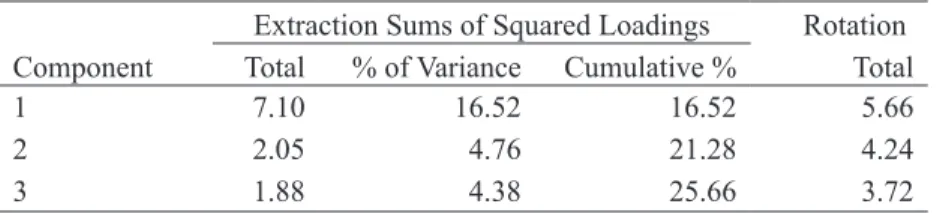
As mentioned earlier, the initial factor analysis of the scale has reported three factors for the ESCQ, and a number of researchers have conirmed the three factor structure of the ESCQ. In the current research also, the results of exploratory factor analysis showed that three factors have eigenvalue greater than one. Table 1 given below shows the eigenvalues of the factors before and after Promax rotation.
Table 1. Eigenvalues And Total Promax Explained
Component
Extraction Sums of Squared Loadings Rotation Total % of Variance Cumulative % Total
1 7.10 16.52 16.52 5.66
2 2.05 4.76 21.28 4.24
3 1.88 4.38 25.66 3.72
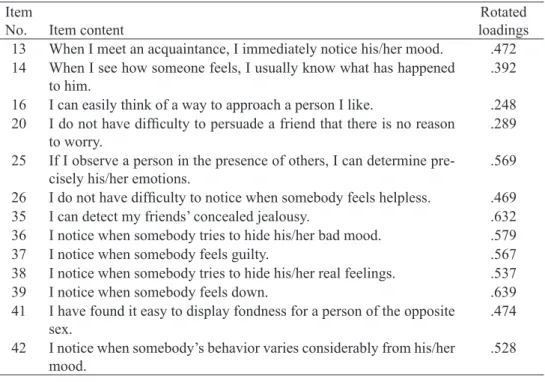
Table 2. Allocated items to irst factor with rotated loadings
Item
No. Item content
Rotated loadings 13 When I meet an acquaintance, I immediately notice his/her mood. .472 14 When I see how someone feels, I usually know what has happened
to him.
.392
16 I can easily think of a way to approach a person I like. .248
20 I do not have dificulty to persuade a friend that there is no reason
to worry.
.289
25 If I observe a person in the presence of others, I can determine pre-cisely his/her emotions.
.569
26 I do not have dificulty to notice when somebody feels helpless. .469
35 I can detect my friends’ concealed jealousy. .632
36 I notice when somebody tries to hide his/her bad mood. .579
37 I notice when somebody feels guilty. .567
38 I notice when somebody tries to hide his/her real feelings. .537
39 I notice when somebody feels down. .639
41 I have found it easy to display fondness for a person of the opposite sex.
.474
42 I notice when somebody’s behavior varies considerably from his/her mood.
.528
The item numbers 13, 14, 25, 26, 35, 36, 37, 38, 39, and 42 are the items which were allocated to irst subscale, namely Perception and Understanding of Emotions (PU) by the authors of the scale. In the current study only the item number 34 was deleted because it decreased the internal consistency of the questionnaire. Item number 19 was originally allocated to the factor 1 by the authors of scale. However, in current research, the same item is allocated to the factor 2. Also, the items number 15, 18 and 45 were deleted in order to ind simple solution.
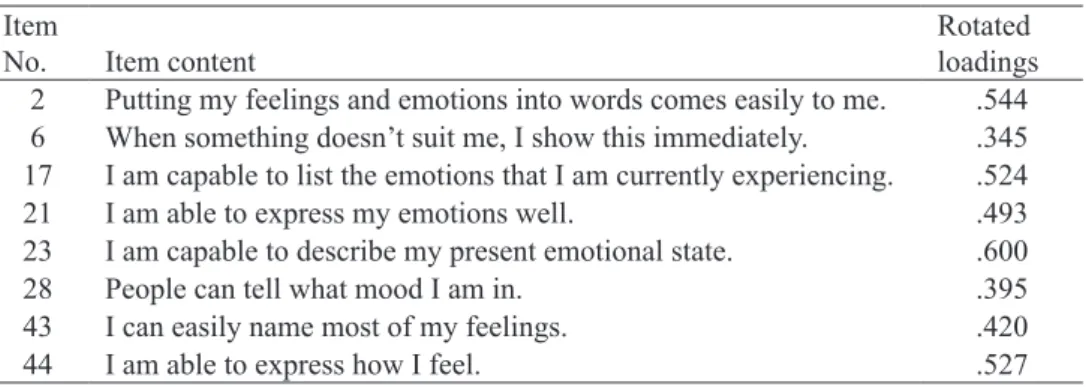
The items number 1, 4, 5, 9, 10, 11, 29, and 33, are allocated to the third subscale, i. e., Management and Regulationof Emotions (MR) by the authors of the questionnaire. The item numbers 19, 22 and 32 are added to this subscale, and the item number 3 is deleted because as reported earlier it has reduced internal consist-ency of the questionnaire. Also, the item numbers 7, 8, 12, 30, 31 and 40 were deleted because they had signiicant factor loading on more than one factor. However, this subscale which is extracted as the 2nd factor in current study is the 3rd factor in the original research.
Table 3. Allocated items to second factor with rotated loadings
Item
No. Item content
Rotated loadings 1 I am able to maintain a good mood even if something bad
hap-pens.
.178
4 Unpleasant experiences teach me how not to act in the future. .341 5 When somebody praises me, I work with more enthusiasm. .399 10 When I am with a person who thinks highly of me, I am careful
about how I behave.
.400
11 I study and learn best, when I am in a good mood and happy. .527 19 I can easily think of a way to make my friend happy on his/her
birthday.
.472
22 I can recognize most of my feelings. .432
29 I try to control unpleasant emotions, and strengthen positive ones. .455
32 I usually understand why I feel bad. .380
33 I try to keep up a good mood. .518
Table 4.Allocated items to third factor with rotated loadings
Item
No. Item content
Rotated loadings 2 Putting my feelings and emotions into words comes easily to me. .544 6 When something doesn’t suit me, I show this immediately. .345 17 I am capable to list the emotions that I am currently experiencing. .524
21 I am able to express my emotions well. .493
23 I am capable to describe my present emotional state. .600
28 People can tell what mood I am in. .395
43 I can easily name most of my feelings. .420
44 I am able to express how I feel. .527
Reliability of the
ESCQ
In order to examine the reliability of the ESCQ and its subscale internal con-sistency, Cronbach α coeficient was used. The results are reported in table 5.
Convergent validity of the ESCQ
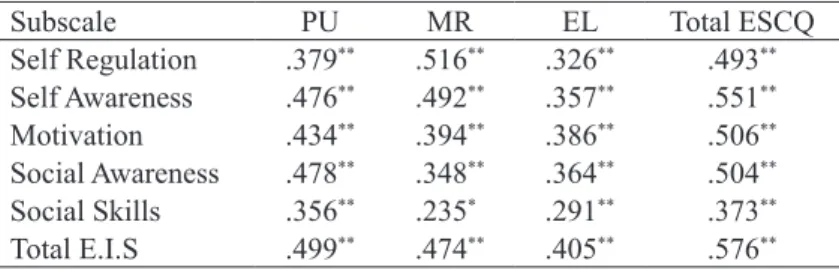
Table 6shows that all correlational values of the ESCQ, EIS and their subscales are positively signiicant. From the results, it could be deduced that the ESCQ is a valid scale for measuring the Emotional Skills and Competence among university student sample in India.
Standardized scores
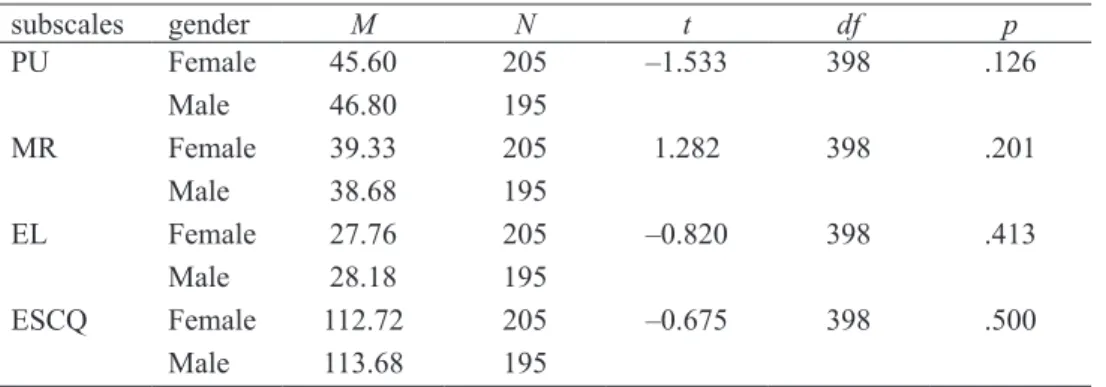
In order to compute the standardized scores of ESCQ and its subscales among Indian university students, it is essential to test the differences between the mean scores of ESCQ and its subscales with consideration of gender. To determine the difference vis-à-vis gender, Independent Samples t-test was administered. In order to test out the normality of the distribution of sample, Kolmogorov-Smirnov test was applied. Table 8 and 9 present the results.
A perusal of table 8 shows that there are no signiicant differences between the mean scores of ESCQ and its subscales with consideration of gender. Since there is no signiicant difference between the mean scores of ESCQ and its subscales, standardized scores are computed for total sample. Hence there is no need to compute standardized scores separately for girls and boys population.
Table 9 presents the standardized score of ESCQ and its subscales among the university student sample in India.
Table 5.Internal consistency and Inter-correlation of ESCQ and its subscales
Subscale PU MR EL Total ESCQ
Cronbach α coeficient .788 .695 .687 .826
MR .410**
EL .432** .338**
Total ESCQ .499** .474** .405**
**p < .01 level (2-tailed).
Table 6:Correlation matrix of ESCQ, EIS and their subscales
Subscale PU MR EL Total ESCQ
Self Regulation .379** .516** .326** .493**
Self Awareness .476** .492** .357** .551**
Motivation .434** .394** .386** .506**
Social Awareness .478** .348** .364** .504**
Social Skills .356** .235* .291** .373**
Total E.I.S .499** .474** .405** .576**
Table 7.Kolmogorov-Smirnov test for normality of the comparing groups distributions
Girls Boys
Variables (K-S)Z p (K-S)Z p
PU 0.79 .58 0.95 .33
ML 1.35 .05 1.08 .20
EL 0.88 .42 0.82 .51
ESCQ 0.57 .90 0.81 .53
Table 8.Independent samples t-test for comparison of mean scores of ESCQ and its subscales
with consideration of gender
subscales gender M N t df p
PU Female 45.60 205 –1.533 398 .126
Male 46.80 195
MR Female 39.33 205 1.282 398 .201
Male 38.68 195
EL Female 27.76 205 –0.820 398 .413
Male 28.18 195
ESCQ Female 112.72 205 –0.675 398 .500
Male 113.68 195
Table 9.Standardized scores of ESCQ and its subscales
Percentages PU MR EL ESCQ
5 33.00 3.00 19.00 89.00
10 36.00 33.00 21.00 95.00
15 38.00 34.00 23.00 10.00
20 4.00 35.00 24.00 103.00
25 41.00 36.00 25.00 104.00
30 42.00 36.00 25.20 106.00
35 44.00 37.00 26.00 108.00
40 45.00 38.00 27.00 109.40
45 45.35 39.00 27.00 111.00
50 46.00 39.00 28.00 112.00
55 47.00 4.00 28.00 114.00
60 48.00 4.40 29.00 116.00
65 49.00 41.00 3.00 118.00
70 5.10 42.00 31.00 12.70
75 52.00 42.00 31.00 123.00
80 53.00 43.00 32.00 126.00
85 54.55 44.00 33.00 128.00
90 56.00 45.00 34.00 131.00
Discussion
This study was aimed to further explore the factor structure and other
psychometric properties of the Emotional Skills and Competence
Question-naire (ESCQ). We were particularly interested in assessing the convergent
validity of the scale with Emotional Intelligence Scale (EIS) developed and
standardized in a diverse cultural setting. Consistent with the indings in other
countries and cultural settings ESCQ showed
enough variability as well assuf-icient level item correlation (KMO measure of sampling adequacy was reported to .842, which is larger than required .6).
The
three sub-scales extracted resemble the original, albeit there were some minor differences in the allocation of the items to the sub-scales, and the order of factors.All sub-scales had the suficient level of alphaco-eficient (internal consist -ency). The sub-scale Perception and understanding of emotions (PU) had an alpha value of .808, management and regulation of emotions (MR) .696 and expression and labeling emotions (EL) .714, and for the total score of ESCQ .848. The suficient level of correlation between ESCQ and EIS is on 99% as well as 95% of conidence level indicates satisfactory convergent validity of ESCQ. In view of the fact that no signiicant differences between the meanscores of ESCQ and its sub-scales in consideration of gender was found, therefore the standardized scores are reported for the whole sample and not separately for two genders.
References
Bar-On, R. (1997). The Emotional Intelligence Inventory (EQ-i): Technical manual. To-ronto, Canada: Multi-Health Systems.
Bar-On, R. (2000).Emotional and social intelligence: Insights from the Emotional Quo-tient Inventory. In R. Bar-On & J. D. A. Parker (Eds.), The handbook of emotional
intelligence (pp.363-388). San Francisco: Jossey, Bass.
Ciarrochi, J. V., Chan, A. Y. C., & Caputi, P. (2000). A critical evaluation of the emotion -al intelligence construct. Personality and Individual Differences, 28, 539-561. Conte, J. M. (2005). A review and critique of emotional intelligence measures. Journal of
Organizational Behavior, 26, 433–44.
Goldenberg, I., Matheson, K., & Mantler, J. (2006). The assessment of emotional intelli -gence: A comparison of performance-based and self-report methodologies. Journal of Personality Assessment, 86, 33–45.
Goleman, D. (1995). Emotional intelligence. New York: Bantam Books.
Goleman, D. (1998). Working with emotional intelligence. New York: Bantam Books.
Guilford, J. P. (1956). The structure of intellect. Psychological Bulletin, 53, 267–293. Landy, F. J. (2005). Some historical and scientiic issues related to research on emotional
Livingstone, H. A., & Day, A. L. (2005). Comparing the construct and criterion related validity of ability-based and mixed-model measures of emotional intelligence. Educational and Psychological Measurement, 65, 757–779.
Mabe, P. A. & West, S. G. (1982). Validity of self-evaluation of ability: A review and meta-analysis. Journal of Applied Psychology, 67, 280–296.
Mathews, G., Zeidner, M., & Roberts, R. (2004) Emotional intelligence: Science and myth. Cambridge, MA: MIT Press.
Mayer, J. D., Caruso, D., & Salovey, P. (1999). Emotional intelligence meets traditional standards for an intelligence. Intelligence, 27, 267-298.
Mayer, J. D., Caruso, D. R., & Salovey, P. (2000). Selecting a measure of emotional intelligence: The case of ability scales. In R. Bar-On & J. D. A. Parker (Eds.). The
handbook of emotional intelligence (pp. 320-342). San Francisco: Jossey, Bass. Mayer, J. D., & Cobb, C. D. (2000). Educational policy on emotional intelligence: Does it
make sense? Educational Psychology Review, 12, 163–183.
Mayer, J. D., & Salovey, P. (1997). What is emotional intelligence? In P. Salovey & D. J. Sluyter (Eds.), Emotional developmentand emotional intelligence: Educational implications (pp. 3–31). New York: Basic Books.
Mayer, J. D., Salovey, P., & Caruso, D. R. (2004). Emotional intelligence: Theory, ind -ings, and implications. Psychological Inquiry, 15, 197–215.
Paulhus, D. L., Lysy, D. C., & Yik, M. S. (1998). Self report measures of intelligence: Are they useful as proxy IQ tests? Journal of Personality, 66, 525–554.
Salovey, P., & Mayer, J. D. (1990). Emotional intelligence. Imagination, Cognition and
Personality, 9, 185–211.
Singh, S. (2004). Development of a measure of emotional intelligence. Psychological
Studies, 49(2), 136-141.
Takšić, V. (2005, July). Basic psychometric properties of Emotional Skills and Compe -tence Questionnaire (ESCQ) in Croatian samples. In V. Takšić (Chair), “Cross-cultural validation of Emotional Skills and Competence Questionnaire (ESCQ)”. Symposium conducted at the 9th European Congress of Psychology, Granada,
Spain.
Takšić, V., Jurin, Ž., & Cvenić, S. (2001). Opercionalizacija i faktorsko-analiticka studija konstrukta emocionalne inteligencije. [Operationalization and factor-analytic study of the emotional intelligence construct]. Psihologijske Teme, 8-9, 95-109.
Thorndike, E. L. (1921). Intelligence and its measurement: A symposium. Journal of Edu
-cational Psychology, 12, 123–147, 195–216, 271–275.
Zeidner, M., Mathews, G., & Roberts, R. (2004). Emotional intelligence in the workplace: A critical review. Applied Psychology: An International Review,53(3) 371-399.