Article
Printed in Brazil - ©2017 Sociedade Brasileira de Química0103 - 5053 $6.00+0.00*e-mail: [email protected]
#The first two authors contributed equally to this work.
Combination of Propylene Glycol Alginate and Lauric Acid on Water Retention and
Mechanical Properties of Soy Protein Isolate-Based Films
Yi Liu,a,b,# Hongyang Pan,a,# Tougen Liao,c Baokun Zhu,c Zhiyu Li,c Jiacan Wu,c
Yuandong Li,c Jibao Caid and Mingfeng Wang*,c
aState Key Laboratory of Food Science and Technology, Jiangnan University, 214122 Wuxi, P. R. China
bHuabao Flavours & Fragrances Co., Ltd., 200070 Shanghai, P. R. China
cTechnology Center, China Tobacco Yunnan Industrial Co., Ltd., 650202 Kunming, P. R. China
dTechnology Center, China Tobacco Jiangxi Industrial Co., Ltd., 330096 Nanchang, P. R. China
The water sorption, water barrier properties and mechanical behavior of soy protein isolate (SPI) based films combined with propylene glycol alginate (PGA) and lauric acid (La) via a direct- or co-dried blending process were investigated. Higher water retention ability and a single glass transition temperature (Tg) were found when the PGA was added to form different ternary co-dried blending films by a co-drying process, indicating their compatibility. Tg was reduced in the case of higher relative humidity and incorporation of La. The response surface methodology (RSM) indicated that the effect of La content was highly significant (p < 0.05) for the water retention ability and mechanical properties, and the proposed models calculated for the tensile strength and elongation at break showed a good fit. The results revealed the importance of the interactions among lipids, protein and polysaccharide in composite films which also provided evidence for modeling film behavior.
Keywords: co-dried blending film, glass transition temperature, water retention ability, mechanical properties, response surface methodology
Introduction
Considerable research interest in edible films derived from renewable sources (proteins, carbohydrates and lipids) or their combinations has been developed over the past two decades. Such films made from whey and soy proteins, corn zein, wheat gluten, and gelatin may be used as food coatings or stand-alone film wraps to retard unwanted mass transfer in food products.1-4 They may also improve the recyclability of some packaging applications by reducing the need for complicated multilayer structures.
Proteins and polysaccharides or their complexes are good film-forming materials, but the improvement of their water-barrier properties requires the extra addition of lipids, which can result in many types of new multi-component edible films. In multi-multi-component edible films, the addition of a lipid component will result in a significant increase in the film water-barrier properties, and affect
the mechanical and oxygen-barrier properties.5 Generally speaking, the atmospheric relative humidity surrounding the films influence lipid component less than hydrophilic component. The equilibrium moisture content has a much more obvious effect on the plasticization function, the barrier and mechanical performance of the hydrophilic film system.6 Film equilibrium moisture is closely related to the environmental relative humidity (RH). The hydrophilic properties of protein and polysaccharides will result in the sensitivity of protein/polysaccharide-based edible films to environmental RH, and thus their film-forming performance varies.6,7 However, different film-forming processes, film matrices, and addition proportions result in different effects on the properties of edible films, especially their mechanical and barrier properties.8-10
film-forming processing temperatures above the Tg, protein or polysaccharide molecules have to create their own interstitial spaces by separating interchain polymer contacts, and the molecules diffuse through the protein-polysaccharide matrix along cylindrical voids created by the synchronized rotation of polymer chain segments.11,12 On the contrary, at temperatures below Tg, gas and water molecules can diffuse through existing interstitial space, requiring lower activation energy. Some studies support the idea of the reliability of calorimetric monitoring, mainly differential scanning calorimetry (DSC), to evaluate the film properties. There is considerable interest in studying thermal transition in film polymers, particularly to test the idea that there is a drastic decrease in mechanical and viscoelastic properties and molecular mobility in the film matrix at temperatures above or below Tg.13,14
There are studies indicating that soy protein isolate (SPI), polysaccharide and lipid co-blended edible films can significantly improve the film water-barrier and oxygen-barrier properties and increase the shelf life of preserved products when applied to fruits, vegetables or other product preservation areas.15-17 From current research and applications, significantly appropriate water vapor permeability (WVP), appropriate oxygen permeability (OP) and preferred mechanical properties are required for the application of edible films in the food industry (fruits, vegetables, drying products, half-drying products and frozen products).
In this research, SPI/La/PGA (soy protein isolate/lauric acid/propylene glycol alginate) ternary films via direct- or co-dried blending of PGA, SPI and La were prepared and its film-forming properties were determined according to the method described by Pan et al.18 The purpose of this study was to determine the effect of La content and environmental RH on the WVP, tensile strength (TS), elongation at break (E%) and OP of SPI/La/PGA films and to establish regression equations for each parameter. Based on the proposed regression equations, the relationships between the film properties and the amount of added La and environmental RH could be determined, targeting the production of films with low permeability and good mechanical properties.
Experimental
Materials
The SPI (9.450 g kg-1 protein content on dry basis; 0.19 g kg-1 moisture content; 0.31 g kg-1 ash content) was obtained from Jiangnan University (Wuxi, China); its amino acid composition was: aspartic acid 0.719 g kg-1; glutamic
acid 1.265 g kg-1; serine 0.485 g kg-1; histidine 0.266 g kg-1; glycine 0.476 g kg-1; threonine 0.632 g kg-1; arginine 0.540 g kg-1; alanine 0.715 g kg-1; tyrosine 0.545 g kg-1; cysteine 0.057 g kg-1; valine 0.607 g kg-1; methionine 0.090 g kg-1; tryptophan 0.016 g kg-1; phenylalanine 0.439 g kg-1; isoleucine 0.538 g kg-1; leucine 0.891 g kg-1; lysine 0.453 g kg-1; proline 0.338 g kg-1. The reagents used for film preparation and testing (La, glycerol, PGA, lithium chloride, potassium acetate, magnesium chloride, potassium carbonate, sodium bromide, strontium chloride, sodium chloride and potassium chloride) were purchased from Fisher Sci. Ltd. (Shanghai, China).
Preparation of direct blending and co-dried blending powders of SPI/PGA
To produce the co-dried SPI/PGA blending powder, a solution of SPI/PGA at ratio of 20:1 (m/m) was spray-dried using the following method. The SPI was added slowly into deionized water at 60 °C. The PGA solution, prepared in distilled water at 60 °C, was added and the final solution was maintained at 60 °C. The concentration of the solution was adjusted to achieve a viscosity of less than 500 cps, and the pH was adjusted to 9.0 using 2.0 mol L-1 NaOH. Spray drying was performed using a BUCHI B-290 Mini Spray Dryer with an atomizer speed of 5,000 × g, an inlet temperature of 200 °C and an outlet temperature of 95 °C. Powder prepared via spray drying was the co-dried blending powders of SPI/PGA at the ratio of 20:1 (m/m). Mixed powder of SPI/PGA at the ratio of 20:1 (m/m) in the dry state was the direct blending powder.
Preparation of SPI/PGA/La (direct blending) and SPI/PGA/La (co-dried blending) films
Different groups of SPI/PGA-based film-forming solutions were prepared. One group of solutions was prepared by adding La, and the other group was prepared without La with the same procedure.
for promoting the formation of disulfide bonds within the protein structure. The emulsions were then cooled in an ice bath. Glycerol (0.3 g g-1 SPI) was added in the amount required to achieve the desired final film composition, according to the method described by Pan et al.,19 and the SPI/PGA (direct blending), SPI/PGA (co-dried blending), SPI/PGA/La (direct blending) and SPI/PGA/La (co-dried blending) film-forming solutions were degassed under vacuum using a vacuum pump (SHZ-D(III), Gongyi City Yuhua Instruments Co. Ltd., China).
Films were prepared by placing an amount of the degassed SPI/PGA-based film-forming solutions that would provide 3 g of total solids on a smooth high-density polyethylene (HDPE) casting plate resting on a leveled granite surface, which showed good resistance to water vapor permeability and good chemical stability. The films were dried for approximately 20 h at 56% RH and 25 °C. All 3 dried films could be peeled intact from the casting surface. The films used for WVP and mechanical testing were conditioned at 56 ± 1% RH and 25 ± 1 °C by placing them in a desiccator containing a saturated solution of sodium bromide for 72 h and tested within one week.
Water sorption isotherms
Sorption isotherms of the SPI/PGA/La (direct blending) and SPI/PGA/La (co-dried blending) films were determined at 25 °C according to the procedure described by Spiess and Wolf20 with some modifications. Films were cut into small pieces and pre-dried in a vacuum oven at 60 °C and 50 Torr for 7 days, to obtain ‘zero’ water content. The dried films (500 mg each) were weighed to the nearest 0.0001 g into pre-weighed weighing bottles. In quadruplicate, the dried samples were equilibrated in air-tight 1-l Kilner jars containing different saturated salt solutions of known RH at 25 °C.21 The saturated salt solutions used were lithium chloride, potassium acetate, magnesium chloride, potassium carbonate, sodium bromide, strontium chloride, sodium chloride and potassium chloride, with % RH of 11, 22, 32, 43, 56, 69, 75 and 84, respectively. The samples were weighed periodically (0.0001 g precision) until they attained a constant weight, at which point they were assumed to have reached equilibrium. Finally, the equilibrium moisture content was determined by drying them in a vacuum oven at 60 °C and 50 Torr for 3 days. The data for each sorption isotherm were obtained in triplicate.
DSC tests
Tg was measured via DSC method performed using a DSC-Q2000 (TA Instruments, USA) instrument. The
instrument used was corrected with indium (156.6 °C), lead (327.5 °C) and zinc (419.6 °C). Thermodynamic analysis was performed using the Universal Analysis 2000 software (version of 4.7A) of TA instruments. Each film sample (10-15 mg) was placed in a desiccator with % RH of 11, 22, 32, 43, 56, 69, 75 and 84 for 72 h and was accurately weighed and then sealed in a DSC aluminum plate; subsequently, each sample was measured, taking an empty aluminum plate as a control. Each sample was first heated up to 100 °C and subsequently quenched to −20 °C. The second heating scans were run from −20 to 200 °C with a heating rate of 5 °C min-1 under a nitrogen atmosphere, to determine the Tg.
Measurement of film thickness
The film thickness was measured using a digital micrometer (High-Accuracy Digimatic Digital Micrometer, USA). Film strips were placed between the jaws of the micrometer and the gap was reduced until the friction was minimal. The mean thicknesses (m) of the films were determined from the average of measurements at 10 locations.
Measurement of water vapor permeability
The water vapor transmission rate (WVTR) of the film specimens was measured according to a modified ASTM E96 method.22-24 Glass cups with diameters of 3 cm and depths of 4 cm were used. To maintain 0% RH in the cup headspace, 3 g of dried CaCl2 was added to the cup, and then the film was sealed over the rim of the cup by applying molten paraffin. The cups were placed in hermetically sealed jars maintained at 20 °C and 100% RH. The RH was maintained by placing 1,000 mL of water in the bottom of the jar. The cups were weighed every 12 h for 1 week. The amount of water that permeated the films was determined from the weight gain of the cups. The WVTR and WVP were calculated using the following equations:
WVTR = ∆w / (∆t × A) (1)
WVP = WVTR × L / ∆p (2)
where WVTR is expressed in g h-1 m-2,
Measurement of mechanical properties
Before testing their mechanical properties, film samples were equilibrated for one week at 25 °C and 56% RH. Two mechanical properties of the films, the TS and the E%, were determined using a texture analyzer (TA-XT2i, Stable Micro Systems, Surrey, UK). The film samples were cut into 10-mm wide and 800-mm long strips using a sharp razor blade. Ten samples of each film type were analyzed. The tensile properties of the films were measured according to ASTM standard method D882-02.25 TS was calculated based on the original cross-sectional area of the test specimen using the equation TS = F/A, where TS is the tensile strength in MPa, F is the force (N) at maximum load and A is the initial cross-sectional area (m2) of the film specimen. The E% value was calculated by dividing the extension-at-break of the specimen by the initial gauge length and multiplying the resulting value by 100.
Measurement of oxygen barrier property
The oxygen permeability of the films was determined with a Labthink VAC-V1 apparatus (Labthink, China) at 23 °C and 40 ± 1% RH. The sample size was 40.52 cm2 and the partial pressure of oxygen was 0.1 MPa.
Statistical analysis
Response surface methodology (RSM) was employed
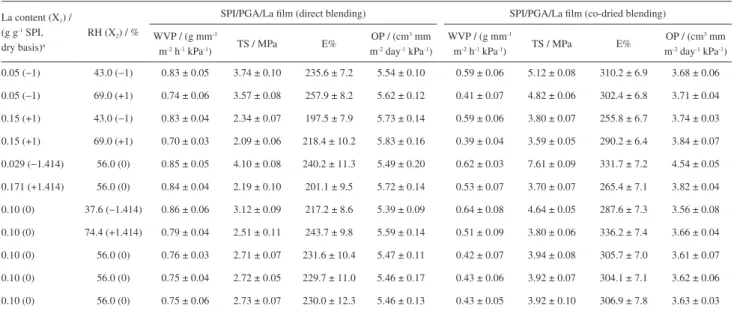
to evaluate the effects of the La content and RH on the WVP, TS, E%, and OP of the SPI/PGA/La (direct blending) and SPI/PGA/La (co-dried blending) films. The levels of the independent variables were defined according to a 22 full factorial central composite design (CCD) (star configuration) with four axial and three central points (triplicate only at the central point), which resulted in 11 experiments (Table 1). The experimental ranges of the La content and RH were defined on the basis of the aforementioned study. The analysis of variance (ANOVA), multiple comparison test, and all of the statistical analyses were performed using SPSS 17.0 for Windows (SPSS Inc., Chicago, IL, USA). A regression analysis was performed to estimate the response function as a polynomial model:
Yi = b0 + b1X1 + b2X2 + b12X1X2 + b11X12 +b22X22 (3)
where bn are constant regression coefficients, Yi are dependent responses (WVP, TS, E%, and OP). X1 and X2 are the coded independent variables (La content and RH, respectively). The data were modeled through multiple regression analysis based on a stepwise analysis. Comparisons between the SPI/PGA-based films were made by ANOVA with post hoc comparisons of the mean values using Duncan’s multiple-range test. Differences between the mean values were considered significant at p < 0.05. Each experiment was repeated in triplicate and mean values, including the pooled standard error of the mean (SEM), were then determined.
Table 1. Properties of WVP, TS, E%, OP for SPI/PGA/La (direct blending) and SPI/PGA/La (co-dried blending) films with different La contents,
conditioned at different RHs
La content (X1) / (g g-1 SPI, dry basis)a
RH (X2) / %
SPI/PGA/La film (direct blending) SPI/PGA/La film (co-dried blending) WVP / (g mm-1
m-2 h-1 kPa-1) TS / MPa E%
OP / (cm3 mm m-2 day-1 kPa-1)
WVP / (g mm-1
m-2 h-1 kPa-1) TS / MPa E%
OP / (cm3 mm m-2 day-1 kPa-1) 0.05 (−1) 43.0 (−1) 0.83 ± 0.05 3.74 ± 0.10 235.6 ± 7.2 5.54 ± 0.10 0.59 ± 0.06 5.12 ± 0.08 310.2 ± 6.9 3.68 ± 0.06
0.05 (−1) 69.0 (+1) 0.74 ± 0.06 3.57 ± 0.08 257.9 ± 8.2 5.62 ± 0.12 0.41 ± 0.07 4.82 ± 0.06 302.4 ± 6.8 3.71 ± 0.04
0.15 (+1) 43.0 (−1) 0.83 ± 0.04 2.34 ± 0.07 197.5 ± 7.9 5.73 ± 0.14 0.59 ± 0.06 3.80 ± 0.07 255.8 ± 6.7 3.74 ± 0.03
0.15 (+1) 69.0 (+1) 0.70 ± 0.03 2.09 ± 0.06 218.4 ± 10.2 5.83 ± 0.16 0.39 ± 0.04 3.59 ± 0.05 290.2 ± 6.4 3.84 ± 0.07 0.029 (−1.414) 56.0 (0) 0.85 ± 0.05 4.10 ± 0.08 240.2 ± 11.3 5.49 ± 0.20 0.62 ± 0.03 7.61 ± 0.09 331.7 ± 7.2 4.54 ± 0.05
0.171 (+1.414) 56.0 (0) 0.84 ± 0.04 2.19 ± 0.10 201.1 ± 9.5 5.72 ± 0.14 0.53 ± 0.07 3.70 ± 0.07 265.4 ± 7.1 3.82 ± 0.04 0.10 (0) 37.6 (−1.414) 0.86 ± 0.06 3.12 ± 0.09 217.2 ± 8.6 5.39 ± 0.09 0.64 ± 0.08 4.64 ± 0.05 287.6 ± 7.3 3.56 ± 0.08
Results and Discussion
Characterization of moisture content-RH relationships
The water sorption value can be used to obtain the film moisture content under different RH in order to calculate the permeability of water and gas.26 The water sorption isotherms of SPI/PGA/La (direct blending), SPI/PGA/La (co-dried blending) and SPI/PGA (co-dried blending) films with added glycerol were displayed in Figure 1. The sorption isotherm curves of SPI/PGA/La (direct blending) and SPI/PGA/La (co-dried blending) films showed typical behavior of water vapor-sensitive hydrophilic biopolymers when the %RH increased. Statistical analysis demonstrated that SPI and PGA, and their interaction, have significant (p < 0.05) effects on the sorption isotherms of the emulsion films studied. As shown in Figure 1, the SPI/PGA/La co-dried film displayed a substantially higher water-retaining ability compared to the SPI/PGA/La film (direct blending) with increasing %RH. It was caused by different adding way of PGA in co-blending system. In the co-blending system including PGA with co-dried process, the interfacial tension between different phases was decreased, thus water-retaining ability of co-blending system was significantly increased.27-29 Owing to the interfacial tension between SPI and PGA phases decreased and adhesion degree increased, PGA could promote polymer chain association and increased the number of active sites (–OH) for water binding through the co-drying process, thus compatibility degree increased.
Characterization of polymers’ perfor mance by Tg relationships
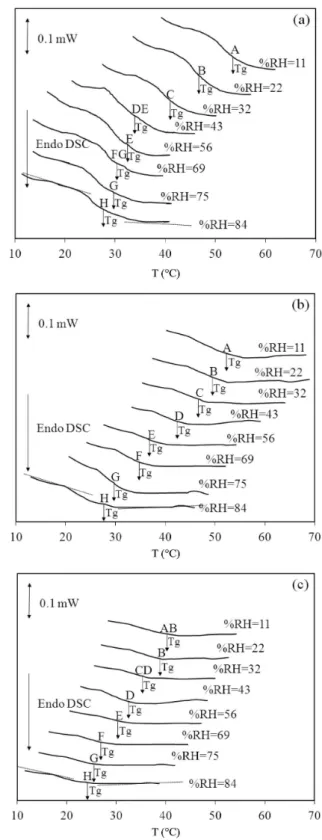
Tg values for samples with and without La are shown in Figure 2. The change of Tg is considered to be an
effective index for the changes of compatibility between polymers.30 There are common studies on the interaction between proteins and polysaccharides; however, there is only poor understanding about the dynamic interaction
Figure 1. Moisture sorption isotherm for SPI/PGA/La (direct blending),
SPI/PGA/La (co-dried blending) and SPI/PGA (co-dried blending) films with La contents of 0.10 (g g-1 SPI, dry basis), conditioned at different RHs.
Figure 2. Thermograms showing glass transition at different %RH values
between polymer molecules.31 The factors of Tg becomes more complex, especially after the addition of lipid, and forming of ternary co-blends. The glass transition is a key parameter for controlling the processing parameters, properties and stability of the amorphous food matrix. The Tg occurs within a temperature range determined by the non-uniformity of the system. The non-uniformity of the co-dried mixture is primarily determined by the physical properties of the polymer used and their interaction on the aqueous mixture, i.e., the phase behavior. Immiscible biopolymer mixtures often reveal two Tg, in contrast, the fully compatible mixture has a single Tg between the Tg of the individual component. The presence of only one Tg could indicate that the films are compatible, and the expected decrease of Tg when RH increases can be observed for SPI/PGA and SPI/PGA/La samples, which implies a penetration of water between the polymer chains and therefore weaken the interaction between SPI and PGA. Moreover, the addition of La could significantly decrease Tg. Under different RH conditions, the Tg of SPI/PGA/La (co-dried blending) film prepared by the addition of PGA with co-drying process will higher than SPI/PGA/La (direct blending) film, which indicated that co-drying process decreased the interfacial tension between SPI and PGA
phases and increased the intermolecular forces and reduced the mobility of polar polymer chains.32
Effect of La content on WVP, TS, E%, and OP of SPI/PGA/La (direct blending) and SPI/PGA/La (co-dried blending) films
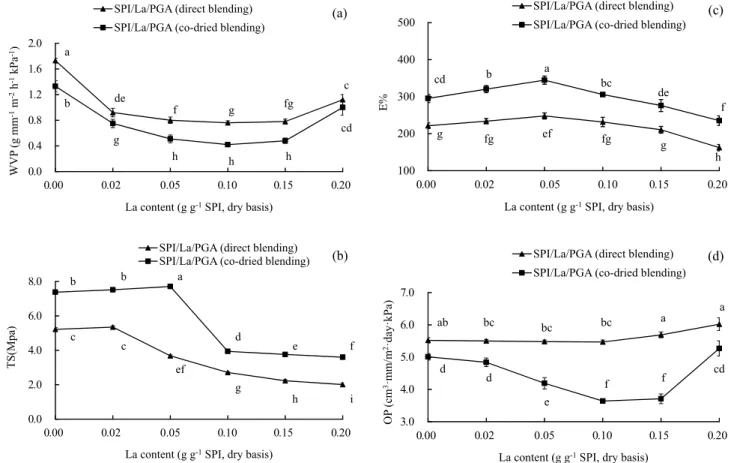
WVP values of SPI/PGA/La (direct blending) and SPI/PGA/La (co-dried blending) films under different added amounts of lipid are shown in Figure 3a. These results indicated that the lipid component could effectively reduce the film WVP at a certain added amount. The WVP was minimized when the added amount of La was 0.10 g g-1 SPI, resulting in WVPs that were 43.93 and 31.58% of the WVP value of the control films without La. Upon increasing the amount of La added further, the WVP began to increase. During the drying process of film emulsion, there are two different processes for lipid distribution. In the first case, proteins and lipids will form a protein/lipid net structure such that lipid substances will be uniformly dispersed in the protein film.33,34 In the second case, the lipid substance will form a lipid layer on the film surface. Due to the protein/lipid net structure and the formation of the lipid layer, the absorption and dissolution of water vapor on the film surface and its expansion inside the film will be reduced,
Figure 3. Effects of La content on the (a) WVP; (b) TS; (c) E%; (d) OP of SPI/PGA/La (direct blending) and SPI/PGA/La (co-dried blending) films.
leading to a reduction in the WVP.33,35 As the amount of lipid substance added increases, the uniformity of the film emulsion will decrease, and the discontinuity of the lipid inside the film will result in an increased WVP. When the La content is greater than 0.20 g g-1 SPI, it will be difficult to remove the film and there will be cracks on film surface.
The water-barrier property values of SPI/PGA/La films (direct blending) with different amounts of La were all lower than those of the analogous SPI/PGA/La co-dried films due to the better emulsion interactions between protein, polysaccharides and La obtained by co-dried blending, better compatibility of the three components, better uniformity of La on or inside the film, and less crystallization. SPI and PGA can form a gel network structure due to the hydrogen bonding and electrostatic interactions between two macromolecules with different charges. This gel network reduces the gap between macromolecules obtained by co-dried blending, thereby reducing the WVP. The Tg results depicted the compatible polymers of SPI/PGA/La and SPI/PGA/La co-dried films, in which, a higher Tg and so more stronger intermolecular forces were found for the SPI/PGA/La co-dried film, resulting in a lower WVP.
By comparing the WVP results obtained in this and other studies, it was determined that there was an enhancement in the water-barrier properties of SPI/PGA/La co-dried films. Furthermore, with a small amount of added La, the WVP was significantly decreased. However, there may be some discrepancies in the comparison of properties of edible films prepared by different researchers due to the different sources of film materials, different filming processes, different equipment and different testing conditions.36-39
The TS and E% of different films formed with different contents of different lipids are shown in Figures 3b and 3c. When the added amounts of La and beeswax were less than 0.05 g g-1 SPI, the TS and E% of the films increased with increasing La content and were the highest when the added amount of La was 0.05 g g-1 SPI. However, when the amount of added lipid was greater than 0.05 g g-1 SPI, the mechanical properties of the film deteriorated. During the filming process for proteins, polysaccharides and lipids, the proteins and polysaccharides first form a net structure via different interactions, such as hydrophobic interactions, hydrogen bonding, covalent bonding and ionic bonding.40-42 The added lipid components are then dispersed in the gaps of the net structure formed by the proteins and polysaccharides. At the initial addition of lipid components, a good net structure of lipid/protein-polysaccharides was formed. The favorable combination interactions increased the TS and E% of the film. However, when the added
amount of lipid increased past a certain amount, the bonding interactions between proteins weakened, and there was an uneven interaction between the lipid layer and protein-polysaccharides layer, resulting in worse mechanical properties. Based on the Tg results, the SPI/PGA/La co-dried film had a compact intermolecular structure, no obvious phase separation and a better combination between the protein and polysaccharides and, therefore, better mechanical properties.43
The oxygen permeability results of the SPI/PGA/La film (direct blending) and SPI/PGA/La film (co-dried blending) are shown in Figure 3b. These results indicated that, when added amount of La was 0.10 g g-1 SPI, the oxygen permeability was the lowest, which was 99.09 and 72.65% of the films without added La. When the added amount of lipid was greater than 0.10 g g-1 SPI, the OP values of the films with two different added lipids were increased. By comparing the influences of La on SPI/PGA/La (direct blending) and SPI/PGA/La (co-dried blending) films, the addition of La resulted in good barrier properties for the two different films, especially with respect to the oxygen-barrier properties of the SPI/PGA/La co-dried film. La has a tight orientation in the film, and the orientation must be perpendicular to the direction of the oxygen stream to enhance the oxygen-barrier property.44 In addition to the properties of the film material itself, the compatibility of the film matrix and the film uniformity are important factors for determining the film barrier properties. When comparing OP values of different films prepared by different researchers, SPI has a relatively high polarity, and stronger hydrogen bonding interactions were formed in films, resulting in better fluidity of macromolecules in edible films based on SPI. The OP values of edible films based on protein are usually lower than those for synthetic films, such as low density polyethylene (LDPE) and high density polyethylene (HDPE). For example, the SPI/PGA/La (co-dried blending) film was shown to have 512 times lower OP than LDPE.45
Optimization using response surface analysis
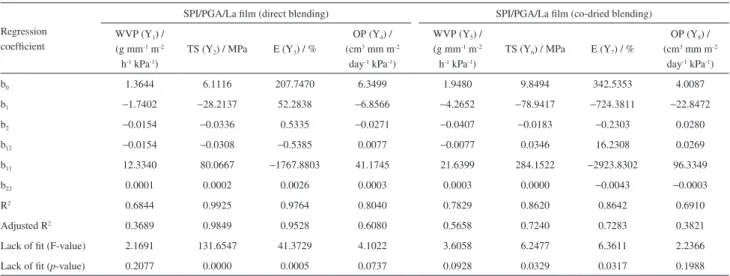
the TS, and E% of SPI/PGA/La (direct blending) and SPI/PGA/La (co-dried blending) films were statistically significant (p < 0.05) (Table 2).
Therefore, the RSM was able to predict most of the variation (37-98%) of the TS and E% properties of SPI/PGA/La (direct blending) and SPI/PGA/La (co-dried blending) films as a function of the La content and RH. All interaction effects of the independent variability were insignificant (p > 0.05) in their effects on the TS and E% of the SPI/PGA-based films. The effect of La content was highly significant (p < 0.05) for TS and E% properties (Table 2), considering the highest coefficient of main linear effects.
These results are consistent with the net structure of protein-polysaccharides with the addition of La as described previously,42 which should significantly influence the film TS and E%. The addition of lipid results in changes in the bonding interactions between protein molecules, the interactions between lipids and protein-polysaccharides, and the Tg, which should further influence the mechanical properties of SPI/PGA-based films.26
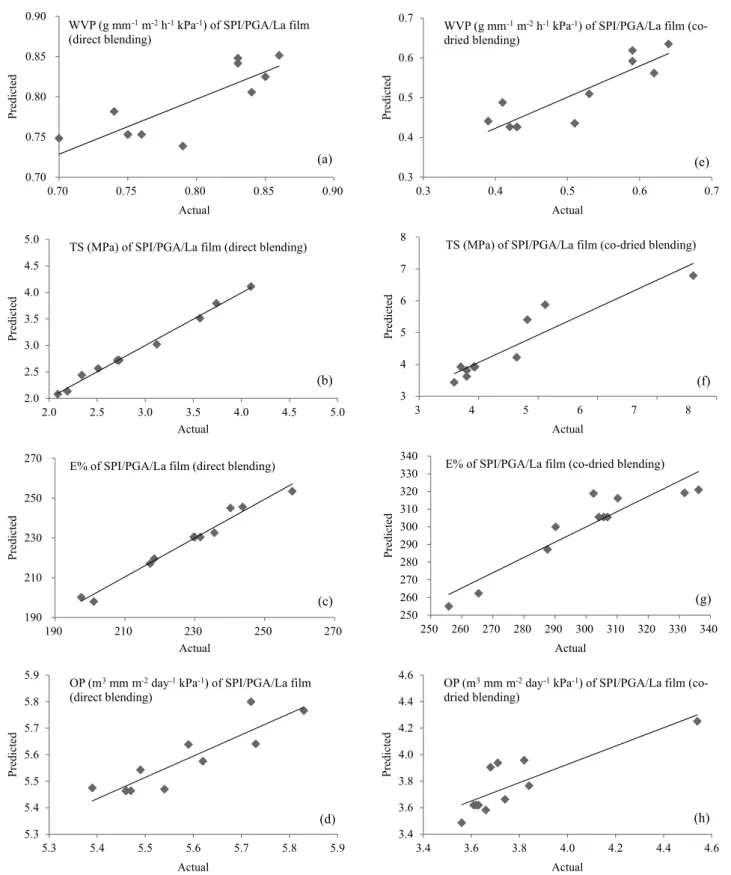
The quadratic model of La content showed a significant (p < 0.05), but variable effect on the response variables. The fitted models were suitable, showing significant regression, no lack of fit and satisfactory coefficients (Table 2). There was a good relationship between the predicted and experimental TS (R2 = 0.9925 for SPI/PGA/La film (direct blending), R2 = 0.8620 for SPI/PGA/La film (co-dried blending)) and E% values (R2 = 0.9764 for SPI/PGA/La film (direct blending), R2 = 0.8642 for SPI/PGA/La film (co-dried blending)) (Figure 4), indicating the adequacy and significance of the model. For validation of the model, the
adequacy of the response surface equations was determined by comparing the experimental and fitted values predicted by the response regression models.
Conclusions
The barrier and mechanical properties of SPI/PGA/La (direct blending) and SPI/PGA/La (co-dried blending) films are influenced by the added amount of La and environmental RH. The optimal water-barrier, oxygen-barrier and mechanical properties were found when the added amount of La was 0.05-0.10 g g-1 SPI. SPI/PGA/La (co-dried blending) films prepared by co-drying of PGA had the best water retention properties under different RH and better barrier and mechanical properties.
The obtained results demonstrate the important role of specific interactions between lipids and protein/ polysaccharide film components in defining film functional properties and provide evidence for the difficulties in modeling film behavior as a function of lipid composition and environmental conditions. Taking into account the different application conditions in which the films have been characterized, their mechanical behavior could be predicted when the product water content was between 2.10 and 24.81%.
Acknowledgments
This study was financially supported by the Natural Science Foundation of China (No. 31501492), the CNTC (110201402036 and 110201402034), projects of China
Table 2. The regression coefficients (R2), adjusted R2, and lack of fit for the final reduced models
Regression coefficient
SPI/PGA/La film (direct blending) SPI/PGA/La film (co-dried blending) WVP (Y1) /
(g mm-1 m-2 h-1 kPa-1)
TS (Y2) / MPa E (Y3) / %
OP (Y4) / (cm3 mm m-2
day-1 kPa-1)
WVP (Y5) / (g mm-1 m-2
h-1 kPa-1)
TS (Y6) / MPa E (Y7) / %
OP (Y8) / (cm3 mm m-2
day-1 kPa-1)
b0 1.3644 6.1116 207.7470 6.3499 1.9480 9.8494 342.5353 4.0087
b1 −1.7402 −28.2137 52.2838 −6.8566 −4.2652 −78.9417 −724.3811 −22.8472
b2 −0.0154 −0.0336 0.5335 −0.0271 −0.0407 −0.0183 −0.2303 0.0280
b12 −0.0154 −0.0308 −0.5385 0.0077 −0.0077 0.0346 16.2308 0.0269
b11 12.3340 80.0667 −1767.8803 41.1745 21.6399 284.1522 −2923.8302 96.3349
b22 0.0001 0.0002 0.0026 0.0003 0.0003 0.0000 −0.0043 −0.0003
R2 0.6844 0.9925 0.9764 0.8040 0.7829 0.8620 0.8642 0.6910
Adjusted R2 0.3689 0.9849 0.9528 0.6080 0.5658 0.7240 0.7283 0.3821
Lack of fit (F-value) 2.1691 131.6547 41.3729 4.1022 3.6058 6.2477 6.3611 2.2366
Lack of fit (p-value) 0.2077 0.0000 0.0005 0.0737 0.0928 0.0329 0.0317 0.1988
Tobacco Yunnan Industrial Co. Ltd. (2016GY01) and the independent research project program of the State Key Laboratory of Food Science and Technology of Jiangnan University (No. SKLF-ZZB-201506).
References
1. Park, S. K.; Rhee, C. O.; Bae, D. H.; Hettiarachchy, N. S.; J. Agric. Food Chem. 2001, 49, 2308.
Figure 4. Predicted and experimental values of (a) WVP, (b) TS, (c) E%, (d) OP of SPI/PGA/La film (direct blending); and (e) WVP, (f) TS, (g) E%,
2. Ramos, O. L.; Fernandes, J. C.; Silva, S. I.; Pintado, M. E.; Malcata, F. X.; Crit. Rev. Food Sci. Nutr. 2012, 52, 533. 3. Song, F.; Tang, D. L.; Wang, X. L.; Wang, Y. Z.;
Biomacromolecules 2011, 12, 3369.
4. Krochta, J. M.; De Mulder, C. L. C.; Food Technol. 1997, 51, 61.
5. Monedero, F. M.; Fabra, M. J.; Talens, P.; Chiralt, A.; J. Food Eng. 2009, 91, 509.
6. Al-Hassan, A. A.; Norziah, M. H.; Food Hydrocolloids 2012, 26, 108.
7. Tang, C. H.; Jiang, Y.; Wen, Q. B.; Yang, X. Q.; J. Biotechnol.
2005, 120, 296.
8. Fadini, A. L.; Rocha, F. S.; Alvim, I. D.; Sadahira, M. S.; Queiroz, M. B.; Alves, M. V.; Silva, L. B.; Food Hydrocolloids
2013, 30, 625.
9. Ghanbarzadeh, B.; Almasi, H.; Int. J. Biol. Macromol. 2011, 48, 44.
10. Kristo, E.; Biliaderis, C. G.; Zampraka, A.; Food Chem. 2007, 101, 753.
11. Pan, H. Y.; Xu, X. M.; Jiang, B.; Chen, J.; Jin, Z. Y.; Food Hydrocolloids 2016, 52, 393.
12. Madeleine-Perdrillat, C.; Karbowiak, T.; Debeaufort, F.; Delmotte, L.; Vaulot, C.; Champion, D.; Food Hydrocolloids
2016, 61, 57.
13. Bergo, P.; Sobral, P. J. A.; Prison, J. M.; J. Food Process. Preserv.
2010, 34, 401.
14. Xue, J.; Ngadi, M.; Food Hydrocolloids 2009, 23, 286. 15. Kim, K. M.; Hwang, K. T.; Weller, C. L.; Hanna, M. A.; J. Am.
Oil Chem. Soc. 2002, 79, 615.
16. Kim, K. M.; Marx, D. B.; Weller, C. L.; Hann, M. A.; J. Am. Oil Chem. Soc. 2003, 80, 71.
17. Liu, H.; Li, J.; Zhu, D. S.; Wang, Y. X.; Zhao, Y.; Li, J. R.; J. Food Process. Preserv. 2014, 38, 1371.
18. Pan, H.; Jiang, B.; Chen, J.; Jin, Z.; Food Chem. 2014, 151, 1. 19. Pan, H.; Wang, M.; Zhu, B.; Liao, T.; Jin, Z.; Int. J. Food Sci.
Technol. 2016, 51, 2503.
20. Spiess, W. E. L.; Wolf, W. R. In Physical Properties of Foods; Jowitt, R.; Escher, F.; Hallstrom, B.; Meffert, H. F. T.; Spiess, W. E. L.; Vos, G., eds.; Applied Science Publishers: London, 1983, p. 65.
21. Greenspan, L.; J. Res. Natl. Bur. Stand., Sect. A 1977, 81A(1), 89.
22. ASTM E96; Standard Test Method for Water Vapor Transmission of Materials; American Society for Testing and Materials: Philadelphia, United States, 2002.
23. Ou, S. Y.; Wang, Y.; Tang, S. Z.; Huang, C. H.; Jackson, M. G.; J. Food Eng. 2005, 70, 205.
24. Gennadios, A.; McHugh, T. H.; Weller, G. L.; Krochta, E. A. In Edible Coatings and Films to Improve Food Quality, 1st ed.; Krochta, J. M.; Baldwin, E. A.; Nisperos-Carriedo, M. O., eds.; Technomic Publishing Co.: Lancaster, United States, 1994, p. 201.
25. de Carvalho, R. A.; Grosso, C. R. F.; Food Hydrocolloids 2004, 18, 717.
26. Fabra, M. J.; Talens, P.; Gavara, R.; Chiralt, A.; J. Food Eng.
2012, 109, 372.
27. Salvador, A.; Sanz, T.; Fiszman, S. M.; Eur. Food Res. Technol.
2001, 212, 208.
28. Turgeon, S. L.; Beaulieu, M.; Food Hydrocolloids 2001, 15, 583.
29. Coughlan, K.; Shaw, N. B.; Kerry, J. F.; Kerry, J. P.; J. Food Sci. 2004, 69, E271.
30. Tolstoguzov, V.; Nahrung 2000, 44, 299.
31. Fabra, M. J.; Talens, P.; Chiralt, A.; Food Hydrocolloids 2010, 24, 384.
32. Jara, F. L.; Pilosof, A. M. R.; Thermochim. Acta 2009, 487, 65. 33. Wihodo, M.; Moraru, C. I.; J. Food Eng. 2013, 114, 292. 34. Fabra, M. J.; Talens, P.; Chiralt, A.; Food Hydrocolloids 2009,
23, 676.
35. Fabra, M. J.; Perez-Masia, R.; Talens, P.; Chiralt, A.; Food Hydrocolloids 2011, 25, 1112.
36. Kurek, M.; Guinault, A.; Voilley, A.; Galic, K.; Debeaufort, F.; Food Chem. 2014, 144, 9.
37. Motedayen, A. A.; Khodaiyan, F.; Salehi, E. A.; Food Chem.
2013, 136, 1231.
38. Shih, F. F.; Daigle, K. W.; Champagne, E. T.; Food Chem. 2011, 127, 118.
39. Tongnuanchan, P.; Benjakul, S.; Prodpran, T.; Food Chem. 2012, 134, 1571.
40. Avena-Bustillos, R. J.; Chiou, B.; Olsen, C. W.; Bechtel, P. J.; Olson, D. A.; McHugh, T. H.; J. Food Sci. 2011, 76, E519. 41. Jiang, J.; Xiong, Y. L.; Newman, M. C.; Rentfrow, G. K.; Food
Chem. 2012, 132, 1944.
42. Hosseini, S. F.; Rezaei, M.; Zandi, M.; Ghavi, F. F.; Food Chem.
2013, 136, 1490.
43. Parris, N.; Coffin, D. R.; J. Agric. Food Chem. 1997, 45, 1596. 44. Gennadios, A.; Weller, C. L.; Testin, R. F.; J. Food Sci. 1993,
58, 212.
45. Farris, S.; Introzzi, L.; Piergiovanni, L.; Packag. Technol. Sci.
2009, 22, 69.
Submitted: December 7, 2016