Nuclear anomalies in the buccal cells of calcite factory workers
Songül Budak Diler
1and Serap Ergene
21
University of Nigde, Science and Letters , Nigde, Turkey.
2
University of Mersin, Science and Letters, Mersin, Turkey.
Abstract
The micronucleus (MN) assay on exfoliated buccal cells is a useful and minimally invasive method for monitoring ge-netic damage in humans. To determine the genotoxic effects of calcite dust that forms during processing, MN assay was carried out in exfoliated buccal cells of 50 (25 smokers and 25 non-smokers) calcite factory workers and 50 (25 smokers and 25 non-smokers) age- and sex-matched control subjects. Frequencies of nuclear abnormalities (NA) other than micronuclei, such as binucleates, karyorrhexis, karyolysis and ‘broken eggs’, were also evaluated. Micronuclei and the other aforementioned anomalies were analysed by two way analysis of covariance. The linear correlations between the types of micronucleus and nuclear abnormalities were determined by Spearman’s Rho. There was a positive correlation between micronuclei and other types of nuclear abnormalities in accordance with the Spearman’s Rho test. Results showed statistically significant difference between calcite fabric workers and con-trol groups. MN and NA frequencies in calcite fabric workers were significantly higher than those in concon-trol groups (p < 0.05). The results of this study indicate that calcite fabric workers are under risk of significant cytogenetic damage.
Key words:calcite, exfoliated buccal cells, micronucleus (MN), genotoxicity. Received: May 4, 2009; Accepted: October 14, 2009.
The chemical formula of calcite that forms limestone is CaCO3(Cotton and Wilkinson, 1988). Generally it does
not exist in pure form in nature. It forms a complex with other chemicals (SiO2, Al2O3, FeO3, CaO, MgO, SO3,
Na2O, K2O, CO2, Fe+2(Goldsmithet al., 1962; Jeong and
Youngsin, 2006).
In Turkey, limestone (deposits) reserves have a high percentage of CaCO3 (96.8% max.) together with other
substances, such as MgCO3(1% max), Fe2O3(0.3% max),
acid non-soluble material (0.02% max) and water (0.4% max). The amount of silica and impurities from iron com-pounds are very low (Bökeet al., 1999; Dilsiz, 2002).
After being ground into a fine powder, calcite is widely used in industry for making paint, paper and plastic adhesives, as well as a filling substance in food, chemical and construction products (Yekeler and Ozkan, 2002).
The harmful effects of mineral dust in various forms on human health have already been demonstrated (Guthrie, 1992; Donget al., 2006; Princeet al., 2008), notably the dust from iron ore was found to be toxic by genotoxicity tests (Dönbaket al., 2005). In addition, the dust of the cal-cite mineral was found to cause lung damage (Jaunarajs and Liebling, 1972; Zhang and Huang, 2005; Erren et al., 2007). On investigating the genotoxic effects of environ-mental factors on human nuclei, the micronucleus (MN)
test has been employed on buccal epithelial cells (Sartoet al., 1987; Tolbertet al., 1992; Levineet al., 1997), The MN test, which is scientifically approved, is important in dem-onstrating the genotoxic effects of harmful substances on human health (Nersesyan, 2005; Nersesyanet al., 2006; Fenechet al., 2007), such as in measuring genotoxicity in petrol station employees (Çeliket al., 2003; Beniteset al., 2006), agricultural workers (Pastoret al., 2001), cigarette smokers and tobacco users (Özkulet al., 1997; Besaratinia
et al., 2000; Proiaet al., 2006). In addition, it has been used in workers exposed to pesticides (Pastor et al., 2002), polycyclic aromatic hydrocarbons (Karahalilet al., 1999), timber dust (Çelik and Kanik, 2006), ozone and cancer pa-tients (Blochinget al., 2000; Chenet al., 2006).
The aim of our study was to determine the effects of calcite dust formed during its processing on the health of employees of calcite factories by employing the MN test on buccal epithelial cells, which has not been performed so far in any other study in this context.
The study was carried out with 50 calcite factory-workers, (25 smokers and 25 non-smokers) working in the town of Nigde. The control group consisted of 50 healthy men (25 smokers and 25 non-smokers) working on the Nigde University campus, with no known previous occu-pational exposure to genotoxic substances. The question-naire covered standard demographic (age, gender, etc.), lifestyle (smoking, alcohol consumption, etc.) and occu-pational (working hours/day, period of exposure, etc.)
as-www.sbg.org.br
Send correspondence to Songül Budak Diler. University of Nigde, Science and Letters, 51200 Nigde, Turkey. E-mail: [email protected].
pects. There were no significant differences as regards lifestyle and personal factors in participants of the study groups.
Buccal cell samples were collected at the end of work-shifts. Subjects were required to rinse their mouths with water before sampling. Exfoliated epithelial cells of buccal mucosa were obtained by scraping the middle part of the inner cheek with a wooden spatula. The epithelial cells collected from buccal mucosa were smeared onto clean microscope glass slides. The slides were air-dried and fixed with cold 100% methanol. The slides were incubated at 37 °C overnight and then stained with Giemsa (Stich and Rosin, 1984; Acaret al., 2001).
A light microscope using 100 X magnification on coded slides was used for MN analysis. Four replicate slides were prepared for each subject and 1000 cells evalu-ated per slide to determine MN frequency. Thus, at least 4000 cells per person were scored for every four slides.
MN and other nuclear abnormalities were classified according to Tolbertet al.(1992). MNs must satisfy the fol-lowing conditions: a) consist of nuclear material; b) be completely separated from the parent nucleus; c) be less than 1/3 of the diameter of associated nuclei; d) be smooth, oval- or round-shaped; e) be on the same plane of focus and f) be of the same color, texture and refraction as the main nucleus. Cells with two nuclei were considered to be binu-cleate. Besides MN, other nuclear anomalies, such as karyorrhexis (nuclear disintegration), karyolysis (dissolu-tion of nucleus) and ‘broken eggs’ (nuclei that appeared cinched) were recorded separately according to Tolbertet al.(1991).
The statistical analyses were performed using the SPSS software, version 11.5 (SPSS, Chicago,IL). All the data were expressed as the mean± standard error of the mean. MNs and other nuclear abnormalities (binucleates, karyorrhexis, karyolysis and ‘broken eggs’) were analysed by two way analysis of covariance in workers and smokers in order to delineate possible differences between these two groups. In all analyses, the age variable was include in the calculations as a covariant. Linear correlations of the vari-ous types of MN and nuclear abnormalities were deter-mined by Spearman’s Rho. The SPSS v11.5 programme
package was used for statistical analysis. Results with p < 0,05 were considered significant.
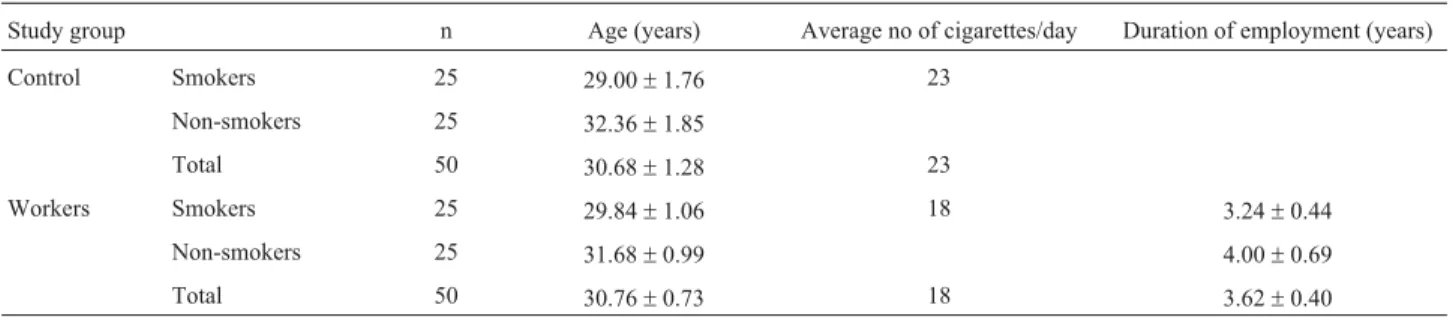
A summary of dermographic characteristics of the groups studied appear in Table 1. 25 of the 50 members (50%) of both the study and control groups were smokers. As described in materials and methods, buccal epithelial samples were obtained from all the 100 involved subjects. 4000 cells from each were evaluated for micronuclei and other nuclear abnormalities (binucleates (BN), karyor-rhexis (KR), karyolysis (KL), ‘broken eggs’ (BE)), counted and statistically analyzed using SPSS. MN and the other anomalies were appraised through two way analysis of covariance in workers and smokers in order to delineate possible differences between the two groups. Differences in age were not statistically significant (p > 0.05). In terms of duration of work the difference between smokers and non-smokers was also not significant (p > 0.05) (Table 1). With respect to BE, the interaction for working and smok-ing was significant (p < 0.05), whereas the opposite was true for MN, BN, KR and KL (p > 0.05) (Table 2). For MN, BN and BE, there was a significant difference (p < 0.05) be-tween smokers and non-smokers, whereas the opposite was the case for KR and KL (p > 0.05). There was also a signifi-cant difference between exposed workers and control groups as regards MN, BN, BE, KR and KL (p < 0.05) (Ta-ble 3). Furthermore, according to Spearman’s Rho testing, the correlations between MN and other types of nuclear ab-normalities were positive (Table 4).
The MN test is a very useful and efficient method for specifying buccal epithelial cell chromosomal abnormali-ties (Levineet al., 1997; Holland et al., 2008). Although studies on the genotoxicity of calcite mineral dust are very limited, the effect of this exposure on the lungs has been in-vestigated more extensively and it was found to be damag-ing (Seldénet al., 2001; Dogan, 2003; Özkurtet al., 2003). At the same time it has been shown that some mineral dusts are factors in lung cancer risk (Wendlandt et al., 2007; Doganet al., 2008).
The factor ‘smoking’ was also taken into account, whereby it was found that nuclear abnormalities were higher in smokers, and previous studies in this regard con-firm our findings (Özkulet al., 1997; Proia et al., 2006).
Other investigators used the buccal MN test and
demon-Table 1- General characteristics of the groups studied.
Study group n Age (years) Average no of cigarettes/day Duration of employment (years)
Control Smokers 25 29.00±1.76 23
Non-smokers 25 32.36±1.85
Total 50 30.68±1.28 23
Workers Smokers 25 29.84±1.06 18 3.24±0.44
Non-smokers 25 31.68±0.99 4.00±0.69
strated that there was an increase in the incidence of nuclear abnormalities in alcohol consumers and workers exposed to environmental pollutants (Ramirez and Saldanha, 2002; Reiset al., 2006). Furthermore, on using the same assay in measuring micronuclei and nuclear abnormalities in timber
workers exposed to wood dust, the difference between these and control subjects was found to be statistically sig-nificant (Çelik and Kanik, 2006). Similar genotoxic studies in coal mine workers demonstrated that the incidence of nu-clear anomalies, including sister chromatid exchanges
Table 2- The frequencies (‰) of micronuclei and other nuclear abnormalities in exfoliated buccal epithelial cells of control and exposed subjects.
Group n Micronuclei
mean (a)±SE
Nuclear abnormality
Binucleates mean (a)±SE
Broken eggs mean (a)±SE
Karyorrhexis mean (a)±SE
Karyolysis mean (a)±SE
Control Smokers 25 11.41±1.12 4.75±0.88 3.52±1.51 1.10±0.25 1.23±0.43
Non-smokers 25 4.68±1.11 3.42±0.88 5.21±1.51 1.05±0.25 1.31±0.43
Workers Smokers 25 25.52±1.11 11.28±0.87 15.16±1.50 3.05±0.25 1.90±0.43
Non-smokers 25 15.19±1.11 6.98±0.87 4.09±1.50 2.27±0.25 3.10±0.43
(a): Covariates appearing in the model are evaluated at the following values: Age = 30,9400.
Table 3- The mean effect (‰) of micronuclei and other nuclear abnormalities in exfoliated buccal epithelial cells of subjects from control groups, ex-posed workers, smokers and non-smokers.
Group n Micronuclei
mean (a)±SE
Nuclear abnormality
Binucleates mean (a)±SE
Broken eggs mean (a)±SE
Karyorrhexis mean (a)±SE
Karyolysis mean (a)±SE
Control 50 8.04±0.78 4.08±0.61 4.37±1.06 1.07±0.17 1.27±0.30
Workers 50 20.36±0.78 9.13±0.61 9.62±1.06 2.66±0.17 3.50±0.30
Smokers 50 18.47±0.78 8.01±0.61 10.19±1.06 2.07±0.17 2.57±0.30
Non-smokers 50 9.93±0.78 5.20±0.61 3.81±1.06 1.66±0.17 2.20±0.30
(a): Covariates appearing in the model are evaluated at the following values: Age = 30,9400.
Table 4- The correlation coefficient between MNs and different types of cytogenetic endpoints.
MN BN BE KL KR
MN Correlation Coefficient 0.643(**) 0.417(**) 0.528(**) 0.588(**)
Sig. (2-tailed) 0.000 0.000 0.000 0.000
N 100 100 100 100
BN Correlation Coefficient 0.643(**) 0.624(**) 0.516(**) 0.615(**)
Sig. (2-tailed) 0.000 0.000 0.000 0.000
N 100 100 100 100
BE Correlation Coefficient 0.417(**) 0.624(**) 0.218(*) 0.402(**)
Sig. (2-tailed) 0.000 0.000 0.030 0.000
N 100 100 100 100
KL Correlation Coefficient 0.528(**) 0.516(**) 0.218(*) 0.688(**)
Sig. (2-tailed) 0.000 0.000 0.030 0.000
N 100 100 100 100
KR Correlation Coefficient 0.588(**) 0.615(**) 0.402(**) 0.688(**)
Sig. (2-tailed) 0.000 0.000 0.000 0.000
N 100 100 100 100
(SCEs) and chromosomal aberrations (CAs), in those ex-posed to coal dust, was higher than in controls (Dönbaket al., 2005).
Our study too shows that there is an increase in MN and nuclear abnormalities in workers exposed to calcite dust when compared to on-exposed controls.
Acknowledgments
This work was supported by the Research Found of Nigde University (Project No. FEB 2007/09).
References
Acar H, Caliskan U, Demirel S and Largaespada DA (2001) Mi-cronucleus incidence and their chromosomal origin related to therapy in acute lymphoblastic leukemia (ALL) patients: Detection by micronucleus and FISH techniques. Teratogen Carcinogen Mutagen 21:341-347.
Benites CI, Amado LL, Vianna RAP and Martino-Roth MG (2006) Micronucleus test on gas station attendants. Genet Mol Res 5:45-54.
Besaratinia A, Van Straaten HW, Godschalk RW, Van Zandwijk N, Balm AJ, Kleinjans JC and Van Schooten FJ (2000) Immunoperoxidase detection of polycyclic aromatic hydro-carbon -DNA adducts in mouth floor and buccal mucosa cells of smokers and nonsmokers. Environ Mol Mutagen 36:127-133.
Bloching M, Hofmann A, Lautenschlager C, Berghaus A and Grummt T (2000) Exfoliative cytology of normal buccal mucosa to predict the relative risk of cancer in the upper aerodigestive tract using the MN-assay. Oral Oncol 36:550-555.
Böke H, Göktürk EH, Caner-Saltik EN and Demirci S (1999) Ef-fect of airborne particle on SO2-calcite reaction. Appl Sur-face Sci 140:70-82.
Chen C, Arjomandi A, Qin H, Balmes J, Tager I and Holland N (2006) Cytogenetic damage in buccal epithelia and periph-eral lymphocytes of young healthy individuals exposed to ozone. Mutagenesis 21:131-137.
Cotton FA and Wilkinson G (1988) Advanced Inorganic Chemis-try. Wiley & Sons, New York, 1455 pp.
Çelik A, Çava T and Ergene-Gözükara S (2003) Cytogenetic biomonitoring in petrol station attendants: Micronucleus test in exfoliated buccal cells. Mutagenesis 18:417-421. Çelik A and Kanik A (2006) Genotoxicity of occupational
expo-sure to wood dust: Micronucleus frequency and nuclear changes in exfoliated buccal mucosa cells. Environ Mol Mutagen 47:693-698.
Dilsiz C (2002) Environmental issues concerning natural re-sources at Pamukkale protected site, southwest Turkey. En-viron Geol 41:776-784.
Dogan AU, Dogan M and Hoskins JA (2008) Erionite series min-erals: Mineralogical and carcinogenic properties. Environ Geochem Health 30:367-381.
Dogan M (2003) Sources and types of mineral dust in regions of Turkey with endemic malignant mesothelioma. Indoor Built Environ 12:377-383.
Dong F, Deng J, Pu X and John H (2006) Pulmonary alveolar macrophage cytotoxicity investigation of irregular shape
mineral dusts. Sheng Wu Yi Xue Gong Cheng Xue Za Zhi 23 848-51.
Dönbak L, Rencuzogullari E, Yavuz A and Topaktas M (2005) The genotoxic risk of underground coal miners from Tur-key. Genet Toxicol Environ Mutagen 588:82-87.
Erren TC, Morfeld P, Glende CB and Piekarski C (2007) Silica and lung cancer. Epidemiology 18:521-522.
Fenech M, Bolognesi C, Kirsch-Volders M, Bonassi S, Zeiger E, Knasmüller S and Holland N (2007) Harmonisation of the micronucleus assay in human buccal cells - A Human Micronucleus (HUMN) project (www.humn.org) initiative commencing in 2007. Mutagenesis 22:3-4.
Guthrie Jr GD (1992) Biological effects of inhaled minerals. Am Mineral 77:225-243.
Goldsmith JR, Graf DL and Witters JDA (1962) Northrop Studies in the system CaCO3•MgCO3•FeCO3: (1) Phase relations; (2) A method for major element spectrochemical analyses; and (3) Composition of some ferroan dolomites. J Geol 70:659-688.
Holland N, Bolognesi C, Kirsch-Volders M, Bonassi S, Zeiger E, Knasmueller S and Fenech M (2008) The micronucleus as-say in human buccal cells as a tool for biomonitoring DNA damage: The HUMN project perspective on current status and knowledge gaps. Mutat Res 659:93-108.
Jaunarajs KL and Liebling RS (1972) The digestion of lung tissue for mineral dust recovery. Am Indust Hygiene Assoc J 33:535-542.
Jeong GY and Youngsin C (2006) Nanofiber calcite in Asian dust and its atmospheric roles. Geophys Res Lett 33:L24802. Karahalil B, Karakaya AE and Burgaz S (1999) The micronucleus
assay in exfoliated buccal cells: Application to occupational exposure to polycyclic aromatic hydrocarbons. Genet Toxicol Environ Mutagen 442:29-35.
Levine AJ, Savlan A, Talaksa G, Boeniger MF, Suruda A and Schulte PA (1997) The utility of epithelial-cell micronuclei in the assessment of intermittent exposures. Biomarkers 2:135-138.
Nersesyan AK (2005) Nuclear buds in exfoliated human cells. Genet Toxicol Environ Mutagen 88:64-68.
Nersesyan AK, Kundi M, Atefie K, Schulte-Hermann R and Knasmüller S (2006) Effect of staining procedures on the re-sults of micronucleus assays with exfoliated oral mucosa cells. Cancer Epidem Biomar 15:1835-1840.
Özkul Y, Donmez H, Erenmemisoglu A, Demirtas H and Ima-moglu N (1997) Induction of micronuclei by smokeless to-bacco on buccal mucosa cells of habitual users. Mutagenesis 12:285-287.
Özkurt S, Kiter G, Baser S, Arpaz S, Hacioglu M, Fisekci F, Köktürk U and Çimrin HA (2003) The frequency of calcific pleural plaque in Yukaribogaz villagers. Solunum 5:25-29. Pastor S, Gutiérrez S, Creus A, Xamena N, Piperakis S and
Marcos R (2001) Cytogenetic analysis of Greek farmers us-ing the micronucleus assay in peripheral lymphocytes and buccal cells. Mutagenesis 16:539-545.
Pastor S, Creus A, Xamena N, Siffel C and Marcos R (2002) Oc-cupational exposure to pesticides and cytogenetic damage: Results of a Hungarian population study using the micro-nucleus assay in lymphocytes and buccal cells. Environ Mol Mutagen 40:101-109.
calcite aerosol in an environmental reaction chamber. Phys Chem Chem Phys 10:142-152.
Proia NK, Paszkiewicz GM, Nasca MSS, Franke GE and Pauly JL (2006) Smoking and smokeless tobacco-associated human buccal cell mutations and their association with oral cancer -A review. Cancer Epidemiol Biomarkers Prevent 15:1061-1077.
Ramirez A and Saldanha PH (2002) Micronucleus investigation of alcoholic patients with oral carcinomas. Genet Mol Res 1:246-260.
Reis SRA, Santo ARE, Andrade MGS and Sadigursky M (2006) Cytologic alterations in the oral mucosa after chronic expo-sure to ethanol. Braz Oral Res 20:97-102.
Sarto F, Finotto S, Giacomelli L, Mazzotti D, Tomanin R and Le-vis AG (1987) The micronucleus assay in exfoliated cells of the human buccal mucosa. Mutagenesis 2:11-17.
Seldén AI, Berg NP, Lundgren EAL, Hillerdal G, Wik NG, Ohlson CG and Bodin LS (2001) Exposure to tremolite as-bestos and respiratory health in Swedish dolomite workers. Occup Environ Med 58:670-677.
Stich HF and Rosin MP (1984) Micronuclei in exfoliated human cells as a tool for studies in cancer risk and cancer interven-tion. Cancer Lett 22:241-53.
Tolbert PE, Shy CM and Allen JW (1991) Micronuclei and other nuclear anomalies in buccal smears: A field test in snuff us-ers. Am J Epidemiol 134:840-850.
Tolbert PE, Shy CM and Allen JW (1992) Micronuclei and other nuclear anomalies in buccal smears: Methods development. Mutat Res 271:69-77.
Yekeler M and Ozkan A (2002) Determination of the breakage and wetting parameters of calcite and their correlations. Part Part Syst Char 19:419-425.
Wendlandt RF, Harrison WJ and Vaughan DJ (2007) Surface coatings on quartz grains in bentonites and their relevance to human health. Appl Geochem 22:2290-2306.
Zhang Q and Huang X (2005) Addition of calcite reduces iron’s bioavailability in the Pennsylvania coals - Potential use of calcite for the prevention of coal worker’s lung diseases. J Toxicol Environ Health 68:1663-1679.
Associate Editor: Catarina S. Takahashi