online | memorias.ioc.fiocruz.br
Behavioural alterations are independent of sickness
behaviour in chronic experimental Chagas disease
Glaucia Vilar-Pereira, Leonardo Alexandre de Souza Ruivo, Joseli Lannes-Vieira/+
Fundação Oswaldo Cruz, Instituto Oswaldo Cruz, Laboratório de Biologia das Interações, Rio de Janeiro, RJ, Brasil
The existence of the nervous form of Chagas disease is a matter of discussion since Carlos Chagas described neurological disorders, learning and behavioural alterations in Trypanosoma cruzi-infected individuals. In most patients, the clinical manifestations of the acute phase, including neurological abnormalities, resolve spontaneously without apparent consequence in the chronic phase of infection. However, chronic Chagas disease patients have behavioural changes such as psychomotor alterations, attention and memory deficits, and depression. In the pres-ent study, we tested whether or not behavioural alterations are reproducible in experimpres-ental models. We show that C57BL/6 mice chronically infected with the Colombian strain of T. cruzi (150 days post-infection) exhibit behavioural changes as (i) depression in the tail suspension and forced swim tests, (ii) anxiety analysed by elevated plus maze and open field test sand and (iii) motor coordination in the rotarod test. These alterations are neither associated with neuromuscular disorders assessed by the grip strength test nor with sickness behaviour analysed by temperature variation sand weight loss. Therefore, chronically T. cruzi-infected mice replicate behavioural alterations (depres-sion and anxiety) detected in Chagas disease patients opening an opportunity to study the interconnection and the physiopathology of these two biological processes in an infectious scenario.
Key words: Chagas disease - Trypanosoma cruzi - behavioural alterations - sickness behaviour - depression - anxiety
doi: 10.1590/0074-02760150300
Financial support: FAPERJ (CNE/E-26/101.549/2010,
E-26/110.153/2013, E-26/111.709/2013), CNPq
(474234/2012-6-Uni-versal, 302534/2008-3), INCTV⁄CNPq (403979/2012-9-DECIT)
GV-P is sponsored by CAPES, LASR and JL-V are research fellows of the CNPq.
+ Corresponding author: [email protected] Received 15 July 2015
Accepted 6 November 2015
The haemoflagellate protozoan Trypanosoma cruzi causes American trypanosomiasis or Chagas disease, which afflicts approximately six-seven million people worldwide (WHO 2015). The existence of a nervous form of Chagas disease is matter of debate since the de-scription by Carlos Chagas of neurological and behav-ioural changes in chronically infected patients (Chagas 1911). Although this work was highly criticised because of the lack of appropriated controls, in the last decades several studies supported the existence of behavioural alterations in chronic Chagas disease patients [reviewed by Silva et al. (2010)]. Further, more than hundred years after the discovery, little is known about the pathophysi-ology of the behavioural changes in Chagas disease. In most patients, the clinical manifestations of the acute phase, including neurological disorders, spontaneously resolve without apparent sequel in the chronic phase of infection (Prata 2001, Pittella 2009). Nevertheless, pa-tients with chronic Chagas disease exhibit many neu-ropathies such as debilitation of muscle tendon reflex,
myoclonic seizures, marching disorders, bradykinesia, and paresis (Jörg & Rovira 1981). The presence of symp-toms of Chagas disease is a risk factor for the develop-ment of feelings of hopelessness and emotional difficul-ties. Patients upon learning of Chagas infection develop reactive symptoms ranging from anxiety, depression to alexithymia syndrome (Jörg & Rovira 1981). Patients with the symptomatic form of Chagas disease have more psychological and physical symptoms of stress and anxi-ety, and lower capacity of resilience compared with as-ymptomatic individuals (Mota et al. 2006). Considering the chronic nature of Chagas disease, in persistence of stress the patients may develop depressive symptoms which may have a negative impact on functional perfor-mance and quality of life (Hueb & Loureiro 2005, Ozaki et al. 2011, Guimarães et al. 2014).
Previously, we have shown that depressive-like be-haviour in the chronic phase of experimental T. cruzi infection in mice models is independent of the prior ex-istence of acute meningoencephalitis, and, therefore, is not a sequel of this (Vilar-Pereira et al. 2012). However, it has not been explored whether or not anxiety is pres-ent in the chronic phase of experimpres-ental Chagas disease in association with depressive behaviour. Anxiety and depression are terms used to describe emotional states associated with stressful events or psychological diffi-culties in pathological conditions (Putilina 2014). These behavioural changes often develop in comorbidity and many of their symptoms are similar. Further, depression is common in patients with anxiety, and anxiety is fre-quently reported in depressed patients, both poor prog-nosis predictors (Nutt 2002, Nutt et al. 2006).
to behavioural changes (Rogers et al. 2001, Maes et al. 2012). Sickness behaviour causes disturbs as fever, loss of libido, decreased locomotor activity, loss of appetite, disinterest in the social and physical environment, and general anhedonia (Rogers et al. 2001, Dantzer et al. 2008, Maes et al. 2012). Acutely T. cruzi-infected mice show signs of sickness behaviour as reduced exploratory and motor activity, decreased consumption of water and chow, weight loss, and temperature variations (da Silva et al. 2012). Importantly, some authors regard clinical anxiety and depression as a form of sickness behaviour and/or as a consequence of the sickness behavioural re-sponse (Dantzer et al. 2008, Maes et al. 2012).
In this work, we hypothesised that the behavioural abnormalities described in patients with Chagas disease depression and anxiety are nonpsychological features, but a neurochemical process resulted of the parasite/host interactions and, therefore, possible of being reproduced in a model of chronic experimental T. cruzi infection. Further, we assessed whether there is or not a relation between depression and anxiety with loss of muscle strength and/or sickness behaviour in the chronic phase of experimental Chagas disease.
MAteRiALS And MethodS
Mouse model of chronic infection by T. cruzi - Five-seven-week-old female C57BL/6 (H-2b) mice obtained
from the animal facilities (Laboratory Animals Breed-ing Center) of the Oswaldo Cruz Foundation (Fiocruz), Rio de Janeiro, Brazil, were maintained under specific pathogen free, standard conditions (with temperature and relative humidity of approximately 22 ± 2°C and 55 ± 10%, respectively) and received food and water ad li-bitum. The noninfected (NI) control experimental group consisted of four-five mice per experiment (14 mice) and infected experimental group consisted of eight-18 mice per experiment (40 mice).
Experimental infection - Mice were infected with the Colombian T. cruzi Type I strain (Zingales et al. 2009), which is considered myotropic (Melo & Brener 1978) and has previously been shown to colonise the central nervous system (CNS) (Silva et al. 1999, 2015, Roffê et al. 2003). The Colombian strain is maintained by serial passages from mouse to mouse every 35-45 day in the Laboratory of Biology of the Interactions, Oswaldo Cruz Institute (IOC), Fiocruz. For the present study, C57BL/6 mice were infected intraperitoneally with the low inoc-ulum of 100 blood trypomastigote (bt) forms suspended in 0.2 mL of sterile buffered saline. Parasitaemia was es-timated using 5 μL of blood obtained from the tail vein. The first circulating parasites were detected in the blood at 14 days post-infection (dpi), marking the onset of the acute phase of infection. The peak of parasitaemia was observed between 42-45 dpi and trypomastigotes were rarely found in the blood at 90 dpi, characterising the onset of the chronic phase of infection, as previously de-scribed (Silva et al. 1999, Vilar-Pereira et al. 2012).
Tail-suspension test (TST) - Mice subjected to the short-term inescapable stress of being suspended by their tail will develop an immobile posture. Immobility
is defined as the absence of initiated movements and in-cludes passive swaying. In this test, adapted from Steru et al. (1985), the mouse was hung upside-down using ad-hesive tape to fix its tail to a vertical surface (an iron rod with a height of 30 cm). A white platform was positioned horizontally 20 cm below the iron rod, just under the mouse’s forepaws, in such a way that the mouse could lightly touch the platform and minimise the weight sus-tained by its tail until the recording began. The animal’s behaviour was recorded with a video camera for 5 min (Sony, USA). The total time of immobility was meas-ured. The mouse was considered immobile when it was not struggling, attempting to catch the adhesive tape, or showing body torsion or jerky movements.
Forced swim test (FST) - This procedure consisted of placing the mouse inside a cylindrical glass tank (height 35 cm, diameter 25 cm) containing clean water at 24-26ºC to a level of 20 cm above the bottom (Porsolt et al. 1977). The animal was left in the cylinder for 6 min. After the first 2 min of habituation, the total duration of immobility was measured over a period of 4 min of test. The mouse was considered to be immobile when it remained floating passively in the water or was making slight movements to keep its head above the water. A video camera (Sony) was placed on top of the water tank to record the test. The water was changed before the in-troduction of each animal. The animal was dried with gauze and replaced in its cage.
Marble burying test (MBT) - This assay was de-scribed in mice (Njung’e & Handley 1991), as these animals exhibit burying behaviour in the presence of aversive stimuli. Mice were placed individually in trans-parent acrylic box containing 20 glass beads distributed over the sawdust. After the 30 min period, each mouse was removed from the box. Subsequently, the number of buried glass beads in sawdust was registered. After test-ing each animal, the exchange of sawdust was performed and the glass beads were cleaned with a solution of 70% alcohol and dried with towel paper.
Elevated plus maze test (EPMT) - This assay evaluates anxiety-like behaviour (Lister 1987). The EPMT consist-ed of two open arms each (50 × 10 cm) crossconsist-ed with two closed arms with 40 cm high walls. In this test, a mouse was selected randomly and placed in the centre zone, fac-ing the corner between a closed arm and an open arm. Its behaviour was recorded for 5 min using a digital video camera (Sony) mounted above the maze. The behavioural parameters related to anxiety were the number of entries and time spent in the open arms. An arm entry was scored when all four paws of the animal were placed in an arm. Before the next mouse was introduced, the maze was cleaned with a solution of 70% alcohol and dried to elim-inate the odour and trace of the previously tested mouse.
Rotarod (RRT) - This test is used to assess motor coordination and balance. An automated device of RRT was used (EFF 411; Insight, Brazil), which consisted of a plexiglass box with a cylinder of 8 cm in diameter, lo-cated approximately 20 cm across the machine from the ground, kept in rotation by a motor. The box was divided into four bays, approximately 10 cm wide, allowing the analysis of four mice simultaneously. For the test, each mouse was placed on the drum already in motion at the initial speed of 10 rpm. Results are expressed as average latency on RRT. In the fall, the timer which checked the equilibrium time is automatically stopped; the animals are brought back to their stall and the timer reactivated, accounting for the total falls after 5 min at a maximum speed of 37 rpm. The time of mice permanency in the apparatus was recorded in a maximum time limit of 300 s. For habituation/training, mice were placed for walk-ing on the rotary drum at minimum speed (10 rpm) for 5 min the day before the test day.
Grip strength meter test (GSMT) -This is a nonin-vasive method widely used to assess the strength of the members of mice and may disclose a neuromuscular dis-order (van Riezen & Boersma 1969). The muscle strength was evaluated through the grip strength meter (EFF 305; Insight). The GSMT is based on the natural tendency of the mouse to grab a horizontal metal bar when slightly pulled by the tail for 2-3 s. The bar is attached to a force transducer which measures the traction force peak (in grams) that is displayed on a digital screen.
Standardised conditions to perform behavioural tests - All behavioural tests occurred during the light phase between 08:00 am-05:00 pm and were recorded with a DSC-DVD810 video camera (Sony). To minimise stress and maximise familiarity, all behavioural tests applied to the different experimental groups were con-ducted in an environment with a 12-h light and 12-h dark cycle, a room temperature of 22 ± 2°C and an ambient noise level of approximately 40 dB produced by an air conditioner. Mice were subjected to behavioural tests at 150 dpi. The animals were subjected to the follow-ing sequence of tests: OFT, GSMT, EPMT, MBT, RRT, TST, and FST. No animal was re-tested. To further as-sess sickness behaviour that might have contributed to behavioural alterations (Rogers et al. 2001), we checked temperature with a rectal probe (Thermometer
DT-610B; ATP, USA), apathy, and body weight loss. Deaths were registered weekly.
Statistical analysis - Data are expressed as arithmetic means ± standard deviation. Student’s ttest was used to analyse the statistical significance of the observed differ-ences. The Kaplan-Meier method was used to compare the survival curves of the studied groups. The statistical tests were performed with GraphPad Prism. Differences were considered statistically significant when p < 0.05.
Ethics -This study was carried out in strict accord-ance with the recommendations in the Guide for the Care and Use of Laboratory Animals of the Brazilian Nation-al Council of AnimNation-al Experimentation (cobea.org.br) and the federal law 11.794 (8 October 2008). The Ethical Commission on Animal Use of Fiocruz (licenses 004/09 and LW10/14) approved all the procedures used in this study. All presented data were obtained from three (D4, D1G, D2G) independent experiments (Experiment Reg -ister Books 49, 53, and 57, LBI/IOC-Fiocruz).
ReSuLtS
Model of chronic experimental Chagas disease - Ini-tially, we established a murine model that reproduces aspects of chronic Chagas disease. To this end, C57BL/6 mice were infected with the low inoculum of 100 bts of the Colombian T. cruzi Type I strain. The parasitaemia peak occurred at 42-45 dpi and trypomastigotes were rarely found in the blood at 150 dpi (Fig. 1A). Most of the infected mice survived the acute phase (26/40 mice in 3 independent experiments), without trypanocidal treatment, and developed a chronic infection (Fig. 1B), as formerly described (Talvani et al. 2000, Silverio et al. 2012, Pereira et al. 2014a). In a previous work, we showed that C57BL/6 mice are resistant to CNS inflam-mation induced by chronic infection with the Colombian strain (Roffê et al. 2003). Therefore, this model repro-duces important aspects of the chronic phase of Chagas disease and allowed us to test whether or not the Colom-bian-infected mice present the behavioural alterations depression and anxiety and, if so, whether these changes were associated with sickness behaviour.
Depressive-like behaviour is present in chronic ex-perimental T. cruzi infection - To assess depressive-like behaviour we used the FST and TST. At 150 dpi, there was a significant increase in the immobility time in TST (p < 0.001) (Fig. 2A) and FST (p < 0.01) (Fig. 2B) of the Colombian-infected mice when compared with sex and age-matched NI controls.
when compared to NI controls (Fig. 3B). Therefore, chronically infected mice did not show the innate repeti-tive/compulsive behaviour when exposed to glass beads. To evaluate anxiety, we used the EPMT with analysis of the frequency of entries and the time the mouse spent in the open arms in 5-min sessions. Our data support that chronically T. cruzi-infected mice show reduced num-bers of entries in the open arms of the apparatus as well as remained significantly reduced time in the open arms (p < 0.001) in comparison with NI controls (Fig. 4A); therefore, these data support the existence of anxiety-like behaviour in chronically T. cruzi-infected mice.
To test whether behavioural alterations of locomotor/ exploratory pattern are present in T. cruzi-infected mice, they were subjected to the OFT and the numbers of to-tal and central crossed lines were analysed. Chronically Colombian-infected C57BL/6 mice exhibited a signifi-cant decrease in the locomotor/exploratory activities in 5-min sessions expressed as reduced numbers of crossed total and central lines (p < 0.001) when compared with NI controls (Fig. 4B).
Motor coordination is reduced in chronic experi-mental T. cruzi infection - When evaluated by the RRT, chronically T. cruzi-infected mice showed impaired per-formance and decrease on motor coordination revealed by significantly (p < 0.001) reduced time to fall from the spinning wheel when compared with NI controls (Fig. 5).
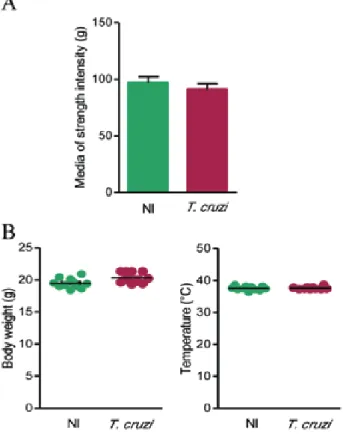
Chronically T. cruzi-infected C57BL/6 mice do not show loss of muscle strength - To determine if the infec-tion with T. cruzi is accompanied by a decrease in mus-cular strength, we performed GSMT. Interestingly, there was no significant difference (p > 0.05) in grip strength when chronically infected mice were compared with their NI matched controls (Fig. 6A).
Absence of sickness behaviour in chronic experimental Chagas disease in C57BL/6 mice - Considering that sick-ness features may contribute to behavioural alterations such as decreases in spontaneous locomotor/exploratory activities (Rogers et al. 2001), we further assessed sickness behaviour by checking body weight loss (which reveals loss of appetite), apathy and increase in temperature
(indica-Fig. 1: parasitaemia curve and mortality during experimental infec-tion of C57BL/6 mice by Trypanosoma cruzi. Mice were infected with 100 trypomastigotes of the Colombian strain of T. cruzi (A). Survival curve, compared with noninfected (NI) matched for age and sex, shows that ~70% of infected animals survived the acute phase and developed chronic infection (B). The groups were composed of 10-18
mice. Data are representative of three independent experiments. dpi:
days post-infection.
Fig. 2: depressive-like behaviour in C57BL/6 mice in the chronic phase (150 days post-infection) of infection with Trypanosoma cruzi. Mice were infected with 100 trypomastigote forms of the Colombian strain and subjected to the tail-suspension test (A) and forced swim test (B). Quantification of immobility time was observed in the period
tive of fever). At 150 dpi, the clinical observation showed that apathy and prostration were not detected in infected mice. Further, chronically infected mice showed neither body weight loss nor alteration in rectal temperature when compared with sex and age-matched NI controls (Fig. 6B). Altogether, these data demonstrate that C57BL/6 mice in-fected with a low inoculum of the Colombian strain do not exhibit signs of sickness behaviour.
diSCuSSion
In the present study we challenged the hypothesis that the behavioural abnormalities depression and anxi-ety described in Chagas disease patients are nonpsycho-logical features and could be reproduced in a model of experimental T. cruzi infection. Therefore, we tested whether infection with a T. cruzi Type I strain that allows survival and development of the chronic phase of infec-tion led to the behavioural alterainfec-tions depression, anxi-ety, and locomotor/exploratory disorders. Our results show that chronic infection of C57BL/6 mice with the Colombian strain reproduces these behavioural changes. Importantly, in this model of chronic experimental Cha-gas disease the behavioural alterations are independent of the loss of muscle strength and sickness behaviour.
The infection of C57BL/6 mice with the low inoc-ulum of the Colombian T. cruzi Type I strain resulted in high parasitaemia that dramatically dropped in the chronic phase of infection. In the three independent ex-periments, the majority of the infected mice survived and developed chronic infection, corroborating previous findings (Silva et al. 1999, 2015, Roffê et al. 2003, Silve-rio et al. 2012, Vilar-Pereira et al. 2012). Thus, this model was considered suitable to investigate possible behav-ioural changes during the chronic phase of infection.
The involvement of the CNS in Chagas disease is recognised in the acute phase of the infection, when me-ningoencephalitis is described as a significant cause of death (Prata 2001, Rassi et al. 2010). However, there is no consensus on the existence of a defined clinical nervous form in the chronic phase of Chagas disease, especially due to the lack of an anatomical basis that can charac-terise it (Pittella 2009). The knowledge of being a Cha-gas disease carrier can elicit psychological disturbances, particularly because there is no cure for this disease (Mota et al. 2006). As a result of the disease and/or the difficulties that are associated as they do not know how to confront this condition, the carriers of Chagas disease may develop depressive symptoms. Therefore, Chagas disease patients need to face physical, psychological, so-cial, and economic difficulties, which can compromise their quality of life (Hueb & Loureiro 2005, Osaki et al. 2011). There is a gap in the knowledge on the association of chronic Chagas disease and the comorbidities depres-sion and anxiety and their impact on the clinical picture and disease prognosis. Thus, experimental models that reproduce aspects of the behavioural changes (depres-sion and anxiety) detected in Chagas disease patients may contribute to the understanding of physiopathologi-cal factors leading these behavioural alterations.
In the present study, we used the TST and FST to assess depressive-like behaviour, as described in mouse models of chronic stress (Ma et al. 2011), immune chal-lenge with LPS (Painsipp et al. 2011), and experimental Chagas disease (Vilar-Pereira et al. 2012). Depressive-like behaviour was detected in the Colombian-infected C57BL/6 mice when a significant increase in immobil-ity was detected during the late phase of infection (150 dpi). Thus, these data support the existence of a non-psychological component of this disorder in this model of experimental Chagas disease, corroborating previous findings (Vilar-Pereira et al. 2012). Thus, this model is proper to test the coexistence of the other behavioural abnormality anxiety and locomotor/exploratory disor-ders in the chronic T. cruzi infection.
Anxiety is considered a psychiatric disorder char-acterised by disproportional phobia in situations that represent stress, danger, real threats, or daily challenges (Moutier & Stein 1999). Diagnosis of seropositivity for Chagas disease is received with anxiety, fear, apprehen-sion, or despair (Uchoa et al. 2002), and Chagas disease patients show high levels of psychological and physical symptoms of stress (Mota et al. 2006). In mouse models, the innate repetitive/compulsive behaviour assessed by the MBT was previously associated to anxiety (Borsini et al. 2002, Li et al. 2006). In our study, after being
ex-Fig. 3: anxiety behaviour in C57BL/6 mice during infection with Try- panosoma cruzi. Animals were infected with 100 trypomastigotes of the Colombian strain and subjected to the marble burying test. The latency and the quantification of the number of hidden balls were analysed in a 30
min period. Data represent means ± standard deviation. The groups were composed of seven-16 mice. Data are representative of three independent
posed to glass beads, which are supposed to represent an extraneous object whose presence can be a threat, NI control mice exhibited intense activity to hide balls. Conversely, chronically infected mice did not show such
Fig. 4: anxiety and locomotor/exploratory abnormalities in Trypanosoma cruzi-infected C57BL/6 mice. Mice were infected with 100 trypomas-tigotes of the Colombian strain and subjected to the test the elevated plus maze. Sex and age-matched noninfected (NI) controls were analysed in parallel. A: anxiety behaviour in the chronic phase of infection [150 days post-infection (dpi)]. The graphs show the number of entries and time spent in the open arms in 5-min sessions; B: locomotor/exploratory activity. NI and T. cruzi-infected mice were subjected to the open field
test for 50-min sessions. The graphs show the number of total and central lines crossed in the chronic (150 dpi) phases of infection. Data are
expressed as means ± standard deviation. The groups consisted of 12-18 infected mice per test. This figure is representative of three independent experiments. Asterisks mean p < 0.001.
Fig. 5: motor coordination assay in Trypanosoma cruzi-infected C57BL/6 mice. Mice were infected with 100 trypomastigotes of the Colombian strain and subjected to the rotarod test, at 150 days post-infection. Motor coordination was analysed in T. cruzi-infected
and noninfected (NI) controls. Data are expressed as means ± stand -ard deviation. The experimental groups consisted of five-eight mice per group. Representative figure of three independent experiments. Asterisks mean p < 0.001.
NI controls. In contrast, motor alterations were absent in mice that survived the acute infection with the Tu-lahuen T. cruzi Type VI strain (Caradonna & Pereirap-errin 2009). Further, mice chronically infected with the Colombian Type I strain, but not with Y T. cruzi Type II strain, present depressive-like behaviour (Vilar-Pereira et al. 2012). Therefore, the association of behavioural changes with infection by specific T. cruzi type strain(s) need to be explored in experimental models and Chagas disease patients. Importantly, in chronically Colombian-infected C57BL/6 mice, despite the low parasitism and absence of inflammatory infiltrates in the CNS (Silva et al. 1999, 2015, Roffê et al. 2003), there are remarkable behavioural changes, consistent with signs of depression and anxiety. The mechanisms that lead to this frame-work require further studies to be clarified.
Considering that sickness features may contribute to behavioural alterations such as decreases in spontaneous locomotor/exploratory activity (Rogers et al. 2001), we assessed sickness behaviour by checking apathy, body weight loss (which reveals loss of appetite), and tempera-ture (since increase in temperatempera-ture indicates fever). Apa-thy and prostration were not detected in chronically Co-lombian-infected C57BL/6 mice. Thus, these data ruled out the presence of sickness behaviour and reinforced
Fig. 6: analysis strength and sickness behaviour in C57BL/6 mice chronically infected with Trypanosoma cruzi. Mice were infected with 100 trypomastigotes of the Colombian strain and subjected to the grip strength muscle (GSM) and a checked for body weight and temperature at days post-infection. A: the graph shows the GSM results of infected mice compared with sex and age-matched noninfected (NI) controls; B:
body weight (g) and rectal temperature (°C) were registered in infected mice compared with NI controls. Data are expressed as means ± standard
deviation. The experimental groups consisted of five-12 mice per group. Representative figure of three independent experiments.
the existence of the morbidities depression and anxiety in the model of chronic infection of C57BL/6 mice with the Colombian strain. Dissociated as possible interfer -ence related with sickness behaviour, our model reflects important aspects to form bridges between animal mod-els of neurological and neuropsychiatric disorders ob-served in humans. Therefore, this model of chronic ex-perimental Chagas disease may offer an opportunity to unravel the cellular and molecular mechanism trigger-ing these behavioural abnormalities that may contribute to decrease the quality of life of Chagas disease patients.
ab-normalities are responsive to the immune modulators anti-tumour necrosis factor (Pereira et al. 2014b) and pentoxifylline (Pereira et al. 2015), therapies that also hampered depressive-like behaviour (Vilar-Pereira et al. 2012). Therefore, in chronically infected mice the car-diac and behavioural abnormalities may be related to the systemic inflammatory profile. Altogether, our model of the comorbidities depression and anxiety in the pres-ence of severe cardiomyopathy may offer an opportunity to achieve mechanistic insights into the complexity of T. cruzi infection. More broadly, this model is suitable to explore therapeutic tools, which may also be applicable to noninfectious disorders.
RefeRenCeS
Arakawa O, Ikeda T 1991. Apomorphine effect on single and paired rat open-field behavior. Physiol Behav50: 189-194.
Belmaker RH, Agam G 2008. Major depressive disorder. N Engl J Med358: 55-68.
Borsini F, Podhorna J, Marazziti D 2002. Do animal models of anx -iety predict anxiolytic-like effects of antidepressants? Psycho- pharmacol163: 121-141.
Caradonna K, Pereiraperrin M 2009. Preferential brain homing fol-lowing intranasal administration of Trypanosoma cruzi. Infect Immun77: 1349-1356.
Chagas C 1911. Nova entidade morbida do homem. Rezumo geral de estudos etiolójicos e clínicos. Mem Inst Oswaldo Cruz3: 219-275.
da Silva DR, de Castro SL, Alves MCS, Batista WS, de Oliveira GM
2012. Acute experimental Trypanosoma cruzi infection: estab-lishing a murine model that utilises non-invasive measurements of disease parameters. Mem Inst Oswaldo Cruz107: 211-216.
Dantzer R, O’Connor JC, Freund GG, Johnson RW, Kelley KW 2008.
From inflammation to sickness and depression: when the im-mune system subjugates the brain. Nat Rev Neurosci9: 46-56.
Greene-Schloesser DM, Van der Zee EA, Sheppard DK, Castillo MR,
Gregg KA, Burrow T, Foltz H, Slater M, Bult-Ito A 2011. Predic-tive validity of a non-induced mouse model of compulsive-like behavior. Behav Brain Res221: 55-62.
Guimarães PM, Passos SR, Calvet GA, Hökerberg YH, Lessa JL, An-drade CA 2014. Suicide risk and alcohol and drug abuse in outpa-tients with HIV infection and Chagas disease. Rev Bras Psiquiatr 36: 131-137.
Hall CS 1941. Emotional behavior in the rat: defecation and urination as measures of individual differences in emotionality. J Comp Psychol18: 385-403.
Hueb MFD, Loureiro SR 2005. Aspectos cognitivos e psicossociais
associados à doença de Chagas. Psicol Estud10: 137-142.
Jörg ME, Rovira IZ 1981. Formas encefalopaticas de enfermedad de Chagas cronica observadas en Argentina. Mem Inst Oswaldo Cruz4: 353-360.
Li X, Morrow D, Witkin JM 2006. Decreases in nestlet shredding
of mice by serotonin uptake inhibitors: comparison with marble burying. Life Sci78: 1933-1939.
Lister RG 1987. The use of a plus-maze to measure anxiety in the mouse. Psychopharmacology92: 180-185.
Ma XC, Jiang D, Jiang WH, Wang F, Jia M, Wu J, Hashimoto K, Dang
YH, Gao CG 2011. Social isolation-induced aggression potenti-ates anxiety and depressive-like behavior in male mice subjected to unpredictable chronic mild stress. PLoS One6: e20955.
Maes M, Berk M, Goehler L, Song C, Anderson G, Gałecki P, Leon
-ard B 2012. Depression and sickness behavior are Janus-faced re -sponses to shared inflammatory pathways. BMC Med29: 10-66.
Melo RC, Brener Z 1978. Tissue tropism of different Trypanosoma cruzi strains. J Parasitol 64: 475-482.
Morato S, Brandão ML 1997. Paradoxical increase of exploratory be-havior in the elevated plus-maze by rats exposed to two kinds of aversive stimuli. Braz J Med Biol Res30: 1113-1120.
Mosovich SA, Mady C, Lopes N, Lanni B, Dias JC, Correia D, Fark -ouh ME 2008. Chagas disease as a mechanistic model for testing a novel hypothesis. Rev Soc Bras Med Trop41: 70-72.
Mota DCGA, Benevides-Pereira AMT, Gomes ML, Araújo SM 2006.
Estresse e resiliência em doença de Chagas. Aletheia24: 57-68.
Moutier CY, Stein MB 1999. The history, epidemiology, and differen-tial diagnosis of social anxiety disorder. J Clin Psychiatry9: 4-8.
Njung’e K, Handley SL 1991. Evaluation of marble-burying behavior as a model of anxiety. Pharmacol Biochem Behav 38: 63-67.
Nutt DJ 2002. Treatment of depression and concomitant anxiety. Eur Neuropsychopharmacol 10: 433-447.
Nutt DJ, Argyropoulos S, Hood S, Potocar J 2006. Generalized anx -iety disorder: a comorbid disease. Eur Neuropsychopharmacol 16: 109-118.
Ozaki Y, Guariento ME, de Almeida EA 2011. Quality of life and depressive symptoms in Chagas disease patients. Qual Vida Res 20: 133-138.
Painsipp E, Köfer MJ, Sinner F, Holzer P 2011. Prolonged depres-sion-like behavior caused by immune challenge: influence of mouse strain and social environment. PLoS One6: e20719.
Pereira IR, Vilar-Pereira G, da Silva AA, Lannes-Vieira J 2014a. Se-verity of chronic experimental Chagas’ heart disease parallels tu-mour necrosis factor and nitric oxide levels in the serum: models of mild and severe disease. Mem Inst Oswaldo Cruz 109: 289-298.
Pereira IR, Vilar-Pereira G, Silva AA, Moreira OC, Britto C,
Sarmen-to ED, Lannes-Vieira J 2014b. Tumor necrosis facSarmen-tor is a thera -peutic target for immunological unbalance and cardiac abnormal-ities in chronic experimental Chagas’ heart disease. Mediators Inflamm ID 798078: 16 pp.
Pereira IR, Vilar-Pereira G, Moreira OC, Ramos IP, Gibaldi D, Britto
C, Moraes MO, Lannes-Vieira J 2015. Pentoxifylline reverses chronic experimental chagasic cardiomyopathy in association
with repositioning of abnormal CD8+ T-cell response. PLoS Negl
Trop Dis9: e0003659.
Pittella JE 2009. Central nervous system involvement in Chagas dis-ease: a hundred-year-old history. Trans R Soc Trop Med Hyg103: 973-978.
Porsolt RD, Bertin A, Jalfre M 1977. Behavioral despair in mice: a
primary screening test for antidepressants. Arch Int Pharmaco-dyn Ther229: 327-336.
Prata A 2001. Clinical and epidemilogical aspects of Chagas disease. Lancet Infect Dis1: 92-100.
Putilina MV 2014. Anxiety-depressive disorders and stroke: possible etiopathogenetic correlations. Zh Nevrol Psikhiatr Im S SKorsak-ova114: 86-92.
Rassi Jr A , Rassi A, Marin-Neto JA 2010. Chagas disease. Lancet 375: 1388-1402.
Roffê E, Silva AA, Marino AP, dos Santos PV, Lannes-Vieira J 2003. Essential role of VLA-4/VCAM-1 pathway in the establishment
of CD8+ T-cell-mediated Trypanosoma cruzi-elicited
meningoen-cephalitis. J Neuroimmunol142: 17-30.
Rogers DC, Peters J, Martin JE, Ball S, Nicholson SJ, Witherden AS,
Hafezparast M, Latcham J, Robinson TL, Quilter CA, Fisher EM 2001. SHIRPA, a protocol for behavioral assessment: validation for longitudinal study of neurological dysfunction in mice. Neu-rosci Lett306: 89-92.
Rumsfeld JS, Ho PM 2005. Depression and cardiovascular disease: a
call for recognition. Circulation111: 250-253.
Sheps DS, Sheffield D 2001. Depression, anxiety, and the cardiovascular
system: the cardiologist’s perspective. J Clin Psychiatry8: 12-16.
Silva AA, Roffê E, Marino AP, dos Santos PV, Quirico-Santos T, Paiva CN, Lannes-Vieira J 1999. Chagas disease encephalitis:
in-tense CD8+ lymphocytic infiltrate is restricted to the acute phase,
but is not related to the presence of Trypanosoma cruzi antigens. Clin Immunol92: 56-66.
Silva AA, Vilar-Pereira G, Souza SA, Silva RR, Rocha SM, Lannes-Vieira J 2010. Trypanosoma cruzi-induced central nervous sys-tem alterations: from the entry of inflammatory cells to potential cognitive and psychiatric abnormalities. J Neuroparasit 1: 1-13.
Silva RR, Mariante RM, Silva AA, dos Santos AL, Roffê E, Santiago H, Gazzinelli RT, Lannes-Vieira J 2015. Interferon-gamma pro-motes infection of astrocytes by Trypanosoma cruzi. PLoS One 10: e0118600.
Silverio JC, Pereira IR, Cipitelli M da C, Vinagre NF, Rodrigues MM,
Gazzinelli RT, Lannes-Vieira J 2012. CD8+ T-cells expressing
in-terferon gamma or perforin play antagonistic roles in heart inju-ry in experimental Trypanosoma cruzi-elicited cardiomyopathy. PLoS Pathog 8: e1002645.
Steiner MA, Lecourt H, Rakotoariniaina A, Jenck F 2011. Favoured genetic background for testing anxiolytics in the fear-potentiated and light-enhanced startle paradigms in the rat. Behav Brain Res 221: 34-42.
Steru L, Chermat R, Thierry B, Mico JA, Lenegre A, Steru M, Simon P,
Porsolt RD 1985. The tail suspension test: a new method for screen -ing antidepressants in mice. Psychopharmacology85: 367-370.
Talvani A, Ribeiro CS, Aliberti JC, Michailowsky V, Santos PV, Mur-ta SM, Romanha AJ, Almeida IC, Farber J, Lannes-Vieira J, Silva JS, Gazzinelli RT 2000. Kinetics of cytokine gene expression in experimental chagasic cardiomyopathy: tissue parasitism and
en-dogenous IFN-γ as important determinants of chemokine mRNA
expression during infection with Trypanosoma cruzi. Microbes Infect 8: 851-866.
Uchoa E, Firmo JO, Dias EC, Pereira MS, Gontijo ED 2002. Signs,
meanings, and actions associated with Chagas disease. Cad Sau-de Publica18: 71-79.
van Riezen H, Boersma L 1969. A new method for quantitative grip strength evaluation. Eur J Pharmacol6: 353-356.
Vilar-Pereira G, Silva AA, Pereira IR, Silva RR, Moreira OC, de Al-meida LR, de Souza AS, Rocha MS, Lannes-Vieira J 2012. Try- panosoma cruzi-induced depressive-like behavior is independent of meningoencephalitis but responsive to parasiticide and TNF-tar-geted therapeutic interventions. Brain Behav Immun26: 1136-1149.
WHO - World Health Organization 2015. Chagas disease (American trypanosomiasis). Available from: who.int/mediacentre/fact-sheets/fs340/en/.
Zingales B, Andrade SG, Briones MRS, Campbell DA, Chiari