Organic micropollutants on river sediments
from Rio de Janeiro State, Southeast Brazil
Micro-poluentes orgânicos em sedimentos fluviais
no Estado do Rio de Janeiro, Sudeste do Brasil
1 Laboratório de Radioisótopos Eduardo Penna Franca, Instituto de Biofísica Carlos Chagas Filho, Centro de Ciências da Saúde, Universidade Federal do Rio de Janeiro. Cidade Universitária, Ilha do Fundão, Rio de Janeiro, RJ 21941-900, Brasil. [email protected] 2 Department of Water and the Environment, ALTERRA – Green World Research. P. O. Box 47. 6700 AA Wageningen, The Netherlands.
João Paulo Machado Torres 1 Olaf Malm 1
Elisa Diniz Reis Vieira 1 Jan Japenga 2
Gerwin Ferdinand Koopmans 2
Abstract The paper is a contribution for the knowledge upon concentrations and fate of differ-ent kinds of organic micropollutants in Tropical River system from a very industrialized region in Brazil. The presented data was obtained during three years of an International Research Pro-ject between Brazilian and Dutch institutions. The sediments were sampled at the Paraiba do Sul-Guandu river watershed, the most important watercourse of Rio de Janeiro state, where up 90 % of the population depends on its water for domestic uses. After extraction with non-polar solvents in a hot sohxlet device and clean up using chromatographic columns, three classes of organic micropollutants were analyzed: organochlorine insecticides (OCs), polychlorinated biphenyls (PCBs) and polynuclear aromatic hydrocarbons (PAHs). The organochlorines, includ-ing the PCBs were scarcely present in the collected samples probably reflectinclud-ing the restrictions of use of this class of compounds in the Brazilian market. However, the PAHs levels were high at the vicinity of a huge steelworks located in the city of Volta Redonda. This contamination is proba-bly due to the massive use of coal in the above-cited metallurgical plant.
Key words Polychlorinated Biphenyls; Organochlorine Insecticides; Polycyclic Aromatic Hydro-carbons; Sediments; Endocrine Disruptors
Resumo Este artigo pretende contribuir para o conhecimento sobre a concentração e destino de diferentes tipos de micro-poluentes num sistema fluvial tropical de uma região brasileira alta-mente industrializada. Os dados apresentados foram obtidos ao longo de três anos, como parte de um projeto de pesquisa internacional envolvendo instituições brasileiras e holandesas. As amostras de sedimentos foram obtidas da bacia hidrográfica Paraíba do Sul/Guandu, a mais importante hidrovia no Estado do Rio de Janeiro, onde 90% da população depende dessa água para uso doméstico. Após extração com solventes não-polares num dispositivo sohxlet quente, e limpeza utilizando colunas cromatográficas, foram analisadas três classes de micro-poluentes orgânicos: inseticidas organoclorados (OCs), bifenis policlorados (PCBs) e outros hidrocarbone-tos polinucleares (PAHs). Os organoclorados, inclusive os PCBs, estavam presentes em quantida-des muito reduzidas nas amostras, provavelmente refletindo as restrições contra o uso quantida-dessa clas-se de compostos no mercado brasileiro. Entretanto, os PAHs mostravam níveis elevados ao redor de uma grande indústria siderúrgica na cidade de Volta Redonda. Tal contaminação deve-se, provavelmente, ao uso maciço de carvão nesta fábrica.
Introduction
The present work is a contribution of the joint research project on organic micropollutants initiated in 1994. The project had the financial support of the European Commission and was entitled Organic Micropollutants in Tropical River Systems: The Paraíba do Sul-Guandu Riv-er Case Study.
The first efforts towards the installation of a laboratory for sample preparation and for the chromatographic devices (GC-ECD for the organochlorines and HPLC for the polynuclear aromatic hydrocarbons) were completed in March of 1994 and 1995, respectively.
The project was designed in order to give to the Brazilian group the expertise for sampling and analyzing different kinds of organic conta-minants that can reduce, directly or indirectly reduce environmental quality.
Since the middle 80’s, the organochlorine insecticide utilization has been severely re-stricted in Brazil. However, it is known that large stocks of these compounds exist on some farms, and probably they are still being sold around the country by non-registered sellers. Only DDT and γ-HCH can be used by the Health Au-thorities against vectors of tropical diseases like malaria, yellow fever, dengue fever and leishmaniasis, although since the end of 1993, the Health Ministry decided to discontinue any use of there compounds. Brazil had recently (May 2001) signed the International Treaty that will ban 12 POPs (persistent organic pollu-tants) from utilization and trade.
Some studies during the last decades showed that as in other parts of the world, as in Brazil, that organic micropollutant contamination, outside the Agricultural fields, is directly relat-ed to urbanization (Luchini, et al., 1981; To-massi, 1985). There are also some examples of the use of radiotracers to study the fate of pes-ticides in Brazilian soils (Helene et al., 1981; O’Connor et al., 1991). These studies reinforced the importance of organic and moisture con-tents in governing sorption and volatilization of organochlorines under tropical conditions.
In the Agricultural area, sometimes the uti-lization of some cyclodienes, like endosulfan, is permitted, but only after special evaluation and inspection of the crop problem. Aldrin can be used against ants and termites in wood pro-tection (Pinto, 1995).
Polychlorinated biphenyls (PCBs) can only be used in closed systems like electric trans-formers as a dielectric fluid. Although their re-lease in to the environment are not frequent, accidents involving leakage and direct
contam-ination of surface and groundwater, especially near electrical facilities and big smelters have occurred. In 1988, while trying to protect the electric transformers from a fire in the Thyssen Foundry, more than 200kg of ASKAREL (a min-eral oil containing PCBs) was dumped in to the Paraíba do Sul River by factory workers (Coe-lho, 1990). All of the water treatment plants sit-uated downstream from this place had to stop their pumps until the toxic wave has passed.
The polynuclear aromatic hydrocarbons are a class of compounds in which two or more benzene rings are attached to each other and are formed by the partial combustion of organ-ic matter, like wood, fossil fuels, petroleum de-rivatives and coal. Some of them are highly mutagenic (Harvey, 1982). The carcinogenic potential of these molecules have them listed by the United States Environmental Protection Agency (EPA) as priority pollutants.
All of these substances together have some common characteristics. Their octanol/water partition coefficients are always very high, meaning that their aqueous solubility is very low (IEOPOPS, 1990). On the other hand, as their lipophilicity is very high, their concentra-tions are expected to build-up in animal tissues (IEOPOPS, 1990; Larsson & Sodergren, 1987; Neff, 1984). These molecules, once present in the environment, can biomagnify along the food web. The general tendency of escaping from a given phase, expressed by the fugacity constants, plays a key role in the environmen-tal transport of the organic micropollutants (Mackay & Paterson, 1982). These pollutants are also known as POPs.
Study area
The Paraíba do Sul-Guandu River system is the unique source of potable water for more than 10 million people in the metropolitan area of Rio de Janeiro city. The chosen stretch of this watershed covers the most industrialized re-gion of Rio de Janeiro State (Figure 1). Most of the factories are metallurgical plants, but there are also some chemical plants and food indus-tries, among them one brewery plant and a soft drink factory.
during the rainy season. At the end of this very industrialized region, 40% of the river water is pumped up to form reservoirs on the top of a mountain chain, named Santana and Vigario. After that, the water runs down to form the Guandu River, that will run to the second biggest Water Treatment Plant of the world, located in Santa Cruz, a district of the Rio de Janeiro mu-nicipality.
Material and methods
The river sediments were sampled using a metallic scoop, adapted at the end of a 4-meter long aluminum rod. They were stored in ace-tone washed glass jars, and kept at 4oC until analyzed. All the solvents have residue analysis quality, and the glassware was rinsed two times with analytical grade acetone prior analysis.
Basically, the analyzed pollutants have a non-polar character, which means that sol-vents with intermediate polarity can be used for the extraction step. The extraction proce-dure is the same for the three classes of pollu-tants: organochlorines, PCBs and PAHs (Japen-ga et al., 1987).
First, an aliquot of about 2 g. of wet sedi-ment is mixed with twice this quantity of wish hexane washed silica gel. In parallel, the water percentage and the organic content are deter-mined gravimetrically after overnight analysis at 110oC and 550oC, respectively.
The extractor is a modified hot sohxlet, which permits the continuous hot extraction for about two hours. The solvent used contains 25% of cycle-hexane in n-hexane, which make a low boiling point azeotropic mixture, that ex-tract also the water from the sample. All pollu-tants are extracted using 20ml of this mixture and retained in 2ml of isooctane. Using a Kud-erna-Danish device, the extract is concentrat-ed to about 0,5ml. When necessary, a gentle stream of N2is used for concentration of the extracts before the fractionation.
During this process, other substances can be co-extracted, like elemental sulphur and humic substances. When present, they can se-verely interfere with the detection procedure.
The clean-up of the extracts is based on the Jensen reaction (Jensen et al., 1977). First a so-lution of Na2SO3 and NaOH is prepared and mixed with alkaline Al2SO4. The mixture is dried at 110oC, down to the point were the
ad-Study Area
RIO DE JANEIRO (RJ)
SÃO PAULO (SP) Resende
Funil dam
Paraiba do Sul River Barra do Pirai
Santa Cecilia
Santana dam
Guandu River Pirai
Lages dam
Guandu WTP Barra Mansa
Volta Redonda
10 0 10 20 Km Industrial discharges
Main supended particles depositional area Water Treatment Plants (WTP)
N
Figure 1
sorbent will contain 11% of water. This desul-furizating agent will quantitatively remove the elemental sulphur that is rather common, es-pecially in anoxic sediments. The 0,5ml crude extract is transferred to the top of this desulfur-izing agent. The elemental sulphur will react with the sulphide to form thiosulfate that will be retained along a wide bore glass column filled with 7 grams of the adsorbent. The elu-tion of the column is done with 20ml of n-hexa-ne and the purified extract is diluted up to 50ml in acetone washed volumetric flasks.
Once purified, the 50ml extract is split, half in to organochlorinated hydrocarbons and half in to the polynuclear ones. The organochlorine portion of the extract is further fractionated to avoid overlapping of peaks in the gas-chro-matogram.
The fractionation steps are done in open glass narrow bore columns filled with oven dried (130oC) silica gel. In one column the pro-cedure for the fractionation of the OCs is done as follows:
• Fraction I: Twenty-five ml of the purified extract is allowed to evaporate in a Kuderna-Danish apparatus down to 0.5ml. This volume is transferred to the top of the silica gel column and eluted with 15ml of n-hexane. This fraction is evaporated down to 0.5ml, and an internal standard for quantification is added (0.5ml of a 200ppb of octachloronaphtalene – OCN). This fraction contains all of the PCBs and part of the organochlorines including HCB, Aldrin, Hep-tachlors and part of pp’-DDE to be analyzed in the CG-ECD. The concentration range of the standards is between 20 and 50ng/g.
• Fraction II: The same column is now eluted with 25ml of n-hexane containing 10% of di-ethyl ether. Circa 0.5ml of isooctane is added to collect all of the pollutants and this mixture is evaporated in a Kuderna-Danish apparatus. To the remaining 0.5ml, the same quantity of the internal standard OCN is added. This fraction will be analyzed for the remaining organochlo-rines in the CG-ECD (Lindane, Endosulfan, Dieldrin, Endrin, DDT and other metabolites). The concentration of these pesticides in the standard solution is between 20 and 40ng/g. • Fraction III: Using another silica gel identi-cally filled as the former ones, the third fraction will be collected. First, the remaining 25ml of the purified extract is allowed to concentrate in a Kuderna-Danish device down to 0.5ml. This volume is transferred to the top of the column. First the column is eluted with 7ml of hexa-ne. This elluent is discarded. Using 35ml of n-hexane/diethyl ether (9:1) the column is elut-ed. One ml of acetonitrile and 0.5ml of an
in-ternal standard are added (Benzo[b]chrysene – 2mg/l). Using the Kuderna-Danish, the extract is evaporated down to 1ml and is ready to be analyzed for PAHs in the HPLC-UV (Phenan-trene, Anthracene, Fluoranthene, Pyrene, Chry-sene, Benzo[a]anthracene, Benzo[b]fluoran-thene, Benzo[k]fluoranBenzo[b]fluoran-thene, Benzo[a]pyrene, Dibenzo[ah]anthracene, Indeno[123-cd]pyrene, Benzo[ghi]perylene.
Chromatographic equipments
and conditions
• Gas chromatograph: Shimadzu GC-14B, with auto-sampler AOC-1400. Columns: CBP-1 (SE-30) and CBP-5 (SE-52/54 confirmatory col-umn). Injection: Splitless (30seg.) 300oC. Tem-perature program of the oven: 110oC (1 min.); 15oC/min up 170oC; 7.5oC/min up to 290oC, hold for 10 minutes. Total run time: 25 min-utes. Electron Capture Detector (63Ni) temper-ature: 310oC.
• HPLC: Pump: Shimadzu LC-10AS; Mobile phase: acetonitrile: water 80%, isocratic run. Column: Shimadzu STR-ODS-II (C-18 reverse phase) 25cm, L: 4mm ID. UV/VIS detector mod-el: Shimadzu SPD-10A
• Quality Control: For OC measurements, a certified reference material obtained from the International Atomic Energy Agency (IAEA – 466) was used in order to calculate the recover-ies of the method. The results found were with-in the acceptable range of concentrations for the certified sample. Together with every batch of 4 samples, an analytical reagent blank was inserted. Fortified samples were also extracted two times during the whole procedure. For PAHs, all of the analytical standards were used in two levels of concentrations, 50ng/g and 250ng/g respectively.
All of the reported values express a dry weight basis. The organochlorinated pesticides and PCBs concentrations were normalized to 10% of organic matter, determined gravimetri-cally (450oC, overnight). All of the PAH values were also corrected to the analytical recovery of tests using two PAH contaminated reference materials obtained from RIZA, The Nether-lands. The average recovery of these tests (N = 6) was around 60-70%.
methodology is based on acetone: petroleum ether extraction followed by HPLC with on-line C-8 solid phase clean-up and fluorescence de-tection.
Results and discussion
Fourteen sampling points were established in the Paraiba do Sul River. Sediments were sam-pled and analyzed between 1994 and 1996. At ten stations, organic micropollutants were pre-sent. The other samples where sandy ones, col-lected between Itatiaia and Barra Mansa, up-stream the most industrialized upup-stream stretch of the river.
In the same period, in the other 14 stations, sediment samples were collected at the Guan-du River basin. As most stations have coarse sandy sediment, the presence of organochlo-rines was hardly identified. The PAHs presence, though very low, was observed in half of the samples.
As referred above, organochlorinated hy-drocarbons, including PCBs were detected sparsely on the collected surface sediments. For example, no OC residues could be found at Itatiaia or Porto Real. After Volta Redonda, a relative low contamination with PCBs could be detected (Σ of PCBs = 19ng/g). The relative contribution of the lower chlorinated con-geners is evident, especially at Pinheiral (Σof PCBs = 67ng/g).
Among DDT and its metabolites, o,p’-DDT and p,p’-DDE, were present between Volta Re-donda (densely populated) and Barra do Pirai. The Σof DDTs near Volta Redonda is around 225ng/g. Traces of HCB near the first town were below 5ng/g, while near Barra do Piraí this lev-el was 5 times greater (25ng/g). At Volta Redon-da the presence of the cyclodienes heptachlor-epoxide and aldrin were detected in low levels (5-20ng/g).
The results are shown in Table 1.
The analysis of PAHs at the PSR present a different pattern was observed. The levels
be-Table 1
Organichlorines on sediments from the Paraíba do Sul River (ng/g).
Volta Redonda Pinheiral Vargem BR-393, Piraí
R. Bolívia Santo Pt. Olaria Areal WTP Alegre Km 25 Santana
Agostinho Cajueiro reservoir
PCB-28 14.7 8.0 3.0 18.9 3.3
PCB-52 0.6 15.4 4.1 13.2 3.8
PCB-101 0.1 6.4 2.8 1.3 9.6 0.9
PCB-118 2.4 7.2 4.2 0.8 2.3
PCB-153 0.3 6.1 10.4 6.4 6.8 1.0 3.8
PCB-138 6.4 8.9 5.8 4.9 1.1 3.3
PCB-180 4.5 4.5 3.2 2.7 0.7 2.2
Total 1.0 19.3 67.5 34.5 29.0 6.5 28.6 19.5
p,p’-DDE 0.2 2.4 4.0 20.5 9.6 5.9
o,p’-DDE 4.4 1.8 0.8 1.2
p,p’-DDD o,p’-DDT
p,p’-DDT 48.0 214.5 56.2 31.9 15.7 18.9
Total 48.2 216.9 60.2 56.8 27.1 24.8 0.8 1.2
HCB 3.4 2.2 5.3 0.4 27.7 1.7
γ-HCH
Heptachlor 0.1
Heptachlorepoxide 4.0 3.8 1.3
α-Endosulfan
Aldrin 0.2
Dieldrin 21.2 13.0 12.9 0.2
Endrin
fore and near Barra Mansa were low (Σof 12 PAHs < 1mg/kg). At Volta Redonda, however, the PAHs values can be more than 40 times greater (Σof 12 PAHs > 40mg/kg), indicating the presence of an important source in this city. Volta Redonda owns the largest steelworks in Latin America, the Companhia Siderúrgica Nacional(CSN).
As the river runs towards Barra do Pirai the contamination decreases, but the relative con-tribution of each of the analysed PAHs remains more or less the same (Table 2, Figure 2), indi-cating the presence of an important source in the area.
The relation between Benzo[a]pyrene (b[a]p) and Phenanthrene (phe) concentrations most of the time is less than one. Only at Santo Agostinho, a station very close to the refuse site of the steelworks, and at the Santana Reservoir, an important sedimentation area, is the rela-tionship at 1:2. Large amounts of coal have been used since the beginning of the operation of the CSN plant in 1942. Coal combustion gen-erates a complex mixture of PAHs, particularly rich in heavier PAHs (Edwards, 1983).
The B[a]P/Phe index from the SC-DLO data shows most stations with > 1 values. The differ-ent extraction procedure and analysis may ex-plain this fact. More ringed PAHs are better seen with fluorescence detection.
As a matter of fact the two data sets will gen-der the same conclusion. After emission,
heav-ier PAHs adsorbed to the suspended particles that eventually will become part of the bottom sediment, especially at sedimentation areas. Generally speaking, sediment can be viewed as a sink or as a source of organic micropollutants. Some of the PAHs associated with dissolved or-ganic matter may remain in the solution (Malm & Bril, 1997).
With this in mind, the presence of highly mutagenic molecules in relatively high amounts in rivers used for water supply of the huge met-ropolitan area of Rio de Janeiro is a matter of great concern. The purity of the water will be directly related to the efficiency of the treat-ment plants to reduce drastically the dissolved organic carbon and get rid of suspended parti-cles (Azcue et al. 1987).
Tomassi (1985) presented the first Brazilian survey on organochlorine levels in an urban coastal estuary in São Paulo State. These OC re-sults are in the same range as the ones present-ed here. For example, our highest DDT value, 210ppb, is similar to Tomassi’s highest result, 300ppb. However, on lacustrine sediments from a freshwater reservoir (Lobo-Broa, São Paulo), the highest reported value of DDT was < 8ppb (Celeste & Cáceres, 1988).
Residue analysis of environmental samples was also conducted near important agricultur-al areas from Paraná State in Brazil. They found that in 43% of the samples HCB could be de-tected. In 38% Aldrin was found and Heptachlor
Table 2
PAH on sediments from the Paraíba do Sul River (ng/g).
Volta Redonda Pinheiral Vargem BR-393, Piraí
CSN 1 R. Bolívia Santo Pt. Olaria Areal WTP Alegre Km 25 Santana
Agostinho Cajueiro reservoir
Phenanthrene 1,213 1,379 2,058 5,377 1,631 1,225 655 1,440 1,713 516
Anthracene 282 543 983 1,967 681 452 219 537 759 206
Fluoranthene 1,105 2,614 8,564 9,264 3,211 2,029 1,359 2,492 4,163 1,600 Pyrene 942 1,650 5,453 6,341 2,290 1,416 951 1,547 2,601 1,096
Chrysene 266 1,233 5,283 3,869 1,446 865 637 990 2,021 968
Benzo[a]anthracene 297 1,210 5,244 3,780 1,427 858 628 984 1,969 946 Benzo[b]fluoranthene 303 824 3,599 2,705 1,178 667 475 676 1,458 873 Benzo[k]fluoranthene 127 415 1,813 1,434 591 342 248 332 693 434
Benzo[a]pyrene 206 642 3,362 2,579 871 454 422 606 1,348 810
Dibenzo[ah]anthracene 235 11 62 19 6 5 3 7 15 8
Indeno[123cd]pyrene 137 560 2,742 1,412 685 371 246 422 873 558
Benzo[ghi]perylene NA 339 1,610 1,016 445 256 90 273 578 369
B[a]P/Phe 0.2 0.5 1.6 0.5 0.5 0.4 0.6 0.4 0.8 1.6
Sum of PAHs 5,113 11,418 40,773 39,762 14,461 8,940 5,932 10,305 18,190 8,384
Figure 2
PAHs on sediments from the Paraíba do Sul River, 1994-1996.
0
[ng/g]
1,000 2,000 3,000 4,000 5,000 6,000 7,000 8,000 9,000 10,000
Pt. Cajueiro (Volta Redonda) Santo Agostinho (Volta Redonda) R. Bolívia (Volta Redonda) CSN 1 (Volta Redonda)
13 12 11 10 9 8 7 6 5 4 3 2 1
0 1,000 2,000 3,000 4,000 5,000 6,000 7,000 8,000 9,000 10,000
WTP (Pinheiral) Areal (Pinheiral) Olaria (Pinheiral)
13 12 11 10 9 8 7 6 5 4 3 2 1
[ng/g]
0 1,000 2,000 3,000 4,000 5,000 6,000 7,000 8,000 9,000 10,000
Santana reservoir (Piraí) BR-393, Km 25 Vargem Alegre
13 12 11 10 9 8 7 6 5 4 3 2 1
[ng/g]
1 = Phenanthrene; 2 = Anthracene; 3 = Fluoranthene; 4 = Pyrene; 5 = Chrysene; 6 = Benzo[a]anthracene; 7 = Benzo[b]fluoranthene; 8 = Benzo[k]fluoranthene; 9 = Benzo[a]pyrene; 10 = Dibenzo[ah]anthracene; 11 = Indeno[123cd]pyrene; 12 = Benzo[ghi]perylene; 13 = B[a]P/Phe.
residues were present in 18% of the samples (Tanamati et al., 1991). In water samples, other authors have found low levels in the Paraná and São Paulo State watercourses (Cáceres et al., 1988; Souza et al., 1988).
Twenty years ago, a report from CETESB, the Environmental Agency of Sao Paulo State (Southeast Brazil), presented concentrations of some organochlorines on bottom sediments from the PSR basin, upstream from the Funil Dam that were 1,000 times higher than the ones found in this work (CETESB, 1978). Ten years after, this contamination virtually disap-peared and no PCBs or organochlorine residues were present on sediments collected in the
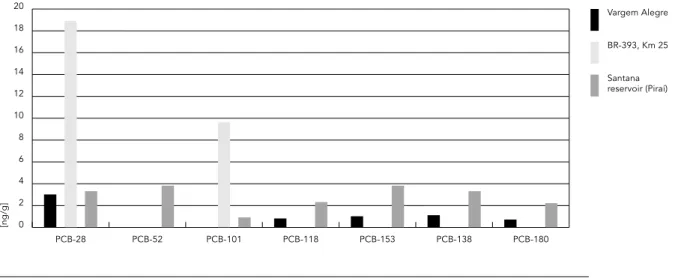
Fu-nil dam near the border between São Paulo and Rio de Janeiro states (Coelho & Fonseca, 1988). In our study, the last agriculture area is now being industrialized. This helps to explain the low levels of organochlorine insecticides found. The presence of PCBs (Figure 3) is more marked, reflecting the urbanization and industrial de-velopment of the Paraíba do Sul River Valley (PASIN, 1988).
Japenga and co-workers reported in 1988 sediment concentrations of organic micropol-lutants in the Rio de Janeiro coastal area ( Ja-penga et al., 1988). Their OC and PAH values are within the same order of magnitude of the ones reported here. The same can be said about
Figure 3
PCBs on sediments from the Paraíba do Sul River.
0 2 4 6 8 10 12 14 16 18 20
Pt. Cajueiro (Volta Redonda) Santo Agostinho (Volta Redonda) R. Bolívia (Volta Redonda)
PCB-180 PCB-138
PCB-153 PCB-118
PCB-101 PCB-52
PCB-28
[ng/g]
0 2 4 6 8 10 12 14 16 18 20
WTP (Pinheiral) Areal (Pinheiral) Olaria (Pinheiral)
PCB-180 PCB-138
PCB-153 PCB-118
PCB-101 PCB-52
PCB-28
[ng/g]
the ones reported by Lima working with core samples from the Guanabara Bay, close to Rio de Janeiro city in 1996 (Sum of PAHs < 20mg/kg) (Lima, 1996).
In Table 3, PAH results obtained at the Winand Staring Centre, The Netherlands, by fluorescence detection after the extraction
ac-0 2 4 6 8 10 12 14 16 18 20
Santana reservoir (Piraí) BR-393, Km 25 Vargem Alegre
PCB-180 PCB-138
PCB-153 PCB-118
PCB-101 PCB-52
PCB-28
[ng/g]
Figure 3 (continued from previous page)
PCBs on sediments from the Paraíba do Sul River.
Table 3
PAH on sediments from the Paraíba do Sul River (ng/g), analyzed at the SC-DLO.
Barra Mansa Volta Redonda Pinheiral Barra do Piraí Piraí
CSN 1 R. Bolívia Santo Pt. WTP WTP Santana
Agostinho Cajueiro reservoir
Phenanthrene 72 2,284 885 702 382 948 696 1,277
Anthracene 8 583 212 156 90 250 209 418
Fluoranthene 47 2,875 1,189 1,190 627 1,432 1,354 2,545
Pyrene 53 2,449 1,091 1,161 616 1,337 1,098 2,287
Chrysene 37 1,632 630 740 427 958 758 1,779
Benzo[a]anthracene 47 1,807 634 835 465 943 719 1,775
Benzo[b]fluoranthene 64 1,589 555 808 442 1,001 710 1,820
Benzo[k]fluoranthene 22 755 276 381 211 499 341 953
Benzo[a]pyrene 43 1,543 612 789 451 1,053 717 1,991
Dibenzo[ah]anthracene 6 218 97 124 73 183 119 354
Indeno[123cd]pyrene 80 1,524 407 583 312 652 422 1,240
Benzo[ghi]perylene 53 1,408 510 710 393 912 567 1,641
B[a]P/Phe 0.6 0.7 0.7 1.1 1.2 1.1 1.0 1.6
Sum of PAHs 532 18,667 7,098 8,179 4,489 10,168 7,710 18,080
CSN = Companhia Siderúrgica Nacional; WTP = Water Treatment Plant.
cording to Dutch protocols confirm the same pattern of anthropogenic PAH contamination (Figure 4). The relative contribution of specific PAHs is quite similar in both data sets.
Figure 4
PAHs on Paraíba do Sul River sediments (SC-DLO data).
0 500 1,000 1,500 2,000 2,500 3,000
Santo Agostinho (Volta Redonda) R. Bolívia (Volta Redonda) CSN 1 (Volta Redonda) Barra Mansa
12 11 10 9 8 7 6 5 4 3 2 1
[ng/g]
0 500 1,000 1,500 2,000 2,500 3,000
Santana reservoir (Piraí) WTP (Barra do Piraí) WTP (Pinheiral) Pt. Cajueiro (Volta Redonda)
12 11 10 9 8 7 6 5 4 3 2 1
[ng/g]
1 = Phenanthrene; 2= Anthracene; 3 = Fluoranthene; 4 = Pyrene; 5 = Chrysene; 6 = Benzo[a]anthracene; 7 = Benzo[b]fluoranthene; 8 = Benzo[k]fluoranthene; 9 = Benzo[a]pyrene; 10 = Dibenzo[ah]anthracene; 11 = Indeno[123cd]pyrene; 12 = Benzo[ghi]perylene.
only traces of chlorinated pesticides (HCB) or PAHs are present in some tributaries. The PAH level of this area is presented in at Table 4. The Queimados River crosses an industrial district with the same name. In the past, another Steel-work Company was installed in this place. The B[a]P/Phe index in this station is around 2. On-ly the less chlorinated PCBs (PCB-28 and 52) were present on the bottom sediments from the Guandu River.
Conclusions
Table 4
PAHs on sediments from the Guandu River basin (ng/g).
Poços River Queimados River Guandu River
BR-116 Industrial Industrial Japeri Paracambi BR-116 Santa Cruz District District
Phenanthrene 25 118 268 78 64 7
Anthracene 10 14 45 12 12 3
Fluoranthene 80 57 186 35 79 25
Pyrene 75 3,101 627 101
Chrysene 122 28 8
Benzo[a]anthracene 52 41 369 808 8
Benzo[b]fluoranthene 595 20
Benzo[k]fluoranthene 49 43 527 81 48 7
Benzo[a]pyrene 55 560 20 46
Dibenzo[ah]anthracene 1,175
Indeno[123cd]pyrene 90 498
Benzo[ghi]perylene 43 712
B[a]P/Phe 2.2 0.0 2.1 0.3 0.7
Sum of 12 PAHs 478 272 8,156 853 1,186 55 15
Blank values are under detection limits; < 3x baseline noise.
Acknowledgements
This work received support from the Commission of the European Community (Project number: C11*-CT93-0055), and Conselho Nacional de Desenvolvi-mento Científico e Tecnológico, Brazil (PRONEX 877). Nowadays, Dr. João Torres is a Selikoff Fellow at the Mount Sinai School of Medicine and Queens College at New York and his research is partially supported by the Grant 1 D43 TW00640 from the Fogarty Interna-tional Center of the NaInterna-tional Institutes of Health, United States.
References
AZCUE, J.; PFEIFFER, W. C.; FISZMAN, M. & MALM, O., 1987. Heavy metals in drinking waters from the Paraiba do Sul – Guandu River system, Rio de Janeiro State, Brazil. Water Science and Technolo-gy, 19:1181-1183.
CÁCERES, O.; TUNDISI, J. G. & CASTELLAN, O. A. M., 1988. Residues of organochloric pesticides in reservoirs of São Paulo State. Ciência e Cultura, 39:259-264.
CELESTE, M. F. & CÁCERES, O., 1988. Resíduos de praguicidas organoclorados no sedimento da re-presa do Lobo (Broa) – São Carlos, SP. Ciência e Cultura, 40:900-905.
COELHO, V., 1990. O Acidente com Óleo Ascarel no Rio Paraiba do Sul. Relatório Técnico Feema 06/241. Rio de Janeiro: Fundação Estadual de Engenharia e Meio-Ambiente.
COELHO, V. M. B. & FONSECA, M. R., 1988. Estudio de Caso: La Contaminación de las Águas del Rio Paraiba do Sul. Washington, DC: Pan American Health Organization.
HARVEY, R. G., 1982. Polycyclic hydrocarbons and cancer. American Scientist, 70:386-393.
HELENE, C. G.; LORD, K. A. & RUEGG, E. F., 1981. The persistence and volatilization of Aldrin- C-14 in two Brazilian soils. Ciência e Cultura, 33:101-105. IEOPOPS (International Experts on POPs), 1990. Meet-ing Background Report. International Experts Meeting on Persistent Organic Pollutants: Towards Global Action. Ottawa: Ministry of Environment. JAPENGA, J.; WAGENAAR, W. J.; SALOMONS, W.;
LA-CERDA, L. D.; PATCHINEELAM, S. R. & LEITÃO FILHO, C. M., 1988. Organic micropollutants in the Rio de Janeiro coastal areas in, Brazil. Science of the Total Environment. 75:249-259.
JAPENGA, J.; WAGENAAR, W. J.; SMEDES, F. & SA-LOMONS, W., 1987. A new, rapid clean-up proce-dure for the simultaneous determination of dif-ferent groups of organic micropollutants in sedi-ments: Application in two estuarine sediment samples. Environmental Technology Letters, 8:9-20.
JENSEN, S.; RENBERG, L. & REUTEGARDH, L., 1977. Residue analysis of sediment and sewage sludge for organochlorines in the presence of elemental sulfur. Analytical Chemistry, 49:316:318.
LARSSON, P. & SODERGREN, A., 1987. Transport of polychlorinated biphenyls (PCBs) in Freshwater mesocosms from sediment to water and air. Wa-ter, Air and Soil Pollution, 36:33-46.
LIMA, A. L. C., 1996. Geocronologia de Hidrocarbone-tos Policíclicos Aromáticos. Estudo de Caso: Baía de Guanabara.Dissertação de Mestrado, Rio de Janeiro: Pontifícia Universidade Católica. LUCHINI, L. C.; LORD, K. A. & RUEGG, E. F., 1981.
Sorption and desorption of pesticides on Brazil-ian soils. Ciência e Cultura, 33:97-101.
MACKAY, D. & PATERSON, S., 1982. Fugacity revisit-ed. Environmental Science and Technology, 16: 654a-660a.
MALM, O. & BRIL, J., 1997. Developing of a simple river basin model for understanding the fate of organic micropollutants.In: International Work-shop on Organic Micropollutants in the Environ-ment, Abstracts, pp. 67-72. Rio de Janeiro: Institu-to de Biofísica Carlos Chagas Filho, Universidade Federal do Rio de Janeiro.
NEFF, J. M., 1984. Bioaccumulation of organic mi-cropollutants from sediments and suspended particles by aquatic animals. Freseniu’s Journal of Analytical Chemistry, 319:132-136.
O’CONNOR, T. P. & EHLER, C. N., 1991. Results from the NOAA National status and trends program on distribution and effects of chemical contamina-tion in the coastal and estuarine United States. Environmental Monitoring and Assessment, 17: 33-49.
PASIN, J. L., 1988. O Vale do Paraíba – Ontem e Hoje. Rio de Janeiro: AC&M/Monsanto do Brasil. PINTO, W. D., 1995. Legislação Ambiental Brasileira.
Brasília: Instituto Brasileiro do Meio Ambiente e dos Recursos Naturais Renováveis.
CETESB (Companhia de Tecnologia de Saneamento Ambiental), 1978. Campanha Especial de Metais Pesados e Pesticidas Realizada no Rio Paraíba do Sul.São Paulo: Superintendência de Tecnologia, Gerência de Avaliação da Qualidade das Águas, CETESB.
SOUZA, N. E.; RUBIRA, A. F.; MATSUSHITA, M. & TANAMATI, A., 1988. Resíduos de pesticidas orga-noclorados em amostras ambientais (águas e so-los) do Município de Maringá. Arquivos de Biolo-gia e TecnoloBiolo-gia, 31:587-594.
TANAMATI, A.; RUBIRA, A. F.; MATSUSHITA, M. & SOUZA, N. E., 1991. Resíduos de pesticidas orga-noclorados no rio Baía, afluente do rio Paraná, Região de Porto Rico – PR, Brasil. Arquivos de Bio-logia e TecnoBio-logia, 34:303-315.
TOMASSI, L. R., 1985. Resíduos de praguicidas em águas e sedimentos de fundo do sistema estuari-no de Santos (SP). Ciência e Cultura, 37:1001-1012.
Submitted on 29 March 2001