Deformation of nickel-titanium closed coil springs:
an in vitro study
Camilla Ivini Viana Vieira1, José Maurício dos Santos Nunes Reis2, Luiz Geraldo Vaz3, Lídia Parsekian Martins4, Renato Parsekian Martins5
1 MSc,Universidade Estadual Paulista (UNESP), Department of Pediatric
Dentistry, School of Dentistry, Araraquara, São Paulo, Brazil.
2 Assistant Professor, Universidade Estadual Paulista (UNESP), Department of
Dental Material, School of Dentistry, Araraquara, São Paulo, Brazil.
3 Full Professor, Universidade Estadual Paulista (UNESP), Department of Dental
Material, School of Dentistry, Araraquara, São Paulo, Brazil.
4 Assistant Professor, Universidade Estadual Paulista (UNESP), Department of
Pediatric Dentistry, School of Dentistry, Araraquara, São Paulo, Brazil. 5 Private practice and part-time Faculty, Universidade Estadual Paulista
(UNESP), Department of Pediatric Dentistry, School of Dentistry, Araraquara, São Paulo, Brazil.
Objective: The aim of this paper was to determine the amount of deformation in four commercial brands of nickel-titanium closed springs. Methods: A total of 130 springs were divided into 13 subgroups, according to their features and manufacturers (Morelli, Orthometric, Ormco and GAC) and activated from 100% to 1000% of the effective length of the nickel-titanium portion present at the spring, at 37 °C. Deactivation data were plotted and deformation was found graphically. The values were compared by analysis of variance and Tukey’s post-hoc test. Results: Springs manufactured by Morelli had the same amount of deformation when they were activated up to 700% of Y activation; springs by Orthometric had the same amount of deformation up to 600-700% of Y; springs by Ormco had the same amount of deformation up to 700-800% of Y; and finally, the majority of springs by GAC had similar deformation up to 800%-1000% of activation. All springs tested could be activated up to 700% without rupture. Conclusions: Most subgroups were similarly deformed up to 700% of activation, without rupture of springs. Subgroups 4B, 4C, 4D and 4E showed the same amount of deformation up to 1000% of activation without any rupture at all.
Keywords:NiTi. Deformation. Biomechanics.
DOI: http://dx.doi.org/10.1590/2177-6709.22.1.038-046.oar
How to cite this article: Vieira CIV, Reis JMSN, Vaz LG, Martins LP, Mar-tins RP. Deformation of nickel-titanium closed coil springs: an in vitro study. Dental Press J Orthod. 2017 Jan-Feb;22(1):38-46.
DOI: http://dx.doi.org/10.1590/2177-6709.22.1.038-046.oar
Submitted: February 17, 2016 - Revised and accepted: June 24, 2016 » The authors report no commercial, proprietary or financial interest in the products or companies described in this article.
» Patients displayed in this article previously approved the use of their facial and in-traoral photographs.
Contact address: Renato Parsekian Martins E-mail: [email protected]
Objetivo: o objetivo desse trabalho foi determinar a deformação em molas fechadas de níquel-titânio de quatro marcas comerciais. Métodos: cento e trinta molas foram divididas em treze subgrupos, de acordo com suas características e fabricantes (Morelli, Orthometric, Ormco e GAC), com ativação entre 100% e 1.000% do comprimento efetivo de níquel-titânio presente na mola (Y), a 37 °C. Dados de desativação foram coletados e a deformação foi obtida de forma gráfica. Os valores foram comparados por meio de análise de variância e teste post-hoc de Tukey. Resultados: as molas da Morelli apresentaram a mesma quantidade de deformação considerando-se 700% de ativação de Y; as molas da Or-thometric tiveram a mesma quantidade de deformação até 600-700% de Y; as molas da Ormco tiveram a mesma quan-tidade de deformação até 700-800% de Y; e, por fim, a maioria das molas da GAC apresentou deformação semelhante até 800-1.000% de ativação. Todas as molas testadas puderam ser ativadas até 700% sem ruptura. Conclusões: a maioria dos subgrupos se deformou de maneira semelhante até 700% de ativação, sem ruptura das molas. Os subgrupos 4B, 4C, 4D e 4E demonstraram a mesma quantidade de deformação até 1.000% de ativação, sem nenhuma ruptura.
INTRODUCTION
In the late 1960s, the U.S. Navy developed a nickel-titanium alloy known as Nitinol,1 which had the property of returning to its original shape ater being heated above a certain temperature. This property was called “shape memory.” Nitinol was introduced in Orthodontics in the 1970s,2 due to its low elastic modulus and good elastic recov-ery. In the following decade, two new nickel-ti-tanium alloys3,4 were introduced in Orthodontics, bringing up a new property to orthodontic thera-py: superelasticity (SE).
SE is characterized by a near-to-constant force (during unloading) depicted on the alloy’s load/delection graph, caused by a stress-induced transformation from austenitic to martensitic phase (SIMT), which are two diferent crystallograph-ic structures that can exist within the same alloy. The image of this near-to-constant force on the graph is referred to as a plateau because of its shape, but it will be termed pseudo-plateau in this paper because it is not completely lat. Each of those two phases has a diferent elastic modulus, which makes this alloy unique.5,6,7 In Orthodontics, it is oten de-sired for nickel-titanium springs to work in its SE plateau, but a high stress is needed to induce SIMT. However, the literature is not clear on how much these springs need to be activated without sufering any signiicant permanent deformation. There are reports in the literature, without presenting any evidence, of activations of 500% the spring’s origi-nal length without permanent deformation,8,9,10 al-though imposing no limits to a higher activation. Only one paper11 mentions ruptures in nickel-tita-nium springs excessively activated, but it does not correlate the rupture to the efective length of the nickel-titanium portion in the spring.
Currently, springs are available in diferent siz-es and several martensitic plateaus, as informed by the manufacturer. This makes the choice for the ideal device for each situation very diicult, espe-cially regarding the size of orthodontic space, force produced, amount of activation and the limit that each device allows for activation without perma-nent deformation.
Therefore, the aim of this study was to deter-mine the percentage of deformation of four
com-mercially available nickel-titanium closed coil springs subjected to several activations.
MATERIAL AND METHODS
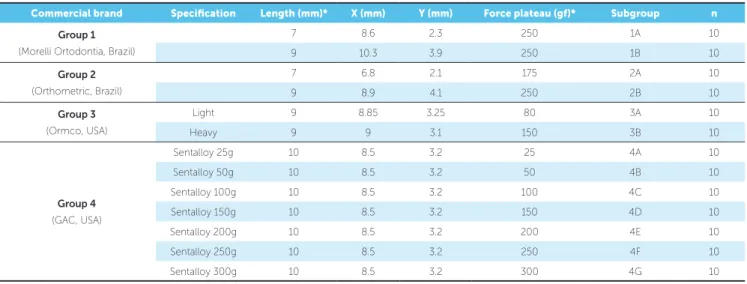
Four groups of springs were established ac-cording to the manufacturer: Group 1, Morelli Ortodontia (Sorocaba/SP, Brazil); Group 2, Or-thometric (OrOr-thometric Importadora Exportadora Ltda, Marília / SP, Brazil); Group 3, Ormco Co. (Glendora, Ca, USA); and Group 4, Dentsply GAC Int. (Bohemia, NY, USA). Within each group, sub-groups of ten springs were determined according to length and force plateau provided by the manufac-turer. All ten springs from each subgroup were from the same batch, totaling 130 springs (Table 1).
An EMIC DL2000 (São José dos Pinhais, Paraná, Brazil) universal testing machine equipped with load cell of 0.1kN was used for testing. The entire system was submerged in distilled wa-ter at 37 ± 1°C,12 controlled with a 30-W heater (Termodelim, São Paulo, Brazil) and a thermostat (Alife, São Paulo, Brazil).
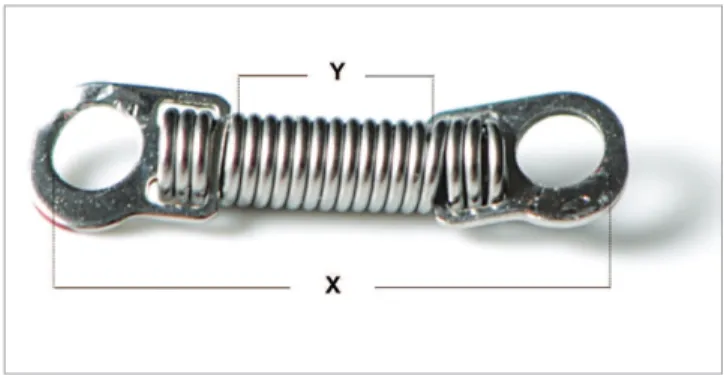
The size of the springs in each group was mea-sured with a digital caliper (Mitutoyo SC-6, Suza-no, São Paulo, Brazil) and the averages were calcu-lated to determine the total size of the spring (X), as well as the efective length of the nickel-titani-um portion (Y) (Fig 1).
Previously to testing, each spring was adjusted with the aid of a digital indicator of extension and force in order to avoid any looseness of the spring, compromis-ing the true activation of the sprcompromis-ing in the test.
Commercial brand Specification Length (mm)* X (mm) Y (mm) Force plateau (gf)* Subgroup n
Group 1
(Morelli Ortodontia, Brazil)
7 8.6 2.3 250 1A 10
9 10.3 3.9 250 1B 10
Group 2
(Orthometric, Brazil)
7 6.8 2.1 175 2A 10
9 8.9 4.1 250 2B 10
Group 3
(Ormco, USA)
Light 9 8.85 3.25 80 3A 10
Heavy 9 9 3.1 150 3B 10
Group 4
(GAC, USA)
Sentalloy 25g 10 8.5 3.2 25 4A 10
Sentalloy 50g 10 8.5 3.2 50 4B 10
Sentalloy 100g 10 8.5 3.2 100 4C 10
Sentalloy 150g 10 8.5 3.2 150 4D 10
Sentalloy 200g 10 8.5 3.2 200 4E 10
Sentalloy 250g 10 8.5 3.2 250 4F 10
Sentalloy 300g 10 8.5 3.2 300 4G 10
Table 1 - Commercial brands and groups division.
* information supplied by manufacturer.
The springs were activated to 100% of Y, and then returned to their original position. The test continued to 200%, 300%, 400%, 500%, 600%, 700%, 800%, 900%, 1000% of Y. A dedicated sot-ware (EMIC - Equipamentos e Sistemas de Ensaio Ltda, São José dos Pinhais, PR, Brazil) registered, in raw format, the force values obtained throughout the trial. The test was performed at 20 mm/min.
The data obtained were exported to Microsot Oice Excel 2007 (Microsot, Redmond, USA) in which the amount of deformation was graphically identiied at each activation. Deformations were only assessed in the subgroups at the activation that presented SE behavior, as determined according to the methods described in the literature.13
Deformation values were transferred to SPSSTM sotware, v. 16.0 (Chicago, Illinois, USA) in which analysis of variance was carried out in order to identify diferences between groups, followed by Tukey’s post-hoc test to compare subgroups, since data were normally distributed.
RESULTS
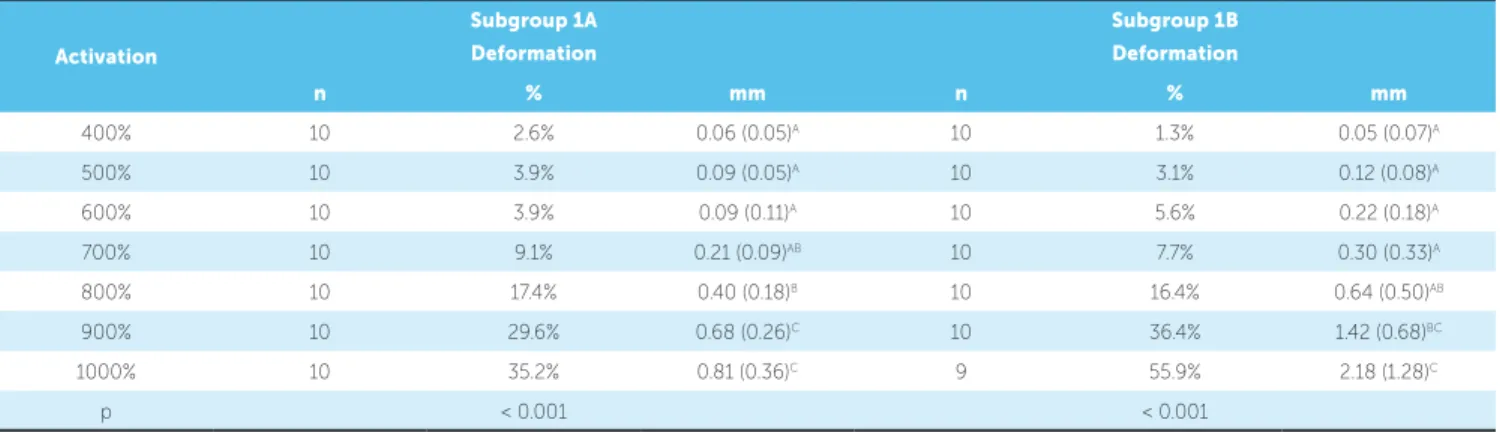
Deformations of subgroup 1A springs from 400% to 700% of activation of Y were similar; deforma-tions at 800% of activation were larger than the ac-tivations from 400 to 600%, but similar to 700%;
while deformations at 900% and 1000% of activation were the same, but diferent from all others activa-tions; there was no rupture to these springs. In sub-group 1B, deformations at 400% to 800% of tion were the same; deformation at 800% of activa-tion was the same as 900% of activaactiva-tion, which was equal to 1000% of activation; in this subgroup, one spring ruptured at 1000% activation (Table 2).
Deformations of subgroup 2A springs occurring from 400% to 700% of activation were similar; de-formations at 800% were diferent from those that occurred from 400 to 600% of activation, but similar to those at 700% of activation; above 800% of activa-tion deformaactiva-tions were similar; one spring ruptured at 800% of activation, two at 900%, and three at 1000%. In subgroup 2B, from 400% to 600% of activation, de-formations were the same; deformation caused at 600% was equal to the one caused at 700%; at 800% of activa-tion, deformation was equal to 700% of activation; ive springs ruptured at 800% of activation, four at 900%, and one at 1000% of activation (Table 3).
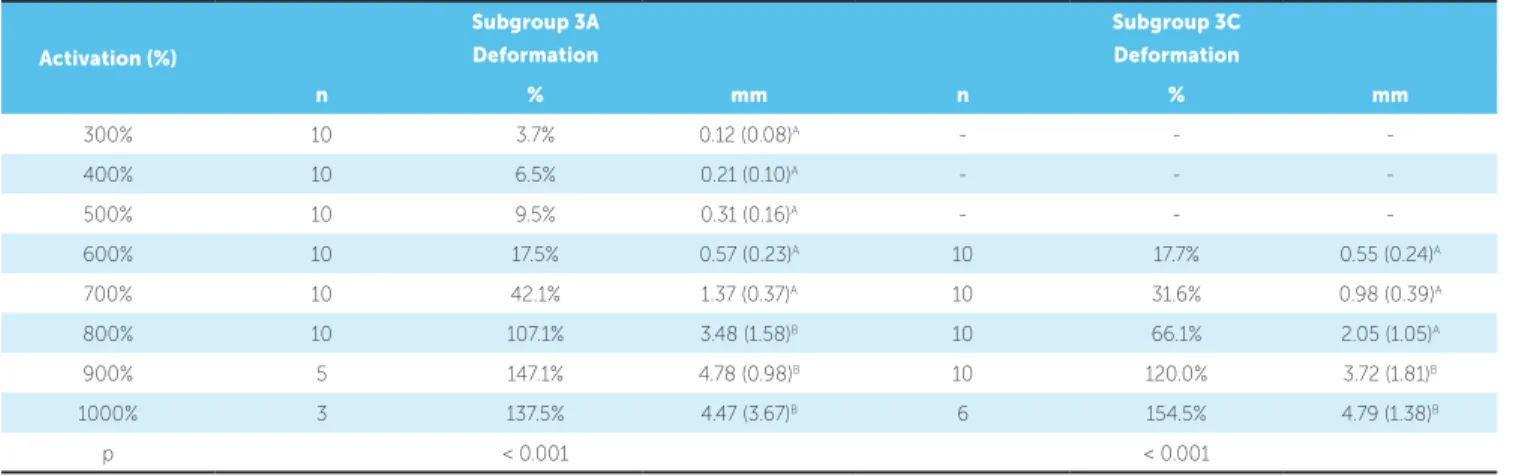
tree remained intact. Subgroup 3B did not show SE behavior, so no comparison was performed. In sub-group 3C, deformations that occurred at 600% to 800% of activation were equal, with deformation at 800% being the same as the deformation at 900% of activation, which was the same deformation that occurred at 1000% of activation; four springs of this subgroup ruptured at 1000% of activation (Table 4).
In subgroup 4A, deformations that occurred at 400% to 800% of activation were equal to each other and diferent from deformations occurring at 900% and at 1000% of activation, which were equal.
In subgroups 4B, 4D, 4C, and 4E, all deformations were the same at 400% to 1000% of activation for the irst two subgroups, at 300% to 1000% of acti-vation for subgroup 4C, and at 500% to 1000% of activation for 4E. In subgroup 4F, deformations were equal at 400% to 800% of activation, but diferent at 900% and 1000%. In subgroup 4G, deformations were equal at 500% to 800% and diferent at 900% and 1000%. None of the springs in subgroups 4A, 4B, 4C, 4D, 4E, and 4F ruptured. Only one spring in subgroup 4G ruptured at 900% of activation and two springs at 1000% (Table 5).
Table 2 - Average deformation in millimeters (SD in parenthesis) and in percentage values of the total length of group 1 springs.
Table 3 - Average deformation in millimeters (SD in parenthesis) and in percentage values of group 2 springs.
Activation
Subgroup 1A Deformation
Subgroup 1B Deformation
n % mm n % mm
400% 10 2.6% 0.06 (0.05)A 10 1.3% 0.05 (0.07)A
500% 10 3.9% 0.09 (0.05)A 10 3.1% 0.12 (0.08)A
600% 10 3.9% 0.09 (0.11)A 10 5.6% 0.22 (0.18)A
700% 10 9.1% 0.21 (0.09)AB 10 7.7% 0.30 (0.33)A
800% 10 17.4% 0.40 (0.18)B 10 16.4% 0.64 (0.50)AB
900% 10 29.6% 0.68 (0.26)C 10 36.4% 1.42 (0.68)BC
1000% 10 35.2% 0.81 (0.36)C 9 55.9% 2.18 (1.28)C
p < 0.001 < 0.001
Activation (%)
Subgroup 2A Deformation
Subgroup 2B Deformation
n % mm n % mm
400% 10 10.0% 0.21 (0.18)A 10 6.6% 0.27 (0.18)A
500% 10 13.8% 0.29 (0.24)A 10 14.4% 0.59 (0.26)A
600% 10 15.7% 0.33 (0.28)A 10 22.4% 0.92 (0.37)AB
700% 10 36.2% 0.76 (0.38)AB 10 36.8% 1.51 (0.84)BC
800% 9 66.2% 1.39 (0.68)BC 5 44.1% 1.81 (0.63)C
900% 7 96.7% 2.03 (0.84)C 1 81.2% 3.33
1000% 4 102.4% 2.15 (1.74)C 0 -
Table 4 - Average deformation in millimeters (SD in parenthesis) and in percentage values of the total length of group 3 springs.
Table 5 - Average deformation in millimeters (SD in parenthesis) and in percentage values of the total length of group 4 springs.
* Non significant values. - Non SE.
- Non SE.
Activation (%)
Subgroup 3A Deformation
Subgroup 3C Deformation
n % mm n % mm
300% 10 3.7% 0.12 (0.08)A - -
-400% 10 6.5% 0.21 (0.10)A - -
-500% 10 9.5% 0.31 (0.16)A - -
-600% 10 17.5% 0.57 (0.23)A 10 17.7% 0.55 (0.24)A
700% 10 42.1% 1.37 (0.37)A 10 31.6% 0.98 (0.39)A
800% 10 107.1% 3.48 (1.58)B 10 66.1% 2.05 (1.05)A
900% 5 147.1% 4.78 (0.98)B 10 120.0% 3.72 (1.81)B
1000% 3 137.5% 4.47 (3.67)B 6 154.5% 4.79 (1.38)B
p < 0.001 < 0.001
Activation
Subgroup 4A Deformation
Subgroup 4B Deformation
Subgroup 4C Deformation
Subgroup 4D Deformation
n % mm n % mm n % mm n % mm
300% - - - 10 2.2% 0.07 (0.05) - -
-400% 10 3.4% 0.11 (0.09)A 10 2.2% 0.07 (0.05) 10 2.2% 0.07 (0.06) 10 3.4% 0.10 (0.07)
500% 10 2.5% 0.08 (0.05)A 10 2.2% 0.07 (0.06) 10 2.5% 0.08 (0.05) 10 4.1% 0.13 (0.13)
600% 10 3.4% 0.10 (0.12)A 10 2.2% 0.07 (0.06) 10 2.5% 0.08 (0.06) 10 4.1% 0.13 (0.13)
700% 10 2.8% 0.11 (0.08)A 10 2.2% 0.07 (0.06) 10 2.5% 0.08 (0.06) 10 3.4% 0.10 (0.12)
800% 10 14.0% 0.45 (0.29)A 10 1.6% 0.05 (0.05) 10 2.5% 0.08 (0.04) 10 3.4% 0.10 (0.12)
900% 10 59.7% 1.91 (1.02)B 10 1.3% 0.04 (0.04) 10 1.3% 0.04* (0.07) 10 3.8% 0.12 (0.19)
1000% 10 44.1% 1.41 (0.96)B 10 -0.6% -0.02 (0.14) 10 1.3% 0.04* (0.25) 10 2.8% 0.09* (0.19)
p < 0.001 0.076 0.965 0.981
Activation
Subgroup 4E Deformation
Subgroup 4F Deformation
Subgroup 4G Deformation
n % mm n % mm n % mm
300% - - -
-400% - - - 10 4.1% 0.13 (0.05)A - -
-500% 10 1.6% 0.05 (0.04) 10 4.1% 0.13 (0.07)A 10 3.4% 0.10 (0.09)A
600% 10 0.6% 0.02 (0.03) 10 3.8% 0.12 (0.08)A 10 3.4% 0.10 (0.08)A
700% 10 0.9% 0.03 (0.03) 10 3.4% 0.11 (0.06)A 10 1.6% 0.05 (0.05)A
800% 10 -0.01 -0.02* (0.18) 10 0.9% 0.03* (0.07)A 10 0.9% 0.03* (0.86)A
900% 10 1.6% 0.05* (0.27) 10 12.5% - 0.4 (0.23)B 9 38.1% 1.22 (1.41)B
1000% 10 1.6% 0.05* (0.38) 10 72.5% 2.32 (0.66)C 7 89.7% 2.87 (1.11)C
p 0.975 < 0.001 < 0.001
DISCUSSION
All springs tested could be activated up to 700% without rupturing, some subgroups however, showed more resistance to rupture. Springs in sub-groups 1A, 4A, 4B, 4C, 4D, 4E, and 4F did not rup-ture up to the length tested, while the ones in sub-groups 1B, 3B, and 4G only ruptured at 1000% of activation. Springs of subgroup 3A began to rupture at 900%, and the ones in Group 2 began to rupture
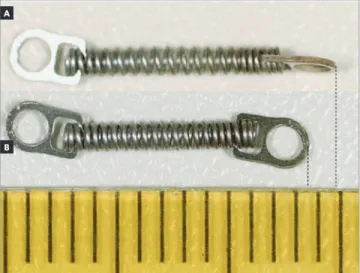
In most springs of Groups 1, 2, and 3, there was no diference between deformation up to 700% of acti-vation. From that percentage of activation on, defor-mations increased (except for subgroups 2B and 3C). Even at the smallest activations where SIMT occurred (mostly at 400%), there was already a small deforma-tion that remained stable until 700% of activadeforma-tion, which could be due to stress relaxation of the springs. An interesting fact is that all springs in groups 1 and 2 showed resistance to rupture up to approximately 36% of deformation, and started to rupture above that amount. Deformations measured by this research in nickel-titanium springs may have happened partially because of stress relaxation, residual permanent de-formation,14 and reversible martensitic deformation, which is reversible upon heating above a certain tem-perature, due to shape memory (Fig 2).
Springs in group 4 ruptured and deformed less than in other groups. In subgroups 4B, 4C, 4D, and 4E, deformation was the same in all activations, even at 1000% of activation, deformations were not clinically signiicant and were smaller than 2.8%. Subgroups 4A, 4F, and 4G showed the same amount of deformation up to 800% of activation, with maximum deformations of 14%, 0.9%, and 0.9%, respectively. It is clear that, even with a subjective assessment, springs in group 4 were superior when compared to the ones in other groups in relation to deformation and resistance. Similarly to springs of groups 1 and 2, springs of subgroup 4G start-ed to rupture above 38% of deformation.
From a clinical standpoint, even with signiicant deformations of about 30%, some springs could still be eicient depending on the situation they are used. When closing pre-molars spaces (Fig 3), nickel-titani-um springs are normally attached from hooks on the irst molars to hooks on the canines (around 23 mm of distance),15 and ater a 7 mm space closure, they would still be active over the 16-mm space let. Thus, if a spring of subgroup 1A (8.6 mm in total length) is attached to the molar hook, stretched to 900% and then engaged over the hook of the archwire during deactivation, it would be efectively activated 14.4 mm and it would remain active up to 7.4 mm of activa-tion with constant force. With a slight diference, one spring from subgroup 1B (10.3 mm) would be ac-tive from 12.7 to 5.7 mm (Fig 4). In those two clini-cal situations, deformations smaller than 7.4 mm and
Figure 2 - Nickel-titanium closed coil spring, before activation (B) and after 900% of activation (A). After heating it above a certain temperature (Af), the martensitic deformation will resume due to the shape memory effect.
5.7 mm, respective to each situation, would be con-sidered clinically irrelevant. However, there are two other variables that should be considered when us-ing nickel-titanium sprus-ings: one is the desired force, since the force plateau decreases with increased acti-vation;11,16 and the second is the relationship between the spring’s clinical work range (Fig 3) and the SE pla-teau length, because even at a SIMT, the dimensions that are clinically used in Orthodontics could make the spring work outside its SE plateau (Fig 4), thus acting in a SE way only ater some space is closed or even never acting in a SE way at all.
The decrease of inclination and increase of length in force plateau with activation occurs because stress in not evenly distributed throughout the spring with activation. As activation is gradually increased, there is a tendency for more areas of the spring to be stressed enough to produce a SIMT; thus, with more areas going through reverse transformation, more “superelastic” the spring becomes. For that reason, limiting nickel-titanium springs activa-tion with the purpose of maintaining forces at a low level is illogical. Moreover, it appears to be a good idea to over-activate those springs upon aixation, in order to improve the springs ability to produce constant and relatively low-er forces.17 That directly connects to the fact that the vast majority of nickel-titanium materials does not behave in a superelastic manner when used in Orthodontics, due to the fact that they are not activated enough to produce SIMT. Large springs will not work properly since not enough stress is produced (Fig 5);17 thus, a
pseudo-pla-A
Figure 4 - A) Load/deflection graph for the springs of the subgroup 1A activated at 900% of Y (20.7 mm of activation or 29.3 mm if the size of the spring is ac-counted). The blue box corresponds to the distance between the hook of the first molar and a hook distal to the upper canine (minus size of the spring), as in Figure 3 (23 mm minus X). Note that to take full advantage of the springs’ SE properties, an increase of approximately 3 mm in the eyelets (not in nickel titanium portion) would be required in order to maintain the force in the SE plateau. That would shift the blue box to the left the same 3 mm. B) Same situation on the subgroup 1B, however, full SE capability would not be achieved in last 2 mm or so of space closure, since the force would start to decrease due to lack of stress.
Figure 3 - Space closure after extraction of first premolars where a nickel titanium spring was attached to a hook from the first molar to a hook distal to the canine (23 mm distance), remaining active even after space closure (minus 7 mm of pre-molar space).
A B
Figure 6 - A 7 -mm long nickel-titanium spring (2.3 mm of nickel-titanium portion) activated approximately 16 mm, which would result in an activation of 23 mm. It can be observed that due to the shape of the load-deflection graph, the pseudo-plateau area, or the near-to-constant force, of the spring would not be used during a 7 mm space closure.
1. Buehler WJ, Wiley RC. TiNi-Ductile intermetallic compound. Trans ASM. 1962;55:269-76.
2. Andreasen GF, Hilleman TB. An evaluation of 55 cobalt substituted Nitinol wire for use in orthodontics. J Am Dent Assoc. 1971 June;82(6):1373-5.
3. Burstone CJ, Qin B, Morton JY. Chinese NiTi wire--a new orthodontic alloy. Am J Orthod. 1985 Jun;87(6):445-52.
4. Miura F, Mogi M, Ohura Y, Hamanaka H. The super-elastic property of the Japanese NiTi alloy wire for use in orthodontics. Am J Orthod Dentofacial Orthop. 1986 July;90(1):1-10.
5. Miura F, Mogi M, Ohura Y. Japanese NiTi alloy wire: use of the direct electric resistance heat treatment method. Eur J Orthod. 1988 Aug;10(3):187-91. 6. Khier SE, Brantley WA, Fournelle RA. Bending properties of superelastic and
nonsuperelastic nickel-titanium orthodontic wires. Am J Orthod Dentofacial Orthop. 1991;99(4):310-8.
7. Gangbing KB, Agrawal BN, Lam PC, Srivatsan TS. Application of shape memory alloy wire actuator for precision position control of a composite beam. J Mat Eng Perf. 2000;9(3):330-3.
8. Miura F, Mogi M, Ohura Y, Karibe M. The super-elastic Japanese NiTi alloy wire for use in orthodontics. Part III. Studies on the Japanese NiTi alloy coil springs. Am J Orthod Dentofacial Orthop. 1988 Aug;94(2):89-96.
9. Manhartsberger C, Seidenbusch W. Force delivery of Ni-Ti coil springs. Am J Orthod Dentofacial Orthop. 1996 Jan;109(1):8-21.
10. Tripolt H, Burstone CJ, Bantleon P, Manschiebel W. Force characteristics of nickel-titanium tension coil springs. Am J Orthod Dentofacial Orthop. 1999 May;115(5):498-507.
REFERENCES
11. Wichelhaus A, Brauchli L, Ball J, Mertmann M. Mechanical behavior and clinical application of nickel-titanium closed-coil springs under diferent stress levels and mechanical loading cycles. Am J Orthod Dentofacial Orthop. 2010 May;137(5):671-8.
12. American National Standards Institute. American Dental Association. Orthodontic wires not containing precious metals speciication 32. New Work: ANSI; 2006. 13. Segner D, Ibe D. Properties of superelastic wires and their relevance to
orthodontic treatment. Eur J Orthod. 1995 Oct;17(5):395-402.
14. Duerig TW, Melton KN, Stockel D, Wayman CM. Engineering aspects of shape memory alloys. London: Butterworth-Heinimann; 1990.
15. Martins RP, Buschang PH, Gandini LG Jr. Group A T-loop for diferential moment mechanics: an implant study. Am J Orthod Dentofacial Orthop. 2009 Feb;135(2):182-9.
16. Maganzini AL, Wong AM, Ahmed MK. Forces of various nickel titanium closed coil springs. Angle Orthod. 2010 Jan;80(1):182-7.
17. Vieira CI, Caldas SG, Martins LP, Martins RP. Superelasticity and force plateau of nickel-titanium springs: an in vitro study. Dental Press J Orthod. 2016 June;21(3):46-55.
18. Tonner RI, Waters NE. The characteristics of super-elastic Ni-Ti wires in three-point bending. Part I: The efect of temperature. Eur J Orthod. 1994 Oct;16(5):409-19.
19. Magno AF, Monini Ada C, Capela MV, Martins LP, Martins RP. Efect of clinical use of nickel-titanium springs. Am J Orthod Dentofacial Orthop. 2015 July;148(1):76-82.
teau is not produced. Even if SIMT is achieved when a shorter spring is used (Fig 6), there is a sudden drop of force in the beginning of reverse transformation, which would not allow constant force. The spring in this situ-ation could be very lexible, but not superelastic on that 7-mm range of activation. The solution would be either to produce a longer spring, adding to the eyelets and not to the nickel-titanium portion,17 or to overactivate the springs, as already mentioned (Fig 7). That would allow a window of activation which would use a long enough pseudo-plateau during space closure, escaping from the sudden drop of force, as depicted by Figure 6. Activating the spring only up to 14 mm, and not overactivating it on this particular situation (Fig 7), would include the sudden drop of force characteristically seen in the beginning of the reverse SIMT up to 7 mm of deactivation spam, simi-lar to what is shown in Figure 6. The force, therefore, would not be as continuous as the one produced when overactivating the spring during space closure.
All springs were tested at 37oC, as mentioned in the Methods section, according to the American Den-tal Association speciication of 2006.12 That was nec-essary because shape-memory alloys respond difer-ently to a given temperature14,18 and, therefore, it was the objective of this paper to know how nickel-titani-um closed coil springs would deform at mouth tem-perature. When one of those alloys, nickel-titanium
included, is below its Af temperature, some martensite is stable and will allow deformation that would not ex-ist at a higher temperature; i.e., above Af. Even though the springs were tested at 37°C, not all characteristics of the oral cavity could be mimicked, which is one of the limitations of this study. This is important because it is known that the oral cavity could contribute fur-ther to the deformation of springs.19
CONCLUSIONS
» The majority of springs had a similar amount of deformation from the moment they became super-elastic, from around 400% of activation up to 700% of activation, in relation to the length of the nickel-titanium portion present in the closed coil springs, without rupturing.
» Subgroups 4B, 4C, 4D, and 4E had a similar amount of deformation up to 1000% of activation (32 mm) without rupturing.
Author contributions