AR
TICLE
1 Instituto de Medicina Social, UERJ. R. S. Francisco Xavier 524/Pavilhão João Lyra Filho/7º andar/blocos D e E, Maracanã. 20550-013 Rio de Janeiro RJ Brasil. [email protected]
Celebrating
Ciência & Saúde Coletiva
,
reminiscing about the trajectory of Physis
Abstract We describe the history and
character-istics of the journal Physis by presenting an over-view of what was published in the 24 years since its first issue. We present some data relating to quotations and a critical discussion of same. We end with a discussion of recently observed move-ments in policies of government agencies regard-ing scientific policy, expressregard-ing our concern and advocating a policy fomenting the diversity and the broadening of the scope of vehicles of scientific dissemination.
Key words Physis
C
amarg
o Júnio
Introduction
It was a great joy for us to receive the invitation to take part in the well-deserved celebrations of the anniversary of Ciência & Saúde Coletiva, as it is one of the most important public health journals in Brazil. This importance is due, among other reasons, to the fact that it is published by our main Association, Abrasco.
The set of Public Health journals, of which Physis is proud to be a part, has been an import-ant instrument in discussing and diffusing the production of the field, which is relevant not only in terms of science, but also in terms of in-tervention, given the field’s dual nature.
Characteristics, editorial line and history
Physis is published by the Instituto de Medicina Social (IMS) of Uerj and by the Centro de Es-tudos e Pesquisas em Saúde Coletiva (CEPESC), a not-for-profit organization linked to IMS that seeks to promote and diffuse the production of scientific knowledge in the Public Health field, as well as to foster and facilitate cooperation be-tween researchers from the several institutions that work in Public Health. Though it is pub-lished by a specific institution, Physis is not a de-partmental or institutional agency and publishes works by authors from all over the country and the world.
Our history begins a short time before Ciên-cia & Saúde Coletiva was founded, in 1991. The date is relevant for other reasons as well. In that year, the Instituto de Medicina Social celebrat-ed its 20th anniversary and its graduate program
accepted its first PhD students. After editing a publication with limited circulation – the “Cad-ernos IMS” –, IMS took on the challenge of cre-ating a new journal that more closely mirrored the themes of its studies and collaborators. Given its singular characteristics, including that it is the graduate program with the greatest percentage of professors/researchers from the Social Sciences and Humanities in Health in the country, IMS saw the opportunity to add new themes to what was already being published in the then-recent Public Health field. Physis began its trajectory as a biannual journal, with Joel Birman, an import-ant intellectual in the field, as its editor.
Joel Birman remained as editor until 1999. The following year, professor André Rangel Rios took over as editor, having previously been an adjunct editor. During his tenure, he sought to
further broaden the journal’s horizons, invit-ing researchers to coordinate special issues with specific themes, and, in 2002, establishing a new structure for the journal, with commissioned articles, reviews and freely submitted articles. Around that time, I was asked to join the journal as an adjunct editor and, in 2004, took over as ed-itor. After the journal was admitted to the SciELO collection in 2005, the number of article submis-sions increased considerably and we started pub-lishing three editions per year, in 2007, and four per year, starting in 2008 and continuing until the present moment. In 2010 we began working with six associate editors, three from IMS and three invited from other institutions. At the end of 2014, we invited four researchers from other countries to join the journal as associate editors.
In 2008 we revised the journal’s graphic lay-out, in part to produce an aggiornamento in its appearance, but also so as to reduce publishing costs. Financial sustainability has been a constant concern throughout Physis’s trajectory. Unlike similar journals, we receive no funds besides those obtained from CNPq, which are limited and have been suffering increasing cutbacks, and are not enough to meet the demands made by SciELO.
Throughout its trajectory, Physis has sought to disseminate the production of national and international authors that is situated at the field’s boundaries, emphasizing interdisciplinarity and the dialogue between the different disciplines that intersect around this theme. Its editorial line is open to production from the Public Health field, with an emphasis on the Social Sciences and Humanities and the Health Policy, Planning and Management areas. Since there are relevant Epi-demiology journals in the country, the journal’s editorial board chose to prioritize those epidemi-ological articles that discuss the area’s conceptu-al dimensions or the sociconceptu-al repercussions of the knowledge it produces. Due to this editorial line, the fact that it is one of the oldest Public Health journals in Brazil, and the predominance of ep-idemiological studies in other journals, Physis became one of the main vehicles for dissemi-nating these Public Health sub-area. This speci-ficity – i.e., that it privileges the Social Sciences and Humanities and the Health Policy, Planning and Management areas – is unique in the Public Health field in Brazil.
e C
ole
tiv
a,
20(7):2053-2058,
2015
admits within its territory a diversity of objects and theoretical discourses, without placing them within a hierarchy or scale of value. Evidently, the different biological discourses have a central place within the health field, but that should not place them in a he-gemonic position with regard to all others. For all of these reasons, we intend to make multidisciplinari-ty this journal’s symbolic mark. We intend to bring together research originating in different areas of knowledge, giving space both to those that circulate in already-established fields of objectivity and to those that open new spaces of investigation.”1
Some characteristics of published articles
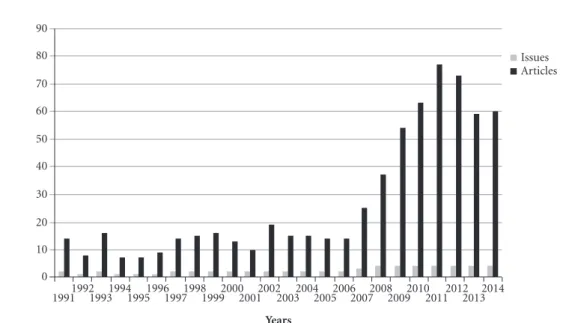
In the 24 years since then, we have published a total of 59 issues (not including the commemo-rative supplement to volume 15) and 654 articles as of the last issue published in 2014 (Figure 1). Most of the themes – 30 in total – were connected to the Social Sciences and Humanities in Health, followed by Health Policy and Planning – 17 in total. Within the Social Sciences and Humanities in Health, some sub-themes received greater at-tention: those connected to sexuality (5), to men-tal health (4) and to Philosophy (3).
Some of the special issues stand out due to their innovation and contribution to the Public Health debate. In issue 7, in 1997, we discussed sexuality as an important issue for Public Health. In 2002, “health in large cities” was the theme of one of the issues. The following year, we put hu-man resources in health at the forefront of dis-cussions and also addressed the issue of abortion. In 2004, we discussed relations between “race” (just like that, between quotation marks), sexu-ality and health. Issues related to science evalu-ation have increasingly been the object of debate in our field and, in 2005, we were one of the first Public Health journals to discuss them. These are only some of the topics that show the scope of the journal’s specific contribution to broadening the field.
It would be more difficult to discuss specif-ic artspecif-icles, since it would be hard to select from the nearly 700 we have published over the past 24 years within the available time. We therefore resorted to a shortcut. The statistics available at the SciELO website provide an interesting basis for reflection, with the caveat that we continue to be critical of their use as criteria for evaluation2.
First, let us consider the ten most cited arti-cles for the period beginning in 2009. The time
Figure 1. Issues and articles published in Physis, 1991-2014.
Source: Physis archives
199119921993199419951996199719981999200020012002200320042005200620072008200920102011201220132014
Years
0 10 20 30 40 50 60 70 80 90
C
amarg
o Júnio
limit is set by the Google Scholar database, which is used by SciELO in its website. As is the case with all citation databases, there are important limitations. Since the citations were retrieved in order to calculate a bibliometric index (H5) which refers only to articles published in the past five years, there is no reference to articles pub-lished before 2008. In any case, the list in the Table 1 reflects, to some extent, the variety of themes published by the journal.
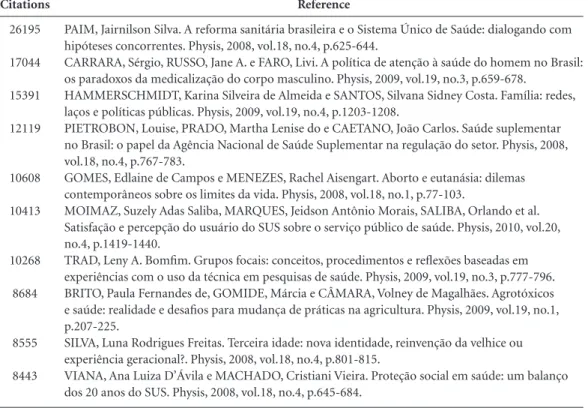
Through the SciELO website, we can also identify the most accessed articles, measured, ac-cording to the website, through access to summa-ries, abstracts and to articles in HTML and PDF formats. In order to maintain the comparability with the Google Scholar metric, we only consid-ered articles published since 2008 and accessed since 2009. The ten most accessed articles, ac-cording to these criteria, are in Table 2.
When considering the two tables, two facts stand out. First, there is little correspondence be-tween the most cited and most accessed articles. Only two appear in both tables (those by Carr-ara, Russo and Faro and by Gomes and Menez-es). Second, ans most importantly, there is an
immense discrepancy between accesses and cita-tions. The articles at the top of the list had more than seven hundred more accesses than citations. Even if we take into account possible limitations to the access index (and there are limitations to citations), this difference should at least encour-age us to reflect on the issue.
“Impact” indicators and the future of the Brazilian scientific publishing
Public Health includes not only the production of knowledge, but also different modes of action, from health care to policymaking and implemen-tation, and also including social movement activ-ism. In such a field, to consider only (and in a limited fashion) use by other researchers, as is the case with citations, leaves aside a relevant aspect of its contributions.
And yet, that is the increasingly criticized – also internationally3 – narrow evaluation that
continues to set the norms for our field. This makes us apprehensive for the future. We were able, with much effort and dedication, to achieve
Citations
34
29
22
20
20
20
19
17
16
16
Reference
CARRARA, Sérgio; RUSSO, Jane A. e FARO, Livi. Política de atenção à saúde do homem no Brasil: os paradoxos da medicalização do corpo masculino. Physis, 2009, vol 19, no.3, p. 659-678. MARTINS, Poliana Cardoso et al. Conselhos de saúde e a participação social no Brasil: matizes da utopia. Physis, 2008, vol.18, no.1, p.105–121.
GOMES, Edlaine de Campos; MENEZES, Rachel Aisengart. Aborto e eutanásia: dilemas contemporâneos sobre os limites da vida. Physis, 2008, vol. 18, no.1, p.77-103.
SANTOS, Suelleng Maria Cunha et al.. Perfil dos pesquisadores da Saúde Coletiva no Conselho Nacional de Desenvolvimento Científico e Tecnológico. Physis, 2009, vol. 19, no.3, p.761-775. MENDONÇA, Fernanda de Freitas; GARANHANI, Mara Lúcia; MARTINS, Vera Lúcia. Cuidador familiar de seqüelados de acidente vascular cerebral: significado e implicações. Physis , 2008, vol .18, no., p.143-158.
SANTOS, Wederson Rufino dos. Pessoas com deficiência: nossa maior minoria. Physis, 2008, vol.18, no.3, p.501-519.
SILVA, Daniela Wosiack da et al. Condições de trabalho e riscos no trânsito urbano na ótica de trabalhadores motociclistas. Physis, 2008, vol.18, no.2, p.339-360.
ANJOS, Tatiana Coletto dos; DUARTE, Ana Cláudia Garcia de Oliveira. A Educação Física e a estratégia de saúde da família: formação e atuação profissional. Physis, 2009, vol.19, no. 4, p.1127-1144.
PIERANTONI, Célia Regina et al. Gestão do trabalho e da educação em saúde: recursos humanos em duas décadas do SUS. Physis, 2008, vol.18, no.4, p.685-704.
LUDERMIR, Ana Bernarda. Desigualdades de classe e gênero e saúde mental nas cidades. Physis, 2008, vol. 18, no.3, p.451-467.
Table 1. Most cited articles in Google Scholar.
e C
ole
tiv
a,
20(7):2053-2058,
2015
a near six-fold increase in the number of arti-cles we published each year. We did this while working with the same infra-structure and with growing funding limitations. Without meaning to start a controversy with our colleagues who made that choice, we would not wish to adopt the (unfortunately increasingly common) model of shifting the onus of financing publications onto authors. Additional demands made by SciELO, especially those concerning the need to publish a considerable portion of articles in English, lead to additional costs – in this case, those related to translation. This cost will add more tension to an already stretched budget, in our case.
Other than that, goals based on, in our view, questionable concepts of impact and interna-tionalization run the risk of interfering with edi-torial lines and even undermining the quality of what is published.
We have noted with some concern growing signs that the quality of what is produced in our field has been decreasing. We believe this is in large part attributable to the pressure to publish an ever-growing volume of articles. We have been especially vigilant of the exponential growth in
the number of authors per article, something we have previously documented4. We have even
ob-served an increase in the number of authors in articles from the Social Sciences and Humanities in Health sub-area, even though this remains a largely authorial field and despite the fact that its methods have not undergone any radical trans-formation in recent years and continue to be ar-tisanal. We and many of our colleagues worry that what is published risks becoming mediocre, restricted to the reiteration of what is known and safe, “more of the same”, as the editors of Cader-nos de Saúde Pública have pointed out5.
We believe there is a need for a deep reflec-tion on the meaning of scientific publishing, the problems brought about by its growing commer-cialization and on the insertion of Brazilian sci-ence into the world setting in order to correctly identify what path we should follow. As Lancet editor Richard Horton recently stated the ques-tion publishers should be asking is not how to pro-tect market share. It is how to explore – and exploit – the full value of science for society6. We have not
seen signs that key instances for the production and diffusion of science in Brazil are rising to the Citations
26195
17044
15391
12119
10608
10413
10268
8684
8555
8443
Reference
PAIM, Jairnilson Silva. A reforma sanitária brasileira e o Sistema Único de Saúde: dialogando com hipóteses concorrentes. Physis, 2008, vol.18, no.4, p.625-644.
CARRARA, Sérgio, RUSSO, Jane A. e FARO, Livi. A política de atenção à saúde do homem no Brasil: os paradoxos da medicalização do corpo masculino. Physis, 2009, vol.19, no.3, p.659-678.
HAMMERSCHMIDT, Karina Silveira de Almeida e SANTOS, Silvana Sidney Costa. Família: redes, laços e políticas públicas. Physis, 2009, vol.19, no.4, p.1203-1208.
PIETROBON, Louise, PRADO, Martha Lenise do e CAETANO, João Carlos. Saúde suplementar no Brasil: o papel da Agência Nacional de Saúde Suplementar na regulação do setor. Physis, 2008, vol.18, no.4, p.767-783.
GOMES, Edlaine de Campos e MENEZES, Rachel Aisengart. Aborto e eutanásia: dilemas contemporâneos sobre os limites da vida. Physis, 2008, vol.18, no.1, p.77-103.
MOIMAZ, Suzely Adas Saliba, MARQUES, Jeidson Antônio Morais, SALIBA, Orlando et al. Satisfação e percepção do usuário do SUS sobre o serviço público de saúde. Physis, 2010, vol.20, no.4, p.1419-1440.
TRAD, Leny A. Bomfim. Grupos focais: conceitos, procedimentos e reflexões baseadas em experiências com o uso da técnica em pesquisas de saúde. Physis, 2009, vol.19, no.3, p.777-796. BRITO, Paula Fernandes de, GOMIDE, Márcia e CÂMARA, Volney de Magalhães. Agrotóxicos e saúde: realidade e desafios para mudança de práticas na agricultura. Physis, 2009, vol.19, no.1, p.207-225.
SILVA, Luna Rodrigues Freitas. Terceira idade: nova identidade, reinvenção da velhice ou experiência geracional?. Physis, 2008, vol.18, no.4, p.801-815.
VIANA, Ana Luiza D’Ávila e MACHADO, Cristiani Vieira. Proteção social em saúde: um balanço dos 20 anos do SUS. Physis, 2008, vol.18, no.4, p.645-684.
Table 2. Most accessed articles in SciELO site.
C
amarg
o Júnio
occasion. On the other hand, these themes have been present in discussions carried out by the newly-created Forum of Public Health Editors, which brings us some comfort.
Having access to a wide and varied set of journals is essential to any scientific field. It is even more important in the case of Public Health, considering its immense internal diver-sity. We need a solid, broad set of journals, with different editorial lines and scopes, even just so that articles in different journals can cite each other. Given Public Health’s political and social commitments, our sights must always be set on broadening, not restricting, publishing opportu-nities. That has been a goal during the trajectory of Physis and clearly the same applies to Ciência & Saúde Coletiva. May the next twenty years see us grow even further.
References
Birman J. A physis da saúde coletiva. Physis Rev Saude Coletiva 1991; 1:7-11.
Camargo Júnior KR. Produção científica: avaliação da qualidade ou ficção contábil? Cad Saude Publica 2013; 29(9):1707-1730.
Cagan R. San Francisco Declaration on Research Asses-sment. Dis Model Mech 2013; 6(4):869-870.
Camargo Jr KR, Coeli CM. Multiple authorship: grow-th or inflationary bubble? Rev Saude Publica 2012; 46(5):894-900.
Carvalho MS, Travassos C, Coeli CM. Mais do mesmo?
Cad Saude Publica 2013; 29(11):2141-2143.
Horton R. Offline: What is the point of scientific pu-blishing? Lancet 385(9974):1166.
Article submitted 12/04/2015 Approved 16/04/2015
Final version submitted 18/04/2015 1.
2.
3. 4.