AR
TICLE
1 Departamento de Saúde Pública, Faculdade de Medicina de Botucatu, Unesp. Av. Prof. Montenegro s/n, Rubião Junior. 18618-970 Botucatu SP Brasil. [email protected] 2 Departamento de Fisioterapia, Fonoaudiologia e Terapia Ocupacional, Faculdade de Medicina, USP.
3 Interface: Comunicação, Saúde, Educação (Botucatu), Unesp. 4 Departamento de Medicina Preventiva, Faculdade de Medicina, USP.
5 Departamento de Educação, Instituto de Biociências de Botucatu.
An interdisciplinary space of scientific communication
in Collective (Public) Health: the journal
Interface - Communication, Health, Education
Abstract This is a reflection upon 17 years of
experience in the production of an interdisciplin-ary scientific journal, the publication “Interface: Communication, Health, Education”, whose scope is in the fields of Collective (Public) Health, Ed-ucation and Communication. It also examines retrospectively the themes published by the jour-nal, seeking to identify them in different sections of this publication. Finally, the evolution of the journal is analyzed.
Key words Public Health, Scientific communica-tion, Social and human sciences in health, Health professional education
Antonio Pithon Cyrino 1 Elizabeth Araújo Lima 2 Vera Lucia Garcia3
C
yr
ino AP
A little history...
[...] At this moment of transition and crisis, where scientific thought frees itself of certainty, Interface was born committed to dialogue,
propos-ing a pluralistic space to ensure communication among diversity, without losing the perspective of a project of organization, construction and
diffu-sion of knowledge. It arose as a borderline entity, socializing studies, debates and concrete experi-ences from different perspectives, motivated by the
preoccupation of contributing to the questioning and understanding of pedagogical and
communi-cational processes involved in the field of Health and constitute, more broadly, the everyday
con-cerns of university and health services [...]1.
This paper presents a reflection upon the
ex-perience of creation and production of Interface
- Communication, Health, Education, a journal gestated in a preparatory character since 1996, a year before officially circulating for the first time, in August 1997. In this manuscript, we also brief-ly anabrief-lyze what we published over these 17 years of regular circulation in print and as electronic media. As we wrote at that time, in the presenta-tion of the second issue, “a publicapresenta-tion is always a certain intervention proposal for a ‘public space’: it generates and regenerates this ‘space’, its
per-manent and constitutive mobility”2. So, in the
retrospective gaze that here we undertake to ex-amine the issues and topics discussed, what we see are the “images” of the questions and thought movement in the fields of its scope: the Collec-tive Health (name of a modified Brazilian Pub-lic Health), its relationship with Philosophy, the Social Sciences and the Humanities, Education, Communication and the Arts in Healthcare, as well as in the Education of health professionals.
Interface was conceived by an interdisciplin-ary study group dealing with Education and Communication related theme studies in the health field, in the UNI Project, funded by the Kellogg Foundation. This project selected Botu-catu as one of locations for the development of this program in Latin America, with the part-nership of the Faculty of Medicine at Botucatu, SP, (Unesp), and local community organiza-tions. Thus, Interface was the result of that in-tense moment of creation and experimentation in integrating projects among the university, the community and the health services, the training in medical schools, as well as in Health graduate courses, involving other professions in this area3.
In the extended debate which took place
within UNI Project, the production of a journal with the characteristics that Interface assumed was considered relevant, as there was no regu-lar national or Latin American scientific journal which worked with this theme since one of the noted journals of that time, published by the Pan American Health Association, stopped circulat-ing. So, after a year of hard work, some work-shops and much discussion, the first issue of In-terface was released at the Fifth Brazilian Congress of Collective Health, in August 1997, with good reception from the field.
The journal innovated introducing other lan-guages in one of its sections – Creation - opening space for the publication of “reflective texts with more formal freedom, emphasizing iconographic, literary and poetical language, etc.4 Furthermore,
the arts (especially the fine arts) were part of the journal’s project from the first number, as an on-going effort to construct a graphic-textual dia-logue with its interdisciplinary: Communication, Health, Education. The selection of artistic ex-pression, moreover, also sought to dialogue with the content of the texts themselves, following the editorial conception of each issue of Interface. It was considered that only scientific language alone would fail to recognize the complexity of the questions posed in this editorial project, which should be guided by the knowledge of the produc-tion based on the inherent sensibility of the arts, for, as Fernando Pessoa wrote, “all art is based on sensibility, and essentially, in sensibility”5.
The presence of Maria Lucia Torales Pereira, as well as of Ricardo Rodrigues Teixeira on the team which conceived the journal – she an art ed-ucator and art researcher and he a sanitary doctor and student of the interfaces between Collective Health, Communication and Philosophy – was decisive for the proposal of this section. From 2009-2014 , it had as editor Mariângela Quar-entei- an occupational therapist and artist, dedi-cated to the issues of the “crossing over” between creative processes and the production of health.
It’s important to note that, from the begin-ning, the journal’s editorial team took over the ongoing challenge of seeking new interfaces and implications between different discourses, show-ing new relations between elements, such as: text and text, text and image, image and image. In a non-linear hypertextual conception of knowl-edge, it took into account technological advanc-es. In this sense, the journal’s project included, from the first editions, an electronic version.
aúd
e C
ole
tiv
a,
20(7):2059-2068,
2015
and the journal was launched as a publication of this foundation. From the second issue on, the team could be characterized as a partnership be-tween the UNI Communication Coordination and the pedagogical disciplines of the graduate courses of the Faculty of Medicine at Botucatu, Unesp.
Although this formal institutional config-uration has been changing over these 17 years, the journal has had only small alterations of its editors and staff, interdisciplinary and interinsti-tutional in nature, which has been important for the progressive maturation of staff and strength-ening of the journal.
Its scope was more explicitly defined in 2002, from the tenth issue on, oriented to the “artic-ulation of Health Sciences with the Humanities, especially regarding Communication, Education and Higher Education”.
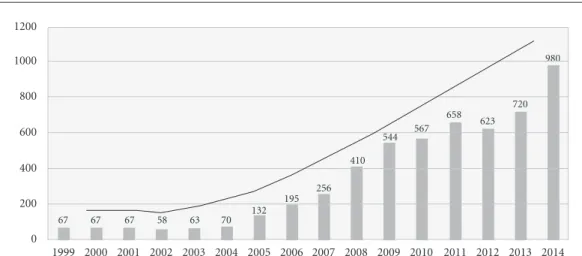
In 2004, the journal established a partner-ship between Unesp (through the Education and Communication Laboratory of Health, De-partment of Public Health, Faculty of Medicine at Botucatu, and the Department of Education, Biosciences Institute at Botucatu) and the UNI Foundation. In 2005, upon completion of its eighth year of circulation, Interface was select-ed to integrate the SciELO Brazil library, which had a huge impact on the volume of submissions (Figure 1) and demanded a gradual internal re-organization of the journal to face the new chal-lenges. The evolution of submissions in the fol-lowing years, with a growth of about 500% in just three years, made Interface a good example of the
importance of open access to “increase visibility” and in the “use and impact of indexed journals”, one of the primary objectives of SciELO6.
This growth in submissions, and consequent-ly, more approved papers, demanded an expan-sion of the periodicity of the journal to three edi-tions per year in 2007, and every three months in 2008. In that year, Interface began utilizing an online submission and an editorial management system (SciELO Submission), which facilitated the flow, the merit-judging procedures and editing of each process, reducing management costs. A recent change to another editorial management
system (ScholarOne Manuscripts) was guided by
the search of specific features, especially, among others, one which permitted an improved search and evaluation of ad hoc reviewers7, one of the
greatest challenges of Brazilian scientific journals today: to quickly receive a qualified evaluation8.
In 2009, because of a reorientation of the UNI Foundation objectives, the journal became a publication of Unesp alone, through the afore-mentioned Education and Communication Lab-oratory in Health.
Based on the thematic analysis of the submis-sions received and the approved papers, as well as on the need to better define the scope of the journal for increasing visibility and delimiting its reading public and collaborators, starting in 2010 the journal began to be characterized as: “ad-dressed to the Education and Communication in health practices, health professional education and Collective Health articulation with Philoso-phy, Social and Human Sciences.” So, its area no
Figure 1. Submissions received during the period 1999-2014.
1999
67
2000
67
2001
67
2002
58
2003
63
2004
70
2005
132
2006
195
2007
256
2008
410
2009
544
2010
567
2011
658
2012
623
2013
720
2014
980
C
yr
ino AP
longer covered the Health Sciences and began to only cover Collective Health, with a preference for qualitative research.
In order to improve the management process and the editorial assessment of scientific merit, in 2011 a pre-evaluation stage was introduced and conducted by Editorial Board. It was established the following criteria for judging manuscripts: the appropriateness to the journal’s scope. the minimum requirements of a scientific paper and the relevance and originality of its thematic and theoretical methodological approach. This also reduced the volume of papers in peer review and the time between submission and publication of the approved papers, bringing greater speed to the judgment of scientific merit. It also ensured a rapid response to the authors of rejected papers, which represented, at this stage, more than 50% of those submitted.
With the same aim of reducing the time be-tween submission and publication of papers, in 2011 the pre-publication in the SciELO Library (ahead of print) of manuscripts already approved was introduced, enabling the rapid dissemina-tion of papers in the scientific community,
al-ready with the allocation of a doi number, thus
allowing for the immediate and correct record of citations received.
Up to the end of 2012, Interface kept both the printed and the electronic publication of their issues, when it was decided to end the print-ed publication, starting from issue number 44 (January-March, 2013), providing only the dig-ital format version. This decision was the result of recognizing the current trend of scientific journals adopting the electronic version, as well as the pressing need to reduce costs. It was also acknowledged that the loss for readers would be small, due to the sharp changes in the way the scientific community currently relates to scien-tific journals: especially in the literature revue through search engines and databases at the ex-pense of regular visits to the library to consult weekly journals, as was done in the not-so-dis-tant past. However, for a journal born under the sign of graphic-textual dialogue, in which the visual arts still occupy a prominent place in the project, you cannot say that this change has been without any damage, no matter how much care is still present in the digital format version.
Interface: a project in movement
In fact, no thinker, as well as no scientist, devel-oped his thought or systematized his scientific knowledge without being questioned, challenged. Although this does not mean that every challenged man becomes a philosopher or a scientist, it means that challenge is fundamental to the construction of knowledge9.
In August 1997, Interface-Communication,
Health, Education brought the words of Paulo Freire, reproduced above, to grace its first issue. In this quote, the emphasis of questioning and challenge has accompanied us since the journal’s creation.
Reviewing that first presentation, and, at the same time, conducting self-criticism of the evo-lutionary process through which the journal has passed, it is possible to assert that Interface has consolidated the initial idea of a moving project, inspired by Pierre Levy and Italo Calvino. “The first, bringing us the metaphor of the hypertext, of the knowledge as a way of building relation-ships and understanding of meaning in a hetero-geneous network without center and in a perma-nent metamorphosis. Calvino offering us light-ness, quicklight-ness, exactitude, visibility, multiplicity and consistency as universal values to challenge the forms of communication of the next millen-nium, while reinforcing the idea of networking and knowledge as an open encyclopedia, and calls for the need of another form of knowledge which is marked by a more plural rationality, a more literary discourse and, above all, with the certainty that we are not personally separated from what we study”1.
Keeping the thematic focus on issues of ed-ucation and communication in health practices and issues of training and education at the uni-versity, the journal is always looking for new dis-cursive articulations. The works which make up the different Interface issues express these artic-ulations.
Focusing specifically on the interdisciplinary character of Interface, it is necessary to compara-tively analyze the journal according to its differ-ent fields of interest.
interdisci-aúd
e C
ole
tiv
a,
20(7):2059-2068,
2015
plinary area that may be named Training and Ed-ucation inHealth. Interface is a journal with that interdisciplinary area in its scope and one of the few journals dedicated to the topic of health pro-fessionals’ education without an affiliation with professions or disciplines of knowledge, which is of considerable importance since various health professionals do not have a broadcast vehicle for reflection on teaching and learning in their area. In this regard and given the significant volume of submissions, Interface has prioritized for publi-cation manuscripts with such an interdisciplin-ary profile.
In addition to the theme of Health Educa-tion, Interface stands out today as a journal in the field of Collective Health and is a reference in one of the areas which make up this interdisci-plinary field: the Social Sciences and Humanities in Health, and has also included the dialogue be-tween Collective Health and Philosophy.
The journal project includes an electronic version, as already mentioned, initially available, from the first editions. It has its own page on the internet, www.interface.org.br, and since 2004, also on SciELO Brazil. In 2012, the Interface web-site was completely redone, gaining a new design and features, allowing online access in the three languages in which Interface accepts submissions: Portuguese, English and Spanish. At the same time there began to be included a facsimile of the printed version of each issue published, allowing for reading directly on the screen or by down-loading and use in different media, in addition to preserving the sense of taking care of the graph-ic-textual design of the journal.
Although the complete journal collection was already present on its website and on SciE-LO, with its content in html or pdf, this did not allow the reader to access the covers, the semantic networks (present in all issues and including the themes covered in each issue) and images, pres-ent only in the printed version. Beyond this con-tent, readers can browse in some sections of the journal – Dossier, Debates, Interviews and Cre-ation - exploring what was published throughout
the collection. With this new website, Interface
includes access to social media (Facebook, Twit-ter and its blog), recognizing the importance of these media in the dissemination of scientific knowledge10.
In recent decades, due to constant and rap-id changes in information and communication technologies, one of the growing challenges for scientific journals is to upgrade in the field of scientific communication, a sector dominated by
large corporations and international publishers. This required renewal has had an impact on the publishing project: it has led to breakthroughs of a more conventional scientific perspective,
guaranteeing Interface its permanence due to a
good performance evaluation including stimu-lating productivity and internationalization; but it has also produced losses, in terms of original boldness in the interdisciplinary area, and in the desired languages, especially in terms of science dialoging with the arts. However, if for some time the Creation section was done by actively searching for collaborators and productions, it is currently receiving contributions through spon-taneous submissions. The other sections have in-creasingly attracted manuscripts articulating the Art-Health connection.
This shifting process, from “printed on pa-per” to “digital format”, has also required a great updating effort from the editorial team and is a continuing challenge for professionalization of this group, requiring the addition of experts in scientific journalism to guarantee that the so-cial media is effectively contemplated. Achieving these high limits of scientific journal profession-alism has shown the limits of public financing in Brazil for the dissemination of knowledge pro-duced by the scientific community.
Collective Health, Education
and Communication: a look at Interface
In its 17 years of existence, Interface has pub-lished 757 articles, distributed among the
three main fields of its interdisciplinary scope - Communication, Health and Education-, re-spectively, with about 9.5%, 48.3% and 42.2% of the total, with significant links between them.
In the sphere of communication, the most common themes identified by keywords, repre-senting 4.2% of the total, are: communication and its means; doctor-patient relationship; in-formation and communication technology; net-works; internet; media; narratives and art.
C
yr
ino AP
violence against women and sexual violence; In-tegrality and public policy.
In the field of Education, the following themes are represented: Education and theo-retical models; Health education; Education of health care professionals and, in particular, med-ical education; Distance education; Permanent and continuing education; Preservice and Inser-vice education; graduation in health areas; Cur-riculum; Evaluation; Learning, including ques-tioning, problem-based learning and meaningful learning; Skills; Teaching; Teacher Education; Higher Education. All together, these comprised 15.24% of the keywords of the manuscripts.
The Sections
Debates
The journal Interface, like other scientific journals, has maintained a Debates section since its inception, with the aim of presenting contro-versial issues, which give rise to discussions in the field. This section went from an initial for-mat, with different authors dealing with the same subject, to the current one, in which three other researchers comment on a main text, followed by a comment from the author who opened the debate. This section has counted on the partic-ipation of young researchers in specific areas of knowledge, but also of established authors with extensive experience in the field, well known as those who built Collective Health in Brazil. The collaborators of this section are researchers from different subfields of Collective Health, such as: Policy Making, Planning and Management; Ep-idemiology and Social Sciences and Humanities in Health. It also included important interna-tional authors, whose works are mainly related to the theme of Education and Health, either as in-volved with university education or with training of human resources for health systems.
In addition, it can be seen that the journal has given voice to authors of different institu-tions, presenting those from the schools of Public Health, of Medicine, Nursing, Dentistry, Psychol-ogy, Communication, Education and Social Sci-ences. Foreign authors are represented, although in a much more limited number, by those from Argentina, Canada, Chile, Spain, Italy and Vene-zuela.
As for themes included, a survey however brief immediately shows us an interdisciplinary concern, as already given by the formation of
the journal, constituted as an interface between three distinct fields of knowledge - Education, Health and Communication. Within these fields, the journal has expressed concern to bring to the public issues both newly initiated and controver-sial ones, including more conjunctural debates, such as classical themes, especially in cases of Collective Health and Education. Thus we see the lively debate on Family Health Strategy, or ques-tions about the work of the community agent, with the hot debate about Popular Education or inter/transdisciplinary, root issues.
It is also possible to observe that the journal expands to include reflections of a philosoph-ical nature of these themes. This is an interest-ing point to notice, as the very field of Collective Health, and even more traditionally the field of Education, already have a critical reflection from a philosophical point of view about their inter-nal affairs, whether in research or in professiointer-nal practice. Thus, opening space for this reflection was productive considering that although the philosophical approach in Collective Health has some accumulation of experience and knowl-edge, in contrast to its traditional presence in Ed-ucation there are few spaces for publication that try to actively stimulate this type of production. In subjects such as Violence, Care and Human-ization, there is a philosophical perspective that interconnects with more traditional trends in humanistic knowledge, represented by the strong and more structured presence in the field of So-cial Sciences, with themes sometimes regarding the cultural aspects of health practices, some-times its social organization.
aúd
e C
ole
tiv
a,
20(7):2059-2068,
2015
debate on Evidence-Based Medicine seemed dar-ing as early as 2002, certainly this strangeness was better understood by the extensive list of more recent years around the issues of Humanization.
Open Space
If at least three explicit principles have marked the editorial line and the construction of the journal since its inception - interdiscipli-narity, the appreciation of qualitative research and the concern to provide an appropriate space for research experiences or professional practices -this last aspect is what defines the Open Space section. In the editorial board words, this space houses “preliminary research notes, current con-troversial texts, relevant experience or informa-tion reports transmitted by electronic means.”
Without losing sight of its necessary scien-tific character, the journal intended to innovate and to connect reports of experience on the one hand, with the publication of papers in scientific language and, on the other hand, with the pub-lication of content freer in form and more open to the arts in general, with the Creation section. Open Space walks between these poles.
The authors here are mostly affiliated with ac-ademic institutions, and are almost all Brazilian. Among the topics discussed, there is a clear predominance of Collective Health, with the field of Education registering 25% of production, and about 10% of Communication. Note that within Collective Health, there are themes that relate to educational issues, but in this case, they are in-scribed in the healthcare practices. What draws attention is the fact that about 10% of the pro-duction, in particular, revolves around the theme of humanization.
Throughout production, either by language or by themes, Open Space has fulfilled its objec-tives and has represented an important link be-tween experience and scientific knowledge.
Creation
Since the first issue of Interface, the Creation section has opened space for compositions which explore the boundaries of academic texts while experiencing other languages without losing the quality and depth of reflection.
This section is connected to the journal’s graphic project, carefully carried out in dialogue with the arts, which includes designing the cover, the production of a network of concepts which shape the themes covered in each issue and the
graphic intervention in the texts, in addition to the blocks of images interspaced between articles published in print on paper, and currently, in its electronic facsimile.
The enthusiasm and investment of the jour-nal creators with the Creation section has been, since its conception, related to the interdisciplin-ary character of this publishing project and the understanding that the complexity of the issues involved often demands other forms of expres-sion and production of knowledge.
In addition to publishing innovative and, sometime, surprising texts, the very existence of the section in the journal always challenged the team of editors to define its scope and the type of article that would be published here. The pro-cess of creation has become part of the work of the team that, in seeking to make room for other forms of expression, ended up working flexibly, giving shape and a better definition for the sec-tion as the contribusec-tions of the authors arrived.
Over the past 17 years in this section, we have published poetry, literary and theatrical texts, critical essays on cinema, visual arts and theater, photo essays, drawings, paintings on canvas and body paintings, woodcuts, collages, sewing and embroidery, mosaics, self-portraits, exhibitions and shows, urban expedition records, architec-tural projects, performances and dance images, among others.
Through these different imaging and written compositions a great variety of themes have been treated: science crisis and crisis of representation, relations between science and art, health human-ization, madness and creation, looks over the city and everyday concerns, vulnerabilities, body and corporality, art workshops, training and health education, health communication, contempo-rary lifestyles, love, loneliness, creative work-shops, academic production and reflections on the writing process. The existence of this section also allowed space for the publication of texts that addressed the issue of the interface of art and health, a theme which is becoming stronger and occupying space in other sections of the journal.
In 2009, the Creation section team was
C
yr
ino AP
new challenges and new possibilities. The section expanded experimentation in graphic produc-tion of texts, the use of colors and images, and also began to include video and audio content in its publications.
For its dimension of innovation and resis-tance in the editorial and scientific areas, the
Creation section plays a key role in Interface, and remains as a differential and singular brand of the journal.
Interview and Dossier
Interview and Dossier are sections whose top-ics have been linked, since the first issue of Inter-face: Dossier (called Essays until 2002) is involved in the publication of text essays or thematic analytical papers, by invitation of the editors,
resulting from studies and research; Interview
publishes testimonies of people whose life stories or professional achievements are relevant to the areas of the journal coverage.
Taking a retrospective look at the themes published in these sections over these last 17 years, it is possible to observe the evolution of the scope of the journal, while, at the same time, con-firming the identity of the initial project.
Generated in a context of crisis and transition at the end of the century, in which the university and, in particular, the health science schools be-gan to question their education processes,
Inter-face sought to participate, building a new space
for discussion and reflection on the problems of the education and the practices which involved the field of health, enabling the production of knowledge that put together areas traditionally conceived within distinct epistemological and semantic fields.
In the early years of the journal, texts pub-lished in Dossier and Interviews predominately expressed concerns which permeated the teach-ing of health professions, especially the medical course, in a context of transition at the new mil-lennium, to reflect on new paradigms for Edu-cation and health practices, discussion of ethics and human rights, curriculum reform, teaching methodology, epistemology, continuing edu-cation, inservice eduedu-cation, innovation, use of technology and autonomy. Such themes still show up in the latest issues, stimulated by induc-ing policies and wideninduc-ing the field of teachinduc-ing for other health professions.
As the journal’s scope consolidates as a pub-lication of Collective Health, prioritizing studies involving qualitative research, the themes of the
Dossier and Interview sections accompany this evolution of the editorial project with topics re-lated to SUS, Family Health, Violence, Primary Health Care, the public versus private issue in the state, Social Networks, Care, and Qualitative Research.
Final thoughts: an evaluative perspective
After a long period of existence, such as our 17 years, a certain brief evaluation of advances and difficulties is necessary. These were years of major changes in the field of Collective Health: strong growth of graduate programs; proposi-tion of undergraduate courses; greater autonomy of internal areas (Epidemiology, Social Sciences and Humanities in Health and Policy, Planning and Management), including the independence of conferences and special events; emergence of Science and Technology policies, with intensive research funding related to SUS; many social pol-icies for SUS, above all, related to primary care, with a rapid substitution and obsolescence of proposals, which produced an important impact in the production of knowledge; rapid growth in the volume of professionals and field research participants, taking as an indicator the large number of people attending and presenting at conferences, etc.
All of this led both to the recognition of Col-lective Health as a scientific field, as well as to a progressively falls within the framework of such status. Likewise, dialectically, Collective Health creates tension in this framework through its interdisciplinary approach and criticism of the more traditional scientific culture.
ba-aúd
e C
ole
tiv
a,
20(7):2059-2068,
2015
sis, which went from the 18th to the 5th position
between 2003 and 2013, while Collective Health (which includes Occupational Health and Envi-ronmental Health) went from the 12th to the 6th
position. In the same period, utilizing the same criterion, Brazilian science as a whole went from the 17th to the 13th position. Interface is currently
the twelfth leading scientific journal published in Portuguese, according to Google Scholar Metrics, based on the h5 index concerning papers pub-lished in the last five years11. Also based on the h5
index, Interface is well positioned among Collec-tive Health journals.
Still within the successful perspective of a sci-entific journal, considering the interdisciplinary character of Interface, it is important to point out its recognition in the different areas of its scope. To this end, we can take the Qualis-Journals, of Capes, with a reference of value assigned in each area of the journal, in which A1 is the maximum. Qualis A2 was conferred in the areas of Arts/Mu-sic, Interdisciplinarity, Education and Teaching, and B1 in Collective Health, Applied Social Sci-ences I (including communication), Anthropol-ogy and SociolAnthropol-ogy.
Interface interdisciplinary characteristic can also be analyzed comparatively, according to
its different areas of interest, based on its per-formance in Scopus. In the area of Education (though its scope is only focusing on higher edu-cation: health professionals teaching), the journal stands out among the Latin American journals of this area. On this basis, among the 29 Latin American Journals of Education, Interface is one of those with the greatest impact according to dif-ferent indicators (SJR, h-index, citation rate, etc.). The same is true in the area of communication, in which, among the six Latin American publications present in the Scopus base, Interface is the best performing in the above mentioned indicators.
Indeed, together with the good scientific in-dicators, the loss of printed publication - both by increased costs in the original proposal, as well as the new way readers and researchers relate to journals centered on digital communication -, called for root changes. Still, Interface sought to keep much of the original design and, as men-tioned, with regard to the Art-Health link, if on the one hand there were loses, on the other this interdisciplinary perspective with the Arts led, over time, to require the publishers to actively search for collaborators and increasingly receive spontaneous contributions, working with ico-nography, imagery and literary devices.
Collaborations
C
yr
ino AP
Referências
Apresentação dos editores. Interface (Botucatu) 1997; 1(1):5-5.
Apresentação dos editores. Interface (Botucatu) 1998; 2(2):5-5.
Cyrino APC, Cyrino EG. Integrando comunicação, saúde e educação: experiência do UNI-Botucatu.
Inter-face (Botucatu) 1997; 1(1):157-168.
Normas de publicação. Interface (Botucatu) 1997; 1(1):5.
Pessoa F. Arte e Sensibilidade. In: Carta a Miguel Torga, 1930. [acessado 2015 jan 10)]. Disponível em: http:// www.citador.pt/textos/arte-e-sensibilidade-fernando -pessoa
Packer A, Meneghini R. O SciELO aos 15 anos: raison d’être, avanços e desafios para o futuro. In: Packer A, Cop N, Luccisano A, Ramalho A, Spinak E, organiza-dores. SciELO - 15 Anos de Acesso Aberto: um estudo analítico sobre Acesso Aberto e comunicação científica: um estudo analítico sobre Acesso Aberto e comunica-ção científica. Paris: Unesco; 2014. p. 26-58.
Cyrino AP, Schraiber LB, Foresti M. Interface: um projeto em movimento. Interface (Botucatu) 2013; 17(44):5-6.
Artigo analisa a saturação dos revisores por pares. SciE-LO em Perspectiva. [acessado 2015 fev 5]. Disponível em: http://blog.SciELO.org/blog/2015/01/22/artigo-a-nalisa-a-saturacao-dos-revisores-por-pares/
Freire P. Extensão ou comunicação. São Paulo: Paz e Ter-ra; 1992
Estudo analisa o uso de redes sociais na avaliação do impacto científico. SciELO em Perspectiva. [acessado 2015 mar 18]. Disponível em: http://blog.SciELO.org/ blog/2015/03/13/estudo-analisa-o-uso-de-redes-so-ciais-na-avaliacao-do-impacto-cientifico
Google Scholar Metrics. [acessado 2015 mar 18]. Dis-ponível em: https://scholar.google.com/citations?view _op=top_venues&hl=pt-BR&vq=pt
Article submitted 13/04/2015 Approved 14/04/2015
Final version submitted 16/04/2015 1.
2.
3.
4.
5.
6.
7.
8.
9.
10.