Malocclusion prevalence and orthodontic treatment
need in central Anatolian adolescents compared to
European and other nations’ adolescents
Fundagul Bilgic1, Ibrahim Erhan Gelgor2, Ahmet Arif Celebi3
How to cite this article: Bilgic F, Gelgor IE, Celebi AA. Malocclusion preva-lence and orthodontic treatment need in central Anatolian adolescents compared to European and other nations’ adolescents. Dental Press J Orthod. 2015 Nov-Dec;20(6):75-81. DOI: http://dx.doi.org/10.1590/2177-6709.20.6.075-081.oar
Submitted: February 04, 2015 - Revised and accepted: July 06, 2015
» The authors report no commercial, proprietary or financial interest in the products or companies described in this article.
Contact address: Fundagul Bilgic Email: [email protected]
1 Assistant Professor, Mustafa Kemal University, Faculty of Dentistry,
Department of Orthodontics, Hatay, Turkey.
2 Professor, Kirikkale University, Faculty of Dentistry, Department of
Orthodontics, Kirikkale, Turkey.
3 Lecturer, Ishik University, Faculty of Dentistry, Department of Orthodontics,
Erbil, Iraq.
Objective: To determine the prevalence of malocclusion and orthodontic treatment need in a large sample of Central
Anatolian adolescents and compare them with European-other nations’ adolescents. Methods: The sample included
1125 boys and 1204 girls aged between 12 and 16 years with no previous orthodontic treatment history. Occlusal variables examined were molar relationship, overjet, overbite, crowding, midline diastema, posterior crossbite, and scissors bite. The dental health (DHC) and aesthetic components (AC) of the Index of Orthodontic Treatment Need (IOTN) were used as an assessment measure of the need for orthodontic treatment for the total sample. Re-sults: The results indicated a high prevalence of Class I (34.9%) and Class II, Division 1 malocclusions (40.0%).
More-over, increased (18%) and reduced bites (14.%), and increased (25.1%) and reversed overjet (10.%) were present in the sample. Conclusion: Using the DHC of the IOTN, the proportion of subjects estimated to have great and very great
treatment need (grades 4 and 5) was 28.%. However, only 16.7% of individuals were in need (grades 8-10) of orthodontic treatment according to the AC.
Keywords:Malocclusion. Orthodontic treatment need. IOTN.
DOI: http://dx.doi.org/10.1590/2177-6709.20.6.075-081.oar
Objetivo: determinar a prevalência de má oclusão e a necessidade de tratamento ortodôntico em uma amostra extensa de ado-lescentes da Anatólia Central, e compará-los a adoado-lescentes europeus de outras nacionalidades. Métodos: a amostra consistiu de 1125 meninos e 1204 meninas, com idades entre 12 e 16 anos, sem histórico de tratamento ortodôntico prévio. As variáveis oclusais avaliadas foram a relação entre molares, overjet, overbite, apinhamento, diastema na linha média, mordida cruzada poste-rior e mordida em tesoura. O Componente de Saúde Dental (DHC) e o Componente Estético (AC) do Índice de Necessidade de Tratamento Ortodôntico (IOTN) foram utilizados para avaliar a necessidade de tratamento ortodôntico de toda a amostra.
Resultados: os resultados sugerem uma alta prevalência de má oclusão de Classe I (34,9%) e Classe II, subdivisão 1 (40,0%). Além disso, overbite aumentado (18,3%) e reduzido (14,4%), e overjet aumentado (25,1%) e reduzido (10,4%) também foram observados na amostra. Conclusão: com base no uso do DHC do IOTN, observou-se que a proporção dos indivíduos ava-liados com necessidade grande e muito grande de tratamento (notas 4 e 5) foi de 28,7%. Porém, de acordo com o AC, apenas 16,7% dos indivíduos apresentaram necessidade (notas 8-10) de tratamento ortodôntico.
INTRODUCTION
On an increased basis, malocclusion is considered an expression of normal biologic variation, and treat-ment need is often based as much on psychosocial concerns as on proven oral health risks attributable to malocclusion.1 The criteria for determining who is most likely to benefit from orthodontic treatment are controversial. These factors make it particularly dif-ficult for the general dentist to determine for whom orthodontic treatment is clearly indicated, since the traditional pathway to orthodontic care starts at the general dentist’s office.
Diferent populations have been investigated to provide epidemiological data of the prevalence of mal-occlusion.2-7 As a common trend, quantitative vari-ables along with Angle’s classiication were used in these reports. Additionally, treatment-need indexes were also used to determine orthodontic need based on esthetic impairment, potential for adverse efect on dental health, and deviation from normal occlusion.8 The Index of Orthodontic Treatment Need (IOTN), involving the Dental Health Component (DHC) and the Aesthetic Component (AC), is the tool most fre-quently used for measuring treatment need.9,10 Per-haps, being objective and synthetic, and allowing for comparisons between diferent population groups, are the most important aspects of this index.7,11,12
Certain European populations, such as the Swed-ish,13 British,14 German,5,15 French16 and Italian6,7,17 have been examined extensively in regards to IOTN. However, there is little research and/or published data that evaluated together the prevalence of malocclu-sion8,18 and orthodontic treatment need19,20 in adoles-cents. Therefore, the aim of the present survey was to document the prevalence of individual traits of maloc-clusion, and to assess the need for orthodontic treat-ment in relation to sex by using the IOTN in a group of adolescent schoolchildren. It also aimed to compare the data provided with the indings of chiely Euro-pean patients as well as other surveys.
MATERIAL AND METHODS
Data were collected during an epidemiological sur-vey, in the period of May, 2008 to December, 2012, from 2329 adolescents (1125 males and 1204 females) aged 12.5–16.2 years, randomly selected using a one-stage cluster sampling procedure in 13 state-funded
secondary schools in Kirikale city which is located in the south area of the capital of Turkey. The schools were randomly selected from an initial pool of 27 schools that had been previously identiied by the school district to avoid possible biases ensuing from social heterogeneity. Written parent informed consent forms were obtained for dental examinations. Family origin and registration information were examined in order to determine that the sample was a good repre-sentative of ancestry from the central part of the coun-try. All male and female patients who met the follow-ing criteria were included in the sample: (1) age from 12 to 16 years; (2) secondary dentition present with no remaining deciduous teeth; (3) no multiple missing teeth; (4) presence of irst permanent canines and mo-lars; and (5) no previous history of orthodontic treat-ment. Each examination took place while the subject was seated in a standard, quiet classroom in the des-ignated chairs. Clinical examination was carried out by one examiner who was previously calibrated. The examination lasted 20 minutes per child, following the World Health Organization guidelines.21
Orthodontic variables
Patients with an occlusal pattern that deviated from the ideal Class I relationship, which is based on the buc-cal groove of the mandibular irst molar settled on the mesiobuccal cusp of the maxillary irst molar as described by Angle, (including crowding, spacing, rotations), were categorized as Class I malocclusion. Thus, the Class I normal category was limited to patients with occlusions that were ideal or near ideal. Patients with a diferent Angle classiication of occlusion on each side were cat-egorized into a single Class based on the predominant pattern of occlusion and/or canine relationship.4,22
For overbite and overjet, values between 0 and 4 mm were considered normal.7 Posterior cross-bite and scissors cross-bite were registered as bilateral, right and let.4,5 Crowding was recorded for the incisor and also posterior segments of each jaw (1-3 mm = mild; 4-6 mm = moderate; > 6 mm = severe).4 Anterior dia-stema was diagnosed when there was a space of at least 1 mm between central incisors in either arch.4
Orthodontic treatment need
The findings served to determine orthodontic treatment need with reference to the IOTN9,10 which consists of the DHC and the AC. Considerations as to no treatment need, borderline need, or great need were based on five grades in the DHC and 10 grades in the AC.
Statistical analysis
To test examiner reproducibility, 25 children were reexamined by Kappa’s method four weeks af-ter initial examination.23 The ratio of the sample, as a maximum estimate of the proportion of individual traits of malocclusion in the whole population, was calculated for the total sample and for girls and boys separately. The number of subjects with diagnosed anomaly (n) and its prevalence (n/N x 100, in which N is the number of subjects examined) was determined. The diferences between sex groups were assessed by means of chi-square test. Data were analyzed by SPSS sotware package (version 21.0, SPSS Inc., Chicago, Ill., USA). for IOTN DHC and AC grades. Level of signiicance was established at p < 0.05.
RESULTS
Kappa test indicated high reliability and reproduc-ibility (0.73 - 0.80) for the parameters tested. Table 1 presents the prevalence of each occlusal trait in the total sample. Class I malocclusion was found in 812 subjects, which represented 34.9% of the 2329 individuals ex-amined. Class II malocclusion was diagnosed in 1041
individuals, 40.0% of all patients were Division 1 and 4.7% of all patients were Division 2. Class III maloc-clusion was found in 240 subjects, 10.3% of the sam-ple. Normal overbite was the most common (73.5%), mostly observed in girls (p < 0.001). Increased overbite
was recorded in 18.3% of the sample, mostly observed in boys (p < 0.05). The prevalence of reduced bite value was found as 8.2%. Normal overjet was present in 1371 individuals (64.5%). Prevalence of increased overjet (25.1%) was found to be higher than negative overjet (10.4%). While crossbite was found more frequently, as much as of 4.0 % of the sample, scissors bite was rarely diagnosed in only 0.3% of the subjects.
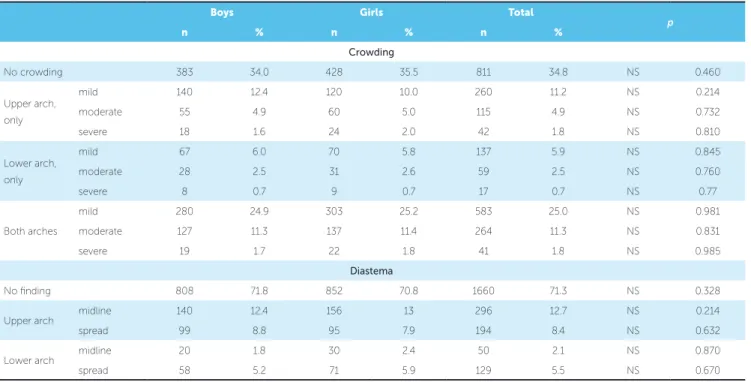
Anterior crowding was present in 1638 individu-als (66.2%) (Table 2); 17.9, 9.1 and 38.1% of those had crowding in the upper arch, lower arch and both arches, respectively. Moderate crowding was more common in both arches. Midline and spread diastemas were found in 14.8 and 12.9% of the sample, respec-tively. Diastemas were observed mostly in the upper arch (Table 2).
In the study group, the IOTN revealed no treatment need in 45.6% of the sample, when the DHC was used (mostly in boys (p < 0.05) and 43.1% when the AC was used. (Figs 1 and 2, and Tables 3 and 4). When border-line cases were taken into consideration, treatment need was diagnosed in 25.7% of the sample when the DHC was used and in 40.2% when the AC was used. The number of subjects with the need for orthodontic treat-ment was 648 (28.7%) when the DHC was used, and 376 (16.7%) when the AC was used.
Figure 1 - Dental Health Component (DHC) grades of the Index of Orth-odontic Treatment Need (IOTN) in Anatolian adolescents (Grades 1 and 2, no need; Grade 3, borderline need; Grades 4 and 5, definite need).
Figure 2 - Aesthetic component (AC) grades of the Index of Orthodon-tic Treatment Need (IOTN) in Anatolian adolescents (Grades 1-4, no need; Grade 5-7, borderline need; Grades 8-10, definite need).
grades
grades
% %
35
1 2 3 4 5
30
20
20
5
5 25
25
10
10 15
15
Table 1 - Occlusal classifications.
Table 2 - Distribution of crowding and diastema. NS: Not significant. *p < 0.05; ***p < 0.001.
NS: Not significant.
Boys Girls Total
p-value
n % n % n %
Occlusal anteroposterior relationships
Normal occlusion 110 9.8 126 10.5 236 10.1 NS 0.63
Class I 404 35.9 408 33.9 812 34.9 NS 0.317
Class II, Division 1 448 39.8 483 40.1 931 40.0 NS 0.899
Class II, Division 2 56 5.0 54 4.5 110 4.7 NS 0.625
Class III 107 9.5 133 11.0 240 10.3 NS 0.246
Distribution of overbite
Normal (0-4 mm) 802 71.2 913 75.8 1715 73.5 *** 0.0001
Increased (> 4 mm) 227 20.2 197 16.4 424 18.3 * 0.018
Reduced (< 0 mm) 96 8.5 94 7.8 190 8.2 NS 0.098
Distribution of overjet
Normal 731 65 770 64 1501 64.5 NS 0.866
Increased 281 25 304 25.2 585 25.1 NS 0.886
Negative 113 10 130 10.8 243 10.4 NS 0.588
Distribution of posterior crossbite and scissors bite
No inding 1021 90.8 1082 89.9 2103 90.3 NS 0.677
Crossbite
Bilateral 41 3.6 52 4.3 93 4.0 NS 0.544
Unilateral right 35 3.1 41 3.4 76 3.3 NS 0.890
left 24 2.1 27 2.2 51 2.2 NS 0.970
Scissors bite
Bilateral 1 0.1 1 0.1 2 0.1 NS 0.957
Unilateral right 2 0.2 0 0.0 2 0.1 NS 0.949
left 1 0.1 1 0.1 2 0.1 NS 0.889
Boys Girls Total
p
n % n % n %
Crowding
No crowding 383 34.0 428 35.5 811 34.8 NS 0.460
Upper arch,
only
mild 140 12.4 120 10.0 260 11.2 NS 0.214
moderate 55 4.9 60 5.0 115 4.9 NS 0.732
severe 18 1.6 24 2.0 42 1.8 NS 0.810
Lower arch, only
mild 67 6.0 70 5.8 137 5.9 NS 0.845
moderate 28 2.5 31 2.6 59 2.5 NS 0.760
severe 8 0.7 9 0.7 17 0.7 NS 0.77
Both arches
mild 280 24.9 303 25.2 583 25.0 NS 0.981
moderate 127 11.3 137 11.4 264 11.3 NS 0.831
severe 19 1.7 22 1.8 41 1.8 NS 0.985
Diastema
No inding 808 71.8 852 70.8 1660 71.3 NS 0.328
Upper arch midline 140 12.4 156 13 296 12.7 NS 0.214
spread 99 8.8 95 7.9 194 8.4 NS 0.632
Lower arch midline 20 1.8 30 2.4 50 2.1 NS 0.870
Table 3 - DHC of IOTN statistics of boys and girls.
Table 4 - AC of IOTN statistics of boys and girls. *,p < 0.05; NS: Not significant.
NS: Not significant. Occlusal anteroposterior
relations-hips
Boys Girls Total p-value
n % n % n %
No need 531 48.3 492 42.8 1023 45.6 * 0.01
Borderline need 263 23.9 316 27.5 579 25.7 NS 0.054
Need 306 27.8 342 29.7 648 28.7 NS 0.328
Total 1100 100 1150 100 2250 100
Occlusal
anteroposterior relationships
Boys Girls Total p-value
n % n % n %
No need 492 44.6 478 41.6 970 43.1 NS 0.136
Borderline need 437 39.6 467 40.7 904 40.2 NS 0.699
Need 171 15.4 205 17.9 376 16.7 NS 0.142
Total 1100 100 1150 100 2250 100
DISCUSSION
Although many studies were published to describe the prevalence and types of malocclusion, when ex-amining a certain population it is difficult to com-pare and contrast these findings, partly because of the varying methods and indexes used to assess and record occlusal relationships, age differences of the study populations, examiner subjectivity, specific objectives, and differing sample sizes.22 Methodology used in this study was mostly collected from Euro-pean studies,4,6,7,22 and our results were discussed with the findings from different European geological re-gions due to close proximity and since there was lim-ited information of individuals in the literature. The general consensus about treatment timing for mal-occlusions is that it should start around permanent dentition. At this stage, maxillary and mandibular de-velopment is almost completed and the malocclusion takes its final pattern. Given the characteristics of the sample, this paper demonstrated the occlusal traits of an untreated adolescent population at those ages.
With respect to the occlusal indings, Class I mal-occlusion was found in 34.9% of the sample. This Class I occlusion igure included individuals with
also claimed that deep bite was oten associated with a Class II malocclusion and more common in boys. How-ever, higher ratios were found in Italian samples.6,7 In-creased overjet proved to be as high as inIn-creased overbite in this study; this is a relection of the higher prevalence of Class II malocclusion among adolescents. Our ind-ings agree with those of Thilander et al,4 in Bogotanian adolescents, and Ciufolo et al,6 in Italian adolescents, in which high rates of increased overjet in the permanent dentition were reported. In a French sample, increased overjet was present in fewer subjects (6%).3
In this study, uni/bilateral posterior crossbite was more frequent than scissors bite and was observed in 9.5% of the sample. This rate was similar to the find-ings of Ciuffolo et al6 and higher than Thilander et al.4 Perillo et al7 showed a higher percentage for crossbite and scissors bite (14.2 and 3.5%, respectively).
Crowding, in one or both arches, was the most fre-quent of all anomalies recorded (66.2%). This ind-ing complied with the results of Thilander et al4 and Lauc.26 There is a general consensus that treatment of crowding should start in the permanent dentition.5 The National Health and Nutrition Survey III, under-taken in the United States between 1989 and 1994, showed a frequency of crowding ranging from 42.3% at ages 8-11 to 54.5% at ages 12-17, which was lower than the frequencies observed in this investigation.29 Nevertheless, other studies have reported lower rates of crowding located in anterior/both segments.3,6,7,24,25
Thilander et al4 found the prevalence of median diastema in their population to be 13.5% in the early mixed and 4% in the permanent dentition. Lauc26 ob-served a high rate of midline diastema (45.1%). In con-trast, in our study, this rate was 12.7%. Perillo et al7 showed the prevalence of median diastema as equal to 9.9%. The frequency of diastema in Nigeria was 24%.30
Administrators of publicly funded programs need a valid screening method to determine priority for orthodontic treatment.15 Priority of orthodontic care through national health care plans in European coun-tries has been a prime factor behind the development of indexes, such as the IOTN.
The need for orthodontic treatment has been presented in the literature by means of different in-dexes. In the present study, the classification by the IOTN was used because the authors’ are familiar with this index.
In Turkey, there are few epidemiologic surveys. Guray et al19 used the Treatment Priority Index (TPI) and found that 72.26 % of 483 students required orthodontic treatment in a primary school with a low socioeconomic standard from Konya district (South Anatolia). Ugur et al20 found a 37.77% orth-odontic treatment need, by using the TPI in 572 6 to 10-year-old Turkish primary school children with a high socioeconomic standard in central Anatolia. Our study was carried out in a large adolescent sam-ple with moderate socioeconomic status, and treat-ment need was lower than those two studies. These studies conducted in different regions show similar results in terms of the need for orthodontic treatment in individuals with different socio-cultural features in different locations. The results of this study were not in agreement with Ugur et al20 who determined that orthodontic treatment needs increase with age. In our study, according to the DHC of the IOTN, 28.7% of the whole sample was classified as being in need of orthodontic treatment (grades 4 and 5). The re-sults showed that the percentage was relatively greater than those reported by Souames et al16 in France and Perillo et al7 in Italy (21.3 and 27.3%, respectively). However, the British studies found a higher preva-lence rate for untreated subjects: 32.7%,10 33% and, 35%.14 Josefsson et al13 found 39.5% of orthodontic treatment need in a Swedish sample. The findings of the present study, therefore, indicated that a substan-tial need for orthodontic intervention was present at a similar level to French and Italian children, but generally lower than northern European populations (United Kingdom and Sweden).
CONCLUSION
The results of this investigation demonstrated that Class II, Division 1 malocclusion was the most preva-lent occlusal pattern among adolescents, and the high incidence of increased overjet and overbite are a relec-tion of the high prevalence of Class II malocclusion. Also, a high percentage of crowding is noteworthy.
Nearly one-third of the evaluated population would have a mandatory need for orthodontic treatment, if the DHC scores were used as the main criterion for such decisions. If the AC scores were used, the need would decrease to one-ith of the sample. These re-sults revealed the high percentage of need for orth-odontic treatment in Turkey.
1. Bentele MJ, Vig KW, Shanker S, Beck FM. Eicacy of training dental students in the index of orthodontic treatment need. Am J Orthod Dentofacial Orthop. 2002 Nov;122(5):456-62.
2. Brunelle JA, Bhat M, Lipton JA. Prevalence and distribution of selected occlusal characteristics in the US population, 1988-1991. J Dent Res. 1996 Feb;75 Spec No:706-13.
3. Tschill P, Bacon W, Sonko A. Malocclusion in the deciduous dentition of Caucasian children. Eur J Orthod. 1997 Aug;19(4):361-7.
4. Thilander B, Pena L, Infante C, Parada SS, de Mayorga C. Prevalence of malocclusion and orthodontic treatment need in children and adolescents in Bogota, Colombia. An epidemiological study related to diferent stages of dental development. Eur J Orthod. 2001 Apr;23(2):153-67.
5. Tausche E, Luck O, Harzer W. Prevalence of malocclusions in the early mixed dentition and orthodontic treatment need. Eur J Orthod. 2004 Jun;26(3):237-44. 6. Ciufolo F, Manzoli L, D’Attilio M, Tecco S, Muratore F, Festa F, et al. Prevalence
and distribution by gender of occlusal characteristics in a sample of Italian secondary school students: a cross-sectional study. Eur J Orthod. 2005 Dec;27(6):601-6. Epub 2005 Jul 11.
7. Perillo L, Masucci C, Ferro F, Apicella D, Baccetti T. Prevalence of orthodontic treatment need in southern Italian schoolchildren. Eur J Orthod. 2010 Feb;32(1):49-53.
8. Gelgör IE, Şişman Y, Malkoç S. Prevalence of congenital hypodontia in the permanent dentition. Turkiye Klinikleri J Dental Sci. 2005;11(2):43-8. 9. Evans R, Shaw W. Preliminary evaluation of an illustrated scale for rating dental
attractiveness. Eur J Orthod. 1987 Nov;9(4):314-8.
10. Brook PH, Shaw WC. The development of an index of orthodontic treatment priority. Eur J Orthod. 1989 Aug;11(3):309-20.
11. Shaw WC, Richmond S, O’Brien KD, Brook P, Stephens CD. Quality control in orthodontics: indices of treatment need and treatment standards. Br Dent J. 1991 Feb 9;170(3):107-12.
12. Cooper S, Mandall NA, DiBiase D, Shaw WC. The reliability of the index of orthodontic treatment need over time. J Orthod. 2000 Mar;27(1):47-53. 13. Josefsson E, Bjerklin K, Lindsten R. Malocclusion frequency in Swedish and
immigrant adolescents: inluence of origin on orthodontic treatment need. Eur J Orthod. 2007 Feb;29(1):79-87.
14. Chestnutt IG, Burden DJ, Steele JG, Pitts NB, Nuttall NM, Morris AJ. The orthodontic condition of children in the United Kingdom, 2003. Br Dent J. 2006 Jun;200(11):609-12.
15. Krey KF, Hirsch C. Frequency of orthodontic treatment in German children and adolescents: inluence of age, gender, and socio-economic status. Eur J Orthod. 2012 Apr;34(2):152-7.
REFERENCES
16. Souames M, Bassigny F, Zenati N, Riordan PJ, Boy-Lefevre ML. Orthodontic treatment need in French schoolchildren: an epidemiological study using the Index of Orthodontic Treatment Need. Eur J Orthod. 2006 Dec;28(6):605-9. 17. Nobile CG, Pavia M, Fortunato L, Angelillo IF. Prevalence and factors related to
malocclusion and orthodontic treatment need in children and adolescents in Italy. Eur J Public Health. 2007 Dec;17(6):637-41.
18. Gelgör IE, Karaman AI, Ercan E. Prevalence of malocclusion among adolescents in central Anatolia. Eur J Dent. 2007 Jul;1(3):125-31.
19. Güray E, Ertas E, Orhan M, Doruk C. An epidemiologic survey using “Treatment Priority Index” (TPI) on primary school children in Konya. Türk Ortodonti Derg. 1994 Nov;7(2):195-200.
20. Ugur T, Ciger S, Aksoy A, Telli A. An epidemiological survey using the Treatment Priority Index (TPI). Eur J Orthod. 1998 Apr;20(2):189-93.
21. World Health Organization. International collaboration study of oral health outcomes (ICS II), document 2: oral data collection and examination criteria. Geneva: WHO; 1989.
22. Silva RG, Kang DS. Prevalence of malocclusion among Latino adolescents. Am J Orthod Dentofacial Orthop. 2001 Mar;119(3):313-5.
23. Landis JR, Koch GG. The measurement of observer agreement for categorical data. Biometrics. 1977 Mar;33(1):159-74.
24. Haynes S. The prevalence of malocclusion in English children aged 11-12 years. Report of the congress. Eur Orthod Soc. 1970:89-98.
25. Foster TD, Day AJ. A survey of malocclusion and the need for orthodontic treatment in a Shropshire school population. Br J Orthod. 1974 Apr;1(3):73-8. 26. Lauc T. Orofacial analysis on the Adriatic islands: an epidemiological study of
malocclusions on Hvar Island. Eur J Orthod. 2003 Jun;25(3):273-8. 27. McNamara JA Brudon WL. Orthodontics and dentofacial orthopedics. Ann
Arbor: Needham Press; 2001.
28. Goose DH TD, Winter FC. Malocclusion in school children of the West Midlands. Br Dent J. 1957;102:174-8.
29. Proit WR, Fields HW Jr, Moray LJ. Prevalence of malocclusion and orthodontic treatment need in the United States: estimates from the NHANES III survey. Int J Adult Orthodon Orthognath Surg. 1998;13(2):97-106.