Floristic composition, diversity and structure of the “cerrado”
sensu stricto
on rocky soils in northern Goiás and southern Tocantins, Brazil
JEANINE MARIA FELFILI
1,2and CHRISTOPHER WILLIAM FAGG
1(received: November 10, 2005; accepted: June 21, 2007)
ABSTRACT – (Floristic composition, diversity and structure of the “cerrado” sensu stricto on rocky soils in northern Goiás
and southern Tocantins, Brazil). The “cerrado” sensu stricto is a savanna woodland physiognomy which occupies most of
central Brazil, with the degree of canopy cover varying from 10% to 60% at a site with trees reaching up to seven meters high. It occurs mostly on deep and well-drained soils but can also be found on shallower ones. The diversity and structure of the “cerrado” sensu stricto on shallow and rocky Cambisols and Litosols were studied here. Sixteen 20 x 50 m2 plots were sampled
in a random design over patches of this vegetation in northern Goiás State and southern Tocantins. All stems from 5 cm diameter at 30 cm from the ground level were measured. Vouchers were collected and deposited at the IBGE herbarium. A total of 87 species in 65 genera and 33 families were found. Diversity index was 2.87 nats ind-1, density was 836 stems ha-1 with a
basal area of 8.4374 m2 ha-1. Sørensen’s index indicated higher similarities between plots at the same site indicating a geographical
gradient influencing the floristic composition of the “cerrado” sensu stricto on rocky soils. Czekanowski’s index confirmed this
trend. TWINSPAN classification final groups were defined by preferential species of more fertile soils, in opposition to those typical of dystrophic soils and to common species to gallery forests occurring on sloping terrains with gullies.
Key words - cerrado, diversity, rock outcrops, savanna, woody vegetation
RESUMO – (Composição florística, diversidade e estrutura do cerrado sensu stricto sobre solos rochosos no Norte de Goiás
e Sul de Tocantins). O cerrado sensu stricto é uma savana que ocupa grande parte do Brasil Central, apresentando cobertura
lenhosa de 10% a 60% onde árvores alcançam até sete metros de altura. Ocorre principalmente em solos bem drenados e profundos mas é também encontrado em solos mais rasos. A diversidade e a fitossociologia do cerrado sensu stricto em
Cambissolos e Litossolos rochosos foram aqui estudadas. Dezesseis parcelas de 20 x 50 m2 foram amostradas aleatoriamente
sobre manchas dessa vegetação no Norte de Goiás e Sul de Tocantins. Os troncos com diâmetros a partir de 5 cm a 30 cm do nível do solo foram medidos. As coletas foram depositadas no herbário do IBGE. Um total de 87 espécies em 65 gêneros e 33 famílias foram encontrados. O índice de diversidade de Shannon foi de 2,87 nats ind-1, a densidade foi de 836 troncos ha-1 e a
área basal foi de 8,4374 m2 ha-1. O índice de Sørensen indicou similaridades mais elevadas entre parcelas no mesmo local,
sugerindo a existência de um gradiente geográfico influenciando a composição florística do cerrado sensu stricto sobre solos
rochosos. O índice de Czekanowski confirmou esta tendência. Os agrupamentos finais da classificação por TWINSPAN foram definidos por espécies preferenciais de solos mais férteis, em oposição à espécies típicas de solos distróficos e à espécies comuns com matas de galeria, que ocorreram nas grotas.
Palavras-chave - afloramento de rochas, cerrado, diversidade, savana, vegetação lenhosa
1. Universidade de Brasília, Departamento de Engenharia Florestal, Laboratório de Manejo Florestal, Caixa Postal 04357, 70919-970 Brasília, DF, Brazil.
2. Corresponding author: [email protected]
Introduction
The “cerrado” sensu stricto is a savanna woodland
physiognomy, with the degree of canopy cover varying from 10% to 60% at a site with trees reaching up to seven meters high (Eiten 1972, 1983), which occupies most of central Brazil (Ribeiro & Walter 1998). It occurs on the uplands mostly on deep and well drained soils presenting an herbaceous layer dominated by grasses and a woody layer with varying heights mostly from three to five meters. The two layers are rich in species but present few epiphytes (Felfili et al. 2001).
Several authors found changes in the floristic composition and physiognomy of “cerrado” formations related to environmental traits especially soil and water (Waibel 1948, Alvin & Araújo 1952, Goodland 1971, Eiten 1978, Goodland & Ferri 1979, AB’Saber 1983, Cole 1986, Silva Júnior et al. 1987, Araújo & Haridasan 1989, Eiten
1991, Ratter & Dargie 1992, Felfili & Silva Júnior 1993, Felfili et al. 1994, Haridasan et al. 1997, Felfili et al. 1998,
Rossi et al. 1998, Ratter et al. 2000). Felfili et al. (2000),
analyzing changes in the floristic composition in permanent plots of “cerrado” sensu stricto over nine years verified
Although occurring mostly in Latosols on the uplands, the “cerrado” sensu stricto occurs in lesser proportions
in Neosols, Cambisols and Litosols, especially in the latter two that according to Reatto et al. (1998) represent about
3.1% and 7.3% respectively of the “cerrado” biome area. “Cerrado” vegetation occurs as mosaics in central Brazil with similar patches occurring in disjunct sites of the biome. The physical conditions that determine the occurrence of the mosaics were analyzed by Cochrane et al. (1985)
that proposed a land system zoning for central Brazil, adopted as a basis for the project Biogeography of the “cerrado” biome (Felfili et al. 1994, 1997, Haridasan et al.
1997, Filgueiras et al. 1998, Felfili & Silva Júnior 2001,
Felfili et al. 2004), where the authors have showed that
there is an agreement in floristic and structural patterns of the vegetation and the proposed zoning. Environmental characteristics have a greater influence on floristic and structure of the vegetation than the geographic proximity (Felfili et al. 1994, Felfili & Felfili 2001).
Most studies are focused on “cerrado” sensu stricto
on Latosols and Neosols while little is known on this vegetation on Cambisols and Litosols, especially those on rocky and concretionary soils. Floristic differentiations
are expected for the “cerrado” sensu stricto on rocky
soils due to the shallowness of the soils and the rock coverage that probably exert a selective pressure on the species establishment and development.
The objective of this study was to analyse the floristic composition, alpha and beta diversity and the phytosociological structure of the “cerrado” sensu stricto
on rocky soils over a geographic gradient in northern Goiás and southern Tocantins.
Material and methods
Study-sites – The sampling was conducted at the north and northeastern Goiás State and southern Tocantins State on rocky soils (table 1) including several patches of “cerrado” sensu stricto
on rocky and concretionary soils on sloping terrain. IBGE 1:100.000 charts (IBGE 1988) were used to guide the field regional survey in search of patches of the “cerrado” sensu stricto.
The climate of the region is Aw by Köppen classification, the vegetation is a mosaic of “cerrado” sensu stricto on Latosols,
on Neosols, on Cambisols, and on Litosols, gallery forests and semideciduous forests. Seasonally deciduous forests also occurs in southern Tocantins (Brasil 1981, 1982, Cochrane
et al. 1985, IBGE 2006).
Table 1. Latitude, longitude, altitude, soil types of the study sites in Goiás and Tocantins States in central Brazil. Source: BRASIL (1981, 1982), Cochrane et al. (1985) and IBGE (2006) soils maps.
Study site (1,000 mPlot no.2) Latitude (S) andLongitude (W) Altitude(m) Soil type Colinas, GO 1 13°49’58” and 47°27’11” 808 Cambisol with rocky concretions
Colinas, GO 2 14°11’42” and 47°03’34” 540 Cambisol with rocky concretions, sloping terrain Colinas, GO 3 14°11’45” and 47°03’33” 540 Cambisol with rocky concretions, sloping terrain,
gulleys and rocky outcrops
Colinas, GO 4 14°11’04” and 47°03’15” 540 Cambisol with rocky concretions, sloping terrain Cavalcante, GO 5 13°49’14” and 47°10’45” 740 Litholic neosol with rocky outcrops
Cavalcante, GO 6 13°49’38” and 47°27’03” 730 Litholic neosol with rocky outcrops
Cavalcante, GO 7 13°49’44” and 47°26’56” 730 Cambisol with rocky concretions, gulleys and rocky outcrops
Cavalcante, GO 15 13°48’58” and 47°48’18” 800 Litolic neosol with rocky outcrops and lateritic concretions
Cavalcante, GO 16 13°49’00” and 47°48’07” 800 Litolic neosol with rocky outcrops and lateritic concretions
Almas, TO 8 11°10’44”and 47°08’27” 455 Plintosol with lateritic outcrops and concretions Almas, TO 9 11°12’14” and 47°10’49” 450 Plintosol with lateritic outcrops and concretions Almas, TO 10 11°15’42” and 47°09’35” 525 Plintosol with lateritic outcrops and concretions Mararosa, GO 11 13°55’09” and 49°14’45” 500 Plintosol with lateritic outcrops
Mararosa, GO 12 13°55’22” and 49°14’23” 434 Plintosol with rocky outcrops
Mararosa, GO 13 13°55’02” and 49°22’31” 750 Plintosol with rocky outcrops at the top of a hill Mararosa, GO * 14 14°05’25” and 49°16’50” 850 Plintosol with rocky outcrops, lateritic
concretions, near to a gulley.
Vegetation sampling – The sampling of the woody vegetation comprised 16 plots of 20 x 50 m (1,000 m²) randomly distributed over the patches of rocky soils covered by “cerrado” sensu stricto. All standing stems, alive or dead, with diameter from
5 cm at 30 cm from the ground level (db) were identified and measured.The db was measured with a 50 cm caliper graduated in cm, if the stem had an irregular shape, two measures, at right angles to each other, were taken and an average was used. Each stem from bifurcated trees below 30 cm from the ground level was measured and had their basal area calculated. The height, as a vertical projection of the top of the crown to the ground level, was measured with a telescopic rod graduated in centimeters. Geographic coordinates were taken with a GPS (Global Positioning System) and altitude was taken with an altimeter. All the measures were taken following the methodology of the project ‘Biogeography of the “cerrado” biome’ (Felfili et al. 2004).
Vouchers were collected during the survey and in other excursions conducted during the dry and the wet seasons. They were deposited in the IBGE herbarium.
Floristic diversity – Shannon’s diversity index and Pielou’s evenness index were used to evaluate alpha diversity, which is related to the number of species and the distribution of individuals per species in a community. Species were listed according to the system of Cronquist (1988). The beta diversity, related to the differences in species composition and abundance between sites (Kent & Coker 1992), was evaluated by similarity indices and also by multivariate analyses. Shannon’s diversity index (nats individual-1) varies from zero to positive values
depending on the chosen logarithmic scale but rarely surpasses five. The less even the distribution of the number of individuals per species the closer to zero becomes the Pielou’s evenness index (Margurran 1988).
Beta diversity – Beta diversity or habitat diversity refers to the differences in species composition between different areas or environments (Margurran 1988). It can be either the differences between different vegetation types in a site or between the same physiognomy along a gradient (Felfili & Rezende 2003). Beta diversity is the opposite of similarity, if the similarity between the plots is high the beta diversity is low and vice-versa (Felfili et al. 2004). The same occurs in the interpretation
of multivariate analyses, if the grouping is strong the beta diversity is low and vice-versa. Both approaches were used in this study to analyse beta diversity.
The presence-absence based similarity index of Sørensen and the Czekanowsky (Percent Similarity) index, that considers species abundance too (Kent & Coker 1992), were used to evaluate Beta diversity to check the patterns regarding the floristics as well as the community structure (Felfili et al. 2004).
The complete data set, a matrix of 87 species per 16 plots was classified by TWINSPAN and ordinated by Detrended Correspondence Analysis (DCA) (Kent & Coker 1992). The variable density (number of trees) of species per hectare for each site was used for the construction of the matrix for the multivariate analyses with cut levels of one, two, five and 10 for TWINSPAN classification. The groups derived from the
classification were considered strong if the eigen-values were equal or higher than 0.3 (Hill 1979).
Structure – The phytosociological parameters density, dominance (basal area), frequency and IVI (Kent & Coker 1992) were calculated. The distribution of the individuals per diameter classes as well as the distribution of species by diameter classes were analysed, the division in classes followed Spiegel’s formulae quoted by Felfili & Rezende (2003).
Results
Alpha diversity, floristic composition and structure – A total of 87 species in 65 genera and 33 families were found in the “cerrado” sensu stricto on rocky soils (table 2).
Shannon’s diversity index was 2.87 nats ind-1, Pielou’s evenness index was of 0.78.
Table 2. Floristic composition of the “ cerrado” sensu stricto
on rocky soils in Northern Goiásand Southern Tocantins State, Brazil.
Family/Species ANACARDIACEAE
Anacardium occidentale L. Astronium fraxinifolium Schott* Myracrodruon urundeuva Allemão
ANNONACEAE
Annona coriacea Mart. Xylopia aromatica (Lam.) Mart.
APOCYNACEAE
Aspidosperma subincanum Mart. ex DC.** Aspidosperma tomentosum Mart.
Hancornia speciosa Gomez var. speciosa Hancornia pubescens Nees & Mart.
Himatanthus obovatus (Müll. Arg.) Woodson
BIGNONIACEAE
Jacaranda brasiliana (Lam.) Pers.*
Tabebuia aurea (Silva Manso) Benth. & Hook. f. ex S. Moore
BOMBACACEAE
Pseudobombax longiflorum (Mart. & Zucc.) A. Robyns Eriotheca gracilipes (K. Schum.) A. Robyns
Eriotheca pubescens (Mart. & Zucc.) Schott & Endl.
BURSERACEAE
Protium heptaphyllum (Aubl.) March.**
CARYOCARACEAE
Caryocar brasiliense Cambess. Caryocar cuneatum Wittm.
CHRYSOBALANACEAE
Couepia grandiflora (Mart. & Zucc.) Benth. ex Hook. f. Hirtella gracilipes (Hook. f.) Prance**
COMBRETACEAE
Terminalia argentea Mart.
continuation
Family/Species
COMPOSITAE (ASTERACEAE)
Piptocarpha rotundifolia (Less.) Baker
CONNARACEAE
Connarus suberosus Planch. Rourea induta Planch.
DILLENIACEAE
Curatella americana L. Davilla elliptica A. St.-Hil.
EBENACEAE
Diospyros burchellii DC.
ERYTHROXYLACEAE
Erythroxylum campestre A. St.-Hil. Erythroxylum deciduum A. St.-Hil. Erythroxylum suberosum A. St.-Hil. Erythroxylum tortuosum Mart.
FLACOURTIACEAE
Casearia sylvestris Sw.
GUTTIFERAE (CLUSIACEAE)
Kielmeyera coriacea (Spreng.) Mart. Kielmeyera rubriflora Cambess.
HIPPOCRATEACEAE
Salacia crassifolia (Mart.) G. Don. Salacia elliptica (Mart. ex Schult.) G. Don.
ICACINACEAE
Emmotum nitens (Benth.) Miers
LEGUMINOSAE (FABACEAE) CAESALPINIOIDEAE
Dimorphandra mollis Benth Copaifera langsdorffii Desf.**
Hymenaea stigonocarpa Mart. ex Hayne Sclerolobium aureum (Tul.) Benth.
Sclerolobium paniculatum Vogel var. paniculatum
LEGUMINOSAE (FABACEAE) PAPILIONOIDEAE
Acosmium dasycarpum (Vogel) Yakovl. Andira paniculata Benth.
Bowdichia virgiloides (Vog) Yakovl. Machaerium acutifolium Vogel Machaerium opacum Vogel
Pterodon pubescens (Benth.) Benth. Vatairea macrocarpa (Benth.) Ducke
LYTHRACEAE
Lafoensia pacari A. St.-Hil. Physocalymma scaberrimum Pohl
MALPIGHIACEAE
Byrsonima coccolobifolia H.B.K. Byrsonima crassa Nied.
Byrsonima verbascifolia (L.) L. C. Rich. ex Juss. Heteropterys byrsonimifolia A. Juss.
MORACEAE
Brosimum gaudichaudii Trécul Ficus sp.
Family/Species
MELASTOMATACEAE
Miconia burchellii Triana Mouriri elliptica Mart.
MYRTACEAE
Eugenia dysenterica DC. Myrcia multiflora (Lam.) DC. Myrcia pubipetala Miq. Myrcia rostrata DC. Myrcia sellowiana O. Berg Myrcia tomentosa (Aubl.) DC. Psidium myrsinoides O. Berg
NYCTAGINACEAE
Guapira noxia (Netto) Lund
OCHNACEAE
Ouratea hexasperma (A. St.-Hil.) Baill. Ouratea spectabilis (Mart.) Engl.
PROTEACEAE
Roupala montana Aubl.
RUBIACEAE
Ferdinandusa elliptica Pohl
Guettarda viburnoides Cham. & Schltdl. Rudgea viburnoides (Cham.) Benth.
Tocoyena formosa (Cham. & Schltdl.) K. Schum.
SAPINDACEAE
Dilodendron bipinnatum Radlk.* Magonia pubescens A.St.-Hil.
SAPOTACEAE
Pouteria ramiflora (Mart.) Radlk.
SIMAROUBACEAE
Simarouba versicolor A. St.-Hil.
TILIACEAE
Luehea divaricata Mart. & Zucc.*
VOCHYSIACEAE
Callisthene fasciculata Mart.* Callisthene mollissima Warm. Qualea dichotoma (Mart.) Warm.* Qualea grandiflora Mart.
Qualea parviflora Mart.
Salvertia convallariodora A. St.-Hil. Vochysia elliptica (Spreng.) Mart. Vochysia rufa Mart.
* = typical species of mesotrophic soils ** = gallery forest species occurring in gulleys
continuation
continue
Table 3. Phytosociology of the cerrado sensu stricto on rocky soils in Northern Goiás and Southern Tocantins State, Brazil.
(DA = Absolute density (n ha-1), DR = Relative density (%), FA = Absolute frequency (%), FR = Relative frequency (%), DoA =
Absolute dominance (m2 ha-1), DoR = Relative dominance (%); Confidence interval for Density: CI = P[836 ± 172] = 0.95,
Confidence interval for Basal area: CI = P[8.4374 ± 1.34] = 0.95).
Species DA DR FA FR DoA DOR IVI
Callisthene mollissima 116.25 13.91 43.8 2.01 1.0539 12.50 28.41 Qualea parviflora 76.88 9.20 100.0 4.58 1.1172 13.25 27.03 Davilla elliptica 110.00 13.16 81.3 3.72 0.7003 8.31 25.19 Curatella americana 69.38 8.30 68.8 3.15 0.8191 9.72 21.17 Qualea grandiflora 46.25 5.53 68.8 3.15 0.4637 5.50 14.18
Dead trees 39.38 4.71 93.8 4.30 0.3470 4.12 13.12
Eleven species represented 50% of the total IVI:
Callisthene mollissima, Qualea parviflora, Davilla elliptica, Curatella americana, Qualea grandiflora, Byrsonima crassa, Psidium myrsinoides, Byrsonima coccolobifolia, Salvertia convallariodora, Terminalia argentea, and Bowdichia virgilioides. In spite of the high
density, Callisthene mollissima presented lower basal
Species DA DR FA FR DoA DOR IVI
Salacia crassiflora 1.88 0.22 18.8 0.86 0.0366 0.43 1.52 Diospyrus burchellii 3.75 0.45 18.8 0.86 0.0175 0.21 1.52 Tocoyena formosa 3.75 0.45 18.8 0.86 0.0154 0.18 1.49 Callisthene fasciculata 3.13 0.37 18.8 0.86 0.0199 0.24 1.47 Hancornia speciosa 3.13 0.37 12.5 0.57 0.0414 0.49 1.44 Myrcia rostrata 3.13 0.37 18.8 0.86 0.0170 0.20 1.43 Guettarda viburnoides 2.50 0.30 18.8 0.86 0.0230 0.27 1.43 Himatanthus obovatus 3.13 0.37 18.8 0.86 0.0156 0.18 1.42
Vochysia rufa 2.50 0.30 18.8 0.86 0.0122 0.14 1.30
Machaerium acutifolium 2.50 0.30 12.5 0.57 0.0187 0.22 1.09 Physocalima scaberrimum 1.88 0.22 12.5 0.57 0.0199 0.24 1.03 Pouteria ramiflora 1.88 0.22 12.5 0.57 0.0188 0.22 1.02 Qualea dichotoma 0.63 0.07 6.25 0.29 0.0546 0.65 1.01 Myrcia tomentosa 1.88 0.22 12.5 0.57 0.0174 0.21 1.00 Emmotum nitens 1.25 0.15 6.25 0.29 0.0465 0.55 0.99 Copaifera langsdorffii 1.25 0.15 12.5 0.57 0.0202 0.24 0.96 Hancornia pubescens 1.88 0.22 12.5 0.57 0.0119 0.14 0.94 Dilodendron bipinnatum 1.25 0.15 12.5 0.57 0.0156 0.19 0.91 Luehea divaricata 1.25 0.15 12.5 0.57 0.0044 0.05 0.77 Hirtella gracilipes 1.88 0.22 6.25 0.29 0.0169 0.20 0.71 Myracruodruon urundeuva 2.50 0.30 6.25 0.29 0.0075 0.09 0.67 Aspidosperma subincanum 1.25 0.15 6.25 0.29 0.0177 0.21 0.65 Machaerium opacum 1.25 0.15 6.25 0.29 0.0171 0.20 0.64
Guapira noxia 1.25 0.15 6.25 0.29 0.0167 0.20 0.63
Myrcia sellowiana 1.88 0.22 6.25 0.29 0.0098 0.12 0.63 Roupala montana 1.25 0.15 6.25 0.29 0.0065 0.08 0.51 Vochysia elliptica 0.63 0.07 6.25 0.29 0.0090 0.11 0.47 Salacia elliptica 0.63 0.07 6.25 0.29 0.0072 0.09 0.45 Brosimum gaudichaudii 0.63 0.07 6.25 0.29 0.0060 0.07 0.43 Erioteca pubescens 0.63 0.07 6.25 0.29 0.0058 0.07 0.43 Erythroxylum tortuosum 0.63 0.07 6.25 0.29 0.0043 0.05 0.41 Ouratea spectabilis 0.63 0.07 6.25 0.29 0.0043 0.05 0.41 Piptocarpha rotundifolia 0.63 0.07 6.25 0.29 0.0040 0.05 0.41 Annona coriacea 0.63 0.07 6.25 0.29 0.0033 0.04 0.40
Ficus sp. 0.63 0.07 6.25 0.29 0.0031 0.04 0.40
Kielmeyera rubriflora 0.63 0.07 6.25 0.29 0.0030 0.04 0.40 Ferdinandusa elliptica 0.63 0.07 6.25 0.29 0.0030 0.04 0.40
Rourea induta 0.63 0.07 6.25 0.29 0.0028 0.03 0.39
Rudgea viburnoides 0.63 0.07 6.25 0.29 0.0023 0.03 0.39 Myrcia pubipetala 0.63 0.07 6.25 0.29 0.0020 0.02 0.39 Jacaranda brasiliana 0.63 0.07 6.25 0.29 0.0016 0.02 0.38
Total 836.00 100.00 2.181.00 100.00 8.4374 100.00 300.00
continuation
area than Qualea parviflora as well as Davilla elliptica
presented lower basal area than Curatella americana
Regarding the diameter distribution (figure 1) almost all species reach up to 23 cm with 75% of them between five and 11 cm. A total of 97% of the individuals are below 26 cm with around 80% of them under 11 cm. Therefore, the majority of species and individuals reach at the most 11 cm diameter. Only ten species presented individuals above 26 cm diameter, they were Callisthene mollissima, Caryocar brasiliense, Curatella americana, Emmotum nitens, Erythroxylum campestre, Mouriri elliptica, Pseudobombax longiflorum, Qualea grandiflora, Qualea dichotoma, Simarouba versicolor.
Beta diversity – Sørensen’s index (figure 2) showed in general, higher similarities between plots at the same site or at least at the same Municipality indicating a geographical gradient influencing the floristic composition of the “cerrado” sensu stricto on rocky soils. Beta diversity
was higher when comparing plots of Tocantins State in Almas with those in Goiás. Within Goiás, the plots of Mararosa differed the most from the others. Czekanowski’s index (figure 3) confirmed this trend but the beta diversity was lower between the plots in Tocantins and those in Goiás. Mararosa in the North of Goiás showed a structure closer to the plots in Cavalcante and Colinas.
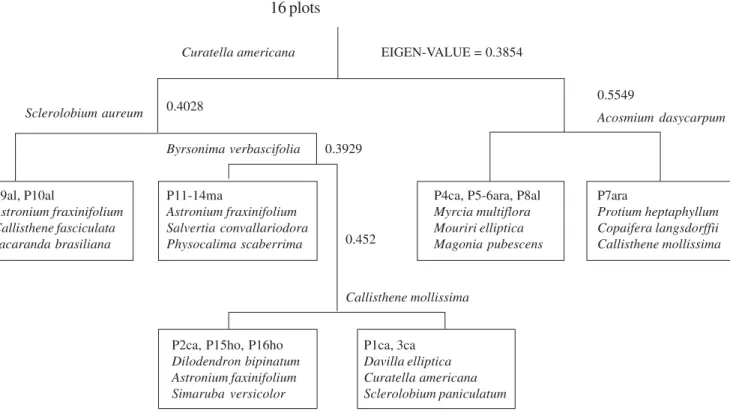
TWINSPAN classification (figure 4) showed strong divisions forming at the first level (eigen-values =
0.3854) a large group with Curatella americana as an
indicator species containing plots characterized by species preferential to richer soils such as Astronium fraxinifolium, Callisthene fasciculata, Dilodendron bipinnatum and another smaller group characterized
by Myrcia multiflora and Mouriri elliptica plus the
gallery forest species Protium heptaphyllum and Copaifera langsdorffii, common between gallery
forest and “cerrado” (Felfili & Silva Júnior 1992). At a second level of division the plots from Almas (P9 and P10) were separated from the others in the first group and the plot containing gallery forest species was separated from the others in the second group at this level. In this latter plot, occurred a gulley where water rises at the rainy season giving support to the establishment of gallery forest species. At a third level of division the plots containing indicator species of fertile soils were separated from the others. The divisions were strong with eigen values above 0.3, suggesting a high beta diversity among plots.
TWINSPAN classification final groups were defined by preferential species of more fertile soils, in opposition to those typical of dystrophic soils and to common species to gallery forests occurring on sloping terrains with gullies.
80 70 60 50 40 30 20 10 0
6.5 9.5 12.5 15.5 18.5 21.5 24.5 27.5 30.5 33.5 36.5 39.5 42.5
Center of diameter class (cm)
Percentage
Figure 1. Distribution of the total number of species (%) and density (%) by diameter class in the “cerrado” sensu stricto on
rocky and concretionary soils of northern Goiás and southern Tocantins State, Brazil ( = Species (%), n = 85; = Relative
0,28
P10al P9al P8al P14ma P13ma P12ma P11ma P16ho P3ca P15ho P2ca P6ara P4ca P7ara P5ara P1ca
0,4 0,52 0,64 0,76 0,88 1
P4ca P15ho P7ara P10al P9al P8al P6ara P16ho P5ara
P14ma P13ma P12ma P3ca P2ca P1ca P11ma
4 20 36 52 68 84 100
Figure. 2 Sørensen’s similarity index for 16 (1,000 m2) plots of “cerrado” sensu stricto on rocky soils in Goiás and Tocantins
State grouped by the method UPGMA. (al = Almas/TO; ma = Mararosa/GO; ho = Fazenda Horta, Cavalcante/GO; ara = Vale das Araras, Cavalcante/GO; ca = Cachoeira das Pedras Bonitas, Colinas/GO; P = plot).
Figure 3. Czekanowski’s (percent similarity) index for 16 (1,000 m2) plots of “cerrado” sensu stricto on rocky soils in Goiás and
Discussion
The ratio species x genera was nearly 1:1 suggesting a high genetic diversity within the woody component of the “cerrado”, most species are not closely related to the others as also suggested by Felfili (1995) for gallery forest.
Shannon’s diversity index was within the range found by Felfili et al. (1994, 1997, 2001) for “cerrado” sensu stricto in Latosols and in Neosols, following the
same sampling methodology, suggesting that in this gradient of “cerrado” sensu stricto on rocky soils the
diversity is high, reaching levels found for this physiognomy on the predominant soil types of the biome.
The values of density and basal area were also within the range found in several sites covered by the “cerrado” sensu stricto on Latosols or Neosols studied
under similar methodology (Felfili & Silva Júnior 1992, 1993, Felfili et al. 1994, 1997, 1998, Rossi et al. 1998,
Felfili et al. 2001). Five percent of dead standing trees
is a value commonly found for the “cerrado” sensu stricto
and indicates low disturbance in this vegetation (Felfili & Silva Júnior, 1992, 1993, Felfili et al. 1994, 1997, 1998,
2001).
P9al, P10al
Astronium fraxinifolium Callisthene fasciculata Jacaranda brasiliana
P4ca, P5-6ara, P8al Myrcia multiflora Mouriri elliptica Magonia pubescens
16 plots
Curatella americana EIGEN-VALUE = 0.3854
Sclerolobium aureum 0.4028
Byrsonima verbascifolia 0.3929
Callisthene mollissima 0.452
P2ca, P15ho, P16ho Dilodendron bipinatum Astronium faxinifolium Simaruba versicolor
P1ca, 3ca Davilla elliptica Curatella americana Sclerolobium paniculatum P11-14ma
Astronium fraxinifolium Salvertia convallariodora Physocalima scaberrima
P7ara
Protium heptaphyllum Copaifera langsdorffii Callisthene mollissima 0.5549
Acosmium dasycarpum
Figure 4. TWINSPAN classification for 16 (1,000 m2) plots of “cerrado” sensu stricto on rocky soils in Goiás and Tocantins State.
(al = Almas/TO; ma = Mararosa/GO; ho = Fazenda Horta, Cavalcante/GO; ara = Vale das Araras, Cavalcante/GO; ca = Cachoeira das Pedras Bonitas, Colinas/GO; P = plot).
Callisthene mollisima is a typical species in that
region which is also favourable to the growth of Davilla
and Curatella. This latter according to Felfili & Silva
Júnior (1993) is typical of low altitude sites, those sites under 1,000 m high.
Qualea parviflora occurred in all sampled plots
corroborating the widespread distribution of this species in central Brazil as found by Ratter & Dargie (1992), Felfili & Silva Júnior (1993), Ratter et al. (2000). Only
nine of the 87 species occurred in more than 50% of the plots while 24 were found in only one plot. Few species are abundant and widespread in tropical formations as well as in the cerrado (Felfili 1995).
Preferential species of the first group by TWINSPAN were indicator species of fertile soils, some common to seasonal forests on limestone (table 2). The amount of litter accumulated in between rocks of these younger soils compared to the Latosols seems to be enough to support those species.
and “cerrado” sensu stricto on Latosols (Felfili & Silva
Júnior 1988) in central Brasil.
Preferential species by TWINSPAN classification,
Callisthene mollisima, Curatella americana, Davilla elliptica, Mouriri elliptica, and Myrcia multiflora plus
several indicator species of richer soils seem to be typical of “cerrado” sensu stricto on rocky soils in the region.
The “cerrado” sensu stricto on rocky and concretionary
soils presented structural and diversity patterns in the same range to those found for this vegetation in other substrates over central Brazil. Generalist species such as Qualea parviflora were present in all plots but a
geographical gradient could be detected. Preferential species to more fertile soils, to dystrophic soils and to humid soils in the gullies determined the species grouping.
Acknowledgements – To the “Biogeography of the Cerrado Biome” project team, to Roberta Mendonça, the curator of the IBGE herbarium, to Newton Rodrigues and Edson Cardoso for the support in the field work. To DIFID-UK for funding to the research and CNPq for the grant to the first author.
References
AB’SABER, A.N. 1983. O domínio dos cerrados: introdução ao conhecimento. Revista do Servidor Público 3:41-55. ALVIN, P.T. & ARAÚJO. W.A. 1952. El suelo como fator ecológico en el desarollo de la vegetation em el centro-oeste de Brasil. Turrialba 2:153-160.
ARAÚJO, G.H. & HARIDASAN, M.A. 1989. A comparison of the nutritional status of two Forest communities on mesotrophic and dystrophic soils in central Brazil. Communications in Soil Science and Plant Analysis 19:1075-1089.
BRASIL, 1981. Levantamento de recursos naturais. Ministério das Minas e Energia. Secretaria Geral Projeto Radambrasil, Rio de Janeiro. Folha SE 22. v.25
BRASIL, 1982. Levantamento de Recursos Naturais. Ministério das Minas e Energia. Secretaria Geral Projeto Radambrasil, Rio de Janeiro. Folha SE 23. v.31
COCHRANE, T.T., SANCHEZ, L.G., AZEVEDO, L.G., PORRAS, J.A. & GARVER, C.L. 1985. Land in Tropical America. CIAT-Embrapa, Cali.
COLE, M. 1986. The Savannas – Biogeography and Geobotany. Academic Press, London.
CRONQUIST, A. 1988. The evolution and classification of flowering plants. 2nd ed. The New York Botanical Garden,
Bronx.
EITEN, G. 1972. The cerrado vegetation of Brazil. Botanical Review 38:201-341.
EITEN, G. 1978. Delimitation of the cerrado concept. Vegetatio 36:169-178.
EITEN, G. 1983. Classificação da vegetação do Brasil. CNPq, Coordenação Editorial, Brasília.
EITEN, G. 1991. Vegetação do Cerrado. In Cerrado, caracterização,
ocupação e perspectivas. (M. N. Pinto, ed.). Editora Universidade de Brasília, Brasília, p. 9-65.
FELFILI, J.M. 1995. Diversity, structure and dynamics of a gallery forest in central Brazil. Vegetatio 117:1-15. FELFILI, J.M. 2000. Crescimento, recrutamento e mortalidade
nas matas de galeria do Planalto Central. In Tópicos
atuais em botânica (T.B. Cavalcanti & B.M.T. Walter, eds.). SBB/EMBRAPA, Brasília, p.152-158.
FELFILI, J.M. & FELFILI, M.C. 2001. Diversidade alfa e beta no cerrado sensu stricto da Chapada Pratinha, Brasil.
Acta Botanica Brasilica 15:243-254.
FELFILI, J.M. & REZENDE, R.P. 2003. Conceitos e métodos em fitossociologia. Comunicações Técnicas Florestais 5 (1). Departamento de Engenharia Florestal, Universidade de Brasília, Brasília.
FELFILI, J.M. & SILVA JÚNIOR, M.C. 1988. Distribuição dos diâmetros numa faixa de cerrado na Fazenda Água Limpa (FAL) em Brasília-DF. Acta Botanica Brasilica 2: 85-104.
FELFILI, J.M. & SILVA JÚNIOR, M.C. 1992. Floristic composition, phytosociology and comparison of cerrado and gallery forests at Fazenda Água Limpa, Federal District, Brazil. In Nature and dynamics of forest-savanna
boundaries (P.A. Furley & J.A. Proctor, eds.). Chapman & Hall, London, p.393-415.
FELFILI, J.M. & SILVA JÚNIOR, M.C. 1993. A comparative study of cerrado (sensu stricto) vegetation in central
Brazil. Journal of Tropical Ecology 9:227-289.
FELFILI, J.M. & SILVA JÚNIOR, M.C. 2001. Projeto biogeografia do bioma cerrado: estudo fitofisionômico na Chapada do Espigão Mestre do São Francisco. Departamento de Engenharia Florestal, Universidade de Brasília, Brasília.
FELFILI, J.M., FILGUEIRAS, T.S., HARIDASAN, M., SILVA JÚNIOR, M.C., MENDONÇA, R. & RESENDE, A.V. 1994. Projeto biogeografia do bioma cerrado: vegetação e solos. Cadernos de Geociências do IBGE 12:75-166. FELFILI, J.M., SILVA JÚNIOR, M.C., REZENDE, A.V.,
NOGUEIRA, P.E.N., WALTER, B.M. T., SILVA, M.A. & IMAÑA-ENCINAS, J. 1997. Comparação do cerrado (sensu stricto) nas Chapadas Pratinha e dos Veadeiros. In Contribuição ao Conhecimento Ecológico do Cerrado
(L.L. Leite & C.H. Saito, eds.). Brasília, Departamento de Ecologia, Universidade de Brasília, p.6-11.
FELFILI, J.M., SILVA JÚNIOR, M.C. & NOGUEIRA, P.E. 1998. Levantamento da vegetação arbórea na região de Nova Xavantina, MT. Boletim do Herbário Ezechias Paulo Heringer 3:63-81.
FELFILI, J.M., REZENDE, A.V., SILVA JÚNIOR, M.C., SILVA, M.A. 2000. Changes in the floristic composition of cerrado sensu stricto in Brazil over a nine-year period.
FELFILI, J.M., SEVILHA, A.C. & SILVA JÚNIOR, M.C. 2001. Comparação entre as unidades fisiográficas Chapada Pratinha, Veadeiros e Espigão Mestre. In Projeto biogeografia
do bioma cerrado: estudo fitofisionômico na Chapada do Espigão Mestre do São Francisco (J.M. Felfili & M.C. Silva Júnior, eds.). Departamento de Engenharia Florestal, Universidade de Brasília, Brasília, p.80-102.
FELFILI, J.M., SILVA JÚNIOR, M.C., SEVILHA, A.C., FAGG, C.W., WALTER, B.M.T., NOGUEIRA, P.E. & REZENDE, A.V. 2004. Diversity, floristics and structural patterns of cerrado vegetation in central Brazil. Plant Ecology 175:37-46.
FILGUEIRAS, T.S., FELFILI, J.M., SILVA JÚNIOR, M.C., NOGUEIRA, P.E. 1998. Floristic and structural comparison of cerrado sensu stricto vegetation in Central Brasil. In
Forest biodiversity in North, Central and South America, and the Caribbean: Research and Monitoring. (F. Dallmeier & J.A. Comiskey, orgs.). Parthenon Publishing Group, Carnforth. v.2, p.633-647.
GOODLAND, R.A. 1971. A physiognomic analysis of the “cerrado” vegetation of Central Brazil. Journal of Ecology 59:411-419. GOODLAND, R.A. & FERRI, M.G. 1979. Ecologia do cerrado.
Itatiaia, Belo Horizonte.
HARIDASAN, M., SILVA JÚNIOR, M.C., FELFILI, J.M., RESENDE, A.V. & SILVA, P.E.N. 1997. Gradient analysis of soil properties and phytosociological parameters of some gallery forests of the “Chapada dos Veadeiros” in the cerrado region of Central Brazil. In Proceedings of the
International Symposium on Assessment and Monitoring of Forests Dry Regions with special reference to Gallery Forests (J. Imana-Encinas, ed.). Departamento de Engenharia Florestal, Universidade de Brasília, Brasília, p.259-276. HILL, M.O. 1979. TWINSPAN – a FORTRAN program for
arranging multivariate data in a ordered two-way table by classification of individuals and attributes. Cornell University, Ithaca.
IBGE 1988. Cartas topográficas do Brasil. Escala 1:100 000. Projeção UTM. Diretoria de Serviço Cartográfico do IBGE, Rio de Janeiro.
IBGE 2006. Mapas interativos. http://www.ibge.gov.br (accessed 2006 Aug. 28).
KENT, M. & COKER, P. 1992. Vegetation description and analysis, a practical approach. Belhaven Press, London.
MARGURRAN, A. 1988. Ecological diversity and its measurement. Chapman & Hall, London.
RATTER, J.A. & DARGIE, T.C.D. 1992. An analysis of the floristic composition of 26 cerrado areas in Brazil. Edinburgh Journal of Botany 49:235-250.
RATTER, J.A., BRIDGWATER, S., RIBEIRO, J.F., DIAS, T.A.B. & SILVA, M.A. 2000. Estudo preliminar da distribuição das espécies lenhosas da fitofisionomia cerrado sentido restrito nos estados compreendidos pelo bioma cerrado. Boletim do Herbário Ezechias Paulo Heringer 5:5-43.
REATTO, A., CORREIA, J.R. & SPERA, S.T. 1998. Solos do bioma cerrado: aspectos pedológicos. In Cerrado: ambiente
e flora (S. Sano & S. Almeida, eds.). Embrapa-CPAC, Planaltina, p.47-86.
RIBEIRO, J.F. & WALTER, B.M.T. 1998. Fitofisionomias do bioma Cerrado. In Cerrado: ambiente e flora (S. Sano &
S. Almeida, eds.). Embrapa-CPAC, Planaltina, p.89-166. ROSSI, C.V., SILVA JÚNIOR, M.C. & SANTOS, C.E.N. 1998. Fitossociologia do estrato arbóreo do cerrado (sensu stricto) no Parque Ecológico Norte, Brasília, DF. Boletim
do Herbário Ezechias Paulo Heringer 2:49-56.
SILVA JÚNIOR, M.C., BARROS, N.F. & CÂNDIDO, J.F. 1987. Relações entre parâmetros do solo e da vegetação de cerrado da Estação Florestal de Experimentação de Paraopeba – MG. Revista Brasileira de Botânica 10:125-137. WAIBEL, L. 1948. Vegetation and land use in the Planalto