
PHONOLOGICAL AWARENESS IN ILLITERATE ADULTS
Consciência fonológica em adultos não alfabetizados
Adna Pontes Neves Lopes(1), Carla Alexandra da Silva Moita Minervino(1)
(1) Universidade Federal da Paraíba (UFPB), João Pessoa,
Paraíba, Brasil.
Source of inancial support: CNPq Conlict of interest: non-existent
Literate Brazil and Youth and Adult Education (EJA)
in an attempt to help solve this social deicit, there is still much to do. Countries with high illiteracy rates are marked by a lack of social and economic devel
-opment 1.
Reading is to make sense of what is read, so it can be inferred that there is no reading if there is no understanding 2. Obviously, it is a process that leads
the subject to extract meaning from information contained in a text. It is beyond decoding a symbol or grapheme-phoneme correspondence 3. To achieve
a full understanding of a text, it is necessary that the individual has automated the process of decoding written words.
Phonological awareness, which is one of the
skills that foster the learning to read, may be under
-stood as the ability to perceive that speech can be decomposed into phonological units (sentences, words, syllables and letters), and such units can be manipulated to form new words and to create new meanings 4-6. This skill is acquired according
to the degree of complexity, going from the simplest to the most complex process: Word - Syllable – Phoneme 4.
INTRODUCTION
The act of reading, though it seems natural to men, is a skill that must be taught and learned. Diferently from speech, which is a skill that is inter
-connected with human genetics and enables the child to diferentiate speech sounds from the irst months of life, the act of reading requires a neural modiication that gives conditions for decoding the graphics and sound symbols that represent speech. It is an ability learned through teaching and, although it seems a simple task, it is a complex and multi
-faceted act involving social, cognitive, emotional
and environmental factors.
The 11th Education for All Global Monitoring Report 1 reveals that ten countries account for 72%
of the percentage of illiterate adults in the world. Among them, Brazil is in the 8th place, and, although there are government initiatives like the programs
ABSTRACT
Purpose: to analyze the estimation of ability in phonological awareness of illiterate adults. Methods:
forty four adults, over the age of twenty eight and of both sexes, participated in the survey. The adults were divided into two groups, namely: (1) illiterate, and (2) literate in childhood. The following instruments were used: Data on demographic data; Predictors of Reading Skills (THPL) test consists of tasks of rhyme, alliteration, and segmentation, administered individually and on a tablet. Results:
it occurs a signiicant diference in estimating ability in phonological awareness between the two groups. It is noteworthy that the ability to rhyme in the task was signiicantly higher in adult literacy. It was observed that the task of segmenting words has been considered more diicult. The results suggest a standard of skill, namely Alliteration> rhyme> targeting. An interesting inding relates to the execution time of the task, it was found that there was a statistically signiicant diference with regard to the execution time of the tasks of alliteration, rhyme and segmentation between the two groups.
Conclusion: when veriied the correlation between runtime and skill in the task, it was revealed that
the correlation did not occur in both groups the same way: the group of positive correlation literate and illiterate group of negative correlation.
researched on the subject, only four articles included adults in their sample.
Knowing that Brazil is eighth in the world ranking of countries with the highest rate of illiterate adults, and phonological awareness being observed as a strong facilitator ability to acquire reading, this research aimed to analyze the estimate of ability in phonological awareness of illiterate adults.
METHODS
Participants
This research was accepted by the Ethics Committee of the Federal University of Paraíba with the number of Protocol 377.659. Data collection was conducted with the voluntary participation of the subjects who signed a free and informed consent form. The participants were 44 adults, 26 females and 18 males, aged between 28 and 56 years (M = 40.9; SD = 7.6). For the sample selection, a conve
-nience sampling technique was used. The subjects were divided into two groups, one of illiterate adults, and the other of literate adults. The illiterate adults were students from an extension project called Zé Peão from an institution with projects aimed at adult
literacy in the city João Pessoa-PB.
The following inclusion criteria were considered: subjects without any suspicion of mental retardation; they could not be attending literacy classes for more than two months, except if after this period they had not mastered reading and writing skills yet. Because of the diiculty in inding illiterate subjects in the education systems, illiterate adults who did not participate in a literacy program were also included. Literate subjects were selected by convenience from the researcher networking, given the criteria they were close in age to the illiterate subjects.
Instruments
To address the objectives of this research, the following instruments were used: Form with questions about sociodemographic data to collect
general data about the participant; Predictors of
Reading Skills Test (THPL), which is a comput
-erized test developed by Moita et al. (2014) 25,
aiming to analyze cognitive skills related to reading competence. This is an instrument based on Item Response Theory and Computer Adaptive Testing (IRT).
The THPL consists of rhyming tasks, alliteration, segmentation (phonological awareness) and visual memory. The tasks are displayed in a virtual space to be answered individually, with the help of a mobile device (tablet). In rhyme and alliteration tasks, a stimulus igure (with sound representation) and three test igures are presented; among the test igures, Phonological awareness is divided into levels:
syllable awareness, awareness of intra-syllabic elements and phonemic awareness. The syllable awareness and intra-syllabic elements allow the person to recognize rhymes, similar phonological units at the end of words (mamão/fogão), and
also to recognize similar phonological units at the beginning of words (pata/panela) that are called allit -erations 4,7. The syllable and phoneme awareness,
besides helping in reading acquisition, is a strong predictor for the writing domain. Among all these tasks, phonemic awareness is considered the most complex level of phonological awareness4,8.
Since the 70s, there is research4,7,9-15
investi-gating the importance of phonological awareness to reading acquisition. Among these surveys, it is emphatic that this skill is a facilitator for learning to read. It was also found that training in phonological awareness contributes to overcoming diiculties in reading5,16,17. Correia and Martins18 stated that
phonological awareness has proved to be the most signiicant skill for the reading domain in adults in the literacy process. Research with illiterate and literate adults assessed the performance in phono
-logical awareness skills, efectively revealing that the group of illiterate adults showed lower perfor
-mance in these skills, while the group of literate adults denotes the consistency and permanence of these skills.
The illiterate adults performed better on tasks of rhyme, alliteration, and segmentation of syllables than in phonemic segmentation tasks 19. Some factors
contributing to failure in performance in phonological awareness among illiterate adults were a result of the lack of formal education and low socioeconomic
level 19-23. In particular, the underperformance of illit
-erate adults in tasks involving phonemic segments is highlighted, more than in tasks involving syllables, or with rhyme detection. The authors report that the ability to detect rhyme and the ability to segment syllables are inluenced by the literacy process. However, there is no correlation between perfor
-mance in both tasks, which means that skills would not be interdependent 24. In particular, the discovery
means that the segmentation abilities do not depend on previous development to identify sounds aspects of speech, therefore, the person may be able to segment syllables, even if the person is not able to appreciate the sound of similarity, and vice
versa 24. However, research on the performance in
phonological awareness skills in illiterate adults is still the subject of much speculation. According to Lopes, in a systematic review on the topic of phono
headphones at their disposal for better under
-standing of the task. The test was applied individually and each participant spent 30 minutes in average for completing the test. The participants were informed that their names and responses would be kept as conidential.
The results of the demographic data sheet classiied the gender, age and profession of the participants. Statistical analysis applied to data obtained through THPL used the Mann Whitney U test with a signiicance level of p <0.05.
RESULTS
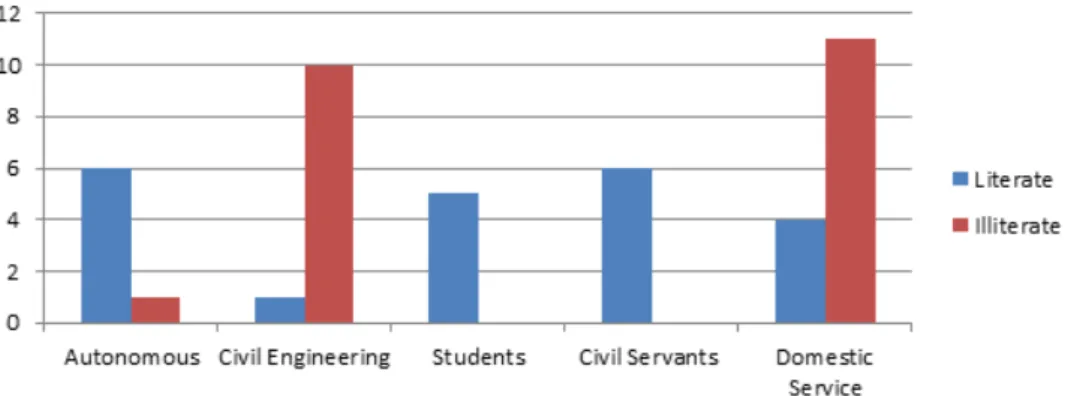
The results will be presented to meet the proposed objectives. Referring to sociodemographic data sheet, the results classiied the gender, age and profession of the participants. Regarding gender, the sample of this research consists of 44 subjects in total, 26 females and 18 males, aged between 28 and 56 years (M = 40.9; SD = 7.6). In regard to professional ield, the subjects were classiied in ive main areas: autonomous, civil engineering, students, civil servants and domestic service. The frequency of occurrence of professions, which were separated by groups analyzed, are shown in Figure 1.
one of them rhymed or alliterated with the stimulus igure. In the segmentation task, a stimulus igure (with the sound representation) and ive possible answers that may correspond to the number of segments are presented, however, there is only one possible correct response. The THPL enables the researcher to have an immediate access to the individual performance of the examinee after the completion of the test. The results are available to the system user (researcher) and the system
administrator.
The THPL database consists of items with various levels of diiculty, however, as the items are answered, the following ones vary according to the level of diiculty. Due to this adaptation of the instrument to the ability of the examinee, at the beginning of the test all the respondents get questions with the same level of diiculty, however, throughout the test each person will have responded to a diferent set of items. In the present study, rhyming, alliteration and segmentation tasks were
used.
Procedures
The application of THPL, instrument used in this study, was done with a tablet (Operating System IOS 7) and, when necessary, the participants had
Figure 1 – Frame rate professional sample
Statistical analysis applied to data obtained through THPL resulted in the estimates of skills/ proiciency of each individual. Descriptive statis
-tical analyzes to obtain mean, median, standard deviation, minimum and maximum were carried out.
Considering that all the measures used are classiied as interval and each group had less than 30 participants, tests of normality and homoge
-neity of variance were performed to verify if the
It is observed that the task of segmenting was possibly the most diicult task to be performed by the illiterate group, a fact that can be seen from the diference between the percentages of correct answers in the tasks (Table 1).
The data in Table 2 present some descriptive measures of the skills of literate and illiterate adults in rhyming, alliteration and segmentation tasks. It is noteworthy that the scale of THPL’s ability ranges
from -3.0 to +3.0.
Table 1 summarizes the descriptive results (mean, standard deviation, minimum and maximum) for the percentage of correct answers in the tasks proposed to the two groups analyzed [literate adult (LA) and illiterate adults (IA)]. Both groups analyzed (LA and IA) had better results in the performance of the alliteration task (approximately 90% and 98% correct answers respectively). It is important to mention that literate adults had a higher percentage of correct answers in all three tasks analyzed.
Table 1 – Descriptive statistics of the results of the phonological awareness tasks*
% Literate Illiterate
Alliteration Segmentation Rhyme Alliteration Segmentation Rhyme
Mean 98,86 83,92 95,38 90,34 72,12 73,14
Median 100,0 87,50 100,0 89,44 72,50 70,00
SD** 3,68 9,82 9,68 7,72 14,06 15,07
Minimum 87,50 62,50 62,50 75,00 50,00 44,44
Maximum 100,0 100,0 100,0 100,0 100,0 100,0 *Considered the correct percentage for each task, because of the adaptive nature of the Predictors of Reading Skills Test.
** Standard Deviation
In Table 2 it is noticed that, as well as the results for percentage of success, the LA showed better results than IA in estimates of the phono
-logical awareness skill and the ability in rhyme task that showed an average diference of 2.02 was highlighted. The data show that the average skill in alliteration (2.75 and 1.73 respectively) was higher than in segmentation and rhyme in both groups and that the segmentation task had the poorest results in both groups. In order to analyze whether such diferences would be signiicant, we used the Mann-Whitney test and according to the results obtained for each task, alliteration (U = 378.00 p =
0.001), segmentation (U = 406.00, p = 0.001) and rhyme (U = 432.00, p = 0.001), the values obtained were statistically signiicant in all cases (p = 0.001).
The results suggest that the same standard of skill happened for the two groups as presented here (from the highest to the lowest): Alliteration> rhyme> segmentation. In this sense, there is the hypothesis that alliterating is easier than segmenting for the groups analyzed.
An average estimate of ability in phonological awareness (alliteration + rhyme + segmentation) obtained by groups through THPL was observed
Table 2 – Ability estimate in phonological awareness (rhyme task, and segmentation alliteration) groups in adult the literate and illiterate
Literate ** Illiterate **
Alliteration Segmentation Rhyme Alliteration Segmentation Rhyme
Mean 2,75 1,20 2,64 1,73 0,49 0,62
Median 3,00 1,08 3,00 1,75 0,43 0,51
SD*** 0,83 0,62 0,81 1,11 1,14 1,59
Minimum -0,554 0,507 -0,023 -0,554 -3,000 -0,538
Maximum 3,000 3,000 3,000 3,000 3,000 3,000 *values for the level of skill ranges may vary from -3 to +3
** in all estimates of skills there was signiicant diference between groups (p = 0,001)
437.5, p <0.0001) in the ability to phonological awareness between the two groups analyzed. Thus, it is observed that the literate group obtained better results than the illiterate group.
after analyzing the results by task. Table 3 summa
-rizes the results.
The results presented in Table 3 suggest that there is a statistically signiicant diference (U =
Table 3 – Ability estimate of average phonological consciousness in thpl*
Literate Illiterate
Mean 2,18 1,02
Median 2,31 0,87
SD** 0,40 -0,73
Minimum 1,178 -0,582
Maximum 3,00 2,836
* Test Mann Whitney = 437,5; p <0,0001
** Standard Deviation
Table 4 summarizes the results of descriptive
statistics (mean, median, standard deviation,
minimum and maximum values) for the time spent on each task analyzed (alliteration, rhyme and segmentation). It is observed that alliteration task required more time to be performed in both groups
investigated, followed by the rhyme and then the segmentation task. Thus, with respect to time spent on the performance of the task, there is the following analysis: alliteration> rhyme> segmentation for both groups. However, the literate group took less time than the illiterate group to perform each task.
Table 4 – Description of time spent in descriptive values each task
Literate Illiterate
Alliteration Segmentation Rhyme Alliteration Segmentation Rhyme
Mean 364,50 206,82 320,23 441,23 349,59 431,50
Median 379,00 203,00 335,50 452,50 292,50 406,00
SD*** 166,17 43,99 64,75 144,74 152,64 156,77
Minimum 156 156 181 243 203 173
Maximum 742 749 820 855 358 423
* the measure of this time reported in seconds ** values p < 0,05
*** Standard Deviation
It was found that there were statistically signif
-icant diferences with regard to the execution time of alliteration, segmentation and rhyme tasks (p =
0.05; p = 0.001; p = 0.004, respectively) between
the two groups.
Finally, the relationship between time and an estimated average of skill in each task performed by groups was veriied. The results suggest the existence of positive and signiicant correlation in the segmentation and rhyme task in the group of literate adults (r = 0.59; p = 0.0004 and r = 0.56;
p = 0.007, respectively), it was identiied that the longer the individual used to perform the main task
the higher his skill was. However, there was no correlation between time spent on performance and alliteration task in the literate group.
With regard to the illiterate group, it was observed only positive and signiicant correlation between time spent on performance and alliteration task (r = 0.58;
p = 0.004). Although the occurrence of correlation
between time spent and segmentation task is not signiicant, it is highlighted that the correlation was negative (r = -0.26; p = 0.23), fact that did not occur
perform segmentation tasks – whether in syllabic,
intra-syllabic or phonemic level – the reader needs sound and graphic familiarity with the language5.
The skills to rhyme and alliterate are easier to be acquired and can arise even before learning the grapheme-phoneme conversion, that is, regardless of school environment7.
The ability to segment, especially phonemic segmentation, is one of the most diicult levels to be reached among the phonological awareness skills. With formal teaching this skill is better developed4,5,8. Participants in the group of illiterate
adults revealed poor performance in the segmen
-tation task. It is interesting to remember that they were at the beginning of the literacy process. In face of such a result, a hypothesis that the segmentation task is not part or was not yet developed as part of the course content of the Zé Peão and Ibraema program is formulated. The implementation of the segmentation task in the course content could favor, according to the literature, the acceleration of the literacy process.
The indings of Melo and Correia27 strengthen
the hypothesis that segmentation ability should be included or better developed in adult literacy programs. It is noticed that when analyzing whether the phonological awareness skills would be the best predictors for the reading performance of illit
-erate adults, using multiple regression (stepwise) involving judgment of rhyme, segmentation of sounds, beginning level of reading and writing, knowledge of capital letters and lowercase letters and the working memory index, results that indicate segmentation task as a good predictor of progress in the reading among young people and adults evaluated were found.
In a practical perspective, the proile revealed in the evaluated skills showed that the segmentation task was the most diicult to be performed in both groups, with more signiicant diference in the group of illiterate adults. This result suggests that this ability should be receive attention by adult literacy programs, as previous research showed this to be strongly related to reading skill20,27.
FINAL CONSIDERATIONS
This research aimed to examine the ability of illiterate adults in phonological awareness tasks, as this skill is of great relevance to the acquisition of reading. To meet the objectives of this study, the performance level of the subjects evaluated in rhyming, alliteration and segmentation tasks was analyzed. It was observed that the illiterate adult group underperformed the literate adults, revealing that despite mastering oral language and their life
DISCUSSION
This study aimed to analyze to estimate the ability in phonological awareness in illiterate adults. The study included literate and illiterate adults who were participating in literacy programs. All partici
-pants were subjected to tests that assessed the ability and performance in alliteration, rhyme and segmentation tasks.
In this study it was observed that: (1) there are diferences in performance and ability to rhyme, allit
-eration and segmentation tasks between illiterate and literate adults; (2) the task of segment was the most diicult to perform; (3) the alliterate task was the easiest to be performed; (4) the pattern of diiculty in both groups was (from the easiest to the most diicult) alliterate > rhyme > segmentation; (5) regarding the standard time spent on performance, the following order (from the fastest to the slowest) was observed: segment <rhyme <alliterate.
The results revealed that the illiterate group obtained underperformed literate adults in all phono
-logical awareness tasks analyzed. Similar perfor
-mance was found in other studies that compared children with reading diiculties and children without reading diiculties9,16,26 and literate adults with
literate adults19,27.
The facility for the alliteration task, followed by the rhyming task and then the diiculty to perform the segmentation task in the group of illiterate adults, coincides with the same pattern of ability in pre-reading children as Dias and Minervino28 and
Pereira and Minervino29 who also used the THPL
to assess the level of performance in pre-reading children and children beginning to read. Partially similar results were found in studies in which illit
-erate young people and adults were compared, at the beginning and end of the school year in the literacy process, pointing out a hierarchy of diiculty in phonological awareness skills, having the task of sounds segmentation as the most diicult one. However, the easiest task was rhyming followed by alliteration. Despite this diference in rank position, a signiicant correlation between reading performance at the end of the school year with the performance in rhyme judgment task and targeting20,27 was found.
As it already mentioned, phonological awareness is a skill that is positively correlated with the devel
-opment of reading4,7,9-15. Among the abilities that
segmentation skills and reading acquisition of illit -erate adults.
Adults who intend to learn to read, besides facing socioeconomic barriers, negligence in the physical structure and social prejudice, must face their own fears, prejudice and perceptions in relation to their own potential. There are already many challenges to be faced by this people to get to a learning environment and, above all, facing diiculties with the teaching method is a problem that can be alleviated. It is noteworthy, however, that the results of this research collaborate with the improvement of adult literacy programs.
experiences are more improved than in children, the phonological awareness is a skill that can only be fully developed with formal education.
It is known that phonological awareness is not the only skill that favors the learning to read. Other cognitive factors, as well as social, environmental and emotional factors, are part of this process. Thus, in theoretical spheres the results of this study corroborate the research that emphasize the impor
-tance of phonological awareness to the acquisition of reading and writing, and add to the research conducted with illiterate adults in order to expand this research area and generate new perspectives of research, focusing on the relationship between
RESUMO
Objetivo: analisar a estimativa da habilidade em consciência fonológica de adultos não alfabetiza -dos. Métodos: participaram da pesquisa 44 adultos, de ambos os sexos, com a idade superior a 28
anos. Os adultos foram divididos em dois grupos, a saber: (1) não alfabetizados, (2) alfabetizados na infância. Utilizou-se os seguintes instrumentos: Ficha sobre dados sociodemográicos; Teste de Habilidades Preditoras da Leitura (THPL), composto por tarefas de rima, aliteração e segmentação,
administrados de forma individual e em um tablet. Resultados: ocorreu diferença signiicante na esti
-mativa de habilidade em consciência fonológica entre os dois grupos. Destaca-se que a habilidade na tarefa de rimar foi signiicantemente superior no grupo de adultos alfabetizados. Observou-se que a tarefa de segmentar palavras foi considerada a mais difícil. Os resultados sugerem um padrão de habilidade, a saber: Aliteração > rima > segmentação. Um dado interessante refere-se ao tempo de execução da tarefa; foi veriicado que houve diferença estatisticamente signiicante no que se refere ao tempo de execução das tarefas de aliteração, segmentação e rima entre os dois grupos
analisados. Conclusão: ao veriicar a correlação entre tempo de execução e habilidade na tarefa,
foi possível perceber que a correlação não ocorreu nos dois grupos da mesma forma: no grupo de alfabetizados houve correlação positiva e no grupo de não alfabetizados correlação negativa.
DESCRITORES: Leitura; Fonética; Escolaridade
REFERÊNCIAS
1. UNESCO. Education for all by 2015. Will we make it?, Paris: UNESCO Publishing & Oxford University
Press, 2007.
2. Viana FL, Ribeiro IS, Fernandes I, Ferreira A, Leitão CGS, Gomes S et al. O ensino da compreensão leitora: da teoria á prática pedagógica.
Coimbra: Almedina; 2010.
3. Roazzi A, Minervino CASMM, Melo MRA. A aprendizagem da leitura e da escrita: princípios teóricos, históricos, níveis conceituais e aspectos motivacionais do processo de aprendizagem do código alfabético. In: Roazzi A, Paula FV, Santos
MJ. Leitura e escrita: a sua aprendizagem na teoria e pratica. Curitiba: Juruá Editora; 2014. p. 19-40. 4. Alves UK. O que é consciência fonológica. In: Lamprecht R, Dutra APB ,Scherer APR, Barreto FM, Alves UK, Santos RMS et al. Consciência dos sons da língua: subsídios teóricos e práticos para alfabetizadores, fonoaudiólogos e professores de língua inglesa. Porto Alegre: EDIPUCRS; 2009. p.
31-46.
5. Liberman IY, Shankweiler D, Liberman AM. The alphabetic principle and learning to read. Haskins Laboratories Status Report on Speech Research. 1990;101(102):1-13.
18. Correa MF, Martins CC. O papel da consciência fonológica e da nomeação seriada rápida na alfabetização de adultos. Psicologia: Relexão e Critica. 2012;25(40):802-8.
19. Mota HB, Romero MV, Kaminski TI, Souza DV, Berticelli A. Desempenho de adultos não-letrados em avaliação das habilidades em consciência fonológica. Rev CEFAC. 2012;14(2):249-53. 20. Melo RB. A relação entre consciência fonológica e a aquisição da leitura e da escrita de jovens e adultos [Tese]. Rio de Janeiro (RJ): Universidade
Federal do Rio de Janeiro; 2006.
21. Mota MMEP, Castro NR. Alfabetização e consciência metalingüística: um estudo com adultos não alfabetizados. Estudos de Psicologia. 2007;24(2):169-79.
22. Moussinho R, Correia J. Habilidades lingüístico-cognitivas em leitores e não leitores. Pró-Fono R. Atual. Cient. 2009;21(2):113-8.
23. Ardila A, Bertolucci PH, Braga LW, Caldas AC, Judd T, Kosmidis MH, Matute E, Nitrini R, Solis FO, Rosselli M. Illiteracy: The Neuropsychology of Cognition Without Reading. Archives of Clinical Neuropsychology. 2010;25:689-712.
25. Moita PMS, Minervino CASM, Chambel MTC. Tecnologia a favor da leitura: construção de um instrumento adaptativo informatizado. Atas do 10o.Encontro Nacional - 8o. Internacional - de investigação em Leitura, Literatura Infantil e Ilustração. Portugal: Fundação Calouste Gulbenkian, 2014.
24. Morais J, Content A, Bertelson PCL, Alegria J. Literacy training and speech segmentation. Cognition. 1986;24(1-2):45-64.
26. Capellini SA, Lanza SC. Desempenho de escolares em consciência fonológica, nomeação rápida, leitura e escrita. Pró-Fono R. Atual. Cient. 2010;22(3):239-44.
27. Melo RB, Correa J. Consciência fonológica e a aprendizagem da leitura e escrita por adultos. Estudos e pesquisa em Psicologia. 2013;13(2):460-79.
28. Dias ÉB, Minervino, CASM. Palavras são palavras rimadas ou aliteradas: análise da relação da complexidade das propriedades da palavra no desempenho de crianças nas tarefas de detecção de rima e aliteração [Monograia]. João Pessoa
(Pb): Universidade Federal da Paraíba; 2013.
29. Pereira EELD, Minervino CASM. Palavras em pedaços; pedaços de palavras: Análise do Desempenho de Pré-Leitores e Leitores Iniciantes em Tarefa de Segmentação [Monograia]. João
Pessoa (PB): Universidade Federal da Paraíba; 2013.
7. Freitas G. Consciência fonológica: rimas e aliterações no português brasileiro. Letras de Hoje. 2003;38(2):155-70.
8. Chraim AM. Relações implicacionais entre desenvolvimento da consciência fonológica e instrução alfabética na educação de adultos inseridos em entornos sociais grafocêntricos [dissertação]. Florianópolis (SC): Universidade
Federal de Santa Catarina; 2012.
9. Capovilla AGS, Capovilla FC, Suiter I. Processamento cognitivo em crianças com e sem diiculdades de leitura. Psicologia em estudo. 2004;9(3):449-58.
10. Viana FL, Teixeira MM. Aprender a ler – da aprendizagem informal à aprendizagem formal. Portugal: Asa; 2002.
11. Barrera SD. Maluf MR. Consciência metalingüística e alfabetização: um estudo com crianças da primeira série do ensino fundamental. Psicologia: Relexão e Critica. 2003;16(3):491-502.
12. Paula GR, Mota HB, Soares MK. A terapia em consciência fonológica no processo de alfabetização. Pró-Fono R. Atual. Cient. 2005;17(2):175-84. 13. Guimarães SRK. Diiculdades no desenvolvimento da lectoescrita: o papel das habilidades metalingüísticas. Psicologia: Teoria e Pesquisa. 2002;18(3):247-59.
14. Capellini SA, Conrado TLBC. Desempenho de escolares com e sem diiculdades de aprendizagem de ensino particular em habilidade fonológica, nomeação rápida, leitura e escrita. Rev CEFAC. 2009;11(2):183-93.
15. Cardoso AMS, Silva MM, Pereira MMB. Consciência fonológica e a memória de trabalho de crianças com e sem diiculdades na alfabetização. CoDAS. 2013;25(2):110-4.
16. Capovilla AGS, Capovilla FC. Efeitos do treino de consciência fonológica em crianças com baixo nível sócio-econômico. Psicologia: Relexão e
Critica. 2000;13(1):07-24.
17. Justino MISV, Barrera SD. Efeitos de uma intervenção na abordagem fônica em alunos com diiculdades de alfabetização. Psicologia: Teoria e Pesquisa. 2012;28(4):399-407.
Received on: November 04, 2014 Accepted on: February 27, 2015
Mailing address:
Adna Pontes Neves Lopes
Rua Farmacêutico Vimário Lacerda Neri, no. 110 / aptº 211, Resid. Candido Portinari, Cuiá
João Pessoa – PB – Brasil CEP: 58075-640
![Table 1 summarizes the descriptive results (mean, standard deviation, minimum and maximum) for the percentage of correct answers in the tasks proposed to the two groups analyzed [literate adult (LA) and illiterate adults (IA)]](https://thumb-eu.123doks.com/thumbv2/123dok_br/19073849.491133/4.892.100.808.354.494/summarizes-descriptive-standard-deviation-percentage-proposed-analyzed-illiterate.webp)

