Rehospitalization rates of patients with
schizophrenia discharged on haloperidol, risperidone
or clozapine
Taxas de re-hospitalização de pacientes após alta
hospitalar em uso de haloperidol, risperidona
ou clozapina
A b s t r a c t
Objective: The purpose of this study was to evaluate the rehospitalization rates of patients discharged from the Institute of Psychiatry of the Clinical Hospital of the Medical School of the Universidade de São Paulo while being treated with haloperidol, risperidone or clozapine. Method: This is a naturalistic study designed to monitor rehospitalization rates for patients discharged on haloperidol (n = 43), risperidone (n = 22) or clozapine (n = 31). Time to readmission over the course of three years was measured by the product-limit (Kaplan-Meier) method. Risk factors associated with rehospitalizations were examined. Results: At 36 months, remained in the community 74% of the haloperidol-treated patients, 59% of the risperidone-treated patients and 84% of the clozapine-treated patients. The haloperidol group showed a higher proportion of women, a later age of onset and shorter length of illness than the other groups, whereas the opposite was observed in the clozapine group. Conclusions: This study suggests that the rehospitalization rates of patients taking clozapine are lower than the rate for patients treated with haloperidol or risperidone. However, confounding variables such as gender distribution and age of onset represent limitations that should be taken into account for the interpretation of the results.
Descriptors: Schizophrenia; Patient readmission; Relapse/prevention and control; Antipsychotic agents/second generation; Haloperidol
R e s u m o
Objetivo: O propósito deste estudo foi observar as taxas de re-hospitalização de pacientes com esquizofrenia que receberam alta do Instituto de Psiquiatria do Hospital das Clínicas da Faculdade de Medicina da Universidade de São Paulo em uso de haloperidol, risperidona ou clozapina. Método: Este foi um estudo naturalístico conduzido de forma a observar as taxas de re-hospitalizações dos pacientes que receberam alta em uso de haloperidol (n = 43), risperidona (n = 22) ou clozapina (n = 31). O tempo de re-hospitalização foi analisado de acordo com a fórmula produto-limite (Kaplan-Meier) por três anos. Fatores de risco associados a internação foram examinados. Resultados: Aos 36 meses, permaneceram em seguimento extra-hospitalar 74% dos pacientes em uso de haloperidol, 59% em uso de risperidona e 84% em uso de clozapina. O grupo tratado com haloperidol apresentou predomínio do gênero feminino, idade de início mais tardia e menor tempo de doença que os demais grupos, enquanto o oposto ocorreu em relação ao grupo com clozapina. Conclusões: Pacientes em uso de clozapina apresentaram taxas de re-hospitalização menores que aqueles em uso de haloperidol e risperidona. No entanto, variáveis tais como distribuição de gênero e idade de início da doença podem representar limitações importantes que devem ser levadas em consideração na interpretação dos resul-tados.
Descritores: Esquizofrenia; Readmissão do paciente; Recidiva/prevenção e controle; Agentes antipsicóticos/segunda geração; Haloperidol
1 Department and Institute of Psychiatry, Clinical Hospital, Medical School, Universidade de São Paulo (FMUSP), São Paulo (SP), Brazil
Ana Paula Werneck de Castro,
1Helio Elkis
1C o r r e s p o n d e n c e Helio Elkis
Instituto de Psiquiatria R. Ovídio Pires de Campos, 785
Phone: (55 11) 3069-7531 Fax: (55 11) 3069-7656 E-mail: [email protected]
Financing: None
Conflict of interests: Helio Elkis acted as consultant, received travel support, was member of the speaker’s bureau or received research grants from: Eli Lilly, Janssen, Pfizer, Sanofi-Synthelabo, Astra-Zeneca, Biossintética, Bristol Myers Squib, Acadia, Lundbeck, Novartis and Fundação de Amparo à Pesquisa do Estado de São Paulo (FAPESP).
I n t r o d u c t i o n
Schizophrenia is a chronic mental disorder with a lifetime prevalence between 0.4 to 1.4 percent of the general population1 and it is associated with serious physical, social
and economic impact.2 The estimated suicide rate among
patients with schizophrenia is 10 percent.3 Fewer than 20
percent of patients with schizophrenia will be employed in competitive work at any time4 and schizophrenia is considered
as one of the thirty most incapacitating conditions in the world.2
Schizophrenia has a chronic course with several different forms of outcome5 but most patients experience frequent
relapses which are characterized by exacerbation of psychosis and rehospitalization. Less than 20 percent of patients maintain a full recovery after a first episode1 and it has been well
established that maintenance treatment with antipsychotic medication decreases relapse rates.6,7 Such rates, for patients
under antipsychotic treatment, range from 0 to 46 percent in one year and are five times higher among noncompliant ones.8
Poor maintenance therapy with successive relapses can reduce the patients’ functioning and increases chances of developing refractoriness to future treatments.9
Therefore it is well established that antipsychotics represent the mainstay of treatment for schizophrenia although consensus panel recommendations regarding choice of an antipsychotic agent for schizophrenia sometimes differ. The conventional antipsychotics with high-affinity for dopamine D2 receptors are the most effective against psychotic symptoms but have high rates of neurological side effects, such as extra-pyramidal signs (EPS) and tardive dyskinesia. Second-generation antipsychotics (SGA) differ pharmacologically in their lower affinity for dopamine D2 receptors and greater affinity for other receptors, particularly serotonin. Evidence of meta-analyses of randomized controlled trials show a modest superiority of SGA over first-generation antipsychotics in reducing psychotic symptoms such as hallucinations, delusions, cognitive (thought disorder) and mood symptoms.10,11 Additionally, SGA are not a
homogenous group and each of the newer antipsychotics has a unique receptor-binding profile, and future direct comparisons may reveal differences in efficacy.11 Lieberman et al., in a
recent study, found that olanzapine was the most effective in t e r m s o f d i s c o n t i n u a t i o n r a t e s , w h i l e e f f i c a c y o f t h e conventional antipsychotic perphenazine appeared similar to that of quetiapine, risperidone and ziprasidone. However, olanzapine was associated with greater weight gain and i n c r e a s e i n g l y c o s y l a t e d h e m o g l o b i n , c h o l e s t e r o l a n d triglycerides, which may have serious implications in medical comorbidity such as the development of the metabolic s y n d r o m e .1 2 S G A a p p e a r t o b e m o r e e f f i c a c i o u s t h a n
conventional antipsychotics in reducing negative symptoms, possibly owing to the absence of EPS rather than to direct therapeutic effects.13 Studies of the effects of treatment on
cognitive impairment and mood symptoms show conflicting results,14 although evidence from a meta-analysis involving
20 clinical trials suggests a modest effect on neurocognitive f u n c t i o n s w i t h S G A w h e n c o m p a r e d t o c o n v e n t i o n a l antipsychotics.15
An important outcome variable for drug effectiveness is relapse/rehospitalization prevention. However the literature is scarce in terms of evaluation of relapse prevention and rehospitalization rates of the SGA in comparison with conventional drugs and to each other. A recent exploratory meta-analysis investigated the potentiality of new-generation antipsychotic drugs to improve adherence and decrease relapse
rates in patients with schizophrenia.16 Six placebo controlled
studies clearly demonstrated that SGA is effective for relapse prevention, while eleven studies comparing data on relapse/ treatment failure for SGA with conventional antipsychotics showed that rates of relapse and overall treatment failure were modestly but significantly lower with SGA. Despite the significant superiority of SGA, the number of treatment failures was high in both atypical and conventional groups. It was also noted that adherence was poorly monitored in the trials and, therefore, the study allowed no definitive conclusions whether this modest superiority for SGA in relapse prevention was related to enhanced efficacy, better adherence, or a combination of these factors.16 An additional randomized
controlled trial developed in Brazil and designed to compare rates of rehospitalization between haloperidol and risperidone over a period of one year showed no differences between groups. However, the study was limited by the small sample size as well as the short follow-up period.17
A series of studies retrospectively reviewed rehospitalizations rates, such as the study by Weiden and Olfson, who estimated by a survival curve analysis that in the “real world” 50% of patients treated with conventional antipsychotic were readmitted within 1 year, and about 80% within 2 years.18 Hogarty reported
1- and 2-year rehospitalization rates of 37% and 55%, respectively, with conventional antipsychotic treatment19 and
similarly, Essok et al. found a 30% rehospitalization rate during the first year after discharge for patients receiving routine care with conventional antipsychotic.20 Comparisons of conventional
antipsychotic with SGA show conflicting results. Honigfeld and Patin found, in a 2-year follow-up study, rehospitalization rates of 27.8% for patients treated with clozapine as compared w i t h 5 6 . 2 % f o r p a t i e n t s t r e a t e d w i t h c o n v e n t i o n a l antipsychotics.21 Essok et al. compared 1-year rehospitalization
rates of treatment-resistant patients, randomly assigned to clozapine or standard treatment and found that patients discharged on clozapine were less likely to be readmitted (18%) than those treated with conventional antipsychotic (30%).20
Lin et al. demonstrated that over a 2-year period atypical antipsychotics (risperidone and clozapine) did not lengthen the time for rehospitalization when compared with conventional antipsychotics and that the earlier the age at onset of schizophrenia, the shorter the time to rehospitalization.22 Conley
et al. reported 1- and 2-year rehospitalization rates of 17% and 34%, respectively, for patients treated with risperidone as compared with 13% of patients discharged on clozapine in both periods.23 In a very similar naturalistic study, Rabinowitz
et al. compared rehospitalization rates for patients discharged on risperidone, olanzapine or conventional antipsychotics. The results also favor significantly SGA in relation to conventional antipsychotic. In their study rehospitalization rates at 12 months were 31% for risperidone-treated patients, 28% for olanzapine-treated patients and 35% for conventional antipsychotics-olanzapine-treated patients. During the second year, a clear superiority of the novel antipsychotics was evident, with rehospitalization rates of 31% for risperidone-treated patients and 33% for olanzapine-treated patients while the rates for patients olanzapine-treated with conventional antipsychotics were 48%.24
than those taking conventional antipsychotics.25 Limitations of
these three last studies are that patients were not randomly assigned to the drug treatment and no data were available on medication use after discharge. Similarly, hospitalization history, age at onset of illness, substance abuse history, and outpatient follow-up information were also not available which could be related to the risk of relapse. However, as in most previous reports on patients receiving conventional antipsychotics, basic demographic variables were not found to contribute to the risk of being readmitted.
Based on the previous review we hypothesized that SGA are superior to conventional antipsychotics for preventing relapse and rehospitalizations in schizophrenia and the purpose of this study is to observe 3-year rehospitalization rates of patients discharged from a psychiatric university hospital on a regimen of haloperidol, risperidone, or clozapine. In addition, we evaluated risk factors associated with relapse.
M e t h o d
T h i s s t u d y w a s d e s i g n e d t o r e t r o s p e c t i v e l y e v a l u a t e hospitalization status of patients in use of conventional and SGA at the Institute of Psychiatry of the Clinical Hospital of the Medical School of the Universidade de São Paulo (IPq). All patients with schizophrenia who were discharged on a regimen of either haloperidol or risperidone or clozapine, between December 1, 1997, and December 31, 1999, were included in the study. This period was chosen due to the fact that SGA were beginning to be introduced for the treatment of schizophrenia as part of the High Cost Medication Program supported by the Brazilian Fede-ral Government, which provides highly expensive medications for patients with certain diagnosis. During the period of this study (1997-1999) the only second-generation antipsychotics available at the IPq for treatment of schizophrenia were clozapine and risperidone and patients were eligible for such medications if they had failed to respond to previous trials with conventional antipsychotics. After discharged, all patients were followed at the IPq outpatient clinic. No special care or therapy was provided for these three patient groups.
Rehospitalization was defined as readmission in any hospital for a psychiatric condition. Rehospitalization status was examined through December 31, 2001. All data were collected from charts of IPq databases. Chart reviews were conducted to verify the most recent diagnoses with computerized records and to classify appropriate diagnoses based on the 10th edition of the International
Classification of Diseases. Confirmation of schizophrenia diagnosis was carried out with OPCRIT version 4.0 which is an operational criteria checklist for psychotic illness and computer program which provides a good reliability on diagnoses.26
The risk factors for readmission that were examined were age, gender, age of onset of symptoms, length of illness, number of previous hospitalizations, length of hospitalization and length of follow-up. Exclusion criteria were patients discharged on two or more antipsychotics, patients with another axis I disorder and diagnosis of neurological disorders.
To evaluate time to readmission we used the survival analysis, which takes into account differences in length of follow-up time. Survival curves were estimated by the product-limit (Kaplan-Meier) formula. The significance differences between the three groups were measured by the Mantel-Cox logrank test. The Cox proportional hazards regression models were used to analyze covariates thought to affect time to readmission, such as age, age of onset of symptoms and length of hospitalization. Standard chi-squared tests, F tests, and nonparametric tests were used to
compare demographic variables. All tests were two-tailed, and significance was defined as an alpha of 0.05.
This study was approved by the Internal Review Board of the Clinical Hospital of the Medical School of the Universi-dade de São Paulo (Cappesq - 368/06).
R e s u l t s
A total of 96 patients met the selection criteria for the study: 43 (44.8%) in use of haloperidol, 22 (22.9%) in use of risperidone and 31 (32.3%) in use of clozapine. The demographic characteristics of the three groups are displayed in Table 1.
No statistically significant differences were found across groups in terms of age (Anova F = 0.65, p = 0.53) or duration of illness (Anova F = 0.50, p = 0.61) but in terms of age of onset of illness a difference was found across groups (Anova F = 3.97, p = 0.022) with post-hoc tests showing that the clozapine group had a significantly early age of onset when compared with the haloperidol group (Bonferroni 5.12, p = 0.018) but not with the risperidone group (Bonferroni 2.94, p = 0.50) and also there was no statistically significant difference between the haloperidol and risperidone groups (Bonferroni 2.2, p = 0.80). In terms of number of previous hospitalizations a significant difference was found across groups (Kruskal Wallis χ2 14.04, p = 0.001) with multiple
comparison nonparametric tests (Dunn) showing that the clozapine group had the highest number of previous hospitalizations, either when compared with the haloperidol group (p = 0.0002) or with the risperidone group (p = 0.0051) and there was no statistically significant difference between the haloperidol and risperidone groups (p = 0.3737). The length of hospitalizations showed a significant difference across groups (Anova F = 9.7; p = 0.001) with patients w h o r e c e i v e d c l o z a p i n e r e m a i n i n g i n t h e h o s p i t a l significantly longer periods than patients with haloperidol (Bonferroni 31.95; p = 0.001) or risperidone (Bonferroni 29.5; p = 0.005) and there was no statistically significant difference between haloperidol and risperidone groups (Bonferroni 2.5, p = 1.0). In terms of gender distribution a significant trend was found across groups (χ2 = 5.97, df = 2,
p = 0.051) due to the effect of a higher proportion of women in the haloperidol group and a higher proportion of men in the clozapine group.
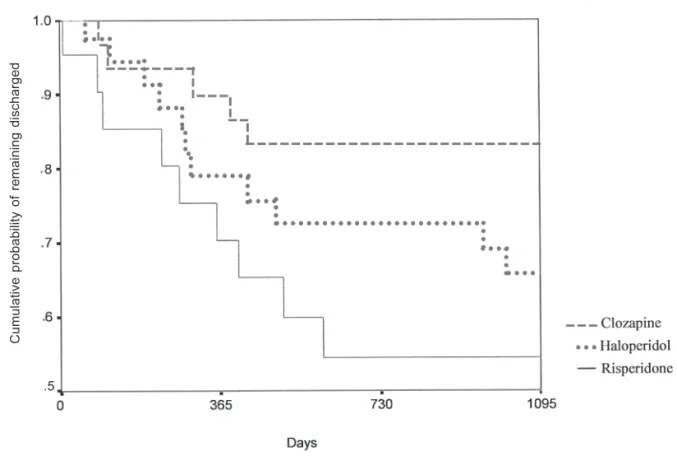
12 months, 84% at 24 months and remained constant at 36 months as it was found in the risperidone group. Thus, rehospitalization rates for the haloperidol group were 16%, 21% and 26%, respectively at 12, 24 and 36 months, compared with the risperidone group that reached 27% at 12 months and 41% at both 24 and 36 months, and with the clozapine group that showed to be 10% at 12 months and 16% at both 24 and 36 months. Although clozapine patients showed lower rehospitalization rates, there were no significant differences in readmission rates between the three groups nor when the comparison is made for groups two by two (haloperidol x risperidone: logrank 0.9; p = 0.331; haloperidol x clozapine: logrank 2.2, p = 0.134; clozapine x risperidone: logrank 5, p = 0.026) controlling for type I error with the Bonferroni method (
α/
3+ 0.05/3 = 0.0166) - Figure 1.Age, gender, age of onset of symptoms, length of illness, number of previous hospitalizations, length of hospitalization, length of follow-up and the three antipsychotics used in this study were not associated with the risk of rehospitalization. Even when the Cox regression model was adjusted using the stepwise method, none of the previous variables showed to be associated with rehospitalization rates.
D i s c u s s i o n
This is a naturalistic retrospective study designed to observe the rehospitalization rates of patients with schizophrenia taking haloperidol, risperidone or clozapine. The results of this study demonstrate lower rehospitalization rates for patients in use of clozapine than those in use of haloperidol and risperidone; lower rehospitalization rates for patients in use of haloperidol than those in use of risperidone and lower rehospitalization rates for the group taking haloperidol than those reported in previous studies with conventional antipsychotics. However, the conclusions drawn from this study must be tempered by the limitations of the methodology used. First, since this is not a randomized controlled trial, patients were not randomly assigned for the three treatments, i.e. the choice of each treatment was defined on a clinical basis. Second, the comparison involves clozapine, a drug well defined for treatment-resistant schizophrenia and third, at the time of the study (1999-2001) risperidone was used for patients who had
not previously responded to conventional antipsychotics and it is possible that they were also treatment resistant. Such heterogeneity of severity of illness may have biased the results favoring patients who received haloperidol as compared with those who were on risperidone. Clozapine was associated with lower rehospitalization rates in all three years of the study and the rates found are comparable to those reported by Essok et al.20 (18% at 1 year) and Conley et al.23 (13% at 1 and 2
years). Honigfeld and Patin21 found a less favorable 2-year
readmission rate for the clozapine group (28%) than it was found in the present study (10% at 1 year and 16% at 2 and 3 years). Another result which is similar to Conley’s et al.23
was that patients taking clozapine who relapsed were most likely to relapse earlier than patients treated with risperidone. The length of hospitalization for the clozapine group (70 days) was higher than the haloperidol (38 days) and the risperidone (40 days) groups and there was a significant difference between groups (Anova F = 9.7; p = 0.001). The clozapine group had a significantly higher number of previous hospitalizations than the haloperidol and the risperidone groups (Kruskal-Wallis χ2 = 14.04, df = 2, p = 0.001). We have previously described
that patients with treatment-resistant schizophrenia, when compared with non refractory patients are predominantly males, have an earlier age of onset and have a higher number of previous hospitalizations27 and in fact these are the same
Table 1) were not related to the risk of being readmitted. Similarly, the same method showed that the use of any of three antipsychotics (haloperidol, risperidone and clozapine) influenced the time of readmission.
Rehospitalization rates for patients in use of haloperidol (16%, 21% and 26%, respectively, at 12, 24 and 36 months) were lower than most the rates previously reported for unselected conventional antipsychotics groups. Hogarty and Rabinowitz et al. found 1-year rehospitalization rates of 37% and 35%, respectively, and 2-year rates of 55% and 48%, respectively, for patients taking conventional antipsychotics.19,24 These rates
are much higher than those found in the present study for the haloperidol-treated group. Perhaps such difference is due to an intrinsic diversity in terms of relapse prevention capability among the conventional antipsychotic groups and it suggests a higher effectiveness of haloperidol as compared with unselected conventional antipsychotic groups of other studies in terms of rehospitalization prevention. The rates of rehospitalization for the haloperidol group were also lower than those found for the risperidone group in the present study, although there were no statistically significant differences. There are some possible explanations that should be considered such as in the case of the haloperidol group who contained a higher proportion of women, a later age of onset of illness and a shorter length of illness than the risperidone group. These are well established variables associated with a better prognosis in schizophrenia and they could have biased the results towards haloperidol. On the other hand, statistical tests used to compare demographic and clinical variables have shown no significant differences.
The outcome data at 12 months (27%) for the risperidone group of the present study are similar to Conley et al’s.,23
Rabinowitz et al’s.24 and Patel et al’s.25 reports that found
rehospitalization rates of 17%, 31% and 35%, respectively, for patients taking risperidone. At 24 months, the rates found in Conley et al’s.23 and Rabinowitz et al’s.24 studies were 34%
e 33%, respectively, while we found a rate of 41% for the risperidone group. Contrarily to our results, the rehospitalization rates reported in most previous studies, which compared risperidone with conventional antipsychotics, were lower in the risperidone-groups than in the conventional antipsychotic-t r e a antipsychotic-t e d g r o u p s . H o w e v e r, Pa antipsychotic-t e l e antipsychotic-t a l . ,25 f o u n d h i g h e r
rehospitalization rates for the risperidone group than the rates for the conventional antipsychotic group (20%). This result is also comparable to the present study for the haloperidol group. As previously stated, there are several limitations of the present study, in accordance to the studies of Conley et al.,23
Rabinowitz et al.24 and Patel et al.,25 this is also a naturalistic
cohort study and not a randomized controlled trial. The methodology used in the present study is similar to those previously mentioned which utilized data from records of inpatient hospitals (infirmaries) and chart reviews to verify diagnoses. Data on risk factors such as age, sex, race and length of hospitalization were carefully collected but are not free from errors. The diagnosis was confirmed in the majority of subjects using the Opcrit system, a reliable instrument designed for such a purpose. In the present study the length of drug treatment before discharge could not be adequately evaluated, as well as dose regimens and outpatient follow-up information. It is well known that compliance represents a key factor for relapse and patients may not have taken their medications adequately thus precipitating relapse, regardless the antipsychotic class. Additionally, it is possible that clozapine administration regimen, with periodic blood counts, may have favored a higher compliance and the better outcome observed in the present study. Another limitation is that some patients
.5
C
u
m
u
la
ti
v
e
p
ro
b
a
b
ili
ty
o
f
re
m
a
in
in
g
d
is
c
h
a
rg
e
R e f e r e n c e s
1. Cannon M, Jones P. Schizophrenia. J Neurol Neurosurg Psychiatry.
1996;60(6):604-13.
2. Murray C, Lopez A. Global mortality, disability and the contribution
of risk factors: Global Burden of Disease Study. L ancet.
1997;349(9063):1436-42.
3. Brown S, Inskip H, Barraclough B. Causes of the excess mortality of
schizophrenia. Br J Psychiatry. 2000;177(4):212-7.
4. Lehman A. Vocational Rehabilitation in schizophrenia. Schizophr
Bull. 1995;21:645-56.
5. Andreasen NC. Symptoms, signs, and diagnosis of schizophrenia.
Lancet. 1995;346(8973):477-81.
6. Davis JM, Kane JM, Marder SR, Brauzer B, Gierl B, Schooler N,
Casey DE, Hassan M. Dose response of prophylactic antipsychotics.
J Clin Psychiatry. 1993;54 Suppl:24-30.
7. Gilbert PL, Harris MJ, McAdams LA, Jeste DV. Neuroleptic withdraw
in schizophrenic patients: a review of the literature. Arch Gen
Psychiatry. 1995;52(3):173-88.
8. Robinson DG, Woerner MG, McMeniman M, Mendelowitz A, Bilder
RM. Symptomatic and functional recovery from a first episode of
schizophrenia or schizoaffective disorder. Am J Psychiatry.
2004;161(3):473-9.
9. Wyatt RJ. Neuroleptics and natural course of schizophrenia.
Schizophr Bull. 1991;17(2):325-51.
10. Geddes J, Freemantle N, Harrison P, Bebbington P. Atypical
antipsychotics in the treatment of schizophrenia: systematic overview
and meta-regression analysis. BMJ. 2000;321(7273):1371-6.
11. Davis JM, Chen N, Glick ID. A meta-analysis of the efficacy of
second-generation antipsychotics. Arch Gen Psychiatr y.
2003;60(6):553-64.
12. Lieberman JA, Stroup T, McEvoy JP, Swartz MS, Rosenheck RA,
Perkins DO, Keefe RSE, Davis SM, Davis CE, Lebowitz BD, Severe J, Hsiao JK, for the Clinical Antipsychotic Trials of Intervention Effectiveness (CATIE) Investigators. Effectiveness of antipsychotic
drugs in patients with chronic schizophrenia. N Engl J Med.
2005;353 (12):1209-23.
13. Rosenheck R, Perlick D, Bingham S, Liu-Mares W, Collins J, Warren
S, Leslie D, Allan E, Campbell EC, Caroff S, Corwin J, Davis L, Douyon R, Dunn L, Evans D, Frecska E, Grabowski J, Graeber D, Herz L, Kwon K, Lawson W, Mena F, Sheikh J, Smelson D, Smith-Gamble V. Effectiveness and cost of olanzapine and haloperidol in
the treatment of schizophrenia: a randomized controlled trial. JAMA.
2003;290(20):2693-702.
could have been readmitted in hospitals other than the IPq with no data being recorded on charts. Furthermore, since patients were not matched due to the small sample size, there may also be some differences between groups in terms of severity that were not detected.
Relapse and rehospitalizations are due to a multiplicity of causes and therefore long-term comparative follow-up studies comparing each SGA to specific conventional antipsychotics a r e s t i l l n e e d e d , d u e t h e f a c t t h a t t h e y r e p r e s e n t a heterogeneous class of drugs. Such studies are also important to inform the debate over cost-effectiveness of antipsychotic agents and this issue should be more explored in the future.
A c k n o w l e d g m e n t s
The statistical orientation of Mr. Jony Arrais Pinto Júnior of the Institute of Mathematics and Statistics of the Universidade de São Paulo (USP) is greatly appreciated.
14. Weiss EM, Bilder RM, Fleischhacker WW. The effects of second
generation antipsychotics and cognitive functioning and psychosocial
outcome in schizophrenia. Psychopharmacology (Berl).
2002;162(1):11-7.
15. Harvey PD, Keefe RS. Studies of cognitive change in patients with
schizophrenia following novel antipsychotic treatment. Am J
Psychiatry. 2001;158(2):176-84.
16. Leucht S, Barnes TR, Kissling W, Engel RR, Correll C, Kane JM.
Relapse prevention in schizophrenia with new-generation antipsychotics: a systematic review and exploratory meta-analysis
of randomized, controlled trials. Am J Psychiatr y.
2003;160(7):1209-22.
17. de Sena EP, Santos-Jesus R, Miranda-Scippa A, Quarantini L de C,
Oliveira IR. Relapse in patients with schizophrenia: a comparison
between risperidone and haloperidol. Rev Bras Psiquiatr.
2003;25(4):220-3.
18. Weiden PJ, Olfson M. Cost of relapse in schizophrenia. Schizophr
Bull. 1995;21(3):419-29.
19. Hogarty GE. Prevention of relapse in chronic schizophrenic patients.
J Clin Psychiatry. 1993;54 Suppl:18-23.
20. Essock SM, Hargreaves WA, Covell NH, Goethe J. Clozapine’s
effectiveness for patients in state hospitals: results from a randomized
trial. Psychopharmacol Bull. 1996;32(4):683-97.
21. Honigfeld G, Patin J. A two-year clinical and economic follow-up of
patients on clozapine. Hosp Community Psychiatr y.
1990;41(8):882-5.
22. Lin CH, Lin SC, Chen MC, Wang SY. Comparison of time to
rehospitalization among schizophrenic patients discharged on typical
antipsychotics, clozapine or risperidone. J Chin Med Assoc.
2006;69(6):264-9.
23. Conley RR, Love RC, Kelly DL, Bartko JJ. Rehospitalization rates of
patients recently discharged on a regimen of risperidone or clozapine.
Am J Psychiatry. 1999;156(6):863-8.
24. Rabinowitz J, Lichtenberg P, Kaplan Z, Mark M, Nahon D, Davidson
M. Rehospitalization rates of chronically ill schizophrenic patients discharged on a regimen of risperidone, olanzapine, or conventional
antipsychotics. Am J Psychiatry. 2001;158(2):266-9.
25. Patel NC, Dorson PG, Edwards N, Mendelson S, Crismon ML.
One-year rehospitalization rates of patients discharged on atypical versus
conventional antipsychotics. Psychiatr Serv. 2002;53(7):891-3.
26. McGuffin P, Farmer A, Harvey I. A Polydiagnostic application of
operational criteria in studies of psychotic illness. Arch Gen
Psychiatry. 1991;48(8):764-70.
27. Henna J, Oliveira J, Melo M, Alves TM, Eizenman IB, Elkis H.
Predictors of response and outcome in treatment resistant