○ ○ ○ ○ ○ ○ ○ ○ ○ ○ ○ ○ ABSTRACT○ ○ ○ ○ ○ ○ ○
C
ase Repor
t
○ ○ ○ ○ ○ ○ ○ ○ ○ ○INTRODUCTION○ ○ ○ ○ ○ ○ ○ ○ ○ ○
Primary hyperparathyroidism is the most common cause of hypercalcemia in unselected patients. The most common cause is a single adenoma (80-85%), while multiple gland hyperplasia occurs in 12-15%, double ad-enoma in 2-3% and carcinoma in about 1%.1 Ectopic adenomas, unrecognized hyperplas-tic glands, and supernumerary glands are con-sidered to be the causes of failure after the ini-tial cervical exploration. Ectopic multiple glands are rare and present a particular chal-lenge in parathyroid surgery. The frequency of multiple parathyroid glands in ectopic lo-cations in the same patient is not well de-scribed in the literature, thus suggesting that they are uncommon.2 We report on a patient with primary hyperparathyroidism with an unusual presentation of ectopic and double adenoma.
○ ○ ○ ○ ○ ○ ○ ○ ○ ○ ○ ○ ○ ○ ○ ○ ○ ○ ○ ○
CASE REPORT
A 65-year-old previously healthy woman presented with an episode of unilateral renal colic associated with hematuria. She was found to have nephrolithiasis and was clinically treated. The physical examination was unre-markable. Her serum total calcium was found to be elevated, confirmed as 12 mg/dl and 11.7 mg/dl. Other results showed serum phosphate of 1.3 mg/dl and alkaline phosphatase of 550 U/l. The diagnosis of primary hyperparathy-roidism was confirmed by elevated serum in-tact parathyroid hormone levels of 95 pg/ml. Ultrasound was successful in localizing one adenoma in the lower right gland. Tech-• Rogério Aparecido Dedivitis
• André Vicente Guimarães
• Gustavo Bastos de Goes Pontes
Multiple ectopic
parathyroid adenomas
Department of Otorhinolaryngology, Head and Neck Surgery of
Universidade Metropolitana de Santos (Unimes), and Hospital Ana Costa,
Santos, São Paulo, Brazil
CONTEXT: Primary hyperparathyroidism is the most common cause of hypercalcemia in unselected patients. The ectopic gland locations should be known for appropriate surgical exploration and for avoiding subsequent re-exploration that would represent higher morbidity. Multiple ectopic glands are rare and present a particular challenge in par-athyroid surgery.
CASE REPORT: A 65-year-old female presented with nephrolithiasis. Her serum total calcium was found to be elevated. The diagnosis of primary hyper-parathyroidism was confirmed by the elevated se-rum intact parathyroid hormone levels. Ultrasound was only successful in localizing one adenoma in the lower right gland. Technetium sestamibi scan-ning correctly localized the same adenoma and showed another contralateral image, lateral to the thyroid cartilage. Fiber optic laryngoscopy showed an extrinsic mass pushing against the lateral and posterior walls of the left pyriform sinus. Resonance imaging revealed a soft tissue mass.
RESULTS: The patient underwent bilateral neck explo-ration. Histopathological examination confirmed the diagnosis of parathyroid double adenomas. The late-stage postoperative checkups were nor-mal.
DISCUSSION: Routine bilateral neck surgery should be performed as a rule. We use ultrasound and technetium sestamibi scanning as a routine for preoperative localization studies. It is helpful to have an experienced surgeon for the localization.
KEY WORDS: Parathyroid glands. Hyperparathy-roidism. Parathyroidectomy. Parathyroid neo-plasms.
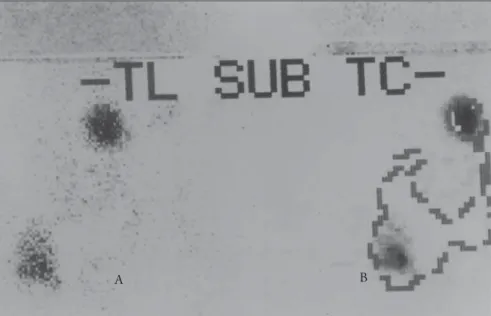
netium sestamibi scanning correctly localized the same adenoma and showed another con-tralateral image, lateral to the thyroid carti-lage (Figure 1). Fiber optic laryngoscopy showed an extrinsic mass pushing against the lateral and posterior walls of the left pyriform sinus, measuring about 1 cm. As this presen-tation was unusual, the patient underwent resonance imaging that revealed a soft tissue mass in that location (Figure 2).
The patient was admitted to hospital for a surgical procedure. The upper right and left glands were identified in their normal ana-tomical positions and their sizes were also normal. The adenomas were located at a topi-cal lower right position and just below the left pyriform sinus. No parathyroid gland was identified in the anatomical position of the lower left gland. Histopathological examina-tion confirmed the diagnosis of parathyroid adenomas for both lesions that were removed. The postoperative serum calcium levels normalized within 24-48 hours and the pa-tient presented symptomatic hypocalcemia due to the “hungry bone” syndrome, which was controlled clinically. The patient was dis-charged with normal serum calcium and nor-mal serum phosphate on the third postopera-tive day. She started on oral calcium carbon-ate medication, which was stopped in the sec-ond postoperative week. The late-stage post-operative checkups were normal.
○ ○ ○ ○ ○ ○ ○ ○ ○ ○ ○ ○ ○ ○ ○ ○ ○ ○ ○ ○
DISCUSSION
Multiple and/or ectopic adenomas are rare causes of primary hyperparathyroidism. The role of preoperative localization studies
São Paulo Medical Journal — Revista Paulista de Medicina
33
mains controversial. Previous positive studies increase surgical confidence and reduce oper-ating time. However, the routine localization of ectopic adenomas is unreliable via ultra-sound. In addition, both isotope scans and ultrasound produce false negative and false positive results.1 Sestamibi scans have been least accurate in patients with multiple abnor-mal glands.3
Abnormal parathyroid glands can be iden-tified during initial surgical exploration by experienced surgeons in about 90-95% of cases. Bilateral neck exploration should be performed in every case, regardless of the preoperative localization methods. A careful search should also be conducted at the most frequent ectopic sites4. Fourteen percent of adenomas are found at ectopic locations. An ectopic upper parathyroid gland is most com-monly found at retroesophageal sites. An ec-topic lower gland is more likely to be found in the anterior mediastinum, in association with the thymus gland.1
○ ○ ○ ○ ○ ○ ○ ○ ○ ○ ○ ○ ○ ○ ○ ○ ○ ○ ○ ○
REFERENCES
1. Summers GW. Parathyroid update: a review of 220 cases. Ear Nose Throat J 1996;75(7):434-9.
2. Maxwell R, Carter WB, Smith RM, Perry RR. Multiple ectopic parathyroid glands. Am Surg 2000;66(11):1028-31. 3. Arici C, Cheah WK, Ituarte PH, et al. Can localization studies
be used to direct focused parathyroid operations? Surgery 2001; 129(6):720-9.
4. Henry JF, Defechereux T, Raffaeli M, Lubrano D, Iacobone M. Parathyroïde hyperfonctionnelle surnuméraire en ectopie majeure: une cause d’échec dans la chirurgie de l’hyperpa-rathyroïdisme primaire sporadique [Supernumerary ectopic hyperfunctioning parathyroid gland: a potential pitfall in sur-gery for sporadic primary hyperthyroidism]. Ann Chir 2000; 125(3):247-52.
Figure 1. (A)Technetium sestamibi scan, correctly localizing both adenomas; (B) Thyroid silhouette superimposed over the
representation of the adenomas.
Figure 2. Resonance image showing a soft tissue mass pushing against the lateral and posterior walls of the left pyriform sinus.
Sao Paulo Med J 2004; 122(1):32-4.
São Paulo Medical Journal — Revista Paulista de Medicina
34
Adenoma múltiplo de paratiróide ectópica
CONTEXTO: Hiperparatireoidismo primário é a causa mais comum de hipercalcemia em indivíduos examinados aleatoriamente. A localização das glândulas ectópicas deve ser conhecida para uma exploração cirúrgica apropriada e para evitar subseqüente re-ex-ploração, o que representa um índice de morbidade maior. Múltiplas glândulas ectópicas são raras e apresentam um desafio particular à cirurgia das paratireóides.
RELATO DE CASO: Paciente do gênero femi-nino de 65 anos apresentou nefrolitíase. A dosagem de cálcio sérico estava elevada. O diagnóstico de hiperparatireoidismo primá-rio foi confirmado pela elevação do paratormônio intacto sérico. O ultra-som só obteve sucesso em localizar um adenoma na glândula inferior direita. Cintilografia por tecnécio-Sestamibi localizou corretamente o
○ ○ ○ ○ ○ ○ ○ ○ ○ ○ ○ ○ ○ ○ ○ ○ ○ ○ ○ ○ ○ ○ ○ ○ ○ ○ ○ ○ ○ ○ ○ ○ ○ ○ ○ ○ ○ ○ ○ ○ ○ ○
RESUMO
Rogério Aparecido Dedivitis, MD, PhD. Department of Otorhinolaryngology, Head & Neck Surgery of Universidade Metropolitana de Santos (Unimes), Santos, São Paulo, and Postgraduate Course of Health Sciences of Hospital Heliópolis, São Paulo.
André Vicente Guimarães, MD. MSc from the postgradu-ate course on Head & Neck Surgery of Hospital Heliópolis, São Paulo, Brazil.
Gustavo Bastos de Goes Pontes. Student at the School of Medicine, Universidade Metropolitana de Santos (Unimes), Santos, São Paulo, Brazil.
Sources of funding: No sources Conflict of interest: No conflict Date of first submission: May 20, 2003 Last received: August 11, 2003 Accepted: August 25, 2003 Address for correspondence: Rogério Aparecido Dedivitis
Rua Olinto Rodrigues Dantas, 343 — conjunto 92 Santos/SP — Brasil — CEP 11050-220 Tel/fax: (+55 13) 3223-5550/3221-1514 E-mail: [email protected]
COPYRIGHT © 2004, Associação Paulista de Medicina ○ ○ ○ ○ ○ ○ ○ ○ ○ ○ ○ ○ ○ ○ ○ ○ ○ ○ ○ ○
Publishing information
mesmo adenoma e outra imagem contra-lateral, lateralmente à cartilagem tireóidea. Laringofibroscopia mostrou uma massa extrínseca empurrando as paredes lateral e posterior do recesso piriforme esquerdo. Ima-gens de ressonância revelaram uma massa de tecido frouxo.
RESULTADO: Ela foi submetida a uma explora-ção de pescoço bilateral. O exame histo-patológico confirmou o diagnóstico de adeno-ma duplo de paratireóide. O controle pós-operatório foi normal.
DISCUSSÃO: Exploração cervical bilateral roti-neira deve ser executada. Nós usamos ultra-som e tecnécio-Sestamibi como uma rotina de estudos pré-operatório de localização. A experiência do cirurgião é importante na lo-calização.
PALAVRAS CHAVE: Glândulas paratireóides. Hiperparatireoidismo. Paratireoidectomia. Neoplasias das paratireóides.