* Extracted from the inal residency report “Carga de trabalho de enfermagem e ocorrência de eventos adversos na terapia intensiva: revisão sistemática”, Programa de Residência em Enfermagem na Saúde do Adulto e do Idoso, Escola de Enfermagem/ Hospital Universitário, Universidade de São Paulo, 2016. 1 Universidade de São Paulo, Escola de Enfermagem, Programa de Residência em Enfermagem na Saúde do Adulto e do Idoso, São Paulo, SP, Brazil. 2 Universidade de São Paulo, Hospital Universitário, Unidade de Terapia Intensiva Adulto, São Paulo, SP, Brazil.
3 Universidade de São Paulo, Escola de Enfermagem, Departamento de Enfermagem Médico-Cirúrgica, São Paulo, SP, Brazil.
Received: 03/15/2016 Approved: 06/02/2016
REVIEW ARTICLE DOI: http://dx.doi.org/10.1590/S0080-623420160000500020
Corresponding author: Andrea Carvalho de Oliveira Av. Dr. Enéas de Carvalho Aguiar, 419 – Cerqueira César
CEP: 05403-000 – São Paulo, SP, Brazil [email protected]
ABSTRACT
Objective: To identify evidences of the inluence of nursing workload on the occurrence of adverse events (AE) in adult patients admitted to the intensive care unit (ICU). Method: A systematic literature review was conducted in the databases MEDLINE, CINAHL, LILACS, SciELO, BDENF, and Cochrane from studies in English, Portuguese, or Spanish, published by 2015. he analyzed AE were infection, pressure ulcer (PU), patient falls, and medication errors. Results: Of 594 potential studies, eight comprised the inal sample of the review. he Nursing Activities Score (NAS; 37.5%) and the herapeutic Intervention Scoring System (TISS; 37.5%) were the instruments most frequently used for assessing nursing workload. Six studies (75.0%) identiied the inluence of work overload in events of infection, PU, and medication errors. An investigation found that the NAS was a protective factor for PU. Conclusion: he nursing workload required by patients in the ICU inluenced the occurrence of AE, and nurses must monitor this variable daily to ensure proper sizing of staf and safety of care.
DESCRIPTORS
Workload; Nursing, Team; Patient Safety; Intensive Care Unit; Review.
Nursing workload and occurrence of adverse events
in intensive care: a systematic review*
Carga de trabalho de enfermagem e ocorrência de eventos adversos na terapia intensiva: revisão sistemática
Carga laboral de enfermería y ocurrencia de eventos adversos en los cuidados intensivos: revisión sistemática
Andrea Carvalho de Oliveira1, Paulo Carlos Garcia2, Lilia de Souza Nogueira3
How to cite this article:
INTRODUCTION
A major challenge for managers in the hospital setting is to ensure patient safety, and one should consider the inves-tigation of adverse events (AE) in the analysis of indicators of quality of care. In the intensive care unit (ICU), a depart-ment for the care of critically ill patients(1), there is a higher
probability of occurrence of adverse events due to clinical instability of patients and the high number of interventions and devices to which they are subjected during treatment(2).
he occurrence of AE is to be discussed as one of the aspects that negatively impact patient safety, especially since 1999, with the release of the report To Err is Human by the Institute of Medicine (IOM). his report was based on the evaluation of the incidence of AE that occurred in three hospitals in the United States of America (USA) that found that approximately 100,000 people die in USA hospitals every year, victims of AE, with a consequent signiicant in-crease in healthcare costs(3).
Five years after the publication of this report, the World Health Organization (WHO) created the World Alliance for Patient Safety, which highlighted the main aspects of pa-tient safety and the factors that can inluence it, such as AE. According to the WHO’s deinition, incidents are events or circumstances which may result or have resulted in unneces-sary harm to the patient, whereas AE are incidents arising from unintentional mistakes that cause measurable lesions(4).
In 2013, the National Program of Patient Safety (PNSP, in Portuguese) was established in Brazil by the Ministry of Health, elaborating and implementing a set of basic proto-cols in health institutions(5). Ordinance No. 1,377 adopted on
July 9, 2013, sets protocols for safe surgery, hand hygiene prac-tices, and pressure ulcer avoidance(6). After a few months, a new
ordinance was published (Ordinance No. 2,095, September 24, 2013) setting new protocols: prevention of falls, safety in pre-scribing and in the use and administration of medications, as well as in patient identiication(7). hese protocols act as guides,
setting standards that must be used in hospitals and support best practices with a focus on patient safety(7).
In the intensive care environment, the quality of nursing care and patient safety depends not only on the qualiication of professionals, but also on the appropriate quota of human resources available. However, health services still face extreme diiculty in matching the number of professionals with the demand, generally due to inancial issues. he numerical and qualitative mismatch between human resources and the care required by patients in intensive care can lead to work over-load and failures in the process of care(8).
Nursing workload can be deined as “work process ele-ments that interact dynamically with each other and with the body of the worker, generating a process of adapta-tion which leads to wear”(9). Acknowledging this load in
the workplace is essential, since it is subject to control and reduction of undesirable efects(10). However, ignoring the
importance of its measurement may cause a negative im-pact on the quality and safety of care to patients, due to the greater likelihood of AE.
herefore, the assessment of nursing workload is a sub-ject of great relevance, insofar as an oversized team implies
higher costs. On the other hand, it is known that a reduced team can cause a drop in efectiveness and/or quality of care, extending the length of hospital stay and generating greater costs of treatment, in addition to exposing patients, staf, and the institution itself to the risk of not having safe care(11-12).
Studies show that an increase in hours of nursing care provided to patients is associated with a decrease in the occur-rence of AE, such as: urinary tract infection; pressure ulcers; hospital-acquired pneumonia; wound infections; complica-tions in central venous access; shock; thrombosis; medication errors; and postoperative complications(13-14). Another
publica-tion shows that the nursing workload is a risk factor for death in the ICU(15). However, no systematic reviews were identiied
from the literature showing a possible relationship between workload and AE in the scope of nursing.
In this context, the authors inquire: Is there an inluence of nursing workload on the incidence of AE in patients admitted to the ICU? he answer to this question may provide contri-butions to intensive care managers and nurses in the use of nursing workload measurement tools in order to justify the appropriate staf size in intensive care, ensuring care safety. he objective of the present review was to ind evidence of the inluence of nursing workload on the occurrence of AE (pressure ulcers, infection, falls, or medication errors) in adult patients admitted to the ICU.
METHOD
his is a systematic literature review, which consists of a rigorous synthesis of relevant results on a given theme, in which the main goal is to indicate the best available evidence on the efect of a particular therapy or interven-tion, so that professionals are aware of the best practices described in the literature(16).
Data were collected through electronic search from October to November 2015 in the following databases: the Medical Literature Analysis and Retrieval System Online (MEDLINE); the Cumulative Index to Nursing and Allied Health Literature (CINAHL); the Latin American and Caribbean Center on Health Sciences Information (LILACS); the database of nursing (BDENF); and the Cochrane library. he portal Scientiic Electronic Library Online (SciELO) was also analyzed. In addition, grey lit-erature was analyzed through Google Scholar and a manual search was undertaken from the references cited in the ar-ticles selected.
Adverse events analyzed in this review include pressure ulcers, infections, falls, and medication errors. hese events were selected from the proposal of the basic protocols previ-ously described(6-7).
he PICO strategy (which is an acronym for Patient, Intervention, Comparison, and Outcomes)(17), was used
Chart 1 –Elements of the PICO strategy, descriptors (MESH, DeCS and CINAHL titles) and keywords used – São Paulo, SP, Brazil, 2016.
Elements MESH DeCS CINAHL Titles Keywords
P
Patients in intensive care units
“Intensive Care” “Intensive Care-Units” “Critical Care-Nursing” “Respiratory Care Units”
“Coronary Care Units” “Burn Units” “Critical Care”
“Unidade de Terapia Intensiva” “Terapia Intensiva” “Unidade de Cuidados
Coronarianos” “Unidade de Cuidados
Respiratórios” “Unidade de Queimados” “Enfermagem de Cuidados Críticos”
“Cuidados Críticos”
“Intensive Care Units” “Critical Care Nursing” “Respiratory Care Units”
“Coronary Care Units” “Burn Units” “Critical Care” “Stroke Units” “Post Anesthesia Care
Units”
“ICU” “UTI” “Intensive Care” “Intensive Care Units” “Critical Care Nursing” “Respiratory Care Units”
“Coronary Care Units” “Burn Units” “Critical Care” “Stroke Units” “Post Anesthesia Care
Units”
I
Nursing workload “Workload” “Carga de trabalho” “Nurse-Patient Ratio”“Workload”
“Nursing workload” “Nurse patient ratio”
“Workload”
C – – – –
O Patient safety (adverse events)
“Patient Safety” “Safety” “Safety” “Management”
“Iatrogenic Disease” “Cross-Infection”
“Pressure Ulcer” “Accident Falls” “Medication Errors” “Medication Systems” “Urinary tract Infections”
“Catheter-related Infections”
“Segurança do Paciente” “Segurança” “Gestão da Segurança”
“Doença Iatrogênica” “Infecção” “Infecção Hospitalar” “Úlcera por Pressão” “Erros de Medicação” “Acidentes por Quedas”
“Patient Safety” “Adverse Health Care
Event” “Health Care Errors” “Iatrogenic Disease”
“Infection” “Cross-Infection” “Pressure Ulcer” “Accident Falls” “Medication Errors” “Medication Systems”
“Urinary tract Infections” “Catheter-related
Infections”
“Adverse Events” “Evento Sentinela” “Eventos Adversos” “Patient Safety”
“Safety” “Safety Management”
“Iatrogenic Disease” “Health Care Errors” “Adverse Health Care
Event” “Fall” “Urinary tract Infections”
“Catheter-related Infections” “Cross-Infection”
“Pressure Ulcer” “Accident Falls” “Medication Errors” “Medication Systems”
“Catheter-related bloodstream infections”
“Quedas”
he element C from the PICO strategy has not been ad-dressed in this research, as this is not intended to compare interventions. he keywords (MESH and DeCS) and the titles from CINAHL were combined with the Boolean operators “OR” and “AND.” he following criteria were used to guide the inclusion of articles in the review: studies published in full in national and international journals in English, Portuguese, or Spanish and which make use of instruments for measuring
the workload of nursing in adult patients in the ICU. No il-ters were applied to the period of publication of the articles. Research on pediatric populations, as well as journal editorials, letters to the editor, comments, theses, and dissertations were excluded from the sample.
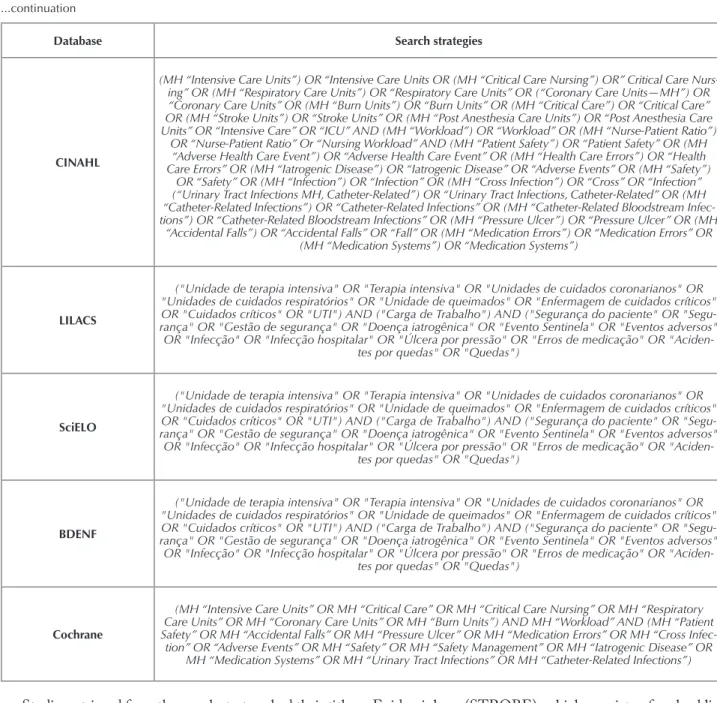
Considering the singularities and distinctive features of the databases, the search was carried out using diferent strategies, as described in Chart 2.
Chart 2 – Search strategies used in the databases MEDLINE, CINAHL, LILACS, SciELO, BDENF and Cochrane – São Paulo, SP, Brazil, 2016.
Database Search strategies
MEDLINE (via PubMed)
(“Intensive Care” [Mesh] OR “Intensive Care” OR “Intensive Care Units” [Mesh] OR “Intensive Care Units” OR “Post-Anesthesia Care Units” OR “Stroke Units” OR “Critical Care Nursing” [Mesh] OR “Critical Care
Nursing” OR “Respiratory Care Units” [Mesh] OR “Respiratory Care Units” OR “Coronary Care Units” [Mesh] OR “Coronary Care Units” OR “Burn Units” [Mesh] OR “Burn Units” OR “Critical Care” [Mesh] OR “Critical Care” OR “ICU” OR “ICUs”) AND (“Workload” [Mesh] OR “Workload” OR “Nursing Work-load” OR “Nurse-patient ratio”) AND (“Patient Safety” [Mesh] OR “Patient Safety” OR “Safety” [Mesh] OR
“Safety” OR “Safety Management” [Mesh] OR “Safety Management” OR “Adverse Events” OR “Iatrogenic Disease” [Mesh] OR “Iatrogenic Disease” OR “Adverse Health Care Event” OR “Health Care Errors” OR “Infection” [Mesh] OR “Infection” OR “Cross Infection” [Mesh] OR “Cross” OR “Urinary Tract Infections, Catheter-Related” OR Related Infections” [Mesh] OR Related Infections” OR “Catheter-Related Bloodstream Infections” OR “Pressure Ulcer” [Mesh] OR “Pressure Ulcer” OR “Fall” OR “Accidental
Fall” [Mesh] OR “Accidental Falls” OR “Medication Errors” [Mesh] OR “Medication Errors” OR “Medication Systems” [Mesh] OR “Medication Systems”)
...continuation
Database Search strategies
CINAHL
(MH “Intensive Care Units”) OR “Intensive Care Units OR (MH “Critical Care Nursing”) OR” Critical Care Nurs-ing” OR (MH “Respiratory Care Units”) OR “Respiratory Care Units” OR (“Coronary Care Units—MH”) OR “Coronary Care Units” OR (MH “Burn Units”) OR “Burn Units” OR (MH “Critical Care”) OR “Critical Care” OR (MH “Stroke Units”) OR “Stroke Units” OR (MH “Post Anesthesia Care Units”) OR “Post Anesthesia Care Units” OR “Intensive Care” OR “ICU” AND (MH “Workload”) OR “Workload” OR (MH “Nurse-Patient Ratio”)
OR “Nurse-Patient Ratio” Or “Nursing Workload” AND (MH “Patient Safety”) OR “Patient Safety” OR (MH “Adverse Health Care Event”) OR “Adverse Health Care Event” OR (MH “Health Care Errors”) OR “Health Care Errors” OR (MH “Iatrogenic Disease”) OR “Iatrogenic Disease” OR “Adverse Events” OR (MH “Safety”)
OR “Safety” OR (MH “Infection”) OR “Infection” OR (MH “Cross Infection”) OR “Cross” OR “Infection” (“Urinary Tract Infections MH, Catheter-Related”) OR “Urinary Tract Infections, Catheter-Related” OR (MH “Catheter-Related Infections”) OR “Catheter-Related Infections” OR (MH “Catheter-Related Bloodstream Infec-tions”) OR “Catheter-Related Bloodstream Infections” OR (MH “Pressure Ulcer”) OR “Pressure Ulcer” OR (MH
“Accidental Falls”) OR “Accidental Falls” OR “Fall” OR (MH “Medication Errors”) OR “Medication Errors” OR (MH “Medication Systems”) OR “Medication Systems”)
LILACS
("Unidade de terapia intensiva" OR "Terapia intensiva" OR "Unidades de cuidados coronarianos" OR "Unidades de cuidados respiratórios" OR "Unidade de queimados" OR "Enfermagem de cuidados críticos" OR "Cuidados críticos" OR "UTI") AND ("Carga de Trabalho") AND ("Segurança do paciente" OR "Segu-rança" OR "Gestão de segu"Segu-rança" OR "Doença iatrogênica" OR "Evento Sentinela" OR "Eventos adversos"
OR "Infecção" OR "Infecção hospitalar" OR "Úlcera por pressão" OR "Erros de medicação" OR "Aciden-tes por quedas" OR "Quedas")
SciELO
("Unidade de terapia intensiva" OR "Terapia intensiva" OR "Unidades de cuidados coronarianos" OR "Unidades de cuidados respiratórios" OR "Unidade de queimados" OR "Enfermagem de cuidados críticos" OR "Cuidados críticos" OR "UTI") AND ("Carga de Trabalho") AND ("Segurança do paciente" OR "Segu-rança" OR "Gestão de segu"Segu-rança" OR "Doença iatrogênica" OR "Evento Sentinela" OR "Eventos adversos"
OR "Infecção" OR "Infecção hospitalar" OR "Úlcera por pressão" OR "Erros de medicação" OR "Aciden-tes por quedas" OR "Quedas")
BDENF
("Unidade de terapia intensiva" OR "Terapia intensiva" OR "Unidades de cuidados coronarianos" OR "Unidades de cuidados respiratórios" OR "Unidade de queimados" OR "Enfermagem de cuidados críticos" OR "Cuidados críticos" OR "UTI") AND ("Carga de Trabalho") AND ("Segurança do paciente" OR "Segu-rança" OR "Gestão de segu"Segu-rança" OR "Doença iatrogênica" OR "Evento Sentinela" OR "Eventos adversos"
OR "Infecção" OR "Infecção hospitalar" OR "Úlcera por pressão" OR "Erros de medicação" OR "Aciden-tes por quedas" OR "Quedas")
Cochrane
(MH “Intensive Care Units” OR MH “Critical Care” OR MH “Critical Care Nursing” OR MH “Respiratory Care Units” OR MH “Coronary Care Units” OR MH “Burn Units”) AND MH “Workload” AND (MH “Patient Safety” OR MH “Accidental Falls” OR MH “Pressure Ulcer” OR MH “Medication Errors” OR MH “Cross Infec-tion” OR “Adverse Events” OR MH “Safety” OR MH “Safety Management” OR MH “Iatrogenic Disease” OR
MH “Medication Systems” OR MH “Urinary Tract Infections” OR MH “Catheter-Related Infections”)
Studies retrieved from the search strategy had their title and abstract evaluated, so as to identify those pertinent to the subject at hand. In studies where the given data were not enough to determine whether or not they should be includ-ed, the study in question was considered for the shortlist, so as to avoid mistaken exclusions.
Preselected studies were recovered in their entirety and analyzed independently by two researchers. In the case of disagreement between them, a third researcher conducted an analysis of the research, so as to ensure the prevailing opinion of the majority.
To extract the data from the articles, we used an instru-ment containing the following information: title; author; journal; year and country of publication; research objectives; methodological design; measuring instrument of nursing workload used; type of adverse event analyzed; main results; and conclusions.
To assess the quality of the studies included in the re-view, two researchers independently applied the instrument Strengthening the Reporting of Observational Studies in
Epidemiology (STROBE), which consists of a checklist with 22 items about recommendations on what should be included in a more accurate and complete description of observational studies(18). It should be noted that this analysis
was carried out not for the purpose of exclusion, but for description of sample studies.
Due to the heterogeneity of the methodology of the studies included in the review, it was not possible to per-form meta-analysis.
RESULTS
From the search strategy employed, 596 potential studies were recovered, with the largest number of studies found in the MEDLINE database (n = 345), followed by CINAHL (n = 226), LILACS (n = 14), BDENF (n = 6), SciELO (n = 3), and Cochrane (n = 2).
Duplicates (n=108)
Evaluation by title and abstract (n = 918)
Preselected for reading in full (n = 37)
Articles excluded after reading their title and abstract (n = 881)
Articles excluded after full reading (n = 29)
# Does not use scale to measure the amount of workload (n = 8) # Was not performed in the intensive care unit (n = 2)
# Does not address the proposed population (n = 2) # Does not address the topic proposed (n = 13) # Thesis (n = 1)
# Letter to the editor (n = 3)
Studies included in theinal sample (n = 8)
Selection
Identiication
Eligibility
Included
Database (n = 6) Retrieved references (n = 596)
Google Scholar and manual search (n = 430)
Chart 3 –Distribution of studies according to title, objective, design, country and year of publication – São Paulo, SP, Brazil, 2016.
Identiication of study and number of items in
the STROBE
Title Objective Study design Country, year
Study 1 (E1) STROBE: 12
Relación entre carga laboral e incidentes en una unidad
de cuidados intensivos polivalente(19)
Check the relationship between workload and the occurrence of incidents in the ICU, including
risk of death
Prospective, cohort
study Chile, 2005
Study 2 (E2) STROBE: 14
Propagation of methicillin-resistant Staphylococcus aureus due to the overloading of medical nurses in intensive
care units(20)
Investigate whether the workload of nursing staff is related to the
development of infections by Methicillin-resistant Staphylococcus
aureus
Prospective cohort
study Slovenia, 2006
Study 3 (E3) STROBE: 15
Multiresistant bacterial colonization due to increased
nurse workload in the neurology intensive care unit(21)
Determine the relationship between nursing workload and coloniza-tion or infeccoloniza-tion by multiresistant
bacteria (BMR)
Prospective,
observational study Turke, 2016
Study 4 (E4) STROBE: 19
Adverse drug events in intensive care units: a cross-sectional study of prevalence and risk factors(22)
Characterize the occurrence of adverse events related to medicines
and to investigate the factors that inluence the occurrence of these
events in an ICU
Retrospective
cross-sectional study Belgium, 2011
Study 5 (E5) STROBE: 19
Nursing workload the risk factor for healthcare associated infections in ICU:
prospective study(23)
Evaluate the role of nursing workload on occurrence of infections associated with assistance
in intensive care units
Prospective, cohort
study Brazil, 2012
Study 6 (E6) STROBE: 19
Pressure ulcers in the intensive care unit: the relationship between nursing workload, illness severity and pressure
ulcer risk(24)
Check the association between pressure ulcer development, nursing
workload and severity of patient status
Prospective
descriptive study Brazil, 2013
Study 7 (E7) STROBE: 19
Nursing workload and occurrence of incidents and
adverse events in ICU patients(25)
Verify the inluence of nursing workload on the occurrence of incidents without injury and
adverse events in ICU
Prospective, cohort
study Brazil, 2014
Study 8 (E8) STROBE: 16 Bacterial colonization due to increased nurse workload in an intensive care unit(26)
Determine the possible association between the risk of hospital-ac-quired infections and increasing the
daily workload of nursing staff
Retrospective study Turkey, 2015
None of the studies in Chart 3 showed agreement with all items of the STROBE. However, all of the research in this review has included at least 50% of the items. Of the eight studies included in the review, three (37.5%) were carried out in Brazil(23-25) and two (25.0%) in Turkey(21,26).
Chile(19), Slovenia(20), and Belgium(22) contributed with one
study each (12.5%).
he searches were performed between 2000 and 2013 and published between 2005 and 2015 in English(20,22,24),
Spanish(19), Portuguese(25) or in all three languages: English,
Spanish and Portuguese(21,26). A total of six studies (75.0%)
were published in international journals(19-24) and two
(25.0%) in national journals(25-26). here has been a higher
percentage of prospective studies (75.0%)(19-21,23-25),
especial-ly of the cohort type(19-20,23-25).Retrospective investigations
were performed less frequently (25.0%)(22,26).
Chart 4 shows that the sample analyzed in the searches ranged from 79 to 970 patients in the ICU(19-26).Of the
studies that described the characteristics of patients in the results(21-24,26), it was possible to identify the prevalence of
women(21-22,24,26) ranging from 50.9 to 65.6 years of age(21-24,26).
Regarding the instrument of workload applied, three stud-ies (37.5%) used the Nursing Activitstud-ies Score (NAS)(23-25),
three (37.5%) the herapeutic Intervention Scoring System (TISS), either the original(20) or the version with 28 items(19,22),
and two (25.0%), the Omega Scoring System (Omega) and the Project de Recherché en Nursing (PRN)(21,26).
Regarding the types of AE, healthcare-associated infec-tions (HAI) were examined in ive studies (62.5%)(19-21,23,26).
Occurrence of pressure ulcer(24-25) was a less frequently
inves-tigated AE (25.0%), as was medication error (25.0%)(22,25).
Adverse events involving accidental loss of central venous catheter, obstruction or loss of the nasogastric tube, loss or damage to the endotracheal tube cuf, loss of bloodline, and falls were also considered as AE in the Chilean study and were referred to as sentinel incidents by the authors(19).
Most of the eight studies included in the review found an inluence of nursing workload on the occurrence of dif-ferent AE: infection(20-21,23,26), pressure ulcer(25), and drug
use(22,25). A Brazilian study that analyzed the occurrence
of pressure ulcers in intensive care concluded that nurs-ing workload was a protective factor for the outcome(24). A
study showed that the TISS-28 exerted inluence only on mortality, that is, there was no relationship between nursing workload and the occurrence of sentinel incidents, includ-ing falls or infections, in the ICU(19).
Chart 4 –Characteristics of studies included in the review according to the sample and patients’ characteristics, analyzed AE, applied instrument of nursing workload, results and influence of nursing workload on occurrence of AE – São Paulo, SP, Brazil, 2016.
Study code
Sample and characteristics:
age - mean (SD) and gender (%)
AE analyzed
Instrument of
nursing workload Mean (SD)
Main results
Inluence of nursing
workload on
the event of infection, PU, fall, or
medication error?
E1 N = 144 Age: SI Gender: SI
Sentinel incidents (accidental loss of central venous catheter, obstruc-tion or loss of a nasogastric tube, loss or damage to the endotracheal
tube cuff, loss of bloodline, or falls), nosocomial infections
(infec-tions associated with the central venous catheter or parenteral
nutri-tion, urinary tract infection related to indwelling urinary catheter), and
death in the ICU
TISS-28 47.4 (9.7)
Occurrence of 101 AE (33 deaths, 27 infections, 14 incidents, and 27 pressure ulcers). There was a cor-relation between the patients who
died in the ICU and TISS values higher than 54 (p = 0.054) and 59
points (p = 0.054). There was no correlation between the daily TISS and the risk of
occur-rence of other AE.
No
E2 N = 970 Age: SI Gender: SI
Infections related to Staphylococ-cus aureus resistant to methicillin
(MRSA)
TISS 188.9 (67.74) =
TISS mean by nurse
144 patients (14.8%) were admit-ted to the ICU with positive MRSA
and 47 (4.84%) acquired MRSA during hospitalization. There was occurrence of MRSA when the daily
TISS score exceeded 150. Daily transmission rate was 0.15, with mean daily TISS score above 250,
0.05 with TISS between 201 and 250, and 0.01 with TISS between
151 and 200.
Yes
E3
N = 138 Age: Women
65.6 (6.7); Men 62.2 (15.8) Gender: 51.4%
female
Infections caused by multiresistant bacteria (MRB)
Omega/PRN Omega: 20 (8.9)
with MRB + and 9 (1.9) with
MRB-PRN: (87) with MRB + and (52)
with
MRB-MRB were identiied in 26 cultures (18.8%). There was a correlation be-tween colonization or infection by MRB and the length of stay, Omega 2, Omega 3, total Omega, total and daily PRN (p < 0.05). Patients evalu-ated by MRB demanded greater nursing workload (PRN) than those
without MRB (p < 0.001).
Yes
Study code
Sample and characteristics:
age - mean (SD) and gender (%) AE analyzed Instrument of nursing workload Mean (SD) Main results Inluence of nursing workload on
the event of infection, PU, fall, or
medication error?
E4
N = 79 Age: 65.3
(12.8) Gender: 77.2%
female
Damage or injury after medication
(AE related to medication) 30.1 (7.1)TISS-28
There was a total of 230 AE related to medication, the most frequent
event being hypoglycemia as-sociated with the use of an insulin pump (33%). The mean TISS-28 was
signiicantly higher on days when there were one or more AE than on
days without AE.
Yes
E5
N = 195 Age: with infection 56.2 (18.5); without infection 50.9 (19.8) Gender: 50.8% male Healthcare-associated infections (HAI) NAS 81.2 (16.2) with
HAI and 66.7 (20.3) without
HAI
22% of patients developed HAI in the ICU. The risk factors for patients
to acquire HAI were: excessive workload NAS≥ 51 (OR 11.41; 95% CI 1.49; −87.28) and organic dysfunction according to the SOFA (OR 1.13; 95% CI 1.02 −1.24).
Yes
E6
N = 160 Age: 55.5
(18.8) Gender: 53.8%
female
Occurrence of pressure ulcer (PU) 62.9 (12.0)NAS
55 patients (34.4%) developed PU. There was a strong negative cor-relation between NAS and Braden scale (r = 0.61, p < 0.01). The NAS was a protective factor for the
oc-currence of PU (OR 0.916; 95% CI 0.855-0.980), that is, patients with a high nursing workload had a
lower chance of developing PU in the ICU.
Yes (protection
factor)
E7 N = 380Age: SI Gender: SI
AE related to medication, dermati-tis, PU, errors in medical diagnosis
and treatment, leabites, problems with the containment of patients,
and mortality NAS 69.55 (1.40)— Hospital 1 61.97 (1.40)— Hospital 2
Of the 399 admissions, 74.2% had undergone at least one AE during stay in the ICU. Risk factors for the occurrence of at least one
nursing-related AE were: length of stay greater than three days (OR 10.63;
95% CI 6.17-18.31) and nursing workload - NAS≥ 51 (OR 3.21; 95%
CI 1.78-5.79).
Yes
E8
N = 168 Age: Women – 64.9 (6.2); Men – 63.1
(11.9) Gender: 54.2%
female
Infections caused by MRB
Omega/PRN Omega: 21 (9.1) with MRB + and 10.3 (2.1) with
MRB-PRN: 1519 (103) with MRB
+ and 719 (52) with
MRB-39 patients (23.2%) were identiied with MRB+. There was a correlation between colonization or infection by MRB and length of stay, Omega 2, Omega 3, total Omega, total and daily PRN (p < 0.05). Patients
evaluated by MRB demanded greater nursing workload
(accord-ing to PRN) than those without MRB (p < 0.001).
Yes
SI: No information; TISS: herapeutic Intervention Scoring System; Omega: Omega Scoring System; PRN: Project de Recherché en Nursing; SOFA: Sequential Organ Failure Assessment; NAS: Nursing Activities Score; OR: Odds ratio; CI: Conidence interval.
...continuation
DISCUSSION
From the full analysis of selected studies in this re-view(19-26), it was found that nursing workload inluences the
occurrence of AE in patients admitted to the ICU. Regarding the instruments of measurement of nursing workload, there was a greater amount of studies that applied the NAS(23-25) or the TISS(19-20,22) in patients analyzed. he
NAS, developed by Miranda et al. in 2003, is an instru-ment that analyzes 23 items (nursing activities), with scores ranging from a minimum weight of 1.2 to a maximum of 32.0. he total score is obtained by summing the points, and directly expresses the percentage of time spent by a professional of the nursing staf in the care of a patient in
critical condition over 24 hours(27). he NAS was translated
and validated in Brazil by Queijo and Padilha in 2009(12).
Amongst the studies that used the NAS, all were carried out in Brazil and displayed mean values of nursing work-load between 61.97% and 81.2%(23-25). hese values are close
to those of other studies that applied the NAS in Brazilian ICU(28-30). However, when analyzing the mean NAS scores
in relation to international studies, discrepant results are found: approximately 41% NAS in Spanish studies(31-33),
but more than 95% in Norwegian research(33). Among the
of the ICU, and the heterogeneity in the interpretation and application of the instrument.
Considering the minimum (61.97%) and maximum (81.2%) means of NAS found in this review and that 1 NAS point is equivalent to 14.4 minutes(27) of nursing care,
it can be concluded that the patients analyzed in these stud-ies(23-25) required minimal care of approximately 14.9 hours
and maximum care of 19.5 hours in a period of 24 hours in intensive care. Comparing these values with those recom-mended by the resolution of the Federal Council of Nursing (Cofen-293/2004)(34) which considers, for sizing purposes,
17.9 hours of care provided by the nursing team to a critical patient, the minimum mean percentage of NAS is within es-tablished parameters. However, for the maximum mean per-centage, there is a possible work overload among nursing staf.
Instruments TISS or TISS-28, used in three stud-ies(19-20,22), were precursors of the NAS. he TISS, created
by Cullen et al. in 1974, was the pioneer measurement sys-tem of nursing workload. he TISS presupposed that the more serious the patient condition, the greater the number of interventions carried out, regardless of the diagnosis pre-sented(35). his instrument underwent various modiications
and simpliications, and the latest version, the TISS-28, an-alyzes 28 items, divided into seven groups: basic activities, ventilatory support, cardiovascular support, renal support, neurologic support, and metabolic support, in addition to speciic interventions. he variation of TISS-28 score is 1 to 78 points, each point of the score being equivalent to 10.6 minutes of care from a nurse to an ICU patient(36).
he practical application of TISS-28 showed weakness-es, since activities related to indirect care to patients, such as administrative and managerial tasks, as well as family sup-port, were not addressed. In order to ill this gap, the same group of researchers proposed the creation of the NAS in 2003(27), as described earlier. It should be noted that both
the TISS-28 and the NAS instruments were created from multi-center studies, with the participation of ICU staf from diferent countries and continents.
Omega and PRN were applied in two studies carried out in Turkey by the same group of researchers with the purpose of analyzing the relationship between colonization or infec-tion by MRB and nursing workload(21,26). he irst scale was
developed in Canada in 1981(37) and, the second in France in
1986(38). he use of instruments for measuring nursing
work-load developed in a single country can result in restrictions in application and generalization of results, because they relect the characteristics of the population to whom these instru-ments were created.
Regarding the design of the studies, the majority was of the prospective type(19-21,23-25). his type of method is more
time consuming and costly, but has the advantage of pre-senting less bias, because variables such as lack of informa-tion can be controlled, allowing for more reliable results(39).
Prospectively collected data may explain the reduced time span of the studies (3 to 8 months) and, consequently, the small size of samples (138 to 3800)(19-21,23-25). Only one
prospective study, conducted in an ICU with 11 beds in Slovenia(20), examined patients admitted to the intensive care
unit during three years, allowing the investigation of a larger number of patients (n = 970). One must take into account that small samples, often from a single ICU, may restrict the application of the results in other populations, because they represent the speciic reality of the units evaluated.
Among the AE analyzed, HAI were the most frequent-ly considered by researchers(19-21,23-26). Such an interest may
be justiied by the fact that HAI are factors associated with extending length of hospital stay, generating high levels of health complications and increasing care costs, as well as favoring the selection and spread of multiresistant organ-isms(40), making this event one of the focuses of interest of
the PNSP. In this respect, the practice of hand hygiene, created with the aim of preventing and controlling HAI, deined the ive major moments in which the hands must be sanitized as well as the technique itself(41).
Of the ive studies that analyzed these AE, most (80.0%) identiied that high workload is a risk factor for occurrence of HAI in intensive care(20-21,23,26). Brazilian researchers stressed
that HAI had an inluence on the overload of nursing work, characterized by a NAS score equal to or greater than 51%, because, in the units of study, each nursing professional pro-vides care to two patients per shift(23). In this respect, when
analyzing the workload of nursing care required by patients, one must consider the number of professionals available to answer it, because this variable directly impacts the quality of care and occurrence of AE(42-43). Only one investigation
failed to identify the relationship between nursing workload and HAI(19). he authors explain this inding, emphasizing
that patients in more severe conditions require more care and are more closely monitoring in the ICU and therefore have greater protection against AE(19).
he overload of nursing work also inluenced the occur-rence of AE related to medications(22,25). Research
conduct-ed in the U.S. revealconduct-ed that in the country’s hospitals each patient admitted is susceptible to one medication error per day(44). In a Brazilian study performed in an ICU, of the 550
AE identiied, 283 were related to medication errors(19-21,23-25).
It must be considered that this type of AE in the ICU can be fatal due to the severity of the clinical condition of the patient and the complexity of the drug therapy(46).
he high incidence of this event became one of the focuses of the Ministry of Health which, together with the National Health Surveillance Agency (ANVISA, in Portuguese), launched a safety protocol on the prescription, use, and administration of medicines, indicating safe prac-tices such as: conirming the patient’s ID on the prescrip-tion; the use of the full name and date of birth; the signature and stamp of the prescriber; identiication of allergies; dos-age; titration; infusion speed; and route of administration of the drugs prescribed. In addition, the protocol recom-mends safe practices in relation to the storage and disposal of medicines(47).
Although studies show that falls in the hospital envi-ronment are related to a lack of quality of care and have unforeseen consequences to the patient such as abrasions, contusions, lacerations, and fractures(48), studies of this event
addressed the topic(19) and did not identify the inluence of
nursing workload on the occurrence of this AE. he scarcity of studies that address this AE in the ICU can be related to a low incidence of falls with injury to the patient in this type of unit, because continuous monitoring is one of the features of intensive care.
Despite investment in devices for the prevention and treat-ment of pressure ulcers in intensive care, there is still a high incidence of this event in patients hospitalized in critical care units(49-51). In this respect, two Brazilian investigations(24-25)
ana-lyzed the possible inluence of nursing workload on this AE and found contradictory results.
Research conducted in ICU of two public hospitals showed that there were 2,317 AE in 399 admissions occurred between May and August 2009, and dermatitis, diaper rash and pressure ulcers were the most frequent (60.45%). In this study, patients with an NAS equal to or higher than 51.0% were about three times more likely to report at least one AE in the ICU than those with an NAS lower than 51%. he authors have reinforced the importance of communication among per-sonnel managers and nursing coordinators regarding detailed analysis and dynamics of the sectors with a focus on people management and sizing of the team(25). Other research carried
out in an ICU in São Paulo, Brazil, showed that the NAS had a signiicant negative correlation with the Braden scale, which assesses the risk of the patient developing a pressure ulcer(52).
However, the NAS was a protective factor for the occurrence of pressure ulcers in the sample. According to the authors, re-sults indicate that the care provided is adequate in preventing injury and suggested that other risk factors, such as severity, length of stay in the ICU, and gender should be considered,
as these variables contribute to the development of this type of injury(24).
In most studies, results of this systematic review showed that nursing workload, analyzed by diferent instruments, had an impact on the occurrence of AE in patients during hospi-talization in ICU. According to the literature, AE generate an impact on the quality of care, with increased rates of mortality, longer hospital stays and, consequently, higher welfare costs(53).
In this regard, the importance of analyzing the workload of nursing required by patients is necessary in order to establish a proper relationship between the number of nursing profes-sionals and patients, focusing on the prevention of AE and ensuring patient safety.
CONCLUSION
he inluence of nursing workload required by patients in intensive care was identiied as a risk factor for the oc-currence of the AE infection, pressure ulcers, and/or medi-cation errors in six of the eight studies examined. In one investigation, workload was identiied as a protective factor for pressure ulcer development.
Intensive care nurses must monitor the daily nursing work-load required by patients, using the tools available in the lit-erature, such as validated scales in the country, to measure this variable, and be attentive to those occurring in the unit due to work overload, because this can exert a negative inluence on patient safety.
he results of this review reinforce the need to conduct multicenter studies, with larger samples and longer follow-up to strengthen the evidence of the relationship between nursing workload and the occurrence of diferent AE in intensive care.
RESUMO
Objetivo: Identiicar evidências sobre a inluência da carga de trabalho de enfermagem na ocorrência de eventos adversos (EA) em pacientes adultos internados em Unidade de Terapia Intensiva (UTI). Método: Revisão sistemática da literatura realizada nas bases de dados MEDLINE, CINAHL, LILACS, SciELO, BDENF e Cochrane de estudos em inglês, português ou espanhol, publicados até 2015. Os EA analisados foram infecção, úlcera por pressão (UPP), quedas e erros associados a medicamentos. Resultados: Das 594 pesquisas potenciais identiicadas, oito compuseram a amostra inal da revisão. O Nursing Activities Score - NAS (37,5%) e o herapeutic Intervention Scoring System - TISS (37,5%) foram os instrumentos mais utilizados para avaliação da carga de trabalho de enfermagem. Seis pesquisas (75,0%) identiicaram inluência da sobrecarga de trabalho na ocorrência de infecção, UPP e uso de medicamentos. Uma investigação identiicou que o NAS foi fator de proteção para UPP. Conclusão: A carga de trabalho de enfermagem requerida por pacientes na UTI inluenciou a ocorrência de EA, e os enfermeiros devem monitorar diariamente esta variável para garantir o correto dimensionamento da equipe e a segurança da assistência prestada.
DESCRITORES
Carga de Trabalho; Equipe de Enfermagem; Segurança do Paciente; Unidades de Terapia Intensiva; Revisão.
RESUMEN
Objetivo: Identiicar evidencias acerca de la inluencia de la carga laboral de enfermería en la ocurrencia de eventos adversos (EA) en pacientes adultos ingresados en Unidad de Cuidados Intensivos (UCI). Método: Revisión sistemática de la literatura llevada a cabo en las bases de datos MEDLINE, CINAHL, LILACS, SciELO, BDENF y Cochrane de estudios en inglés, portugués o español, publicados hasta 2015. Los EA analizados fueron infección, úlcera por presión (UPP), caídas y errores asociados con fármacos. Resultados: De las 594 investigaciones potenciales identiicadas, ocho compusieron la muestra inal de la revisión. El Nursing Activities Score - NAS (37,5%) y el herapeutic Intervention Scoring System - TISS (37,5%) fueron los instrumentos más utilizados para evaluación de la carga laboral de enfermería. Seis investigaciones (75,0%) identiicaron inluencia de la sobrecarga laboral en la ocurrencia de infección, UPP y uso de fármacos. Una investigación identiicó que el NAS fue factor de protección para UPP. Conclusión: La carga laboral de enfermería requerida por pacientes en la UCI inluenció la ocurrencia de EA, y los enfermeros deben monitorear a diario dicha variable a in de asegurar el correcto dimensionamiento del equipo y la seguridad de la asistencia prestada.
DESCRIPTORES
REFERENCES
1. Brasil. Ministério da Saúde. Portaria n. 3432, 12 de agosto de 1998. Estabelece critérios de classiicação entre diferentes Unidades de Tratamento Intensivo – UTI [Internet]. Brasília; 1998 [citado 2016 fev. 16]. Disponível em: http://bvsms.saude.gov.br/bvs/saudelegis/ gm/1998/prt3432_12_08_1998.html
2. Boyle D, O’Connell D, Platt FW, Albert RK. Disclosing error and adverse events in the intensive care unit. Crit Care Med. 2006;34(5):1532-7. 3. Kohn LT, Corrigan JM, Donaldson MS; Committee on Quality of Health Care in America. To err is human: Building a Safer Health System.
Washington: Institute of Medicine/National Academy Press; 2000.
4. World Health Organization (WHO). More than words: conceptual framework for the international classiication for patient safety. Version 1.1. Final Technical Report. Geneva: WHO; 2009.
5. Brasil. Ministério da Saúde. Portaria n. 529, de 1º de abril de 2013. Institui o Programa Nacional de Segurança do Paciente (PNSP) [Internet]. Brasília; 2013 [citado 2016 jan. 15]. Disponível em: http://www.saude.pr.gov.br/arquivos/File/0SEGURANCA_DO_PACIENTE/ Portaria5292013_1.pdf
6. Brasil. Ministério da Saúde. Portaria n. 1.377, de 9 de julho de 2013. Aprova os Protocolos de Segurança do Paciente [Internet]. Brasília; 2013 [citado 2016 jan. 15]. Disponível em: http://www.saude.pr.gov.br/arquivos/File/0SEGURANCA_DO_PACIENTE/portaria1377_2013.pdf 7. Brasil. Ministério da Saúde. Portaria n. 2.095, de 24 de setembro de 2013. Aprova os Protocolos Básicos de Segurança do Paciente
[Internet]. Brasília; 2013 [citado 2016 jan 15]. Disponível em: http://www.saude.pr.gov.br/arquivos/File/0SEGURANCA_DO_PACIENTE/ portaria_2095_2013.pdf
8. Magalhães AMM, Riboldi CO, Agnol CMD. Planejamento de recursos humanos de enfermagem: desaio para as lideranças. Rev Bras Enferm [Internet]. 2009 [citado 2015 dez. 20];62(4):608-12. Disponível em: http://www.scielo.br/pdf/reben/v62n4/20.pdf
9. Laurell AC, Noriega M. Processo de produção de saúde: trabalho e desgaste operário. São Paulo: Hucitec; 1989. p.109-18.
10. Kirchhof ALC, Lacerda MR, Sarquis LMM, Magnago TSB, Gomes IM. Compreendendo cargas de trabalho na pesquisa em saúde ocupacional na enfermagem. Colomb Méd [Internet]. 2011 [citado 2015 dez. 23];42 Supl 1:113-19. Disponível em: http://www.bioline. org.br/pdf?rc11047
11. Tanos MAA, Massarollo MCKB, Gaidzinski RR. Dimensionamento de pessoal de enfermagem em uma unidade especializada em transplante de fígado: comparação do real com o preconizado. Rev Esc Enferm USP [Internet]. 2000 [citado 2015 nov. 15];34(4):376-82. Disponível em: http://www.scielo.br/pdf/reeusp/v34n4/v34n4a09
12. Queijo AF, Padilha KG. Nursing Activities Score (NAS): cross-cultural adaptation and validation to Portuguese language. Rev Esc Enferm USP [Internet]. 2009 [cited 2015 Dec 15];43(n.spe):1018-25. Available from: http://www.scielo.br/pdf/reeusp/v43nspe/en_a04v43ns.pdf 13. Aiken LH, Clarke SP, Cheung RB, Sloane DM, Silber JH. Educational levels of hospital nurses and surgical patient mortality. JAMA.
2003;290(12):1617-23.
14. Needleman J, Buerhaus P, Matte S, Stewart M, Zelevinsky K. Nurse-stafing levels and the quality of care in hospitals. N Engl J Med. 2002;346(22):1715-22.
15. Kiekkas P, Sakellaropoulos GC, Brokalaki H, Manolis E, Adamantios S, Skartsani C, et al. Association between nursing workload and mortality of Intensive Care Unit patients. J Nurs Scholarsh. 2008;40(4):385-90.
16. Galvão CM, Sawada NO, Trevizan MA. Revisão sistemática: recurso que proporciona a incorporação das evidências na prática da enfermagem. Rev Latino Am Enfermagem [Internet]. 2004 [citado 2016 jan. 5];12(3):549-56. Disponível em: http://www.scielo.br/pdf/ rlae/v12n3/v12n3a14.pdf
17. Santos CMC, Pimenta CAM, Nobre MRC. The PICO strategy for the research question construction and evidence search. Rev Latino Am Enfermagem [Internet]. 2007 [cited 2015 Oct 15];15(3):508-11. Available from: http://www.scielo.br/pdf/rlae/v15n3/v15n3a23.pdf 18. Malta M, Cardoso LO, Bastos FI, Magnanini MMF, Silva CMFP. STROBE initiative: guidelines on reporting observational studies. Rev Saúde
Pública [Internet]. 2010 [cited 2015 Nov 7];44(3):559-65.Available from: http://www.scielo.br/pdf/rsp/v44n3/en_21.pdf
19. Ferrada S, Urso A, Riffo C, Sánchez H, Villamizar G. Relación entre carga laboral e incidentes em una unidad de cuidados intensivos polivalente. Rev Chil Med Intensive 2005;20(2):87-90
20. Blatnik J, Lesnicar G. Propagation of methicillin-resistant Staphylococcus aureus due to the overloading of medical nurses in intensive care units. J Hosp Infect [Internet]. 2006;63(2):162-66.
21. Celen MK, Tamam Y, Hosoglu S, Ayaz C, Geyik MF, Apak I. Multiresistant bacterial colonization due to increased nurse workload in a neurology intensive care unit. Neurosciences. 2006;11(4):265-70.
22. Seynaeve S, Verbrugghe W, Claes B, Vandenplas D, Reyntiens D, Jorens PG. Adverse drug events in intensive care units: a cross-sectional study of prevalence and risk factors. Am J Crit Care. 2011;20(6):131-40.
23. Daud-Gallotti RM, Costa SF, Guimarães T, Padilha KG, Inoue EN, Vasconcelos TN, et al. Nursing workload as a risk factor for healthcare associated infections in ICU: a prospective study. PLoS ONE [Internet]. 2012 [cited 2015 Sep 20];7(12):e52342. Available from: http:// www.ncbi.nlm.nih.gov/pmc/articles/PMC3531467/
24. Cremasco MF, Wenzel F, Zanei SSV, Whitaker IY. Pressure ulcers in the intensive care unit: the relationship between nursing workload, illness severity and pressure ulcer risk. J Clin Nurs. 2013;22(15-16):2183-91.
25. Novaretti MCZ, Santos EV, Quitério LM, Daud-Gallotti RM. Sobrecarga de trabalho da Enfermagem e incidentes e eventos adversos em pacientes internados em UTI. Rev Bras Enferm [Internet]. 2014 [citado 2015 set. 20];67(5):692-9. Disponível em: http://www.scielo.br/ pdf/reben/v67n5/0034-7167-reben-67-05-0692.pdf
26. Aycan IO, Celen MK, Ayhan Y, Mehmet AS, Tuba D, Celik Y, et al. Bacterial colonization due to increased nurse workload in an intensive care unit. Braz J Anesthesiol. 2015;65(3):180-85.
28. Coelho FUA, Queijo AF, Andolhe R, Gonçalves LA, Padilha KG. Carga de trabalho de enfermagem em unidade de terapia intensiva de cardiologia e fatores clínicos associados. Texto Contexto Enferm [Internet]. 2011 [citado 2016 jan. 4];20(4):735-41. Disponível em: http:// www.scielo.br/pdf/tce/v20n4/12.pdf
29. Gonçalves LA, Garcia PC, Toffoleto MC, Telles SCR, Padilha KG. Necessidades de cuidados de enfermagem em Terapia Intensiva: evolução diária dos pacientes segundo o Nursing Activities Score (NAS). Rev Bras Enferm [Internet]. 2006 [citado 2016 jan. 10];59(1):56-60. Disponível em: http://www.scielo.br/pdf/reben/v59n1/a11v59n1.pdf
30. Balsanelli AP, Cunha ICKO, Whitaker IY. Nurses leadership styles in the ICU: association with personal and professional proile and workload. Rev Latino Am Enfermagem [Internet]. 2009 [cited 2016 Jan 10]; 17(1). Available from: http://www.scielo.br/pdf/rlae/v17n1/05.pdf 31. Adell AB, Campos RA, Cubedo RM, Quintana BJ, Sanahuja RE, Sanchís MJ, et al. Nursing Activity Score (NAS): our experience with a
nursing load calculation system based on times. Enferm Intens. 2005;16(4):164-73.
32. Adell AB, Campos RA, Bou MY, Bellmunt JQ, Garcia CG, Canuto MS, et al. Care workload in critical patients: comparative study NEMS versus NAS. Enferm Intens. 2006;17(2):67-77.
33. Stafseth SK, Solms D, Bredal IS. The characterisation of workloads and nursing staff allocation in intensive care units: a descriptive study using the Nursing Activities Score for the irst time in Norway. Intensive Crit Care Nurs. 2011;27(5):290-4.
34. Conselho Federal de Enfermagem. Resolução n. 293, de 21 de setembro de 2004. Fixa e Estabelece Parâmetros para o Dimensionamento do Quadro de Proissionais de Enfermagem nas Unidades Assistenciais das Instituições de Saúde e Assemelhados [Internet]. Brasília; 2004 [citado 2016 jan. 15]. Disponível em: http://www.cofen.gov.br/resoluo-cofen-2932004_4329.html
35. Cullen DJ, Civetta JM, Briggs BA, Ferrara LC. Therapeutic Intervention Scoring System: a method for quantitative comparison of patient care. Crit Care Med. 1974;2(2):57-60.
36. Miranda DR, de Rijk A, Schaufeli W. Simpliied Therapeutic Intervention Scoring System: the TISS-28 itens – results from a multicenter study. Crit Care Med. 1996;24(1):64-73.
37. Saulnier F, Duhamel A, Descamps JM, de Pouvourville G, Durocher A, Blettery B, et al. Indicateur simplifé de la charge en soins spéciique à la réanimation: le PRN réa. Réan Urg. 1995;4(5):559-69.
38. France. Comission d’Évaluation de la Société de Réanimation de Langue Française. Utilisation de Lindice de gravité simplilié et du systéme OMEGA. Réan Soins Intens Méd Urg. 1986;2:219-21.
39. Oliveira MAP, Parente RCM. Estudos de coorte e de caso-controle na era da medicina baseada em evidência [editorial]. Bras J Video-Sur [Internet]. 2010 [citado 2016 jan. 3]; 3(3):115-25. Disponível em: http://sobracil.org.br/revista/jv030303/bjvs030303_115.pdf
40. Souza ES, Belei RA, Carrilho CMDM, Matsuo T, Yamada-Ogatta SF, Andrade G, et al. Mortality and risks related to healthcare-associated infection. Texto Contexto Enferm [Internet]. 2015 [cited 2016 Jan 15];24(1):220-8. Available from: http://www.scielo.br/pdf/tce/ v24n1/0104-0707-tce-24-01-00220.pdf
41. Brasil. Ministério da Saúde. Protocolo para a prática de higiene das mãos em serviço de saúde [Internet]. Brasília; 2013 [citado 2016 mar. 02]. Disponível em: http://www.saude.pr.gov.br/arquivos/File/0SEGURANCA_DO_PACIENTE/protocolo_higiene_das_maos.pdf 42. Schwab F, Meyer E, Geffers C, Gastmeier P. Understafing, overcrowding, inappropriate nurse: ventilated patient ratio and nosocomial
infections: which parameter is the best relection of deicits? J Hosp Infect. 2012;80(2):133-9.
43. Hugonnet S, Uçkay I, Pittet D. Stafing level: a determinant of late-onset ventilator-associated pneumonia. Crit Care. 2007;11(4):R80. 44. Aspden P, Wolcott J, Bootman JL, Cronenwett LR; Committee on Identifying and Preventing Medication Errors. Preventing medication
errors: quality chasm series.Washington: National Academies Press; 2007.
45. Beccaria LM, Pereira RAM, Contrin LM, Lobo SMA, Trajano DHL. Nursing care adverse events at an intensive care unit. Rev Bras Ter intensiva [Internet]. 2009 [cited 2016 Jan 6];21 (3):276-82. Available from: http://www.scielo.br/pdf/rbti/v21n3/en_a07v21n3.pdf 46. Toffoletto MC, Padilha KG. Consequências dos erros de medicação em unidades de terapia intensiva e semi-intensiva. Rev Esc Enferm USP
[Internet]. 2006 [citado 2016 jan. 7];40(2):247-52. Disponível em: http://www.scielo.br/pdf/reeusp/v40n2/12.pdf
47. Brasil. Ministério da Saúde. Protocolo de segurança na prescrição, uso e administração de medicamentos [Internet]. Brasil; 2013 [citado 2016 Mar 02]. Disponível em: http://www.saude.pr.gov.br/arquivos/File/0SEGURANCA_DO_PACIENTE/ PROTOCOLOSEGURANAMEDICAMENTOSA.pdf
48. Rohde JM, Myers AH, Vlahov D. Variation in risk for falls by clinical department: Implications for prevention. Infect Control Hosp Epidemiol. 1990;11(10):521-4.
49. Silva MLN, Caminha RTO, Oliveira SHS, Diniz ERS, Oliveira JL, Neves VSN. Úlcera por pressão em unidade de terapia intensiva: análise da incidência e lesões instaladas. Rev Rene [Internet]. 2013 [citado 2016 jan. 15];15(5):938-44. Disponível em: http://www.revistarene. ufc.br/revista/index.php/revista/article/view/1341
50. Matos LS, Duarte NLV, Minetto RC. Incidência e prevalência de úlcera por pressão no CTI de um Hospital Público do DF. Rev Eletr Enf [Internet]. 2010 [citado 2016 jan. 18];12(4):719-26. Disponível em: https://www.fen.ufg.br/fen_revista/v12/n4/pdf/v12n4a18.pdf 51. Manzano F, Navarro MJ, Róldan D, Moral MA, Leyva I, Guerrero C, et al. Pressure ulcer incidence and risk factors in ventilated intensive
care patients. J Crit Care. 2010;25(3):469-76.
52. Paranhos WY, Santos VLG. Avaliação de risco para úlceras de pressão, utilizando a Escala de Braden em Português. Rev Esc Enferm USP. 1999;33(n.esp):191-204.