http://dx.doi.org/10.1590/0104-070720170001560017
THE METHODOLOGY OF CLASSIC GROUNDED THEORY:
CONSIDERATIONS ON ITS APPLICATION IN NURSING RESEARCH
Tom Andrews1, Grasielly Jeronimo dos Santos Mariano2, José Luis Guedes dos Santos3, Karen Koerber-Timmons4, Fernanda Hannah da Silva5
1 Ph.D. in Nursing. Professor nursing. School of Nursing and Midwifery, University College Cork. Cork, Ireland. E-mail: t.andrews@ ucc.ie
2 Ph.D. in Nursing. Registered Nurse. Chief Knowledge Oficer (CKO) at Brit N&N Consulting. Atibaia, São Paulo, Brazil. E-mail: [email protected]
3 Ph.D. in Nursing. Professor, Nursing Department, Universidade Federal de Santa Catarina. Florianópolis, Santa Catarina, Brazil. E-mail: [email protected]
4 Ph.D. in Nursing. Professor, Department of Nursing, College of Arts, Sciences, and Education, Texas A&M University-Texarkana. Texarkana, Texas, United States. E-mail: [email protected]
5 Doctoral student, Programa de Pós-Graduação em Enfemagem, Universidade Federal de Santa Catarina. Florianópolis, Santa Catarina, Brazil. E-mail: [email protected]
ABSTRACT
Objective: to discuss the role of supervisors and students using Classic Grounded Theory within the context of nursing research degrees
such as a Masters, Ph.D. or Professional Doctorate.
Method: it is a relexive analysis, organized into three sections: 1) Overview of Classic Grounded Theory; 2) The role of supervisors; and
3) The role of students.
Results: Grounded Theory is one of the most widely used qualitative research methodologies in nursing. However, in practice different
approaches are used, leading to much confusion. Grounded Theory methodology as originated by Glaser and Strauss emphasises openness to what is happening in a substantive area and its procedures guide researchers in discovering the main concern of participants based on emergence rather than preconceptions.
Conclusion: it encourages researcher autonomy and supervisors need to supervise in a way that maximises this, while being aware that
Grounded Theory is best learned experientially. Students should trust that the methodology will enable them to develop a multivariate theory accounting for how participants resolve or process their main concern.
DESCRIPTORS: Qualitative research. Nursing research. Grounded theory. Nursing methodology research. Data collection.
A METODOLOGIA DA TEORIA FUNDAMENTADA NOS DADOS
CLÁSSICA: CONSIDERAÇÕES SOBRE SUA APLICAÇÃO NA PESQUISA EM
ENFERMAGEM
RESUMO
Objetivo: discutir o papel dos orientadores e estudantes que usam a Teoria Fundamentada dos dados no contexto da pós-graduação em
enfermagem, como mestrado, doutorado ou doutorado proissional.
Método: utilizou-se análise relexiva, organizada em três seções: 1) Visão geral da Teoria Fundamentada nos dados; 2) Papel dos orientadores;
e 3) Papel dos estudantes.
Resultados: a Teoria Fundamentada nos dados é uma das metodologias de pesquisa qualitativa mais utilizadas na enfermagem.
No entanto, na prática, diferentes abordagens são empregadas, gerando confusão. A metodologia Teoria Fundamentada nos dados, desenvolvida por Glaser e Strauss, busca compreender o que está acontecendo em uma área substantiva, e seus procedimentos orientam os pesquisadores na descoberta da principal preocupação dos participantes com base em dados emergentes, não em dados pré-concebidos.
Conclusão: a Teoria Fundamentada nos Dados incentiva a autonomia de pesquisadores, e os orientadores precisam adotar um estilo de
supervisão que maximize o desenvolvimento da teoria, sabendo que a Teoria fundamentada dos Dados é melhor aprendida por meio de experiências. Os pesquisadores devem coniar que a metodologia permitirá que eles desenvolvam uma teoria signiicativa, contando a forma utilizada pelos participantes para resolverem suas principais preocupações.
LA METODOLOGÍA DE LA GROUNDED THEORY CLÁSICA:
CONSIDERACIONES SOBRE SU APLICACIÓN EN LA INVESTIGACIÓN EN
ENFERMERÍA
RESUMEN
Objetivo: discutir el papel de los supervisores y los estudiantes que utilizan la Teoría de Grounded Theory en el contexto de los grados
de investigación de enfermería, tales como en la Maestría, doctorado académico o Doctorado Profesional.
Método: análisis relexivo, organizado en tres secciones: 1) Visión general de la grounded theory clásica; 2) El papel de los supervisores;
y 3) El papel de los estudiantes.
Resultados: la Grounded Theory es una de las metodologías de investigación cualitativa más utilizadas en enfermería. Sin embargo, en
la práctica se utilizan diferentes enfoques, lo que genera mucha confusión. La metodología de la Grounded Theroy como originada por Glaser y Strauss enfatiza la apertura a lo que está sucediendo en un área sustantiva y sus procedimientos orientan a los investigadores a descubrir la principal preocupación de los participantes basada en la emergencia y no en los preconceptos.
Conclusión: fomenta la autonomía de los investigadores y los supervisores deben supervisar de una manera que maximice esto, siendo
conscientes de que la teoría fundamentada es mejor aprendida experimentalmente. Los estudiantes deben coniar en que la metodología les permitirá desarrollar una teoría multivariable que explique cómo los participantes resuelven o procesan su principal preocupación.
DESCRIPTORES: Investigación cualitativa. Investigación en enfermería. Grounded theory. Investigación metodológica en enfermería.
Recopilación de datos.
INTRODUCTION
Grounded Theory (GT) is one of the most widely used qualitative research methodologies
in nursing comprising a set of steps that are rigor-ous and systematic,1 guiding researchers from the
time they enter the ield to when they leave.2 The
potential of GT methodology is to provide an ac
-tion guide through greater understanding of the phenomenon, which is very important in nursing
and health ield.1,3-4
GT originated in sociology, from a study of the
dying process in hospital.5 Very quickly, there was di
-vergence in the methodology. There is evidence from
their students, that from the start Glaser and Strauss
did not share an understanding as to what GT was.
There are three main versions of the methodol
-ogy: Classic GT (Glaser); Straussarian GT (Corbin
and Strauss) and constructionist GT (Charmaz).4,6
These different versions have originated in response to what is seen as GT’s failure to take account of postmodernism, in particular to debates around the nature of reality, resulting in GT being criticised for being “objectivist”.7 However, GT is not objectivist
but conceptual in nature.8 These issues are dis
-cussed elsewhere.6,9 This article focuses on classic
Grounded Theory as originated and elaborated on by Glaser2,4,10-13 and other publications, abbreviated
throughout as GT.
The aim of this article is to discuss the role
of supervisors and students within the context of research degrees such as a Masters, Ph.D. or
Profes-sional Doctorate when students have decided to use
GT methodology. The open and emergent nature of
GT is emphasised throughout together with practi
-cal advice for supervisors and students on how to handle the supervisory relationship to their mutual
beneit. This is best achieved when the relationship is based on respect for autonomy and where the
supervision is supportive and encouraging. First,
the methodology of GT is briely outlined.
OVERVIEW OF CLASSIC GROUNDED
THEORY
GT at its core is very simple. It is based on peoples’ natural tendency to theorise and on the idea that behaviour is patterned. GT assumes that the social organization of life is such that individuals are always in the process of resolving relevant prob -lems.2 The aim of those using this methodology is to
pick up on these patterns and conceptualise them.
For this reason, the unit of analysis is behaviour and not people. The purpose of GT is to provide
a theoretical explanation of how the main concern of participants is managed.2,4 Main concern refers
to something of importance to individuals or to a
worry. It is a general methodology that may be used with qualitative or quantitative data, but is mainly
used with the former.10,14
One of the deining characteristics of GT is
its openness.4 The meaning of openness in GT is
studying whatever comes up as interesting but to
focus on what is of interest to participants,
remem-bering that the goal of GT is to generate a theory that accounts for their patterns of behaviour which are problematic and relevant for them. Openness is about trusting in theory emergence, which means being open to what is going on in the substantive
area, while tolerating not knowing what the study
will be about. Glaser10 cautions against researching
a professionally preconceived problem rather than trusting that the problem will emerge.
Researchers cannot know prematurely what
is going on in the ield. However, the requirements
of universities, ethics committees and funding bod
-ies often demand that a research proposal include
speciic research questions or objectives. While this seems to be at variance with GT, the proposal can be written in such a way that it maintains lexibility in the research questions and design. For example, the former could be written in a non-speciic, general way, using broad research questions or objectives. It is not at all unusual in qualitative research for the
focus of the research to change.
Data collection
The mantra in GT is that “all is data”.2 There
are potentially multiple sources of data available
to researchers. Hartman and Gibson6 maintain that
researchers should use diverse sources of data in
any one study, including interviews, observations, documentaries, biographies/auto biographies and
documentaries.10 If interviews are used, Glaser
rec-ommends that these be conversational in nature and
should be short, on the understanding that research
-ers may return to the same participants on several occasions.8 However, pragmatism may deem it nec
-essary that participants are interviewed at length.
Theoretical sampling
In GT, data are analysed as soon as they are
collected, before going back into the ield to col
-lect further data. Sampling is theoretical whereby questions to ask or the topics to explore are based on what is emerging from the data and cannot be
predetermined.2 This involves jointly collecting,
coding, and analysing data and deciding what data
to collect next and where to ind them, to develop
the theory as it emerges.2 The idea is that research
-ers are not collecting the same data over and over
based on asking the same questions. This minimises
data collection.10
Coding
Analysis is not a description of the “voice” of
participants, but an abstract theoretical explana
-tion of what they are doing.10 The explanation is
conceptual, not interactional.10 Generating concepts
is covariant with data collection and analysis, and memoming on the categories.10 The core process
in GT data analysis is coding: substantive coding,
comprising of open and selective coding and theo-retical coding.2
Substantive coding
The aim of open coding is to generate an
emergent set of categories and their properties
which it, work and are relevant for integration into
a theory.2 To achieve this, the data is analyzed
line-by-line and each incident is coded with a key word,
which summarizes sections of data.14 However, it
is important not to code each line, since this leads to the generation of too many codes and will cause
overwhelm. A code may be found in a sentence, a
paragraph or in a page.10 When coding, researchers
ask four questions: (1) What is this data a study of?; 2) What category does this incident indicate?; 3) What is happening in the data?; and 4) What is the participants’ main concern?
Researchers using GT are coding for patterns of behaviour. Coding is simply the naming of such
a pattern. Coding for a particular pattern stops once saturation is reached, that is, when incidents yield
no new properties of the category. The category has
earned its way into the theory.
Central to GT is constant comparison, where
every piece of data is compared to every other
piece and the collection of further data is modiied
according to the advancing theory.2 This completes
the cycle of data collection, analysis and theory
production. It is its own constant veriication, con
-tinually modifying the emerging theory by constant
comparison.14 Theoretical sampling and constant
comparison help ensure that only concepts based
Once the core category emerges, then open coding is changed to selective coding, where
re-searchers only collect and code related. The core cat -egory guides further data collection and theoretical
sampling. This continues until no new categories or
properties of categories emerge.2 The core category
is central to the theory and integrates all the other
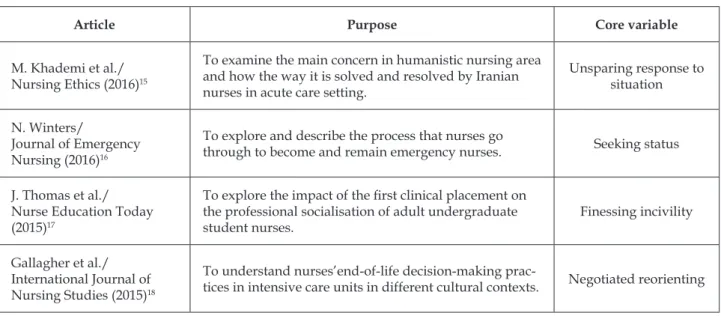
categories. It must reoccur frequently in table 1.
Table 1 - Examples of classic Grounded Theory in nursing research. Florianópolis-SC, Brasil, 2017
Article Purpose Core variable
M. Khademi et al./
Nursing Ethics (2016)15
To examine the main concern in humanistic nursing area and how the way it is solved and resolved by Iranian
nurses in acute care setting.
Unsparing response to situation
N. Winters/
Journal of Emergency
Nursing (2016)16
To explore and describe the process that nurses go
through to become and remain emergency nurses. Seeking status
J. Thomas et al./ Nurse Education Today (2015)17
To explore the impact of the irst clinical placement on
the professional socialisation of adult undergraduate student nurses.
Finessing incivility
Gallagher et al./ International Journal of
Nursing Studies (2015)18
To understand nurses’end-of-life decision-making prac
-tices in intensive care units in different cultural contexts. Negotiated reorienting
Theoretical coding
Within qualitative research a framework is the conceptual underpinnings of a study. This is
no different in GT, where the purpose of the frame
-work is to integrate the theory by conceptualizing how the substantive codes relate to one another
as hypotheses.12 Like everything in GT, this frame
-work itself emerges in what is known as theoretical
coding. This process takes the emerging theory to a higher level of conceptualization, yet keeps the
theory grounded in the data.19
Memoing
Memos are so central to GT that if researchers are not writing them, then they are not doing GT. They are the theorizing write-up of ideas about the substantive codes and how they relate to one
another.2 This is a constant process and should be
done throughout the research. Ideas about naming
concepts, their relationship to one another and the
core are developed in memos. They raise the concep
-tual level and help to keep track of ideas to be sorted later into the theory. Despite the over formulation by
some writers, researchers are free to memo as they wish.10 There is only one rule for memoing: interrupt
whatever is being done to write one, otherwise the idea may be lost and for this reason may be thought
of as “moment capture”.8 Memos are eventually
sorted and the theory is ready to be written.
Integrating the literature
Once the core category begins to emerge, then
the literature is read, since the relevant literature is now known. In deciding what literature to review, students decide where they want their theory to have
the most impact. This is usually within their profes
-sion and this is the literature that is reviewed irst.2,8
Writing the theory
Glaser advises reading other monographs
and papers for their little logic iguring out how
they are constructed. In writing the thesis, he
suggests starting by introducing the nature of the problem and outing the general properties of the core category. This means presenting the core concept in terms of its sub-core categories. In GT, the challenge is to write conceptually. This means
relating concept to concept and not to people.10 The
theory can be quite dense and therefore should be broken up by providing illustrations of the categories. These might be in the form of direct quotes or vignettes. These are for illustrative and not evidentiary purposes. The end product is a
preponder-ance of behaviour of how participants resolve or
process their main concern.
Finally, GT comes with its own criteria for judging rigour. Fit deines how well the concepts
and theory relect what is going on in the sub
-stantive area. This means that categories must be
indicated by the data.2,5 For a theory to work, it
must predict or explain what will or is happening
within the substantive area. Relevance means that
the concepts and theory are relevant to the people
whose behaviour it explains.2,10 Modifiability
means that the theory can change to accommodate new data.10,20
THE ROLE OF SUPERVISORS
Many of the characteristics of a good
super-visor of students using GT have been discussed21
but overall this should take the form of supportive supervision. How this can be done and maintained is discussed next. What supervisors know about GT
is very variable. Presented here are three main su
-pervisory types though there are likely many
varia-tions within each typology: 1) The “know nothing” supervisor; 2) The “I know best” supervisor; and 3) The “methodology expert” supervisor.
There are those who know little or nothing about GT but encourage their students to study it and are humble enough to learn from them. They
can provide very effective supervision. Once they
accept that students know more about the methodol
-ogy than they do and as their understanding of GT
develops, they are likely to give them the autonomy
to do their research according to GT methodology. The second type of supervisor, who usually has been trained in Qualitative Data Analysis (QDA), knows a little bit about GT methodology but may confuse the different versions. They may try to impose
their views on students, forcing them to apply the
methodology their way. This has the effect of alien
-ating students, leading to frustration and conlict. They have the potential to do the most damage by undermining students’ conidence and creating a dependency that is the antithesis of GT.
Supervisors who have been trained in GT are in the optimal position to supervise. They are most likely to be able to guide students and pace the
study of GT.2 Their understanding will ensure that
students produce a multivariate theory, provided of course students follow their advice and can
con-ceptualise. They usually have experience in using or teaching GT, constantly study the methodology
and update their knowledge.
If supervisors are unsure about any aspect of GT, then they are encouraged to refer periodically to an expert in GT as their students may inadvertently
drift into QDA.21 Experts can be found from their
publications on GT from www.groundedtheoryon
-line.com. The most effective supervisors are likely to be those who are open, permissive, facilitative
and promote student autonomy.21
Not knowing what students are researching
can be very dificult for supervisors to tolerate, since
many do not like such uncertainty. If supervisors
are not comfortable tolerating cognitive confusion
in themselves and their students, then they are unlikely to successfully supervise students using
GT. This means not rescuing students from confu
-sion by suggesting codes or telling students what the study is about since this is likely to lead to the
use of preconceived concepts and forcing the data,
diluting the full power of GT. The most effective
strategy is to trust in the methodology to deliver, while supporting students in doing the same.
Supervisors need to be alert to the possibility
of students using preconceptions since this will lead to forcing the data. It is likely that they are
preconceiving the problem or asking preconceived questions if they are not getting any data. Other
indicators of preconception include participants not
answering questions asked or changing the subject to talk about what is really of concern to them. Also,
students not seeing patterns in the data. Encourag-ing students to engage in theoretical samplEncourag-ing and constant comparison are strategies for dealing with
these issues. This also means not using an inter
-view guide or topic list, if inter-viewing is the main method of data collection.
However, supervisors need to be pragmatic as students may not have the conidence to enter the ield without such a guide. As students become more conident, they usually engage fully with
theoretical sampling. Disciplinary interpretations as
to what a methodology is or should be has limited
understanding of GT and has contributed to think
-ing of it as another qualitative method rather than
one that stands alone.22 It is essential therefore that
supervisors are aware of their own disciplinary, methodological and experiential preconceptions
and biases. If they have studied qualitative method
-ologies, then they are likely to have some unlearning
to do, since many of its tenets do not apply to GT.
Supervisors should not preconceive their students.
GT gives students autonomy and ownership10
research question, an interview guide and a theo -retical or conceptual framework.23 The thesis tradi
-tionally begins with an extensive literature review and the issues to be investigated further usually emerge from the literature. This means not forcing students to pursue a problem that ought to exist as suggested by the literature. The main concern or issue facing participants cannot be known in advance and must be facilitated to emerge. This is
why writing a literature review at an early stage is not recommended since it may lead to preconceiving
the problem as well as using preconceived concepts. In this way students can avoid the conceptual grab
of the literature.
It is essential that students try to understand
the action in the substantive area from the perspec
-tive of participants.10 In the spirit of discovery,
openness, and autonomy students need to develop their own concepts. It is imperative that supervi-sors realise that students must do their own coding
without interference. This maintains and supports
their autonomy.
It is essential therefore that supervisors do not tell students how to see the data, tell them what concepts to use or jointly code with them. It is not the role of supervisors to agree with the generated concepts, since they do not have access to the data in
their entirety and therefore are not able to name pat
-terns of behaviour. Rather, it is their role to continu -ally challenge students to raise the conceptual level.
Encourage students to use in vivo codes if
relevant but above all encourage them to look for
patterns in the data. One way to ensure this is to
ask them: what are the indicators of the concept? This will guard against conceptual foppery, where every incident is given a name. This is often because of a misinterpretation of what line by line coding.
The likely consequence of this is that students end up being overwhelmed by hundreds of codes.
One student came to a GT seminar having gener
-ated over 600 codes from three interviews, while
another had 1,000 from just one interview. Both examples are because of misunderstanding line by
line coding or supervisors thinking that they know
how to code the GT way and imposing this on their
students. Students need constant reminding that
the unit of analysis is behaviour and not people.
Encouraging students to continually ask four ques
-tions of the data as outlined above, will aid analysis. As students become more practiced at coding and
constant comparison, supervisors should challenge
them to engage in conceptual reit to ensure more grab, it or relevance.10
In generating the core category and writing,
there are three issues that supervisors need to be
aware of: incident tripping, full conceptual descrip-tion and logical drift.10
Incident tripping happens when students
de-scribe at length the core category or any category,
using incidents, instead of conceptualising the
pat-tern of behaviour. With supervisors’ help, this can be prevented by ensuring that students engage in
constant comparison, as discussed, as well as using
theoretical codes to integrate the theory. This mini -mises description, while ensuring conceptualisation and data saturation.
Full conceptual description is similar but here there is no attempt to distinguish between con
-cepts and their properties. Also, there is no use of theoretical codes to integrate hypotheses. This can be dealt with in a similar way to incident tripping
whilst also encouraging students to write in a way that relates concept to concept rather than merely
describing each one. Logical drift happens when
students assume that an emergent code is the core category and stop theoretically sampling.
They may then logically conjecture other cat
-egories and their properties to weave into the theory,
often without even being aware that this is what they are doing. The end product is often preconceived,
conjectured or ungrounded. Encourage students to
stay open to other possible core categories.
Challenge students as to why they think they
have found the core category by asking them to demonstrate how it integrates the other sub-core
categories. This could be done by means of dia
-grams or by writing a brief summary of the theory.
If it is not central and does not integrate the other
sub-core categories, then it is not core and some other category should be tried. Asking students to talk about the theory in terms of its concepts helps
theoretical integration. Diagramming the theory is very effective at getting them to see how concepts relate to one another.
To integrate the theory, the inal step of GT is
sorting, where the memos are integrated.2 How to do
this is fully discussed elsewhere.2,6,10 It is important
for supervisors to understand that students need to do this themselves without interference, since only they know the concepts and how they relate to one another.10 Supervisors will realise that this step
has been missed if the theory is not integrated, not multivariate, lacking breadth and depth.
Writing the theory is always a challenge for
constantly challenge students to raise the conceptual level of their theory, while ensuring that the theory
is eminently readable. It is imperative to remind stu -dents that the theory is independent of time, place
and people. Thinking of the general implications of
the core category and theory may help students to write conceptually.
THE ROLE OF STUDENTS
Student autonomy and accountability in com
-municating supervisor expectations is important
for adherence to the GT methodology. How this can be done and maintained is discussed in this section. Students should remain accountable and take ownership for producing a GT. They ought to learn early on in research to be risk takers and to work independently, as well as in collaboration with GT experts. There are ive key issues for success
while navigating the supervisor-doctorate student
relationship: 1) A mutual understanding of the purpose of seeking a research degree; 2) Selecting a supervisor who will move the GT process forward; 3) Ensuring that the university accepts the choice of
GT, as an appropriate method; 4) Ongoing evalu
-ation of the committee to maintain focus toward
successful completion; and 5) Publishing the GT
with a co-author.24
It is imperative that in studying GT, students
read original texts, since secondary sources may distort or misrepresent the methodology. Students
must be accountable for the full completion of GT
research and take an active part in facilitating an effective supervisor-student relationship.
There are four recommendations for students to take in establishing and maintaining an effective supervisor-student relationship: 1) Commitment to GT methodology with consideration to institutional
requirements and independently seeking oppor
-tunities to gain knowledge and understanding; 2)
Open communication and trust with supervisors
throughout the educational journey; 3) Conidence to articulate clearly all aspects of GT relevant oth
-ers, and to write throughout the process; and 4)
Commitment to disseminating the theory through
scholarship. Students can reasonably expect a simi
-lar commitment from supervisors.
If supervisors are not supportive of students
using GT or displays an obstructive attitude, then it is advisable to seek a new supervisor. It is advis
-able for supervisors and students to establish a
detailed timeline for reviewing and revising work
to progress the research. At times, students may
need to speak up and be politely assertive in order
to remain true to GT methodology while also meet
-ing institutional requirements.25
The supervisor-student relationship has in
-creased potential for success while working with
GT if both adhere to spirit of the methodology, which requires students to remain accountable and
take ownership. Choosing this methodology can
be intimidating and frustrating at the onset unless
students are resilient, persevere, remain committed, and in discussion with their supervisor, seek out
every opportunity to learn about GT, such as GT
seminars and methodological training. Inclusion
of the four recommendations above is necessary to establish and maintain an effective supervisor-student relationship and to minimize frustrations
and delays in completing the thesis.26
Students are encouraged to adhere to the
methodological stages of GT as discussed. Students are encouraged to maintain theoretical sensitivity by minimizing preconceptions and letting the concepts emerge through careful analysis. When addressing preconceptions, “remember one does not throw out everything they have learned. The researcher just suspends it when using GT methodology, especially
when coding and theoretical coding”.23:14
Students should reasonably expect the type of supervision that will build self-conidence and support autonomy. Open communication between
supervisors and students starts early. Extensive and
meaningful critique and formative feedback is a stu
-dent expectation to advance conceptualisation and theory development, as well as understanding of
GT. At a minimum, this will include being listened
to in a respectful way.
Students should have the support from
su-pervisors to attend a Grounded Theory Institute (GTI) seminar or similar and establish a working relationship with a CGT Fellow, if supervisors do not have expertise in GT. Observer participation in a GTI seminar at the beginning of studies is a worthy foundation for advancing understanding of GT an early stage. It would be beneicial for supervisors and students to attend a seminar together. There
are ive areas for students to consider when choos
-ing GT methodology: 1) Seek expertise; 2) Engage in community; 3) ‘Just do it’; 4) Know self; and 5)
Balance challenge and support.27
GT methodology is usually taught as part of a broader course in qualitative research but academic institutions might consider adding a GT course to doctoral programmes due to the increased number
is not possible, students beneit greatly by having
support and mentorship from a GT expert.22 This
could be as a seminar facilitator or guest lecturer. In
addition, It is highly recommended for students to
ind a mentor to ensure that a GT thesis is success
-ful. The GTI has a list of GT Fellows and provides seminars to support students in their study of GT.
In conclusion, students are encouraged to
embrace the autonomy that GT offers by seeking
out supervisors who will listen, remain open to the
uniqueness of the methodology, and offer support
in a trusting and respectful way to ensure timely completion of the thesis. Students are charged with
maintaining accountability and taking ownership
of the GT thesis through commitment, communi
-cation and conidence to defend it and leave the
academic institution with a longstanding relation-ship with supervisors and the potential for future
research collaboration.
CONCLUSION
As has been emphasised throughout, GT is characterised by its openness to what is going on
in a substantive area and is the antithesis of pre
-conception. It is based on recognising patterns of behaviour and naming them using concepts. As
discussed, it is important to acknowledge that there
are other versions of GT that may legitimately be
used to investigate issues of importance in nursing. For example, if students want to study a particular topic or value the co-construction of data, then
a constructionist GT may be more appropriate. However, students and their supervisors should
realise that in doing so, openness may be compro
-mised since students enter the ield with a deined research question. The most effective supervisors are likely to be open and permissive rather than controlling, stiling or disapproving. Openness to
discovery encourages students to fully realise the
power of GT and theory development. Permis
-siveness in supervisors encourages autonomy and experiential learning in students. In turn, students
need to be open to discovery, and trust in emer
-gence. It is imperative that they learn GT experi
-entially and thoroughly study the methodology. A good and mutually respectful relationship between
students and supervisors will prepare students
to be independent researchers remembering that
a Ph.D. is a process of empowerment to achieve intellectual autonomy and creativity, as well as
developing personal self-conidence.
REFERENCES
1. Evans GL. A novice researcher’s irst walk through the
maze of grounded theory: rationalization for classical grounded theory. Int J Grounded Theory Rev [Internet]. 2013 [cited 2017 Jan 20]; 12(1):37-55. Available from:
http://groundedtheoryreview.com/2013/06/22/a- novice-researchers-first-walk-through-the-maze-
of-grounded-theory-rationalization-for-classical-grounded-theory/
2. Glaser BG. Theoretical sensitivity: advances in the
methodology of grounded theory. Mill Valley (CA): Sociology Press; 1978.
3. Lanzoni GMM, Meirelles BHS, Cummings G. Nurse leadership practices in primary health care: a
grounded theory. Texto Contexto Enferm [Internet]. 2016 [cited 2017 Mar 30]; 25(4):e4190015. Available from: http://www.scielo.br/scielo.php?script=sci_ arttext&pid=S0104-07072016000400305&lng=pt
4. Santos JLG, Erdmann AL, Sousa FGM, Lanzoni GMM,
Melo ALSF, Leite JL. Methodological perspectives
in the use of grounded theory in nursing and health
research. Esc Anna Nery [Internet]. 2016 [cited 2017 Jan 20]; 20(3):e20160056. Available from: http://www. scielo.br/scielo.php?script=sci_arttext&pid=S1414-81452016000300201&lng=en
5. Glaser BG, Strauss A. The discovery of grounded
theory: strategies for qualitative research. London (UK): Aldine Transaction, 1967.
6. Gibson B, Hartman J. Rediscovering grounded theory.
London (UK): Sage Publications Ltd., 2014.
7. Bryant A, Charmaz K. GT in historical perspective.
The sage handbook of grounded theory. London (UK): Sage Publications Ltd., 2010.
8. Glaser BG. Constructivist grounded theory? FQS.
2002; 3(3):1-14.
9. Andrews T. What is social constructionism? Int J
Grounded Theory Rev. 2012; 11(1):39-46.
10. Glaser BG. Doing grounded theory: issues and discussions. Mill Valley (CA): Sociology Press, 1998. 11. Glaser BG. The grounded theory perspective II:
description’s remodelling of grounded theory methodology. Mill Valley (US): Sociology Press, 2003.
12. Glaser BG. The grounded theory perspective III:
theoretical coding. Mill Valley (US): Sociology Press,
2005.
13. Glaser BG, Holton J. Remodeling grounded theory.
FQS. 2004; 5(2):1-22.
14. Kenny M. Fourie R. Contrasting classic, straussian, and constructivist grounded theory: methodological
and philosophical conlicts. Qualitative Report. 2015; 20(8):1270-89.
15. Khademi M, Mohammadi E, Vanaki Z. A grounded theory of humanistic nursing in acute care work
from: http://journals.sagepub.com/doi/ abs/10.1177/0969733016638140
16. Winters N. Seeking status: the process of becoming and remaining an emergency nurse. J Emerg Nurs.
2016; 42(5):412-9.
17. Thomas J, Jinks A, Jack B. Finessing incivility: the professional socialisation experiences of student
nurses’ irst clinical placement, a grounded theory. Nurse Educ Today. 2015; 35(12):e4-9.
18. Gallagher A, Bousso RS, McCarthy J, Kohlen H,
Andrews T, Paganini MC et al. Negotiated reorienting: a grounded theory of nurses’ end-of-life
decision-making in the intensive care unit. Int J Nurs Stud.
2015; 52(4):794-803.
19. Holton J. The coding process and its challenges. Int J
Grounded Theory Rev. 2010; 9(1):21-40.
20. Glaser BG. Basics of grounded theory analysis: Emergence vs forcing. Mill Valley (US): Sociology Press, 1992.
21. Glaser BG. The grounded theory perspective:
conceptualization contrasted with description. Mill Valley (US): Sociology Press, 2011.
22. McCallin A, Nathaniel A, Andrews T. Learning
methodology minus mentorship. In Martin VB, Gynnild A, organizers. Grounded theory: the philosophy, method, and work of Barney Glaser. Boca Raton (US): Brown Walker Press; 2011.
23. Glaser, B. No preconceptions the grounded theory
dictum. Mill Valley (US): Sociology Press, 2013.
24. Guthrie W, Lowe A. Getting through the PHD process
using GT: a supervisor-researcher perspective. In: Martin VB, Gynnild A, organizers. Grounded theory: the philosophy, method, and work of Barney Glaser. Boca Raton (US): Brown Walker Press; 2011.
25. Ahmed S, Haag M. Entering the ield: decisions of an early career researcher adopting classic grounded
theory. Int J Grounded Theory Rev. 2016; 15(2):76-92.
26. Elliott N, Higgins A. Surviving grounded theory research method in an academic world: proposed writing and theoretical frameworks. Int J Grounded
Theory Rev. 2012; 11(2):1-12.
27. Roderick C. Learning classic grounded theory: an account of the journey and advice for new researchers.
Int J Grounded Theory Rev. 2009; 8(2):49-63.
Correspondence: José Luís Guedes dos Santos Universidade Federal de Santa Catarina
Centro de Ciências da Saúde. Departamento de Enfermagem 88040-970 –Trindade, Florianópolis, SC, Brasil
E-mail: [email protected]