Artigo Original
PSYCOMETRIC CHARACTERISTICS OF THE MORAL DISTRESS SCALE
IN BRAZILIAN NURSING PROFESSIONALS
1Edison Luiz Devos Barlem2, Valéria Lerch Lunardi3, Guilherme Lerch Lunardi4, Jamila Geri Tomaschewski-Barlem5, Anderson Sousa de Almeida6 Carolina Domingues Hirsch7
1 Extract from the thesis - Reshaping moral distress in nursing: a foucaultian view, submitted to the Nursing Graduate Program (PPGEnf) of the Universidade Federal do Rio Grande (FURG) 2012.
2 Ph.D. in Nursing. Professor of PPGEnf-FURG. Rio Grande, Rio Grande do Sul, Brazil. E-mail: [email protected] 3 Ph.D. in Nursing. Professor of PPGEnf-FURG. Rio Grande, Rio Grande do Sul, Brazil. E-mail: [email protected] 4 Ph.D. in Administration. Professor of PPGEnf-FURG. Rio Grande, Rio Grande do Sul, Brazil. E-mail: [email protected] 5 Ph.D. Student at PPGEnf-FURG. Scholarship from the Research Support Foundation of the State of Rio Grande do Sul
(FAPERGS). Rio Grande, Rio Grande do Sul, Brazil. E-mail: [email protected]
6 Nursing Undergraduate Student at FURG. Rio Grande, Rio Grande do Sul, Brazil. E-mail: [email protected] 7 Master’s Student at PPGEnf-FURG. Rio Grande, Rio Grande do Sul, Brazil. E-mail: [email protected]
ABSTRACT: The Moral Distress Scale was designed to assess the severity and frequency of the moral distress experienced by nursing professionals in everyday situations. The objective of this study was to analyze the psychometric characteristics of the Moral Distress Scale adapted to Brazilian nursing. Through factor analysis, ive constructs were identiied: lack of competence in the work team; disregard for patient autonomy, inadequate working conditions, denial of the nursing role as an advocate in terminal patients; denial of the nursing role as an advocate of the patient. The proposed pentafactorial solution is statistically and semantically more appropriate to the Brazilian nursing scenario. Based on these results, the scale is considered to be valid and reliable, showing the necessary requirements regarding convergent and discriminating validity as well as internal consistency to be used while evaluating the intensity and frequency of moral distress in Brazilian nursing professionals.
DESCRIPTORS: Validation studies. Burnout, professional. Ethics. Nursing.
CARACTERÍSTICAS PSICOMÉTRICAS DA
MORAL DISTRESS SCALE
EM
PROFISSIONAIS DE ENFERMAGEM BRASILEIROS
RESUMO: A Escala de Sofrimento Moral foi projetada para avaliar intensidade e frequência de sofrimento moral vivenciado por proissionais de enfermagem a partir de situações cotidianas. Objetivou-se analisar as características psicométricas da Escala de Sofrimento Moral adaptadas para a enfermagem brasileira. A análise estatística permitiu identiicar cinco constructos: falta de competência na equipe de trabalho, desrespeito à autonomia do paciente, condições de trabalho insuicientes, negação do papel da enfermagem como advogada do paciente na terminalidade e negação do papel da enfermagem como advogada do paciente.A solução pentafatorial proposta demonstra maior adequação estatística e semântica ao contexto de enfermagem brasileiro. Com base nos resultados encontrados, considera-se que a escala é válida e idedigna, demonstrando os requisitos necessários quanto às validades convergente e discriminante, bem como de consistência interna para ser utilizada na avaliação da intensidade e frequência do sofrimento moral em proissionais de enfermagem brasileiros.
DESCRITORES: Estudos de validação. Esgotamento proissional. Ética. Enfermagem.
CARACTERÍSTICAS PSICOMÉTRICAS DE LA
MORAL DISTRESS SCALE
EN PROFESIONALES DE ENFERMERÍA EN BRASIL
RESUMEN: La escala del sufrimiento moral fue proyectada para evaluar la intensidad y frecuencia del sufrimiento moral vividos por los profesionales de enfermería a partir de situaciones cotidianas. Se objetivó analizar las características psicométricas de la escala adaptadas para la enfermería brasileña. A través del análisis factorial, se identiicaron cinco construcciones: falta de competencia en el equipo de trabajo; desprecio por la autonomía del paciente; condiciones de trabajo inadecuadas; negación del papel del enfermero como abogado del paciente en fase terminal; y negación del papel de la enfermería como abogados del paciente. La solución con cinco factores propuesta demostró mayor adecuación estadística y semántica al contexto de enfermería brasileña. Con base en los resultados encontrados, se considera que la escala es válida y iable, ya que muestra los requisitos necesarios cuanto a la validez convergente y discriminante, bien como a la consistencia interna para ser utilizada en la evaluación de la intensidad y frecuencia del sufrimiento moral en profesionales de enfermería brasileña.
INTRODUCTION
In the professional context of nursing, Moral Distress (MD) was irst described in the 1980s, and it can be expressed as the suffering re-sulting from the inconsistency between workers’ actions and their personal convictions.1 Hence,
MD can be deined as the feeling arising from the inconsistency between people’s actions and their beliefs. The person knows what is right, but it is almost impossible to take this action, which may, in this situation, contribute to errors of judgment, personal failures, character weak-nesses or even circumstances beyond personal control.2-3
Aiming to identify MD in nursing profes-sionals, most studies conducted on the subject, up to the present day, researched it using a qualitative approach, interviewing professionals, individually or in small groups.4 Feelings of anger and sadness
were most cited in literature as bio-psychosocial effects caused by MD, with introspection being the major characteristic of nursing workers who receive little or no support for coping with their conlicts.5
These feelings, which result in MD, can lead to emotional responses in the individual, such as dissatisfaction with the work, reluctance to go to work or even abandonment of the profession.6-7
Faced with the situation of living with MD, the nurses report that this experience does not com-promise the care they provide, however, what is perceived is a remoteness from situations in which the patient needs support and protection, with weaknesses in the care provided.5
MD can lead nurses to trivialize everyday sit-uations, negating possible damages to the patient and, consequently, these workers may abandon their principles based on fear, for convenience or self-preservation.8 Nevertheless, each individual
may perceive situations that arise in their lives differently, being singular, complex and different from others.
Unlike qualitative approaches, an instru-ment called Moral Distress Scale (MDS)9 has been
applied in quantitative studies in different reali-ties.8,10-15 Its questions are focused on dilemmas,
ethical problems, unnecessary treatment, unsafe working conditions, among others, allowing to identify the experience of many behaviors related to MD in different cultures.
HISTORY AND DEVELOPMENT OF THE
MORAL DISTRESS SCALE
The most broadly used instrument for measuring MD in nursing is the MDS, being irst presented in 1995, when it was applied to 111 nurses who worked in the ICU16 and later in 2001,
applied to 214 nurses from different units, active in North American hospitals.9 Its construction
was based on three fundamental assumptions: that nurses apply their personal values to their work environments; that nursing professionals can identify the existence of ethical issues in their everyday professional life; and that professional nurses can assess the extent of MD experienced in their everyday lives.9
Initially, the instrument had 32 questions, operationalized by using a seven-point likert scale, ranging from 1 (for never occurs) to 7 (for very intense distress), without discriminating, hitherto, frequency and intensity. It encompassed issues that focused on prolonging life, performing unnecessary tests and treatment, incompetent professional actions by the medical staff and situ-ations of omission against patients.16
As this instrument had no questions re-garding pain management, administration of the nursing care and incompetence of nursing professionals, a review of the MDS was proposed, operationalized with 38 questions in two scales, the irst for the intensity of distress and the second for the frequency of MD occurrence, both ranging from 0 (for never occurs or no frequency) to 6 (for very intense distress or very frequent).
In Brazil, the irst adaptation and validation of the MDS occurred in 2009,14 when it was
con-cluded that the instrument did not seem to have sufficiently explored MD related to problems experienced by the nursing staff in their work en-vironment, in the Brazilian reality, many of them related to organizational issues that have been identiied in other studies, such as insuficient professional staff, poor resource materials,17-19 and
lack of professional autonomy.20
METHOD
This is a quantitative, exploratory, descriptive study, using a cross-sectional design. The non-probabilistic convenience sample consisted of 247 nursing professionals, with 47 nurses, 169 nursing technicians and 31 nursing assistants, working in two different hospitals, one philanthropic and the other public. Most of the subjects were women (85.8%) and worked in the philanthropic hospital (72.9%). The mean age of the subjects was 33.5 years old (±9.16); the mean time working in the profession and the mean time working in the unit in which they worked, at the time of data collection, were 5.8 years and 4.0 years (±6.1 and ±4.7), respectively.
Of the 47 nurses, 13 had only an under -graduate degree; 23 had completed specialization courses; and 11 had a master’s degree. Regarding the 200 nursing technicians and nursing assistants, 141 had completed only a medium-level course; 18 had completed an undergraduate course; 27 had completed post-technical courses; 13 had completed short courses; and one professional had completed a graduate course.
This study employed the MDS,9 an
instru-ment that had already been replicated in other settings in several international studies,8,10-13 and
also in Brazil.14 Nevertheless, as the instrument
applied in Brazil was insuficient to analyze dif -ferent problems experienced by the nursing staff related to MD in their work environment, a new questionnaire with 39 questions was proposed, 21 from the original MDS, already adapted to the Portuguese language,14 and 18 coming from
knowledge produced by other national studies.17,19
The questionnaire was applied in two ver-sions; one for nurses and the other for nursing technicians and nursing assistants, differing only in the initial items related to characterization. At the end of the instruments, a question was inserted seeking to identify if, in general, situations expe-rienced at work caused MD, measured equally in seven-point Likert scales.
Before its implementation, a pilot study with 30 nursing professionals, with similar characteris-tics to the study population, was conducted com-prehensively seeking to validate the contents of the proposed questions and the questionnaire. The instrument was easy to understand and complete, with no need to adapt the language and an aver-age time of 20 minutes being used to complete it.
The insertion in the ields for collection oc -curred gradually, with a irst moment of identii
-cation and recognition of the physical area in the institutions, after the delivery and collection of the instruments took place. Visiting the units was adopted as the procedure for delivery, initially car-rying out the personal presentation of the collec-tors previously trained by the nursing staff, briely describing the research objectives, reading the irst page of the instrument and explaining how to complete it. The instrument was self-administered and it was delivered directly to respondents in a brown envelope with no identiication. During the delivery, the ethical procedures were explained.
After the distribution of the questionnaires, the collection schedule was proceeded to. At this stage, a maximum of ive attempts at different locations was deined, for the search of previously delivered instruments. The research was approved by the Ethics Committee of the researchers’ insti -tutional afiliations, with all ethical procedures being carried out (Report n. 70/2010).
The data were subjected to three different analyses: 1) exploratory factor analysis, seeking the reduction and summarization of data; 2) de-scriptive analysis, aiming at obtaining the mean and standard deviation between the respondent groups; and 3) variance analysis, in order to obtain correlation values for the constructs. SPSS statisti-cal software version 13.0 (Statististatisti-cal Package for Social Sciences) was used at the data analysis stage.
A total of 350 questionnaires were deliv-ered to the nursing staff at these institutions, 90 for nurses, 210 for nursing technicians and 60 for nursing assistants, with 291 being returned, repre-senting an 83.14% return rate. 44 instruments were excluded, with seven from nurses, 27 from nursing technicians and ten from nursing assistants, either by being inaccurate in the marking of questions, dichotomous scale (zero to six) or being blank, with the inal sample consisting of 247 question -naires, with 47 nurses, 169 nursing technicians and 31 nursing assistants.
RESULTS
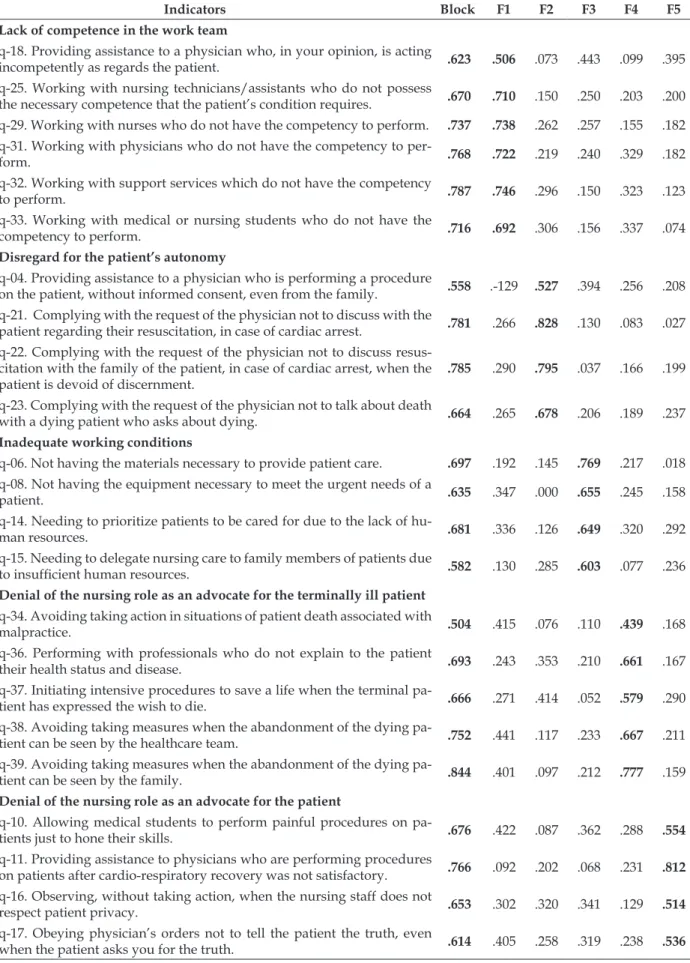
Initially, 39 questions were submitted to exploratory factor analysis (between blocks) seeking to verify the discriminant validity of the instrument. This was deined as the method for extracting the analysis of the main components, applying the Varimax orthogonal rotation to bet-ter discriminate the relevance of the variables to the identiied components. The formation of the factors followed two criteria: the degree of associa-tion between variables, found through the factor loads; and their degree of subjectivity.
The irst group suggested the formation of seven constructs, making it dificult to categorize, according to the proposed theoretical framework. Thus, there was the process of gradual exclusion of each of the issues that had low correlations in their blocks, or which did not adhere conceptu-ally to the constructs formed, so as to facilitate the grouping of questions.
As questions were being eliminated and constructs became clearer, pentafactorial training was deined as the extraction solution, using the division of the components from the ifth construct with an eigenvalue equal to 0.840 (eigenvalue ≥ 0840) and considering factorial loadings greater than 0.400 as the cut-off point. Conceptually, the main criterion to deine the number of constructs to be extracted is to consider only those with eigenvalues greater than 1, since each variable contributes to a value of 1 of the total eigenvalue.
Thus, any single factor variance should explain at least one variable, if it was kept for interpretation. Nevertheless, in practice, most researchers rarely use a single criterion to deter-mine how many factors should be extracted; the selection of the number of constructs should also consider the conceptual structure of the research and its interpretation.21 At the end of this analysis,
15 questions were excluded for having low cor-relations with other items in their group, and one question (q-35) was excluded for not presenting conceptual adherence in its block.
Subsequently, an exploratory factor analysis (in blocks) was performed in order to observe the one-dimensionality of the constructs. Few researchers have made use of this type of analysis in blocks, which is unfortunate, since the result is quite informative. It was possible to identify the items of each construct, analyzed together and converged to a single factor, suggesting that they are all one-dimensional.
A inal assessment of the reliability of the instrument was performed using Cronbach’s al -pha, not suggesting the elimination of other items in the questionnaire. The reliability coeficient of the instrument showed a value of 0.95, whereas the coeficients of the factors were between 0.79 and 0.91, values considered high for exploratory studies, thus demonstrating the reliability of the MDS in the selected sample. In its inal version, the instrument presented ive constructs, consist -ing of 23 items.
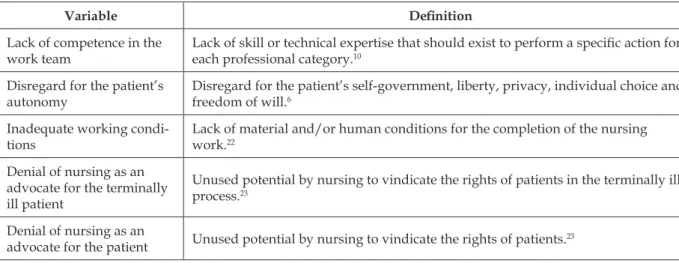
Table 1 - Deinitions of variables used in the data analysis. Rio Grande-RS, 2012
Variable Deinition
Lack of competence in the work team
Lack of skill or technical expertise that should exist to perform a speciic action for
each professional category.10
Disregard for the patient’s autonomy
Disregard for the patient’s self-government, liberty, privacy, individual choice and freedom of will.6
Inadequate working condi-tions
Lack of material and/or human conditions for the completion of the nursing work.22
Denial of nursing as an advocate for the terminally ill patient
Unused potential by nursing to vindicate the rights of patients in the terminally ill process.23
Denial of nursing as an
Table 2 - Exploratory factor analysis (Varimax rotation). Rio Grande-RS, 2012
Indicators Block F1 F2 F3 F4 F5
Lack of competence in the work team
q-18. Providing assistance to a physician who, in your opinion, is acting
incompetently as regards the patient. .623 .506 .073 .443 .099 .395 q-25. Working with nursing technicians/assistants who do not possess
the necessary competence that the patient’s condition requires. .670 .710 .150 .250 .203 .200 q-29. Working with nurses who do not have the competency to perform. .737 .738 .262 .257 .155 .182 q-31. Working with physicians who do not have the competency to
per-form. .768 .722 .219 .240 .329 .182
q-32. Working with support services which do not have the competency
to perform. .787 .746 .296 .150 .323 .123 q-33. Working with medical or nursing students who do not have the
competency to perform. .716 .692 .306 .156 .337 .074
Disregard for the patient’s autonomy
q-04. Providing assistance to a physician who is performing a procedure
on the patient, without informed consent, even from the family. .558 .-129 .527 .394 .256 .208
q-21. Complying with the request of the physician not to discuss with the
patient regarding their resuscitation, in case of cardiac arrest. .781 .266 .828 .130 .083 .027
q-22. Complying with the request of the physician not to discuss resus -citation with the family of the patient, in case of cardiac arrest, when the patient is devoid of discernment.
.785 .290 .795 .037 .166 .199
q-23. Complying with the request of the physician not to talk about death
with a dying patient who asks about dying. .664 .265 .678 .206 .189 .237
Inadequate working conditions
q-06. Not having the materials necessary to provide patient care. .697 .192 .145 .769 .217 .018 q-08. Not having the equipment necessary to meet the urgent needs of a
patient. .635 .347 .000 .655 .245 .158 q-14. Needing to prioritize patients to be cared for due to the lack of
hu-man resources. .681 .336 .126 .649 .320 .292 q-15. Needing to delegate nursing care to family members of patients due
to insuficient human resources. .582 .130 .285 .603 .077 .236
Denial of the nursing role as an advocate for the terminally ill patient
q-34. Avoiding taking action in situations of patient death associated with
malpractice. .504 .415 .076 .110 .439 .168 q-36. Performing with professionals who do not explain to the patient
their health status and disease. .693 .243 .353 .210 .661 .167 q-37. Initiating intensive procedures to save a life when the terminal
pa-tient has expressed the wish to die. .666 .271 .414 .052 .579 .290 q-38. Avoiding taking measures when the abandonment of the dying
pa-tient can be seen by the healthcare team. .752 .441 .117 .233 .667 .211 q-39. Avoiding taking measures when the abandonment of the dying
pa-tient can be seen by the family. .844 .401 .097 .212 .777 .159
Denial of the nursing role as an advocate for the patient
q-10. Allowing medical students to perform painful procedures on
pa-tients just to hone their skills. .676 .422 .087 .362 .288 .554 q-11. Providing assistance to physicians who are performing procedures
on patients after cardio-respiratory recovery was not satisfactory. .766 .092 .202 .068 .231 .812
q-16. Observing, without taking action, when the nursing staff does not
respect patient privacy. .653 .302 .320 .341 .129 .514
q-17. Obeying physician’s orders not to tell the patient the truth, even
Initial Eigenvalue 11.08 1.56 1.40 .958 .840 % variance explained - rotated (68.99%) 48.20 6.80 6.10 4.16 3.65
Cronbach’s alpha (0.95 instrument) .91 .79 .79 .88 .82
KMO measure of sampling adequacy (KMO = 0.941) Bartlet test: chi-square = 3305.983
Correlation matrix determinant(1.63)
After the validation stage of the instrument, descriptive analyses were carried out in order to
evaluate the intensity and frequency (Fq) of MD experienced by the nursing professionals studied.
Table 3 - Mean, standard deviation and correlation values for the constructs. Rio Grande-RS, 2012
M SD Fq SD A B C D E
A 4.36 1.26 2.57 1.19 - .576* .661* .779* .718* B 3.77 1.26 1.98 1.26 .576* - .514* .578* .598*
C 4.09 1.24 2.54 1.30 .661* .514* - .589* .653* D 4.14 1.30 2.26 1.25 .779* .578* .589* - .665* E 4.19 1.23 2.37 1.33 .718* .598* .653* .665*
-MD 4.11 1.25 2.34 1.31 - - - -
-* Correlation signiicant at the 0.01 level.
A) Lack of competence in the work team; B) Disregard for patient autonomy; C) Inadequate working conditions; D) Denial of the nursing role as a advocate for the terminally ill patient; E) Denial of the nursing role as a patient advocate; MD) Moral distress.
The “lack of competence in the work team” dimension had the highest perceived mean of MD (4.36), and frequency (2.57) experienced by the nursing professionals surveyed. Whereas
“denial of the nursing role as a patient advocate” (4.19; Fq=2.37) and also in the “terminally ill” (4.14; Fq=2.26), followed by “inadequate
work-ing conditions” (4.09; Fq=2.54) appear in the intermediate group. In turn, the “disregard for patient autonomy” (3.77; Fq=1.98) appeared as the dimension with less intensity and frequency of MD experienced by the study participants.
By observing Pearson’s correlation coef-icients, the relation between the “lack of com-petence in the work team” and “denial of the nursing role as an advocate in the terminally ill patient” (r=0.779, p<0.001) appears as the most signiicant, followed by the correlation between
“lack of competence in the work team” and
“denial of the nursing role as a patient
advo-cate” (r=0.718, p<0.001). The lower correlations, although quite high, were between “disregard for patient autonomy” and “insuficient work -ing conditions” (r=0.514, p<0.001), followed by the correlation between “disregard for patient autonomy” and “lack of competence in the work team” (r=0.576, p<0.001). It is noteworthy that all
correlations tested had positive and statistically signiicant associations, at the level of 1%, dem -onstrating that the proposals to evaluate the MD in the Brazilian context dimensions are strongly correlated.
DISCUSSION
As evidenced in the results presented, the distribution of the MDS, in the version applied in this study, is justiied by the greater range of ev -eryday situations that may possibly trigger moral distress among the nursing staff of two hospitals, with ive constructs that, in relation to the concep -tual framework and deinition, are distinct from the results obtained in previous studies,9, 14 with
tri-factorial and tetra-factorial solutions.
Taking into account the theoretical foun-dation of MD1 and the assumptions used in the
development and expansion of the original MDS,9, 16 the instrument validated in this study showed
Table 4 - MDS questions adapted to the Brazilian context. Rio Grande-RS, 2012
Validated Original - DS Included
q-01. Performing improvisations to face the lack of material in the care of patients.
q-02. Following the family’s wishes in order to maintain the patient’s life, although it is not the best for
him/her.
q-03. Avoiding taking measures to ind leftover medicines in the patient’s box.
q-04. Providing assistance to a physician who is performing a procedure on the patient, without informed
consent, even from the family.
q-05. Initiating intensive procedures to save a life, when you believe that they only delay death. q-06. Not having the materials necessary to provide patient care.
q-07. Ignoring situations where the patient was not given the appropriate information to ensure their
in-formed consent.
q-08. Not having the equipment necessary to meet the urgent needs of a patient.
q-09. Avoiding taking measures to discover that a member of the nursing team applies the wrong
medica-tion and fails to report it.
q-10. Allowing medical students to perform painful procedures on patients just to hone their skills.
q-11. Providing assistance to physicians who are performing procedures on patients after
cardio-respira-tory recovery was not satisfaccardio-respira-tory. q-12. Performing medical prescriptions to conduct unnecessary tests and treatments in terminally ill
pa-tients.
q-13. Working with the nursing staff at a level considered to be “unsafe”. q-14. Needing to prioritize patients to be cared for due to the lack of human resources. q-15. Needing to delegate nursing care to family members of patients due to insuficient human resources. q-16. Observing, without taking action, when the nursing staff does not respect patient privacy.
q-17. Obeying physician’s orders not to tell the patient the truth, even when the patient asks you for the
truth.
q-18. Providing assistance to a physician who, in your opinion, is acting incompetently as regards the
patient.
q-19. Demanding better working conditions for the care of patients.
q-20. Performing with professionals who do not respect patients’ demonstrations on the nursing care.
q-21. Complying with the request of the physician not to discuss with patients regarding their resuscita
-tion, in case of cardiac arrest.
q-22. Complying with the request of the physician not to discuss resuscitation with the family of the pa
-tient, in case of cardiac arrest, when the patient is devoid of discernment.
q-23. Complying with the request of the physician not to talk about death with a dying patient who asks
about dying.
q-24. Working with nurses who do not possess the necessary competence that the patient’s condition
re-quires.
q-25. Working with nursing technicians/assistants who do not possess the necessary competence that the
patient’s condition requires.
q-26. Working with medical or nursing students who do not possess the necessary competence that the
patient’s condition requires.
q-27. Working with physicians who do not possess the necessary competence that the patient’s condition
requires.
q-28. Working with support services which do not possess the necessary competence that the patient’s
condition requires.
q-29. Working with nurses who do not have the competency to perform.
Validated Original - DS Included q-33. Working with medical or nursing students who do not have the competency to perform. q-34. Avoiding taking action in situations of patient death associated with malpractice.
q-35. Being required to care for patients, and not feeling prepared to take care of them. q-36. Performing with professionals who do not explain to the patient their health status and disease. q-37. Initiating intensive procedures to save a life when the terminal patient has expressed the wish to die.
q-38. Avoiding taking measures when the abandonment of the dying patient can be seen by the healthcare
team.
q-39. Avoiding taking measures when the abandonment of the dying patient can be seen by the family.
In comparison to international studies evalu-ating MD, the instrument used in this study had higher means for the application of the MDS used in the English language.9 In a study with
Ameri-can nurses, it appears that the mean intensity of MD was 3.64 (ranging from 2.61 to 4.79) and a frequency equal to 1.45 (ranging from 0.08 to 3.54), whereas in the present study, the mean intensity of MD was higher, equal to 4.11 (ranging from 3.77 to 4.36) and a frequency of 2.34 (ranging from 1.98 to 2.57). When compared to the irst version validated in Brazil in 2009,14 differences with the
present study (although small) are also observed, with a mean intensity of MD equal to 4.0 (ranging from 3.55 to 4.55) and a frequency of 1.95 (ranging from 1.42 to 2.42) being obtained from the irst Brazilian version of the MDS.
Regarding the use of factor analysis and training of constructs in its initial implementation, during the development of the MDS,9 30 questions,
divided into three constructs were validated and denominated thus: “Individual responsibility”, with 20 items (mean intensity of distress = 4.98 and Cronbach’s alpha equal to 0.98); “not in the best interest of the patient”, with seven items (mean intensity of distress = 4.93 and Cronbach’s alpha of 0.82) and “disappointment” with three items
(mean intensity of distress = 4.34 and Cronbach’s alpha equal to 0.84). The total variance explained by this instrument was 19.38%.16
In the first Brazilian implementation in 2009,14 conducted only with nurses, 21 questions
were validated, divided into four factors and de-nominated thus: “Lack of competence in the work team”, with six items (mean intensity of distress
4.55; frequency 2.42 and Cronbach’s alpha 0.89), followed by “denying the role of the nurse as a patient advocate”, with 8 items (mean intensity
of distress 4.30; frequency 1.71; and Cronbach’s alpha 0.91), “therapeutic obstinacy” with 3 items (mean intensity of distress 3.60; frequency 2.26; and Cronbach’s alpha 0.68) and “disregard for
patient autonomy”, with 4 items (mean intensity
of distress 3.57; frequency 1.42; and Cronbach’s alpha 0.82). The total variance explained by this instrument was 66.71%, quite similar to the present study, which showed a total variance of 68.99%.
Important differences can still be highlighted when comparing different studies performed using the MDS in other countries.24 -26 In Japan,
a version of the MDS for nurses working in the mental health ield has demonstrated the existence of MD attributed to three factors denominated by the authors of: “Unethical conduct of caregivers”;
“insuficient professional staff ”; and “acquiescence in the violation of patients’ rights”. In this MDS application, comprising 24 original MDS questions plus 19 questions prepared by Japanese authors, MD was considered too low by their authors, and not comparable with other studies that used the MDS, however, the “insuficient professional staff”
factor proved to be the most potentially related to MD in Japanese nursing.25
In a study with Iranian nurses, it could be detected that a hierarchical environment, so as to favor the medical staff, following a traditional model of work organization, can inluence the experience of MD more negatively. In this study, the concepts of hierarchy, order, power imbalance and following the physician’s orders showed that the physician can inluence MD negatively.13
The differences between the studies show singularities in the application of the MDS in dif-ferent environments, highlighting its use in profes-sional environments of American,9,16 Japanese,2,25
study. It is possible to perceive that the environ-ments and the way the work is organized can relect on the experience of different situations of MD.26 Thus, subjects in different environments
and societies can experience MD uniquely, with special attention being needed to better evaluate the experience.
FINAL CONSIDERATIONS
The results obtained showed that the scale proposed for the Brazilian context is valid and ap-plicable to all professionals in the nursing team. This study allowed for the identiication of ive di -mensions, which explain more broadly MD in the Brazilian context: lack of competence in the work team; disregard for patient autonomy, inadequate working conditions, denial of the role of nurses as an advocate for the terminally ill patient, and denial of the nursing role as a patient advocate. Lack of competence in the work team appeared as the factor of greater intensity and frequency of MD experienced by study participants, whereas disregard for patient autonomy appeared as the one with lower intensity and frequency.
When compared to other studies, the MD identiied among Brazilian nursing professionals appeared as higher both in intensity and frequen-cy. Recurrent situations of the inadequate technical competence of the team of health workers and the lack of material and human conditions necessary for the safe performance of nursing work both for patients and for the workers, as well as recognition of the condition of patients as subjects entitled to exercise their autonomy and consent of nursing as to not deny the rights of patients are factors that cause MD, with them being possibly more intense in the Brazilian context than in other contexts.
As the main limitation of the study, the sample selected for this study belong to the same cultural and social context of two hospitals in a city in southern Brazil, differing only in relation to the legal character of the institutions to which they belonged, with one being a public hospital and the other philanthropic. Although the analyzed sample is representative in statistical terms, the interpreta-tion of descriptive results should not be generalized to other contexts than the institutions studied. This weakness is relative to descriptive analysis and not to the validation process of the instrument.
Finally, the need for further studies apply-ing the adapted instrument in this research in other places in Brazil can be highlighted, checking
whether, or not, signiicant differences that affect the understanding of the intensity and frequency of MD exist.
REFERENCES
1. Jameton A. Nursing practice: the ethical issues. New Jersey (US): Taylor Print Hall; 1984.
2. Hardingham LB. Integrity and moral residue: nurses as participants in a moral community. Nurs Philos. 2004 Jan; 5(1):127-34.
3. Kopala B, Burkhart L. Ethical dilemma and moral distress: proposed new NANDA diagnoses. Int J
Nurs Terminol Classif. 2005 Jan-Mar; 16(1):3-13.
4. McCarthy J, Deady R. Moral distress reconsidered.
Nurs Ethics. 2008 Mar; 15(2):254-62.
5. Gutierrez KM. Critical care nurses’ perceptions of
and responses to moral distress. Dimens Crit Care Nurs. 2005 Set-Out; 24(5):229-41.
6. Corley MC. Nurse moral distress: a proposed
theory and research agenda. Nurs Ethics. 2002 Nov; 9(6):636-50.
7. Elpern EH, Covert B, Kleinpell R. Moral distress of
staff nurses in a medical intensive care unit. Am J
Crit Care. 2005 Nov; 14(6):523-30.
8. Hamric AB, Blackhall LJ. Nurse-physician perspectives on the care of dying patients in intensive care units: collaboration, moral distress,
and ethical climate. Crit Care Med. 2007 Fev;
35(2):422-9.
9. Corley MC, Elswick RK, Gorman M, Clor T.
Development and evaluation of moral distress scale. J Adv Nurs. 2001 Jan; 33(2):250-6.
10. Corley MC, Ptlene M, Elswick RK, Jacob M. Nurse
moral distress and ethical work environment. Nurs Ethics. 2005 Jul; 12(4):381-90.
11. Mobley MJ, Mohamed YR, Verheijde JL, Patel B, Larson JS. The relationship between moral distress and perception of futile care in the critical care unit.
Intens Crit Care Nurs. 2007 Out; 23(1):256-63.
12. Zuzelo RP. Exploring the moral distress of registered nurses. Nurs Ethics. 2007 Mai; 14(3):343-59.
13. Khoiee EM, Vaziri MH, Alizadegan S, Motevallian
AS, Kashani OMR, Goushegir SA, et al. Developing
the Moral Distress Scale in the population of Iranian nurses. Iran J Psychiatry.2008; 3(1):55-8.
14. Barlem ELD, Lunardi VL, Lunardi GL, Dalmolin GL, Tomaschewski JG. Vivência do sofrimento moral
na enfermagem: percepção da enfermeira. Rev Esc
Enferm USP. 2012 Jun; 46(3):681-8.
15. Sporrong SK, Höglund AT, Arnetz B. Measuring moral distress in pharmacy and clinical practice. Nurs Ethics. 2006 Jul;13(4):416-27.
16. Corley MC. Moral distress of critical care nurses.
17. Barlem ELD, Lunardi VL, Tomaschewski-Barlem JG, Lunardi GL, Lunardi Filho WD, Schwonke
CRGB. Moral distress: challenges for an autonomous
nursing professional practice. Rev Esc Enferm USP. 2013 Abr; 47(2):506-10.
18. B a r l e m E L D , L u n a r d i V L , L u n a r d i G L , Tomaschewski-Barlem JG, Silveira RS. Sofrimento
moral no cotidiano da enfermagem: traços ocultos
de poder e resistência. Rev Latino-Am Enferm. 2013 Jan; 21(1):293-99.
19. Barlem ELD, Lunardi VL, Fialho AR, Silveira RS.
Percepções, sentimentos e diiculdades da equipe
de enfermagem no cuidado a pacientes terminais idosos. Enferm Bras. 2006; 5(1):289-98.
20. Barlem ELD, Lunardi VL, Lunardi GL, Tomaschewski-Barlem JG, Silveira RS, Dalmolin GL. Sofrimento moral em trabalhadores de enfermagem. Rev Latino-Am Enferm. 2013 Jan-Fev; 21(spec):79-87.
21. Hair JF, Black WC, Babin BJ, Anderson RE, Tatham
RL. Análise multivariada de dados. Porto Alegre (RS): Bookman; 2009.
22. Lunardi Filho WD. O mito da subalternidade do trabalho da enfermagem à medicina. Pelotas (RS):
Editora e Gráica Universitária UFPel; 2004.
23. Dejours C, Abdoucheli E, Jayet C. Psicodinâmica do
trabalho. São Paulo (SP): Atlas; 2011.
24. Grace PJ. Professional advocacy: widening the scope of accountability. Nurs Philos. 2001 Jul; 2(2):151-62.
25. Ohnishi K, Ohgushi Y, Nakano M, Fuji H, Tanaka
H, Kitaoka K, et al. Moral distress experienced by psychiatric nurses in Japan. Nurs Ethics. 2010 Nov; 17(6):726-40.
26. Range LM, Rotherham AL. Moral distress among nursing and non-nursing students. Nurs Ethics. 2010 Mar; 17(2):225-32.
Correspondence: Edison Luiz Devos Barlem Rua Doutor Nascimento, 367, ap. 701 96200-300 – Centro, Rio Grande, RS, Brasil E-mail: [email protected]