Caren RuottiI
Taís Viudes de FreitasI Juliana Feliciano de AlmeidaI Maria Fernanda Tourinho PeresI,II
I Núcleo de Estudos da Violência. Universidade de São Paulo. São Paulo, SP, Brasil
II Programa de Pós-graduação Mestrado Profi ssional Adolescente em Confl ito com a Lei. Universidade Bandeirante de São Paulo. São Paulo, SP, Brasil
Correspondence: Caren Ruotti
Av. Prof. Lúcio Martins Rodrigues Travessa 4, bloco 2 – Butantã 05508-900 São Paulo, SP, Brasil E-mail: [email protected] Received: 08/25/2008 Revised: 11/13/2008 Approved: 11/21/2008
Gross violation of human rights
and inequality in São Paulo,
Brazil
ABSTRACT
OBJECTIVE: To analyze the profi le of gross human rights violations, and the relationship between these violations and socioeconomic and demographic indicators.
METHODS: Cross-sectional ecological study of 96 census districts of the city of São Paulo (Southeastern Brazil) in the year 2000. The data used came from the gross human rights violations database maintained by the Núcleo de Estudos de Violência (Center for the Study of Violence) at the Universidade de São Paulo. This database contains information on all the cases of summary executions, lynching and police violence reported on the written press. Socioeconomic and demographic data were obtained from the 2000 Census carried out by the Instituto Brasileiro de Geografi a e Estatística (Brazilian Institute of Geography and Statistics). A descriptive analysis of the data was carried out, and the association between the dependent variable – gross human rights violations (number of police violence victims, lynching episodes and summary executions) –, and different socioeconomic and demographic variables was tested. In order to test this association the Spearman’s correlation test was used.
RESULTS: The correlations between gross human rights violations and the socioeconomic and demographic indicators were statistically signifi cant, except for the urbanization rate and the hospital beds per 1000 inhabitants. The strongest correlations were found between the dependent variable and the following variables: size of the resident population (r=0,693), proportion of youths aged from 15 to 24 years (r=0,621), and proportion of household heads with no education or with up to 3 years of schooling (r=0,590).
CONCLUSIONS: Gross human rights violations more markedly occur in the population with the worst living conditions. Therefore, in a scenario in which inequality in attaining social and economic rights is directly superposed to the violation of civil rights, the violence cycle is intensifi ed and perpetuated.
DESCRIPTORS: Human Rights. Human Rights Abuses. Violence. Socioeconomic Factors. Social Inequity. Ecological Studies.
INTRODUCTION
Fatal violence is one of the most serious problems affecting the daily life of the population. In addition to causing the victimization of the population it is responsible for a feeling of unsafeness and fear.3,9 In line with this, the high
mortality rates due to homicide, seen mainly in the more urbanized locations of Brazil,5,11,23 mirror the violation of a fundamental right of any citizen: the
In fact, the State itself largely acts, directly or indi-rectly, as a violator of this right. The lack of political will in enforcing public policies aimed at ensuring the right to life reveals the State’s pervasive omission. Likewise, the perpetuation of abuse and violence per-petrated by the State mirror obstacles which have not been overcome in the last 24 years with the end of the military dictatorship in Brazil, despite the invaluable advances that have been achieved, including the legal aspects to guarantee the human rights.5,20 As a result,
to date, despite the democratic context, gross human rights violations (GHRV) still persist. These GHRV represent a threat to the right to life perpetrated by the State or as a consequence of the omission of the State, as in the case of lynching events.
Violations occur in the context of an increasing crimi-nality rate that started in the 1980s, and due to the inef-fectiveness of public safety and the justice system in Brazil.1 The absence of the State in solving confl icts,
promoting justice and ensuring public safety, encourages actions that result in violence and exclusion on the part of citizens and government agents; actions which gener-ally do fall under effective State control mechanisms.3,17
In addition, the impunity levels that apply to violators contribute to the permanence of the situation.9
In conjunction with these factors one fi nds the unequal social and economic structure in Brazil, in which the un-derprivileged population is the main victim of violence. The fi ndings of studies on homicide are similar when reporting on the profi le of the share of the population that is more victimized: young males residing in the poorer areas of large cities.13,15,23,25 However, the fi gures
on the number of victims of vigilante groups, police institutions or even lynching events are still imprecise due to the lack of standardizing in data gathering, lack of investigation efforts or absence of police reports. The diffi culty in measuring and monitoring GHRV is widely discussed in international literature8 and, to a
certain extent, this is due to the fact that, in many cases, State agents and institutions are among the violators. Offi cial data sources, when they exist, are weak and inconsistent, thus hindering data analysis.19
The hypothesis tested in this study is that GHRV are associated to the violation of social and economic rights.5 The objective was to examine the profi le of
gross human rights violations and their association with socioeconomic and demographic aspects.
METHODS
A cross-sectional ecological study of 96 census districts of the city of São Paulo, Southeastern Brazil was car-ried out in the year 2000. The cases of police violence,
a Núcleo de Estudos da Violência da Universidade de São Paulo. Banco de dados da imprensa sobre as graves violações de direitos humanos. [cited on 2009 Mar 5] Available from: http://www.nevusp.org/portugues/index.php?option=com_content&task=view&id=1378&Itemid=79
lynching events and summary killings were considered GHRV.
Lynching events were defi ned as such when involving two or more aggressors acting together as an ephemeral group, in a public location, to explicitly ensure the ex-emplary nature of their act. In addition to consummated lynching episodes, lynching attempts and threats were also considered. The police violence cases were marked by police action – affecting the physical or psycho-logical integrity of individuals – that occurred during working hours (during policing and crime fi ghting) or in off hours, as was the case with summary killings and common crimes perpetrated by police offi cers. The sum-mary killings episodes were murders in which there was (manifest or non-manifest) evidence that the offenders committed the crime: with the intention of killing the victim; with a clear motive, such as, above all, revenge, debt settlement; based on a specifi c modus operandi
(kind of weapon and injuries, number of shots and vic-tims, and characteristics of perpetrators); and without providing the victim a chance to defend him/herself.
The three dependent variables investigated were: total number of GHRV victims (total GHRV), total number of GHRV victims between 15 and 24 years of age (GHRV young), and total number of GHRV casualties (GHRV fatal).
The database used in this study was the Banco de Da-dos da Imprensa sobre Graves Violações de Direitos Humanos [Press Database on Gross Human Rights Violations] of the Núcleo de Estudos da Violência
[Center for the Study of Violence] at the Universidade de São Paulo (NEV-USP/ CEPID-FAPESP).a The NEV
database stores information on all the cases of summary executions, lynching episodes and police violence re-ported on the written press. The information is currently gathered based on the following newspapers: Folha de São Paulo, O Estado de São Paulo, Diário de São Paulo, O Globo and O Dia. This study examined GHRV cases that were reported in the year 2000, since all the independent variables we used were based on the 2000 Population Census (IBGE).10 (Table 1)
The association between GHRV and social and de-mographic indicators was tested based on Spearman’s correlation test, which was chosen because according to the Kolmogorov-Smirnov test,most of the variables do not present a normal distribution.
RESULTS
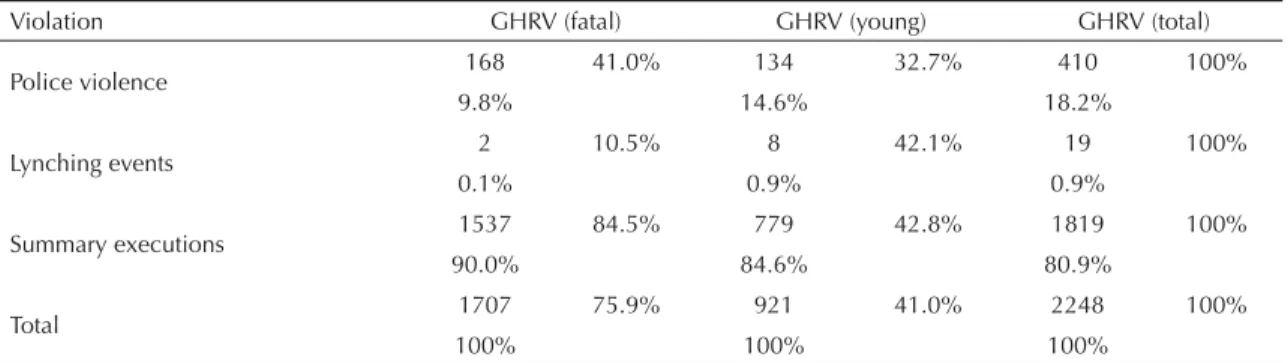
due to lynching episodes (Table 2). There was a high mortality and victimization rate among the young population. Among the summary executions, 84.5% (n=1,537) were fatal and 42.8% (n=779) were against youngsters (15 to 24 years of age). In the case of police violence, 41.0% (n=168) of the events resulted in deaths and 32.7% (n=134) were against the young. In regard to lynching episodes, 10.5% were fatal and 42.1% of the victims were youngsters. Furthermore, there was an unequal GHRV distribution among the districts in the city of São Paulo, where total GHRV was zero in some districts and 104 was the highest number of reported victims. In regard to youngsters, the fi gures varied from zero to 53 victims.
The correlations between GHRV and sociodemographic indicators showed a correspondence between the locali-ties where the population presented the worst living conditions and the number of GHRV. Exception for urbanization rate and hospital bed/1,000 inhabitants, all the other correlations were statistically signifi cant (Table 3).
The size of the resident population presented a strong and positive correlation with GHRV. In addition, the correlations with the proportion of the young population (15 to 24 years) in the districts were strong, presenting r= 0.621 for the total GHRV. In the same fashion, the correlations found, for both the number of people per household and the number of people living in favelas (slums)/sub-housing conditions, showed a correspon-dence between population density and poor housing conditions and GHRV.
Income also revealed itself to be a signifi cant factor for the outcome. The Spearman correlation coeffi cient between average income of the head of the household and total GHRV was negative, r= -0.574. Schooling indicators, were also associated with GHRV. The cor-relation coeffi cient was r= 0.590 between the GHRV (total) variable and the rate of heads of household with no schooling or with up to three years of schooling. Among the health indicators, the number of teenage mothers was the one with the strongest correlation, and the coeffi cient for total GHRV was positive, r=0.548.
The analyses carried out between fatal GHRV and GHRV among the young, and the sociodemographic indicators showed the same trend and strength as total GHRV. This can be seen in Table 4.
DISCUSSION
Studies quantifying GHRV are rare. The lack of stud-ies is due to the diffi culty in defi ning indicators and gathering information in a systematic and reliable way. For instance, there are no offi cial sources on lynching events and summary killings, also called death by extermination: these cases are all counted as homicide
Table 1. Dependent and independent variables related to gross human rights violations. Municipality of São Paulo, Southeastern Brazil, 2000.
Variable Source Year
Total number of victims resulting from gross human rights violations (Total GHRV)
NEV/ USPa 2000
Total number of young victims (between 15 and 24 years of age) of gross human rights violations (GHRV young)
NEV/ USPa 2000
Total number of casualties resulting from gross human rights violations (GHRV fatal)
NEV/ USPa 2000
Demographics
Size of resident population IBGEb 2000
Proportion of youngsters aged between 15 and 24 in the total district population
IBGEb 2000
Housing
Number of people per household IBGEb 2000
Proportion of households connected
to sewage IBGEb 2000
Proportion of the population residing in favellas or in sub-housing conditions
SMP/ PMSPc 2000
Proportion of the population living
in urban areas (Urbanization rate) IBGEb 2000
Schooling/Education
Illiteracy rate among population
aged above 15 IBGEb 2000
Proportion of heads of households with no schooling or with up to three years of education
IBGE 2000
Income
Mean income of head of permanent
household IBGE
b 2000
Proportion of heads of permanent households with income between 0 to 3 minimum wages
IBGEb 2000
Health
Child mortality rate/1,000 live births (LB)
SMS/ PMSPd 2000
Proportion of mothers aged between 15 and 19 years/100LB
SMS/ PMSPd 2000
Hospital beds/1,000 inhabitants SMS/ PMSPd 2000
a Banco de Dados da Imprensa sobre Graves Violações de
Direitos Humanos (Press Database on Gross Human Rights Violations), Núcleo de Estudos da Violência (Center for the Study of Violence), Universidade de São Paulo.
b Instituto Brasileiro de Geografi a Estatística (IBGE - Brazilian
Institute of Geography and Statistics), 2000 Census.
c SMP/PMSP: Secretaria Municipal de Planejamento
(Munici-pal Planning Secretariat), São Paulo City Administration
d SMS/PMSP: Secretaria Municipal de Saúde (Municipal
and, therefore, there is a loss of information since they are not considered separately. In the case of police violence, despite the offi cial sources, many problems affect the validity and reliability of information.4,19
Consequently, the newspapers are one of the few existing sources of information in Brazil that enable us to follow these kinds of violation of rights across time.5 With the goal of contributing to closing this gap
Table 2. Total number and proportion of gross human rights violation victims (GHRV). Municipality of São Paulo, Southeastern Brazil, 2000.
Violation GHRV (fatal) GHRV (young) GHRV (total)
Police violence 168 41.0% 134 32.7% 410 100%
9.8% 14.6% 18.2%
Lynching events 2 10.5% 8 42.1% 19 100%
0.1% 0.9% 0.9%
Summary executions 1537 84.5% 779 42.8% 1819 100%
90.0% 84.6% 80.9%
Total 1707 75.9% 921 41.0% 2248 100%
100% 100% 100%
Source: Núcleo de Estudos da Violência da Universidade de São Paulo. Banco de dados da imprensa sobre as graves violações de direitos humanos. [cited 2009 Mar 5] Available from: http://www.nevusp.org/portugues/index.php?option=com_content& task=view&id=1378&Itemid=79
Table 3. Spearman’s correlation (r) between gross human rights violations and socioeconomic indicators. Municipality of São Paulo, Southeastern Brazil, 2000.
Indicator GHRV (total) GHRV (fatal) GHRV (young)
Size of resident population r 0.693 0.725 0.704
p 0 0 0
Proportion of youngsters aged between 15 and 24 r 0.621 0.685 0.632
p 0 0 0
Urbanization rate r -0.142 -0.139 -0.173 p 0.168 0.176 0.093
Number of people per household r 0.507 0.601 0.531
p 0 0 0
Proportion of households connected to sewage r -0.497 -0.577 -0.507
p 0 0 0
Proportion of the population residing in favellas or in sub-housing conditions
r 0.516 0.583 0.522
p 0 0 0
Illiteracy rate among population aged 15 and above r 0.589 0.637 0.591
p 0 0 0
Proportion of heads of households with no schooling or with up to three years of education
r 0.590 0.644 0.609
p 0 0 0
Mean income of head of permanent household r -0.574 -0.611 -0.593
p 0 0 0
Proportion of heads of permanent households with income between 0 to 3 minimum wages
r 0.572 0.621 0.591
p 0 0 0
Child mortality rate/1,000 LB r 0.368 0.379 0.419
p 0 0 0
Hospital beds/1,000 inhabitants r -0.153 -0.207 -0.178 p 0.136 0.043 0
Teenage mothers between aged 15 and 19 years/100LB r 0.548 0.592 0.539
p 0 0 0
and of promoting a better understanding of the GHRV phenomenon in the context of violence in Brazil, NEV-USP has been keeping, since 1987, a database of press information on GHRV. This database has advantages and disadvantages.
As pointed out by Davenport & Ball8 (2002),
newspa-pers as well as other sources of data used in monitoring GHRV (witness reports, information supplied by NGOs and offi cial data), mirror different ways of observing and understanding these phenomena. Each source of data focuses on violations under different perspectives, having advantages and disadvantages according to the goal of a certain study. Newspapers in particular tend to have sub-representation problems, since they focus on events that have a greater impact and emotional appeal, and usually report more often on what takes place where their news agencies are located. On the other hand, there are clear advantages in terms of easiness of access and coverage of certain events, and their distribution in time and space. Thus, a number of factors infl uence the coverage given by newspapers to a certain event, such as its amplitude or the degree of violence, the place and even the nature of the newspaper (whether it is more commercial or focused on protecting human rights). Therefore, this kind of source of data should not be discarded, but must be used with caution. Its usefulness resides in documenting behaviors consid-ered politically important within a certain geographi-cal context, thus enabling comparative investigations, seeing that newspapers tend to focus on certain social and political phenomena across time and they provide more accurately dated information when compared to other sources. Consequently, although the press is not an unbiased source, GHRV have been, in the last decades, an important issue on the agenda, and this has signifi cantly contributed to GHRV monitoring.
In regard to validity, the only way of assessing it is by comparison with other sources, which is not always possible due to the lack of offi cial reference sources. In terms of police violence, Peres et al19 (2008) found that
the number of casualties due to police violence in the city of São Paulo in 2000 was higher than the number of victims reported by the Public Safety State Secretariat. The opposite was found for the other cities in the met-ropolitan area of São Paulo and for inner state cities. In the latter, the number of reported victims according to the press was lower than those reported in the offi cial sources. A possible reason to explain this difference is that the Public Safety State Secretariat records some of the deaths that occurred in the city of São Paulo to have occurred in other cities, adopting as a reference not the place where the violent episode took place, but the place of residence/work of the police offi cers involved. Concerning the remaining violations, that is, lynching
events and summary executions, there are no sources that enable comparisons of any kind.
The study carried out by Davenport & Ball8 (2002)
shows enough credibility and the importance of the writ-ten press data in monitoring GHRV. Using such data to monitor GHRV in international scenarios is considered more consistent that when compared to other sources of data. Additionally, the usefulness of newspapers is also mirrored by a number of international organizations aimed at monitoring and protecting human rights. An example of an organization that uses newspapers as sources of data is the Human Rights Information and Documentation Systems, International.a Therefore, press
data can be used as an additional source for controlling offi cial sources, and as a primary source when other sources of information do not exist, or when they do not suffi ce, or when they are diffi cult to access.
In Brazil, there is only a small number of quantitative studies aimed at investigating GHRV and their relation with socioeconomic aspects, due to the aforementioned lack of data. However, the gravity and the permanence of the violations require effort in establishing method-ologies and carrying out adequate studies.
One of the limitations of this study relies on analyz-ing 2000 data. The association observed for that year, if it is to indicate a relation of determination among variables, must prove to be persistent across time. This however will only be able to be proven when more recent data are available. Nevertheless, the limitations of this study do not invalidate the fi ndings concerning the association of GHRV and social inequalities in the city of São Paulo.
The results show that GHRV persist in the city of São Paulo and represent disrespect to civil rights, although human rights are enshrined in the Brazilian 1988 Con-stitution (according to the main international documents such as the Universal Declaration of Human Rights), which legally established the transition to democratic regime.3,9,20 In the case of the city of São Paulo, the
diffi culty in effectively promoting citizenship on the population’s daily life is emblematic due to the perpetu-ation of the cycle of violent and social and economic inequalities.
It was seen that GHRV are closely tied to socioeco-nomic disadvantages and occur more frequently where the state is defi cient. The sociodemographic indicators used in this study are strongly correlated, and this shows that many socioeconomic needs overlap. This fact makes it diffi cult to build models for multivariate analysis, because multicollinearity among independent variables violates one of the basic assumptions of mul-tiple regression models.
The association between overlapping needs and GHRV shapes a social framework of extreme violence. As pointed out by Caldeira3 (2000), this violence can only
be understood when one takes into account the connec-tion between different processes, such as “the violent pattern of police action; disbelief in the justice system as a public and lawful confl ict-solving mediator and provider of just reparation; violent and private respon-dents to crime; and the feeble perception of individual rights, and the support of violent forms of punishment by the population” (p. 101).
The failure of the State to enforce the law and control illegal forms of violence committed by State agents directly contributes to this situation and renders peace across society impossible. To date, the action of the police in controlling criminality is full of arbitrary acts.3,14,17,20 What one mainly sees is repressive action,
which is often illegal and violent, against the poor and underprivileged population, mostly made up of young people living in peripheral areas. This population is considered potentially criminal due to its living condi-tions. The results presented confi rm this scenario: only in the year 2000, among the cases reported by the press 410 involved victims of police violence in the city of São Paulo, 41% of which were fatal victims, and 33% of which were the young victims.
Although some measures aimed at reducing police violence have represented major steps, such as the creation of the Police Ombudsmana and transferring
the law suits against police officers charged with murdering civilians to the common law courts – in-stead of being on trial at the military courts – (Federal Lawn. 9,299/96), impunity still persists, and this has been contributing to the general feeling of unsafeness and the perpetuation of violence.3,9,17 Many homicides
committed by police offi cers are deemed justifi ed as a result of alleged confrontation or resistance to prison, even when the circumstances give evidence of exces-sive action and even criminal action on the part of the police, as in the cases of intentional executions, in which the circumstances of the death reveal it was impossible for the victim to react.20 The breakout of death squads,
essentially made up of police offi cers – that during the Brazilian military dictatorship period were largely tolerated despite a number of reports2,17 – shows the
amount of police violence has not disappeared with the democratic regime. To the contrary, the increase in violence served to promote, in underprivileged areas, the formation of vigilante groups, which succeeded the earlier death squads, still count with the participation of police offi cers or even of former police offi cers whose discourse is the control of criminality.21
In addition, the ineffectiveness of the police and of the judicial system results in the lack of legitimacy and trust on the part of the population; thus spurring a perverse process through which public safety is privatized, and illegal forms of ‘justice’ intensify.3,17 On one hand, you
have private professional forces, generally acting outside the law and, on the other, the actions of society itself.
A study carried out by Nunes & Paim16 (2005) shows that
exposing the population to anti-democratic, illegitimate and violent acts committed by the State and criminal groups contributes to the acceptance of violent resources and illegal forms of protection, which can lead to mani-fest support to vigilante groups and lynching, where a “social cleansing” movement7 is put into practice. Based
on our fi ndings, vigilante groups play a strong role in the city of São Paulo. The “social cleansing” rationale lying under GHRV, and pointed out by Nunes & Paim (2005), is mirrored in the correlations found in our study.
Just as illegal executions, lynching events can be under-stood by the failure of the state in effectively promot-ing justice.6,12,b As pointed out by Martins12 (1989), the
lynching episodes in underprivileged neighborhoods are essentially an act of justice performed by the popula-tion who implicitly does not acknowledge the authori-ties responsible for public safety and the justice system. To Cerqueira & Noronha6 (2004), lynching episodes
are motivated by distrust in social control institutions. The authors highlight the role that fear of crime and the existing social discourse (that indiscriminately as-sociates criminality and poverty) play in encouraging the population to give support to violent and drastic measures against those who are considered dangerous. As a result, lynching episodes, considered a punitive and collective action “that denies the victim the right to proportional and retributive sentencing for the allegedly committed criminal action”12 (p.24), end up diluting and
even making it impossible to uncover responsibilities and to effectively enforce justice. Therefore, instead of eliminating, lynching practices reproduce violence and social injustice that fall on the most vulnerable and stigmatized portion of the population.3,7,16
According to Caldeira3 (2000), in Brazil, there is a certain
tolerance of the manipulation of the body, and this results in violent actions being considered legitimate, includ-ing to punish alleged offenders, and also to deal with certain social strata considered dangerous or that have to be controlled. For instance, according to Sudbrack24
(2004), from 1980s on, street kids began to be consid-ered a “dangerous” group that required social control and extermination practices. Violations to the body of the other, according to Caldeira3 (2000), affect different
dimensions and are committed both by agents of the State
a in January 1995, Decree 39.900 created the fi rst police ombudsman in São Paulo to receive reports from the population on both civil and military police offi cers and from police offi cers against abuse committed by other police offi cers.
b Sinhoretto J. Os justiçadores e sua justiça. Linchamentos, costumes e confl itos. [Justice-makers and their justice. Lynching, custom and
and by citizens. These violations denote the notion of an “uncircumscribed body”, which is closely associated to violence and to the disrespect of civil rights.
Therefore, a process involving a number of elements is shaped. And these elements are: corruption of the police and their involvement in illegal practices; the spread of the drug traffi cking and illegal trade of weapons (and, as a result, the greater presence of fi rearms and an increase in the death rates resulting from confl icts18); the inoperative
legal mechanisms of justice (and, as a consequence, the permanence of impunity). As a result, there is less safety, dissatisfaction on the part of society, the adoption of private and extralegal mechanisms to control crime, and the use of violence in interpersonal confl ict resolution. All of these factors are mirrored in the high homicide and GHRV rates, which are most strongly felt by the
socially and economically underprivileged population. In this case, unequal access to social and economic rights overlap with the violations of civil rights.
In short, the results show that enforcing civil rights, individual liberties, physical and moral integrity, is weakened when other kinds of rights are threatened. The indivisibility principle – i.e., the interdependence among the set of political, social, economical and civil rights20 – is materialized in the context of the GHRV
addressed in this study. The high correlation between GHRV and the number of socioeconomic and demo-graphic indicators used in this study show, once again, there are areas where there is “no rule of law” or where there is “democracy without citizenship” in Brazil.22
1. Adorno S. Insegurança versus direitos humanos: entre a lei e ordem. Tempo Soc. 2000;11(2):129-53.
2. Bicudo HP. Meu depoimento sobre o Esquadrão da Morte. São Paulo: Martins Fontes; 2002.
3. Caldeira TPR. Cidade de muros: crime, segregação e cidadania em São Paulo. São Paulo: Edusp; 2000.
4. Cano I. Execuções sumárias no Brasil: o uso da força pelos agentes do Estado. In: Justiça Global, Núcleo de Estudos Negros, organizadores. Execuções sumárias no Brasil: 1997-2003. Rio de Janeiro; 2003. p.11-21.
5. Cardia N, Adorno S, Poleto F. Homicídio e violação de direitos humanos em São Paulo. Estudos
Avançados. 2003;17(47):43-73. DOI: 10.1590/S0103-40142003000100004
6. Cerqueira RT, Noronha CV. Cenas de linchamento: reconstruções dramáticas da violência coletiva. Psicol Estud. 2004;9(2):163-72. DOI: 10.1590/S1413-73722004000200003
7. Cruz-Neto O, Minayo MCS. Extermínio: violentação e banalização da vida. Cad Saude Publica 1994;10(supl. 1):S199-212.
8. Davenport C, Ball P. Views to a Kill. Exploring the implications of source selection in the case of Guatemala state terror, 1977-1995. J Confl Resolut. 2002;46(3):427-50. DOI: 10.1177/0022002702046003005
9. Dellasoppa E, Bercovich AM, Arriaga E. Violência, direitos civis e democracia no Brasil na década de 80: o caso da área metropolitana do Rio de Janeiro. Rev Bras Ci Soc. 1999;14(39):155-76. DOI: 10.1590/ S0102-69091999000100009
10. Fundação Instituto Brasileiro de Geografi a e Estatística (IBGE). Censo Demográfi co 2000 [citado 2007 nov 10]. Disponível em: URL: http://www.ibge.gov.br/ servidor_arquivos_est/
11. Gawryszewski VP, Mello-Jorge MHP. Mortalidade violenta no Município de São Paulo nos últimos 40 anos. Rev Bras Epidemiol. 2000;3(1-3):50-69. DOI: 10.1590/S1415-790X2000000100006
12. Martins JS. Linchamentos: a vida por um fi o. Travessia. 1989;2(4):21-7.
13. Mello-Jorge MHP. Adolescentes e jovens como vítimas da violência fatal em São Paulo. In: Pinheiro PS, Gunn P, Malta Filho C, Calligaris C, Eastman AC, et al. São Paulo sem medo: um diagnóstico da violência urbana. Rio de Janeiro: Garamond; 1998. p.97-120.
14. Mesquita Neto P. Violência policial no Brasil: abordagens teóricas e práticas de controle. In: Pandolfi D, Murilo J, Carneiro LP, Grynspan M, organizadores. Cidadania, justiça e violência. Rio de Janeiro: Fundação Getulio Vargas; 1999. p.130-48.
15. Minayo MCS. A violência na adolescência: um problema de saúde pública. Cad Saude Publica. 1990;6(3):278-92. DOI: 10.1590/S0102-311X1990000300005
16. Nunes M, Paim JS. Um estudo etno-epidemiológico da violência urbana na cidade de Salvador, Bahia, Brasil: os atos de extermínio com o objeto de análise. Cad Saude Publica. 2005;21(2):459-68. DOI: 10.1590/ S0102-311X2005000200012
17. Peralva A. Violência e democracia: o paradoxo brasileiro. São Paulo: Paz e Terra; 2000.
18. Peres MFT, Santos PC. Mortalidade por homicídios no Brasil na década de 90: o papel das armas de fogo. Rev Saude Publica. 2005;39(1):58-66. DOI: 10.1590/ S0034-89102005000100008
19. Peres MFT, Cardia N, Mesquita Neto P, Santos PC, Adorno S. Homicídios, desenvolvimento socioeconômico e violência policial no Município de São Paulo, Brasil. Rev Panam Salud Publica 2008;23(4):268-76.
20. Pinheiro PS. O passado não está morto: nem passado é ainda. In: Dimenstein G. Democracia em pedaços: direitos humanos no Brasil. São Paulo: Companhia das Letras; 1996.
21. Pinheiro PS, Mesquita Neto P. Direitos humanos no Brasil. Perspectivas no fi nal do século. Textos Brasil. 1998;2(6):43-52.
22. Pinheiro PS. O Estado de Direito e os não-privilegiados na América Latina. In: Mendez JM, O’Donnell G, Pinheiro PS. Democracia, violência e injustiça: o não-estado de direito na América Latina. São Paulo: Paz e Terra; 2000. p.11-29.
23. Souza ER, Lima MLC. Panorama da violência urbana no Brasil e suas capitais. Cienc Saude Coletiva. 2006;11(2):363-73.
24. Sudbrack UG. O extermínio de meninos de rua no Brasil. São Paulo Perspec. 2004;18(1):22-30. DOI: 10.1590/S0102-88392004000100004
25. Zaluar A. A integração perversa: pobreza e tráfi co de drogas. Rio de Janeiro: Fundação Getúlio Vargas; 2004.
REFERENCES