Characterization of Family Health
Teams and their work process
CARACTERIZAÇÃO DAS EQUIPES DA SAÚDE DA FAMÍLIA E DE SEU PROCESSO DE TRABALHO
CARACTERIZACIÓN DE LOS EQUIPOS DE SALUD DE LA FAMILIA Y SU PROCESO DE TRABAJO
1 Biologist. Professor of the Department of Nursing of the Centro de Educação Superior Norte of the Federal University of Santa Maria. Palmeira das Missões, RS, Brazil. [email protected] 2 RN, MSc. Professor of the Department of Nursing of the Centro de Educação Superior Norte of the Federal University of Santa Maria. Palmeira das Missões, RS, Brazil. [email protected] 3 RN, MSc. Professor of the Department of Nursing of the Centro de Educação Superior Norte of the Federal University of Santa Maria. Palmeira das Missões, RS, Brazil. [email protected] 4 RN, MSc. Professor of the Department of Nursing of the Centro de Educação Superior Norte of the Federal University of Santa Maria. Palmeira das Missões, RS, Brazil. [email protected] 5 Undergraduate student of the Nursing Program of the Centro de Educação Superior Norte of the Federal University of Santa Maria. Palmeira das Missões, RS, Brazil. [email protected] 6 Undergraduate student of the Nursing Program of the Centro de Educação Superior Norte of the Federal University of Santa
O
RIGINAL
A
R
TICLE
RESUMO
Este estudo tem por objetivo conhecer as características das equipes da Estratégia de Saúde da Família (ESF) de uma Coordena-doria Regional de Saúde do RS, identifican-do suas dificuldades no processo de traba-lho. Trata-se de uma pesquisa qualitativa do tipo exploratório-descritiva, com aplicação de questionário. Os resultados revelaram uma faixa etária jovem, feminina e com for-mação profissional recente. Quanto ao pro-cesso de trabalho, foram observadas algu-mas dificuldades, dentre elas: a forma de contratação, a falta de infra-estrutura das unidades de saúde, a dificuldade de traba-lhar em equipe, a falta de especialização dos trabalhadores, a não compreensão da população sobre a proposta da ESF e até mesmo o relato da ausência de dificuldes. Alguns dos resultados corroboram da-dos relatada-dos pela literatura, no entanto os dois últimos ítens foram pouco explorados em outros estudos, constituindo aspectos relevantes a serem considerados no proces-so de trabalho e na implementação da ESF.
DESCRITORES Programa Saúde da Família. Equipe de assistência ao paciente. Condições de trabalho.
Atenção Primária à Saúde.
Alessandra Bernadete Trovó de Marqui1, Alice do Carmo Jahn2, Darielli Gindri Resta3, Isabel Cristina dos Santos Colomé4, Neidiane da Rosa5, Tami Zanon6
ABSTRACT
This study aims to learn the characteristics of Family Health Strategy (FHS) teams from a Regional Health Coordination of RS, iden-tifying its difficulties in the work process. It is a qualitative exploratory-descriptive study, with a questionnaire application. Results revealed a group of young females with recent professional education. Regard-ing the work process, some difficulties ob-served were: the hiring model, the lack of infrastructure of the health units, the diffi-culty to work in teams, the lack of special-ization of the employees, the non-compre-hension of the population about the FHS proposal and even the reporting of the lack of difficulties. Some of the results corrobo-rate the data reported by the literature, but the last two items were poorly explored in other studies, constituting relevant aspects to be considered in the work process and in the implementation of the FHS.
KEY WORDS Family Health Program. Patient care team. Working conditions. Primary Health Care.
RESUMEN
Este estudio tuvo como objetivo conocer las características de los equipos de la Estrate-gia de Salud de la Familia (ESF) de una Coor-dinadora Regional de Salud del RS, identifi-cando las dificultades en el proceso de tra-bajo. Se trata de una investigación cualitati-va del tipo exploratorio-descripticualitati-va, con apli-cación de cuestionario. Los resultados reve-lan una faja etaria joven, femenina y con gra-duación profesional reciente. Respecto del proceso de trabajo, se observó la presencia de algunas dificultades, entre ellas: el modo de contratación, la falta de infraestructura de las unidades de salud, la dificultad para trabajar en equipo, la falta de especialización de los trabajadores, la incomprensión de la población sobre la propuesta de la ESF y has-ta incluso el relato de ausencia de dificulhas-ta- dificulta-des. Algunos de los resultados corroboran datos reseñados en la literatura, mientras que los últimos dos han sido poco explora-dos por otros estudios, constituyendo aspec-tos relevantes a ser considerados en el pro-ceso de trabajo e implementación de la ESF.
INTRODUCTION
The United Nations (UN) designated 1994 as the Interna-tional Year of the Family, thus, the Ministry of Health in Bra-zil created the Family Health Strategy (FHS), trying to follow the guidelines foreseen in the Brazilian Unified Health Sys-tem (SUS), especially, having the family as the structural axis of the determinant and conditioning factors of the
health-disease continuum of the population, the recipient of care(1).
The FHS aims to reorient the Brazilian care model and the reorientation project is a driving force in the SUS. Besides a new structure, it is a reform in the forms of work and in the relationships between professionals and users. The FHS pro-poses to work with an enrolled clientele, focused on the fam-ily, establishing bonds through a multi-professional team. These professionals should plan their actions based on the realities of the lives of the families who receive care. Thus, the action of the team requires the implementation of new theoretical
references and the (re)organization of the work process(2).
The basic or nuclear team recommended by the FHS consists of a generalist physician, one nurse,
two nursing auxiliaries and five to six com-munity health agents and, depending on the city, it also has the support of professionals from the oral health, mental and rehabilita-tion teams(2).
In this way, the FHS incorporates and reaf-firms the basic principles of the SUS – universal access, decentralization, integrality and commu-nity participation – and is established on three major pillars: the family, the territory and the responsibility, in addition to the support of team work. The present study considers workers and
managers as members of the health team. The theoretical framework used was that of the health work process.
In the new care model, the work process should have specific characteristics. Professionals should have particular qualities and profiles, once the emphasis of care is not on the technical procedures, but on the interrelation among the
team/community/family and on team/team interrelations(3).
The interest in developing this study emerged from the report of the difficulties experienced by one Regional Health Coordination office (RHC) in the interior of the state of Rio Grande do Sul (RS) of working with the health teams. Among these difficulties there are: physician-centered care; diffi-culties in working with the enrolled population; greater focus on healing than on preventing; difficulty in planning, assessing and on teamwork, among others.
OBJECTIVE
This study sought to know the characteristics of the fam-ily health teams and to identify the difficulties faced in their work process.
METHOD
Type of Study
This is field study is exploratory, descriptive and qualitative.
Characterization of the study’s participants
The study’s participants were 126 workers from the FHS teams and municipal managers from a Regional Health Co-ordination office in the interior of the state of RS, consist-ing of 26 cities and 39 family health teams.
The inclusion criteria were: being professionals acting in cities which were part of the RHC linked to the FHS who agreed voluntarily to participate in the research by signing a free and informed consent form and filling out the data collection instrument.
Ethical aspects
The present research followed the ethical guidelines es-tablished in Resolution 196/96 from the Brazilian National Health Council, thus respecting the regulating standards of research with human beings. Data were collected after approval of the Research Ethics Committee of the Federal University of Santa Maria (UFSM), report n. 23081.016231/ 2007-62.
Data collection methods
A semi-structured questionnaire with both open and closed questions was used for data collection. The instrument consisted of two sections: the first regarded participant’s personal data, aiming to outline the profile of the workers and managers of the FHS. The second sec-tion consisted only of open quessec-tions related to aspects of the work process. Data collection was carried out in July and August 2007.
Questionnaires were sent to the cities of the RHC by courier, along with an explanatory note and two copies of the free and informed consent form. It is highlighted that prior telephone contact was established with the co-ordinators of the FHS teams to communicate the sending of the data collection instrument. In total, 479 question-naires were sent out, of which 126 were answered and sent back.
Data analysis
Data were analyzed based on thematic analysis(4). This
analysis occurs through the organization, reading and discussion of the collected data, consisting of three stages: pre-analysis, careful examination of the material, treatment of the obtained results and interpretation. No statistical test was used for data analysis, only comparison between relative frequencies.
...the FHS incorporates and reaffirms the basic principles of the SUS [...] and is established on three major pillars: the family, the territory
RESULTS AND DISCUSSION
This section presents the data related to the character-ization of the participants and their perception concerning the work process in the family health teams.
Characterization of the research participants
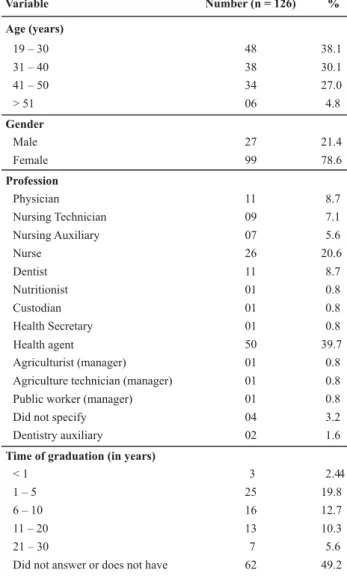
The analysis of the questionnaires enabled the identifi-cation of the characteristics of the FHS teams, as analysis of data from the first section of the questionnaire is pre-sented in Table 1.
Table 1 - Characterization of the workers who compose the FHS
teams and managers, 15th Regional Health Coordination unit
-Palmeira das Missões, RS - 2007-2008
Variable Number (n = 126) %
Age (years)
19 – 30 48 38.1
31 – 40 38 30.1
41 – 50 34 27.0
> 51 06 4.8
Gender
Male 27 21.4
Female 99 78.6
Profession
Physician 11 8.7
Nursing Technician 09 7.1
Nursing Auxiliary 07 5.6
Nurse 26 20.6
Dentist 11 8.7
Nutritionist 01 0.8
Custodian 01 0.8
Health Secretary 01 0.8
Health agent 50 39.7
Agriculturist (manager) 01 0.8
Agriculture technician (manager) 01 0.8
Public worker (manager) 01 0.8
Did not specify 04 3.2
Dentistry auxiliary 02 1.6
Time of graduation (in years)
< 1 3 2.44
1 – 5 25 19.8
6 – 10 16 12.7
11 – 20 13 10.3
21 – 30 7 5.6
Did not answer or does not have 62 49.2
As to the characterization of the FHS teams, the pre-dominant age group of the professionals was from 19 to 30 years (38.1%), which shows a young representation of the professionals acting in the FHS. Recent professional train-ing, varying from 1 to 5 years, was also observed. These characteristics can contribute to the accomplishment of the
Strategy, considering the possibilities of change shown in the new Curricular Guidelines of the undergraduate Health Programs.
Health teaching is adapting its training structure as it approaches students early to pre-professional activities, through extra-classroom activities. With this opportunity, professionals under training can understand and discuss the current structure of public health policies, among them the Primary Health Care National Policy, focused on Family Health. Most undergraduate programs have a generalist train-ing that enables students to develop their competencies and abilities to intervene in several situations in the
health-dis-ease process of individuals, families and communities(5).
Knowing that the participants in the study have recent training puts at issue the characteristics of teaching, the expectations concerning graduates’ professional behavior and the policies of health work, once these are the main sources that base the actions of the health workers.
Addressing professional training is important to under-standing the context of health practices, considering the historical mark left by the biomedical-centered teaching and the current trial by training institutions to put into action
the indications of the new Curricular Guidelines(6).
As to specialization, regarding higher education profes-sionals (nurses, physicians, dentists and nutritionists), the main reported areas of activity were Collective Health (16.7%), Public Health (12.5%) and Hospital Management (8.3%). Data demonstrated the workers’ desire to improve their professional practice in important areas of knowledge for implementation and consolidation of the FHS proposal. On the other hand, a study carried out with nurses work-ing in the FHS in the city of Marilia, in the state of Sao Paulo, showed that none of them had specialization in the area of Collective or Public Health(7).
Considering gender distribution, the professionals on the teams were predominantly female (78.6%). Most re-search subjects were health agents, nurses, physicians, nursing technicians and auxiliaries, corresponding to the composition of the minimum team recommended by the
Ministry of Health for FHS work(2).
As to the type of work contract, most were employees hired according to the Labor Law Consolidation (38.1%) and on temporary contracts (32.5%). These types of contract can make the establishment of a professional bond with the ser-vice and the population who receive care difficult. Studies
by the Pan-American Health Organization(8) demonstrated
that most health workers in the SUS were hired under the above-mentioned contracts, causing instability in their pro-fessional careers. The instability of propro-fessional bonding is pointed out as one of the main factors responsible for the
high turnover of professionals working on the FHS teams(9).
partici-pants(10) . Another form of contract for FHS professionals is
by political-partisan appointment, which is common and evident in small cities, and can contribute to the insertion of professionals with nonspecific knowledge in the family health area. This form of labor contract interferes directly in the services delivered. It should guarantee stability and strengthen labor bonding, in addition to enabling
profes-sional/user bonding and social responsibility(11).
Perceptions of workers of the FHS teams concerning their work process
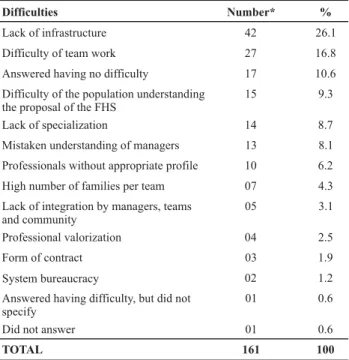
The study’s participants were asked about the existence or non-existence of difficulties in the work process of the FHS teams. The results were categorized and are presented in Table 2.
Table 2 - Main difficulties faced by professionals and managers in the process of work in the FHS* teams, 15th Regional Health
Coordination - Palmeira das Missões, RS - 2007-2008
Difficulties Number*
Lack of infrastructure 42
Difficulty of team work 27
Answered having no difficulty 17
Difficulty of the population understanding the proposal of the FHS
15
Lack of specialization 14
Mistaken understanding of managers 13
Professionals without appropriate profile 10
High number of families per team 07
Lack of integration by managers, teams and community
05
Professional valorization 04
Form of contract 03
System bureaucracy 02
Answered having difficulty, but did not specify
01
Did not answer 01
TOTAL 161
%
26.1
16.8
10.6
9.3
8.7
8.1
6.2
4.3
3.1
2.5
1.9
1.2
0.6
0.6
100
* some individuals reported more than one difficulty
Concerning the difficulties reported by participants, lack of infrastructure in the basic health units was the most fre-quent one. The lack of transportation for home visits was highlighted, as it renders the appropriate accomplishment of the daily tasks unviable, especially in rural areas. There is also lack of materials and equipment to carry out the work, mainly medication, material for wounds and clean-ing. Data from the literature confirm that the lack of or deficiency in infrastructure compromise the planning and execution of the FHS proposals, interfering directly in the work of the team and in the care delivered to users, caus-ing a lack of motivation and responsibility in the execution
of the activities(12-14). Thus, the research carried out in the
state of Minas Gerais found in the work of the FHS the lack of transportation, infrastructure, equipment, medication,
support from the institutions responsible for the FHS, hu-man resources, political desire, passing on of budgets from the municipal government and the improper use of
bud-gets to be main difficulties(11). These problems were also
faced by graduates from the State University of Campinas/ UNICAMP when they joined the public health system as
professionals(15). This shows that these problems are not
exclusively present in the FHS, but are part of the context of Brazilian public health, demanding the construction of
broader governmental projects(11). However, community
participation, social control and commitment by the agents involved, either users, managers or professionals, is essen-tial for the consolidation of the system.
Regarding teamwork, approximately 17% of the partici-pants reported difficulties, among them the lack of plan-ning by members for collective work, lack of sensitivity and interaction of people for teamwork, individualization of work characterizing a division of activities, and difficulty in the flow of information, among others. The concept of teamwork can be understood as a kind of collective work, with a reciprocal relationship between the technical inter-ventions and agents’ interaction. Interaction is a commu-nicative practice characterized by the search for consensus
and aiming to build a common work project(16). These
diffi-culties pointed out by the participants concerning team-work are opposed to the understanding of health team-work as something collective. The absence of a collective planning of action cause the care provided by professionals to be parceled out, not considering the many facets of users’ health needs, depriving care of the characteristics of the proposal recommended by the FHS.
A study carried out with nurses working in the FHS in Marilia, state of São Paulo, showed that, concerning team-work, 62.5% of the interviewed nurses reported interac-tion difficulties with the team and considered these diffi-culties to be both personal and professional. They also re-ported that teamwork promotes the superposition of func-tioning with other health professionals. Another interest-ing aspect revealed by this study was the suggestion about work given by the nurses themselves, including knowing how to work in groups and being prepared, while still in
undergraduate training, to work on teams(7), thus agreeing
with the findings in the present study.
The participants’ answers that they did not have diffi-culties in their work process were a result that captured the researcher’s attention. However, data from the litera-ture show that the difficulties are present in most studies
carried out with FHS teams in their work process(10,14,17). One
Another difficulty pointed out by participants regards the lack of understanding by the population of the FHS pro-posal. This data was also reported in a study carried out in
the FHS in two cities in the state of Minas Gerais(14). One
possible explanation for this finding could be the lack of political concern of the population, their lack of knowledge of their rights as citizens, the lack of participation of users in the process of making health decisions, the shortage or absence of activities for health sensitization and education regarding the proposal of the strategy, professionals’ anxi-ety over user complaints in biomedical procedures and also the lack of flexibility on the part of management.
One difficulty reported by the workers was the lack of professional qualification. Professional qualification is es-sential for worker education and the improvement of the health services, besides the social relationships established inter- and intra-teams and with users, which would permit
an improvement in the quality of the care provided(15). The
implementation of a strategy for promoting the value of qualified professionals on the FHS teams should promote workers’ intellectual autonomy, the domain of technical-scientific knowledge and a capacity for planning, manag-ing their action time and space, the exercise of their cre-ativity, team work, interaction with services’ users, con-sciousness of the quality and of the ethical implications and
greater humanization of the primary health care activities(2).
Managers’ mistaken understanding of the FHS, itself, was another difficulty reported by the participants. It is possible, in certain situations, to perceive a divergence re-garding the work process of the family health team and the management model. A study has demonstrated the presence of centralized and authoritarian managerial prac-tices, based on management theories with excessive stan-dardization and bureaucratic control of the health practices,
depriving workers’ of autonomy(17). A study carried out with
FHS teams in Juiz de Fora, the state of Minas Gerais, found similar characteristics in the management model, such as vertical power relations among managers and secondary
and higher level professionals(18).
The presence of professionals without the appropriate profile to work in the FHS was also reported as a difficulty, expressed under the description of a lack of commitment by them and, consequently, a lack of resolution of the health actions. The work of these professionals in the FHS requires them to be able to plan, organize, develop and evaluate
actions that meet a community’s needs(15). The lack of the
appropriate profile negatively influences the change of the health care model proposed by the FHS.
The elements that constitute the work process include objects, instruments and aims. The practice and the instru-ments to be used to achieve the work aim are defined by
knowledge of the objects in the work process(17). When the
work object is the family in its life context, professionals from the FHS teams should be able to respect the cultural, social and economic differences therein, using listening,
welcoming, bonding and the setting of responsibilities as a means to meet individual and collective health needs. The work process in the FHS demands these abilities and their absence can be a factor that contributes to the presence of professionals who have difficulty in using this framework in their professional activity.
As to the high number of families per team, a study car-ried out in the interior of the state of São Paulo reported an attempt to restructure the excessive number of families
receiving care(17). However, there was no support by the
managers to solve this problem, showing the tendency of a centralized and non-democratic practice. According to the
Ministry of Health(2), one family health team should be
re-sponsible for delivering care to around 1,000 families in order to be possible to accomplish the activities proposed by the strategy and establish bonding with the community.
The form of contract was also pointed out as one of the difficulties due to instability at work and was previously discussed.
One study performed with five physicians of the FHS from a city in the Northeast region of Brazil showed that the difficulties faced by them regarding working conditions are similar to the ones reported in this study. Besides work instability, the inadequate work facilities (there were fre-quent complaints concerning the lack of appropriate physi-cal space, human and material resources and medication), the excessive work generated by the high number of fami-lies per team, the distances crossed to go to rural areas, the bad condition or lack of vehicles for transporting the professionals, the maintenance of the same level of income and payments in arrears were considered tiring. The situa-tion is worse in rural areas, where the condisitua-tions of the Family Heath Units are more precarious and combined with communication difficulties with the headquarters of the city, as well(10).
This study demonstrates that difficulties identified by the health workers and managers are related to several fac-tors such as work instability, precarious working places, and an excess of work due to the high number of families re-ceiving care by the teams, among others.
CONCLUSION
The results presented and discussed in this study cor-roborate previous research and show that the practical ex-perience of the FHS strategy reveals different weak points – related to infrastructure, working conditions, team work, among others – that clearly influence the professionals’ motivation and certainly limit the accomplishment of the objectives of the FHS.
re-ceive little attention in other studies, but are relevant as-pects to be considered in the work of health teams and in the implementation of the FHS, which aims to change the care model through the exercise of citizenship.
It is believed that the improvement of working conditions supports the motivation for health work, as the valuing of
workers can enable the development of a qualified and ef-fective health care. The importance of knowing the work process of the FHS teams to (re)think and reflect on the or-ganization and production of health care is highlighted. Thus, the findings of this study enable the improvement of more effective actions by workers, managers and social control in
the work process of the primary health care.
REFERENCES
1. Martines WR, Chaves EC. Vulnerabilidade e sofrimento no tra-balho do Agente Comunitário de Saúde no Programa de Saúde da Família. Rev Esc Enferm USP. 2007;41(3):426-33.
2. Brasil. Ministério da Saúde. Portaria n. 648/GM, de 28 de mar-ço de 2006. Dispõe sobre a Política Nacional de Atenção Básica [legislação na Internet]. Brasília; 2006. [citado 2009 out. 22]. Disponível em: http://dtr2001.saude.gov.br/sas/PORTARIAS/ Port2006/GM/GM-648.htm
3. Oliveira RG, Marcon SS. Trabalhar com famílias no Programa de Saúde da Família: a prática do enfermeiro em Maringá-Paraná. Rev Esc Enferm USP. 2007;41(1):65-72.
4. Minayo MCS. O desafio do conhecimento: pesquisa qualitativa em saúde. São Paulo: Hucitec; 2004.
5. Brasil. Ministério da Educação. Conselho Nacional de Educação. Parecer CNE/CES 1133, de 7 de agosto de 2001. Dispõe sobre as Diretrizes Curriculares dos Cursos de Graduação [legislação na Internet]. Brasília; 2001. [citado 2009 out. 22]. Disponível em: http://portal.mec.gov.br/dmdocuments/ces1133.pdf
6. Pinheiro R, Ceccim RB. Experienciação, formação, cuidado e conhecimento em saúde: articulando concepções, percepções e sensações para efetivar o ensino da integralidade. In: Pinhei-ro R, Ceccim RB, Mattos RA, organizadores. Ensinar saúde: a integralidade e o SUS nos Cursos de Graduação na Área da Saú-de. Rio de Janeiro: ABRASCO; 2005. p. 13-35.
7. Ermel RC, Fracolli LA. O trabalho das enfermeiras no Programa de Saúde da Família em Marília/SP. Rev Esc Enferm USP. 2006;40 (4):533-9.
8. Organização Pan-Americana da Saúde (OPAS). Avaliação de ten-dências e prioridades sobre recursos humanos de saúde. Brasília: OPAS; 2002.
9. Canesqui AM, Spinelli MAS. A implementação do Programa Saúde da Família em municípios do Estado de Mato Grosso, Brasil. Cad Saúde Publica. 2008;24(4):862-70.
10. Meneses e Rocha AAR, Trad LAB. A trajetória profissional de cinco médicos do Programa Saúde da Família: os desafios de construção de uma nova prática. Interface Comun Saúde Educ. 2005;9(17):303-16.
11. Cotta RMM, Schott M, Azeredo CM, Franceschini SCC, Priore SE, Dias G. Organização do trabalho e perfil dos profissionais do Programa Saúde da Família: um desafio na reestruturação da Atenção Básica em Saúde. Epidemiol Serv Saúde. 2006;15(3):7-18.
12. Mattos ATR, Caccia-Bava MCG. Repercussões da implantação do Programa Saúde da Família no município de Araraquara: impactos e perspectivas. Rev Bras Med Fam Comunidade. 2004;1(1):36-45.
13. Colomé ICS, Lima MADS. Desafios do trabalho em equipe para enfermeiras que atuam no Programa Saúde da Família (PSF). Rev Gaúcha Enferm. 2006;27(4):548-56.
14. Ronzani TM, Silva CM. O Programa Saúde da Família segundo profissionais de saúde, gestores e usuários. Ciênc Saúde Co-letiva. 2008;13(1):23-34.
15. L’Abbate S. Educação e serviços de saúde: avaliando a capacita-ção dos profissionais. Cad Saúde Pública. 1999;15 Supl 2:15-27. 16. Peduzzi M. Equipe multiprofissional de saúde: conceito e
tipologia. Rev Saúde Pública. 2001;35(1):103-9.
17. Reis MAS, Fortuna CM, Oliveira CT, Durante MC. A organiza-ção do processo de trabalho em uma unidade de saúde da família: desafios para a mudança das práticas. Interface Comun Saúde Educ. 2007;11(23):655-66.
18. Friedrich DBC, Pierantoni CR. O trabalho das equipes da saú-de família: um olhar sobre as dimensões organizativa do pro-cesso produtivo, político-ideológica e econômica em Juiz de Fora. Physis Rev Saúde Coletiva. 2006;16(1):83-97.
ACKNOWLEDGMENTS