457
Revista da Sociedade Brasileira de Medicina Tropical 44(4):457-460, jul-ago, 2011
INTRODUCTION
Article/Artigo
1. Programa de Pós-Graduação em Biologia de Agentes Infecciosos e Parasitários, Instituto de Ciências Biológicas, Universidade Federal do Pará, Belém, PA. 2. Laboratório de Micologia, Seção de Bacteriologia e Micologia, Instituto Evandro Chagas, Ananindeua, PA.
Address to: Dra. Silvia Helena Marques da Silva. Lab. Micologia/IEC. Rodovia BR 316, Km 07 s/nº, Levilândia, 67030-000 Ananindeua, PA, Brasil.
Phone: 55 91 3214-2120; Fax: 55 91 3214-2129. e-mail: [email protected]
Received in 22/02/2011 Accepted in 28/04/2011
Diferentiation between
Candida albicans
and
Candida dubliniensis
using
hypertonic Sabouraud broth and tobacco agar
Diferenciação entre
Candida albicans
e
Candida dubliniensi
s usando caldo
Sabouraud
hipertônico e ágar Tabaco
Fabíola Silveira-Gomes
1, Dayse Nogueira Sarmento
1, Elaine Patrícia Tavares do Espírito-Santo
1, Nádia de
Oliveira Souza
2, hifany Mendes Pinto
2and Silvia Helena Marques-da-Silva
2ABSTACT
Introduction: Opportunistic fungal infections in immunocompromised hosts are caused by
Candida species, and the majority of such infections are due to Candida albicans. However, the emerging pathogen Candida dubliniensis demonstrates several phenotypic characteristics in common with C. albicans, such as production of germ tubes and chlamydospores, calling atention to the development of stable resistance to luconazole in vitro.he aim of this study was to evaluate the performance of biochemistry identiication in the diferentiating between
C. albicans and C. dubliniensis, by phenotyping of yeast identiied as C. albicans. Methods:
Seventy-nine isolates identiied as C. albicans by the API system ID 32C were grown on Sabouraud dextrose agar at 30°C for 24-48h and then inoculated on hypertonic Sabouraud broth and tobacco agar. Results: Our results showed that 17 (21.5%) isolates were growth-inhibited on hypertonic Sabouraud broth, a phenotypic trait inconsistent with C. albicans in this medium. However, the results observed on tobacco agar showed that only 9 (11.4%) of the growth-inhibited isolates produced characteristic colonies of C. dubliniensis (rough colonies, yellowish-brown with abundant fragments of hyphae and chlamydospores). Conclusions:
he results suggest that this method is a simple tool for screening C. albicans and non-albicans
yeast and for veriication of automated identiication.
Keywords: Biochemistry identiication. Phenotypic characteristics. Candida albicans.
RESUMO
Introdução: Infecções fúngicas oportunistas em hospedeiros imunocomprometidos são causadas por espécies de Candida, cuja maioria das infecções se deve a Candida albicans. Entretanto, o patógeno emergente Candida dubliniensis demonstra várias características fenotípicas em comum com C. albicans, tais como produção de tubo germinativo e clamidósporos, solicitando atenção por desenvolver resistência in vitro estável ao luconazol. O objetivo do presente estudo foi avaliar a performance da identiicação bioquímica na diferenciação entre C. albicans e Candida dubliniensis, analisando fenotipicamente leveduras previamente identiicadas como C. albicans. Métodos: Setenta e oito isolados identiicados como C. albicans pelo sistema API ID 32C foram cultivados em ágar Sabouraud dextrose a 30°C por 24-48h e em seguida inoculados em caldo hipertônico Sabouraud e agar tabaco. Resultados:
Nossos resultados mostraram que 17 (21,5%) isolados tiveram o crescimento inibido no caldo hipertônico Sabouraud, característica fenotípica inconsistente para C. albicans neste meio de cultura. Entretanto, os resultados observados em ágar tabaco mostraram que somente 9 (11,4%) dos isolados inibidos produziram colônias características de C. dubliniensis (colônias rugosas, marrom-amarelada com fragmentos de hifas e abundantes clamidósporos). Conclusões:
Os resultados obtidos sugerem que este é um instrumento simples para triagem entre leveduras de C. albicans e não-albicans, bem como conirmação de identiicação automatizada.
Palavras-chaves: Identiicação bioquímica. Características fenotípicas. Candida albicans.
he increased incidence of opportunistic fungal infections has been well documented, especially during the last two decades. The main factor contributing to this increase is growing number of immunocompromised patients1. Opportunistic
fungal infections are caused above all by Candida albicans and other Candida species2.
C. albicans is a human pathogenic fungus capable of infecting both the skin and mucous membranes, oten causing severe systemic infections in immunocompromised hosts3. Distinctive features
of this species are morphological conversion in the body of the host yeast blastoconidia and hyphae true, and germ tube formation4. C. dubliniensis is a yeast
that has been isolated in various geographical regions and is associated with superficial and systemic infections in immunocompromised individuals, especially those infected with HIV, who need of atention due to their ability to develop resistance to fluconazole in vitro5. This species has several
morphological, phenotypic, biochemical and virulence characteristics that are similar to those of C. albicans, hampering the presumptive identiication6.
he most accurate method for identifying of C. dubliniensis and discriminating it from C. albicans is based on PCR7. Carbohydrate assimilation for yeast
identiication is widely used in laboratories due to the speed. However, systems such as API 20C AUX and Vitek YBC have not been entirely speciic in diferentiating of C. albicans and C. dubliniensis and thus require additional phenotypic tests8.
Several phenotypic tests differentiating to diferentiate between the two species have been described, such as discrimination by color on CHROMagar, growth at 42 and 45°C9, and produce
458
METHODS
RESULTS
DISCUSSION Silveira-Gomes F et al - Phenotypic methods in the diferentiation between Candida albicans and Candida dubliniensis
Hypertonic Sabouraud broth11 and tobacco agar12 culture media
have been described to distinguish between these species with high reproducibility and simplicity at low cost, results using this media agreed with those of molecular identiication. In hypertonic Sabouraud broth (Sabouraud dextrose broth with 6.5% NaCl), C. dubliniensis displays no growth, and its micromorphological aspects on tobacco agar is distinguishable from that of C. albicans.
In this study, we evaluated the performance of carbohydrate assimilation (API ID 32C) and phenotypic identiications in the diferentiation between C. albicans and C. dubliniensis of yeasts previously identiied as C. albicans.
Isolates
A total of 79 yeast isolates identiied as C. albicans by the API ID 32C system (bio Merieux, France) were studied. he analyzed isolates belong to the culture collection of the Mycology Laboratory of the Instituto Evandro Chagas. he yeasts were stored in Malte Extrat broth medium and 15% glycerol at -70°C, and were grown on Sabouraud dextrose agar (Difco, Detroit, Mich.) and maintained at 30°C for 24-48h for testing. All were isolates from culture of wide spectrum of clinical presentation of patients (hospital/outpatient) suspected of fungal infection (skin, sputum, bronchoalveolar lavage and hemoculture), in the period of 2005 to 2009. C. albicans (ATCC 90028) and C. dubliniensis (was obtained from the Escola Paulista de Medicina Yeast Collection, Mycology Laboratory, São Paulo, Brazil.) strains were used as control both for hypertonic Sabouraud broth and tobacco agar.
API ID 32C system
According to the instructions of the manufacturer (bio Merieux, France), 250µL of the yeast suspension was inoculated and homogenizated in an ampule of API C medium. An aliquot (135µL) of this suspension was dispensed into each well of the strip and incubated at 28°C for 24-48h. Strip was read using the
mini API® instruments and identiication was obtained using the database (V2.0). Ater automatic reading the results transmited to the computer was interpreted by the identiication sotware.
Hypertonic Sabouraud broth
Hypertonic Sabouraud broth was produced as described by Alves et al11. Briely, isolates from a 48h culture on Sabouraud agar
plates were suspended in sterile distilled water (0.5 Mc Farland). Aliquots (20µL) of each suspension were added to tubes containing 1ml of sterile Sabouraud broth supplemented with 6.5% NaCl and then statically incubated for 96h. he cultures were then visually examined for the detection of fungal growth at 24h intervals. A positive test result was deined as the absence of any visible colony growth of in the test tube ater 96h of incubation. In this case, C. albicans but not C. dubliniensis is able to grow in an excess of NaCl.
Tobacco agar
Tobacco was produced with agar as described previously12.
Briely, 50g of tobacco from commercially available tobacco (Fumo Extra Forte LTDA, Brazilian Industry, Manaus, State of Amazonas) was mixed with 1L of distilled water. he mixture was boiled for 30min and then iltered through several layers of gauze. To this iltrate, 20g of agar was added, and the volume was adjusted made up to 1L. he pH of the medium at this point was 5.4. It was autoclaved
at 121°C for 15min and poured into each Petri plates. Yeast isolates were freshly subcultured on Sabouraud dextrose agar (Difco, Detroit, Mich.), and the tobacco agar plates were streaked with a small amount of inoculum from the isolated colonies. he culture plates were incubated at 28°C, and the macro and micromorphological characteristics were observed daily up to 96h. he isolates were observed under a light microscope (Carl Zeiss) at lower (10X) and higher magniication (40X) to identify fragments of hyphae and chlamydospores produced by C. dubliniensis.
In this study, 79 yeasts previously identiied as C. albicans by the API ID 32C system were tested for salt tolerance (hypertonic Sabouraud broth) and growth on tobacco agar. Seventeen isolates (17/79; 21.5%) were growth inhibited in hypertonic Sabouraud broth, initially suggesting that they represented C. dubliniensis as described by Alves et al in 200211. However, eight of the
growth-inhibited isolates (8/79; 10.1%) showed morphotype and micromorphology on tobacco agar typical of C. albicans. Smooth colonies of a whitish-cream color developed, and microscopy revealed globose yeasts with or without one bud, eliminating the possibility of identiication as C. dubliniensis.
Colonial and micromorphological aspects suggestive of
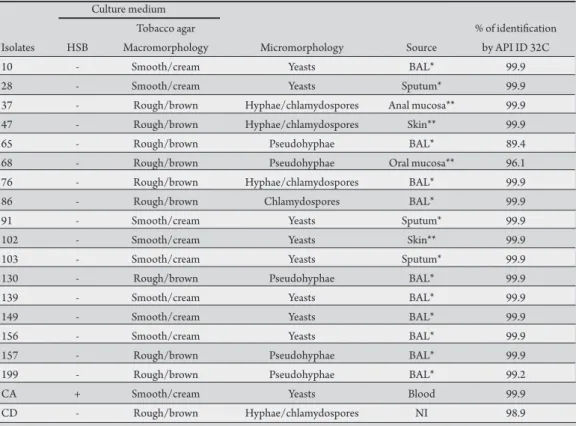
C. dubliniensis on tobacco agar were observed for nine isolates (9/79; 11.4%) inhibited in hypertonic Sabouraud broth. his presented rough/brownish-yellow colonies constituted of pseudohyphae and hypae with chlamydospores. Table 1 summarizes the results obtained on tobacco agar for isolates inhibited in hypertonic Sabouraud broth, and the values indicated the percentage of identiied as C. albicans
by API ID 32C.
Hypertonic Sabouraud broth and tobacco agar were developed to discriminate between C. albicans and C. dubliniensis, based on the diferent phenotypic characteristics of these two species. In these studies11,12, the carbohydrate assimilation was used as a test
standard to identify and correctly diferentiate between the two species. However, our results suggest that there may be a bias in species identiication during the discrimination by API ID 32C system. One reason for this is that the carbohydrate assimilation proile, which is foundation of the API ID 32C identiication system, shows signiicant variations among strains of the same species; some authors have suggested that such tests have low discriminatory power 8,13. Other trials have been conducted that identify C. dubliniensis
by the absence of growth at 42°C and the activity of α-D-glucosidase, but false positives can be obtained because of atypical strains of
C. albicans are capable of displaying these phenotypic aspects14.
he isolates inhibited in hypertonic Sabouraud broth, with typical aspects of C. albicans (colonies white/smooth with single yeasts) on tobacco agar, may represent non-osmotolerant, non-albicans species (e.g., C. glabrata) that are mistakenly identiied by carbohydrate assimilation15,16. It is known that C. albicans isolates ater long-term
storage can produce both morphological and enzymatic changes17,
by phenomenon known as phenotypic switching. This event is spontaneous, reversible and observed at high frequencies18. At despite
459
Rev Soc Bras Med Trop 44(4):457-460, jul-ago, 2011
TABLE 1 - Complete description of tests to discriminate C. dubliniensis from C. albicans based on the lack of growth in hypertonic Sabouraud broth (HSB);morphotyping on tobacco agar of yeasts identiied as C. albicans by API ID 32C.
Culture medium
Tobacco agar % of identiication
Isolates HSB Macromorphology Micromorphology Source by API ID 32C
10 - Smooth/cream Yeasts BAL* 99.9
28 - Smooth/cream Yeasts Sputum* 99.9
37 - Rough/brown Hyphae/chlamydospores Anal mucosa** 99.9
47 - Rough/brown Hyphae/chlamydospores Skin** 99.9
65 - Rough/brown Pseudohyphae BAL* 89.4
68 - Rough/brown Pseudohyphae Oral mucosa** 96.1
76 - Rough/brown Hyphae/chlamydospores BAL* 99.9
86 - Rough/brown Chlamydospores BAL* 99.9
91 - Smooth/cream Yeasts Sputum* 99.9
102 - Smooth/cream Yeasts Skin** 99.9
103 - Smooth/cream Yeasts Sputum* 99.9
130 - Rough/brown Pseudohyphae BAL* 99.9
139 - Smooth/cream Yeasts BAL* 99.9
149 - Smooth/cream Yeasts BAL* 99.9
156 - Smooth/cream Yeasts BAL* 99.9
157 - Rough/brown Pseudohyphae BAL* 99.9
199 - Rough/brown Pseudohyphae BAL* 99.2
CA + Smooth/cream Yeasts Blood 99.9
CD - Rough/brown Hyphae/chlamydospores NI 98.9
CA: Candida albicans, CD: Candida dubliniensis, -: negative, +: positive, BAL: bronchoalveolar lavage, NI: No information. *Hospital, **Outpatient.
of colony in culture medium of routine, such as Sabouraud dextrose agar, during this experiment. Only were obtained colonies smooth/ white before of the proceeding of salt tolerance and submission at tobacco agar. Nevertheless, we cannot to exclude the hypothesis of that the cause from isolates inhibited in hypertonic Sabouraud broth and constituted of pseudohyphaes (n = 5) is the switching. Additionally, this study is one of few relates of that salt tolerance can be afected by phenotypic switching in isolates of C. albicans
storage for long-term, but the inclusion of others parameters, such as molecular identiication, is critical for to corroborate this result.
Tobacco agar was developed for the presumptive identiication of
Cryptococcus neoformans19 and later to discriminate between isolates
of C. albicans and C. dubliniensis with 100% accuracy12, displays
a rough colony on tobacco agar, although isolates of C. krusei, C. tropicalis, and C. parapsilosis also produce fragments of hyphae ater 48h of incubation. his leads us to believe that the three isolates inhibited in hypertonic Sabouraud broth and with morphotyping in tobacco agar suggestive of C. dubliniensis need of conirmation using molecular tools based in species-speciic primers.
Based on these results, the carbohydrate assimilation and phenotyping gave the same result in 78.5% of isolates for identifying
C. albicans. However, the results of 21.5% of the isolates were outliers for biochemistry identiication, suggesting a low discriminatory power between the two closely related species C. albicans and C. dubliniensis. herefore, the low cost and minimal infrastructure necessary to carry out the methodology in our study make the application of hypertonic Sabouraud broth and tobacco agar an atractive strategy to inquire concerning identiication for carbohydrate assimilation in the discrimination between these two species.
ACKNOWLEDGMENTS
he authors declare that there is no conlict of interest.
CONFLICT OF INTEREST
REFERENCES
We expressed our gratitude to American Journal Expert for proofreading this manuscript.
1. Hung CC, Yang YL, Lauderdale TL, Cliford McDonald L, Hsiao C, Cheng H, et al. Colonization of human immunodeiciency virus-infected outpatients in Taiwan with Candida species. J Clin Microbiol 2005; 43:1600-1603. 2. Pfaller MA. Nosocomial candidiasis: Emerging species, reservoirs, and modes
of transmission. Clin Infect Dis 1996; 22 (suppl 2):89-94.
3. Calderone A. Candida and candidiasis. 1st ed. Washington (DC): ASM Press; 2002. 4. Cutler JE. Putative virulence factors of Candida albicans. Annu Rev Microbiol
1991; 45:187-218.
5. Sullivan D, Coleman D. Candida dubliniensis: Characteristics and Identiication. J Clin Microbiol 1998; 36:329-334.
6. Sullivan DJ, Moran G, Donnelly S, Gee S, Pinjon E, McCartan B, et al. Candida dubliniensis: An update. Rev Iberoam Micol 1999; 16:72-76.
7. Selvarangan R, Limaye AP, Cookson BT. Rapid identiication and diferentiation of Candida albicans and Candida dubliniensis by capillary-based ampliication and luorescent probe hybridization. J Clin Microbiol 2002; 40:4308-4312. 8. Gales AC, Pfaller MA, Houston AK, Joly S, Sullivan DJ, Coleman DC, et al.
460
9. Kirkpatrick WR, Revankar SG, Mcatee RK, Lopez-Ribot JL, Fothergill AW, McCarthy DI, et al. Detection of Candida dubliniensis in oropharyngeal samples from human immunodeiciency virus-infected patients in North America by primary CHROMagar candida screening and susceptibility testing of isolates. J Clin Microbiol 1998; 36:3007-3012.
10. Schoofs A, Odds FC, Colebunders R, Ieven M, Goossens H. Use of specialised isolation media for recognition and identiication of Candida dubliniensis isolates from HIV-infected patients. Eur J Clin Microbiol Infect Dis 1997; 16:296-300. 11. Alves SH, Milan EP, Sant’ana PL, Oliveira LO, Santurio JM, Colombo AL.
Hypertonic sabouraud broth as a simple and powerful test for Candida dubliniensis
screening. Diagnostic Microbiol Infect Dis 2002; 43:85-86.
12. Khan ZU, Ahmad S, Mokaddas E, Chandy R. Tobacco Agar, a New Medium for Diferentiating Candida dubliniensis from Candida albicans. J Clin Microbiol 2004; 42: 4796-4798.
13. Salkin IF, Pruit WR, Padhye AA, Sullivan D, Coleman D, Pincus DH. Distinctive carbohydrate assimilation proiles used to identify the irst clinical isolates of
Candida dubliniensis recovered in the United States. J Clin Microbiol 1998; 36:1467.
14. Tintelnot K, Haase G, Seibold M, Bergmann F, Staemmler M, Franz T, et al. Evaluation of phenotypic markers for selection and identification of C. dubliniensis. J Clin Microbiol 2000; 38:1599-1608.
15. Akgül Ö, Çerikçioğlu N. Hypertonic Sabouraud Dextrose Agar as a Substrate for Diferentiation of Candida dubliniensis. Mycopathologia 2009; 167:357-359. 16. Krauke Y, Sychrova H. Four Pathogenic Candida Species Difer in Salt Tolerance.
Curr Microbiol 2010; 61:335-339.
17. Bacelo KL, Costa KRC, Ferreira JC, Candido RC. Biotype stability of Candida albicans isolates after culture storage determined by randomly amplified polymorphic DNA and phenotypical methods. Mycoses 2009; 53:468-474. 18. Soll DR. High frequency switching in Candida albicans. Clin Microbiol Rev 1992;
5:183-203.
19. Tendolkar U, Taniwala S, Jog S, Mathur M. Use of a new médium - tobacco agar, for pigment production of Cryptococcus neoformans. Indian J Med Microbiol 2003; 21:277-279.