On Lean Turbulent Combustion Modeling
Constantin LEVENTIU*
,1, Sterian DANAILA
1*Corresponding author
*
,1“POLITEHNICA”
University of Bucharest, Department of Aerospace Sciences,
Splaiul Independenţei 313, 060042, Bucharest, Romania
[email protected]*, [email protected]
DOI: 10.13111/2066-8201.2014.6.2.6Abstract: This paper investigates a lean methane-air flame with different chemical reaction mechanisms, for laminar and turbulent combustion, approached as one and bi-dimensional problem. The numerical results obtained with Cantera and Ansys Fluent software are compared with experimental data obtained at CORIA Institute, France. First, for laminar combustion, the burn temperature is very well approximated for all chemical mechanisms, however major differences appear in the evaluation of the flame front thickness. Next, the analysis of turbulence-combustion interaction shows that the numerical predictions are suficiently accurate for small and moderate turbulence intensity.
Key Words: lean laminar and turbulent combustion, thermal flame structure, turbulence/combustion interaction.
1. INTRODUCTION
The burning of fossil fuels for energy is still the primary source of global energy production due to their availability and has a significant role in environmental contamination. Lean premixed combustion is one of the most promising concepts for substantial reduction of pollutant emissions because it decreases the burning temperature which leads to a reduction of the NOx formation.
The development of efficient combustion devices in a rapid and cost-effective manner, requires predictive models that should be robust and general as much as possible.
Modelling of a premixed flame in a turbulent flow environment remains a challenging task due to the non-linear coupling of turbulence structures, time- and length-scales, and the combustion process.
Different type of interaction turbulence/combustion, such as flamelets regime (infinitely thin reaction zones), pocket or distributed reaction zone lead to the so-called combustion diagrams where different regimes are identified and delineated by introducing non-dimensional characteristic numbers and length scales ratio. High accurate measurements of the temperature gradient will provide data describing of the instantaneous, thermal structure of premixed flames that can be interpreted and use to validate different models of turbulent combustion.
First, the predicted results for laminar combustion obtained with CANTERA and GRI3.0 mechanism are compared with experimental data.
2. MATEMATICAL MODEL
The complete set of equations governing the fluid flow is obtained from the fundamental conservation laws, and bringing together the continuity, momentum and energy equations. The resulting Navier-Stokes mathematical model is the most general description of the flow of a Newtonian fluid in thermodynamic equilibrium.
Navier-Stokes equations
The full Navier-Stokes equations describing the conservation of mass, momentum, total energy and conservation of N chemical species are [1]:
0 ) ( i i u x t (1)
ij ij
j j i j i p x u u x u
t
) ( ) ( (2) ) ( ) ( )
( j ij j
j v j j u q x q Hu x E
t
(3)
m i im
mi
m Y u V
x t
Y
) ( ) (
, ,m1,2N (4)
where
ij is the shear (viscous) stresses:ij k k ij ij x u s 3 2
2 . (5)
In the above equations, Ym is the species mass fraction of the m-th species, Vi,m is the diffusion velocity of the m-th species in the i-th direction. The internal energy per unit mass is computed as:
p h Y e m N i m 1 (6)where
h
m is the species enthalpy per unit mass given by:
T T m P o m fm T h c d
h
0
,
, . (7)
In the above, hof,m is the enthalpy of formation per unit mass of the m-th species at the
reference temperature T0, cP,mis the specific heat at constant pressure for the m-th species.
The mass reaction rate per unit volume of the m-th species is:
N r r m m w m M 1 , , ˆ , m1,2...M (8)
m r T R p X T R E T A u j M j u r a r r m r m r m
1 , , ,, ( ) exp
ˆ (9)
where m,r and m,rare the stoichiometric coefficients of the m-th species and for the r-th chemical reaction on the product and reactant side, respectively. Ar and Ea,r are the Arrhenius rate pre-exponential coefficient, temperature exponent and activation energy for the r-th chemical reaction, respectively, T is the temperature and Ru is the universal gas constant. Xjis the molar fraction of the j-th species.
The heat flux vector contains the thermal conduction, enthalpy diffusion (i.e. diffusion of heat due to species diffusion), the Dufour heat flux and the radiation heat flux. Dufour heat flux and radiation heat flux are neglected, therefore:
N m m i m m ii h Y V
x T K q 1 , (10)
Diffusion velocity is determined from the Fick’s law:
i m m m m i x Y Y D V , (11)
where DMis the m-th species molecular diffusion coefficient. Gradients of temperature and pressure can also produce species diffusion (Soret and Dufour effects, respectively). The pressure p is directly derived from the equation of state for perfect gas:
N m m mu Y W
R R
1
/ (12)
Finally, total mass conservation is ensured by enforcing:
M m m
Y 1,
V, 0, i1,2,3 Mm m
i (13)
For premixt combustion with constant pressure and adiabatic chemical reaction, instead of solving the conservation equations for species (Ym), a balance equation for the progress variable c [2] can be solved:
j j j j x c D x c u x c
t( ) ( ) (14)
i i eq i i Y Yc / , (15)
where D is the dissipation coefficient of progress variable c, and Yi,eq is equilibrium mass fraction of product species i.
RANS turbulence model
0 ) ( i u x t i (16) j i ij ij j j i j
i p uu
x u
u x u
t( ) ( ) (17)
i i ij j j v j j u H u τ q x q u H x E
t( ) ( ) (18)
The turbulent Reynolds stresses uiuj are calculated using Boussinesq hypothesis:
k x u x u x u u u ij k k i j j i t j
i
3 2 3 2 (19)
where turbulent viscosity t and turbulent kinetic energy k are:
i i
t k uu
k
C
2 1 ; 2 (20)
The introduction of the Favre average variables k and (turbulent dissipation) requires modelled equations, which are for the k
turbulent model: k j k t j j j P x k x k u x k
t( ) ( ) (21)
) (
) ( )
( 1 2
C P C k x x u x
t j k
t
j j
j
(22)
where the production of turbulent kinetic energy
P
k isi j ij k k i j j i t k x u k x u x u x u P 3 2 3 2 (23)
and the closure constants are k 1, 1.3, C1 1.44 and C2 1.92.
The energy flux Hui is calculated by turbulent Prandtl number Prt::
i t t i x H u H Pr (24)
Turbulent combustion modelling
Thus, a thorough understanding of the combustion process would require first to understand the interplay and interdependency between combustion and turbulence. However, the field of turbulent combustion is still an open research topic and significant research efforts are currently underway towards this end.
The turbulence convects/mixes cold reactants and hot products into the reaction zones, where reaction occurs rapidly, so the combustion is said to be mixing-limited. A turbulence-chemistry interaction model, called eddy-dissipation model, based on the work of Magnussen and Hjertager [3] proposes a limited reaction rate given by the smaller of the net rate of production of species m due to reaction r calculated by the two expressions below:
R w r R R R m w r m r m M Y k A M , , , , , min ˆ (25)
Nj jr wj P P m w r m r m M Y k A M , , , , , ˆ (26)
For turbulent premixt combustion the transport equation for the density-weighted mean reaction progress variable c is:
c S x c x c u x c
t t j u t
t j j j Sc ) ( ) ( (27)
where u is the density of unburnt mixture, Sct is the turbulent Schmidt number and St is the turbulent flame speed.
Zimont [4,5] has proposed that turbulent premixed flames can be modelled based on a theory that turbulent premixed combustion takes place with a stationary combustion velocity, that depends on the turbulence and physicochemical parameters of the mixture. This model assumes an increasing flame brush thickness according to the turbulent diffusion law. The turbulent flame speed is calculated as a function of the physicochemical properties of the combustible mixture and turbulence parameters is given as:
4 / 1 4 / 1 2 / 1 4 / 3 t l
t Au S l
S (28)
where A is a model constant, Sl is laminar flame speed, α is molecular heat transfer coefficient of unburnt mixture and lt is turbulence length scale.
3. CASE DESCRIPTION
Flow configuration
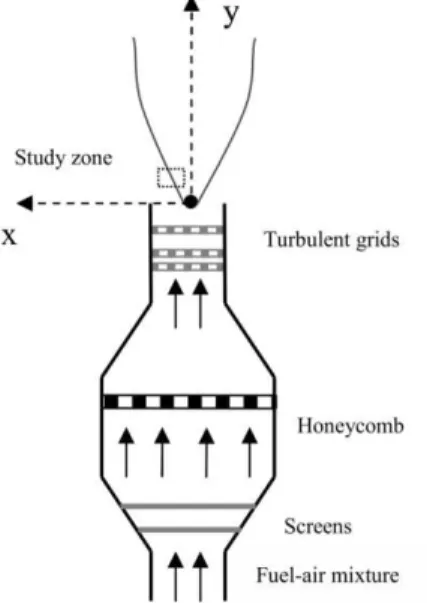
The problem studied is similar to that presented by Lafay [6] and [7]; the experimental setup consists of a vertical wind tunnel (Fig. 1) adapted for stationary combustion. Fuel and air are mixed far upstream from the burner nozzle and laminarized with a divergent-convergent channel and a series of screens and honeycombs providing a very low velocity fluctuation of
near-field, located at 35 mm above the heated rod. For numerical simulation the computational domain is presented in Fig. 2 with an average grid size of 0.25 mm, and the temperature of the heated rod is imposed at 1000K.
Fig. 1 Experimental setup
Fig. 2 Flow simulation configuration
For turbulent cases, an isotropic and homogeneous turbulent flow is generated using perforated plates located upstream the rod. Various blockage ratio and mesh size are used to vary by an order of magnitude the level of turbulence. For the highest turbulence regime MH, a new type of turbulence generator called “Multi-Scale Turbulence Injector” (MoSTI) [8,9] has been designed and tested in the Coria laboratory.
The MoSTI injector is made of three perforated plates shifted in space such that the diameter of their holes and blockage ratio increase with the downstream distance. MoSTI injector provides higher turbulence kinetic energy distributed over a large range of scales. Moreover, homogeneity and isotropy are reached earlier with higher turbulence intensity at a moderate Reynolds number (
Re
≈80) based on the Taylor micro scale.Fig. 3 Location of study regimes in the combustion diagram
Table 1 Investigated turbulent flames
Case u(mm) u' (m/s) u/L <u'
2
>½/SL
B 5.18 0.153 5.08 1.39
E 5.35 0.263 5.24 2.39
F 5.21 0.414 5.11 3.77
Five lean turbulent premixed methane–air flames at equivalence ratio of =0.6 are investigated. The regimes are summarize in Table 1, where: u is integral length-scale, SL is laminar flame speed (SL=0.11 m/s), L is laminar flame thickness (L=1.02 mm).
Locations of investigated regimes in the combustion diagram Fig. 3, are at a quasi-constant integral turbulent length scale, starting from a relatively low turbulence corresponding corrugated flamelets regime (case B), to a very high turbulence, in thin reaction zone (case MH).
Table 2 Tested reaction mechanisms
Mechanism Species Reactions Reference
GRI3.0 53 325 Berkley [10]
SanDiego 50 235 UC San Diego [11]
Leroy 22 49 Leroy 2008 [12]
DRM19 19 84 Kazakov [13]
Sankaran 17 73 Sankaran 2007 [14]
Kee 17 58 Kee 1985 [15]
JL 6 4 Guessab 2012 [16]
WD 6 3 Wang 2012 [17]
R2 5 2 Fluent database
R1 4 1 Fluent database
The reaction mechanisms
For a lean methane-air flame, ten reactions mechanism where implemented in CANTERA and Ansys Fluent. The mechanisms are presented in Table 2, starting with the most complete GRI3.0, with 53 species and 325 reaction and ending with R1 mechanism with only 4 species and one reaction.
The kinetic mechanisms can be classified in three categories: complete GRI3.0 and Sandiego, skeletal Leroy DRM19, Sankaran, Kee and reduced mechanisms the last four. It is very important to assess different mechanism because the cost calculation is increasing with the complexity of the mechanism.
4. RESULTS
Laminar flame
First we start with one dimensional analysis, by testing several complete and skeletal kinetics mechanisms for a lean methane-air flame with CANTERA library. Usually in engineering calculation we are interesting in prediction of burn gases temperature and eventually on the flame thickness but better understanding of the combustion physics is very important, too. One of the analysed quantities is the normal temperature gradient to the flame front direction. For the analysis we use an adimensional temperature named progress variable and defined as:
u ad
u
T T
T T c
(29)
Fig. 4 The progress variable gradient for laminar flame front for different mechanisms (Cantera).
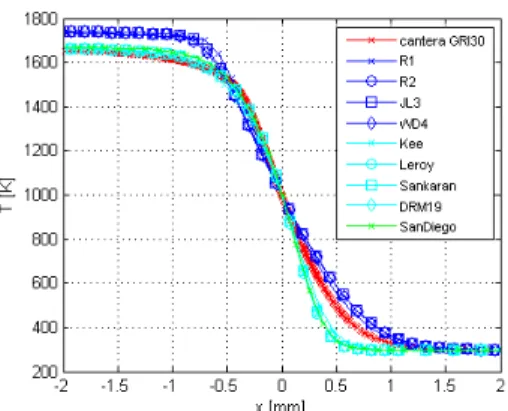
Fig. 5 Laminar flame front temperature profiles for different mechanisms (Cantera).
In Fig. 4 the gradient of progress variable versus progress variable is plotted. For all analyzed mechanism, the shapes are similar. The maximum value of the gradient is located near the 0.65 value of the progress variable. Moreover, the maximum value of the temperature gradient is practically the same for the all models excepting Leroy mechanism. Consequently, the flame thickness obtained with Leroy model is slightly higher in respect to the all other mechanisms. This can be seen in Fig. 5 that shows the predicted temperature distribution versus the flame thickness.
We see again the similarity of prediction for all models and the effect of the small temperature gradient predicted by Leroy model which has a larger preheat zone. Regarding of the burn temperature, all mechanisms have a very well predictions.
Fig. 6 Comparison of experimental and GRI3.0 mechanism results for laminar flame
A comparison between experimental and theoretical results obtained with Cantera software and GRI3.0 mechanisms are presented in Fig. 6, where the gradient of progress variable and standard deviation are plotted along the flame front. The results are very accurate in the preheat and the flame zones but in the burn side the range of experimental data is much larger.
This is due to the noise that has a greater influence in the burn side, because the scattered signal captured by the camera is lower than the signal in unborn side.
Fig. 7 The progress variable gradient for laminar flame front for different mechanisms (Fluent).
Fig. 8 Laminar flame front temperature profiles for different mechanisms (Fluent).
All mechanisms excepting GRI3.0 are implemented in Ansys Fluent due to the imposing limit of 50 species. We observe a distinct behaviour for the complete and skeletal mechanisms from the reduced mechanisms, see Fig. 7. For reduced mechanisms the maximum of the temperature gradient is shifted to the burn side while for the complete and skeletal mechanisms the maximum is shifted on the preheat side, so the flame will be larger for reduced mechanisms (Fig. 8) and much thinner for complete and skeletal mechanisms.
In our opinion the differences are due to the convection effects which are not captured in Cantera software. For the complete mechanisms presence of secondary species change the energetic balance locally and the effect, is an increase of temperature gradient in the preheat zone, so the combustion is amplified and the flame thickness is thinner. Because the chemistry time scale is very small compared with the flow scale this energy distribution effect exceeds the diffusion effect and becomes the key factor in flame development. However, we appreciate that the differences are large, especially in the displacement of the maximum gradient which is not in concordance with the experimental and one dimensional numerical results.
This difference could be due to the precision or the method in which the equations of the chemical model are integrated in Ansys Fluent.
Concerning the temperature values, see Fig. 8, all models practically predict the same temperature for the burn gases. The reduced mechanisms predict higher temperature, but the difference is less than 7%. For industrial applications it can be appreciated that all models offer a good accuracy.
Next, we tried to investigate the influence of transport and thermodynamics properties. We note that the all properties are calculated for the mixture, counting all species contributions in the mechanisms. The prediction for density, specific heat, viscosity and thermal conductivity are plotted in Fig. 9.
The predicted density plotted on the flame thickness direction (Fig. 9a) shows that all models predict a similar variations but because the much thinner flame front predicted by complete and skeletal mechanisms the density gradient is significantly higher for these models. The Fig. 9b refers to the computed density mixture against the dimensionless temperature c.
a) b)
c) d)
e) f)
g) h)
Fig. 9 The prediction of density, specific heat, viscosity and thermal conductivity for all studied mechanisms
Again, we see that the variation of the mixture specific heat with the adimensional temperature is the same for all models, but the distributions on the flame thickness differ. Similar conclusions were obtained concerning the viscosity of the mixture.
We note significant differences on the thermal conductivity values for the mixture, as shown in Fig. 9g and Fig. 9h. In the preheat zone all reduced mechanism predict the thermal conductivity very well, while the complete and skeletal mechanisms presents a much sharper gradient which is in concordance with the displacement of the maximum gradient of adimensional temperature in the preheat zone (Fig. 7). In the burn side all mechanisms predicts lower values for thermal conductivity than the values predicted by Cantera with GRI3.0 mechanism. We believe the differences at high temperatures are caused by the contributions of secondary species for which the assumed laws for thermal conductivity variation with temperature are not well validated.
Turbulent cold flow
To avoid the uncertainties induced by the chemical model and by the turbulence-combustion interaction, first, a cold flow in turbulent conditions is analysed. Turbulence statistics have been previously obtained, in accurate studies, by Samson [8] and Mazellier [9] by Particle Image Velocimetry and Laser Doppler Velocimetry, the evolution, in the flow direction, of the turbulent kinetic energy k (u2 v2 w2)/2 is reported in Fig. 10 where u,v and
w are the velocity fluctuations.
Fig. 10 Experimental and numerical turbulent kinetic energy for cold flow
Table 3 Boundary parameter for velocity inlet
Case Turbulent intensity [%]
Turbulent length scale [m] B 6 0.00050 E 12 0.00055 F 24 0.00063 MH 43 0.00150
The boundary condition parameters imposed for velocity inlet are presented in Table 3 where turbulent intensity is I u/uavg. The results obtained with Ansys Fluent are in good concordance with the experimental results, the small difference for the highest turbulent regime MH are due to the small anisotropy which is present in this case.
Turbulent flame
The predicted temperature along the flame front thickness is presented in Fig. 11. The cases that were investigated correspond to four turbulence intensities, for low and moderate turbulence intensity the calculated and experimental results are sufficiently close, see Fig. 11a and Fig. 11b. With the increase of turbulent intensity the experimental flame thickness is much higher compared with numerical predictions. Partially the differences can be caused by the two dimensional assumptions involved in numerical simulation and partially by the theoretical model for turbulence-combustion interaction used; also for the highest intensity turbulence the experimental results may be not sufficiently accurate because of insufficient number of shots acquired. In the future we will try to simulate the tri-dimensional flow with LES model.
b) Case B b) Case E
b) Case F b) Case MH Fig. 11 Experimental and numerical turbulent flame front temperature profile.
5. CONCLUSION
REFERENCES
[1] C. D. Ghodke, J. J Choi and S. Menon, Large Eddy Simulation of Supersonic Combustion in a Cavity-Strut Flameholder, 49th AIAA Aerospace Sciences Meeting , AIAA 2011-323, 2011.
[2] N. Peters, Turbulent combustion, Ed. Cambrige University Press, 2000.
[3] B. F. Magnussen and B. H. Hjertager., On mathematical models of turbulent combustion with special emphasis on soot formation and combustion, In 16th Symp. (Int’l.) on Combustion. The Combustion Institute. 1976.
[4] V. Zimont, W. Polifke, M. Bettelini and W. Weisenstein, An Efficient Computational Model for Premixed Turbulent Combustion at High Reynolds Numbers Based on a Turbulent Flame Speed Closure, J. of Gas Turbines Power, ISSN: 1528-8919, eISSN: 0742-4795, 120(3),doi:10.1115/1.2818178, 526-532, 1998. [5] V. L. Zimont and A. N. Lipatnikov, A Numerical Model of Premixed Turbulent Combustion of Gases,Chem.
Phys. Report. 14(7). 993–1025. 1995.
[6] Y. Lafay, B. Renou, G. Cabot, M. Boukhalfa, Experimental and numerical investigation of the effect of H2 enrichment on laminar methane-air flame thickness, Combustion and Flame, 153, 540-561, 2008. [7] Y. Lafay, B. Renou, C. Leventiu, G. Cabot, A. Boukhalfa, Thermal structure of laminar methane/air flames:
influnet of H2 enrichement and reactants preheating, Combust. Sci. and Tech., 181: 1145–1163, 2009.
[8] B. Renou, E. Samsom, A. Boukhalfa, An experimental study of freely propagatin turbulent propane/air flames in stratified inhomogeneous mixture, Combust. Sci.Technol., 176 (11) 1–24, 2004.
[9] N. Mazellier, L. Danaila and B. Renou, Multi-scale energy injection: a new tool to generate intense homogeneous and isotropic turbulence for premixed combustion, Journal of Turbulence, Volume 11, N 43, 2010.
[10] *** http://www.me.berkeley.edu/gri-mech/version30/text30.html. [11] *** http://web.eng.ucsd.edu/mae/groups/combustion/mechanism.html.
[12] V. Leroy, E. Leoni and P. A. Santoni, Reduced mechanism for the combustion of evolved gases in forest
fires, Combustion and Flame, 154, 410-433, 2008.
[13] *** http://www.me.berkeley.edu/drm/.
[14] R. Sankaran , E. R. Hawkes, J. H. Chen, T. Lu and C. K. Law, Structure of a spatially developing turbulent lean methane–air Bunsen flame, Proceed. of the Comb. Institute, 31, 1291–1298, 2007.
[15] R. J. Kee, J. F. Grcar, M. D. Smooke, J. A. Miller and E. Meeks, PREMIX: A Fortran Program for Modeling Steady Laminar One-Dimensional Premixed Flames, 1985.
[16] A. Guessab, A. Aris, A. Bounif and I. Gökalp, Numerical analisys of confined laminar diffusion flame – Effects of chemical kinetic mechanisms, IJARET, vol. 4, issue 1, 59-78, 2012.