V Conferência Nacional de Mecânica dos Fluidos, Termodinâmica e Energia MEFTE 2014, 11–12 Setembro 2014, Porto, Portugal APMTAC, 2014
ABSTRACT: The thermal effects of a localized fire bellow a concrete slab with the length of 10 m and the thickness of 30 cm is simulated. The nonlinear equation of heat transfer was solved by finite differences using an implicit scheme. The appropriate mesh size in the direction corresponding to the heat flux resulting from the fire was defined. The temperature results of the two dimensional simulation does not depend on the dimension of the mesh size in the horizontal direction (perpendicular to the heat flux).
KEY-WORDS: Fire; Heat transfer; Concrete slab; Eurocode; Finite differences; Mesh size.
1 STATEMENT OF THE PROBLEM
The main objective of this work is the development of a scientific programming tool that allows modelling the temperature distribution inside a concrete slab subjected to a localized fire. This paper intends to analyse the effect of a car fire accident inside a compartment, made of concrete. When flash-over is unlikely to occur, thermal effects of a localised fire should be taken into account [1].
To obtain the thermal effect of the localized fire, the heat released rate of a utilitarian car was used. The net heat flux incident on the exposed surface of concrete slab was also calculated according to the simplified formulas of Eurocode [1].
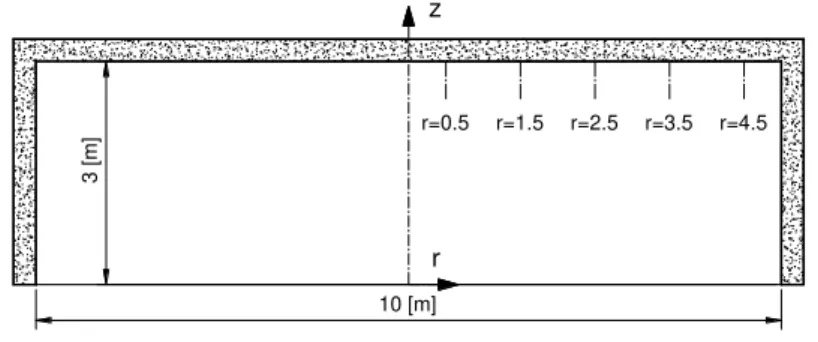
The slab has a length of 10 m and a thickness of 30 cm, but the problem is reduced to the vertical section of the slab that is positioned above the axis of the flame. In this way we obtain a two dimensional domain, corresponding to a very flat rectangular area. Figure 1 represents the section of the compartment where the analysed area is at the top, where r corresponds to the horizontal distance to the vertical axe of the flame.
r=0.5 r=1.5 r=2.5 r=3.5 r=4.5
3
[m]
10 [m]
z
r
Figure 1: Geometry of the compartment.
The temperature inside the plate is governed by the equation of heat transfer:
T T T
k k c
x x y y t
(1)
where k, and c are, respectively, the thermal conductivity, the specific mass and the specific heat of the concrete. The solution is nonlinear, because the material properties varies with temperature. Inside the slab we consider that x is the vertical direction, coincident with the main axis of the flame (z-axis in Figure 1), y is the horizontal direction, perpendicular to the axis of the flame.
Numerical simulation of the thermal effects of localized fires
C Balsa
1,2, B Béjannin
3, S Mouysset
4, P Piloto
1,51Instituto Politécnico de Bragança, Campus de Santa Apolónia, 5300-253 Bragança, Portugal.
2Centro de Estudos de Energia Eólica e Escoamentos Atmosféricos (CEsA), FEUP, Rua Dr. Roberto Frias, 4200-465
Porto, Portugal
3Universitée de Toulouse, INP(ENSEEIHT)-IRIT, 2, rue Charles Camichel, B.P. 7122, 31071 Toulouse Cedex 7,
France
4University of Toulouse, IRIT-UPS, 2, rue Charles Camichel, B.P. 7122, 31071 Toulouse Cedex 7, France 5Instituto de Engenharia Mecânica (IDMEC), FEUP, Rua Dr. Roberto Frias, 4200-465 Porto, Portugal
The numerical solution of equation (1) is obtained by finite difference using implicit discretization schemes. The code is implemented in Matlab. This work follows a previous publication [2] which was addressed to solve the same problem using an explicit scheme.
Section 2 is devoted to the description of the boundary conditions of the slab. Its definition is extremely important because it is through the boundary conditions that the effects of fire are transmitted to the slab. Thereafter, in section 3, we analyse the effect of mesh size in the parallel direction to the axis of the flame, where there is a large temperature gradient on the exposed surface. Section 4 shows the results of simulation in two dimensions covering the vertical section of the slab immediately above the axis of the flame. Section 6 finishes with some observations about the results obtained.
2 BOUNDARY CONDITIONS
The boundary conditions allow transfer to the slab the heat released by the localised fire. The Gasemi method was considered to setup the boundary conditions [1]. This method is applied when the flame is impacting the ceiling. The resulting heat flux (h) depends on the parameters illustrated in Figure 2 [1]. H (m) is the height of the compartment. D (m) is the is the diameter of the fire, r (m) is the horizontal distance between the vertical axis of the fire and the ceiling point where the heat flux is calculated,Lh (m)
is the horizontal flame length that depends on H and on Q, the rate of heat release of the fire.
Figure 2: Geometry of the compartment [1].
The heat flux
h
[W/m2] received by the exposed surface area at the level of the ceiling is given by:3.7
100000 if 0.3
136300 121000 if 0.3 1
15000 if 1
h y
h y y
h y y
(2)
The parameter y depends on the diameter D and on the heat release rate Q. For the heat release of the fire we have choose the typical curve that corresponds to a utility car. This curve as trapezoidal form with a maximum value equal to 18 MW that corresponds to a conservative value for the dimensioning [3].
The net heat flux h that affects the exposed surface of the slab along its entire length (from r0
tor5), from the beginning (t0) to the end of the fire duration (t1500s). The values of the net heat flux are represented in Figure 3 for different values of r. We consider also that he values of the heat flux are symmetric relatively to the axe o of the flame (see Figure 2).
Additionally, the heat of the slab loosed by radiation and convection was also considered. In the exposed surface area the heat flux by radiation is calculated using equation (3),
4 4273 293
r m f m
h (3)
where represents the configuration factor, m is the surface emissivity of the member, f is the
emissivity of the fire, is the Stephan Boltzmann constant and m is the surface temperature of the
member [°C]. In the unexposed and exposed surfaces of the slab, the convective heat flux is also calculated according to equation (4),
20
c c m
Figure 3: Net heat flux h for different values of r.
where c is the coefficient of heat transfer by convection [W/m
2K]. The insulation boundary condition
was imposed on the left and right side of the slab.
3 SETUP OF THE GRID SIZE IN ONE DIMENSION
The numerical solution of equation (1) in one dimension was solved along the vertical direction that corresponds to the axis of the flame (r0in Figure 1). The grid size by finite differences was defined using an implicit scheme as described by Patankar [4].
Figure 4: Temperatures across the slab on the axe of the flame obtained with 2
0.5 10
x
m.
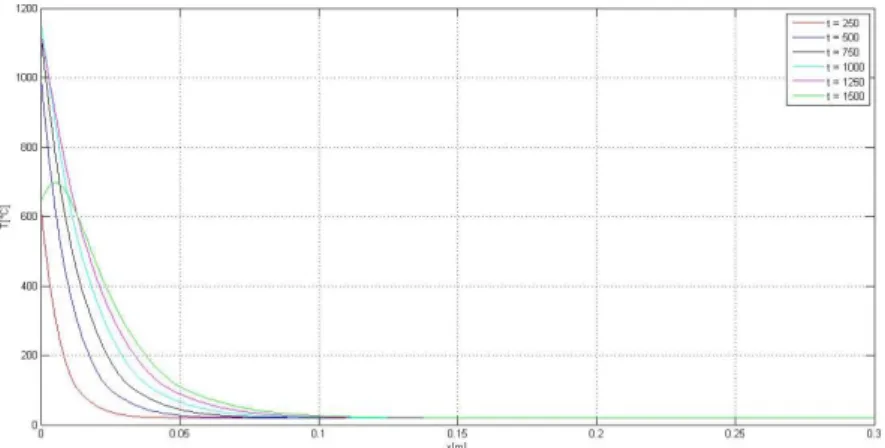
The grid size was set up with a uniform value and then the variation effect was analysed. Figure 4 shows the variation of the temperature across the slab on the axis of the flame at different times, obtained with
2
0.5 10
x
m. The maximum temperature is near to 700 ºC and occurs in the exposed side of the slab. During fire development, temperature inside the slab increases as well as the maximum temperature at the exposed side. When fire approaches the end and the incident heat flux is almost zero, the temperature of the exposed surface is lower than the temperature inside the slab. Figure 5 represents the temperature solution with a grid size five times smaller.
Results of Figures 4 and 5 show that the problem is sensitive to the dimension of the spatial grid. If grid size x is reduced to 10-3 m the temperature curves are shifted to higher values (see Figure 5). This
Figure 6 shows the temperature evolution of the exposed surface of the slab for different grid size. As we can observe, smaller values of x lead to temperature curves with higher values. But values of x smaller than 10-3 m are responsible just for slight increases in temperature.
The results obtained with x 103m are satisfactory. However, in order to reduce the computational effort, a grid with variable step was implemented. This grid size was modified by a factor higher than 1.0 to increase the grid where there is no significant temperature gradient
1 .
i i
x x
(5)
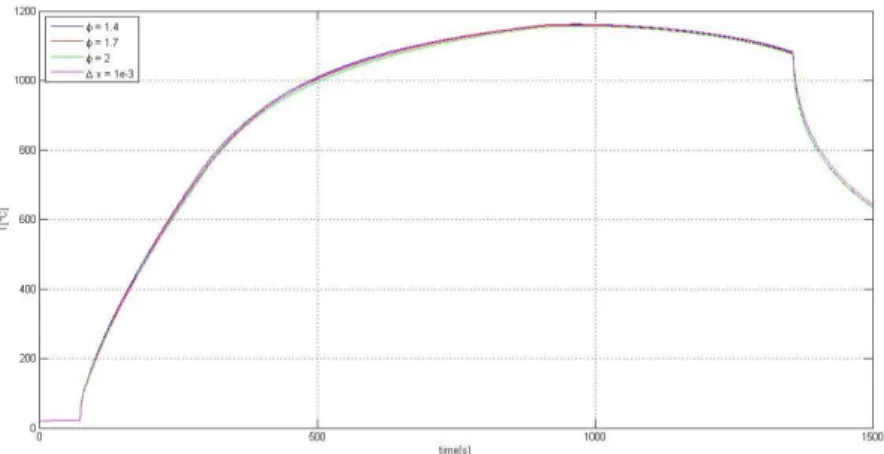
Figure 7 contains the evolution of the temperature at the bottom of the slab resulting from different grid with different values of the step factor. As comparison it is also included the curve resulting from the discretization with a constant step 3
10
x
m. The values obtained with 1.4 are very close to the values obtained with a constant step 3
10
x
m and enables a considerable reduction in terms of computational work because it reduces the total number of operation and the requirements of memory storage. From now on, the grid size will be described by equation (5) using1.4.
Figure 5: Temperatures across the slab on the axis of the flame obtained with 3 10
x
m.
Figure 6: Temperatures at the bottom of the slab on the axis of the flame, for different values of x.
4 TWO DIMENSIONAL SIMULATION
To determine the temperature field in the cross section of the slab located on the axis of the flame, an implicit scheme described by Patankar [4] was used. The Cartesian coordinates are y as the horizontal direction and x as the vertical direction (similarly to the resolution in one dimension).
Figure 7: Temperatures at the bottom of the slab on the axis of the flame, for different step factor.
0.1 y
m and t1300s y 0.5m and t1300s
Figure 8: Temperatures inside the slab at t = 1300 s, for different values of y.
Figure 9: Evolution of the temperature inside the slab.
In Figure 9 we show the temperature distribution within the slab in two different time instants (t400s and t1600s) of the fire. The highest temperatures occur always near the edge in contact with the flames. Most of the slab remains at low temperatures and little affected by heat.
5 CONCLUSIONS
The solution of heat transfer equation in a concrete slab subject to a localized fire is a very sensitive problem due to the high temperature gradients existing in the exposed surface. Because of the low conductivity of the concrete there is a large temperature gradient between the exposed surface boundary of slab and the neighbouring points. Large values of the grid size in this direction can lead to erroneous results.
REFERENCES
[1] CEN – Comité Europeu de Normalização (2004). EN1992-1-2 - Eurocódigo 2: Projecto de Estruturas de Betão – Parte 1–2: Regras Gerais – Verificação da Resistência ao Fogo, Bruxelas.
[2] NGR Caiado (2012). Simulação Numérica do Comportamento Térmico de Compartimentos Sujeitos a Incêndios Localizados, Tese de Mestrado, Escola Superior de Tecnologia e Gestão, Instituto Politécnico de Bragança. [3] C Harmemza, AMC Santiago, LAP Simões da Silva (2011). Metodologias de dimensionamento de parques de
estacionamento abertos mistos aço-betão em situação de incêndio. In VIII Congresso de Construção Metálica e Mista, Guimarães, Portugal.
![Figure 2: Geometry of the compartment [1].](https://thumb-eu.123doks.com/thumbv2/123dok_br/16862285.753715/4.892.297.609.426.618/figure-geometry-of-the-compartment.webp)