Endovascular approach for isolated common iliac
aneurysm and severe kyphoscoliosis
Tratamento endovascular de aneurisma isolado de artéria ilíaca
comum e cifoescoliose grave
Alexandre Campos Moraes Amato, Germano Melissano, Xiaobing Liu,
Efrem Civilini, Roberto Chiesa*
Introduction
Isolated iliac artery aneurysms are rare.1 They are found in only about 0.03%2of the general population and represent 2% of all abdominal aneurysms.3-5Moreover, its association with severe kyphoscoliosis, to our best know-ledge, was not previously reported.
Although open surgical repair with prosthetic graft is the gold standard treatment for iliac artery aneurysms,3,4,6 an increasing number of reports show that endovascular repair is possible, with several advantages.4,7-11
The purpose to this study is to report a case of a patient with an isolated left common iliac aneurysm with occlusi-on of the right commocclusi-on iliac artery and severe kyphoscoli-osis and gibbosity causing extreme vessel tortuosity. He was successfully treated with a carefully planned endovas-cular approach.
Case report
A 72-year-old man was admitted at our service with a 5.6 cm isolated left common iliac aneurysm with occlusion of right common iliac artery discovered during ultrasound screening.
The patient was a former heavy smoker who also had hypertension. He had no previous history of aneurysms. However, 2 years before, he had a trauma with lumbar ver-tebrae fracture (L2 and L3) and secondary spinal canal ste-nosis. His physical examination revealed severe kyphos-coliosis, gibbosity in lumbar region, significant thoracic asymmetry and obesity.
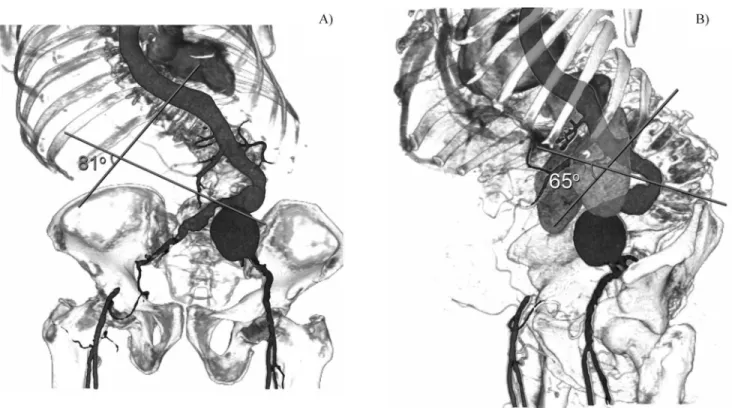
A preoperative CT scan was performed (Figure 1) showing the isolated left common iliac aneurysm and an important tortuosity of the abdominal aorta subsequent to the tortuosity of the spine (video available online at
277
J Vasc Bras. 2009;8(3):277-280.
Copyright © 2009 by Sociedade Brasileira de Angiologia e de Cirurgia Vascular
* Chair of Vascular Surgery, Vita-Salute University, Scientific Institute H. San Raffaele, Milan, Italy. No conflicts of interest declared concerning the publication of this article.
Manuscript received Nov 11 2008, accepted for publication May 05 2009.
CASE REPORT
Abstract
We report the case of a 72-year-old patient presenting with an iso-lated common iliac aneurysm with occlusion of contralateral common iliac artery and severe kyphoscoliosis. Because of high risk for open sur-gery due to chronic obstructive pulmonary disease, this patient was treated with an endovascular approach using an aortomonoiliac stent graft, followed by a femoro-femoral crossover bypass. This report illus-trates the usefulness of a minimally invasive approach, and feasibility even for patients with difficult anatomy.
Keywords: Aneurysm; aortic and iliac surgery; endovascular treatment, adult; therapeutic; iliac aneurysm; stents; tomography, treat-ment outcome; vascular patency.
Resumo
Relatamos o caso de um paciente de 72 anos com aneurisma isolado de ilíaca, oclusão contralateral de artéria ilíaca comum e cifoes-coliose grave. Devido ao alto risco para cirurgia convencional em razão de doença pulmonar obstrutiva crônica, o paciente foi tratado com abor-dagem endovascular, utilizando uma endoprótese aortomonoilíaca, se-guida de uma derivação fêmoro-femoral cruzada. Este relato ilustra a utilidade de uma abordagem minimamente invasiva e demonstra que, mesmo para pacientes com anatomia difícil, é factível.
www.scielo.br/jvb). In the radiological examination, left convex dorsal and right convex lumbar scoliosis were sta-ted, denoting an 81-degree lumbar scoliosis in frontal pla-ne (Figure 1A) and a 65-degree kyphotic curvature in the sagittal plane (Figure 1B).
During surgical risk stratification, electrocardio-graphy stated left bundle branch block, echocardioelectrocardio-graphy revealed moderate left ventricular hypertrophy and a rest ejection fraction of 55%, suggesting a previous mild asymptomatic myocardial infarction. He also had a severe respiratory insufficiency due not only to chronic obstructi-ve pulmonary disease, but also to restrictiobstructi-ve disorder, which turned him into a night bi-level positive airway pressure dependent.
Due to the obvious risks of open surgery and despite the anatomical difficulties, endovascular approach was preferred over open surgery. The procedure was perfor-med in the operating room and a portable digital C-arm image intensifier was used. Under local anesthesia, left fe-moral artery was surgically exposed. At this time, 5000 IU of unfractionated heparin were administered intrave-nously. A standard 8F sheath was inserted over guidewire.
Angiography showed a large left common iliac aneurysm. Selective catheterization using a Simmons-2 catheter and left hypogastric artery embolization with five coils (0.035 inch in diameter and 5 cm in length; MReye stain-less-steel coils; William Cook Europe) were performed. A Lunderquist extra-stiff guidewire was inserted through the catheter, over which a stent graft (24-12 mm in diameter and 131 mm in length; Zenith® Aortomonoiliac Graft ZCMD-24-12-131-SR-UNI-E-ENDO; William Cook Eu-rope Aps) was infrarenally deployed, excluding the com-mon iliac aneurysm and covering collateral circulation. Completion angiography revealed correct placement of the endograft, with complete exclusion of the aneurysm and hypogastric artery without evidence of endoleaks and good renal flow. Following the endovascular procedure, right femoral artery was surgically exposed, and a femo-ro-femoral crossover bypass procedure (InterGard® 6 mm ringed, InterVascular) was performed.
The postoperative period was uneventful. The patient was discharged home 3 days after the procedure. He is ali-ve and asymptomatic at 1-year follow-up.
278 J Vasc Bras 2009, Vol. 8, N° 3 Endovascular approach for common iliac aneurysm and kyphoscoliosis – Amato ACM et al.
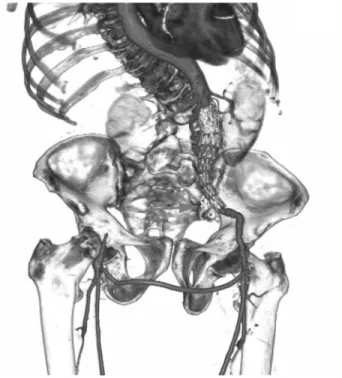
A CT scan performed 12 months after the surgery de-monstrated endograft and femoro-femoral graft patency, complete exclusion of left common iliac aneurysms wit-hout evidence of endoleak (Figure 2 and video available online at www.scielo.br/jvb) and shrinkage of the aneury-smal sac from 98.24 cm3 measured in preoperative CT scan to 35.3 cm3(Figure 3).
Discussion
Aorta and major vessels may change their normal path due to scoliosis13,14 and irregular aortic blood flow may lead to aneurysm formation.14,15 Vessel tortuosity can make endovascular repair technically challenging.16,17In the presented case, moreover, severe respiratory insuffici-ency and thoracic deformity were also contraindications to open surgery. Thus, the best treatment for this case was du-bious.
Open repair of common iliac aneurysms is the current gold standard. However, endovascular technique carries a number of potential advantages, as it avoids general anest-hesia and aortic clamping, reduces operative blood loss and transfusion requirements, shortens hospital stays and limits the overall physiological stress associated with con-ventional open surgery1,4,8-10,18Pitoulias et al.9stated that endovascular repair is safe and effective in cases without anatomical challenges, with better intraoperative and early postoperative outcomes, as well as durable mid-term
re-sults, concluding that endovascular procedure should be offered as first-line therapy.
Literature shows that coil embolization of the internal iliac artery is performed in 37-78% of the cases,1,9and it
Endovascular approach for common iliac aneurysm and kyphoscoliosis – Amato ACM et al. J Vasc Bras 2009, Vol. 8, N° 3 279
Figure 2- Three-dimensional reconstruction of postoperative CT scan with OsiriX software showing left endograft and femoro-femoral bypass graft patency, right iliac occlusion and complete exclusion of common iliac aneurysm. The arrow points to the coils used in the procedure to prevent backflow from the hypogastric branches
was also performed in the case reported here to prevent backflow into the aneurysm.
Post-processing preoperative CT scan with OsiriX software12allowed accurate measurement and planning of the endovascular procedure. The aortomonoiliac endograft used to expressly adapt to the patient’s particular anatomy, with a short proximal large segment, designed to fit the aorta, followed by a long narrow iliac segment, designed to fit the iliac artery, allowed it to be deployed even in this tortuous artery.
Complete exclusion of the iliac aneurysm resulted in significant shrinkage of the aneurysmal sac after only 1 year, proving the efficacy of the method. Our encouraging result demonstrates acceptable mid-term graft patency.
In conclusion, this report confirms the feasibility of endovascular repair of isolated common iliac aneurysms in complex vessel anatomy worsened by severe kyphoscolio-sis. New generation devices are more adaptable to difficult anatomy, broadening endovascular approach and allowing us to make a personalized choice for each patient.
Supplementary online information:Video available at www.scielo.br/jvb - Three-dimensional reconstruction movie of preoperative and postoperative CT scan with OsiriX software.
References
1. Boules TN, Selzer F, Stanziale SF, et al. Endovascular man-agement of isolated iliac artery aneurysms. J Vasc Surg. 2006;44:29-37.
2. Brunkwall J, Hauksson H, Bengtsson H, Bergqvist D, Takolander R, Bergentz SE. Solitary aneurysms of the iliac arterial system: an estimate of their frequency of occurrence. J Vasc Surg. 1989;10:381-4.
3. Lowry SF, Kraft RO. Isolated aneurysms of the iliac artery. Arch Surg. 1978;113:1289-93.
4. Huang Y, Gloviczki P, Duncan AA, et al. Common iliac ar-tery aneurysm: expansion rate and results of open surgical and endovascular repair. J Vasc Surg. 2008;47:1203-10; dis-cussion 1210-1.
5. Richardson JW, Greenfield LJ. Natural history and manage-ment of iliac aneurysms. J Vasc Surg. 1988;8:165-71.
6. Minato N, Itoh T, Natsuaki M, Nakayama Y, Yamamoto H. Isolated iliac artery aneurysm and its management. Cardiovasc Surg. 1994;2:489-94.
7. Marin ML, Veith FJ, Lyon RT, Cynamon J, Sanchez LA. Transfemoral endovascular repair of iliac artery aneurysms. Am J Surg. 1995;170:179-82.
8. Caronno R, Piffaretti G, Tozzi M, et al. Endovascular treat-ment of isolated iliac artery aneurysms. Ann Vasc Surg. 2006;20:496-501.
9. Pitoulias GA, Donas KP, Schulte S, Horsch S, Papadimitriou DK. Isolated iliac artery aneurysms: endovascular versus open elective repair. J Vasc Surg. 2007;46:648-54.
10. Wolf F, Loewe C, Cejna M, et al. Endovascular management performed percutaneously of isolated iliac artery aneurysms. Eur J Radiol. 2008;65:491-7.
11. Chaer RA, Barbato JE, Lin SC, Zenati M, Kent KC, McKinsey JF. Isolated iliac artery aneurysms: a contempo-rary comparison of endovascular and open repair. J Vasc Surg. 2008;47:708-13.
12. Ratib O, Rosset A. Open-source software in medical imag-ing: development of OsiriX. Int J Comput Assist Radiol Surg. 2006;1:187-96.
13. Sucato DJ, Duchene C. The position of the aorta relative to the spine: a comparison of patients with and without idio-pathic scoliosis. J Bone Joint Surg Am. 2003;85-A:1461-9. 14. Richardson NG. A case of ruptured abdominal aortic
aneu-rysm in association with congenital kyphoscoliosis. Eur J Vasc Surg. 1993;7:586-7.
15. Vollmar JF, Paes E, Pauschinger P, Henze E, Friesch A. Aor-tic aneurysms as late sequelae of above-knee amputation. Lancet. 1989;2:834-5.
16. Erzurum VZ, Sampram ES, Sarac TP, et al. Initial manage-ment and outcome of aortic endograft limb occlusion. J Vasc Surg. 2004;40:419-23.
17. Carroccio A, Faries PL, Morrissey NJ, et al. Predicting iliac limb occlusions after bifurcated aortic stent grafting: Ana-tomic and device-related causes. J Vasc Surg. 2002;36:679-84.
18. Laganà D, Carrafiello G, Recaldini C, et al. Endovascular treatment of isolated iliac artery aneurysms: 2-year fol-low-up. Radiol Med. 2007;112:826-36.
Correspondence:
Dr. Germano Melissano, MD
IRCCS H. San Raffaele, Department of Vascular Surgery Via Olgettina, 60
20132 – Milan, Italy Tel.: +39 02.2643.7146 Fax: +39 02.2643.7148
E-mail: [email protected]