SAFYRE
TM: A READJUSTABLE MINIMALLY INVASIVE SLING FOR
FEMALE URINARY STRESS INCONTINENCE
PAULO C.R. PALMA, CASSIO L.Z. RICCETTO, MÍRIAM DAMBROS, MARCELO THIEL,
ROGÉRIO DE FRAGA, NELSON R. NETTO JR
Division of Urology, State University of Campinas, Unicamp, Campinas, São Paulo, SP, Brazil
ABSTRACT
Introduction: SAFYRETM is a readjustable and minimally invasive sling for the treatment of
stress urinary incontinence (SUI). It is as a pubovaginal sling placed in the medial third of the urethra. The initial experience is described.
Materials and Methods: Forty-five patients (mean age = 59 years) underwent a SAFYRETM
implant to treat SUI. Physical examination and urodynamic study were performed before surgery. All patients presented symptoms of SUI and 20% also reported mild urgency. Approximately 60% of this group had a previously failed anti-incontinence procedure. Urethral hypermobility was diagnosed in 40% of the patients and intrinsic sphincter deficiency (ISD) in 60% of the cases.
Results: The average follow up period was 10 months. The mean operative time was 20 min-utes. Dystopia repair was performed whenever necessary, during the same procedure. The average hos-pital stay was 24 hours. In 11% of the implants, bladder perforation occurred. During the postoperative period, 9 patients (20%) developed transient urgency symptoms. During the initial follow up period, 90% were found to be continent, 3% reported an improvement and 7% were unchanged.
Conclusion: SAFYRETM is a safe and quick procedure that allows postoperative
readjust-ment. This technique may be an attractive alternative in the management of SUI, should the good result obtained so far prove to be long lasting.
Key words: urinary incontinence, stress; prostheses and implants; reconstructive surgical procedures Int Braz J Urol. 2003; 29: 353-9
INTRODUCTION
Autologous pubovaginal sling is the choosen treatment for complex cases of stress uri-nary incontinence (SUI) (1). Preference for autolo-gous material was largely due to 2 basic concerns: implant infection and urethral erosion (2).
On the other hand, the use of synthetic slings transforms major surgeries into minimally in-vasive procedures and also reduces operative time and hospital stay as well as postoperative discom-fort and the recovery period (1).
The readjustable and self-anchoring SAFYRETM sling has recently been added to the
ex-isting therapeutic arsenal. It is a tension-free,
syn-thetic sling, placed at the mid urethra that makes ure-thral erosion unlikely.
According to the integral continence theory (3), the medial and distal third regions of the ure-thra are the most important regions in urinary con-tinence because of the insertion of the pubourethral ligament and the pelvic muscle floor (4). Should postoperative urinary leakage or retention occurs, this innovative device allows for tension readjust-ment (3).
Slings are now being used more often and the SAFYRETM system, which has imbibed these new
MATERIALS AND METHODS
Patients
An open prospective non-randomized clinical study involving SUI patients was conducted after receiving the approval of the Hospital Ethics Committee.
From February 2001 to July 2002, 45 pa-tients with SUI diagnosis underwent the SAFYRETM
implant. The patient’s ages ranged from 42 to 72 years (mean age 59 years). The work-up for incon-tinence included clinical examination and urodynamic study.
After the surgery, the recall was monthly for clinical assessments. At these monthly recalls, the patients were questioned about presence of sponta-neous micturition, involuntary urinary leakage, blad-der irritative symptoms, vaginal or suprapubic pain and questions related to the degree of satisfaction with the procedure.
Besides history, a physical examination was performed during follow-up to access continence and to verify signs of infection or erosion of the vaginal wall.
The surgical results were classified accord-ing to Blaivas & Jacobs (5) into 3 categories: a) cured - absence of incontinence; b) improved - frequency of incontinence episodes less than once every 2 weeks; c) failure - frequency of incontinence episodes more than once a week.
During preoperative evaluation, all patients showed urinary leakage during repeated Valsalva ma-neuvers. None of them presented significant degree of atrophic vaginitis, even among post-menopausal pa-tients. The gynecological examination revealed the presence of mild cystocele in 13 patients (30%), 90% of the cases was grade I and the rest grade II. Recto-cele was diagnosed in 4 patients (9%) and only cases of grade II cystocele were repaired. The dystopias were corrected during the SAFYRETM implant surgery.
Urodynamic evaluation disclosed urethral hypermobility in patients with Valsalva leak point pressure (VLPP) above 90 cm H2O and intrinsic sphincter deficiency when VLPP was less than 60 cm H2O. Intermediate VLPP values were analyzed along with clinical information to establish the
di-agnosis (6,7). Using these criteria, 18 patients (40%) were diagnosed as intrinsic sphincteric deficiency and in 27 patients (60%) urethral hpermobility. Patients who presented involuntary detrusor contractions dur-ing bladder filldur-ing or infravesical obstruction were excluded from the study but those with irritative symp-toms without urodynamically proven involuntary con-tractions were included. Although urodynamically proven detrusor instability does not have a signifi-cant effect on surgical outcome, this decision was based on the concept regarding the postoperative im-provement of sensory urgency, as described previ-ously (8). Patients with involuntary detrusor contrac-tions were excluded from this initial study due to the less favorable prognosis regarding post-operative ir-ritative symptoms (9).
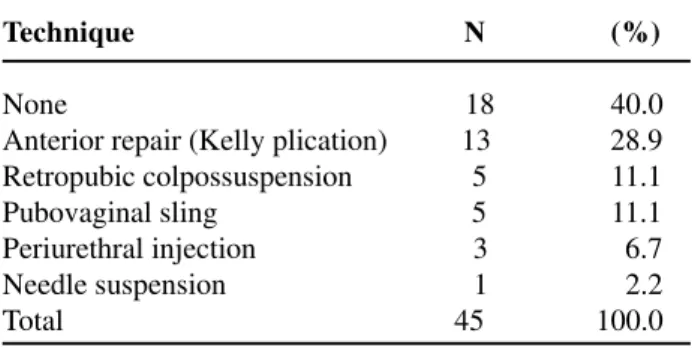
Urgency in association with urinary leakage symptoms was reported by 20% of the patients while 60% of the patients reported a history of previous surgical treatment for incontinence; the one most com-monly performed was the anterior vaginal repair (Table-1).
Material
SAFYRETM consists of a polypropylene mesh
that acts as a urethral support, held between 2 self-anchoring tails made of polydimethylsiloxane polymer. These tails are the basis of the readjust able self-an-choring system. In order to minimize the surgical dam-age to pelvic floor natural support structures, a special 3.5 mm in diameter needle, allows for both suprapubic and transvaginal approaches, according to the surgeon best skills. The versatile needle is assembled for
trans-Table 1 – Previous surgical procedures for stress urinary incontinence.
Technique N (%)
vaginal approach when the hooked extremity is intro-duced inside the needle holder, and for supra pubic approach when assembled the other way (Figure-1).
Surgical Technique
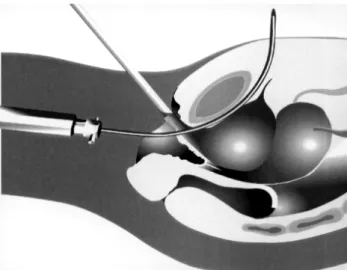
Two 0.5 cm transverse incisions are made close to the superior aspect of the pubic bone 5 cm apart. A longitudinal vaginal incision, 1.5 cm in length is made, starting 1 cm from the urethral me-atus. Notice that this incision is not allowed en-croaching on the bladder neck. Dissection is done to create a 1 cm tunnel lateral to the urethra for the introduction of the needle. First, the needle is ad-vanced through the vaginal tunnel until the perfora-tion of pelvic floor at the level of the mid-urethra. Then, it is redirected against the back of pubic bone and advanced continuously to the previously made landmarks in the suprapubic area (Figure-2). Cys-toscopy is performed to rule out bladder
perfora-tion. After the removal of the holder, SAFYRETM is
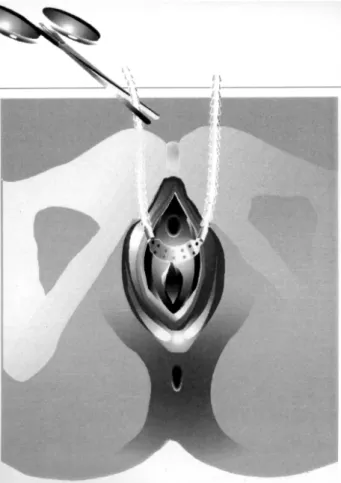
attached to the needle and pulled out to the supra-pubic area (Figu3). The same maneuvers are re-peated on the other side. The proper tension of the sling is adjusted maintaining a Metzenbaum scis-sors between the urethra and the sling, to prevent undue tension (Figure-4). The extremities of the sling are cut and the Metzenbaum scissors removed (Figure-5). No further fixation is needed and the incisions are closed in the usual manner. An ind-welling catheter is left in place overnight.
Readjustment Technique
The procedure to tight the SAFYRETM can
be performed under local or spinal anesthesia. As the extremities of the polydimethylsiloxane tails can be easily palpable in the subcutaneous tissue, local an-esthesia with lidocaine 1% solution seems to be the method of choice. Usually, the readjustment of only one tail is enough, without risk of significant devia-tion of the urethral axis. A small incision is made over the palpable tail extremity (close to the superior aspect of the pubic bone) and it is gentle dissected and grasped using a haemostatic clamp. Then, it is pulled carefully, until the proper tension is achieved. During this maneuver, a cystoscope sheath should be maintained inside the urethra, to prevent over correc-tion. The bladder is filled with saline solution before the procedure, so the patient can be asked to cough Figure 1 - SAFYRETM sling set.
Figure 2 - After perforation of the endopelvic fascia, the needle is directed through the retropubic space close to the pubic bone.
and to do repeated Valsalva maneuvers to check if leakage occurs. Prophylactics antibiotics are used for 3 days. Generally, the readjustment is proposed before 30 days postoperative, but theoretically it can be done at any time after the procedure, because of the forma-tion of a fibroblastic pseudocapsule surrounding the polydimethylsiloxane tails of SAFYRETM, that permits
easy dissection and mobilization of the tails inside this pseudocapsule, whenever it became necessary.
The procedure to loosen the SAFYRETM can
be performed under spinal, intravenous or local anes-thesia. When local anesthesia is used, both suprapubic area (including rectus muscle and fascia) and anterior vaginal wall (including urethropelvic fascia) have to be anesthetized with lydocaine 1% solution. A longi-tudinal vaginal incision, 1.5 cm in length is made, start-ing 1 cm from the urethral meatus, and the
polypropy-lene mesh is dissected from the urethropelvic fascia. The tails are dissected bilaterally, grasped with haemostatic clamps and pulled back, until a Metzenbaum scissors or a right-angle clamp can be interposed between the mesh and the urethra. A Foley catheter is left in place overnight and prophylactics antibiotics are used for 3 days.
RESULTS
The follow up period ranged from 2 to 17 months, the mean follow up period was 10 months. The mean duration of the procedure was 20 minutes (15 to 35 minutes) and the mean hospital stay was 24 hours (from 12 to 36 hours). All procedures were per-formed under spinal anesthesia. Perforation of the up-per lateral wall of the bladder occurred in 5 patients Figure 4 - A Metzenbaum scissors is placed between the tape
and the urethra for proper tension adjustment.
(11%), including, 2 patients that have been previously submitted to a retropubic colpossuspension and to an anterior repair as well. A Foley catheter was left in place for 48 hours and the patients presented no com-plications.
The diagnosis of urinary retention was done when the residual volume, obtained by post micturi-tion urethral catheterizamicturi-tion, was higher than 100 ml. Patients which could not present spontaneous mictu-rition in the immediate post-operative period were maintained in a clear intermittent catheterization pro-gram until 4 weeks post-operatively when a loosen-ing procedure was performed if retention had per-sisted. All of the patients that presented spontaneous micturition in early post-operative period showed post-void residual less than 100 ml and were consid-ered without retention. Following the above criteria, postoperative urinary retention occurred in 3 patients (6.7%) that had not presented spontaneous micturi-tion after 4 weeks post-operatively. All underwent sling tension loosening under local anesthesia and voided spontaneously, with completed relief of irri-tative symptoms and with a mean post void residual volume of 60 ml after the procedure.
There were 4 cases (9%) of vaginal wall in-fection but no vaginal or urethral wall erosion. Tran-sient irritative voiding symptoms were reported by 9 patients (20%) during the immediate postoperative period (up to 4 postoperative weeks). None of the patients presented pelvic floor defects that required surgical correction during the follow-up.
According to Blaivas & Jacobs criteria (5) after 10 months mean follow up, 40 patients (90%) were considered cured, 2 (3%) reported significant improvement and 3 patients (7%) were dissatisfied with the procedure and were considered as failures.
DISCUSSION
Pubovaginal slings and the retropubic urethrocystopexies are the procedures that can lead to the best continence results in long-term follow up (1). Autologous pubovaginal slings, however, imply in a considerable period of surgical training and the inconvenient need for a donor site to obtain the
fas-cia to be used in the surgery as well as the risks of infra-vesical obstruction and voiding dysfunction (3). Retropubic urethrocystopexies, on the other hand, im-ply an abdominal incision with increased morbidity and hospital stay, high costs when performed using a laparoscopic access and a time consuming learn-ing curve (4). Therefore all efforts towards the de-velopment of minimally invasive techniques are jus-tifiable.
From a conceptual standpoint, the SAFYRETM corresponds to a sling. So, the creation
of a suburethral support zone increases urethral re-sistance and diminishes the rotational as well as the descending movement of the urethra when abdomi-nal pressure increases. Additioabdomi-nally, it improves the coaptation of the urethral lumen at rest and under stress. However, contrary to the classical pubovaginal slings, the SAFYRETM is applied in the middle third
of the urethra, where the pubourethral ligaments re-sponsible for natural stability of the urethra are in-serted (10). The SAFYRETM self-anchoring system
is created by a sequence of 4 mm cones, creating a hook-like effect on the pelvic fascias and the abdomi-nal rectus muscle as well (11,12).
Although most patients had previously un-dergone an anti-incontinence procedure, no compli-cations or technical operative difficulties were no-ticed. Contrary to previous reports, rejection of im-planted material was not observed with this synthetic sling (2).
SAFYRETM insertion is tension-free and is
possible. The unique feature of SAFYRETM allows
for postoperative tension readjustment without dif-ficulties. These patients underwent sling readjust-ment under local anesthesia and voided sponta-neously, with completed relief of irritative symp-toms and with a mean post void residual volume of 60 ml.
Although this study have not compared SAFYRETM to other minimally invasive techniques,
such as Tension-free Vaginal Tape (TVT) or simi-lar, there are specific and significant differences con-cerning the biochemical and biomechanical proper-ties of this device. As opposed to TVT or other polypropylene minimally invasive slings, the smooth surface of SAFYRETM mesh allows for easy primary
adjustment during the implant and even during even-tual readjustment, besides keeping its resistance and shape due to its low deformity rate. Moreover, the elasticity of polymetylsyloxane tails can provide fine movements according to the changes of patient’s ab-dominal pressure, acting as a dynamic support. Fur-thermore SAFYRETM self-anchoring system is unique
as far as postoperative readjustibility is concerned. The procedure is minimally invasive and no large abdominal incision is required for harvesting fascia, neither to fix the sling to the aponeurosis of the ab-dominal rectus muscle as in classical slings. Its readjustability allows for late adjustments of sling tension in patients presenting persistent incontinence or urinary retention, avoiding major surgeries such as urethrolysis or the need for another sling inser-tion, reducing costs. The coherence of the physiologi-cal principles involved in female urinary incontinence, cure rate over 90% and the uncontestable benefits of postoperative tension readjustments make this pro-cedure a promising step forward in the surgical man-agement of SUI.
CONCLUSION
SAFYRETM is a safe and quick procedure,
easy to perform and to learn, and allows for postop-erative readjustment under local anesthesia. This unique and innovative feature is a major advantage for the individual patient and makes SAFYRETM an
attractive alternative in the management of SUI, should the good results prove to be long lasting.
REFERENCES
1. Norris JP, Breslin DS, Staskin DR: Use of synthetic material in sling surgery: a minimally invasive ap-proach. J Endourol. 1996; 10: 227-30.
2. Palma PCR, Ikari O, D’Ancona CAL, Netto NR Jr: Alça pubovaginal sintética no tratamento da incontinência urinária de esforço. J Bras Urol. 1992; 18: 202-4 [in Portuguese].
3. Ulmsten U, Henriksson L, Johnson P, Varhos G: An ambulatory surgical procedure under local anesthesia for treatment of female urinary incontinence. Int Urogynecol J. 1996; 7: 81-6.
4. Petros P, Ulmsten U: An integral theory and its method for the diagnosis and management of female urinary incontinence. Scand J Urol Nephrol. 1993; 153: 1-93.
5. Blaivas JG, Jacobs BZ: Pubovaginal fascial sling for the treatment of complicated stress urinary incontinence. J Urol. 1991; 145: 1214-8.
6. Blaivas JG, Olsson CA: Stress incontinence: classification and surgical approach. J Urol. 1988; 139: 727-30.
7. McGuire EJ, Fitzpatrick CC, Wan J, Bloom D, Sanvor-Denker J, Rithey M, et al.: Clinical assesment of ure-thral sphincter function. J Urol. 1993; 150: 1452-4. 8. Schrepferman CG, Griebling TL, Nygaard IE, Kreder
KJ: Resolution of urge symptoms following sling cystourethropexy. J Urol. 2000; 164: 1628-31. 9. Kaplan SA, Te AE, Young GP: Prospective analysis
of 373 consecutive women with stress urinary inconti-nence treated with a vaginal wall sling the Columbia-Cornell University experience. J Urol. 2000; 164: 1623-8.
10. Ulmstem U, Falconer C, Johnson P, Jomaa M, Lannér L, Nilsson CG, et al.: A multicenter study of tension-free vaginal tape (TVT) for surgical treatment of stress urinary incontinence. Int Urogynecol J. 1998; 9: 210-3.
11. Carlin BI, Klutke JJ, Klutke CG: The tension-free vagi-nal tape procedure for the treatment of stress inconti-nence in the female patient. Urology 2000; 55 (Suppl 6): 28-31.
13. Palma PCR, Riccetto CLZ, Dambros M, Thiel M, Herrmann V, Netto Jr. NR: Safyre sling: early results of a new tension-adjustable and self-anchoring device
for female stress incontinence. J Endourol. 2002; 16 (suppl 1): Abst P25-2.
Received: October 18, 2002 Accepted after revision: May 9, 2003
Correspondence address: Dr. Paulo C. R. Palma Av. Barão de Itapura, 1206 Campinas, SP, 13020-432, Brazil Fax: + 55 19 3233 6016