Araújo, VA.
a,b*, Melo, SK.
b, Araújo, APA.
a,b, Gomes, MLM.
cand Carneiro, MAA.
baPrograma de Pós Graduação em Entomologia, Departamento de Biologia Animal, Universidade Federal de Viçosa – UFV, Av. P.H. Rolfs, Centro, CEP 36570-000, Viçosa, MG, Brazil
bDepartamento de Ciências Biológicas, Universidade Federal de Ouro Preto – UFOP, CEP 35400-000, Ouro Preto, MG, Brazil
cDepartamento de Biologia Geral, Universidade Federal de Viçosa – UFV, CEP 36570-000, Viçosa, MG, Brasil *email: [email protected]
Received April 18, 2005 – Accepted June 5, 2006 – Distributed November 30, 2007 (With 4 Figures)
Abstract
Several bromeliads species store water and organic substrates, allowing the establishment of phytotelmata and as-sociated fauna on their leaves. In this study, we sampled 70 individuals of Vriesea sp. (Carrière) (Bromeliaceae), in rupestrian fields in the Serra de Ouro Branco-MG, Brazil. The relationships between invertebrate species richness and abundance and size of bromeliads were tested using multiple regression. We found 19 species associated with bromeliads, mainly Diptera larvae. The abundance of the phytotelmate fauna increased principally in relation to the volume of water in the bromeliad reservoir. Phytotelmata richness was affected principally by diameter of the reservoir. There was a significant relationship between the abundance and richness of invertebrates associated with leaves with diameter and height of the plant. Invertebrate richness was better explained by abundance of individuals. These results suggest that the increase of richness was attended by higher numbers of microhabitats and more space for coloniza-tion of bigger bromeliads. Addicoloniza-tionally, there was more chance of sampling different species in locales with greater abundance of individuals.
Keywords: species-area relationship, phytotelmata fauna, insects, Bromeliaceae.
Relação entre a fauna de invertebrados e o tamanho da bromélia
Resumo
Muitas espécies de bromélias são capazes de armazenar água e detritos, permitindo o estabelecimento de comunidades associadas aos seus tanques de água e às suas folhas. Neste trabalho, foram amostrados 70 indivíduos de Vriesea sp. (Carrière) (Bromeliaceae), em uma área de campo rupestre na Serra de Ouro Branco-MG, Brasil. Foi testada a relação entre a riqueza e a abundância das comunidades de invertebrados associados e o tamanho da bromélia. Em todos os casos foram utilizadas análises de regressão linear múltipla. Foram amostradas 19 espécies, principalmente larvas de Diptera associadas à bromélia. A abundância da fauna fitotelmata aumentou principalmente com o volume de água no reservatório da bromélia. Já a riqueza de fitotelmata foi relacionada principalmente com o diâmetro da planta. No entanto, a abundância e riqueza dos invertebrados associados às folhas apresentaram relação significativa com a altura e o diâmetro da planta. A riqueza de invertebrados foi mais bem explicada pela abundância de indivíduos do que pelo tamanho da bromélia. Estes resultados sugerem que o aumento da riqueza pode ter sido resultante do maior número de microhabitats e de espaço para colonização em bromélia de maior tamanho. Além disso, houve maior chance de amostrar espécies diferentes em locais com maior abundância de indivíduos.
Palavras-chave: relação espécie-área, fauna fitotelmata, insetos, Bromeliaceae.
1. Introduction
In ecology, one of the most studied patterns is the relationship between species and area (Connor and McCoy, 1979; May, 1981), showing an increase in the number of species with increased size of the area. Larger areas are heterogeneous and support larger populations, thus reducing the probability of spe-cies extinction (Willig et al., 2003). The spespe-cies-area relationship has been studied on a variety of spatial
mological pincer and paintbrushes. Animals were classi-fied into morphospecies.
2.3. Statistical analyses
To investigate the relationship between the abun-dance and the richness of the phytotelmata fauna with the bromeliad size were performed multiple regressions whose explanatory variables were the surrogates of bro-meliad size: brobro-meliad height, water storage volume, and diameter of the reservoir and their interactions.
All analyses were carried out using generalized line-ar models followed by residual analyses (Crawley, 2002) and performed under R (R Development Core Team, 2005), followed by residual analyses to verify error dis-tribution and the suitability of the models employed, in-cluding checks for overdispersion.
Model simplification was achieved by extracting non-significant terms (p > 0.05) from the model accord-ing to their respective complexity, startaccord-ing with the most complex one. When two non-significant terms presented the same complexity, the one explaining less deviance was extracted first. Each term deletion was followed by an ANOVA with F test, in order to recalculate the devi-ance explained by remaining terms. In order to prevent misinterpretation arising from term redundancy, six models were built and tested, each model comprising all explanatory variables and interactions, but differing from the others by the order in which the variables were included in the model (Crawley, 2002). (Table 1).
To evaluate the relationships between the abundance and the richness of the fauna associated to the bromeliad leaves with plant size, the variable water storage volume was not tested because the leaves associated to fauna is not directly dependent on this variable.
In order to verify a possible effect of passive sam-pling (Schoereder et al., 2004), a multiple linear regres-sion using Binomial negative errors, was carried out to check the effects of phytotelmata abundance and abun-dance of invertebrates associated with leaves (x varia-bles) on the phytotelmata richness (y) and richness of the invertebrates associated to leaves (y), respectively.
3. Results
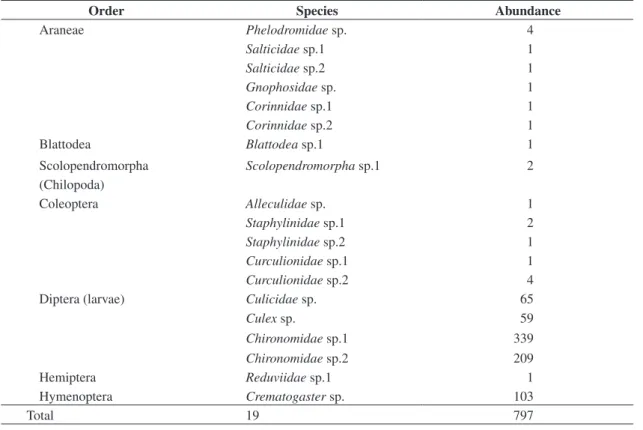
A total of 797 individuals associated with Vriesea sp. were sampled, consisting of 19 species (Table 2). Larval Diptera constituted 83.8% of the total catch. The Chironomidae sp.1 was the most abundant among the four larvae species, followed by the Chironomidae sp.2, Culicidae sp. and Culex sp. Species of the order Hymenoptera were the second most abundant (12.9%), and the other groups (Coleoptera 1.2%, Arachnida 1.2%, Orthoptera 0.8%, Hemiptera 0.1%, Blattodea 0.1% e Chilopoda 0.2%) were less representative.
All models used to describe the effects of bromeliad size on phytotelmata richness converged to an equation comprising a single explanatory variable (diameter of the reservoir or water volume) that describes a positive rela-tionship (Diameter: F1.68 = 5.964, p = 0.014, R2 = 0.10 Bromeliads have an important ecological role
(Cathcart, 1995) because they have phytotelmata, small bodies of water held by the plant in which many organ-isms live. Thus, bromeliads do not only increase the number of habitats for invertebrates associated with their leaves, as other plants do, but they also provide habitats for aquatic organisms (Ratsirarson and Silander, 1996). Generally, such water reservoirs harbour a low number of species. This relative simplicity facilitates the study of feeding relationships; hence, the communities inside phytotelmata can be used as models for ecological stud-ies of colonization and community structure (Marguire, 1971).
In this study, we analyzed the effects of the epiphyt bromeliad Vriesea sp. (Bromeliaceae) size on the rich-ness (number of species) and abundance (number of in-dividuals) of the phytotelmata fauna, as well as of the invertebrate fauna associated with the bromeliad leaves. Larger bromeliads have larger reservoirs with a higher water volume increasing the space and site of oviposition (Richardson, 1999). We tested whether species richness and abundance of phytotelmata fauna as well as that of invertebrate fauna associated with the bromeliad leaves increased with size of the plant.
2. Material and Methods
2.1. Study sites
The Serra de Ouro Branco is situated south of the Espinhaço Mountain (43° 39’ 44’’ W and 20° 28’ 44’’ S), with a maximum altitude of 1573 m. The soil was char-acterized by an area of quartzite (canga), with rupestrian fields as the main vegetation type, with the predominance of Velloziaceae and Poaceae (Alkmim, 1987). The sam-ples were obtained at an average altitude of 1250 m.
2.2. Sampling and analysis
Samples were collected from November 2002 to February 2003. Seventy individuals of Vriesea sp. (Carrière E. Morren ex Mez) (Bromeliaceae) were sam-pled in a 400 m transect, with a minimal distance of two meters between each sample. The sampled brome-liads were epiphytic and were associated with trunks of Vellozia compacta (Mart. ex. Schult. f.) (Velloziaceae).
ento-Table 1. Models tested to inspect the effects of bromeliad size parameters. Height = bromeliad height, Diameter = diameter of the reservoir and Volume = water storage volume. Full models converge to a simpler equation, depending on the order at which x variables enter the model and the y variable used. * denotes inclusion of single terms plus all possible interactions.
†denotes significancy of the terms. See Material and Methods for details.
Full Model Minimum adequate model
y = Phytotelmata richness
y ~ height * volume * diameter y ~ diameter
y ~ height * diameter * volume y ~ diameter
y ~ diameter * height * volume y ~ diameter
y ~ diameter * volume * height y ~ diameter
y ~ volume * height * diameter y ~ volume
y ~ volume * diameter * height y ~ volume
y = Phytotelmata abundance
y ~ height * volume * diameter y ~ height + volume† + diameter + height:diameter†
y ~ height * diameter * volume y ~ height + diameter† + volume† + height:diameter†
y ~ diameter * height * volume y ~ diameter† + height + volume† + diameter:height†
y ~ diameter * volume * height y ~ diameter† + volume† + height + diameter:height†
y ~ volume * height * diameter y ~ volume† + height + diameter + height:diameter†
y ~ volume * diameter * height y ~ volume† + diameter + height + diameter:height†
y = Invertebrate richness associated with leaves
y ~ height * diameter y ~ height† +diameter† + height:diameter†
y ~ diameter * height y ~ height† +diameter† + height:diameter†
y = Invertebrate abundance associated with leaves
y ~ height * diameter y ~ height +diameter + height:diameter†
y ~ diameter * height y ~ height +diameter + height:diameter†
Table 2. Richness and abundance of the invertebrates sampled in Vriesea sp.
Order Species Abundance
Araneae Phelodromidae sp. 4
Salticidae sp.1 1
Salticidae sp.2 1
Gnophosidae sp. 1
Corinnidae sp.1 1
Corinnidae sp.2 1
Blattodea Blattodea sp.1 1
Scolopendromorpha Scolopendromorpha sp.1 2
(Chilopoda)
Coleoptera Alleculidae sp. 1
Staphylinidae sp.1 2
Staphylinidae sp.2 1
Curculionidae sp.1 1
Curculionidae sp.2 4
Diptera (larvae) Culicidae sp. 65
Culex sp. 59
Chironomidae sp.1 339
Chironomidae sp.2 209
Hemiptera Reduviidae sp.1 1
Hymenoptera Crematogaster sp. 103
since these reservoirs contain water, even in dry seasons (Picado, 1913; Frank and Curtis, 1977). Our results show that bromeliad size was an important predictor of abundance and richness of invertebrates associated with Vriesea sp. However, it is important to point out that the spatial autocorrelation of the samples are not considered in this work. Thus, these results are insufficient to de-scribe the variation along the spatial scale due to spa-tial localization of the samples not being considered in the sampling (Taylor, 1961, 1984). An alternative would the utilization of geostatistic to describe spatial patterns using autocorrelation between value and distance of the samples (Liebhold et al., 1991). Geostatistic includes the utilization of correlation methods, covariance and semi-variance functions to describe spatial patterns of the indi-viduals (Liebhold et al., 1993). This analyses tests if the value of the one variable observed is dependent on the value neighbors (Sokal and Oden, 1978). So, such results must be viewed with the necessary caution because an effect of autocorrelation cannot be dismissed.
Within the Diptera species sampled, two belonged to the Culicidae family. Several species of this family are vectors of diseases and use the water reservoir as natural breeding sites (Pittendrigh, 1948; Forattini et al., 1998; Forattini and Marques, 2000). Together with species of Chironomidae, the Culicidae are the most common or-ganisms in phytotelmata (Fish, 1983).
We observed that the increases in phytotelmata rich-ness and of the invertebrates associated to leaves were more related with an increase in abundance of individu-als than bromeliad size. These relationships suggest an effect of passive sampling (Schoereder et al., 2004). On the other hand, the parameters of bromeliad size also af-fected the abundance and richness of invertebrate fauna in bromelia.
Several studies show that larger bromeliads contain higher amounts of detritus (Richardson, 1999) and this may cause higher abundance of fauna (Jenkins et al., 1992; Richardson, 1999; Richardson et al., 2000). Therefore, larger plants contain more resources, and more water, which allows them to shelter a larger quan-tity of organisms (Figures 1-4). Additionally space for colonization can be a result of the interaction between bromeliad height and diameter of the reservoir which de-termined greater abundance of phytotelmata and increase of abundance and richness of the invertebrates associated to leaves. Srivastava and Lawton (1998) observed that the taller plants, besides supporting a larger volume of water, also contained more nutrients. Therefore, larger bromeli-ads can contain higher numbers of organisms (Figure 2). Our results are in agreement with earlier results, showing a positive relationship between species abundance and water volume (Sota, 1996; Yanoviak, 1999).
In rupestrian fields, the relationships between plant size and invertebrate abundance can be more pro-nounced, since bromeliads contain a low quantity of nu-trients (Leme and Marigo, 1993). In these environments, the distribution and the contents of organic detritus in and Volume: F1.68 = 5.492, p = 0.019, R2 = 0.09). This
result denounces redundant effects of both variables on phytotelmata richness, however the diameter of the res-ervoir seems more suitable to explain phytotelmata rich-ness since it presents lower Akaike Information Criterion (AIC = 226.66) than the one comprising water volume (AIC = 227.13).
On the other hand, a different result was presented by the models explaining the effects of plant size on phytotelmata abundance. The variables water volume, diameter of the reservoir, and interaction between height and diameter showed positive relationship with phyto-telmata abundance depending on the order at with it has been included in the full model. Furthermore, the AIC value was the same for all the models (AIC = 451.39), what prevent the separation the more suitable model to explain phytotelmata abundance. However, the wa-ter volume was the unique variable that presented sig-nificance in all the models independent of the order at which it was included (Table 1). The results were grouped in two groups: in one of them (y = height*v olume*diameter; y = volume*height*diameter; and y = volume*diameter*height) volume (F = 18.099, p < 0.001) and interaction between diameter and height (F = 6.467, p = 0.010) were determinants of phytotel-mata abundance (χ2
1.65 = 23.170, p < 0.001, R2 = 0.25). In the other group (y=height*diameter*volume; y = di ameter*height*volume; y = diameter*volume*height) volume (F = 7.989, p = 0.004), diameter (F = 12.895, p < 0.001) and interaction between diameter and height (F = 6.467, p = 0.010) were positively related to phyto-telmata abundance (χ2
1.65 = 24.073, p = 0.001, R2 = 0.25). The variable diameter just was significant when included before volume.
All the models used to test the relationship between bromeliad size and richness of insects associated with leaves presented the same results (AIC = 157.55). The richness was explained by interaction between height and diameter of reservoir (F1.66= 3.427, p = 0.016, R2 = 0.153). The abundance of the invertebrates associated to leaves was positively related to height, diameter and interac-tion between these variables (χ2
1.66 = 16.664, p < 0.001, R2 = 0.21), in the two models used (AIC = 255.22).
Phytotelmata richness and richness of invertebrates associated to leaves were positively related with the abun-dance of phytotelmata fauna (F1. 68 = 15.331, p < 0.001, R2 = 0.26; AIC = 219.30) and with abundance of inver-tebrates associated to leaves (F1. 68 = 10.442, p < 0.001; R2 = 0.15 AIC = 155.40) respectively. Considering the lower value of AIC, phytotelmata richness, as well as richness of invertebrates associated to leaves, were more explained by abundance of individuals than by brome-liad size.
4. Discussion
larger bodied plants make possible the coexistence of spe-cies with different ecological necessities.
Species richness increases with the area when this promotes different habitats. Probably, as bromeliad size increased, there was a parallel increase in the availabil-ity of resources and microhabitats. Indeed, Richardson (1999) suggested that species richness could be related to the availability of niches in bromeliads because of their simple architecture, while invertebrate abundance can be more dependent on nutritional factors.
This work supports the idea that phytotelmata abun-dance could be related mainly with the increase of the area for colonization, which could come with an increase bromeliad reservoirs depend on physical factors, such as
wind. Besides, elevated altitude and occurrence of open fields in these locales can increase the intensity of insola-tion and, consequently the loss of water by evaporainsola-tion.
An increase of the area can also generate higher heter-ogeneity or complexity of the environment. This can result in some advantages such as an increase in the spatial dis-tribution of resources, in sites of oviposition and increased microhabitats in the same plant. Besides, it can supply a higher number of refuges against predators (Strong et al. 1984). This can explain the positive relationship found be-tween the richness of phytotelmata fauna and the volume and diameter of the reservoir (Figures 1-2), since those
4
3
2
1
0
Ph
ytotelmata richness
Diameter of the reservoir (cm)
10 15 20 25 30
Figure 1. Relationship between phytotelmata richness and diameter of the reservoir (y = –0.126 + 0.045x, P = 0.0151, R2 = 0.10).
0 50 100 150
0 1 2 3 4
Ph
ytotelmata richness
Water volume in the reservoir (mL)
Figure 2. Relationship between phytotelmata richness and water volume in the bromeliad reservoir (y = 0.476 + 0.006x, P = 0.0138, R2 = 0.09).
0 50 100 150
Water volume in the reservoir (mL) 40
30
20
10
0
Ph
ytotelmata ab
undance
Figure 3. Relationship between phytotelmata abundance
and water volume in the bromeliad reservoir (y = 1.66 + 0.012x, P = 0.001, R2 = 0.25).
Figure 4. Relationship between invertebrate abundance as-sociated with leaves of the bromeliad (y = –1.070 + 0.086x, P < 0.001, R2 = 0.06).
10 15 20 25 30
Diameter of the reservoir (cm)
In
vertebrates ab
undance associated with lea
ves
15
10
5
in nutrient availability. The probability of sampling more individuals increases with the plant size, and indirectly amplifies the chances of sampling more species.
Acknowledgments — The authors are indebted to Michelle P. Filardi and L. Bacci for comments and revisions. Arne Janssen (visiting professor, CAPES) corrected the English. Thanks to the Federal University of Ouro Preto for support.
References
ALCKIM, FF., 1987. Modelo deposicional para a seqüência de metassedimentos da Serra de Ouro Branco, Quadrilátero Ferrífero, Minas Gerais. Anais do simpósio sobre Sistemas Deposicionais no Pré-Cambriano. Ouro Preto, MG.
ARAÚJO, APA., CARNEIRO, MAA. and FERNANDES, GW., 2003. Efeitos do sexo, do vigor e do tamanho da planta hospedeira sobre a distribuição de insetos indutores de galhas em Baccharis pseudomyriocephala Teodoro (Asteraceae). Revista Brasileira de Entomologia, vol. 47, no. 4, p. 483-490. CATHCART, DJ., 1995. The importance of maintaining bromeliad imports. Florida Entomol. vol. 78, no. 1, p. 16-21. CONNOR, EF. and MCCOY, ED., 1979. The statistics and biology of the species-area relationship. American Naturalist, vol. 113, p. 791-833.
CRAWLEY, M., 2002. Statistical Computing: An introduction to data analysis using S-plus. John Wiley and Sons, Inc., Chichester.
FISH, D. 1983. Phytotelmata: fauna and flora. In FRANK, JH. and LOUNIBOS, LPL (eds.). Phytottelma: terrestrial plants as hosts for aquatic insect communities. Plexus Publishing Inc., Medford, New Jersey, p. 1-27.
FORATTINI, OP., MARQUES, GRAM., KAKITANI, I., BRITO, M. and SALLUM, MAM., 1998. Significado epidemiológico dos criadouros de Aedes albopictus em bromélias. Revista de Saúde Pública, vol. 32, no. 4, p. 530-532.
FORATTINI, OP and MARQUES., GRAM., 2000. Nota sobre o encontro de Aedes aegypti em bromélias. Revista de Saúde Pública. vol. 34, no. 5, p. 543-544.
FRANK, JH. and CURTIS, GA., 1977. On the bionomics of bromeliad-inhabiting mosquitoes. IV. Egg mortality of Vanduzeei wyeomyia caused by rainfall. Mosquito News. vol. 7, no. 2, p. 239-245.
JENKINS, B., KITCHING, RL. and PIMM, SL., 1992. Productivity, disturbance and food web structure at a local, spatial scale in experimental containers habitats. Oikos, vol. 65, no. 2, p. 249-255.
KITCHING, RL., 1987. Spatial and temporal variation in food webs in water filled tree-holes. Oikos, vol. 48, no. 3, p. 280-288.
-, 2000. Foods webs and container habitats. Cambridge University Press, Cambridge.
LAWTON, JH. and SCHRÖDER, D., 1977. Effects of plant type size of geographical range and taxonomic isolation on number of insect species with British plants. Nature, vol. 265, p. 137-140.
LEME, EMC. and MARIGO, LC., 1993. Bromélias na natureza. Marigo Comunicação Visual, Rio de Janeiro, 184p.
LIEBHOLD, AM., ROSSI, RE. and KEMP, WP., 1993. Geostatistics and geographic information systems in applied insect ecology. Ann. Rev. Entomol., vol. 38, p. 303-327. LIEBHOLD, AM., ZHANG, X., HOHN, ME., ELKINTON, JS., TICEHURST, M., BENZON, GL. and CAMPBELL, RW., 1991. Geostatistical analysis of gypsy moth (Lepidoptera: Lymantriidae) egg mass populations. Env. Entomol., vol. 20, no. 5, p. 1407-1417.
LOPEZ, LCS., D’ELIAS, AMA. and IGLESIAS, R., 1998. Fatores que controlam a riqueza e composição da fauna aquática em tanques da bromélia Aechmea bromelifolia (Rudge) Baker, na restinga de Jacarepiá-Saquarema/RJ. Ecologia de insetos aquáticos. Oecologia, vol. 5, p. 91-100.
LOZOVEI, AL. and SILVA, MAN., 1999. Análise comparativa entre métodos alternativos e convencionais para amostras de mosquitos obtidos a partir de habitats fitotélmicos (Bromeliaceae) na floresta Atlântica, Serra do Mar, Paraná, Brasil. Revta. Bras. Zool., vol. 16, no. 4, p. 957-966.
MAGUIRE, B., 1971. Phytotelmata: Biota and community structure determination in plant-held waters. Annual Review of Ecology and Systematics, vol. 2, p. 439-464.
MAY, RM., 1981. Patterns in multi-species communities. In Theoretical Ecology: principles and applications. 2a edição.
Blackwell Scientific Publications, Oxford. p. 197-277. PICADO, C., 1913. Les broméiacées épiphytes condiérées comme mileu biologique. Bulletin Scientifique de la France et de la Belgique, vol. 47, p. 215-360.
PITTENDRIGH, CS., 1948. The bromeliad-Anopheles-malaria complex in Trinidad I. The bromeliad flora. Evolution. vol. 2, no.1, p. 58-89.
RATSIRARSON, J. and SILANDER, JA., 1996. Structure and dynamics in Nepenthes madagascariensis pitcher-plant micro-communities. Biotropica. vol. 28, no. 2, p. 218-227.
RICHARDISON, BA., 1999. The bromeliad microcosm and the assessment of faunal diversity in a Neotropical forest. Biotropica. vol. 31, no. 2, p. 321-336.
RICHARDSON, BA., ROGERS, C. and RICHARDSON, MJ., 2000. Nutrients, diversity, and community structure of phytotelm systems in a lower mountain forest, Puerto Rico. Ecological Entomology. vol. 25, no. 3, p. 348-356.
ROSENZWEIG, M., 1995. Species Diversity in Space and Time. Cambridge University Press, Cambridge.
R DEVELOPMENT CORE TEAM, 2005. R: A language and environment for statistical computing. R Foundation for Statistical Computing. Vienna, Austria. http://www.R-project.org. SCHOEREDER, JH., GALBIATI, C. and RIBAS, CR., 2004. Should we use proportional sampling for species-area studies? J. Biogeogr. vol. 31, no. 8, p. 1219-1226.
SOKAL, RR. and ODEON, NL. 1978. Spatial autocorrelation in biology. 1. Methodology. Biological J. Linnean Soc., vol. 10, p. 199-228.
SOTA, T., 1996. Effects of capacity on resource input and aquatic metazoan community structure in phytotelmata. Res. Popul. Ecol., vol. 38, no. 1, p. 65-73.
WILLIG, MR., KAUFMAN, DM., and STEVENS, RD., 2003. Latitudinal gradients of biodiversity: pattern, process, scale and synthesis. Annu. Rev. Ecol. Syst., vol. 34, p. 273-309. YANOVIAK, SP., 1999. Community structure in water-filled tree holes of Panama: effects of hole height and size. Selbyana. vol. 20, no. 1, p. 106-115.
STRONG, DR., LAWTON, JH. and SOUTHWOOD, TRE., 1984. Insects on plants: community patterns and mechanisms. Blackwell Scientific Publications, Oxford, 245p.
TAYLOR, LR. 1961. Aggregation, variance and the mean, Nature, vol. 189, p. 732-735.