Offi cial Publication of the Brazilian Society of Anesthesiology www.sba.com.br
REVISTA
BRASILEIRA DE
ANESTESIOLOGIA
Abstract
Background and objectives: Sedation-analgesia is recommended for comfortable colonoscopy procedures, which are invasive and can be painful. This study aimed to compare the combinations of propofol-alfentanil and propofol-fentanyl for sedation-analgesia in elective colonoscopy patients.
Methods: This prospective and randomized study was planned in ASA I-II groups and included 80 patients between the ages of 18 and 65 years. Sedation-analgesia induction was performed as 1 μg.kg-1 fentanyl, 1 mg.kg-1 propofol in the propofol-fentanyl group (Group PF) and 10 μg.kg-1 alfentanil, 1 mg.kg-1 propofol in the propofol-alfentanil group (Group PA). Patients’ scores were limited to 3-4 values on the Ramsey Sedation Scale (RSS) by 0.5 mg.kg-1 bolus additional doses of propofol in sedation-analgesia maintenance. We recorded demographical data, heart rate, mean arterial pressure (MAP), oxygen saturation of hemoglobin (SpO2), RSS value, colonoscopy time, total dose of propofol, complications, recovery time, and discharge time, as well as colonoscopist and patient satisfaction scores.
Results: MAP at the 15th minute in Group PA was signifi cantly higher than in Group PF (p = 0.037). Group PA’s beginning mean heart rate was higher than the mean heart rate at subsequent readings (p = 0.012, p = 0.002). The mean total propofol dose of Group PA was signifi cantly higher than the total dose of Group PF (p = 0.028). The mean recovery time of Group PA was signifi cantly longer than that of Group PF (p = 0.032).
Conclusion: Fentanyl provides better operative conditions and reduces the need for additional propofol doses. These advantages cause a shorter recovery time. Therefore, propofol-fentanyl is superior to the propofol-alfentanil for sedation-analgesia in colonoscopy.
© 2013 Sociedade Brasileira de Anestesiologia. Published by Elsevier Editora Ltda. All rights reserved.
Sedation-Analgesia in Elective Colonoscopy:
Propofol-Fentanyl versus Propofol-Alfentanil
Hacer Şebnem Türk*
1, Meltem Aydoğmuş
1, Oya Ünsal
1, Hakan Mustafa Köksal
1,2, Mehmet Eren Açik
1,
Sibel Oba
11. Şişli Etfal Training and Research Hospital, Department of Anesthesiology and Intensive Care Medicine, Istanbul, Turkey 2. Şişli Etfal Training and Research Hospital, Department of General Surgery, Istanbul, Turkey
Received from Şişli Etfal Training and Research Hospital, Department of General Surgery, Istanbul, Turkey.
Submitted on May 2, 2012. Approved on July 9, 2012.
Keywords:
Alfentanil; Colonoscopy; Fentanyl; Propofol.
SCIENTIFIC ARTICLE
*Corresponding author: Hacer Şebnem Türk, Şişli Etfal, Training and Research Hospital, Department of Anesthesiology and Intensive Care Medicine 90 212 231 22 09 (5414)
Introduction
Due to the frequency of colorectal malignancies in industrial countries, diagnostic and therapeutic colonoscopy rates have increased dramatically. Colonoscopy-induced pain and
anxiety affects both patient and colonoscopist comfort 1. The
best sedation/analgesia type for gastrointestinal endoscopic
procedures is still not clear 2. Although some studies
recom-mend that the colonoscopy procedure can be performed without sedation, various other studies have reported this is not possible and that sedation administration before the
procedure is safer for both patient and colonoscopist 3-5. Both
anesthesia and sedation-analgesia are options for
colonos-copy procedures 6, but conscious sedation is recommended 1.
Conscious sedation allows the patient to give responses to verbal or tactile stimulation and provides the attendance of
respiratory and cardiovascular functions 1.
Doctors performing colonoscopy screenings through-out the world tend to prefer sedation-analgesia. Mida zo-lam, propofol and/or alfentanil or pethidine combinations, α-agonists, and neuroleptics are used for sedation-anal-gesia 6,7.
This study aimed to compare the hemodynamic ef-fects, recovery and discharge times, patient-colonoscopist satisfaction, and complications of propofol-fentanyl and propofol-alfentanil combinations in elective colonoscopy procedures.
Material and Methods
After obtaining the Ethics Committee’s approval and the patients’ written informed consents, this prospective and randomized 80-patient study proceeded in Şişli Etfal Training and Research Hospital, Istanbul, Turkey. The research team selected a group of ASA I-II patients between 18 and 65 years scheduled for elective colonoscopy screening. Researchers verifi ed the status of patients’ 8-hour fasting period and the absence of alcohol or sedative drug use 24 hours before the colonoscopy procedure. The same anesthesiologist ad-ministered sedation-analgesia on all patients. The exclusion criterions of this study were pregnancy, gastrointestinal hemorrhage, known or predicted airway diffi culty, alcohol or drug addiction, neuropsychiatric disease, severe heart or respiratory insuffi ciency, and sedative drug allergy.
An independent nurse performed randomization by sequentially opening numbered opaque envelopes with group allocation cards in a random computer generated sequence. Patients were not informed of the group in which they were included.
We explained the oral scoring system to the patients, which is on a scale of 1 to 10 and necessary to evaluate the patient satisfaction. After patients were admitted to the gastrointestinal endoscopy unit, intravenous (IV) catheteriza-tion was performed with 18-gauge IV catheters and a 0.9% NaCl infusion was started; patients received no premedica-tion. The lateral positioned patients were monitored with noninvasive systemic mean arterial pressure (MAP), 3-channel
ECGs, and pulse oximetry (SpO2). Patients received 3L.min-1
oxygen by nasal catheter.
The research team performed sedation-analgesia
induc-tion as 1 µg.kg-1 fentanyl and 1 mg.kg-1 propofol in Group
PF and 10 µg.kg-1 alfentanil and 1 mg.kg-1 propofol in Group
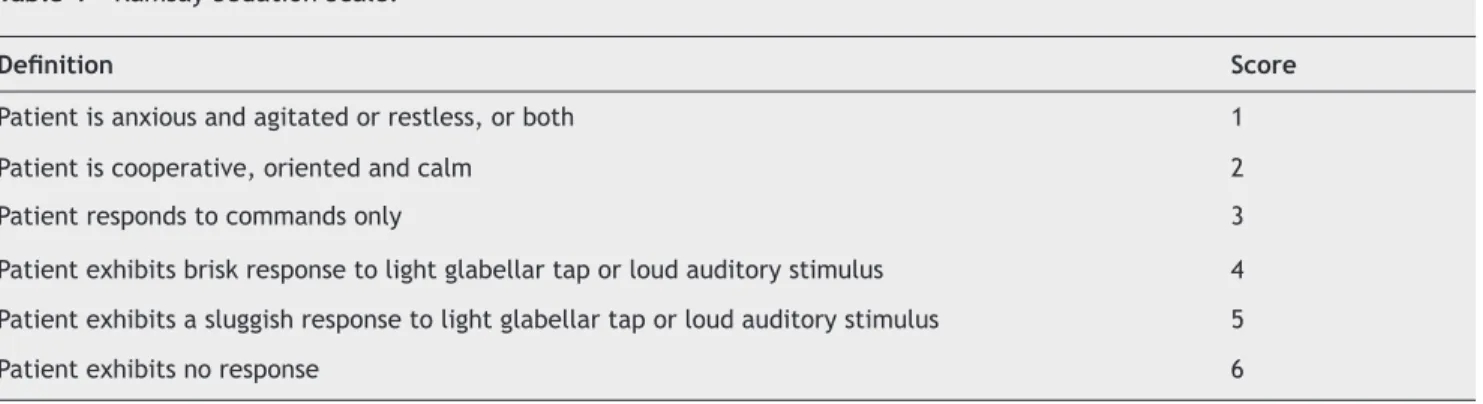
PA. After the beginning of the colonoscopy screening, the patients’ scores were limited to 3-4 values on the Ramsey
Sedation Scale (RSS) (Table 1) by 0.5 mg.kg-1 bolus additional
doses of propofol in sedation-analgesia maintenance. We
recorded heart rate, MAP, SpO2, and RSS values before the
procedure, at the beginning of the colonoscopy screening, and at 5-minute intervals during the procedure.
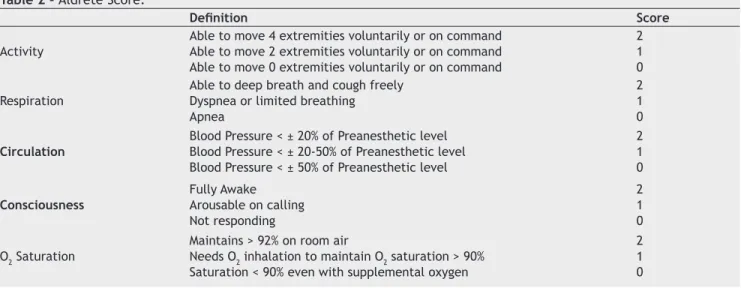
We established colonoscopy time as the time from induc-tion to the end of the colonoscopy screening. The recovery time was the time from induction until the RSS scores pro-gressed to value 2. We recorded total propofol doses and complications. After the procedure, patients with scores of 9 or greater, according to the Aldrete Score (Table 2), were discharged. After recovery, patients orally scored satisfaction on a scale of 1 to 10 (1: not satisfi ed, 10: very satisfi ed). Colonoscopist satisfaction was scored with 10 cm visual analog scale. We recorded colonoscopist and patient satisfaction scores.
We recorded anesthesia and endoscopy-related complica-tions that appeared during or after procedure, such as allergic reactions, bradycardia, tachycardia, hypotension, hyper-tension, respiratory depression, desaturation, perforation, bleeding, nausea and vomiting. Desaturation was defi ned as the decrease of oxygen saturation to below 85%.
Table 1 - Ramsay Sedation Scale.
Defi nition Score
Patient is anxious and agitated or restless, or both 1
Patient is cooperative, oriented and calm 2
Patient responds to commands only 3
Patient exhibits brisk response to light glabellar tap or loud auditory stimulus 4
Patient exhibits a sluggish response to light glabellar tap or loud auditory stimulus 5
We calculated the sample sizes with the assumption of at least 30% possible difference in our study between any two groups. Therefore, we allocated 40 patients into each group to obtain an alpha error of 5% and statistical power of 80%.
For data evaluation and descriptive statistics (mean, stan-dard deviation), researchers used paired variance analysis for repeated measures of the groups and the Newman-Keuls multiple comparison test for subgroups. We used an inde-pendent t-test for comparisons between the two groups and the chi-square test for comparison of qualitative parameters. Results were considered statistically signifi cant when the p value was under 0.05.
Results
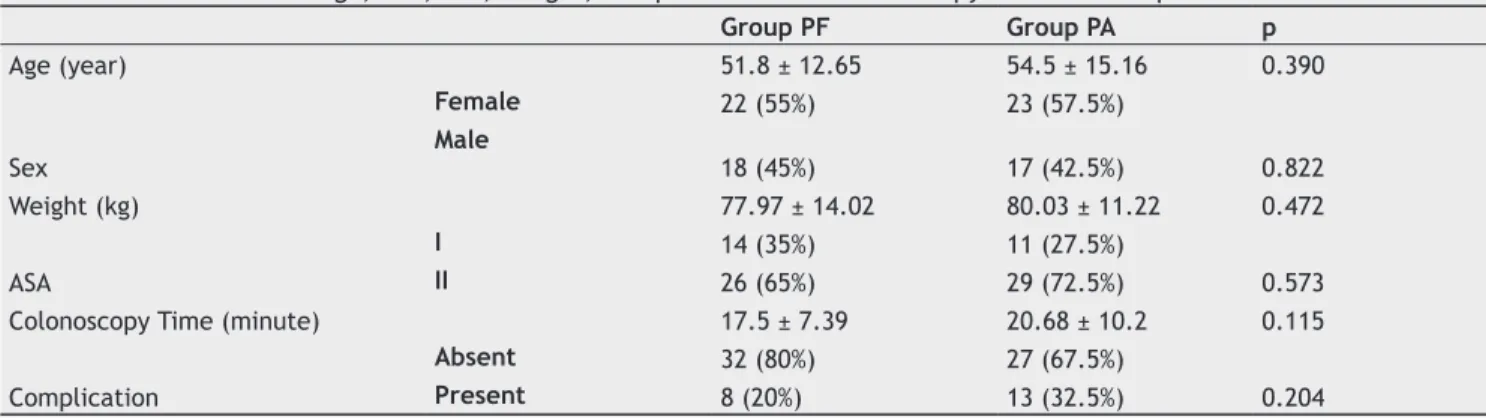
Age, sex, weight, ASA values, colonoscopy times, and complication rates were similar in both groups (Table 3). Complications were apparent in 21 patients. Although there was no respiratory depression, 8 patients from Group PF, and 12 from Group PA experienced desaturation. These patients did not need endotracheal intubation or mask ventilation;
vocal or tactile stimuli produced adequate recovery from desaturation. Only one patient had nausea and vomiting; this patient was in Group PA. All of the patients that experi-enced complications were discharged safely. We did not see endoscopy-related complications.
The MAP mean at the 15th minute in Group PA was signifi
-cantly higher than in Group PF (p = 0.037), but there were no differences between the two groups at all other times of MAP (Table 4). Similar to Group PA, Group PF showed no signifi cant differences when the beginning MAP mean was compared with the mean at all other times.
There was no difference in mean heart rate between the two groups at any time. Although mean heart rates were similar in Group PF for all recording times, signifi cant differences were found in Group PA (p = 0.0001). Group PA’s beginning mean heart rate was signifi cantly higher than the mean heart rates for all other recording times (p = 0.002, p = 0.012), which were similar to each other (Table 5). There were no signifi cant differences between the two groups in mean oxygen saturation values (Figure 1).
Table 2 - Aldrete Score.
Defi nition Score
Activity
Able to move 4 extremities voluntarily or on command Able to move 2 extremities voluntarily or on command Able to move 0 extremities voluntarily or on command
2 1 0
Respiration
Able to deep breath and cough freely Dyspnea or limited breathing Apnea
2 1 0
Circulation
Blood Pressure < ± 20% of Preanesthetic level Blood Pressure < ± 20-50% of Preanesthetic level Blood Pressure < ± 50% of Preanesthetic level
2 1 0
Consciousness
Fully Awake Arousable on calling Not responding
2 1 0
O2 Saturation
Maintains > 92% on room air
Needs O2 inhalation to maintain O2 saturation > 90% Saturation < 90% even with supplemental oxygen
2 1 0
Beggining 1st min. 5th min. 10th min. 15th min. 20th min. 25th min. 30th min. Mean Oxygen Saturation Values
100
99
98
97
96
95
94
Group PF Group PA
Table 3 - Distributions of Age, ASA, Sex, Weight, Complications and Colonoscopy Times in Groups.
Group PF Group PA p
Age (year) 51.8 ± 12.65 54.5 ± 15.16 0.390
Sex
Female 22 (55%) 23 (57.5%)
0.822
Male
18 (45%) 17 (42.5%)
Weight (kg) 77.97 ± 14.02 80.03 ± 11.22 0.472
ASA
I 14 (35%) 11 (27.5%)
0.573
II 26 (65%) 29 (72.5%)
Colonoscopy Time (minute) 17.5 ± 7.39 20.68 ± 10.2 0.115
Complication
Absent 32 (80%) 27 (67.5%)
0.204
Present 8 (20%) 13 (32.5%)
Table 4 - Mean MAP Values of the Groups.
MAP Group PF Group PA p
Beginning 93.32 ± 18.25 96.7 ± 18.81 0.423
1st Minute 84.2 ± 100.61 72.95 ± 13.24 0.491
5th Minute 75.33 ± 16.29 76.8 ± 15.29 0.681
10th Minute 80.37 ± 14.32 82.81 ± 20.41 0.550
15th Minute 75.95 ± 10.87 85.1 ± 17.76 0.037*
20th Minute 83.08 ± 13.41 87.09 ± 21.78 0.553
25th Minute 89.4 ± 17.19 86.45 ± 29.69 0.787
30th Minute 81.67 ± 2.52 84.5 ± 25.03 0.854
Table 5 - Mean Heart Rates of the Groups.
Heart Rate Group PF Group PA p
Beginning 84.98 ± 13.19 89.10 ± 11.64 0.142
1st Minute 81.8 ± 10.87 82.48 ± 13.06 0.802
5th Minute 77.44 ± 9.71 76.88 ± 12.43 0.824
10th Minute 76.59 ± 10.34 77.41 ± 11.51 0.479
15th Minute 77.09 ± 11.83 76.39 ± 11.4 0.828
20th Minute 75.46 ± 13.82 77.05 ± 10.46 0.704
25th Minute 77.6 ± 14.74 77.9 ± 14.17 0.964
30th Minute 79 ± 22.07 78.13 ± 12.15 0.933
P 0.770 0.0001*
Table 6 - Mean RSS Values of the Group.
RSS Group PF Group PA p
1st Minute 4.85 ± 0.43 4.8 ± 0.69 0.697
5th Minute 3.93 ± 1.12 3.78 ± 1.03 0.534
10th Minute 3.7 ± 0.91 3.41 ± 1.09 0.207
15th Minute 3.68 ± 1.04 3.35 ± 0.84 0.212
20th Minute 3.29 ± 0.73 3.1 ± 1 0.543
25th Minute 3.1 ± 0.74 3.33 ± 0.87 0.534
30th Minute 2.25 ± 0.5 3 ± 0.82 0.134
Mean RSS values were similar when comparing the groups. Group PF’s mean RSS values differed signifi cantly for
record-ing times (p = 0.0001). Group PF’s first and 5th minute
mean RSS values were signifi cantly higher than at other times (p = 0.002, p = 0.045) when no differences were noted. Group PA’s mean RSS values had signifi cant differences during all the recording times (p = 0.017). Group PA’s fi rst-minute mean RSS
value was signifi cantly higher than the 15th, 20th, 25th, and
30th minute values (p = 0.002, p = 0.022) (Table 6).
The mean total propofol dose of Group PA was signifi cantly higher than Group PF (p = 0.028) and the mean recovery time of Group PA was signifi cantly longer than the recovery time of Group PF (p = 0.032). Mean discharge times and colonos-copist and patient satisfaction scores were similar in both of the groups (Table 7).
Discussion
Propofol is a short-acting, intravenous hypnotic, which pro-vides rapid and complete recovery from anesthesia. When propofol is used as the sole anesthetic agent for an invasive
procedure, very high doses (14.9 mg.kg-1.h-1) are required for
toleration of the procedure 2. Both direct myocardial
depres-sion and peripheral vasodilation are propofol’s cardiovascular depressant effects, which are dose and concentration
de-pendent 7,8. Complications, such as hypotension, respiratory
depression, and decreased upper airway protective refl ex
activity can appear with the use of high-dose propofol 7.
Because the propofol is insuffi cient for analgesia, combin-ing propofol with an intravenous opioid is recommended to
increase the quality of sedation 7,9.
Both alfentanil and fentanyl can be used safely in colonoscopy procedures. Fentanyl clinical potency is 3-10 times that of alfentanil. Alfentanil, a tetrazole derivative of fentanyl, crosses rapidly to highly perfused tissues like those of the brain, then distributes to the peripheral tissues. Both alfentanil and fentanyl cross the blood brain barrier rapidly. Alfentanil has rapid onset and produces unconsciousness 50 seconds after administration. Respiratory depression and unconsciousness occur at the same time with alfentanil; however, unconsciousness occurs 30-60 seconds after respira-tory depression in fentanyl because fentanyl has higher lipid solubility than alfentanil and fentanyl’s plasma concentra-tion accumulates in tissue compartments before the onset of suffi cient opioid effects. Less accumulation of alfentanil provides greater binding of plasma concentrations to opioid
receptors and a more rapid onset of effects 8,10.
Because the propofol and alfentanil have rapid onset and
are short acting, they are useful for sedation-analgesia 11 and
the propofol-alfentanil combination is successful in analgesia 9.
Avramov et al. reported that the propofol-combined opioid provides analgesia and amnesia, as well as reduces incidences
of nausea, vomiting, and respiratory depression 12. In the
current study, only one patient had nausea and vomiting; this patient was in Group PA.
Despite the appropriate sedation level achieved in opi-oid use, colonoscopy patients experienced decreased upper airway protective refl ex activity and upper airway
manage-ment problems 7. Alfentanil, as a short-acting opioid, was
recommended for short procedures but when used as a sole agent, reports indicate that intraoperative and postoperative
respiratory depression occurred more frequently 12,13. In the
current study, the incidence of respiratory complications was higher in Group PA than in Group PF. Although there was no respiratory depression, 8 patients from Group PF and 12 from Group PA experienced desaturation. These patients did not need endotracheal intubation or mask ventilation; vocal or tactile stimuli produced adequate recovery from desaturation.
Roseveare et al. suggested that the propofol-alfentanil combination was more short-acting and effective than
benzodiazepines were in colonoscopy screening 14. Külling
et al. compared the propofol-alfentanil combination with midazolam and meperidine. They reported that the propofol-alfentanil combination resulted in more rapid recovery and
increased patient satisfaction in colonoscopy 15.
In one study of midazolam combinations, researchers compared meperidine, alfentanil, fentanyl, and sufentanil combinations in gastroscopy. Recovery times were
report-edly shorter in the sufentanil and alfentanil groups 16. In
Holloway et al.’s study, midazolam combined with alfentanil and fentanyl were compared in colonoscopy. They reported that although alfentanil and fentanyl had similar recovery
times, alfentanil provided better operative conditions 17. The
current study compared propofol combined with fentanyl and alfentanil but the results did not confi rm the previous studies. Recovery time was shorter and the mean propofol dose was less in Group PF than in Group PA.
The mean colonoscopy times were 20, 68 ± 10, 2 minutes in Group PA and 17, 5 ± 7, 39 minutes in Group PF. Because alfentanil acting time is shorter than the colonoscopy time,
additional propofol doses were needed, and the 15th minute
MAP values were higher in Group PA than in Group PF. Group PA’s beginning mean heart rate was higher than at subsequent recording times, which researchers related to the additional doses of propofol. None of our patients had hypotension or bradycardia.
In our study, we used RSS for the evaluation of seda-tion level. Mean RSS values were similar in both of the groups. Bispectral Index (BIS) could be used to regulate Table 7 - Distribution of Total Propofol Doses, Recovery Time, Discharge Time, and Colonoscopist and Patient Satisfaction Scores in Groups.
Group PF Group PA p
Total Propofol Dose (mg) 148 ± 38.13 170.5 ± 50.95 0.028*
Recovery Time (minute) 18.88 ± 6.76 23.1 ± 10.2 0.032*
Discharge Time (minute) 31.37 ± 9.55 35.31 ± 13.06 0.136
Colonoscopist’s Satisfaction Score 9.25 ± 0.84 9.33 ± 1.31 0.761
the appropriate sedation level and to reduce the dosage of sedatives during endoscopy. There are studies that compare
the use of RSS and BIS 18-20. One of these studies reported
that the BIS was the method recommended for monitoring patients under sedation and BIS monitoring could prevent
oversedation and related complications 18. In this study, we
consider RSS insuffi cient to evaluate oversedation 18. Not
using BIS monitoring could be considered the negative side of our study. Nonetheless, there are studies comparing RSS and BIS that reported evaluations of sedation levels and the
dosage of sedatives used were similar 19,20. Since our country
is a developing one, acquiring BIS monitor and electrodes is hard and expensive. In similar studies from our country, RSS
was used for the evaluation of sedation level 21.
A most signifi cant fi nding is that the patient/colonosco-pist satisfaction scores were similar and high in both of the groups. This emphasizes that sedation-analgesia is the golden key for a comfortable and safe colonoscopy experience.
Because fentanyl has a longer acting time than alfentanil, fentanyl provides better operative conditions and reduces the need for an additional propofol dose, which results in a shorter recovery time. The propofol-fentanyl combination is superior to the propofol-alfentanil combination for sedation-analgesia in colonoscopy procedures.
References
1. Runza M - Which type of sedation should be the target goal for use in colorectal endoscopic screening? Minerva Anestesiol. 2009;75(12):673-674.
2. Fanti L, Agostoni M, Gemma M et al. - Sedation and monitoring for gastrointestinal endoscopy: A nationwide web survey in Italy. Dig Liver Dis. 2011;43(9):726-730.
3. Demiraran Y, Tamer A, Korkut E, et al. - Comparison of the sedative effects of dexmedetomidine and midazolam in cases undergoing colonoscopy. Endoscopy 2009;17(1):18-22. 4. Madan A, Minocha A - Who is willing to undergo endoscopy
without sedation: patients, nurses, or the physicians? South Med J 2004;97:800-805.
5. Lazzaroni M, Bianchi-Porro G - Premedication, preparation, and surveillance. Endoscopy. 1999;31:2-8.
6. Sporea I, Popescu A, Sandesc D, Salha CA, Sirli R, Danila M - Sedation during colonoscopy. Rom J Gastroenterol. 2005;14(2):195-198.
7. Dal H, İzdeş S, Kesimci E, Kanbak O - Intermittent bolus vs target controlled infusion of Propofol sedation for colonoscopy. JTAICS 2011;39(3):134-142.
8. Jabbour-Khoury SI, Dabbous AS, Rizk LB et al. - A combination of alfentanil-lidocaine-propofol provides better intubating conditions than fentanyl-lidocaine-propofol in the absence of muscle relaxants. Can J Anaesth. 2003;50(2):116-120. 9. Heiman DR, Tolliver BA, Weis FR, O’Brien BL, Di Palma JA -
Patient-controlled anesthesia for colonoscopy using propofol: results of a pilot study. South Med J. 1998;91(6):560-564. 10. Di Palma JA, Herrera JL, Weis FR, Dark-Mezick DL, Brown RS
- Alfentanil for conscious sedation during colonoscopy. South Med J. 1995;88(6):630-634.
11. Lee et al. The safety, feasibility, and acceptability of patient-controlled sedation for colonoscopy: prospective study. Hong Kong Med J, 2004;10:84-88.
12. Avramov MN, White PF - Use of alfentanil and propofol for outpatient monitored anesthesia care: determining the optimal dosing regimen. Anesth Analg. 1997;85(3):566-572.
13. Usta B, Türkay C, Muslu B, Gözdemir M, Kasapoglu B, Sert H et al. Patient-controlled Analgesia and Sedation with Alfentanyl Versus Fentanyl for Colonoscopy: A Randomized Double Blind Study. J Clin Gastroenterol. 2011;45(7):72-75.
14. Roseveare C, Seavell C, Patel P, Criswell J, Shepherd H - Patient-controlled sedation with propofol and alfentanil during colonoscopy: a pilot study. Endoscopy. 1998;30(5):482-483. 15. Külling D, Fantin AC, Biro P, Bauerfeind P, Fried M - Safer
colonoscopy with patient-controlled analgesia and sedation with propofol and alfentanil. Gastrointest Endosc. 2001;54(1):1-7. 16. Chokhavatia S, Nguyen L, Williams R, Kao J, Heavner JE -
Sedation and analgesia for gastrointestinal endoscopy. Am J Gastroenterol. 1993;88(3):393-396.
17. Holloway AM, Logan DA - Pain relief for outpatient colonoscopy: a comparison of alfentanil with fentanyl. Anaesth Intensive Care. 1990;18(2):210-213.
18. Consales G, Chelazzi C, Rinaldi S, De Gaudio AR - Bispectral Index compared to Ramsay score forsedation monitoring in intensive care units. Minerva Anestesiol 2006;72:329-336. 19. Weatherburn C, Endacott R, Tynan P, Bailey M - The impact
of bispectral index monitoring on sedation administration in mechanically ventilated patients. Anaesth Intensive Care 2007;35:204-208.
20. Mondello E, Siliotti R, Noto G, Cuzzocrea E, Scollo G, Trimarchi G, et al. - Bispectral Index in ICU: correlation with Ramsay Score on assessment of sedation level. J Clin Monit Comput 2002;17:271-277.