Virna Ribeiro Feitosa Cestari
I, Raquel Sampaio Florêncio
II, Thereza Maria Magalhães Moreira
III,
Vera Lúcia Mendes de Paula Pessoa
III, Islene Victor Barbosa
IV,
Francisca Elisângela Teixeira Lima
V, Ires Lopes Custódio
VI Universidade Estadual do Ceará, Postgraduate Program in Clinical Care in Health and Nursing. Fortaleza, Ceará, Brazil.
II Universidade Estadual do Ceará, Postgraduate Program in Public Health. Fortaleza, Ceará, Brazil.
III Universidade Estadual do Ceará, Health Sciences Center, Nursing Department. Fortaleza, Ceará, Brazil.
IV Universidade de Fortaleza, Health Sciences Center, Nursing Department. Fortaleza, Ceará, Brazil.
V Universidade Federal do Ceará, Postgraduate Program in Health Promotion. Fortaleza, Ceará, Brazil.
How to cite this article:
Cestari VRF, Florêncio RS, Moreira TMM, Pessoa VLMP, Barbosa IV, Lima FET, et al. Nursing competencies in promoting the health of individuals with chronic diseases. Rev Bras Enferm [Internet]. 2016;69(6):1129-37.
http://dx.doi.org/10.1590/0034-7167-2016-0312
Submission: 05-31-2016 Approval: 07-28-2016
ABSTRACT
Objective: to identify nurse’s competencies related to health promotion of individuals with chronic cardiac disease, in the light
of the Galway consensus. Method: integrative literature review was conducted to search for studies published between 2010 and 2014 in the databases LILACS, BDENF, IBECS; and PubMed in February 2015. The 21 included studies were analyzed according to the eight domains of competence: Catalyzing change, Leadership, Evaluation, Planning, Implementation, Assessment, Advocacy and Partnerships. Results: all domains of competence were included in the nursing interventions in health promotion of chronic cardiac patients, and the Planning and Evaluation were the most evident competences. Conclusion: the results of this research highlighted the nurse as an agent capable of operating care management, in order to improve coordination of the latter with work and education and, thus, the health care of the population.
Descriptors: Chronic Disease; Heart Diseases; Professional Competence; Nursing; Health promotion.
RESUMO
Objetivo: identifi car as competências do enfermeiro relacionadas à promoção da saúde de indivíduos com cardiopatas crônicas, à luz do
Consenso de Galway. Método: revisão integrativa da literatura, com busca de artigos publicados entre os anos de 2010 e 2014, nas bases de dados LILACS, BDENF, IBECS; e no portal PubMed, em fevereiro de 2015. Os 21 artigos selecionados foram analisados de acordo com os oito domínios de competências: Catalisar mudanças, Liderança, Avaliação das necessidades, Planejamento, Implementação, Avaliação do impacto, Defesa de direitos e Parcerias. Resultados: todos os domíniosde competências foram contemplados nas intervenções do enfermeiro na promoção da saúde de cardiopatas crônicos, sendo o Planejamento e a Avaliação os mais evidenciados.
Conclusão: os resultados desta pesquisa destacaram o enfermeiro como agente capaz de operar a gestão do cuidado, com vistas a
melhorar articulação deste último com o trabalho e educação e, desta maneira, a assistência à saúde da população.
Descritores: Doença Crônica; Cardiopatias; Competência Profi ssional; Enfermagem; Promoção da Saúde.
RESUMEN
Objetivo: identifi car las competencias del enfermero relacionadas a la promoción de la salud de individuos con cardiopatías
crónicas, a la luz del Consenso de Galway. Método: revisión integrativa de literatura basada en la búsqueda de artículos publicados en las bases de datos LILACS, BDENF, IBECS entre los años 2010 y 2014, y en el portal PubMed, en febrero de 2015. Se seleccionaron 21 artículos y se analizaron de acuerdo con los ocho dominios de competencias: Aceleración
Nursing competencies in promoting the health of
individuals with chronic diseases
Raquel Sampaio Florêncio E-mail: [email protected]
CORRESPONDING AUTHOR
INTRODUCTION
Chronic diseases include all deviations from normality that have one or more of the following characteristics: perma-nence or presence of residual disability; not reversible patho-logical change in the body system; need for special training of the patient for rehabilitation; and long periods of supervision, observation and care(1).
Among the chronic diseases, there are the chronic heart disease (CHD), clinical conditions characterized by progres-sive limitation of physical and functional capacity of the heart that cause impairments in activities of daily living, and would entail risk to life. They are responsible for high morbidity and mortality rates, and are considered a first magnitude public health problem(2).
The CHDs bring significant impact on the patient’s daily life and their families, representing a continuing threat to them, which highlights the need to use health care strategies, aiming at stabilization, clinical improvement, health and well-being, reducing the likelihood of hospital readmissions and premature death(3).
Considering the complexity of the CHDs, assistance guid-ed by the integrality and interdisciplinarity are fundamental for the promotion of health, recovery and restoration of the population health. Providing health means, besides prevent-ing disease and prolongprevent-ing life, ensurprevent-ing means and situations that increase the quality of life, that is, increasing their capac-ity for autonomy and standard well-being(4). In this
perspec-tive, so that care is directed to promoting the health of chronic cardiac patients to be effective, it is necessary for nurses to have specific competencies.
In the Galway Conference held in Ireland in June 2008, a consensus on global exchange and cooperation was agreed between countries in order to identify and build core com-petencies in health promotion and health education, as well as the development of the labor force(5). This
consen-sus pointed values and principles, a common definition and eight domains of core competencies required for effective engagement in health promotion practices. The domains are: 1) Catalyzing change; 2) Leadership; 3) Evaluation; 4) Plan-ning; 5) Implementation; 6) Assessment; 7) Advocacy; and 8) Partnerships(5-7).
Therefore, we can assume the importance of visibility of scientific production focused in nursing competencies within the health promotion of adult patients with chronic heart dis-ease and justifying the interest in developing an integrative literature review of studies involving these competencies.
It is hoped that this study can contribute to a critical re-flection of nursing care practices in promoting the health of patients with chronic diseases, aiming to improve the perfor-mance of nurses. Thus, a service that condenses this informa-tion will enable the nurse a better planning of their acinforma-tions, and make them more participant in the care process.
In this perspective, this study aimed to identify the nurs-ing competencies related to health promotion of adults with chronic diseases, in the light of the Galway consensus.
METHOD
Ethical aspects
Since this is an integrative review, the study was not sub-mitted to the Research Ethics Committee. However, we kept the ideas of the authors of the publications used in this study.
Design, study site and period
This is an integrative review, a research method that en-ables the synthesis of published studies, producing general conclusions about a particular area of research. It consists of a comprehensive analysis of the literature, which contributes to discussions about methods and research findings, while identifying knowledge gaps that can be filled with the perfor-mance of new studies(8).
In order to conduct this review, six steps were followed: identification of the topic and selection of the hypothesis or research question; establishment of inclusion and exclusion criteria; definition of the information to be extracted from selected studies; evaluation of studies included in the inte-grative review; and interpretation of results(9). Thus, initially,
we formulated the following question: What are the nursing competencies related to health promotion of adult individuals with chronic disease?
The bibliographic search was carried out through consul-tations in databases, such as Latin American and Caribbean Health Sciences (LILACS), Nursing Database (BDENF), Biblio-graphical Index Spanish Health Sciences (IBECS) and National Library of Medicine (PubMed). This search was conducted in February 2015.
Sample and inclusion and exclusion criteria
On national databases, the following descriptors were used: heart disease; professional competence; nursing; and health pro-motion; according to MeSH terminology. On the international databases, the descriptors used were heart diseases, professional competence, nursing and health promotion, according to MeSH de Cambios, Liderazgo, Evaluación de las Necesidades, Planeamiento, Implantación, Evaluación del Impacto, Defensa de Derechos y Acciones Conjuntas. Resultados: se contemplarontodos los dominiosde las competencias en las intervenciones del enfermero para la promoción de la salud de cardiópatas crónicos, sobresaliendo el Planeamiento y la Evaluación. Conclusión:
los resultados de esta investigación posicionan al enfermero como agente capaz de organizar el cuidado con miras a la mejora continua de la articulación del trabajo y la educación y, como consecuencia, de la atención a la salud de la población.
terminology. The search strategy was (“heart diseases” AND “professional competence” AND “nursing” OR “heart diseases” AND “nursing” AND “health promotion”).
The inclusion criteria defined for the pre-selection of the studies were: study written by nurses; consider the proposed objective; published between 2010-2014; restricted to Eng-lish, Portuguese or Spanish languages; and fully-available electronically. We excluded: editorials, letters to the editor, studies published in event annals, reflection papers and re-peated studies.
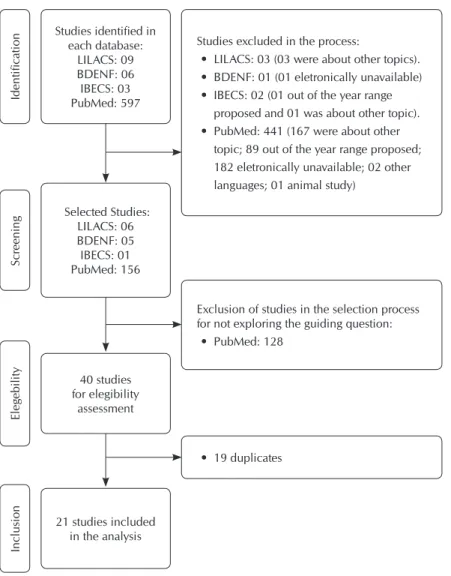
For description of the search and selection of studies we used the Preferred Reporting Items for Systematic Review and Meta-Analyses (PRISMA), as presented in the flowchart below (Figure 1). The study selection process was carried out through close reading of titles and abstracts, so that studies that went to the final selection met the above mentioned inclusion criteria. At the end, we included six studies from LILACS database; Two from BDENF; one from IBECS and 12 from PubMed. Thus, the review was composed of 21 studies.
Study protocol
The review was composed of 21 studies, which are classi-fied according to the level of scientific evidence proposed by Howick and colleagues(10).
Analysis of results and statistics
For the final selection of studies, we conducted a critical and de-tailed analysis, making comparison with theoretical knowledge(9).
Initially, the data were collected through an observational script. The results were presented in the form of boxes, charts and analyzed according to the eight areas of competence for the prac-tice of health promotion, as defined in Galway Conference(5).
RESULTS
In the characterization of the selected studies, it was ob-served that 12 (57.1%) were international studies. The United States and the Netherlands were the countries with the high-est scientific literature on the subject, with two (9.5%) stud-ies each; followed by China, Japan, the UK, Iran, Colombia, Sweden, Australia and Ger-many, with one study (4.8%) each.
With regard to national publications, it was observed that six (28.6%) were from the Southeast; two from the Northeast (9.5%); and one from the South (4.8%), the journals with the highest number of published stud-ies related to the topic are the Revista Latino-Americana de Enfermagem with four studies (19%); and European Journal of Cardiovascu-lar Nursing with three studies (14.3%). Re-garding the years of publication, it was found that in the last five years, we highlight the years 2012 and 2013, with the largest num-ber of studies per year, with seven (33.3%) and six (28.6%), respectively (Box 1).
The predominant research design was ran-domized controlled trials, 12 (57.1%) stud-ies; followed by four descriptive-exploratory studies (19%); two longitudinal (9.5%); one cross-sectional (4.8%); one case study (4.8%); and one methodological study (4.8%). The most prevalent approach is the quantitative, 19 (90.5%) studies. According to the classi-fication of levels of evidence of the studies, 12 studies were classified as level I (57.1%); six studies level V (28.6%); and three studies level IV (14.3%).
After the classification of studies on the domains of competencies and nursing in-terventions (Figure 2), it was found that the most evident in the interventions of nurses in health promotion of heart disease were: Plan-ning (81%) and Assessment (66.6%).
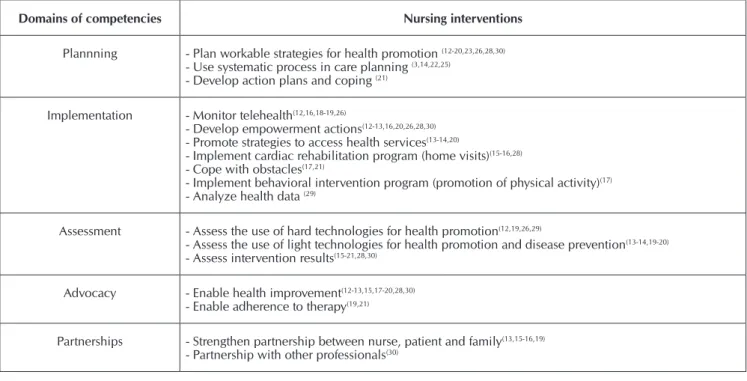
It was found that all domains of expertise were explored in the included studies, as shown in Box 2.
Studies excluded in the process:
• LILACS: 03 (03 were about other topics). • BDENF: 01 (01 eletronically unavailable) • IBECS: 02 (01 out of the year range
proposed and 01 was about other topic). • PubMed: 441 (167 were about other
topic; 89 out of the year range proposed; 182 eletronically unavailable; 02 other languages; 01 animal study)
Studies identified in each database:
LILACS: 09 BDENF: 06 IBECS: 03 PubMed: 597
Selected Studies: LILACS: 06 BDENF: 05 IBECS: 01 PubMed: 156
40 studies for elegibility
assessment
21 studies included in the analysis
Inclusion
Eleg
ebility
Scr
eening
Identification
Exclusion of studies in the selection process for not exploring the guiding question:
• PubMed: 128
• 19 duplicates
Figure 1 – Studies selection process at LILACS, BDENF, IBECS and PubMed,
Box 1 – Summary of studies composing this review, 2015
Study Journal publicationYear of Country Study design evidenceLevel of
A1(11) European Journal of Cardiovascular Nursing 2014 China Descriptive-exploratory V
A2(12) BMC Health Services Research 2014 UK Longitudinal, qualitative IV
A3(3) Revista Escola de Enfermagem da USP 2013 Brazil Descriptive-exploratory V
A4(13) Heart 2013 Netherlands Randomized controlled trial I
A5(14) Revista de Pesquisa Cuidado é Fundamental Online 2013 Brazil Case study IV
A6(15) BMC Research Notes 2013 Iran Randomized controlled trial I
A7(16) Revista Latino-Americana de Enfermagem 2013 Brazil Randomized controlled trial I
A8(17) Revista Latino-Americana de Enfermagem 2013 Brazil Randomized controlled trial I
A9(18) Cardiovascular Disorders 2012 Netherlands Randomized controlled trial I
A10(19) Revista Latino-Americana de Enfermagem 2012 Colombia Randomized controlled trial I
A11(20) BMC Family Practice 2012 Sweden Randomized controlled trial I
A12(21) Revista Latino-Americana de Enfermagem 2012 Brazil Randomized controlled trial I
A13(22) Revista Gaúcha de Enfermagem 2012 Brazil Descriptive-exploratory V
A14(23) European Journal of Cardiovascular Nursing 2012 Japan Methodological V
A15(24) European Journal of Cardiovascular Nursing 2011 Australia Descriptive-exploratory V
A16(25) Escola Anna Nery 2011 Brazil Cross-sectional V
A17(26) Arquivos Brasileiros de Cardiologia 2011 Brazil Randomized controlled trial I
A18(27) Nursing Clinicsof North America USA Randomized controlled trial I
A19(28) Heart & Lung 2010 USA Randomized controlled trial I
A20(29) Journal Health Informatics 2010 Brazil Longitudinal IV
A21(30) BMC Geriatrics 2010 Germany Randomized controlled trial I
Box 2 – Distribution of studies according to the domains of competence and nursing interventions, 2015
Domains of competencies Nursing interventions
Catalyzing change - Promote health education(14-16,18-19,21,26,29-30)
- Promote empowerment(13-15,19-20,26,28,30)
- Develop activities to promote healthy habits(17-19,23)
Leadership - Encourage communication between nurse and patient (15-16,28)
Evaluation - Evaluate the psychosocial context (perception of quality of life and social support)(11,24)
- Evaluate social support(11)
- Identify cardiovascular risk factors(13,18,20,27,29)
- Evaluate lifestyle(17,23)
- Identify barriers for the treatment(19,21)
23,8%
47,6%
66,6% 67,0%
81,0% 52,4%
14,3%
62,0% Catalyze changes
Leadership Evaluation Plannning Implementation Assessment Advocacy Partnership
Figure 2 – Studies of each domain of competencies of nurses in
promoting the health of patients with chronic heart dis-ease, 2015
DISCUSSION
It was found that most studies had a high level of evidence, being classified as high validity and relevance studies. In most of the analyzed studies, we highlight the intervention pro-grams aimed at the planning viable strategies for promoting the health of patients with chronic diseases.
Building a competent workforce for health promotion with the knowledge and competencies required to develop, imple-ment and evaluate policies and health promotion practices is key to integrate and sustain health promotion action(31-32).
The competencies have proven to be a foundation for train-ing in health promotion, academic preparation and ongotrain-ing professional development because it corroborates the devel-opment of professional and quality assurance systems stan-dards, and support the promotion of health as a specialized field of practice. Health promotion agents need specific edu-cation and training together with continuing professional de-velopment in order to maintain the particular combination of knowledge and competencies necessary to ensure the quality of practice of health promotion(33).
The participation of health professionals as promot-ers of health is a proven effective strategy for improv-ing the quality of life and prevention of complications arising from CHDs. In this context, the participation of nurses providing a scientific and competent care will meet the unique needs of the subjects received in health services and their families.
Important tools for the development of autonomy and empowerment of individuals and communities were found in some included studies(13-15,19-20,26,28,30). The actions
in this area are inserted in the domain “catalyze change”, characterized by enabling transformation through indi-vidual and collective training to improve health(31).
Health education and empowerment are clearly effective tools for disease prevention(30). This fact could be observed in
a study conducted in a center of cardiac rehabilitation whose results showed that patients monitored regularly by nurses, receiving information about the disease and control measures, had fewer complications of the disease, when compared to the control group(15).
From the Ottawa Charter on Health Promotion, it is strong-ly argued that the empowerment of individuals and communi-ties are important tools to gain ownership and control over their health. The concept of empowerment has been the main health promotion focus(19-20).
The educational actions in health can empower individuals and groups in the construction of new knowledge, leading to consistent preventive behaviors or health promotion practic-es(20). Individual and group educational meetings, home visits
(HV), tele-nursing and printed booklet are valid methodolo-gies for promoting self-care behaviors(17).
It appears that the activities developed for health promotion require the intervention of the social and economic spheres, beyond the health sector, as it includes the participation of all
Domains of competencies Nursing interventions
Plannning - Plan workable strategies for health promotion (12-20,23,26,28,30)
- Use systematic process in care planning (3,14,22,25)
- Develop action plans and coping (21)
Implementation - Monitor telehealth(12,16,18-19,26)
- Develop empowerment actions(12-13,16,20,26,28,30)
- Promote strategies to access health services(13-14,20)
- Implement cardiac rehabilitation program (home visits)(15-16,28)
- Cope with obstacles(17,21)
- Implement behavioral intervention program (promotion of physical activity)(17)
- Analyze health data (29)
Assessment - Assess the use of hard technologies for health promotion(12,19,26,29)
- Assess the use of light technologies for health promotion and disease prevention(13-14,19-20)
- Assess intervention results(15-21,28,30)
Advocacy - Enable health improvement(12-13,15,17-20,28,30)
- Enable adherence to therapy(19,21)
Partnerships - Strengthen partnership between nurse, patient and family(13,15-16,19)
- Partnership with other professionals(30)
sectors and related fields of activity at national and community development, in particular the agricultural field, food, the indus-try, education, housing, public constructions, communications and others, requiring coordinated efforts of all(34). The promotion
and protection of population health are indispensable for sus-tainable economic and social development and contribute for the improvement of quality of life, achieving people’s welfare, since it has the right and duty to participate individually and col-lectively in planning and implementing health actions.
Health promotion, from the perspective of bioethics in-volves the principles of responsibility and autonomy. Informed patients who are involved and have an active role (empow-ered), will interact more effectively with health professionals, trying to carry out actions that produce health results.
To meet these principles, the nurse should value the lead-ership competence that allows the professional to produce a strategic direction and opportunities for the development of healthy public policies, mobilization and management of re-sources for health promotion(31).
In a study evaluating the impact of a program for the pre-vention of Cardiovascular Disease risk (CVD) in patients dis-charged after an episode of acute coronary syndrome, there were changes in relation to risk factors. The program was coordinated by nurses and developed in secondary and ter-tiary care units, and covered guidelines which had focused on healthy lifestyle, biometric risk factors and medication adher-ence, in addition to usual care. The authors found that, in a year, the program resulted in reduced risk for CVD (17.4%) and the reduction of re-hospitalizations (34.8%)(13).
Therefore, the importance of enhancing the implementa-tion of integrated and inter-sectoral intervenimplementa-tional acimplementa-tions of health promotion and prevention, individually and collec-tively, help people to modify risk behaviors and to adhere to healthier living habits(35).
From this perspective, interdisciplinarity and intersectorali-ty appear as coping strategies of multiple health problems that have affected people with CHD, especially for professionals contributing in the process of discussing and reflecting, which are fundamental requirements in the process of care. Health promotion requires technical competencies in engaging and facilitating the participation of various sectors in partnership working and implementing intersectoral strategies(5).
Thus, diagnosing the psychosocial context, support net-works, identification of cardiovascular risk factors and barriers to treatment and assessment of lifestyle are essential actions in chronic cardiac disease patient care and are inserted into the competence of diagnosis(24). In this perspective, the nurse
is one of the professionals involved in the diagnosis of the community, that is, conducting community assessment, iden-tifying and analyzing behavior, culture, social, environmental and organizational aspects, which can be instrumental in pro-moting health or impairing it(31).
Nevertheless, despite the efforts made in the control of CHDs, the evolution of these patients have not changed significantly, at least in regard to hospital mortality and readmissions, because in general, the CHDs are caused by several factors, together they will trigger the disease. Most of them are related to the lifestyle
of the population, diet, physical inactivity, excessive weight, high waist circumference, alcohol consumption, smoking, stress level, quality of the environment they live in. Thus, they can be avoided, since the main causes are not related to genetic factors, but modifiable factors related to the environment and behavior, as shown in a study on risk factors for cardiovascular disease among nursing professionals(35).
Consequently, in order to cause change in the safety culture of the health care facilities of patients with CHD, profession-als must have knowledge and competencies to identify modi-fiable factors and know what to do, since the promotion of health has its base in lifestyles, the new orientation focused on social and environmental factors. This fact confirms the com-plexity of the therapeutic regimen and it requires a significant challenge for health professionals, since there are many gaps and inefficiencies in the management of these patients(11-12).
The stimulus for the participation of the person who has chronic heart disease in their treatment is also part of clinical care in cardiovascular nursing. The nurse’s role in this context should prioritize the strengthening of an empathic relation-ship, acceptance and recognition of the limitations(20).
The diagnostic competence guide the nurse professional to the domains of planning and implementation. While the plan-ning domain is described as the ability to establish measurable goals and objectives in response to the needs assessment, imple-mentation is the way to effectively perform these strategies(31).
In this context, the follow-up of patients in their residence allows the nurse to implement their actions in a real environ-ment in which the individual is inserted. Authors sought to determine the effect of a nursing educational intervention re-sulting from the combination of HD and telephone contact for a period of six months to patients with decompensated heart failure (DHF). The results showed improvements in blood pressure control, proper weight maintenance and adherence to the use of prescription drugs and fewer readmissions(16).
In addition, the nurse should be able to stimulate commu-nication between the staff, the patients and their families in order to promote health and to involve everyone in care. The nurse demonstrates competence in the domain “partnership” when they create an environment of mutual trust and estab-lishes partnerships with patients; conveying a sense of being present with the patient and providing comfort and emotional support, reflecting upon this process and using this knowl-edge to additional therapeutic interaction(13,16,19).
This dialogic relationship - in which professionals, pa-tients and families should understand that success depends on shared decision - the important role that nurses play in the individual’s empowerment to promote care and health. Therefore, we conclude that the domains “catalyze change”, “leadership” and “partnership” are interconnected.
The actions most used by nurses in the planning domain are those related to the viable strategies to promote health. This in-volves appointments(12,16,26,28,30), the prevention of
cardiovascu-lar risk programs(13,17- 18,23) and educational measures(14-15,19-20).
broad theoretical framework of nursing clinical practice, mak-ing individualized care possible, in an ordered manner and directed to results(14,22).
In the context of patient care with heart disease, the NP should be understood as a complex technological model that allows us to offer comfort, physical and mental well-being of the patient. In a study that sought to use NP in 30 patients hospitalized for cardiovascular disease, it was shown that the list of nursing diagnoses was associated with a better analysis of the responses to cardiovascular disease(25). These findings
corroborate with other researchers(3,14,22).
Another way of planning is through the development of action and coping plans, as evidenced in the study(21) held in
Brazil, with 59 coronary artery disease patients. The plan of action and barriers to face for making the associated behavior to time counters and the sleep/wake cycle. The authors found that non-adherence was related to forgetfulness and lack of routine. Thus, the action plans focused on these parameters allowed them to change behavior to the prescribed therapy.
In implementation, the strategies should ensure the great-est possible number of improvements in health, including the management of human and material resources(12,27,31). In
the studies analyzed, it was found that follow-up strategies for telehealth, development of empowerment actions, access to health services strategies, cardiac rehabilitation programs, coping with obstacles, behavioral interventions and health data analysis are examples that should be considered for pro-moting the health of cardiac patients.
Among the various approaches to the care of people with chronic heart disease, it appears that the combination of an in-hospital educational program followed by telephone contact made by nurses after hospital discharge has provided health improvement in quality of life of patients and their families.
An European study(18) implemented a telephone monitoring
program for patients with Acute Myocardial Infarction (AMI) and patients with angina pectoris, the Hartcoach. The program consists of monitoring patients for a period of six months, in which the guiding nurse advised regarding the importance of patients taking their responsibility in managing their health, and sought to identify modifiable risk factors(17). Through this
technology, the authors were able to identify cardiovascular risk factors (weight, waist circumference, blood pressure, physical activity and diet) and adherence to pharmacological treatment, self-care and quality of life.
Experimental research conducted in Brazil, with similar objective, found that in-hospital educational intervention, in addition to telephone contact, enabled a better understanding of the disease and self-care(26).
Determining the scope, effectiveness and impact of poli-cies and health promotion programs include the appropriate organization of evaluation and research methods to support the improvement of programs, sustainability and dissemina-tion(31). It appears, therefore, that the importance of
evaluat-ing the results of the intervention is a key measure for the re-planning, if necessary, or continue actions.
The patient and communities’ advocacy, another domain of competencies found among the studies analyzed, aimed
at improving the health and well-being, to promote important aspects of quality of life and health promotion(31). In patients
with chronic heart disease, the advocacy role involves defend-ing their interests, enabldefend-ing the improvement of health and adherence to therapy.
Interventions to improve adherence to drug and non-drug therapies have been developed and evaluated, however, those based on theoretical assumptions deserve special mention, es-pecially the theories that focus on the intention or motivation to perform certain behaviors(26).
A study demonstrated the effectiveness of interventions with different theoretical framework to encourage the adoption of healthy behaviors, with the performance of physical activity. The authors reported positive results with the use of action and cop-ing strategies in order to optimize adherence to physical activity in patients enrolled in a cardiac rehabilitation program(21).
It is noteworthy that in the Unified Health System (SUS), the nurse should be able to promote community empower-ment. To this end, advocacy is an extremely valuable compe-tence, nurses should advocate on behalf of individuals and communities, acting in defense of healthy public policies and creating supportive environments(31).
As stated, important skills were identified and discussed as the Consensus of Galway. However, it is noted that method-ological circumstances limited broader results. The difficulty of access to full text studies from some databases are config-ured as a limitation, since other competencies may not have been contemplated.
FINAL CONSIDERATIONS
A total of 21 studies on health promotion nursing compe-tencies for patients with chronic heart disease were analyzed. According to the data presented in this study, there are several competencies that nurses develop, such as: comprehensive approach to assessment of the psychosocial context; health education; development of empowerment strategies; prevent-ing diseases; assessment of lifestyle and promotion of partner-ships between patients, families and professionals; planning; and evaluation.
The most evident domains of competencies in the publi-cations were: Planning, Implementation and Evaluation. It is noteworthy, however, that all domains have been reported. Undoubtedly, competencies are conceptualized and allow the nurse to highlight as an agent capable of operating resource management, with a view to improve articulation with work and education and, thus, the health care of the population.
As limitation of this review, we highlight the fact that much of the scientific knowledge produced on NCDs come from developed countries. To guide the development of effective interventions, broadening the understanding also in the con-text of low and middle income countries, for which new stud-ies are very important, is imperative.
REFERENCES
1. Schneider KLK, Martini JG. Cotidiano do adolescente com doença crônica. Texto Contexto Enferm [Internet]. 2011[ci-ted 2016 Jun 30];20(spe):194-204. Available from: http:// www.scielo.br/pdf/tce/v20nspe/v20nspea25.pdf
2. Brennan PF, Casper GR, Sturgeon B. Technology enhanced practice for patients with chronic cardiac disease: home im-plementation and evaluation. Heart Lung [Internet]. 2010[cit-ed 2015 Feb 1];39(6Suppl):34-46. Available from: http:// www.heartandlung.org/article/S0147-9563(10)00359-6/pdf
3. Araújo AA, Nóbrega MML, Garcia TR. Nursing diagno-ses and interventions for patients with congestive heart failure using the ICNP®. Rev Esc Enferm USP [Internet]. 2013[cited 2016 Jul 01];47(2):385-92. Available from: http://www.scielo.br/pdf/reeusp/v47n2/en_16.pdf
4. Oliveira-Campos M, Rodrigues-Neto JF, Silveira MF, Ne-ves DMR, Vilhena JM, Oliveira JF, et al. Impacto dos fato-res de risco para doenças crônicas não transmissíveis na qualidade de vida. Ciênc Saúde Colet [Internet]. 2013[ci-ted 2016 Jul 01];18(3):873-82. Available from: http:// www.scielo.br/pdf/csc/v18n3/33.pdf.
5. Barry MM, Allegrante JP, Lamarre MC, Auld, ME, Taub A. The Galway Consensus Conference: international col-laboration on the development of core competencies for health promotion and health education. Glob Health Pro-mot [Internet]. 2009[cited 2015 Feb 1];16(2):5-11. Avail-able from: http://ped.sagepub.com/content/16/2/05.long
6. Gurgel GI, Alves MDS, Ximenes LB, Vieira NFC, Beserra EP, Gubert FA. Revisão integrativa: prevenção da gravidez na adolescência e competências do enfermeiro para promoção da saúde. Online Braz J Nurs [Internet]. 2011[cited 2015 Feb 1];10(3). Available from: http://www.objnursing.uff.br/index. php/nursing/article/viewFile/3586/1116
7. Gonzaga NC, Araújo TL, Cavalcante TF, Lima FET, Galvão MTG. Nursing: promoting the health of overweight children and adolescents in the school context. Rev Esc Enferm USP [In-ternet]. 2014[cited 2016 Jul 01];48(1):153-61. Available from: http://www.scielo.br/pdf/reeusp/v48n1/0080-6234-r eeusp-48-01-153.pdf
8. Soares CB, Hoga LAK, Peduzzi M, Sangaleti C, Yonekura T, Silva DRAD. Integrative Review: concepts and methods used in nursing. Rev Esc Enferm USP [Internet]. 2014[cited 2016 Jul 01];48(2):335-45. Available from: http://www.scielo.br/ pdf/reeusp/v48n2/0080-6234-reeusp-48-02-335.pdf
9. Souza MT, Silva MD, Carvalho R. Revisão integrativa: o que é e como fazer. Einstein [Internet]. 2010[cited 2015 Feb 1];8(1pt1):102-6. Available from: http://www.scielo. br/pdf/eins/v8n1/pt_1679-4508-eins-8-1-0102
10. Howick J, Chalmers I, Glasziou P, Greenhalgh T, Heneghan C, Liberati A, et al. OCEBM Levels of Evidence Working Group. “The Oxford Levels of Evidence 2”. Oxford Centre for Evidence-Based Medicine The Oxford 2011 Levels of Evidence [Internet]. 2011[cited 2015 Feb 28]. Available from: http://www.cebm.net/ocebm-levels-of-evidence
11. Wang W, Lau Y, Chow A, Thompson DR, He Hong-Gu. Health-related quality of life and social support among
Chinese patients with coronary heart disease in mainland China. Europ J Cardio Vasc Nurs [Internet]. 2014[cited 2015 Feb 1];13(1):48-54. Available from: http://www.ncbi.nlm.nih. gov/pubmed/23382534
12. Sharma U, Clarke M. Nurses’ and community support work-ers’ experience of telehealth: a longitudinal case study. BMC Health Serv Research [Internet]. 2014[cited 2015 Feb 1];14:164-9. Available from: http://www.ncbi.nlm.nih.gov/ pmc/articles/PMC3990032/pdf/1472-6963-14-164.pdf
13. Jorstad HT, Birgelen CV, Alings AMW, Liem A, Dantzig JMV, Jaarsma W. et al. Effect of a nurse-coordinated prevention programme on cardiovascular risk after acute coronary syndrome: main results of the RESPONDE randomized trial. Heart [Internet]. 2013[cited 2015 Feb 1];99:1421-30. Available from: http://www.ncbi.nlm.nih.gov/pmc/ articles/PMC3786610/pdf/heartjnl-2013-303989.pdf
14. Felipe LC, Araújo ARA, Vitor AF. Processo de enfermagem segundo o modelo do autocuidado em um paciente car-diopata restrito ao leito. R de Pesq: cuid fund [Internet]. 2014[cited 2015 Feb 1];6(3):897-908. Available from: http://www.index-f.com/pesquisa/2014/r6-897.php
15. Poortaghi S, Baghernia A, Golzari SEJ, Safayian A, Atri SB. The effect of home-based cardiac rehabilitation program on self-efficacy of patients referred to cardiac rehabilita-tion center. BMC Res Notes [Internet]. 2013[cited 2015 Feb 1];6:287-90. Available from: http://www.ncbi.nlm.nih.gov/ pmc/articles/PMC3733948/pdf/1756-0500-6-287.pdf
16. Mussi CM, Ruschel K, Souza EM, Lopes ANM, Trojahn MM, Paraboni CC. et al. Home visit improves knowledge, self-care and adhesion in heart failure: randomized Clini-cal Trial HELEN-I. Rev Latino-Am Enfermagem [Internet]. 2013[cited 2016 Jul 02];21(spe):20-8. Available from: http://www.scielo.br/pdf/rlae/v21nspe/04.pdf
17. Rodrigues RCM, João TMS, Gallani MCBJ, Cornélio ME, Alexandre NMC. The “Moving Heart Program”: an inter-vention to improve physical activity among patients with coronary heart disease. Rev Latino-Am Enfermagem [In-ternet]. 2013[cited 2016 July 02];21(spe):180-9. Available from: http://www.scielo.br/pdf/rlae/v21nspe/23.pdf
18. Leemrijse CJ, Dijk LV, Jorstad HT, Peters RJG, Veenhof C. The effects of Hartcoach, a life style intervention provided by tele-phone on the reduction of coronary risk factors: a random-ized trial. BMC Cardiovasc Disord [Internet]. 2012[cited 2015 Feb 1];12:47-53. Available from: http://bmccardiovascdisord. biomedcentral.com/articles/10.1186/1471-2261-12-47
19. Rodriguez-Gázquez MA, Arredondo-Holguin E, Her-rera-Cortés R. Effectiveness of an educational program in nursing in the self-care of patients with heart failure: randomized controlled trial. Rev Latino-Am Enfermagem [Internet]. 2012[cited 2016 July 02];20(2):296-306. Avail-able from: http://www.scielo.br/pdf/rlae/v20n2/12.pdf
COR-PRIM study. BMC Fam Pract [Internet]. 2012[cited 2015 Feb 1];113:110. Available from: http://www.ncbi.nlm.nih.gov/ pmc/articles/PMC3528480/pdf/1471-2296-13-110.pdf
21. Lourenço LBA, Rodrigues RCM, Spana TM, Gallani MCBJ, Cornélio ME. Action and coping plans related to the be-havior of adherence to drug therapy among coronary heart disease outpatients. Rev Latino-Am Enfermagem [Internet]. 2012[cited 2016 Jul 02];20(5):821-9. Available from: http://www.scielo.br/pdf/rlae/v20n5/02.pdf
22. Nunciaroni AT, Gallan MCBJ, Agondi RF, Rodrigues RCM, Castro LT. Caracterização dos diagnósticos de enferma-gem de pacientes internados em uma unidade de cardio-logia. Rev Gaúcha Enferm [Internet]. 2012[cited 2016 Jul 02];33(1):32-41. Available from: http://www.scielo.br/ pdf/rgenf/v33n1/a05v33n1.pdf
23. Tokunaga-Nakawatase Y, Taru C, Miyawaki I. Develop-ment of an evaluation scale for self-manageDevelop-ment behavior related to physical activity of patients with coronary heart disease. Europ J Cardiovasc Nurs [Internet]. 2012[cited 2015 Feb 1];11(2):168-74. Available from: http://www. ncbi.nlm.nih.gov/pubmed/21288776
24. Worrall-Carter L, Ski CF, Thompson DR, Davidson PM, Cameron J, Castle D et al. Recognition and referral of depres-sion in patients with heart disease. Europ J Cardiovasc Nurs [Internet]. 2012[cited 2015 Feb 1];11(2):231-8. Available from: http://www.ncbi.nlm.nih.gov/pubmed/21612982
25. Pereira JMV, Cavalcanti AND, Santana RF, Cassiano KM, Que-luci GC, Guimarães TCF. [Nursing diagnoses for inpatients with cardiovascular diseases]. Esc Anna Nery Rev Enferm [Internet]. 2011[cited 2016 Jul 02];15(4):737-45. Available from: http:// www.scielo.br/pdf/ean/v15n4/a12v15n4.pdf Portuguese. 26. Domingues FB, Clausell N, Aliti GB, Dominguez DR, Rabelo
ER. Education and telephone monitoring by nurses of patients with heart failure: randomized clinical trial. Arq Bras Cardiol [Internet]. 2011[cited 2016 July 02];96(3):233-9. Available from: http://www.scielo.br/pdf/abc/v96n3/en_aop00611.pdf
27. Mudd GT, Martinez MC. Translation of Family Health History Questions on cardiovascular disease and type 3 diabetes with implications for Latina health and nursing practice. Nurs Clin North Am [Internet]. 2011[cited 2015 Feb 1];46:207-18. Available from: http://www.ncbi.nlm. nih.gov/pubmed/21501732
28. Brennan PF, Casper GR, Sturgeon B. Technology enhanced
practice for patients with chronic cardiac disease: home implementation and evaluation. Heart Lung [Internet]. 2010[cited 2015 Feb 1];39(6Suppl):34-46. Available from: http://www.ncbi.nlm.nih.gov/pmc/articles/PMC3033014/ pdf/nihms249837.pdf
29. Morais ERED, Silva SS, Caritá EC. Business Intelligence utilizando tecnologias Web para análise dos fatores de ris-co na oris-corrência de doença arterial ris-coronariana. J Health Inform [Internet]. 2010[cited 2015 Feb 1];2(1):7-13. Avail-able from: http://www.jhi-sbis.saude.ws/ojs-jhi/index.php/ jhi-sbis/article/view/2/50
30. Kirchberger I, Meisinger C, Seidl H, Wende R, Kuch B, Holle R. Nurse-based case management for aged patients with myocardial infarctation: study protocolo of a randomized controlled trial. BMC Geriatr [Internet]. 2010[cited 2015 Feb 1];10:29-37. Available from: http://www.ncbi.nlm.nih.gov/ pmc/articles/PMC2885396/pdf/1471-2318-10-29.pdf
31. Frangelli TBO, Shimizu HE. Competências profissionais em Saúde Pública: conceitos, origens, abordagens e apli-cações. Rev Bras Enferm [Internet]. 2012[cited 2016 Jul 02];65(4):667-74. Available from: http://www.scielo.br/ pdf/reben/v65n4/a17v65n4.pdf.
32. Battel-Kirk B, Barry MM, Taub A, Lysoby L. A review of the international literature on health promotion compe-tencies: identifying frameworks and core competencies [Internet]. 2009[cited 2015 Feb 1];16(2):12–20. Avail-able from: https://aran.library.nuigalway.ie/bitstream/han-dle/10379/2283/2009_ja_review_literature_hp_competenci es_ghp_162.pdf?sequence=1&isAllowed=y
33. Barry MM, Battel-Kirk B, Davison H, et al. The CompHP Core Competencies Framework for Health Promotion Handbook. Health Promotion Research Centre. Interna-tional Union for Health Promotion and Education (IUHPE) [Internet]. Paris: 2012[cited 2015 Feb 1]. Available from: http://www.fundadeps.org/recursos/documentos/450/ CompHP_Project_Handbooks.pdf
34. Brasil. Ministério da Saúde. Secretaria de Políticas de Saú-de. Projeto Promoção da SaúSaú-de. As cartas da promoção da saúde. Brasília: Ministério da Saúde, 2002.