ABSTRACT
Dental arch dimensions in the mixed dentition:
a study of Brazilian children from 9 to 12 years
of age
Fabiane LOULY1, Paulo Roberto Aranha NOUER2, Guilherme JANSON3, Arnaldo PINZAN4
1- DDS, MSc, Graduate student, Department of Pediatric Dentistry, Orthodontics and Community Health, Bauru School of Dentistry, University of São Paulo, Bauru, SP, Brazil.
2- DDS, MSc, PhD, Professor. Private practice, São Paulo, SP, Brazil.
3- DDS, MSc, PhD, M.R.C.D.C. (Member of the Royal College of Dentists of Canada), Professor and Head, Department of Pediatric Dentistry, Orthodontics and Community Health, Bauru School of Dentistry, University of São Paulo, Bauru, SP, Brazil.
4- DDS, MSc, PhD, Associate Professor, Department of Pediatric Dentistry, Orthodontics and Community Health, Bauru School of Dentistry, University of São Paulo, Bauru, SP, Brazil.
Corresponding address: Dra. Fabiane Louly - Faculdade de Odontologia de Bauru - USP - Departamento de Odontopediatria, Ortodontia e Saúde Coletiva - Disciplina de Ortodontia - Alameda Octávio Pinheiro Brisolla, 9-75 - Bauru, SP - Brazil - 17012-901 - Phone/Fax: +55-14-3234-4480 - e-mail: [email protected]
5HFHLYHG-XQH0RGL¿FDWLRQ0DUFK$FFHSWHG0D\
O
bjective: This study evaluated dental arch dimensional changes of Brazilian children.Material and methods: Dental casts were taken from 66 children (29 males; 37 females) with normal occlusion selected among 1,687 students from public and private schools aged 9, 10, 11 and 12 years, according to the following criteria: Class I canine and molar relationships; well-aligned upper and lower dental arches; mixed dentition; good facial symmetry; no previous orthodontic treatment. Dental arch dimensions were taken by one examiner using the Korkhaus’ compass and a digital pachymeter. ANOVA test was applied to compare the arch dimensions at the different ages and the t-test was used to compare the arch dimensions of male and female subjects. Arch forms were compared by means of chi-square tests. Results: Only the maxillary anterior segment length showed a maxillary depth than females at the age range evaluated. The predominant dental arch form found was elliptical. Conclusions: In the studied age range, anterior maxillary length increased from 10 to 12 years of age, males had larger maxillary depth than females and the predominant arch form was elliptical.
Key words: Dental arch. Growth. Mixed dentition.
INTRODUCTION
The width, length and depth of dental arches have had considerable implications in orthodontic diagnosis and treatment planning in a modern dentistry based on prevention and early diagnosis of oral disease7.
These dental arch dimensions systematically change during the period of intensive growth and development, but lessen at adulthood7. Because of this, many studies have investigated arch dimensional changes in various stages of growth and development, such as arch width and arch dimensions2,3,7,17,18,23.
During the mixed dentition, the changes that
occur in the dental arches are consequences of tooth movement and growth of supporting bone, besides modest genetic component8. These naturally occurring changes, which happen in untreated individuals, have been used for many times, as comparative “gold standards”, which have been employed to assist the diagnosis and orthodontic planning7.
clinical treatment.
Not only it is obvious that the clinician treats the individual and not a segment of population, but it is also true that people from different ethnic groups present different modal conditions. The clinician should anticipate the differences in size and form rather than treating all cases with a single ideal.
A number of researches have attempted to identify dental arch characteristics, which have been unique to a certain ethnic group. Nojima, et al.20 (2001) compared Caucasian and Japanese mandibular clinical arch forms. Defraia, et al.11 (2006) studied dental arch dimensions in the mixed dentition of Italian children. Lindsten, et al.16 (2002) evaluated transverse dental arch dimension and dental arch depth dimensions in mixed dentition of Norwegian children. Yuen, et al.30 (1988) performed a mixed dentition analysis for Hong Kong Chinese children. Burris and Harris6 (2001) evaluated the maxillary arch size and shape in American Black and White children.
The Brazilian population, which has a great ethnic diversity, can present different characteristics from those observed in the studies carried out in samples of Caucasian countries, Eastern countries or other countries. Based on the hypothesis that these dental occlusion maturation characteristics pattern and that occlusal changes could have occurred even in patients with normal occlusion, the aim of this study was to evaluate the changes that could occur in dental arches, in the mixed dentition of Brazilian children.
MATERIAL AND METHODS
Dental casts were taken from 66 children (29 males; 37 females) with normal occlusion that were selected among 1,687 students from public and private Brazilian schools aged 9, 10, 11 and 12 years, who met the following criteria: Class I canine and molar relationships; well-aligned upper and lower dental arches; mixed dentition; good ! medical history; no history of trauma and no previous orthodontic or prosthodontic treatment.
Dental arch dimensions of width, length and depth were taken by one examiner using the Korkhaus’ compass and a digital pachymeter.
To examine the total length of dental arch, the perpendicular distance from the line which connects the central incisors and the raphe point " The length of the anterior segment of the arch was evaluated through the perpendicular distance from the line which connects the central incisors up to the canine’s distal line. Length of the posterior segment of the arch was observed by the difference between
the total length and the anterior segment length of the arch (Figure 1).
The intercanine width was observed by the distance between the cusp tips of the right and left #$$ " " distance between the central sulcus of the right and #$ $ " " " molars. Inter-second-molar width was observed by the distance between the central sulcus of the right and left second molars (Figure 1).
Maxillary depth (Figure 2) was measured from a line which connects the occlusal plane up to the greatest palatal depth. The form of the dental "
% 9, parabola13,
segments of circles joined to straight lines, or 5,26.
Some maxillary and mandibular second molar widths were not measured because these teeth were not present yet.
Error study
Every 66 dental casts were measured again after examiner. The casual error was calculated according to Dahlberg’s formula (S2&'2/2n), where S2 was the error variance and d was the difference between
Figure 2- Maxillary depth
the two determinations of the same variable10. Kappa test was used to evaluate the systematic error of the dental arch form. Intraexaminer " " generated by Kappa statistics15.
Statistical analysis
The intergroup comparisons of the ages were performed with one-way ANOVA, followed by Tukey’s test as a second step. T-tests were applied for comparison between males and females. The form of the arch was evaluated with chi-square * " at P<.05.
RESULTS
Casual errors varied from 0.0 for the anterior mandibular segment length to 0.076 mm for the posterior maxillary segment length. The systematic error of dental arch form, according to Kappa " intraexaminer agreement.
Descriptive statistics (mean, standard deviation) are shown in Table 1. The total length and all maxillary measurements increased, but did not + " compared to 10 years of age (Table 1).
Mandibular measurements had small changes and no statistically differences were found.
Variable 9 years 10 years 11 years 12 years P
(n=8) (n=18) (n=22) (n=18)
Mean sd Mean sd Mean sd Mean sd Maxillary arch
total length
38.9a 1.2 39.2a 1.4 39.5a 2.3 40.2a 2.3 0.355
Anterior maxillary segment length
13.8ab 1.2 13.9a 1.2 14.5ab 1.4 15.3b 1.7 0.022*
Posterior maxillary segment length
25.1a 1.0 25.3a 1.6 24.9a 1.5 24.9a 2.0 0.874
Maxillary intercanine width
26.2a 2.1 26.7a 1.8 26.8a 2.0 27.4a 1.5 0.498
premolar width
36.3a 1.2 35.8a 2.2 35.9a 1.8 36.5a 1.8 0.619
molar width
46.7a 2.5 47.5a 2.6 47.9a 2.5 48.4a 2.7 0.459
Maxillary depth 10.1a 1.4 10.5a 1.0 10.9a 2.2 11.6a 2.3 0.275
Mandibular arch total length
36.0a 1.1 35.0a 1.7 35.5a 1.8 36.0a 2.0 0.303
Anterior mandibular segment length
9.8a 1.1 10.0a 1.0 10.5a 0.8 10.6a 0.9 0.102
Posterior mandibular segment length
26.2a 1.7 24.9a 2.0 25.0a 1.6 25.4a 1.8 0.358
Mandibular intercanine width
21.9a 1.7 21.6a 2.1 21.3a 1.7 20.7a 1.1 0.334
premolar width
36.3a 1.2 35.8a 2.2 35.9a 1.8 36.5a 1.8 0.619
molar width
42.3a 1.8 42.9a 2.1 42.6a 2.4 43.5a 1.4 0.436
9 years 10 years 11 years 12 years
(n = --- ) (n = 4) (n=11) (n=13)
Maxillary
second molar width
---- --- 51.8a 2.9 52.6a 2.3 53.5a 1.7 0.328
9 years 10 years 11 years 12 years
(n = 1 ) (n = 9) (n=14) (n=17)
Mandibular second molar width
47.0a ---- 47.8a 3.0 47.6a 2.5 48.9a 1.5 0.374
Table 1- Means and standard deviations of age and results of ANOVA test
Descriptive statistics and comparisons of the males and females in each age-group (according to independent samples t-test P<0.05) were
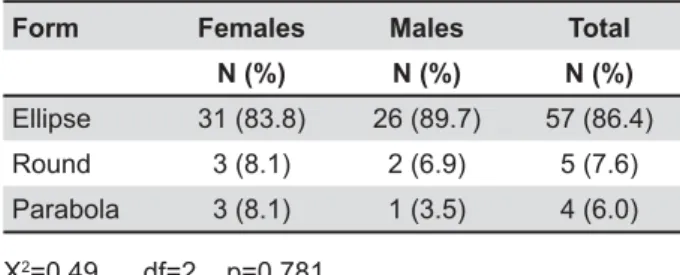
" larger maxillary depth than females to 10 years of age (Table 2). The ellipse form9 was the most frequent dental arch form found in the sample studied (Table 3).
DISCUSSION
In this study, when comparing children ages, only the maxillary anterior segment length showed $ old children exhibited a maxillary anterior segment
length greater than 10-year old children (Table 4 = arches during the early mixed development period. Eruption of the permanent incisors resulted in an
Arch total length
Anterior segment
length
Posterior segment length
Intercanine width
First premolar
width
First molar width
Second molar width
Maxillary depth
Maxillary measurements 9 years
M=3 40.00 14.50 25.50 27.99 36.89 48.06 --- 11.00
F=5 38.40 13.30 25.10 27.04 35.89 45.74 --- 9.40
p 0.056 0.159 0.558 0.450 0.277 0.251 --- 0.159
10 years
M=7 39.00 13.57 24.42 26.72 35.28 46.69 50.70(n=1) 11.71
F=11 39.36 14.09 25.27 26.73 36.06 48.05 52.16(n=3) 9.72
p 0.602 0.379 0.850 0.994 0.481 0.288 0.745 0.042*
11 years
M=9 39.05 14.27 24.77 26.56 35.57 47.14 52.02(n=4) 11.00
F=13 39.76 14.63 25.13 26.91 36.14 48.47 52.98(n=7) 10.84
p 0.462 0.564 0.567 0.686 0.482 0.223 0.535 0.877
12 years
M=10 40.45 15.37 25.08 26.51 36.48 48.93 53.44(n=8) 12.20
F=8 39.87 15.12 24.75 25.78 36.47 47.61 53.56(n=5) 10.87
p 0.618 0.773 0.734 0.488 0.982 0.320 0.908 0.241
Mandibular measurements 9 years
M=3 36.66 9.66 27.00 22.73 31.30 43.26 ---
---F=5 35.60 9.90 25.70 21.43 29.69 41.69 47.00(n=1)
---p 0.206 0.789 0.321 0.336 0.156 0.258 ----
---10 years
M=7 34.78 10.28 24.50 21.79 30.45 42.80 47.67(n=4)
---F=11 35.13 9.86 25.27 21.42 31.99 43.03 47.90(n=5)
---p 0.667 0.387 0.422 0.727 0.411 0.828 0.920
---11 years
M=9 35.22 10.44 24.77 21.04 30.45 42.13 47.42(n=5)
---F=13 35.76 10.55 25.21 21.34 31.16 42.79 47.68(n=9)
---p 0.499 0.769 0.542 0.704 0.461 0.525 0.855
---12 years
M=10 35.95 10.35 25.60 20.96 31.65 43.48 48.63(n=9)
---F=8 36.12 10.87 25.25 20.46 31.13 43.37 49.18(n=8)
---p 0.862 0.252 0.700 0.329 0.418 0.882 0.745
---Table 2- Descriptive statistics and comparisons of the males and females in each age-group (according to independent samples t-test P<0.05)
!"#$
Form Females Males Total
N (%) N (%) N (%)
Ellipse 31 (83.8) 26 (89.7) 57 (86.4)
Round 3 (8.1) 2 (6.9) 5 (7.6)
Parabola 3 (8.1) 1 (3.5) 4 (6.0)
Table 3- Form of the dental arch (chi-square test)
increase of the anterior segment, especially in the maxilla, and with eruption of the permanent canines, a further minor increase occurred27.
It was found an insignificant increase in maxillary arch total length, from 9 to 12 years. A little decrease in mandibular arch total length was also found and this arch length seemed to remain constant after 12 years. These results are similar to those of a longitudinal study of dental arches in a Turkish population, where the maxillary arch length increased until 13 years and showed a little decrease starting from 9 years1.
Arch length decreased between the ages of 9 and 14 years due to changes in the dentition and it remained constant after the age of 142,18. The main causes of these length changes have been the closure of posterior interproximal spaces by the replacement of the primary dentition with the permanent dentition, and the interproximal contacts made by the permanent teeth2,18.
" + and mandibular posterior segment length. This decrease should be related to the mesial shifting of
" 27. This is
in agreement with the dental arches measurements found on a Turkish population1. Lundstrom17 (1969) evaluated age-related changes in dental arches, and followed 41 pairs of twins, males and females, from an initial age of 9 to 19 years and found decreases in maxillary and mandibular length.
Our study found a mandibular decrease and a maxillary increase in intercanine widths. This was similar to the Iowa growth study and the untreated UMGS (University of Michigan Growth Series) study sample19. This trend was observed for the mandibular and maxillary results, but these "
Intercanine widths were studied by Barrow and White2 (1952), Moorrees18 (1959), and Sillman23 (1964) who observed a rapid increase between the ages of 6 and 9, which have been associated to the eruption of the permanent canines and incisors. According to Moorrees18 (1959) a decrease have occurred between the ages of 10 and 12, with no change after that. However, other authors suggested that intercanine width have continued to decrease after age 122,18,23.
In a longitudinal study performed by Knott14 (1972) there has been an average change in the intercanine width during the transition from primary to the permanent dentition, however, with high individual variations. Sinclair and Little24 (1983) found a decrease in mandibular intercanine width between the mixed and early permanent dentitions. # " $ increase for the maxillary intercanine width and a decrease for the mandibular intercanine width. These differences could be related to genetic or
ethnic variations.
The variation of the premolar width was greater for the mandibular arch, but it was not statistically " those of Bishara, et al.3 (1997) and the Michigan Growth Study19 (1976) indicated that most arch widths dimensions have been established in the mixed dentition. The results of the Michigan Growth Study19 (1976) showed that the premolar width have increased in both jaws, which have been greater in the maxillary than in the mandibular dental arch. In " difference, maxillary and mandibular first and " that the studied period of time represented when most of the transverse growth of the molar region have occurred1.
In a study conducted in the United Kingdom, decreases have been found in intermolar widths between the ages of 11 and 1429. Lindstron16 (2002) found minimal increases in permanent intermolar width between ages of 9 and 19. Moorrees18 (1959) found that the mandibular intermolar width increased between the ages of 9 and 14 and remained constant after the age of 14. Our results are consistent with these increases during the studied period of time. Odajima21 (1990) performed a longitudinal study on growth and development of dental arches of primary, mixed and permanent dentitions and found a gradually increase for the width at the region of the permanent maxillary " stable condition at about 12 years of age.
further increase of palatal height27. The continuous increase of palatal height observed in the present study seems to be an effect of a slow continuous eruption of the teeth. Even if the mechanisms of tooth eruption have still not been fully elucidated, the slow continuous increase of this distance seems to indicate an important role in the eruption mechanisms27.
the dental arch form has no single and universal form12. These observations are strengthened by in this investigation. Raberin, et al.22 (1993) studied mandibular arch form in subjects with normal forms are among the most frequently seen. In the light of the large individual variation in arch form in the present sample, the dental arch form predominantly found was the elliptical9 (86.4%) (Table 3).
CONCLUSIONS
In conclusion, in the studied age range, anterior maxillary length increased from 10 to 12 years of age, males had larger maxillary depth than females and the predominant arch form was elliptical.
REFERENCES
1- Arslan SG, Kama JD, Sahin S, Hamamci O. Longitudinal changes in dental arches from mixed to permanent dentition in a Turkish population. Am J Orthod Dentofacial Orthop. 2007;132:576 e15-21.
2- Barrow GV, White JR. Developmental changes of the maxillary and mandibular dental arches. Angle Orthod. 1952;22:41-6. 3- Bishara SE, Jakobsen JR, Treder J, Nowak A. Arch width changes from 6 weeks to 45 years of age. Am J Orthod Dentofacial Orthop. 1997;111:401-9.
4- Björk A, Skieller V. Growth of the maxilla in three dimensions as revealed radiographically by the implant method. Br J Orthod. 1977;4:53-64.
5- Bonwill W. Geometrical and mechanical laws of articulation: anatomical articulation. Odontol Soc Penn Trans. 1884:119-33. 6- Burris BG, Harris EF. Maxillary arch size and shape in American blacks and whites. Angle Orthod. 2001;70:297-302.
7- Carter GA, McNamara JA Jr. Longitudinal dental arch changes in adults. Am J Orthod Dentofacial Orthop. 1998;114:88-99. @$ Q X Z [\ [] X *^ ^ on dental arch form in orthodontic patients. Angle Orthod. 1998;68:445-54.
9- Currier JH. A computerized geometric analysis of human dental arch form. Am J Orthod. 1969;56:164-79.
10- Dahlberg G. Statistical methods for medical and biological students. London: George Allen and Unwin; 1940.
11- Defraia E, Baroni G, Marinelli A. Dental arch dimensions in the mixed dentition: a study of Italian children born in the 1950s and the 1990s. Angle Orthod. 2006;76:446-51.
12- Felton JM, Sinclair PM, Jones DL, Alexander RG. A computerized analysis of the shape and stability of mandibular arch form. Am J Orthod Dentofacial Orthop. 1987;92:478-83.
_$ ` { * = ] curve to pre- and post-treatment dental arches. Br J Orthod. 1989;16:85-93.
14- Knott VB. Longitudinal study of dental arch widths at four stages of dentition. Angle Orthod. 1972;42:387-94.
15- Landis JR, Koch GG. The measurement of observer agreement for categorical data. Biometrics. 1977;33:159-74.
16- Lindsten R, Ogaard B, Larsson E, Bjerklin K. Transverse dental and dental arch depth dimensions in the mixed dentition in a skeletal sample from the 14th to the 19th century and Norwegian children and Norwegian Sami children of today. Angle Orthod. 2002;72:439-48.
17- Lundström A. Changes in crowding and spacing of the teeth with age. Dent Pract Dent Rec. 1969;19:218-24.
18- Moorrees C. The dentition of the growing child: a longitudinal study of dental development ages 3-18. Cambridge: Harvard University Press; 1959. p. 87-110.
19- Moyers R, Van Der Linden F, McNamara J Jr. Standards of human occlusal development. Ann Arbor: University of Michigan; 1976.
20- Nojima K, McLaughlin RP, Isshiki Y, Sinclair PM. A comparative study of Caucasian and Japanese mandibular clinical arch forms. Angle Orthod. 2001;71:195-200.
21- Odajima T. A longitudinal study on growth and development of dental arches of primary, mixed and permanent dentitions. Shikwa Gakuho. 1990;90:369-409.
22- Raberin M, Laumon B, Martin JL, Brunner F. Dimensions and form of dental arches in subjects with normal occlusions. Am J Orthod Dentofacial Orthop. 1993;104:67-72.
23- Sillman J. Dimensional changes of the dental arches: longitudinal study from birth to 25 years. Am J Orthod Dentofacial Orthop. 1964;50:600-16.
24- Sinclair PM, Little RM. Maturation of untreated normal occlusions. Am J Orthod. 1983;83:114-23.
25- Staley RN, Stuntz WR, Peterson LC. A comparison of arch widths in adults with normal occlusion and adults with class II, Division 1 malocclusion. Am J Orthod. 1985;88:163-9.
26- Sved A. The application of engineering methods to orthodontics. Am J Orthod Dentofacial Orthop. 1952;38:399-421. 27- Thilander B. Dentoalveolar development in subjects with normal occlusion. A longitudinal study between the ages of 5 and 31 years. Eur J Orthod. 2009;31:109-20.
28- Thilander B, Persson M, Adolfsson U. Roentgen-cephalometric standards for a Swedish population. A longitudinal study between the ages of 5 and 31 years. Eur J Orthod. 2005;27:370-89. 29- Ward DE, Workman J, Brown R, Richmond S. Changes in arch width. A 20-year longitudinal study of orthodontic treatment. Angle Orthod. 2006;76:6-13.