Tuberculum sellae meningioma: Is there an ideal
approach?
Iracema Araújo EstevãoI, Bruno CamporezeI, Giovanna MatricardiII, Pedro da Silva JúniorIII, Daniel A. GrippIII, Natally M. SantiagoIII, Paulo Henrique Pires de AguiarII,III,IV,V,VI
DOI: 10.5935/MedicalExpress.2017.04.03
I Universidade de São Francisco, Faculdade de Medicina, Bragança Paulista, SP, Brasil.
II Pontifícia Universidade Católica de São Paulo, Departamento de Neurologia, Sorocaba, SP, Brasil. III Hospital Santa Paulo, Divisão de Neurocirurgia, São Paulo, SP, Brasil.
IV Hospital do Servidor Publico de São Paulo, Departamento de Neurocirurgia, São Paulo, SP, Brasil.
V Universidade Federal do Rio Grande do Sul, Departamento de Cirurgia, Secção de Pós-Graduação em Cirurgia, Porto Alegre, RS, Brasil. VI Hospital Oswaldo Cruz, Divisão de Neurocirurgia, São Paulo, SP, Brasil.
BACKGROUND: Tuberculum sellae meningiomas is a serious challenge for neurosurgeons. It accounts for up to 10% of all intracranial meningiomas. The diiculty in surgically excising a Tuberculum sellae meningioma comes from its anatomical relationship to the optic nerves and chiasm and to the anterior cerebral and internal carotid arteries and their perforators. The authors discuss the main approaches and the complications based on their experience in comparison to previously reported data.
METHODS: We report our personal case series of 38 patients with Tuberculum sellae meningiomas; 36 patients under went craniotomy for tumor resection (12 bifrontal, 12 pterional, 6 supraciliary, 4 unilateral frontals, and 2fronto-orbito-zygomatic); in two patients, the excision was performed through an endoscopic endonasal approach. The Simpson grade of meningioma resection as well as the non-visual morbidity and the mortality rates were analyzed. RESULTS: Thirty-one patients had Simpson grades 1 and 2 excisions, while seven had Simpson grade 4 excisions. The overall rate of non-visual morbidity was 13.15% (5 of 38 patients) and mortality was 5.3% (2 of 38).
CONCLUSION: The primary symptom leading to the diagnosis of a Tuberculum sellae meningioma is visual compromise and the main goal of surgery is to achieve improvement of vision. Favorable outcomes were achieved with appropriate selection of surgical approach. More studies are necessary to deine the prognostic factors for patients in this scenario.
KEYWORDS: Tuberculum Sellae, Meningiomas, Skull Base, Clinoid Process, Optic Nerve.
Estevão IA, Camporeze B, Matricardi G, Silva-Júnior P, Gripp DA, Santiago NM, Aguiar PHP. Tuberculum sellae meningioma: Is there an ideal approach? MedicalExpress (São Paulo, online). 2017 Aug;4(4):M170403
Received for Publication on April 17, 2017; First review on May 29, 2017; Accepted for publication on June 30, 2017; Online on July 28,2017
E-mail: [email protected]
■
INTRODUCTIONMeningiomas are benign and slow growing tumors that usually take years to produce clinical symptoms. But the tuberculum sellae meningioma (TSM) is a challenge for neurosurgeons. Due to the complex anatomy of the tuberculum sellae region,
decision making is very difficult. When choosing an
approach, neurosurgeons must carefully analyze which is the best alternative for each case, because
these are among the most challenging surgeries in
the neurosurgical field.1,2 These meningiomas appear
from the limbus sphenoidale, chiasmatic sulcus, and tuberculum, and comprise approximately 3%–10% of all intracranial meningiomas.3 The tumor may fill
The intimate relationship between tubercular sellae meningeomas and the optic apparatus characterizes their main clinical interaction. Compromise of the optic apparatus is an important feature for decision making.5 In cases of visual
loss, surgical treatment seems to be the best alternative. It is mandatory to relieve the mass effect upon the optic apparatus. The proximity of these tumors to the optic apparatus usually eliminates radiosurgery as a treatment option for these tumors.1,6 Fortunately, a layer of arachnoid is always present
between tumor and surrounding brain structures, and this provides a plane for dissection to aid the surgeon.7
Several surgical approaches such as subfrontal, bifrontal, unilateral frontal, supraorbital keyhole, pterional have been proposed for the resection of TSM, and more recently the neurosurgical endoscopic techniques have been introduced as a visualization option during removal of skull base tumors, both transcranially and endonasally.4
The aim of this paper is to report our case series, with special emphasis on different surgical approaches for TSM and their advantages and complications.
■
CASE SERIES AND METHODSA total of 38 patients with TSM underwent surgery by our group during the period from 1995 to 2014, among a total of 201 skull base meningiomas. All patients underwent evaluation by CT scan and MRI. The radiological parameters included tumor size, brain–tumor interface, perilesional edema, arterial encasement, optic canal extension, and hyperostosis. The size of the tumors was calculated based on measurements obtained from MRI. Ophthalmologic evaluation was obtained from all patients before and after surgical procedure. The surgical approaches included bifrontal, unilateral frontal, pterional, supraciliary, fronto-orbito-zygomatic (FTOZ), and endoscopic endonasal. The extent of tumor resection was based on Simpson grading. Follow-up examinations were scheduled at 1, 3, 6, and 12 months postoperatively and annually thereafter.
■
RESULTSThis patient series includes 30 women and 8 men, whose age ranged from 19 to 82 years, with a mean of 52 years. Figures 2 and 3 illustrate some cases.
Visual impairment was present in 25 patients. The overall visual preservation (improvement + stable
visual deficit) was 88% (23 patients). Among these, 40%
(10 patients), had vision impairment recovery just after surgery, 12% (3 patients) recovered after 6 months, and 40% (10 patients) did not recover after 12 months. Vision deterioration occurred in 8% (2 patients – 1 who underwent supraciliary craniotomy and 1 who underwent fronto-orbito-zygomatic craniotomy).
The tuberculum sellae is an osseous protuberance that constitutes the anterosuperior limit of the pituitary fossa. The diaphragm of the sellae creates a roof to the pituitary fossa stretching from the tuberculum over the sella turcica to the posterior clinoid processes and covers the pituitary gland, except for the pituitary stalk. The limbus sphenoidale
is identified as a small borderline separating the planum
sphenoidale and chiasmatic sulcus. Vital structures and important anatomic landmarks bound the tuberculum sellae.
Laterally we find the clinoid processes, the internal carotid
and the posterior communicating arteries; posteriorly we identify the pituitary stalk, infundibulum, and the Lillequist membrane; superiorly, we have the optic chiasm, the lamina terminalis, and the anterior cerebral artery complex.4 The
space is quite small, (mean length 8mm, mean width 11mm), and the path of least resistance for tumor growth tends to be over the planum sphenoidale (anteriorly), the optic nerves into the optic canals (laterally), above the chiasma, displacing it superiorly, or down over the tuberculum and sellae (inferiorly) as shown in Figure 1.
Figure 2 - A - Microsurgical vision of the frontotemporal approach of Tuberculum Sellae Meningioma by subfrontal access through the transsylvian issure. B - Microsurgical vision, showing the tumor compressing the optic chiasm. C - Microscopic view of the dissection into the space between the optical nerve and the tumor using pterional access. D - Microscopic view shows the complete removal with preservation of the optic nerve and pituitary stalk.
Figure 3 - Three cases (CASE 1: panels A and B; CASE 2: - panels C and D; CASE 3 - pa-nels E and F) of Tuberculum Sellae Meningioma operated in our neurosurgery service. Panel A: MRI of a 63-year-old male patient showing a tuberculum sellae meningioma after contrast. Panel B: same patient, CT scan, showing complete resection of tumor associated to an increase of ventricular dilation. Panel C: MRI T1 of a 62-year old female patient, complaining of preoperative visual impairment, showing (in sagittal section) an injury in tuberculum sellae and diaphragm with sellar invasion after contrast. Panel D: ame patient, postoperative MRI T1 in sagittal section shows complete resection, with residual intrasellar component. Panel E: preoperative MRI T1 in coronal section, with contrast, showing a tumor with suprasellar extension. Panel F: postoperative MRI in coronal section, showing the radical resection.
Table 1 shows the distribution of tumor size and levels of recovery of the 25 patients with visual impairment. Best recovery rates of visual impairment were among patients with tumor size of 1-2 cm (75%), followed by tumor size 3-4 cm (40%); for tumor size 4-5 cm only 1 patient recovered (14%). The two larger size tumor groups
(5-6 cm and > 6 cm) included only two patients each. We found no significant influence of tumor size on the visual
outcome; however, due to the anatomy of region (shown in Figures 1 and 2), we did observe that the extension of the optic canal and the degree of arterial encasement by the tumor did relate to visual outcome.
Table 1 - Tumor size of the patients with visual impairment.
Tumor Size Visually impaired patients Recovery number (5)
< 2 cm 4 3 (75%)
3 - 4 cm 10 4 (40%)
4 -5 cm 7 1 (14%)
5 - 6 cm 2 1 (50%)
> 6 cm 2 0 (0%)
Total 25
Thirty-six patients underwent craniotomy for tumor resection: 12 bifrontal, 12 pterional, 6 supraciliary, 4 unilateral frontals, 2 fronto-orbito-zygomatic Figures 2 and 4 illustrate the techniques employed in the surgical act; two patients underwent an endoscopic endonasal approach. No patients were considered for radiosurgery due to the proximity of the tumor with the optic apparatus.
Figure 4: Techniques in surgical approach of TSM. A - Patient positioned with bicoro-nal marked incision to perform bifrontal craniotomy. B - Inter-hemispheric access for tuberculum sellae meningioma approach. C - Patient positioning for frontotemporal approach. D - Pterional craniotomy.
Thirty-one patients (81%) had Simpson grades 1 + 2 excisions, while seven (19%) had Simpson grade 4 excisions, owing to fact that their tumors were located around the vessels or the optic nerve.
Postoperatively, the observed complications were
(a) cerebrospinal fluid fistulae in three patients (1 from
endoscopic endonasal and 2 from bifrontal craniotomy); (b) operative site hematoma in two patients, with transient
deficits. Two patients (5.3%) died: one patient with a fistula
■
DISCUSSIONDifferent surgical routes can be used for Tuberculum Sellae Meningiomas; each has its advantages and disadvantages and this allows the neurosurgeon to make decisions concerning route preference, tactics and strategies. To correctly select the surgical approach, it is necessary to understand the advantages and disadvantages of each procedure and some factors must be considered by the neurosurgeon in making the right decision.
In the case of TSM, the factors that should receive due attention are: (1) the anatomical characteristics of the tumor, such as size, consistency and its relationship with neurovascular areas (optic device, ICASs, cavernous sinuses, pituitary, among others); (2) patient condition and symptoms presented; (3) the experience of the neurosurgeon, a decisive factor in the choice of the approach.
The most frequent primary symptom leading to the diagnosis of a TSM is visual compromise.8 Therefore, the aim
of surgery is to achieve improvement of vision. In previous reports, visual acuity improved in 28% to 80% of patients, remained unchanged in 9% to 64%, and deteriorated in 7% to 33%.3 In our series, vision improved in 52% of the
patients, remained unchanged in 40%, and deteriorated in 8%. The key to preserving visual function is to minimize direct manipulation or trauma to the optic nerves and avoid injury to the blood supply of the optic apparatus.
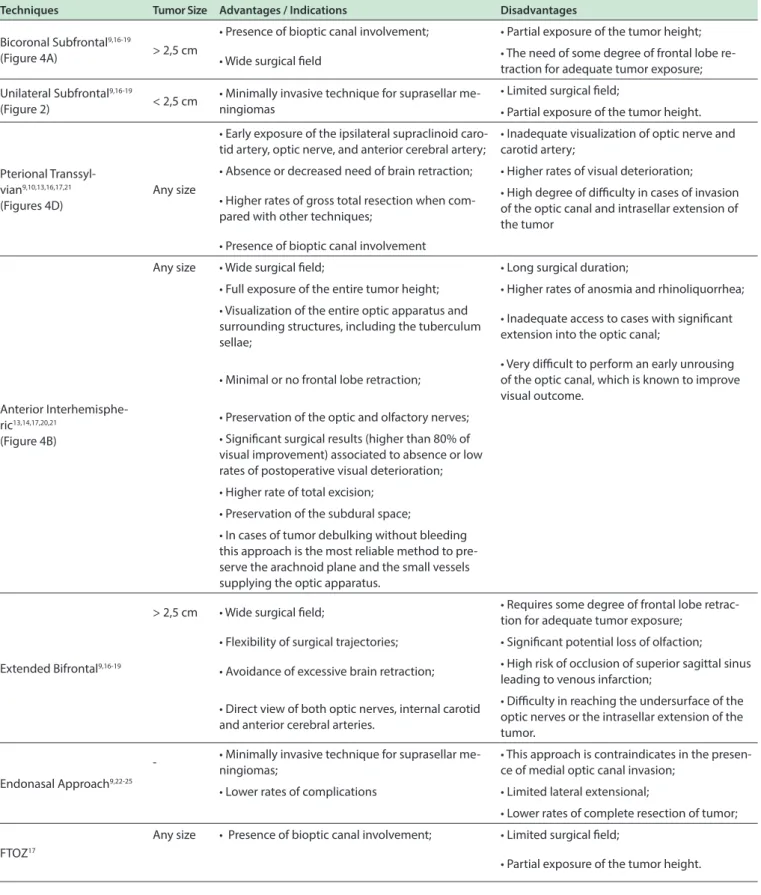
There are various transcranial approaches used to resect these meningiomas: (1) bicoronal subfrontal, (2) unilateral subfrontal, (3) pterional transsylvian, (4) anterior interhemispheric, (5) extended bifrontal, (6) skull base technique, and (7) Fronto-Temporal-Orbito-Zygomatic. Regarding the choice of the ideal approach aiming at the best prognosis, the following points are relevant: (i) tumor size and location, (i) anterior cerebral artery encasement, (iii) optic canal involvement, (iv) arachnoid membrane intactness, (v) age of patient, (vi) duration of symptoms (vii) preoperative visual function. Table 2 shows that small and well localized tumors, with little or no cerebral artery encasement or optic canal involvement offer good prognosis. Prognosis is also better in younger patients with a short history of symptoms and good preoperative visual function.3,9-25
Regarding the surgical act, independently of technique, the initial debulking of the tumor should start from its center, where no vital structures are present. The arachnoid plane is then delineated, starting at the contralateral optic nerve and working toward the undersurface of the optic chiasma and then along the
ipsilateral nerve. During resection of the meningioma, small
vessels observed in the stretched arachnoid layer should not be coagulated. By preserving these vessels, there is a better chance for visual function improvement. Although
the medial optic canal can be opened endonasally to address the meningioma through the sphenoid sinus, opening the medial optic canal in its length causes the closure of the dural defect to turn into a challenging task. According to the literature and to our experience, the presence of medial optic canal invasion contraindicates endonasal approaches.
In cases of TSM with a significant level of optic nerve
compromise and with limited lateral extensional, Gadget et al.22 have shown that an endoscopic endonasal resection is
an excellent option.
In another study, Ajlan et al23 noted that recent
reviews comparing transcranial vs. endoscopic transnasal resections failed to show superiority of one approach over the other, as far as visual outcomes are concerned. The transnasal endoscopic access, in general, offers less complication from a statistical point of view, although tumor resection rates are less complete when compared to transcranial approaches.9,24,25 In our series the endonasal
approach showed worse results compared to transcranial approaches with increased CSF leakage; however, our number of endonasal endoscopic approach is very low and cannot be compared to other approaches.
In our series of TSMs, it was possible to achieve a favorable outcome with a low incidence of morbidity and
mortality. We strongly believe that these results were due to
an appropriate selection of the surgical approach, including minimally invasive surgery by craniotomy and anterior clinoidectomy. Early CSF drainage, meticulous duroplasty and bony repair for skull base reconstruction were also
found to be relevant. More studies are necessary to define
the prognostic factors for patients with TSM after surgical intervention.
■
CONCLUSIONSThe most common primary symptom leading to the diagnosis of a TSM is visual compromise and the main goal of surgery is to achieve improvement of vision. Favorable outcomes were achieved with appropriate selection of
surgical approach. More studies are necessary to define
the prognostic factors for patients with TSM after surgical intervention.
■
CONFLICT OF INTERESTAuthors declare no conflict of interest concerning
the materials discussed in this study.
■
ACKNOWLEDGMENTSThis research was partially supported by Hospital
Santa Paula. We thank our colleagues from the Medical
Table 2. Advantages, disadvantages and indications of techniques in surgical approach of TSM.
Techniques Tumor Size Advantages / Indications Disadvantages
Bicoronal Subfrontal9,16-19
(Figure 4A) > 2,5 cm
• Presence of bioptic canal involvement; • Partial exposure of the tumor height;
• Wide surgical ield • The need of some degree of frontal lobe re-traction for adequate tumor exposure;
Unilateral Subfrontal9,16-19
(Figure 2) < 2,5 cm
• Minimally invasive technique for suprasellar me-ningiomas
• Limited surgical ield;
• Partial exposure of the tumor height.
Pterional
Transsyl-vian9,10,13,16,17,21
(Figures 4D)
Any size
• Early exposure of the ipsilateral supraclinoid caro-tid artery, optic nerve, and anterior cerebral artery;
• Inadequate visualization of optic nerve and carotid artery;
• Absence or decreased need of brain retraction; • Higher rates of visual deterioration;
• Higher rates of gross total resection when com-pared with other techniques;
• High degree of diiculty in cases of invasion of the optic canal and intrasellar extension of the tumor
• Presence of bioptic canal involvement
Anterior Interhemisphe-ric13,14,17,20,21
(Figure 4B)
Any size • Wide surgical ield; • Long surgical duration;
• Full exposure of the entire tumor height; • Higher rates of anosmia and rhinoliquorrhea;
• Visualization of the entire optic apparatus and surrounding structures, including the tuberculum sellae;
• Inadequate access to cases with signiicant extension into the optic canal;
• Minimal or no frontal lobe retraction;
• Very diicult to perform an early unrousing of the optic canal, which is known to improve visual outcome.
• Preservation of the optic and olfactory nerves;
• Signiicant surgical results (higher than 80% of visual improvement) associated to absence or low rates of postoperative visual deterioration;
• Higher rate of total excision;
• Preservation of the subdural space;
• In cases of tumor debulking without bleeding this approach is the most reliable method to pre-serve the arachnoid plane and the small vessels supplying the optic apparatus.
Extended Bifrontal9,16-19
> 2,5 cm • Wide surgical ield; • Requires some degree of frontal lobe retrac-tion for adequate tumor exposure;
• Flexibility of surgical trajectories; • Signiicant potential loss of olfaction;
• Avoidance of excessive brain retraction; • High risk of occlusion of superior sagittal sinus leading to venous infarction;
• Direct view of both optic nerves, internal carotid and anterior cerebral arteries.
• Diiculty in reaching the undersurface of the optic nerves or the intrasellar extension of the tumor.
Endonasal Approach9,22-25
- • Minimally invasive technique for suprasellar me-ningiomas;
• This approach is contraindicates in the presen-ce of medial optic canal invasion;
• Lower rates of complications • Limited lateral extensional;
• Lower rates of complete resection of tumor;
FTOZ17
Any size • Presence of bioptic canal involvement; • Limited surgical ield;
Universidade Católica of São Paulo who provided insight and expertise that greatly assisted the research.
■
AUTHOR PARTICIPATIONPaulo Henrique Pires de Aguiar contributed to the conception of the project, revised the manuscript, approved the completed manuscript and participate of all steps of study; Iracema Araújo Estevão and Bruno Camporeze performed the bibliographical research, analyzed the data and wrote the draft manuscript; Giovanna Matricardi, Pedro da Silva Júnior, Daniel A. Gripp and Natally M. Santiago collected the clinical data of participants and contributed to the conception of the project.
■
MENINGIOMA DE TUBÉRCULO SELAR: HÁ UMA ABORDAGEM CIRÚRGICA IDEAL?INTRODUÇÃO: Os meningiomas de tubérculo
selar certamente representam um desafio para os
neurocirurgiões no que se refere ao manejo cirúrgico. Estes tumores representam até 10% de todos os meningiomas
intracranianos. A dificuldade em ressecar cirurgicamente
estes meningiomas provém da sua relação com os nervos ópticos, com o quiasma óptico e com as artérias carótidas internas, cerebrais anteriores e suas perfurantes. Discutimos as principais abordagens e as complicações com base em nossa série de pacientes e numa revisão da literatura.
CASUÍSTICA E MÉTODOS: Relatamos nossa série de casos pessoais de 38 pacientes com meningiomas de tubérculo selar. Trinta e seis pacientes foram submetidos a craniotomia para ressecção tumoral (12 bifrontal, 12 pterional, 6 supraciliar, 4 unilateral frontal e 2 fronto-orbito-zigomático) e 2 receberam abordagem endoscópica endonasal. A escala de Simpson, bem como as taxas de morbidade e mortalidade foram analisadas durante
o período pós-operatório, em função das diferentes abordagens.
RESULTADOS: Trinta e um pacientes foram submetidos a excisões de grau I e II da escala de Simpson; os demais foram submetidos a excisão de grau IV da mesma escala. A taxa global de morbidade sem acometimento visual foi de 13,15% (5 de 38 pacientes), enquanto a mortalidade evidenciada foi de 5,3% (2 dentre 38 pacientes).
CONCLUSÃO: O principal sintoma que leva ao diagnóstico de meningioma de tubérculo selar é o comprometimento visual, de modo que o principal objetivo da cirurgia é alcançar a melhora da visão nestes pacientes. Os resultados alcançados foram favoráveis quando associados com a seleção apropriada da abordagem
cirúrgica. Mais estudos são necessários para definir os
fatores prognósticos para os pacientes com meningioma de tubérculo selar após intervenção cirúrgica.
Palavras-chave: Tubérculo selar, Meningiomas, Base do Crânio, Processo Clinóide, Nervo óptico
■
REFERENCES1. Arifin MZ, Mardjono I, Sidabutar R. Pterional approach versus unilateral frontal approach ontuberculum sellae meningioma: single center experiences. Asian J Neurosurg. 2012;7(1):21-4. DOI:10.4103/1793-5482.95691
2. El-Wardany M. Fronto-Lateral Key Hole Approach versus Unilateral Sub-Frontal Approach for Tuberculum Sellae Meningioma. Egyptian J Neurosurg. 2014;29(4):9-16.
3. Palani A, Panigrahi MK, Purohit AK. Tuberculum sellae meningiomas: A series of 41 cases; surgical and ophtalmological outcomes with proposal of a new prognostic scoring system. J Neurosci Rural Pract. 2012;3(3):286-93. DOI:10.4103/0976-3147.102608
4. Chen G, Wang Z, Zhou D. Lateral supraorbital approach applied to sellar tumors in 23 consecutive patients: the Suzhou experience from China. World J Surg Oncol, 2013;11-41. DOI:10.1186/1477-7819-11-41. 5. Perondi GE, Isolan GR, Aguiar PH, Stefani MA, Falcetta EF. Endoscopic
anatomy of sellar region. Pituitary. 2013;16(2):251-9. DOI:10.1007/ s11102-012-0413-9.
6. Al-Mefty O, Smith RR. Tuberculum sellae meningiomas. In Al-Mefty O (ed): Meningiomas. New York: Raven Pres, 1991;395–411. 7. De Notaris M, Solari D, Cavallo LM, D’Enza AI, Enseñat J, Berenguer
J, et al. The “suprasellar notch”, or the tuberculum sellae as seen from below: definition, features, and clinical implications from an endoscopic endonasal perspective. J Neurosurg. 2012;116(3):622-9. DOI:10.3171/2011.11.JNS111162.
8. Leu CH, Hu TL, Shen CC, Wang YC. Tuberculum sellae meningiomas: clinical manifestation, radiologic diagnosis, surgery and visual outcome. Zhonghua Yi XueZaZhi (Taipei). 1998;61(1):1-7.
9. Chokyu I, Goto T, Ishibashi K, Nagata T, Ohata K. Bilateral subfrontal approach for tuberculum sellae meningiomas in long-term postoperative visual outcome. J Neurosurg. 2011;115(4):802-10. DOI: 10.3171/2011.5.JNS101812.
10. Fahlbusch R, Schott W. Pterional surgery of meningiomas of the tuberculum sellae and planum sphenoidale: Surgical results with special consideration of ophthalmological and endocrinological outcomes. J Neurosurg, 2002;96(2):235-43. DOI:10.3171/ jns.2002.96.2.0235
11. Margalit N, Kesler A, Ezer H, Freedman S, Ram Z. Tuberculum and diaphragm sella meningioma - surgical technique and visual outcome in a series of 20 cases operated over a 2.5-year period. Acta Neurochirurgica. 2007;149(12):1199-204. DOI:10.1007/s00701-007-1280-4.
12. Margalit N, Shahar T, Barkay G, Gonen L, Nossek E, Rozovski U, et al. Tuberculum sellae meningiomas: surgical technique, visual outcome, and prognostic factors in 51 cases. J Neurol Surg B Skull Base. 2013;74(4):247-58. DOI:10.1055/s-0033-1342920.
13. Margalit NS, Lesser JB, Moche J, Sen C. Meningiomas involving the optic nerve: Technical aspects and outcomes for a series of 50 patients. Neurosurgery. 2003;53(2):523-33. DOI: 10.1227/01. NEU.0000079506.75164.F4
14. Terasaka S, Asaoka K, Kobayashi H, Yamaguchi S. Anterior Interhemispheric approach for Tuberculum Sellae Meningioma. Neurosurgery. 2011 Mar;68(1 Suppl Operative):84-8. DOI:10.1227/ NEU.0b013e31820781e1
17. Koutourousiou M, Fernandez-Miranda JC, Stefko ST. Endoscopic endonasal surgery for suprasellar meningiomas: experience with 75 patients. J Neurosurg. 2014;120:1326-39. DOI:10.3171/2014.2.JNS13767.
18. Honegger J, Fahlbusch R, Buchfelder M, Huk WJ, Thierauf P. The role of transsphenoidal microsurgery in the management of sellar and parasellar meningioma. Surg Neurol. 1993;39(1):18-24.
19. Romani R, Laakso A, Kangasniemi M, Niemelä M, Hernesniemi J. Lateral supraorbital approach applied to tuberculum sellae meningiomas: experience with 52 consecutive patients. Neurosurg. 2012;70(6):1504-19. DOI:10.1227/NEU.0b013e31824a36e8
20. Ganna A, Dehdashti AR, Karabatsou K, Gentili F. Fonto-basal interhemispheric approach for tuberculum sellae meningiomas; long-term outcome. Br J Neurosurg. 2009;23(4):422-30. DOI:10.1080/02688690902968836
21. Schick U, Hassler W. Surgical management of tuberculum sellaemeningiomas: involvement of the optic canal and visual outcome. J Neurol Neurosurg Psychiatry. 2005;76(7):977-83. DOI:10.1136/ jnnp.2004.039974.
22. Gadgil N, Thomas JG, Takashima M, Yoshor D. Endoscopic Resection of Tuberculum Sellae Meningiomas. J Neurol Surg B Skull Base. 2013;74(4):201-10. DOI:10.1055/s-0033-1342922.
23. Ajlan AM, Choudhri O, Hwang P, Harsh G. Meningiomas of the Tuberculum and Diaphragma Sellae. J Neurol Surg B Skull Base. 2015;76(1):74-9. DOI:10.1055/s-0034-1390400.
24. Clark AJ, Jahangiri A, Garcia RM, George JR, Sughrue ME, McDermott MW, et al. Endoscopic surgery for tuberculum sellae meningiomas: a systematic review and metaanalysis. Neurosurg Rev. 2013;36(3):349-59. DOI:10.1007/s10143-013-0458-x.