the role of nuclear energy
in Brazil
J
oaquim
F
rancisco
de
c
arvalho
Introduction
t
he history of nuclear energy in Brazil begins in the mid-1930s,when to set the teaching and research standards of the newly created university of são Paulo at a high level, the state government hired eu-ropean professors and researchers from several fields of expertise and founded the school of Philosophy, sciences and Letters of the university, with Physics, Mathematics, science, humanities, earth sciences, Chemistry and Biology de-partments. Later on (1956) the institute of atomic energy (iea) was created, to where some physicists from the Physics department of the school of Philoso-phy, and engineers from the Polytechnic school were relocated.
in 1979 the iea was transferred to the jurisdiction of the secretariat of industry, trade, science and technology, under the name of institute of energy and nuclear research (iPen).
Currently iPen is managed by the national nuclear energy Commission (Cnen), but remains linked to the university for graduate education purposes.
the Center for nuclear energy in agriculture was established in 1966, at the school of agriculture of the university of são Paulo, in Piracicaba (sP).
in the 1940s, 1950s and 1960s the federal government created in rio de Janeiro the Brazilian Center for Physics research, the national research Council, the national nuclear energy Commission, the institute of radiation Protection and dosimetry and the nuclear energy institute.
the radiological research institute was created in 1953 in Belo hori-zonte, linked to the Federal university of Minas Gerais, where the thorium Group was set up in 1965, with the mission to develop the conceptual design of a heavy water moderated reactor, based on the thorium cycle (Brito, 1968).
the project was placed in the framework of the France-Brazil technical cooperation initiative and was included in the program that assessed the feasibil-ity of thorium and heavy water reactors of the French Commissariat à l’energie atomique. however, due to budgetary constraints, the project was ultimately cancelled when the Brazil-Germany nuclear agreement it was signed.
nuclebras was closed. the Commission, which had been created in 1959, was already preparing a preliminary study for the construction of a nuclear plant in the central-south region of the country, but the comparative advantage of hy-droelectric plants stopped the project from moving forward.
in 1971 the government decided to build a 750 MW nuclear power plant in the municipality of angra dos reis, state of rio de Janeiro, creating for that purpose the Brazilian nuclear technology Company, whose mission was later expanded to include the planning and implementation of a nuclearpower program in the country. in 1975 the company was replaced by nuCLeBras (Brazilian nuclear enterprises), already in the climate of the negotiations that led to the nuclear agreement with Germany.
the new company, which had been created to promote the development of the nuclear industry in Brazil with the technical assistance of Germany, ended up limited to coordinating an equipment import and personnel training program for the construction of two nuclear powerplants in angra dos reis and a heavy com-ponents manufacturing facility in itaguaí, state of rio de Janeiro (Carvalho, 1987).
The Brazilian experience in nuclear energy
nuclear energy was first used in Brazil in the early 1950s in biomedical radioisotope applications for biomedical purpose. in 1959 the atomic energy institute was already producing radiopharmaceuticals.
the Center for nuclear energy in agriculture conducts research for the use of radioactive tracers in the study of fertilizer absorption and plant metabo-lism, and for the application of radioisotopes in the study of metabolic phenom-ena in beef and dairy cattle.
in the Brazilian industry radioisotopes have been used routinely since the 1960s, for fault detection, quality control and production control, particularly in the metallurgical and mechanical construction industries.
due to budget constraints, work at this center moves slowly. however, thanks to it Brazil has already mastered all stages of the fuel cycle, and has also developed the prototype of a nuclear propulsion reactor.
Fallacies and facts about nuclear energy
all activities related to industrial, biomedical and agricultural applications of nuclear energy and the uranium enrichment project are well accepted by society. however, the establishment of nuclear power plants generates much controversy, triggered particularly by nPP component manufacturers and service providers, who manipulate citizens and disseminate fallacies through misleading arguments.
some of the arguments often seen in these manufacturers’ brochures and even in official statements by authorities in the sector are described below, fol-lowed by the corresponding facts, which seldom are remembered.
The fallacy: nuclear plants can guarantee the supply of electricity for an unlimited time. The fact: uranium ore reserves are finite and their exploitation depends on petroleum-based fuels to power uranium ore extraction and transportation equipment. however, the known reserves of this ore may last long enough for the development of technologies that enable the use of renewable energy sources. in the transition period, nuclear power plants can meet the electricity demand in countries that do not have a safer and more economical alternative.
The fallacy: nuclear plants do not emit Co2 into the atmosphere.
The fact: the operation of a nuclear plant does not cause Co2 emissions. however, carbon dioxide is emitted continuously at all stages of the nuclear fuel cycle, from the mining uranium oxide to the production of fuel elements. there is also a marginal emission of Co2 from the construction and installation of nuclear power plants.
The fallacy: the risk of accidents related to nuclear power plants is negligible. The fact: there is a one in a millionth chance of a serious accident oc-curring in the primary circuit due to the leakage of radionuclides to the envi-ronment in nuclear plants such as angra. these plants are equipped with pres-surized light-water reactors (PWr) in which the fuel elements (where nuclear fission reactions occur) are inside a pressure vessel, which is isolated from the environment by a double barrier.
and regardless of how traumatic it may be, it is an accident that ends at the place and time at which it occurs. an accident in a nuclear plant only starts at the time and place at which it occurs. years later, hundreds of people will sustain the injuries and damages induced by exposure to ionizing radiation, as it is still hap-pening with the populations that remained in the cities close to Chernobyl, as a result of the accident - and the same is expected to happen in the case of Fuku-shima. thus, in the event of major accidents such as these, the risk (probability versus severity) of injury to persons and damage to public and private property is incalculable. that is why insurance companies refuse to cover such claims in full and the losses always befall on the affected populations.
The fallacy: nuclear waste becomes harmless in a short time.
The fact: thirty years after being removed from the reactor, spent fuels (fission products, actinides and activation products) emit about 6 percent of the radiation they used to emit and have 0.2 percent of their thermal power. during that time they are stored at the plant site itself. But there is no definitive solu-tion for the final disposal of high-activity waste removed therefrom. and even in small doses, ionizing radiation has a cumulative effect on living organisms which, if continuously exposed, are subject to chromosomal aberrations and cancerous lesions.
The fallacy: nuclear plants are invulnerable to terrorist attacks.
The fact: any industrial facility is vulnerable and nuclear plants are no excep-tion. it all depends on the rigor with which the facilities are monitored and protected. The fallacy: Fuels irradiated in nuclear plants are not suitable for terrorist groups to manufacture atomic bombs.
The fact: terrorist groups do not need atomic bombs. they just need to get hold of fuel irradiated in a nuclear plant to have access to highly active fission products such as cesium-137 and strontium-90, and actinides such as plutoni-um-239 and plutonium-240, which are also highly active and toxic. therefore, they can threaten to spread these products over populated areas. to prevent such acts, a strong and costly police apparatus needs to be institutionalized.
The fallacy: Brazil should invest in nuclear plants because it has one of the largest uranium reserves in the world.
The fact: it makes no sense to invest in nuclear plants - which are uneco-nomical in Brazil - just to exploit uranium reserves, since the country can generate sustainably, in an integrated water-wind system, all the electricity it consumes and will consume when the population stabilizes. as for uranium, it would be strategi-cally more rational to process it up to the enrichment stage and export part of it.
Hydroelectric plants vs. nuclear plants in the expansion of the Bra-zilian electric system
technological development and economic capacity - but never under the influ-ence of lobbies from the coal, natural gas or nuclear energy industries.
in Brazil, the debate over the expansion of the electric system has been skewed in favor of nuclear energy, natural gas and recently even coal, against renewable and clean alternatives such as hydropower and wind power.
in 2009, only 29.6 percent of the Brazilian hydroelectric potential was being used, as shown in table 1.
table 1 – Brazilian hydroelectric potential
Hydroelectric potential and use thereof GW %
Plants in operation (potential in use) 79.3 29.6
Potential to be tapped 171.0 63.8
Subtotal 250.3 93.3
Potential of Small Hydroelectric Plants 17.5 6.6
Total 267.8 100.0
Source: ePe (2010).
the north - essentially amazon - holds 65 percent of the untapped po-tential, as shown in table 2.
table 2 – Geographic distribution of the potential to be tapped
Region North Northeast Central-West Southeast South
% 65 3 3 8 21
Source: ePe (2010).
this region, which is rich in strategic minerals, is a breeding ground of activist groups strongly opposed to the construction of hydropower plants. some of these groups have the support of mining companies and others interested in building coal and nuclear plants.
suppose that for social and environmental reasons the plans for expanding the electric system were redesigned so as to limit to 80 percent the hydroelectric potential to be tapped in the amazon - and that the hydroelectric plants to be built in that region flooded 0.2 km2 / MW.
table 3 shows that this is a conservative assumption because, except for solteira island, some existing facilities in other regions or under construction in the amazon itself have a much lower flooded area/installed power ratio.
even so, Brazil can add a capacity of 148.7 GW to the existing 79.3 GW. With 17.5 GW from small hydropower plants, the total hydroelectric capacity will be 245.5 GW.
table 3 – Flooded area /installed Power
PLANT Flooded area (km2) * Power (MW) A/P (km2/MW)
Itaipú 1,400 14,000 0.10
Jupiá 330 1,411 0.24
Solteira Island 1,239 3,230 0.39
Campos Novos 27 880 0.03
Chapecó 90 885 0.10
Jirau 258 3,450 0.08
Santo Antônio 271 3,150 0.09
* includes the area already occupied by the river at the reservoir site.
Source: eletrobras.
in the amazon, rationally hydroelectric plants scaled along the rivers should be favored, as indicated in inventories and implementation programs that meet well defined socio-environmental and economic feasibility criteria. this requires regulating the matter through specific laws.
Mini hydroelectric plants operated by hydrokinetic turbines can also be established to supply small isolated loads, thus avoiding transmission lines from cutting through the forest.
abhorrent projects such as Balbina and samuel should be disabled and their reservoirs, once emptied, converted into biological reserves.
through a smart and strictly enforced energy policy, public companies and companies in the electricity generation industry should become the strongest defenders of the amazon ecosystem, as changes caused by deforestation would jeopardize the flow of rivers, thus making the plants themselves unfeasible.
Greenhouse gas emissions from hydroelectric reservoirs are owed especially to the decomposition of organic matter and would be much lower if those respon-sible for the construction of the plants would pre-clear the areas to be flooded and remove all wood and organic waste to non-flood areas. in dry seasons, when the reservoir level drops, the sludge accumulated at the edges should be removed to be used as fertilizer in local family farming based on case by case agronomic studies.
simple guidelines such as these could lead to a productive and profitable activity for local residents willing to participate in mainstream economics.
at the same time, emissions from hydroelectric reservoirs would be re-duced to those from any natural lake.
however, environmental nGos choose to take a fundamentalist position based on the dogma that the amazon is untouchable.
billions of years, as all terrestrial ecosystems have. With or without dams, indig-enous peoples (who were part of the amazon ecosystem long before coloniza-tion) will continue to change the nature through logging and burning, which are traditional activities in their agricultural system. and there are also mining companies, ranchers and agribusiness.
* * *
in addition to one of the largest hydropower potentials in the world, Bra-zil has very favorable conditions for the use of wind energy.
the Brazilian hydroelectric system currently operates with a capacity fac-tor of 0.5. this facfac-tor can be improved with the implementation of wind farms, provided that these are integrated to power plants in the form of a wind-hydro system, in which load dispatches enable part of the energy generated by the wind farms to be “stored” – i.e., accumulated in the form of water in hydroelec-tric reservoirs - similarly to the thermal-wind grid in some european countries, where wind energy enables saving natural gas or fuel oil (ummels, 2008).
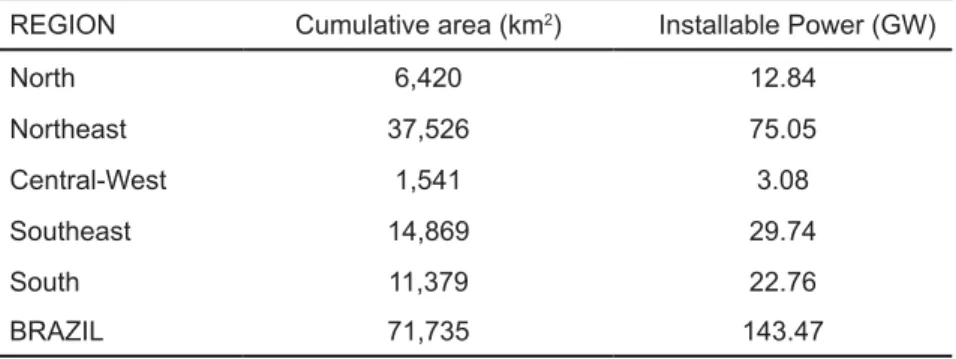
according to a survey conducted in 2001 by the research Center for en-ergy, eletrobras, together with the Camargo-schubert Wind energy and true Windows solutions companies, the Brazilian wind potential for winds with aver-age speed higher than 7 m/s and turbines installed on 50-meter high towers is 143.47 GW (table 4). recent studies show that with higher towers the poten-tial can reach s much as 300 GW.
table 4 – Wind potential (average wind speeds higher than 7 m/s)
REGION Cumulative area (km2) Installable Power (GW)
North 6,420 12.84
Northeast 37,526 75.05
Central-West 1,541 3.08
Southeast 14,869 29.74
South 11,379 22.76
BRAZIL 71,735 143.47
Notes:
1 - includes wind farms with a maximum land use density of MW/km2, which is a
conserva-tive figure.
2 – does not include areas occupied by forests, lakes and rivers, or areas on the sea.
3 – includes mean performance curves of modern wind turbines found in the market, installed on 50-meter high towers.
therefore, using only primary clean and sustainable sources, the intercon-nected system would have a combined capacity of 389 GW, with a generation of 1,466 GWh x firm hour per year, assuming conservatively that the capacity factor of the integrated system will be 0.43 (weighted average of the capacity factors of each system, separately). the safety reserve of the wind-hydro system would be in the existing natural gas power plants, which would operate only during critical wind-hydro periods.
this system could still operate in synergy with biomass power plants, be-cause as most of the Brazilian automotive fleet runs on ethanol fuel, surplus ba-gasse can feed small power plants, with a total combined capacity of around 15 GW (Única, 2008). although negligible for the energy sector, this contribution is interesting because it prevents distilleries from burning their surplus bagasse outdoors.
according to iBGe, the Brazilian population is expected to stabilize at 215.3 million people by the year 2050, as indicated in table 5.
table 5 – revision of the projected population growth for Brazil
Year Population (million)
2010 193.2
2020 209.9
2030 215.8
2040 219.2
2050 215.3
Source: iBGe (2008).
so, starting from that year the interconnected electric system will be able to provide permanently about 6.820 kWh per inhabitant per year. this means that without resorting to nuclear power, per capita consumption of electricity in Brazil will no longer match that of european countries with a high standard of living listed in table 6.
table 6 – electricity consumption per capita in europe, 2007
COUNTRY CONSUMPTION (kWh/inhab/year )
France 7.328
Holland 6.695
Germany 6.663
United Kingdom 5.774
as the weather in Brazil is temperate, commercial, industrial and residen-tial buildings do no require heating systems as in France, where these systems account for about 20 percent of electricity consumption (insee, 2009).
Without this burden Brazil could electrify many sectors that today rely on fossil fuels, starting from urban transport, currently based on cars and buses. this would help to reduce air pollution, therefore improving the quality of life of the population.
any country with important hydroelectric potential and technical capacity to exploit it seeks to use it to the fullest before appealing to more expensive and environmentally unfriendly or dangerous alternatives, such as fossil fuels and nuclear plants. For example, hydropower accounts for 99 percent of electricity supply in norway; 60 percent in austria; 55 percent in switzerland; 50 percent in sweden; and 12 percent in France (hydro Power and dams World atlas, 2001).
* * *
this article does not take into account the photovoltaic potential, which, thanks to significant technological advances in the fields of semiconductors and smart grids may, in the medium term, play a very important role in the Brazilian electric system.
to encourage the use of photovoltaic energy, developed countries like Germany, France, spain, Japan and the united states have implemented incen-tive programs to lower their costs to competiincen-tive levels compared to traditional sources.
owing to this policy, a total capacity of 10.2 GW in individual photovol-taic systems was installed in Germany in 2010 alone.
the article does not consider the possibility of using municipal waste in mini- power plants either. according to the ePe, mini-power plants powered by urban waste could total a combined capacity of 11.4 GW by 2030 (ePe, 2010).
Sales strategy in the nuclear industry
Countries such as France and Japan already use their hydroelectric po-tential to the fullest. thus, to produce the electricity essential for the survival of their economies, they had no choice but to invest in the nuclear option - especially France, which is a highly electrified country. that is on the medium term, because on the long term they are investing heavily in the development of renewable sources.
France has 59 nuclear power plants operated by state-owned electricité de France (edF) generating more than 430,000 GWh per year, which represents about 78 percent of the electricity consumed in the country.
invest-ments are expected to be made in the coming years to deactivate and decommis-sion old plants and build new ones to replace the entire nuclear capacity.
in 2005 the French government established new guidelines on energy policy and safety of nuclear facilities - and decided to invest in the development of a new generation reactor, the european Pressurized Water reactor (ePr), with the entry into operation of an initial 1.65 GW unit planned for 2015. after this unit, 40 similar plants should be established to replace those that are near-ing the end of their useful life (World nuclear association, 2009).
optimistic estimates indicate that the investment required to decontaminate sites and decommission old plants - and build new ones - will be in the order of a trillion euros.
the economic viability of these investments entails electricity costs that could not be borne by the French economy.
to alleviate the problem, the nuclear industry seeks to apportion the costs of these investments in expanded markets to countries vulnerable to its lobby, even if they have sources of renewable, clean and more economical energy such as hydro and wind power.
With this objective in mind, component manufacturers and suppliers of services for nuclear power plants are adopting the strategy of encouraging the creation of forums and associations for the development of nuclear activities in the various countries with financial capacity to import these plants.
these associations are usually run by former directors or former employees of gov-ernment agencies with easy access to govgov-ernment organizations from the energy sector.
in carrying out their activities, these associations try to interact with the most important universities in the country by participating in roundtables and seminars and publishing dissemination papers extolling the advantages of nucle-ar power plants but concealing their disadvantages.
these publications influence public opinion and politicians holding tech-nical positions in ministries. this partly explains the Brazilian government’s de-cision, announced in october 2008, to invest in a vast nuclear plant construc-tion program, neglecting the advantage Brazil enjoys of being able to generate all the electricity needed for its development using only primary energy sources that are renewable, clean ad more economical than nuclear energy.
table 7 – Cost of electricity and annual production by typical Brazilian plants
PROJECT (Power) Energy cost Annual production* Construction time Coal (350 MW) US$ 134 / MWh 1.534.000 MWh ~ 4 years
Nuclear (1,345MW) US$ 113 / MWh 10.258.000 MWh ~ 7 years
Natural gas (500 MW) US$ 79 / MWh 1.315.000 MWh ~ 3 years
Bagasse (12 MW) US$ 74/ MWh 63.000 MWh ~ 3 years
Hydroelectric (6,450 MW) US$ 46 /MWh 28.270.350 MWh ~ 5 years
* Capacity factors: hydro = 0.50; nuclear = 0.87; Gas = 0.80; Coal = 0.50; Bagasse= 0.60.
Source: energy Policy (2009).
table 7 takes into account the government subsidy to nuclear power plants (energy Policy, 2009).
Final remarks
as a result of the Manhattan Project introduced in 1942 by initiative of the u.s. government in its plan to develop the atomic bomb, nuclear power began to be treated as a matter of national security, subject to restrictive rules in relation to the information that is made public.
this had great influence in the civil nuclear industry - which partly ex-plains its lack of transparency - and has also influenced the international atomic energy agency (iaea), which was established in 1957 and follows a clearly biased corporate orientation in favor of increasing the share of nuclear energy in electric systems on all continents.
after the Fukushima accident, however, the arcane vault of the industry began to be open even in France, where nuclear plants account for 78 percent of the electricity generated in the country.
in the book La vérité sur le nucléaire published in June 2011, the former minister of the environment, Corinne Lepage, reveals that the cost of the ener-gy generated in nuclear power plants are highly subsidized by the state and that all that is published about it is wrapped in a layer of deceptions and half-truths.
according to her, facts rarely disclosed to the public show that the companies areva (manufacturer of components and provider of services for the installation of nuclear power plants) and edF (state company that generates, transmits and distrib-utes electricity in France) will face serious difficulties caused, among other things, by the failure of the ePr reactor, for which orders were canceled by China and india.
the former minister condemns the shamelessness used to minimize the severity of nuclear accidents, in particular that of a catastrophe like Chernobyl, which caused the immediate death of dozens of plant workers and has made each year thousands of victims of ionizing radiation emitted by the high activity products scattered over vast areas of Belarus, ukraine and russia. she finally re-veals that contrary to what is boasted by the nuclear corporation, French public opinion is not unanimous, as opposition to nuclear power is considerably high in the country.
* * *
the accident in Fukushima cooled the rebirth drive that the nuclear in-dustry had experienced in previous years.
in Germany, the country that holds the technology of the angra ii and angra iii, seven nuclear plants have been disabled and the government has canceled plans for the construction of new ones, having decided also that all the others will be disabled and decommissioned by 2022. similar action is seen in Belgium, spain and italy.
however, yielding to the lobbying of the nuclear industry, Brazilian au-thorities state that the plan to establish other nuclear power plants besides angra dos reis will be fully maintained, in which they are supported by some journal-ists, professors and economists of renown in their respective fields of expertise - but who know nothing about energy.
Conclusions
no other country the size of Brazil has such renewable energy potential. as shown in this article, Brazil could be the first large country in the world to have a fully sustainable electric system, in both environmental and economic terms. But this is being undermined by the lobbying of the nuclear, natural gas and coal industries.
in Brazil, there is room for nuclear energy in scientific research as well as in biomedical, industrial and agricultural applications - and naval propulsion.
the resources earmarked for nuclear power plants would bring greater ben-efits to the country if channeled to the aforementioned applications - and to techno-logical development in renewable energy; otherwise, we will continue to lag behind industrialized countries, which are already investing significantly in this area.
insisting on the construction of nuclear power plants is a paradoxical and obstinate attitude against technological development in the field of modern en-ergy sources that are actually renewable and clean and should prevail in the future.
territory shall only be admitted for peaceful purposes and subject to approval by the national Congress.”
Moreover, in 1997 Brazil signed the treaty on the non-Proliferation of nuclear Weapons, thus renouncing any kind of activity related to the produc-tion and use of nuclear energy for military purposes.
references
BraZiL. Atlas do potencial eólico brasileiro (Atlas of Brazilian Wind Potential).
Cre-sesb/Cepel/eletrobrás, 2001.
Brito, s. s. situação atual e perspectivas da energia nuclear. in: LePeCKi et al.
in-trodução à geração núcleo-elétrica. Belo horizonte: imprensa uFMG, 1968. p.355-9.
CarvaLho, J. de. o acordo nuclear Brasil-alemanha. in: CarvaLho, J. de. et al.
o Brasil nuclear – uma anatomia do desenvolvimento nuclear brasileiro. Porto alegre:
tche, 1987. p.49-50.
CresesB-eLetroBrÁs-CePeL. Atlas do potencial eólico brasileiro (Atlas of
Bra-zilian Wind Potential). Center for electricity research, Brasília, 2001. available at: <
http://www.cresesb.cepel. br/publicacoes/index.php?task=livro&cid=1>.
does BraZiL need nuclear Power Plants? Energy Policy, v.37, p.1580-4, 2009.
enerGy statistiCs, 2007. available at: <http://www.nationmaster.com/graph/ ene_ele_con_percap-energy-electricity-consumption-per-capita&date=2007>.
enerGy PoLiCy. Does Brazil need new nuclear power plants? amsterdam: elsevier,
2009. v.37, p.1580-1584.
ePe – national energy assessment, 2010.
hydro Power and dams World atlas. in: LeCKsCheidt, J.; tJaroKo, t. s.
Overview of mini and small hydropower in Europe - GriPP - n e t, 2001.
iBGe, 2008. available at: <http://www.ibge.gov.br/home/presidencia/noticias/ noticia_visualiza.php?id_noticia=1272&id_pagina>.
insee, 2009, Consommation finale d’électricité en France, par secteur. available at: <http://www.insee.fr/fr/themes/tableau.asp?reg_id=0&ref_id=natteF11358>. LePaGe, C. La vérité sur le nucléaire. Paris: albin Michel, 2011.
uMMeLs, B. C. et al. integration of large-scale wind power and use of energy storage in the netherlands’ electricity supply. IETT Renewable Power Generation, v.2, n.1, 2008.
ÚniCa – sugarcane industry union, 2008. a importância do etanol e da cogeração na atual matriz energética brasileira e os principais desafios.
abstract – this article reviews the history and describes the experience in nuclear
ener-gy in Brazil, showing that nuclear technoloener-gy applied to biomedical sciences, industry and agriculture has been largely developed in this country, from the year 1950 on. then the paper shows that Brazil can cover its electricity consumption with only renewable energy sources, without nuclear power plants. Finally, the arguments usually employed in the press, pro and against nuclear power plants are analyzed and some commercial and political aspects of the problem are commented. the sales strategy of the nuclear industry in Brazil is also commented.
Keywords: hydro and wind power plants versus nuclear and fossil power plants, sales
Joaquim Francisco de Carvalho is a research associate at the iee / usP. he was
direc-tor of nuclen (current eletronuclear) and chaired the advisory committee established by the President of the republic to assess the accident with cesium-137 occurred in 1987. @ - [email protected]